Article Contents:
- How Decoration Transforms Furniture
- Creating Volume and Depth
- Imitating Traditional Techniques
- Creating Stylistic Identity
- Decorative Molding for Furniture
- Types of Furniture Molding by Profile
- Application of Molding on Various Furniture Elements
- Installation of Furniture Molding
- Bагеты and Frames as Accents
- Glazed Doors with Bагет
- Mirror Inserts in Furniture
- Decorative Panels and Inserts
- Borders and Small Details
- Framing Panels and Panels
- Zoning on Fronts
- Small Decorative Elements
- Conclusion
- Frequently Asked Questions

Furniture in interior design can be a simple functional item, or it can become a work of art, a central element that defines the character of the entire space. The difference between ordinary furniture and exclusive pieces often lies not in expensive materials or complex construction, but in decorative details — molding, bагеты, borders. These elements can radically change the perception of furniture, turning simple flat fronts into elegant panelled structures, adding volume, depth, character, and visual value.
The history of using decorative elements in furniture spans centuries. From luxurious French Baroque furniture with rich carving and gilding to strict classical forms of 18th-century English furniture — decorative details have always played a key role in creating style and status. Molding, bагеты, borders transformed simple wooden structures into luxury items, demonstrating the owner's taste and wealth.
Modern furniture production has made these decorative solutions accessible not only for elite projects.Decorative Molding for FurnitureMade from MDF and solid wood, it allows creating furniture of classic style at a reasonable budget. Machining and painting technologies ensure quality comparable to handcrafted work, but at significantly lower cost.
The demand for decorative elements in modern furniture design is linked to a renewed interest in classic styles, quality and durability, and individuality. In an era of mass-produced, uniform furniture, decorated pieces stand out, create unique interiors, and demonstrate taste and an appreciation for true craftsmanship.


How Decoration Transforms Furniture
Decorative elements possess an amazing ability to completely change the perception of furniture, turning budget items into visually expensive ones, simple structures into complex, modern forms, and classic ones. This transformation occurs due to several mechanisms affecting visual perception.




Creating Volume and Depth
A flat surface of a cabinet or chest front is a two-dimensional plane that can be painted any color, but remains visually flat. Applied molding creates a third dimension — depth. Even a simple molding frame around a door transforms a flat surface into a volumetric structure, where there is a foreground, middle ground, and play of light and shadow.
Complex compositions with intersecting moldings create multi-layered depth, where each element is on its own depth level. This creates visual complexity and richness of forms associated with high quality and value. The eye distinguishes these levels, and the brain interprets complexity as a sign of craftsmanship and cost.
The molding profile enhances the effect of volume. A simple rectangular molding creates minimal relief. A decorative molding with coves and beads creates a complex play of protrusions and recesses. Light falling on such a surface creates gradients from light protruding parts to dark recesses, which significantly enhances the perception of volume.
Coloring moldings and the main facade in different shades can enhance or reduce the effect of volume. Contrasting coloring — light moldings on a dark background or vice versa — maximally emphasizes relief. Monochromatic coloring creates a delicate volume, noticeable only under certain lighting, which is characteristic of modern interpretations of classic styles.
Our factory also produces:


Imitation of traditional technologies
Classic panel furniture was made from solid wood using a frame-and-panel construction method — the frame was assembled with dowels, and the panel was placed inside. This is a labor-intensive carpentry job requiring skill and time. Modern technologies allow this construction to be imitated much more simply and affordably.
An MDF flat door with glued-on moldings, after painting, looks like a traditional panel door. Visually, it is almost impossible to distinguish the imitation from a real framed construction, especially after quality painting. At the same time, the cost and production complexity are incomparably lower, making classic furniture accessible to a wide range of buyers.
This imitation is not deception — it is technological evolution, allowing to achieve an aesthetically valuable result more efficiently. The final visual effect matters, not the method of achieving it. Moldings create the same beauty and character as traditional carpentry, making classic aesthetics accessible.
The possibility of restoring and modernizing old furniture is another advantage of applied decorative elements. Simple Soviet cabinets and chests can be transformed into stylish classic furniture by gluing moldings and repainting. This gives a second life to old but sturdy items, which is relevant in the context of sustainable consumption.
Get Consultation
Creating stylistic affiliation
Decorative elements are style markers by which we instantly determine the belonging of furniture to a certain era or direction. Simple smooth facades are read as modern, minimalist. Facades with classic moldings — as traditional furniture. Carved elements with floral motifs — as baroque or rococo.
The ability of decoration to define style allows flexible adaptation of furniture to different interiors. The basic structure may be the same, but different decorative elements create completely different stylistic images. Manufacturers use this, offering furniture with different decoration options on a single base.
Coordinating decorative furniture elements with architectural interior details — moldings on walls, cornices, window casings — creates stylistic unity in space. Repeating profiles, identical proportions, a unified color palette transform a set of individual items and elements into a coordinated composition, which is a hallmark of professional design.
The possibility of personalization through the choice of decorative elements makes furniture more personal, reflecting the owner's tastes. Even standard furniture with individually selected moldings and cornices becomes unique, without exact copies. This creates an emotional connection with the item, increasing its value in the owner's eyes.
Decorative moldings for furniture
Furniture moldings are applied profiled strips that are attached to facades, sides, and bases of furniture to create volumetric decoration. They differ by profile, size, material, and purpose, forming a rich assortment of solutions for any stylistic tasks.
Types of furniture moldings by profile
Flat moldings have a simple rectangular cross-section and are used to create graphic frames on facades. Their width is usually 20-40 millimeters, thickness 8-12 millimeters. Flat moldings are characteristic of modern interpretations of classic styles, where restrained forms are important. After painting, they create clear lines that structure the facade without excessive ornamentation.
Semi-circular moldings with oval cross-sections create a softer, more voluminous appearance. They combine well with classic doors, adding volume without excessive complexity. The width of semi-circular moldings is 25-50 millimeters, profile height 10-20 millimeters. The play of light on the curved surface creates pleasant gradients, enlivening the facade.
Figured moldings have complex profiles with several tiers — coves, rolls, shelves. These are classic profiles based on architectural orders. The width of figured moldings is 30-70 millimeters, profile height can reach 25-30 millimeters. They create rich relief, characteristic of traditional classic furniture.
Carved moldings are decorated with ornaments — floral motifs, geometric patterns, stylized elements. Carving is performed using CNC machines, ensuring precision and repeatability. Carved moldings are the pinnacle of decoration, transforming furniture into a work of art. They are characteristic of luxurious classic interiors and exclusive projects.
Application of moldings on various furniture elements
Facades of cabinets, chests, and tables — the main area of application for furniture moldings. A glued-on frame around the door creates a classic panel. Additional moldings inside the frame divide the space into sections, creating a more complex composition. A typical scheme — a vertical molding in the center divides the door into two halves, each being a stretched rectangle.
Kitchen facades especially benefit from moldings. Simple smooth MDF doors become classic panel facades. Moldings are glued according to a pre-marked scheme, then the entire surface is painted in one color. The result is indistinguishable from milled facades at significantly lower cost. Kitchen moldings must be coated with wear-resistant lacquer, resistant to wet cleaning.
Furniture bases and cornices are decorated with special moldings that create a transition from the body to the floor or ceiling. A base molding conceals the technical base on which the furniture stands, creating a classic foundation. A cornice crowns the top of a cabinet, creating an architectural finish. Combining base and cornice with identical or matching profiles creates a complete composition.
Sides and back panels of display cases and buffets can be decorated with moldings that create panels or frames. This transforms technical construction elements into decorative surfaces visible through glass doors. This solution is especially effective for corner display cases, where the side panel is clearly visible.
Drawers of chests and tables are decorated with moldings that create relief on front panels. A frame around the drawer facade visually enhances a simple flat surface. Several drawers with the same decoration create a rhythmic vertical composition. Accuracy of marking is important — moldings on all drawers must be aligned symmetrically.
Installation of furniture moldings
Surface preparation is critical for quality results. The facade must be perfectly smooth, clean, and degreased. Any irregularities, dust, or grease stains will reduce adhesive bond. To improve adhesion, the surface can be lightly sanded with fine abrasive, then dusted and degreased.
Marking is performed with maximum precision. Use a ruler, set square, and pencil. For symmetrical compositions, it is important to find the center of the facade and build the marking from it. Distances from moldings to the edges of the facade must be equal. Checking diagonals of rectangles ensures correct geometry.
Molding cutting is performed taking into account the angles of joints. For rectangular frames, corners are cut at 45 degrees using a circular saw or a chisel. The quality of the cut is critical — gaps at the corners will be noticeable even after filling. For complex profiles, ready-made corner elements can be used.
Gluing is performed using carpentry PVA glue or special furniture glue. Glue is applied in a thin, even layer to the back side of the molding. The molding is placed on the marking, pressed firmly. For reliability, the molding can be fixed with painter’s tape or clamps until the glue dries. Excess glue is immediately wiped off with a damp cloth.
Final finishing includes filling joints, sanding, priming, and painting. All joints and small gaps are filled with acrylic putty, then sanded to perfect smoothness after drying. The surface is primed, then painted in two to three coats with intermediate sanding. The quality of painting determines the final result — after quality painting, moldings visually merge with the facade, creating a single volumetric surface.
Moldings and frames as accents
Wooden frameIn furniture, they are used to create accent zones, frame inserts made of other materials, and decorate glass doors. A molding differs from a profile in the presence of a quarter — an L-shaped groove for inserting glass, mirrors, or panels.
Glass doors with molding
Display cases, buffets, and bookcases traditionally have glass doors, allowing the contents to be displayed while protecting them from dust. Simple glass in a frame looks utilitarian. A molding with a lattice transforms the door into a decorative element. The molding frame outlines the perimeter, internal strips divide the glass into sections, creating a lattice.
A classic lattice is cross-shaped, dividing the glass into four parts. More complex variants create 6, 8, or 12 sections of varying sizes. The proportions of the sections are important — they must be harmonious, usually rectangular in a ratio of approximately 2:3. Sections that are too narrow or too square appear disproportionate.
The profile of molding for glass doors is usually relatively narrow — 30–50 millimeters — to avoid obscuring the contents of the cabinet. The quarter must have sufficient depth — at least 10 millimeters to accommodate 4-millimeter-thick glass, a strip, and necessary gaps. The molding can be smooth or ornamental, depending on the style of furniture.
Installing glass with molding begins with assembling the frame. The molding is cut at a 45-degree angle, assembled with glue and nails or pins. After the frame is assembled, the glass is inserted into the quarter and secured with strips — thin strips nailed with small nails. The strips must match the molding profile.
Mirror inserts in furniture
Mirrors in furniture — cabinet doors, back panels of display cases, decorative panels — visually enlarge space, add light, and create interesting visual effects. A simple mirror glued into a door looks like a utilitarian solution. A mirror in a molding frame becomes a decorative element.
The width of molding for mirrors can be significant — 50–100 millimeters — creating an expressive frame. The profile can be simple or richly ornamented, especially for classical furniture. Carved molding with gilding around the mirror creates a luxurious, palace-like appearance, characteristic of Baroque and Empire interiors.
A mirror in a frame can be flush-mounted into a cabinet door, creating a smooth surface. Or the frame can protrude, creating a three-dimensional element on a flat door. The second option is more decorative but requires careful handling — a protruding frame may catch when opening.
A beveled edge on a mirror — a slanted edge around the perimeter — creates an additional decorative effect, especially when combined with a molding frame. Light refracting through the bevel creates rainbow reflections, enlivening the mirror surface. Combining a beveled mirror with carved molding is a hallmark of expensive, exclusive furniture.
Decorative panels and inserts
Panels contrasting in color or material within molding frames create accent zones on furniture facades. A dark panel in a light frame, a light panel in a dark frame, or a colored panel in a neutral frame — all these combinations create visual interest, making furniture more expressive. The panel may be made of the same MDF but painted in another color, or of another material — wood of a different species, veneer, fabric, or leather.
Textile inserts within frames are characteristic of bedroom and living room furniture. Cabinet doors and headboards of beds may have panels covered with expensive fabrics — velvet, silk, jacquard. The molding frame surrounds the textile, protects edges from wear, and creates a finished composition. A carved stretcher within the frame adds volume and luxury.
Leather inserts create a presentable, masculine look, characteristic of office furniture. Natural leather in a dark molding frame — a classic solution for writing desks, shelves, and panels. Embossing on leather and contrasting stitching add detail.
Carved panels within molding frames create rich, multi-layered decoration. Carving may be openwork, creating a lace effect, or relief, creating three-dimensional images. Carved panels are characteristic of handcrafted exclusive furniture and antique items, creating uniqueness and artistic value.
Borders and small details
Decorative border— a narrow decorative strip 10–30 millimeters wide, used for framing, dividing, and creating fine lines in furniture decoration. If moldings and moldings are the main decorative elements, then borders are accents and details that add completeness and refinement.
Framing panels and panels
Double framing — a main molding and an additional inner border — creates a complex, multi-layered composition. This solution is characteristic of luxurious classical furniture, where detail is important. The border is usually 2–3 times narrower than the molding, placed 5–10 millimeters inside the main frame.
The color solution for double framing can vary. Both elements in one color create a monochromatic relief. Contrasting colors — for example, a gold border inside a white molding — create a rich, luxurious effect. The border can be painted in an accent color supporting the interior’s color scheme.
The border profile is usually simpler than the molding — flat, semi-circular, or with minimal relief. An overly complex profile on a narrow strip will be difficult to read. Clear lines and neat execution are important — on small elements, any defects are especially noticeable.
Zoning on facades
Horizontal borders divide tall cabinet doors into zones, creating proportionality. A 2-meter-high door without division looks like a solid plane. A horizontal border at 2/3 height or according to the golden section divides it into upper and lower parts, creating a more interesting composition.
Vertical borders divide wide facades, creating rhythm. Several vertical strips spaced evenly resemble a colonnade, adding classical rigidity. Combining vertical and horizontal borders creates a grid, dividing the facade into numerous rectangular sections.
Borders around countertops and shelves protect edges and simultaneously create an elegant frame. A small border glued to the countertop edge visually enhances a simple slab while protecting it from chips. For shelves, the border can create a small lip, preventing items from falling.
Small decorative elements
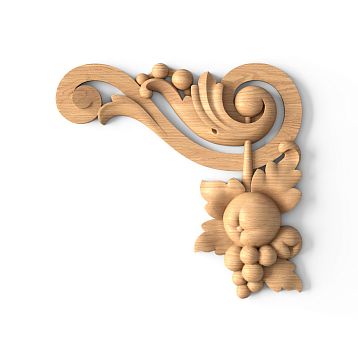
Corner caps — decorative elements installed at corners of frames, at intersections of moldings. They may be carved with floral motifs, geometric patterns, or stylized images. Corner caps conceal joint lines between strips while simultaneously creating compositional focal points.
Central rosettes - round or oval decorative elements installed at the center of panels, at the intersection of diagonals. A carved rosette becomes a compositional focal point, drawing the eye. It can be quite large - up to 100-150 millimeters in diameter, creating a striking accent.
Decorative appliqués of arbitrary shapes - leaves, flowers, scrolls, geometric figures - are used to create unique compositions. They are applied to facades according to the designer's concept, creating individual decoration. This is characteristic of exclusive furniture, where each item is unique.
Furniture nails with decorative heads, in combination with moldings, create a special effect. The heads may imitate wrought iron, be brass, bronze, or patinated. They are placed around fabric- or leather-covered panels, securing the material while simultaneously creating a rhythmic decoration.
Conclusion
Decorative solutions for furniture - moldings, picture frames, borders - represent a powerful tool for transforming simple items into exclusive, visually valuable pieces. These elements create volume, imitate traditional techniques, define stylistic affiliation, turning functional furniture into works of decorative art.
Decorative moldings for furniture are available in an enormous variety of profiles, sizes, and materials, allowing the realization of any design concept - from strict modern classicism to luxurious baroque. Applying moldings to facades, bases, and cornices creates volumetric compositions that visually enrich furniture at relatively low cost.
Wooden picture frame molding is used to create accent zones, frame glass and mirror inserts, decorative panels. The picture frame transforms utilitarian elements into decorative ones, adding elegance and completeness. Glazed doors with frames, mirrors in ornate frames, contrasting panels - all of this is created using picture frames.
Decorative borders and small details are the final touches that give furniture decoration completeness and refinement. Double framing, zoning, corner appliqués, rosettes create complexity and detail, characteristic of handmade luxury furniture. Attention to detail distinguishes professional design from amateur work.
STAVROS offers a wide range of decorative elements for furniture made from high-quality MDF and solid wood. Various molding profiles, picture frames with quarter for glazing, narrow borders, corner elements, carved appliqués enable the creation of furniture of any style and level of decoration.
STAVROS products are manufactured with high precision on modern equipment. Ideal geometry, smooth surface, clear profiles guarantee a professional result. Ecologically safe MDF class E1 is suitable for residential spaces. Wooden elements from selected species create premium quality.
STAVROS specialists' consulting support helps correctly select elements for a specific project, calculate material quantities, and obtain installation and finishing recommendations. This is especially valuable for complex compositions requiring coordination of many details.
Choosing decorative elements from STAVROS, you get quality materials, diverse solutions, professional support, and the opportunity to create furniture that will delight with beauty and individuality for many years, becoming not just a functional item, but a full-fledged part of the interior, demonstrating taste and understanding of the value of genuine quality.
Frequently asked questions
Can you decorate ready-made furniture with moldings?
Yes, decorating ready-made furniture with moldings is an excellent way to refresh the interior without significant expenses. Simple smooth cabinet or chest fronts can be transformed into classic paneled ones by applying moldings and repainting. Careful marking is essential for symmetrical compositions. The surface must be clean and degreased for good adhesive bond. After applying moldings, the entire surface is painted in one color, creating a visually unified structure. This works with MDF, particleboard, solid wood furniture. Not suitable for laminate furniture without prior surface preparation.
What width of moldings to choose for furniture facades?
For standard cabinet doors 40-60 centimeters wide, optimal molding width is 30-50 millimeters. Too narrow moldings will disappear, too wide ones will overload the composition. For large facades 80-100 centimeters wide, moldings 50-70 millimeters wide can be used. For small elements - drawers, chest doors - narrow moldings 25-40 millimeters are suitable. Proportions between facade size and molding width are important. The classic rule - molding occupies approximately 1/8-1/10 of the width of the framed panel.
What to use to glue moldings to furniture?
For gluing moldings to furniture facades, PVA wood glue is used - it ensures strong bonding of MDF and wood, is safe, and inexpensive. For demanding applications, professional furniture glues based on PVA or polyurethane with improved properties are used. Glue is applied in a thin, even layer, and the molding is carefully pressed. For added security, finish nails 20-30 millimeters long can be used, which are driven in and sanded. Full drying time of glue is 12-24 hours, after which finishing treatment can be performed.
How to paint furniture with moldings?
After applying moldings and filling all joints, the surface is primed with acrylic primer for MDF or wood. Primer improves paint adhesion and equalizes absorption. After primer drying, the surface is lightly sanded with fine abrasive. Painting is done with acrylic paint in two to three thin coats with intermediate drying and light sanding. Use a quality brush or spray gun for even coverage. Grooves in the profile require special attention - paint must reach all details of the relief. After paint drying, a protective varnish can be applied to improve durability.
How much does decorating furniture with moldings cost?
The cost consists of material and labor prices. Moldings cost 100-500 rubles per linear meter depending on profile and material. To decorate a 50-centimeter wide cabinet facade, approximately 2-2.5 meters of moldings are needed - 200-1250 rubles. Glue, putty, paint add 200-500 rubles per facade. Professional work costs 500-1500 rubles per facade depending on complexity. Decorating a two-door cabinet will cost 2000-5000 rubles including materials and labor. Doing it yourself saves labor costs but requires time and skills.
Can moldings be used on kitchen facades?
Moldings are ideal for kitchen facades, transforming simple smooth doors into classic paneled ones. It is important to use quality moisture-resistant materials and coatings. MDF must be moisture-resistant, and painting is done with durable acrylic enamels or polyurethane varnishes. Moldings are glued with water-resistant glue. After painting, the surface withstands wet cleaning, temperature fluctuations typical for kitchens. Avoid direct contact of moldings with water, steam from kettles, grease splashes - regular cleaning extends service life. Properly installed and protected moldings on the kitchen last 10-15 years without losing appearance.
What mistakes are commonly made when decorating furniture?
Asymmetric marking - distances from moldings to facade edges differ, disrupting balance. Careful marking from the center of the facade is mandatory. Inaccurate corner trimming - joints do not align, creating gaps. Requires sharp tools and precise 45-degree angle adjustment. Inconsistent sizes - moldings too wide or narrow for the facade, creating disproportion. Poor joint filling - filled areas are visible after painting. Putty must be perfectly sanded. Insufficient paint layers - base shows through, color is uneven. Minimum two full coats after priming. Lack of planning - installing moldings without a sketch leads to chaotic results.
How to care for furniture with moldings?
Caring for furniture decorated with moldings is simple. Regular dry cleaning with a soft cloth removes dust - weekly during general cleaning. Pay special attention to profile grooves where dust accumulates more - use a soft brush or vacuum cleaner with a brush attachment. Wet cleaning is done with slightly damp cloth without excess water and neutral cleaning agents. Avoid abrasive cloths and aggressive chemicals that may damage paint. In case of scratches or chips, local restoration is possible - filling with putty and repainting. After 7-10 years, the coating can be renewed with full repainting, restoring original freshness and allowing color change to adapt furniture to a new interior.