Article Contents:
- The Language of Ornament: How Wall Decor and Handles 'Communicate' with Each Other
- Repeating Motifs: Direct Echo
- Stylistic Kinship: Indirect Connection
- Contrast Through Scale: When Difference Works
- Materials: Wood, Polyurethane, Metal — How to Coordinate
- Wooden Handles and Polyurethane Molding
- Metal Handles and Molding
- Combining Materials in Handles
- Scenario 1: Classic Molding and Carved Wooden Handles
- Molding: Floral Ornaments, Rosettes, Moldings
- Furniture and Handles: Continuing the Theme
- Visual Connection
- Scenario 2: Geometric Molding and Minimalist Handles
- Molding: Lines, Angles, Rhythm
- Furniture and Handles: Purity of Form
- Coordination Through Geometry
- Scenario 3: Eclectic Molding and Designer Handles
- Molding: Mix of Styles and Eras
- Furniture and Handles: Art Objects
- Connection Through Boldness
- Proportions and scale: the mathematics of beauty
- Scaling Principle: One to Three or One to Five
- Element Density: Rhythm and Breathing Space
- Color as a Coordination Tool
- Monochrome: Unity Through Shades
- Contrast: Highlighting Elements
- Accent Color: A Bright Detail
- Texture and Finish: Tactile Dialogue
- Smooth Molding — Smooth Handles
- Relief molding — textured handles
- Contrast of textures: a play of sensations
- Style scenarios: from Baroque to loft
- Baroque: opulence and theatricality
- Classicism: restraint and symmetry
- Art Deco: Geometry and Luxury
- Minimalism: purity of lines
- Loft: industrial chic
- Practical recommendations for selection
- Step 1: Determine the style and character of the molding
- Step 2: Choose handles with similar characteristics
- Step 3: Check the scale and proportions
- Step 4: Coordinate the color
- Step 5: Test in the space
- Mistakes to Avoid
- Mixing Incompatible Styles
- Ignoring scale
- Color chaos
- Forgetting about door and window hardware
- Frequently Asked Questions
- Can modern handles be used in a classic interior with molding?
- Should all handles in the interior be the same?
- How to choose handles if the molding is very lush and decorative?
- Can I Paint Wooden Handles Myself?
- How to care for carved handles with patina?
- How Much Do Quality Wooden Handles Cost?
- Can handles be ordered according to a custom sketch?
- How are carved wooden handles attached to furniture?
- Are metal handles suitable for polyurethane molding?
- How to understand that handles and molding are coordinated correctly?
- Conclusion: composition of details with STAVROS

Have you ever noticed how sometimes expensive furniture with exquisite handles looks alien against the background of textured walls with molding? Or vice versa — magnificent wall molding with Baroque rosettes coexists with furniture adorned with simple metal brackets that kill the entire atmosphere? The problem lies in the disconnect of languages: the walls speak one dialect of ornament, texture, era, while the furniture handles speak a completely different one. It's like an orchestra where the violins play Bach, and the drums play rock 'n' roll. Does it sound? Yes. Harmoniously? No.
Decorative molding and furniture handles should be coordinated not by chance, not intuitively, but thoughtfully, systematically, with an understanding of the logic of ornaments, proportions, and style. How to selectFurniture Handlesso that they continue the patternof wall molding, echo its motifs, support the scale, and create a unified visual environment? Today we will analyze this in detail — from the principles of coordination to specific examples for different interior styles.




The language of ornament: how wall decor and handles 'talk' to each other
Ornament is not just a beautiful pattern. It is a visual code that carries information about an era, culture, and aesthetics. Floral motifs speak of nature, organic forms, and classicism. Geometry speaks of order, rationality, and modernity. Zoomorphic elements speak of mythology, symbolism, and historicism.




Repetition of motifs: direct echo
The most obvious way to coordinate is by repeating the motif. If on the wallwall decorative elementwith a plant ornament — acanthus leaves, grapevines, rosettes with petals — it's logical to choose furniture handles with similar motifs. They don't have to be identical, but related.
For example, a wall overlay with an acanthus leaf measuring 200x150 mm, carved, three-dimensional, in a classic style. On the furniture — a bracket handle with a light acanthus curl at the ends, 120 mm long, also carved, made from the same wood or painted the same color. This creates a visual rhyme: a large acanthus on the wall, a small acanthus on the handle. They don't compete but complement each other, harmonized in scale.
Our factory also produces:


Stylistic kinship: indirect connection
A more subtle approach is not to repeat the ornament literally, but to choose elements from the same stylistic family. Baroque stucco on the walls — lush, multi-layered, with curls, volutes, cartouches — requires handles with Baroque features: curved, with soft lines, possibly with slight asymmetry, with carving.
At the same time, the ornament on the handles can be different. On the wall — a rosette with a cherub, on the handle — an abstract curl. But the character of the lines, plasticity, three-dimensionality — are common. The eye reads: this is one era, one aesthetic, one space.
Get Consultation
Contrast through scale: when difference works
Sometimes contrast creates interesting dynamics. Large, monumental stucco on the walls — pilasters, capitals, massive cornices — and miniature, elegant handles on the furniture. The contrast in scale emphasizes both the walls (they seem even more majestic against the backdrop of the furniture's miniature details) and the handles (they look jewel-like precise against the backdrop of large forms).
But this only works if the style is unified. Classical pilasters and classical miniature handles — yes. Classical pilasters and high-tech handles — no, that's a conflict.
Materials: wood, polyurethane, metal — how to coordinate
Stucco is most often polyurethane or plaster, less often wood. Handles — wooden, metal, less often ceramic. How to coordinate different materials?
Wooden handles and polyurethane stucco
Furniture HandlesWood — that's tactility, warmth, natural beauty. Polyurethane stucco — that's clarity of form, lightness, practicality. Coordination happens through color and shape, not through material.
Polyurethane stucco can be painted any color. Wooden handles can also be painted, tinted, patinated. If the stucco is white, the handles can be made of whitewashed oak or painted white. If the stucco is patinated with gold, the handles — made of oak with light gilding on the raised parts of the carving. Color unites different materials into a single palette.
Shape — too. If the stucco has soft, rounded lines, the handles — also rounded, streamlined. If the stucco is geometric, strict — handles with clear edges, straight lines.
Metal handles and stucco
Metal is colder than wood, more technological. But in classic interiors withstucco decormetal handles can work if they are stylized to look classic: brass with patina, bronze, aged iron, copper.
It's important that the metal has character — not shiny chrome (too modern), but matte noble alloys with a slight texture, wear, an effect of time. Then the metal is perceived as a classic material, akin to bronze elements in historical interiors.
Combining materials in handles
An interesting solution — handles where wood is combined with metal. For example, a wooden bracket handle with metal tips stylized to look classic. Or a knob handle with a wooden base and metal inlay. This creates material richness, echoes the fact that stucco can also be complemented with metal elements (gilding, patina).
Scenario 1: Classic stucco and carved wooden handles
The most traditional and foolproof option for interiors in classic, neoclassical, palace styles.
Stucco: plant ornaments, rosettes, moldings
On the walls —Wall moldingpolyurethane stucco in a classic style. Moldings 70-100 mm wide with a profile including coves, ogees, beads. Overlay rosettes 150-300 mm in diameter with plant motifs: acanthus, laurels, palmettes, wreaths. Corner overlays with curls, symmetrical, lush.
Stucco color — white or cream, matte, with possible light patina in the recesses (dark gray, golden), emphasizing the relief. The stucco creates a rich, noble background, an architectural structure for the space.
Furniture and handles: continuing the theme
Furniture in such an interior — classic or neoclassical. Cabinets with paneled fronts, chests of drawers with drawers, display cabinets with glass inserts. The fronts may haveDecorative Inserts— carved elements that enhance the classical style.
Furniture Handles— carved, made of solid oak or beech. Forms: bracket handles with floral carving on the arches, knob handles with a rosette on the front, handles with acanthus scrolls at the ends. Sizes: 80-150 mm for brackets, 40-60 mm for knobs.
Finishing: tinted in warm shades (walnut, golden oak), with possible light patina that matches the patina on the molding. If the molding has gilding, the handles feature gold highlights on the raised parts of the carving, applied by hand or using a tamponing method.
Visual connection
The floral motif on the wall (e.g., an acanthus leaf in a rosette) echoes the floral motif on the handle (acanthus scroll). The scale is different: the wall element is 200 mm, the handle is 30 mm — but the character of the lines, plasticity, and three-dimensionality of the carving are recognizably related. The eye glides along the wall, sees the relief, descends to the furniture, encounters a similar relief in miniature — creating a sense of integrity, thoughtfulness, and harmony.
Scenario 2: Geometric molding and minimalist handles
A modern approach where the molding is not classical but geometric, abstract, and the handles are also strict, without decoration.
Molding: lines, angles, rhythm
On the walls — simple rectangular profile moldings creating geometric panels. Or polyurethane overlay panels with a relief geometric pattern: honeycombs, rhombuses, parallelepipeds, waves. The relief is shallow, 10-15 mm, but clear, graphic.
Color — monochrome: white, gray, black, or matching the wall (wall light gray, molding a shade darker). No gilding, patina — pure modern aesthetics.
Furniture and handles: purity of forms
Furniture is smooth, without milling, without overlays. Facades are flat, matte, possibly with integrated profile handles (where the top edge of the facade protrudes, forming a grip). But where traditional handles are needed — they are maximally laconic.
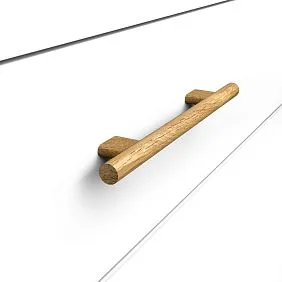
Bracket handles of rectangular or round cross-section, without decoration, made of light wood (ash, beech) or painted in graphite, black, white. Length 100-150 mm, diameter 12-18 mm. Or bar handles — narrow horizontal rails, recessed into the facade. Geometry is clean, lines are straight.
Coordination through geometry
Rectangular panels on the wall — rectangular handles on the furniture. Vertical rhythm of moldings — vertical bar handles. Geometric pattern on the wall (e.g., hexagons) — hexagonal knob handles on the furniture (miniature, 20-30 mm). This is a play with forms, where the same language of geometry is used at different scales and on different planes.
Scenario 3: Eclectic molding and designer handles
For bold interiors where eras, styles, and approaches are mixed.
Molding: mix of styles and eras
On the walls — an intentionally eclectic set of molded elements. A Baroque rosette neighbors an Art Deco molding, a classical pilaster — with a modern geometric overlay. This is not chaos, but a thoughtful composition where contrasts create dynamics and intrigue.
Colors can be different: one wall with white molding, another — with black, a third — with gold. Or a gradient: from light to dark. This is an authorial, artistic approach requiring boldness and a sense of proportion.
Furniture and handles: art objects
Furniture can also be eclectic: a classical chest of drawers on modern metal legs, a minimalist wardrobe with a Baroque handle.Furniture HandlesHere, handles become art objects, noticeable, expressive.
These can be designer handles of unusual shapes: asymmetrical, sculptural, resembling branches, stones, abstract figures. Or classical carved handles, but painted in bright unexpected colors: emerald, burgundy, mustard. Or combined: wood with metal, with inlay, with patina.
Connection through boldness
Coordination occurs not through direct repetition of motifs, but through a shared spirit of experimentation. The molding is bold, the handles are bold. The molding mixes eras, the handles do too. It is important that the overall density of decorativeness is balanced: if there is a lot of molding and it is lush, the handles can be simpler to avoid overload. If the molding is minimal, the handles can be accent pieces, bright.
Proportions and scale: the mathematics of beauty
Beauty is born from correct proportions. The sizes of wall molding and furniture handles must be coordinated mathematically.
Scaling principle: one to three or one to five
If a wall rosette has a diameter of 300 mm, a knob handle on furniture can be 60 mm (ratio 5:1) or a bracket handle 100 mm (ratio 3:1). This is not a strict rule, but a guideline. Too large handles against fine molding look crude, too small against large molding — get lost.
If a wall molding is 80 mm wide, a bar handle on furniture logically has a width of 15-20 mm (approximately 4:1). The eye perceives this as a harmonious ratio.
Density of elements: rhythm and breathing
On the wall — a certain number of molded elements: moldings, overlays, rosettes. On furniture — a certain number of handles. It is important that the density is proportionate. If the wall is very saturated with molding (many elements, dense relief), it is better to make the furniture calmer: fewer handles, simpler shapes. If the wall is laconic (one or two moldings, minimal decor), the furniture can be more expressive: handles that are noticeable, decorative.
This is a question of balance: the overall visual load should not exceed a comfortable level. The space should breathe, not suffocate under a layer of decor.
Color as a coordination tool
Color is the most powerful unifying factor.
Monochrome: unity through shades
Molding and handles in the same color scheme, but different shades. Molding is white, handles are made of bleached oak (warm white with a slight yellowish tint). Or molding is gray, handles are made of oak tinted gray. A difference of half a tone to a tone creates visual depth, but the overall color tone unites.
This works even with different materials and styles: polyurethane classical molding and wooden modern handles, but both gray — and they are already related.
Contrast: highlighting elements
Molding is white, handles are dark (dark walnut, wenge, painted graphite). The contrast emphasizes both the molding (it appears even lighter, cleaner) and the handles (they stand out, become noticeable accents). This creates graphic quality, clarity, modernity even in a classic interior.
It is important that the contrast is supported somewhere else: for example, dark door trims, dark baseboards, a dark mirror frame. Then the dark handles are not an accident, but an element of the system.
Accent color: a bright detail
Molding is neutral (white, beige, gray), handles are a bright accent color (emerald, burgundy, terracotta). This is a bold solution that requires support: the accent color should be repeated in textiles (pillows, curtains), in decor (vases, paintings), in lighting (colored lampshades).
Then the bright handles are perceived as part of the interior's color concept, not as foreign spots.
Texture and surface: tactile dialogue
In addition to shape and color, the texture of the surface is important.
Smooth molding — smooth handles
Polyurethane molding after painting has a smooth surface, matte or with a slight satin sheen. Handles can also be smooth — made of wood coated with matte varnish, or painted with matte paint. Unity of texture creates calmness, elegance, and an absence of visual noise.
Relief molding — textured handles
If the molding has a pronounced relief, the handles can have texture: visible wood grain (oil coating without painting), light carving, the texture of brushing (when soft wood fibers are selected, the texture is emphasized). This creates tactile richness, material density of the interior.
Contrast of textures: a play of sensations
Smooth molding and textured handles, or vice versa — relief molding and mirror-smooth handles. Contrast of textures creates dynamics, interest, invites touch. It is important that this is a conscious decision, not an accident.
Style scenarios: from Baroque to loft
Let's analyze specifically which handles suit which types of molding in different styles.
Baroque: opulence and theatricality
Baroque molding — these are curls, volutes, cartouches, cherubs, abundant vegetation. Large elements, deep relief, possibly gilding. Handles — carved, curved, asymmetrical, with plant motifs. Material — oak or beech, tinted, with gilding. Sizes — large, noticeable.
Classicism: restraint and symmetry
Classical molding — moldings with a regular profile, symmetrical rosettes, pilasters with capitals. Moderate relief, strict proportions. Handles — symmetrical, turned or with moderate carving, clear shape. Material — light wood, painted or varnished. Sizes medium, proportional.
Art Deco: geometry and luxury
Art Deco molding — geometric shapes with decorative inserts, stepped profiles, zigzags, sun rays. Handles — geometric, often with inlay, contrasting inserts. Material — wood with metal, high-gloss varnish. Colors contrasting: black with gold, white with silver.
Minimalism: purity of lines
Minimalist molding — simple moldings, geometric panels, minimal decor. Handles — laconic brackets, strips, buttons of simple shapes. Material — light wood, painted in neutral colors. Sizes small, inconspicuous.
Loft: industrial chic
Moldings in a loft are usually absent or minimal. But if present (e.g., in an adapted historical building with original moldings) — handles should be industrial: metal, rough, with a rust effect or aged iron. The contrast between historical (molding) and industrial (handles) creates the eclectic style characteristic of lofts.
Practical recommendations for selection
How to practically approach the task of coordination?
Step 1: Determine the style and character of the molding
Look at your wall molding. What style is it? Classic, Baroque, Art Nouveau, modern geometry? What is the character of the lines — soft curves or sharp angles? What motifs — floral, geometric, zoomorphic? Write down the key characteristics.
Step 2: Choose handles with similar characteristics
Look for handles that share at least two or three characteristics with the molding: style, line character, type of ornament. Not necessarily identical, but related. Create several options, lay out samples next to molding samples (or photographs).
Step 3: Check scale and proportions
Measure the characteristic dimensions of the molding (width of the molding, diameter of the rosette) and handles. Ensure the ratio is approximately 3:1 or 5:1. If handles seem too large or too small — adjust the selection.
Step 4: Coordinate color
Decide on a color strategy: monochrome, contrast, or accent? Select handle colors according to this strategy. If needed, order handles painted to match or with patination so the color exactly matches the molding or creates the desired contrast.
Step 5: Check in the space
If possible, order one or two sample handles, temporarily attach them to the furniture (with double-sided tape), see how they look against the molding under different lighting (daylight, evening). This is the final check before bulk ordering.
Mistakes to avoid
Typical mistakes in coordinatingdecorative moldingand furniture handles.
Mixing incompatible styles
Baroque molding and high-tech handles — conflict. Classic moldings and country-style antique handles — also. Styles should be if not identical, then at least not clashing. A mix of close eras is acceptable (Classicism and Empire), but not opposite ones (Baroque and minimalism), unless it is deliberate eclecticism where contrast is part of the concept.
Ignoring Scale
Large, massive handles against delicate, fine molding — crude. Miniature handles against monumental pilasters — get lost. The scale must be proportionate.
Color chaos
White molding, gold handles, silver trims, copper light fixtures — too many metals, too many colors. Choose one or two metallic palettes (e.g., gold and bronze) and stick to them throughout the space.
Forgetting about door and window hardware
Furniture Handles— this is only part of the hardware in the interior. There are also door handles, hinges, hooks, curtain rods. All of them must be coordinated with each other and with the molding. If furniture handles are antique brass, door handles should also be brass.
Frequently asked questions
Can modern handles be used in a classic interior with molding?
Yes, if it is a deliberate contrast. Classic molding + modern minimalist handles = eclecticism, which can be very interesting. But it is important that the furniture is also modern — then the contrast between classic walls and modern furniture looks harmonious.
Should all handles in the interior be identical?
Not necessarily, but it is desirable that they be from the same stylistic family. Sizes can vary (large handles on cabinets, small ones on drawers), but style, material, color should be uniform or related.
How to choose handles if the molding is very lush and decorative?
If the molding is very saturated, it is better to make the handles slightly simpler to avoid overload. But stylistically they should still correspond. For example, Baroque molding + Baroque handles, but not the most ornate possible, but of medium decorativeness.
Can I paint wooden handles myself?
Yes, wooden handles paint well. Use acrylic paint for wood, prime first, paint in two or three thin layers with intermediate sanding. Finish with a matte or semi-matte varnish for protection.
How to care for carved handles with patina?
Wipe with a dry, soft cloth, avoiding water and harsh chemicals. The patina may wear slightly over time on raised areas — this is normal and adds a natural aging effect. To preserve the patina longer, you can apply a thin layer of wax once a year.
How much do quality wooden handles cost?
Depends on size, carving complexity, and material. Simple beech bracket handles — from 800 to 1500 rubles. Medium-sized carved handles — 1500-3000 rubles. Large, intricately carved oak handles — 3000-6000 rubles and above. Handles with patina, gilding, or custom finishing — more expensive.
Can I order handles based on a custom design?
Yes, many manufacturers (including STAVROS) offer custom handle production based on individual drawings. You can develop a sketch that replicates a specific motif from your wall molding and get unique handles perfectly coordinated with your wall decor.
How are carved wooden handles attached to furniture?
Typically through a through-hole in the facade — a screw is inserted from the inside, passes through the facade, and screws into a threaded insert (bushing) inside the handle. Alternatively, special furniture screws with decorative heads are used if the design calls for them.
Are metal handles suitable for polyurethane molding?
Yes, if the style is coordinated. Brass, bronze, and aged metal handles work excellently with classic polyurethane molding. Chrome, nickel, and shiny finishes pair well with modern geometric molding.
How can you tell if handles and molding are properly coordinated?
If, when looking at the interior, you don't think about coordination — then everything is done correctly. Harmony is unnoticeable; it simply exists. If something catches your eye, seems foreign, or stands out — then there is a mismatch that needs to be corrected.
Conclusion: Composition of details with STAVROS
Creating a harmonious interior is the art of composition, where every detail plays its role, but together they create a symphony.Molding decorWall decor sets the tone, defines the style, and creates the architectural structure.Furniture HandlesFurniture handles are a continuation of this theme on a smaller scale, a tactile point of contact where the hand meets the space, where the ornament becomes tangible.
Properly selected handles that match the pattern of the wall relief create a visual echo, a rhythm that unites different planes — vertical walls and horizontal furniture — into a single environment. Repeating motifs, coordinating scales, color kinship, and unity of textures — all these are tools that turn a set of elements into a cohesive work. The interior ceases to be a collection of furniture and finishes; it becomes a space with character, history, and soul.
For over two decades, STAVROS has been creating elements that make such interiors possible.Polyurethane wall moldingWall molding — over 1500 models: moldings of all profiles and sizes,Decorative Insertswith diverse ornaments (floral, geometric, abstract), rosettes, panels, pilasters, capitals, consoles. From miniature elements 50x50 mm to monumental panels 1000x1500 mm. From classic Baroque to modern minimalist. Each element is the result of precise pressure casting from polyurethane with a density of 280-320 kg/m³, ensuring clear relief, stable geometry, and durability.
Simultaneously, STAVROS producesWooden furniture handlesFurniture handles — over 130 models of various styles and shapes. Classic carved bracket handles with floral motifs — acanthus, grapes, laurels. Turned handles with balusters, rings, fluting. Modern minimalist brackets and bars. Round, square, and polygonal knob handles. Asymmetrical designer shapes. Material — solid oak and beech of the highest grade, kiln-dried to 8-12% moisture, processed on CNC machines with hand finishing for complex elements.
STAVROS offers handles unfinished (for any final finish) or with ready-made treatments: painting in any RAL color, staining with tints, patination (artificial aging), gilding and silvering (imitation gold leaf, acrylic gold), brushing (highlighting the grain). Possibility to create handles based on custom sketches — replicating a specific motif from your molding, creating a unique visual rhyme.
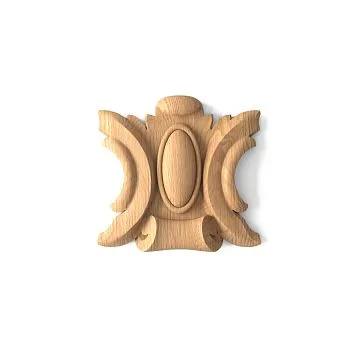
decorative inlays for furnitureFurniture overlays — over 400 models of carved elements that complement handles and enhance the decorativeness of facades. Central and corner, symmetrical and asymmetrical, from miniature leaves 30x20 mm to large panels 600x400 mm. They can repeat the motifs of wall molding, creating a three-dimensional visual connection: ornament on the wall — ornament on the facade overlay — ornament on the handle.
All STAVROS products are stylistically coordinated within collections. You can choose wall molding from the 'Classic' collection and furniture handles from the same collection — they will harmonize in style, scale, and character of the ornament. Consultants will help select elements, suggest finishing options, calculate quantities, and explain installation nuances.
STAVROS production — 6000 sq.m of production space, 19 CNC machines, computer-controlled polyurethane injection molding machines, drying chambers, painting lines. Yet, manual work is preserved — carvers finish complex elements, sanders achieve perfect smoothness, painters apply patina by hand, creating unique effects. This combination of technology and craftsmanship yields products of the highest quality.
Delivery to Moscow, St. Petersburg, all of Russia, CIS, and abroad (STAVROS products adorn interiors in the USA, Canada, Europe). Own logistics, careful packaging, integrity guarantee. We work with private clients, designers, architects, furniture and construction companies. Flexible pricing, volume discounts, loyalty program.
Create interiors whereWall decor and furniture hardware speak the same languagewhere the ornament flows from plane to plane, where every detail is meaningful, where the hand reaching for the handle meets the continuation of the wall relief. Where space is not a set of elements, but a cohesive work — harmonious, expressive, memorable. With STAVROS, this is not just a dream, but an achievable reality — quality proven over decades, an assortment covering all styles and tasks, expertise enabling the most complex projects. Beauty that serves and inspires.