Article Contents:
- Why proportions are critical: the physics and aesthetics of vertical elements
- Load and stability
- Visual balance: the golden ratio in wooden elements
- Standard baluster heights: where the numbers come from
- Baluster height vs. railing height
- Typical baluster sizes on the market
- Measuring and calculating: how to avoid mistakes
- Measuring an existing staircase for baluster replacement
- Calculation for a new staircase
- Furniture legs: height determines function
- Standard heights for different types of furniture
- Leg proportions: the ratio of height, thickness, and shape
- When standard doesn't fit: custom orders
- Non-standard ceiling heights
- Furniture of non-standard sizes
- Harmonizing proportions with other elements
- Material and its influence on proportions
- Oak: strength allows for elegance
- Beech: uniformity and stability
- Pine: affordability requires a safety margin
- Baluster fastening: how the installation method affects height
- Mortise and tenon: the traditional method
- Metal pins and dowels
- Surface mounting
- Furniture leg attachment: precision to the millimeter
- Threaded connection
- Adhesive Joining
- Attachment using aprons and tabletop supports
- Checking the quality of ready-made elements
- Measuring length
- Checking diameters and cross-sections
- Quality Processing Assessment
- Frequently Asked Questions about Balusters and Furniture Legs
- Can a baluster be shortened if it turns out to be too long?
- Can a leg be extended if it turns out to be too short?
- How to coordinate baluster height if steps are of different heights?
- What to do if one table leg is 2-3 mm shorter than the others?
- Which wood species is best to order balusters for an outdoor staircase from?
- How long do wooden furniture legs last?
- Conclusion: Precision in Details Creates Integrity

Height matters. This is not a phrase from an architecture textbook, but a practical truth you understand whenBalusters for staircaseafter installation turn out to be 5 cm shorter than needed, andfurniture legmakes the table crooked because one leg differs from the others by a millimeter. Ready-made wooden elements are convenience and speed, but they also carry the risk of mismatch. Let's figure out how to measure correctly, what to pay attention to when ordering, what standards exist, and when a standard is not suitable.



Why Proportions Are Critical: The Physics and Aesthetics of Vertical Elements
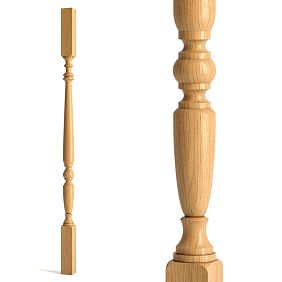
A baluster is not just a vertical rod. It is a load-bearing element that must withstand the horizontal load from the railing.furniture legis not just a stand. It is a support that bears the weight of the tabletop, the contents of drawers, and the elbows of a person leaning on the table. Incorrect height or disproportionate cross-section leads to functional problems and visual imbalance.




Load and Stability
Imagine a staircase with balusters 900 mm high for a standard railing height of 900-1000 mm from the step. If the baluster is thin (40 mm diameter at 900 mm height), under lateral load (a person leaning on the railing) it will flex, creating a feeling of unreliability. If the baluster is too thick (80 mm diameter at the same 900 mm height), it is visually bulky, consumes space, and the staircase looks massive.
The optimal height-to-diameter ratio for turned balusters is approximately 1:15 or 1:20. For a baluster 900 mm high, the optimal diameter of the central part (the widest) is 45-60 mm. This ensures strength without excessive bulkiness.
Forfurniture supportshave different proportions. A dining table leg 720 mm high (standard tabletop height) can have a cross-section of 60×60 mm (for light tables) or 80×80 mm (for massive ones). But if the leg is too thin (40×40 mm at 720 mm height), the table will wobble, especially with uneven weight distribution.
Our factory also produces:


Visual Balance: The Golden Ratio in Wooden Elements
The human eye intuitively assesses proportions. If an element is disproportionate—too tall and thin or too short and thick—discomfort arises, even if the person cannot explain what the problem is.
The golden ratio (a ratio of approximately 1:1.618) is also applicable to wooden elements. If a baluster has several decorative sections (base, central part, top), their proportions should correspond to this ratio. The base may constitute 1/3 of the height, the central part—1/2, and the top—the remainder.
For furniture legs, visual balance is achieved through the ratio of leg height to furniture size. A leg should not be too short (the furniture looks grounded, heavy) or too long (the furniture seems unstable, fragile).
Get Consultation
Standard Baluster Heights: Where the Numbers Come From
Building codes define the height of stair railings—from 900 to 1200 mm from the step surface to the top edge of the railing. This is dictated by ergonomics and safety: a person of average height (170-180 cm) finds it comfortable to hold a railing at a height of about 900 mm. For children and shorter people—slightly lower, for tall people—slightly higher.
Baluster Height vs. Railing Height
It's important to understand: baluster height and railing height are different things. Railing height is measured from the step to the top point of the railing. Baluster height is from the installation point (step or riser) to the railing attachment point.
If a baluster is installed on a horizontal step, its height should be such that after installing the railing, the total railing height is 900-1000 mm. But railings have thickness (usually 40-60 mm), which must be considered. If the railing thickness is 50 mm, the baluster should be 850-950 mm so that the total railing height is 900-1000 mm.
If a baluster is installed on an inclined plane (stair stringer), the calculation becomes more complicated. The top part of the baluster must be cut at an angle corresponding to the staircase's incline. This means the actual vertical height of the baluster may differ from its length.
Typical Baluster Sizes on the Market
buy balustersavailable in standard sizes that cover most applications:
-
700 mm — for low railings (terraces, first-floor balconies)
-
900 mm — universal size for interior stairs
-
1000 mm — for high railings (second floor with children, public buildings)
-
1200 mm — for stairs in public buildings where regulations require increased height
But this is the baluster length, not the final railing height. When designing, you need to consider the mounting method (tenon-mortise, dowel, metal rod), railing thickness, and stair slope angle.
Measurement and calculation: how to avoid mistakes
Measuring an existing staircase for baluster replacement
If you are replacing old balusters with new ones, the algorithm is as follows:
Measure the height of the existing baluster from the lower mounting point (step surface or stringer) to the upper mounting point (bottom surface of the railing). This is not the vertical distance, but the length of the baluster itself. If the staircase is sloped, measure along the slope line.
Check the diameter of the balusters at their widest point. New balusters should be comparable in diameter, otherwise they will look visually out of place.
Count the number of balusters. The standard is two balusters per step (one at the beginning, one at the end). But there are options with one baluster per step (if there are many steps and the staircase is wide) or three balusters (for steps wider than 1.5 meters).
Calculation for a new staircase
If the staircase is being designed from scratch, the calculation starts with determining the desired railing height. Standard is 900-1000 mm. Subtract the railing thickness (usually 40-60 mm). The remaining height is for the baluster: 840-960 mm. Round to the nearest standard size — 900 mm.
Consider the mounting method. If the baluster is mounted in a step groove (a 20-30 mm deep groove is cut, and the baluster is inserted with a tenon), the actual visible height of the baluster will be reduced by the groove depth. If the baluster is mounted on top of the step (on a metal rod or dowel), the visible height is full.
Determine the baluster installation spacing. Building codes require that the distance between balusters does not allow a child to stick their head through — maximum 120-150 mm between baluster centers. If a step is 300 mm wide, two balusters are installed on it with a distance of about 150 mm between them.
Furniture legs: height determines function
The height of a furniture leg depends on the type of furniture and ergonomics of use.
Dining Tables: 70–73 cm
Dining table: tabletop height from the floor is 720-750 mm. This is an ergonomic standard at which a person of average height can sit comfortably at the table on a chair with a seat height of 450 mm.Legs for such a tablemust provide this height minus the tabletop thickness. If the tabletop is 40 mm, the leg should be 680-710 mm.
Coffee table: height 400-500 mm. This is comfortable for use with a sofa (you can place a cup, pick up a book without getting up). Legs for such tables are short — 360-460 mm (accounting for tabletop thickness).
Console table (sofa-side, wall-mounted): height 700-800 mm, close to dining table height. Used for placing lamps, decor, keys in the hallway. Legs — 660-760 mm.
Bar counter: height 1000-1100 mm. Used with special bar stools with a height of 750-800 mm. Bar counter legs — 960-1060 mm.
Sofa, armchair: legs are usually 100-200 mm. They lift the furniture off the floor for air circulation, easier cleaning, and aesthetics. Legs that are too high (over 250 mm) make upholstered furniture look visually unstable.
Leg proportions: ratio of height, thickness, shape
A thin, long leg (40 mm diameter at 700 mm height) looks elegant but requires sturdy wood (oak, beech) and quality mounting. Suitable for lightweight tables without heavy loads.
A thick, short leg (80 mm diameter at 400 mm height) is massive, reliable, suitable for heavy tables with stone tops, and furniture in classic or rustic style.
Leg shape affects perception. Straight cylindrical leg — strictness, minimalism. Tapered (narrowing towards the bottom) — elegance, classic. Carved with decorative elements — luxury, tradition.
When standard doesn't fit: custom order
There are situations where standard sizes don't work.
Non-standard ceiling heights
In houses with ceilings 3.5-4.0 meters high, the staircase may have non-standard steps, and therefore non-standard railing height. Balusters will have to be custom-ordered, specifying the exact height.
When ordering, it's important to specify not only the height but also the diameters at different points (if the baluster is turned with variable cross-section), the fastening method (tenon, groove, pin), wood species, and finish coating.
Furniture of non-standard sizes
If you're creating a table 650 mm high (for working while sitting on low poufs) or 800 mm high (for standing work), standard legs won't work. A custom order is needed specifying the exact height, cross-section, and shape.
Custom orders are more expensive than ready-made elements (by 30-50%), but guarantee exact compliance with your requirements.
Coordinating proportions with other elements
If the interior already has wooden elements—baseboards, trims, furniture—new balusters or legs should coordinate in style, color, and proportions. Sometimes this requires deviation from standards.
For example, if all wooden elements in the house are massive, with a cross-section of 80-100 mm, thin balusters with a diameter of 40 mm will look alien. You'll have to order balusters with a larger diameter, even if it doesn't correspond to typical solutions.
Material and its influence on proportions
Wood species affects not only strength but also the visual perception of proportions.
Oak: strength allows for elegance
Oak is one of the hardest European species (hardness 3.7 on the Brinell scale). This allows for thinner elements without loss of strength.Oak balusterswith a diameter of 45 mm and a height of 900 mm will be strong enough to withstand the load from handrails.
The pronounced oak texture (large annual rings) creates visual depth. This means that even a thin element doesn't look flat—the texture adds volume.
Beech: uniformity and stability
Beech is lighter than oak, with a more uniform texture. Hardness is even higher (3.8 on the Brinell scale). Beech balusters and legs are strong, but visually they may appear lighter than oak ones due to the light tone.
To create a sense of massiveness in beech elements, thicker cross-sections or dark-toned staining are used.
Pine: affordability requires a safety margin
Pine is softer than oak and beech (hardness 2.5 on the Brinell scale), which requires increasing the cross-section to achieve the same strength. If an oak baluster with a diameter of 45 mm is strong, a pine one should be at least 50-55 mm.
Pine is cheaper, making it popular for budget projects. But it's important to understand: saving on material requires compensation in size.
Fastening balusters: how the installation method affects height
The method of fastening the baluster to the step and handrail affects its final visible height.
Tenon-groove: traditional method
A tenon (protrusion) 20-40 mm high is cut in the lower part of the baluster, which is inserted into a groove (recess) in the step. Similarly in the upper part—the tenon fits into the groove of the handrail.
This means the actual length of the baluster must include the length of two tenons. If a visible baluster height of 900 mm is needed, the total length with tenons will be 940-980 mm (20-40 mm for each tenon).
When ordering balusters, it's important to specify: whether a baluster with ready-made tenons is needed or without them (tenons will be cut on-site during installation).
Metal pins and dowels
A simpler method is fastening with metal pins (threaded studs) or wooden dowels. A blind hole is drilled in the lower part of the baluster, into which a pin is glued. The pin protrudes 30-50 mm and is inserted into a hole in the step.
With this method, the total length of the baluster equals the visible height plus the hole depth (usually 20-30 mm).
Surface mounting
The simplest method is attaching the baluster on top of the step using a decorative base plate (the baluster base is widened and has holes for screws). With this method, the baluster length equals the visible height excluding the fasteners.
However, surface mounting is less reliable, especially for stairs under high load. It is suitable for decorative railings on terraces and balconies where the load on the handrail is minimal.
Furniture leg attachment: precision to the millimeter
A furniture leg is attached to a tabletop, chair frame, or dresser body. The attachment method affects the furniture's stability.
Threaded connection
A thread (M8, M10, M12 are standard diameters) is cut into the top part of the leg. A threaded insert (a metal insert with internal threads) is installed in the tabletop or apron (the horizontal rail between legs). The leg is screwed into the insert.
Advantages: reliable connection, ability to disassemble the furniture (for transport), precise height adjustment (by screwing the leg in or out a few turns).
Disadvantages: precise installation of inserts is required (if inserts are not installed perfectly vertical, the legs will splay and the furniture will become crooked).
Adhesive bonding
The leg is glued into a socket in the tabletop or apron. This is the strongest connection but is not suitable for disassembly.
Critical: all four legs must be absolutely identical in length. A difference of 1 mm will cause the furniture to wobble. When orderingof furniture supportsbe sure to specify the length tolerance — maximum ±0.5 mm.
Attachment using aprons and under-table frames
For more complex furniture, legs are connected not directly to the tabletop, but to an under-table frame (a frame made of aprons that is attached to the tabletop). This allows for more elegant legs without risk of deformation.
In this case, the leg height is measured from the floor to the lower surface of the apron, not to the tabletop. When calculating, the apron thickness and the method of attaching the tabletop to the under-table frame must be taken into account.
Quality check of finished elements
You've purchased balusters or legs. How to check if they meet the stated specifications?
Length measurement
Use a caliper or laser measure. Measure all elements in the batch. For balusters, permissible deviation is ±1-2 mm (provided they will be trimmed on-site). For furniture legs — maximum ±0.5 mm (otherwise the furniture will be unstable).
If in a batch of 20 balusters the length variation is 5-8 mm, this is a defect. Such balusters will have to be adjusted on-site, complicating installation and reducing accuracy.
Diameter and cross-section check
For turned balusters, symmetry is important — the diameter at a given point of the profile should be the same for all balusters. Measure the diameter at three to four points (base, central part, top). Variation over 2 mm indicates poor-quality processing.
For straight elements (rectangular legs) check face parallelism. Place the leg on a flat surface, apply a square. If the faces are not parallel, the leg will attach crookedly.
Quality of finish assessment
Run your hand along the surface. There should be no burrs, machine marks, or untreated areas. A quality baluster or leg is smooth, all transitions are smooth, and sanding is uniform.
Inspect the ends. They should be even and perpendicular to the element's axis. If an end is cut at an angle (this is a defect), the element will stand unevenly.
Frequently asked questions about balusters and furniture supports
Can a baluster be shortened if it turns out to be too long?
Yes, a turned baluster can be shortened by sawing off the required length from the bottom or top end. Important: saw from the end with the least decorative complexity. If the bottom part of the baluster is a simple cylinder and the top is carved — saw from the bottom.
After sawing, treat the end with sandpaper to make it even and perpendicular to the baluster's axis.
Can a leg be extended if it turns out to be too short?
Technically it's possible, but it's difficult and the result is rarely aesthetically pleasing. You can glue an additional piece of wood underneath, but the joint will be visible and the strength will be reduced. It's better to order new legs of the required height or use adjustable supports (with a threaded mechanism allowing for a 20-30 mm height increase).
How to coordinate the height of balusters if the steps are of different heights?
In custom construction, stairs with uneven steps sometimes occur (riser height varies by 10-20 mm). In this case, balusters need to be ordered in two or three different heights or custom-fitted on-site by trimming the lower end to the required height.
The ideal option is to correct the staircase by leveling the steps. But if that's not possible, it's better to order balusters with extra height and trim them individually for each step.
What to do if one table leg is 2-3 mm shorter than the others?
Don't try to put paper or cardboard under the leg — that's a temporary solution that quickly gets crushed. Use adjustable glides (plastic or metal caps with a threaded mechanism allowing height adjustment within 5-10 mm). Or saw off the other three legs, shortening them to the length of the shortest one.
What type of wood is best to order balusters for an outdoor staircase from?
For outdoor use, moisture resistance is critical. Oak is the best choice among European species. It has natural resistance to moisture due to its high tannin content. But even oak balusters outdoors require treatment with protective compounds (oil-wax with UV filter, yacht varnish).
Even better are exotic species (teak, iroko, merbau), which are used in shipbuilding. They don't rot even in water. But they are 3-5 times more expensive than oak.
How long do wooden furniture legs last?
With proper use (absence of constant moisture, mechanical impacts, overloads), woodenfurniture legs made of oak or beechlast 30-50 years. That's longer than the furniture itself lasts — sofa upholstery wears out in 10-15 years, tabletops get scratched and require renewal. The legs remain functional.
Pine legs last less — 15-20 years, especially under high loads. They are softer, prone to dents, and chipping.
Conclusion: Precision in details creates integrity
buy balustersand installation — it's not just a mounting task. It's creating a system where every millimeter matters, where proportions determine not only functionality but also aesthetics.furniture legs— are not just stands, but elements that define the character of furniture, its stability, and durability.
Ready-made wooden elements are a balance between convenience (no need to make them yourself) and the risk of mismatch (the standard doesn't always fit). Knowledge of standards, the ability to measure, understanding of proportions, attentiveness when checking quality — these are the skills that turn buying ready-made elements from a lottery into a conscious choice.
Company STAVROS has been producing for over twenty yearsbalusters for stairs made of solid oak and beech. The catalog features over 50 models of turned and carved balusters with heights from 700 to 1200 mm, diameters from 40 to 80 mm. Each baluster is manufactured on CNC lathes and milling machines, ensuring geometric accuracy with a tolerance of ±0.5 mm.
The wood undergoes chamber drying to a moisture content of 8-12%, which eliminates deformation, cracking, and size changes after installation. All balusters are sanded in three stages (coarse, medium, finish sanding), the surface is perfectly smooth, ready for finishing.
STAVROS offers balusters in two processing categories: Standard (basic sanding, suitable for painting with opaque enamels) and Prestige (enhanced sanding, ideal for transparent varnishes and oils that highlight the wood grain).
In parallel, the company manufacturesfurniture legs and supports made of solid wood— over 130 models of various styles and sizes. From elegant turned legs for coffee tables (height 300-400 mm) to massive carved supports for dining tables (height 700-720 mm) and bar counters (height 1000-1100 mm).
Each batch of legs is checked for length — the maximum permissible deviation is ±0.3 mm between elements of the same order. This is critical for furniture where even a half-millimeter difference between legs leads to instability.
STAVROS offers a custom manufacturing service for balusters and legs to non-standard sizes. Minimum order — 4 pieces (for a set of table legs) or 10 pieces (for staircase balusters). Lead time for a custom order is 14-21 days. A finishing service is provided — tinting, painting, varnishing according to the customer's sample.
Create stairs and furniture where every element is precisely calibrated, where height and proportions work for functionality and beauty, where wood serves for decades without losing strength and aesthetics.