Article Contents:
- The philosophy of biophilia: why wood heals
- Balusters: vertical biophilic anchors
- Tactility of balusters: touching the living
- Visual biophilia: texture as nature’s pattern
- Rhythm of balusters: vertical biophilic music
- Wooden planks: the breath of walls and ceilings
- Vertical planks: forest in the interior
- Horizontal planks: layering of nature
- Acoustics and light: functional biophilia
- Wooden skirting board: connection between earth and wall
- Skirting board as root system
- High skirting board: European biophilic tradition
- Skirting board as floor frame
- Classic furniture: biophilia through form and material
- Organic shapes: curves versus angles
- Solid wood: honesty of material
- Furniture legs as balusters: unity of verticals
- Wood species in biophilic design: character through material
- Oak: strength and durability
- Ash: flexibility and light
- Larch: amber resilience
- Beech: Uniform Warmth
- Wood finishing for maximum biophilia
- Brushing: emphasizing texture
- Oil Finish: Breathability of Wood
- Wax Finish: Silky Smoothness
- What to avoid: glossy lacquer
- Creating biophilic unity: balusters + planks + skirting boards + furniture
- Principle of species unity
- Principle of consistent finishing
- Principle of identical coating
- Practical example: oak biophilia
- STAVROS Company: biophilic elements from one source
- Single Tree Party
- Custom Sizes and Profiles
- Biophilic Design Consultations
- FAQ: Biophilia Through Wood
- Is one wooden element enough for a biophilic effect?
- Can wood be combined with other natural materials?
- How often to renew oil finish?
- Is brushed wood suitable for homes with children?
- Does Wood Darken Over Time?
- Conclusion: Home as Forest

Human beings of the 21st century spend ninety percent of their lives in enclosed spaces — offices, homes, shopping malls, transportation. Connection with nature has been lost. We do not feel the wind on our faces, do not hear the rustling of leaves, do not touch tree bark, do not inhale the scent of earth after rain. This alienation from nature creates psychological discomfort, stress, a sense of emptiness. In 2026, interior design undergoes a profound transformation: the cold minimalism of glass and concrete gives way to biophilic design — a concept of creating spaces that restore the emotional connection between humans and nature through materials, forms, textures, and tactile experiences.
And at the heart of this revolution is natural wood — a material that carries the genetic memory of a living organism, that breathes, ages, responds to touch with warmth, that smells of forest and resin.Wooden balustersStaircase railings, wooden strips on walls and ceilings, wooden skirting boards connecting floor to walls, solid wood furniture — all these elements create a biophilic environment where humans subconsciously feel protected, calm, in harmony with natural rhythms.
Biophilic design is not simply using wooden elements. It is a philosophy of space design, where every surface, every material, every texture works to restore connection with nature. Where a hand gliding over a wooden handrail feels the warmth and roughness of natural wood. Where the eye wandering along a wall with wooden strips calms down, following the vertical rhythm reminiscent of tree trunks in the forest. Where a foot stepping on parquet framed by wooden skirting boards feels not synthetic material, but natural material that was once part of a living tree. This article is a complete guide to creating a biophilic interior through wooden elements, where tactility, natural textures, and emotional connection become the foundation of home comfort.


Philosophy of Biophilia: Why Wood Heals
The term 'biophilia' was introduced by biologist Edward O. Wilson in 1984, defining it as an innate human need for connection with nature and other forms of life. For millennia, humans evolved in natural environments — forests provided food, shelter, protection. Our brains developed to instantly recognize natural patterns, respond to natural materials, and seek biophilic signals of safety.
Neurobiological studies show: when a person touches natural wood, brain regions associated with positive emotions, calmness, and reduced anxiety are activated. When a person looks at wooden textures with visible growth rings, their pulse slows, breathing becomes deeper, cortisol levels (stress hormone) decrease. The scent of natural wood — volatile organic compounds emitted by trees — is perceived by the brain as a signal of safety, clean air, natural environment.
In interiors dominated by synthetic materials — plastic, laminate, painted MDF, glass, metal — these biophilic signals are absent. The brain subconsciously perceives such a space as foreign, potentially dangerous (synthetics do not exist in nature = unrecognized environment = anxiety). A person may consciously admire minimalist design, but their body will experience chronic low-level stress due to the absence of biophilic stimuli.
Biophilic design through natural wood is not an aesthetic trend, but a scientifically grounded strategy for creating a healthy living environment. Every wooden element — baluster, strip, skirting board, countertop — is a biophilic anchor that tells your ancient brain: 'You are safe. You are in the forest. You are home.'




Balusters: Vertical Biophilic Anchors
The staircase is a transition between levels of the home, a vertical journey we undertake dozens of times a day. And each time, ascending or descending, the hand instinctively reaches for the handrail, resting on it. This is one of the few moments during the day when we consciously touch an architectural element of the home. And if the hand encounters cold metal or plastic — the contact is neutral, functional, emotionless. But if the hand rests on a warm wooden handrail supported by wooden balusters — a biophilic connection occurs.
Our factory also produces:


Tactility of Balusters: Touching the Living
A wooden baluster is not just an architectural detail. It is a piece of wood that grew for decades, absorbing sunlight, water, minerals from the earth. Its cellular structure is preserved in the wood — pores, fibers, resin canals. When you touch a wooden baluster, you physically touch something that was once alive. And your body feels it.
Temperature: Wood feels warmer to the touch than metal or stone, because it has low thermal conductivity. It does not draw heat away from your hand, but retains it. A hand on a wooden baluster feels comfortable — no shock of cold in winter, no overheating in summer.
Texture: A properly finished wooden baluster has a light texture — not perfectly smooth (like plastic), but not rough either. This microtexture activates skin tactile receptors, creating a sense of 'living' surface. Brushed balusters are especially expressive, where soft wood fibers are combed out, leaving hard fibers to create a relief that the hand reads as natural bark texture.
Form: Turned balusters with volumetric profiles — vase shapes, grips, rings — invite you to wrap around, feel the varying diameter. This organic form resembles a tree trunk with thickening and narrowing sections. The hand instinctively seeks such forms — they are biophilically familiar.
Get Consultation
Visual Biophilia: Texture as Natural Pattern
Even if you do not touch balusters (they stand vertically, handrail above them), you see them dozens of times a day, passing by the staircase. And each time your brain scans visual information. Wooden balusters with preserved natural texture — growth rings, natural wood grain patterns — create a biophilic visual pattern.
Growth rings are concentric circles of varying widths, creating a fractal pattern (self-similarity at different scales). Fractals are the basis of natural forms (tree branches, clouds, coastlines), and the human brain has evolved to recognize them as 'natural,' 'safe,' 'beautiful.' When you look at an oak baluster with pronounced growth rings, your brain reads the fractal pattern and calms down.
Wood color — warm tones from light cream (beech, birch) to golden-brown (oak) and dark chocolate (walnut, wenge) — is also biophilically positive. Studies show that warm wood tones reduce anxiety, create a sense of coziness and homeliness. In interiors with wooden balusters, people feel calmer than in spaces with cold gray-white tones.
Rhythm of balusters: vertical biophilic music
A staircase typically has between twenty and fifty balusters, installed at equal intervals of one hundred to one hundred fifty millimeters. This repeating vertical rhythm creates a biophilic association with a picket fence, bamboo hedge, tree trunks in the forest, reed stalks along the shore. The human eye loves rhythm — it creates predictability, order, calm.
In biophilic design, the rhythm of wooden balusters is enhanced if they are not painted (natural wood color preserved), not glossy varnished (matte surface with visible texture), and have variation in tone (each baluster slightly differs in shade due to natural wood variations). This creates a 'living' rhythm — not mechanical, like plastic posts, but organic, like in nature, where no two trees are identical.
Wooden slats: the breath of walls and ceilings
One of the most popular biophilic techniques of 2026 is using wooden slats on walls and ceilings. Slats are narrow wooden boards, typically twenty to forty millimeters wide and twenty to fifty millimeters thick, installed vertically or horizontally with gaps.
Vertical slats: forest inside the interior
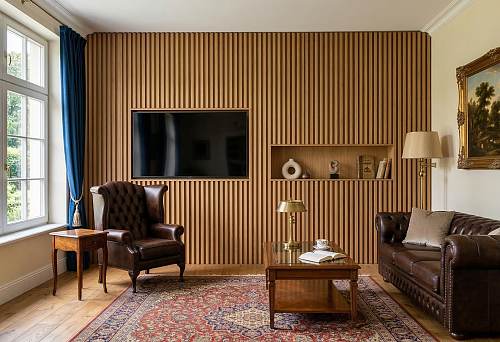
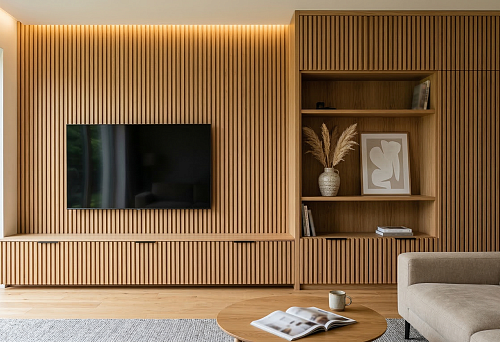
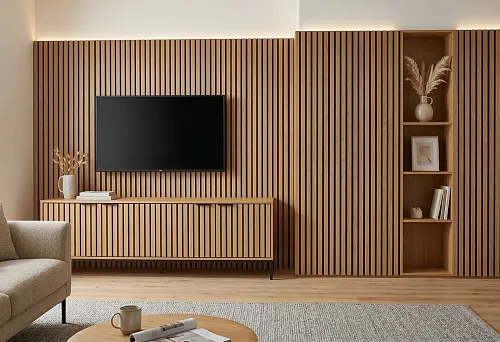
Vertical wooden slats on a wall create a powerful biophilic metaphor — the wall transforms into a forest, where the slats are the tree trunks. When you look at such a wall, your brain subconsciously reads the pattern 'vertical lines of natural material with gaps of light between them' and associates it with the forest edge, where light filters through the trunks.
Vertical slats visually raise the ceiling — the gaze follows the lines upward, creating a sense of height and spaciousness. This is especially important in small rooms, where the biophilic effect combines with visual expansion of space.
Tactilely, slats invite you to run your hand over them — fingers glide over ridges and grooves, creating a rhythmic touch. Children instinctively do this; adults — if they allow themselves to be spontaneous. This simple action activates tactile receptors, creates a connection with the material, and calms.
Horizontal slats: layering of nature
Horizontal slats create another biophilic effect — layering, reminiscent of geological strata, sedimentary rocks, horizons in the landscape. Horizontal lines visually expand space, make the wall wider, create a sense of stability and grounding.
On the ceiling, horizontal slats (running along the long axis of the room) create a pergola effect — an open wooden structure in gardens, where beams cast bands of light and shadow. This is a powerful biophilic association with architecture that unites interior and exterior space.
Acoustics and light: functional biophilia
Wooden slats are not only visually and tactilely biophilic, but also functionally improve the space. Wood is an acoustically warm material, absorbing high frequencies and diffusing sound. A wall of wooden slats with gaps (sound-absorbing material is often installed behind the slats) significantly improves room acoustics — eliminating hollow echoes, making sound softer and more comfortable. This is especially important in living rooms, home theaters, and music rooms.
Slats also function as an architectural light filter. If LED lighting is installed behind the slats, light passes through the gaps, creating bands of light and shadow on adjacent surfaces. This dynamic interplay of light and shadow resembles sunlight filtering through tree leaves — one of the strongest biophilic stimuli.
Wooden skirting board: connection between earth and wall
Skirting board — an element many consider secondary, purely functional (covering the gap between floor and wall, protecting walls from damage). But in biophilic design,Wooden baseboardit plays a key role — it creates a transition between the horizontal plane of the floor (earth) and the vertical plane of the wall (wood, sky), unifying space.
Skirting board as root system
In nature, trees are connected to the earth through roots — the transition from the vertical trunk to horizontal roots extending into the soil. A wooden skirting board metaphorically performs the same function — it connects the vertical wall to the horizontal floor, creating a visual and conceptual link.
When the skirting board is made from the same wood as other interior elements (staircase balusters, wall slats, furniture), it becomes part of a unified biophilic system. The eye reads: 'All the wood in this space comes from the same forest, same species, same family' — this creates a sense of wholeness and organic unity.
High skirting board: European biophilic tradition
In classical European interiors (especially French and English) skirting boards are high — one hundred fifty to two hundred fifty millimeters, with ornate milled profiles. Such a skirting board is not merely a technical detail, but an architectural element that visually 'grounds' the wall, making it appear heavier, more substantial.
A high wooden skirting board made of oak or walnut with a classic profile (bevels, grooves, rounded edges) creates a biophilic connection with woodworking traditions and craftsmanship. It says: 'This house is built to last, from real materials, with respect for tradition.' This psychologically calms — in a world of disposable items, such a skirting board is a symbol of permanence.
Skirting board as floor frame
The skirting board frames the floor, like a frame frames a picture. A wooden floor (parquet, solid plank) framed by a wooden skirting board of the same or contrasting species creates a finished composition. The floor is perceived not as a random surface, but as a thoughtfully designed element.
In a biophilic interior, the skirting board can be wide (up to three hundred millimeters), creating a powerful horizontal line along all walls. This visually expands space, creates a sense of stability and protection — walls 'grow from the earth'.
Classic furniture: biophilia through form and material
Classic FurnitureMade from solid wood — tables, chairs, chests, cabinets — in biophilic design of 2026, classic furniture is experiencing a renaissance. Not because people are nostalgic or conservative, but because classic furniture embodies biophilic design principles at the level of form, material, and craftsmanship.
Organic forms: curves versus angles
Classic furniture (baroque, rococo, neoclassical, empire) features smooth curves — table and chair legs are S-shaped, chair backs are curved, cabinet fronts are convex or concave. These organic forms are opposite to the rigid, straight angles of minimalist furniture. And they are biophilically correct.
In nature, there are almost no straight angles — tree branches bend, shoreline curves, stones are rounded by erosion. The human brain is evolutionarily tuned to perceive curves as natural and safe (sharp angles = potential danger, cuts, punctures). When you sit in a chair with a curved wooden backrest, your body relaxes — the shape supports, embraces, rather than presses against with sharp angles.
Solid wood: honesty of material
Classic furniture is made from solid wood — whole boards of oak, ash, beech, walnut. Not from particleboard covered with "wood" veneer. Not from plywood with veneer. From real wood, where growth rings are visible, where weight is felt, where tapping produces a deep, noble sound, not an empty crack.
This honesty of material is biophilically important. Your brain can (even without realizing it) distinguish real wood from imitation. Tactilely — solid wood is warmer, more textured. Visually — the texture is deep, three-dimensional, not a flat print. Acoustically — the sound is alive. Olfactory — the scent of wood, especially fresh, without a thick layer of varnish.
Furniture made from solid wood in the home is a constant biophilic stimulus. A dining table made of oak, to which you sit three times a day — it’s a daily touch of wood. A cabinet made of walnut, whose handles you grasp every morning — a tactile connection with nature. A wardrobe made of beech, past which you walk dozens of times — a visual reminder of the forest.
Legs of furniture as balusters: unity of verticals
In classic furniture, legs of tables, chairs, armchairs, cabinets often have turned profiles — the same vases, handrails, rings as staircase balusters. This is not coincidence, but tradition: carpenters used one turning lathe and one profile for all vertical elements in the house — balusters and furniture legs.
In a biophilic interior, this creates powerful unity. When the legs of a dining table repeat the profile of staircase balusters — all vertical elements in the house rhyme, creating visual harmony. The brain reads: "One material, one form, one system" — this calms, creates a sense of order and organization in space.
Wood species in biophilic design: character through material
Different wood species create different biophilic atmospheres. The choice of species determines not only color and texture, but also the emotional impact of the space.
Oak: strength and durability
Oak — the king of trees, symbol of strength, reliability, durability in cultures from Europe to Asia. Oak wood is dense, heavy, with expressive texture — large pores, contrasting growth rings. Color ranges from light gold to dark brown.
Biophilically, oak creates a sense of protection, stability, connection with traditions. Oak balusters, skirting boards, furniture in the home — this is a statement: "This house is built to last for centuries." Oak is especially expressive after brushing — soft fibers are combed out, hard ones remain, creating a textured tactile surface.
Ash: flexibility and light
Ash is not inferior to oak in hardness, but has a lighter tone (cream, light gray) and delicate texture. Ash creates a sense of freshness, airiness, purity. Biophilically, it is associated with northern forests, Scandinavian nature, spaciousness.
Ash elements in interior — balusters, rails, skirting boards, furniture — make the space lighter, visually larger. Ash is ideal for small rooms, where dark oak would create heaviness. Ash also whitens beautifully, creating almost white wood with preserved texture — this is a unique biophilic aesthetic of northern purity.
Larch: amber durability
Larch — a coniferous species with hardness close to oak, and unique resistance to moisture due to high resin content. Color is amber-honey, texture expressive. Larch smells of resin — a strong biophilic stimulus, reminiscent of coniferous forests.
Biophilically, larch creates a sense of warmth, sun, connection with Siberian and northern forests. Larch elements suit any room, including humid ones (bathhouses, terraces, unheated verandas), where other species quickly deteriorate.
Beech: uniform warmth
Beech has a uniform fine-grained structure without large pores, warm rose-beige color. Beech is ideal for turning — the profile comes out clear, smooth. Biophilically, beech creates a sense of softness, warmth, cozy home atmosphere without showiness.
Beech balusters, furniture — classic without drama. Beech is excellent for staining, allowing to create any shades from light maple to dark walnut, while preserving its uniform pleasant texture.
Wood treatment for maximum biophilia
The method of treating wooden elements is critical for the biophilic effect. The goal — to preserve the material's naturalness, its tactility, texture, scent, while protecting against damage and contamination.
Brushing: highlighting texture
Brushing (from English brush — brush) — a technique where soft wood fibers are combed out with metal brushes, leaving hard fibers. This creates a textured surface where growth rings protrude tactilely. A hand sliding over a brushed baluster or handrail feels the rhythm of fibers — this is maximum tactile biophilia.
Brushing suits species with contrasting structure — oak, ash, larch. Not suitable for uniform species — beech, maple (they lack clear separation of soft and hard fibers). Brushed wood looks natural, slightly aged, as if weathered by time and wind.
Oil finish: wood’s breath
Wood oil (linseed, tung, specialized formulations) penetrates into the wood structure, impregnating it, but does not create a surface film. Wood covered with oil remains porous, breathable, tactilely rough, smells of wood. This is maximum biophilic finish.
Oil enhances texture, deepens color (wood becomes one to two tones darker, richer), creates a matte velvety surface. A hand on an oiled baluster feels wood, not film. The downside of oil — requires renewal once a year or two (reapplying a thin layer), less protective against moisture than varnish.
Wax Coating: Silkiness
Wax (beeswax, carnauba, synthetic formulations) creates a thin protective film, but unlike varnish, it penetrates into wood pores and leaves the surface tactilely pleasant, silky. Wax finish gives a light matte sheen, highlights texture, preserves the scent of wood.
Wax is ideal for furniture, balusters, skirting boards in dry rooms. It creates a noble patina that becomes more beautiful over time. Wax coating requires periodic renewal (polishing with wax every six months to a year).
Avoid: glossy lacquer
Thick glossy lacquer creates a plastic film on wood, completely hiding its tactile quality, scent, and pores. Wood under glossy lacquer looks like a plastic imitation, and upon touch, feels cold and slippery — anti-biophilic.
If lacquer is necessary (high load, humidity), choose matte or semi-matte polyurethane lacquers in thin layers. They protect while preserving the visibility of texture and some tactile quality.
Creating a biophilic unity: balusters + rails + skirting boards + furniture
Maximum biophilic effect is achieved when all wooden elements in the space are unified by the same species, finish, and tone. This creates the impression that the entire house was carved from one forest, one tree.
Principle of species unity
All visibleWooden itemsin one space (room, floor) must be of the same species. Oak balusters + oak wall rails + oak skirting boards + oak dining table = visual and conceptual unity. The brain interprets: 'One material, one natural system.'
Mixing species (oak balusters + beech rails + walnut table) destroys biophilic unity. Different species have different textures, colors, energies — this creates visual chaos.
Principle of consistent finish
All wooden elements must have the same finish. If balusters are brushed, rails and skirting boards are also brushed. If balusters are smoothly sanded, everything else is too. Inconsistency in finish (some elements textured, others smooth) creates tactile and visual dissonance.
Principle of identical coating
All elements are coated with the same composition. Balusters, rails, skirting boards, furniture — everything is coated with the same oil (or wax, or matte lacquer). This ensures identical gloss (or its absence), identical color saturation, identical tactile quality.
Practical example: oak biophilia
Rural house, modern country style. Stairs — oak steps, oak turned balusters with classic profile, oak handrail. All are brushed and coated with matte natural-tone oil (untinted, preserving the natural honey color of oak).
Living room: one wall — vertical oak rails 40x40 mm with 30 mm spacing, brushed, coated with the same oil. Skirting boards throughout the house — oak 150 mm high, classic profile, brushed, oil. Dining table — oak top from solid panel, legs replicate the baluster profile of the stairs, brushed, oil. Chairs — oak with curved backs, oil.
Result: the entire first floor of the house is unified by an oak thread. Look anywhere — oak. Touch anywhere — warm brushed oak texture. Smell in the house — light oak and oil wood aroma. This is full biophilic immersion — the house becomes an extension of the forest.
Company STAVROS: biophilic elements from one source
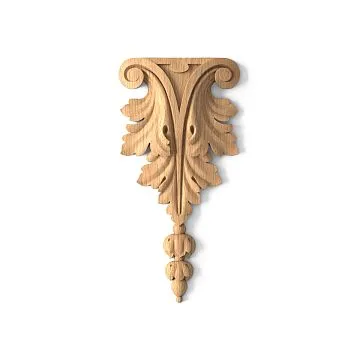
Implementing the concept of biophilic unity requires access to wooden elements made from identical materials. Company STAVROS has been producing solid wood items for over twenty years:balustersrails, skirting boards, decorative elements, furniture components.
Single batch of wood
STAVROS’s key advantage — the ability to order all elements from a single batch of wood. You specify the species (oak), finish (brushing), coating (natural-tone oil) — STAVROS will manufacture balusters for stairs, wall rails, skirting boards, furniture legs from one batch of oak. Color, texture, tone consistency is guaranteed — the foundation of biophilic unity.
Custom sizes and profiles
STAVROS manufactures elements to custom sizes and profiles. If you have specific ceiling heights (non-standard rail lengths), non-standard skirting board heights (250 mm instead of standard 100 mm), unique baluster profiles (reproducing an antique pattern) — STAVROS will execute your order exactly according to your drawings.
Consultations on biophilic design
STAVROS specialists will help select elements to create a biophilic interior. Describe your space, send photos, explain your desired atmosphere — receive recommendations on species, profiles, finishes that will create maximum biophilic effect.
FAQ: Biophilia through wood
Is one wooden element enough for biophilic effect?
Any natural wooden element creates a biophilic stimulus. But maximum effect is achieved through saturation — the more wood in the space, the stronger the biophilic connection. One wooden baluster on a metal staircase — weak stimulus. Entire staircase made of wood — medium. Wood staircase + wall rails + wooden skirting boards + solid wood furniture — maximum biophilic effect, full immersion.
Can wood be combined with other natural materials?
Yes, wood combines beautifully with stone, ceramic, textiles, and leather — all of which are natural and biophilic. Avoid dominance of synthetics — plastic, laminate, artificial fabrics. The foundation of a biophilic interior is natural materials in the majority.
How often to renew oil finish?
It depends on usage. Balusters frequently touched — once a year. Wall rails rarely touched — every two to three years. Furniture countertops — once a year to a year and a half. Baseboards — every three years. Renewal is simple: light sanding with 320-grit sandpaper, applying a thin layer of oil, rubbing in.
Is brushed wood suitable for homes with children?
Yes, if properly treated. Brushed surfaces are textured but not sharp — after brushing, wood is sanded with 180-220 grit sandpaper to remove sharp edges. Oil finish further smooths the surface. Children often enjoy touching brushed wood — the texture stimulates tactile receptors.
Does wood darken over time?
Yes, natural wood changes color under light, air, and touch — usually darkens and develops patina. This is a natural aging process, which is biophilic and positive — wood lives alongside the house. If you wish to maintain a light tone, use oils with UV filters or periodically renew the finish.
Conclusion: home as forest
Biophilic design through natural wood — it is not an aesthetic trend, but a return to roots, to understanding the home as an extension of nature. When your home features wooden balusters on the staircase, wooden rails on walls, wooden baseboards around rooms, and classic solid wood furniture — you create a forest microclimate. Not literally (no trees in pots, no live plants in every corner), but conceptually, materially, energetically.
Every morning, descending the stairs and gliding your hand along the oak handrail supported by oak balusters, you begin your day with contact to wood. During the day, working at an oak desk, you feel the warmth and texture of solid wood under your palms. In the evening, sitting in a chair with a curved wooden backrest, gazing at walls with vertical rails, you subconsciously relax — your ancient brain reads biophilic signals and reports: 'You are in the forest. You are safe. You are home.'
This is not a romantic metaphor, but a physiological reality confirmed by neurobiologists. People living in spaces with high natural wood content have lower cortisol (stress) levels, sleep better, recover faster from illness, and feel happier. Investing in wooden interior elements — balusters, rails, baseboards, solid wood furniture — you invest not only in beauty, but in health, emotional well-being, and quality of life.
In 2026, when biophilic design becomes mainstream, the home transforms from a mere living box into a living space that breathes alongside you, gracefully aging, evoking memories of forests from which the wood came. And every time you touch a wooden baluster, glide your palm over a brushed rail, step onto parquet framed by wooden baseboards — you restore your connection to nature, which modern humans have lost but desperately need.