Article Contents:
- What is a Baluster: History, Function, Meaning
- Functions of a Baluster in a Staircase Structure
- Types of Wooden Balusters: Classification by Shape and Technology
- Turned Balusters: The Classic Lathe Work
- Carved Balusters: When a Staircase Becomes a Sculpture
- Flat Balusters: Geometry Instead of Sculpture
- Round Balusters with a Large Body
- Wood Species for Balusters: What to Choose and Why It Matters
- Beech Balusters: A Universal Choice
- Oak Balusters: Status and Longevity
- Pine: Affordable and Natural
- How to Choose Balusters: Calculation Parameters
- First Parameter: Baluster Height
- Second Parameter: Installation Spacing
- Third Parameter: Number of Balusters
- Fourth Parameter: Cross-Section and Load
- Table: Approximate Selection Parameters
- Installing Balusters Yourself: From Marking to Handrail
- What You'll Need: Tools and Materials
- Step One: Marking the Position of Balusters
- Step Two: Preparing the Ends of the Balusters
- Step Three: Attaching the Lower Part of the Balusters
- Step Four: Checking Vertical Alignment and Plane
- Step Five: Installing the Handrail
- Step six: finishing
- Balusters in the Stair Railing System
- Buying Wooden Balusters: How to Place a Correct Order
- About STAVROS Company: Twenty Years in the Top League
- FAQ: Answers to the Most Popular Questions
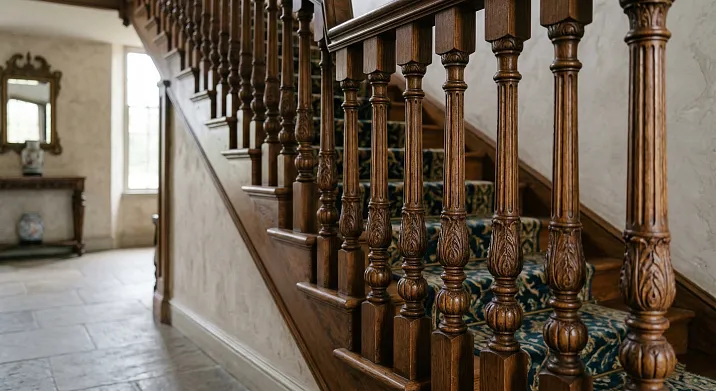
A staircase in a home is not just a structure for moving between floors. It's the first thing a guest sees upon entering the hall. It's a silhouette that can be read from afar when you open the front door. It's an architectural object that sets the tone for the entire space—and that's precisely why each of its elements should be chosen with the same care as one would select a fireplace, a chandelier, or a flight of stairs.
Balusters for staircase— The vertical posts that hold the handrail seem like a secondary detail. But this is a profound misconception. It is they that form the rhythm of the railing, create the transparency or density of the stair flight, determine whether the staircase will look light or heavy, classical or modern, luxurious or modest. The baluster is the metronome that counts the beat of your home's architecture.
If you want the staircase to become a decoration, not just a functional structure — start precisely with them.



What is a Baluster: History, Function, Meaning
The word 'baluster' itself entered the Russian language via the Polish 'balas' from the Persian 'baladustan' — 'column'. The entire meaning of the object is already in this etymology: a small column, a miniature architectural support. And indeed, balusters appeared as scaled-down versions of the columns with which Greek and Roman architects adorned the terraces and balconies of their structures.
In Europe during the Baroque period, the baluster transformed into an independent artistic element: a vase-shaped profile with a tiered turned form became a recognizable language of classical architecture. Russian country estates of the 18th–19th centuries — Kuskovo, Ostankino, hundreds of others — were literally built around white balustrades with turned balusters. This image became firmly etched into the cultural memory.
Todaywooden balusters for staircasesare experiencing a new heyday. Country house construction is moving beyond standard projects, clients want authentic materials and expressive details — and a baluster made of solid oak or beech meets this demand more precisely than any metal or plastic.




Functions of a Baluster in a Staircase Structure
A baluster performs three inseparable functions — structural, protective, and decorative.
Structural: Balusters connect the lower and upper framing (the stringer/kosour and the handrail) into a single rigid system. Without them, the handrail lacks vertical supports and either spans large distances between newel posts or sags.
Protective: The railing formed by balusters prevents accidental falls from the staircase. According to construction standards, the gap between balusters in a residential house should not exceed 100–120 mm (especially critical if children are present). The spacing of balusters is one of the key design parameters when planning a railing.
Decorative: The most noticeable and most subjective function. Shape, profile, wood species, color — all this creates the visual image of the staircase. Twenty identical balusters form a rhythm. Rhythm creates character. Character determines the style of the interior.
Our factory also produces:


Types of Wooden Balusters: Classification by Shape and Technology
The market for wooden balusters is vast, and it's difficult to navigate without a system. Let's classify by the main feature — production method and shape.
Get Consultation
Turned Balusters: The Classic of the Lathe
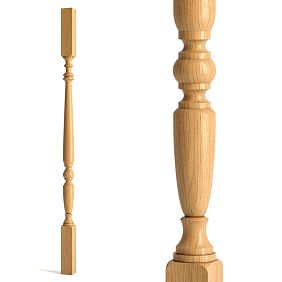
Turned balusters are rotational symmetry in its pure form. A round blank is processed on a lathe, taking on a profile that is symmetrical about the central axis. It is precisely this principle that gives birth to those very 'vase-shaped' forms we recognize as classical balusters.
A turned profile can be simple — a minimalist cylinder with slight tapers. It can be complex — a multi-tiered form with balls, disks, spools, beads. Each profile carries a certain style: simple — Scandinavian minimalism or modern classic; complex multi-tiered — Baroque, Empire, Provençal.
Wooden baluster L-019— is one of the most accessible and popular models in the STAVROS range: a laconic turned profile that works organically in any style. This is a baluster that needs no explanation — it simply looks right and serves correctly.
Baluster L-020— a slightly more expressive profile, with a clearly readable vase-shaped body.L-056— a transitional model between simplicity and decorativeness: suitable for a classic country house.L-021— already pronounced classicism with clear turned rings. This baluster works well alongsidewooden handrailswith a rounded top profile.
Carved Balusters: When a Staircase Becomes Sculpture
Carved balusters are a fundamentally different class of product. If a turned baluster is a product of rotational symmetry, then a carved one is created using 3D CNC milling. This allows for the reproduction of the most complex three-dimensional forms: acanthus leaves, fluting, floral garlands, weaves, geometric ornaments, figured panels.
Carvedbaluster L-054— an example of medium decorative richness: expressive relief without being overloaded.L-052— a more saturated ornamental program, appropriate in Baroque and Empire interiors.L-049andL-045— representative products with detailed relief work, for grand staircases in significant country houses.
STAVROS Author Series: balusters in Renaissance, Baroque, Empire, Art Nouveau, Neoclassical styles — this is a separate chapter in the company's history. Developed in collaboration with artists, they do not merely reproduce historical examples — they interpret them from the standpoint of modern production and modern taste.
Flat Balusters: Geometry Instead of Sculpture
Flat balusters are profile products with rectangular or square cross-sections featuring milled elements on their flat faces. This is not a lathe-turned product nor three-dimensional carving: it is relief on a plane. Such balusters are closer to modern design—clean lines, geometric shapes, sometimes with pauses and openings in the body of the baluster.
Flat balusters work well in interiors where the staircase is combined withoak slatted partitionsor withwooden decorative overlaysin geometric motifs. The unity of formal language—geometric rigor—creates an interior with a modern, confident character.
Round balusters with a thick body
A separate type is a baluster with a large spherical or egg-shaped body.Round baluster L-118is a vivid example: a voluminous spherical central element gives the railing sculptural weight. Each such baluster is a volume, not a line. A row of similar balusters creates a railing that is perceived as a sculptural installation.
Wood species for balusters: what to choose and why it matters
Choosing a wood species is not just about price. It's about color, texture, strength, character. Let's examine in detail.
Beech balusters: a universal choice
Beech is the most common wood species for producing balusters in the mid to high price range. Its dense, uniform structure without large pores is ideal for turned and carved processing: the profile comes out clean, without tear-outs or fuzz. The color is light beige with a slight pinkish tint. Under clear varnish or oil—neutral and warm. Under tinting—it takes any shade evenly, without blotches.
Beech balusters—the standard for most residential projects where there is no strict requirement for 'wood species' as a status marker. Lightness, strength, affordable price—the optimal choice.
Oak balusters: status and longevity
Oak is a material that needs little introduction. Its reputation has been built over millennia. The density of oak wood is 700–750 kg/m³, Brinell hardness—3.7 units. This means: an oak baluster will not deform under load, is not sensitive to abrasive wear, and is resistant to moisture.
But the main thing about oak is not its technical parameters. The main thing is the expressive, large, lively grain texture, which under clear oil looks like natural painting. Oak balusters paired with oakstaircase postsand oakhandrails—this is a staircase built once and for all.
Next towooden furniture legs made of oakin the living room,oak baseboardaround the perimeter andwooden casingson doors—oak balusters create a complete system of a unified material. This is an interior where wood speaks consistently, from floor to handrail.
Pine: affordable and natural
Pine balusters are the most affordable option for budget projects, dachas, and country houses in a rustic style. Pine is lightweight and easy to work with. Natural resin content provides additional biological protection. The drawback is relative softness: over time, dents and scratches from mechanical impacts appear on the surface. For a dacha staircase or country porch—the optimal choice in terms of price/result ratio.
How to choose balusters: calculation parameters
Choosing balusters is not just about taste. It's a precise calculation where several parameters must be coordinated with each other.
First parameter: baluster height
The height of the baluster determines the height of the staircase railing. According to residential construction standards, the minimum railing height is 900 mm from the step surface to the top of the handrail. In homes with children, 1000–1050 mm is recommended. The height of the baluster itself is slightly less than the railing height: the thickness of the handrail above and the lower support tenon or base plate are added to it.
The standard height of STAVROS wooden balusters is from 900 to 1200 mm. Non-standard heights are available upon request. For straight-run staircases, balusters are installed perpendicular to the handrail, which runs at an angle to the horizontal: this means the lower end of each baluster is cut at an angle corresponding to the slope of the flight.
Second parameter: installation spacing
Baluster spacing is the distance between the axes of adjacent balusters. It is calculated based on two requirements: the regulatory gap (no more than 100–120 mm in the clear opening) and visual proportion. Too frequent balusters create a solid, heavy railing. Too sparse ones create an unsafe and visually empty railing.
Practical recommendation: a spacing of 150–170 mm with a baluster diameter of 50–60 mm provides a gap of about 100 mm and creates a beautiful visual rhythm. Check: gap width = spacing minus the diameter of the baluster at its widest point.
Third parameter: number of balusters
The number of balusters for a flight of stairs is calculated using the formula: number of steps multiplied by the number of balusters per step. The standard is one or two balusters per step. Two balusters per step provide a denser rhythm and greater railing rigidity — recommended for stairs with a step depth of more than 260 mm.
For a second-floor landing (horizontal railing section): the length of the section is divided by the chosen spacing — resulting in the number of gaps. Number of balusters = number of gaps + 1.
Fourth parameter: cross-section and load
A baluster carries a transverse load: a person leans on the handrail, the load is transferred through the handrail to the balusters. According to regulations, the railing must withstand a horizontal load of 100 kg per linear meter. This means the cross-section of the baluster must be sufficient to bear this load.
Minimum diameter of a turned beech baluster for a residential staircase — 40 mm. Recommended — 50–60 mm. For landings and open terraces — from 60 mm. For monumental entrance groups and grand staircases — 80 mm and more.
Table: approximate selection parameters
| Staircase type | Baluster height | Diameter | Installation spacing | Species |
|---|---|---|---|---|
| Interfloor in a house | 900–1050 mm | 50–60 mm | 150–170 mm | Beech, oak |
| Entrance group (porch) | 900–1000 mm | 60–80 mm | 150–160 mm | Oak, larch |
| Balcony / terrace | 900–1100 mm | 60 мм | 120–150 mm | Oak, larch |
| Country house staircase | 900 мм | 40–50 mm | 160–180 mm | Pine, beech |
| Grand staircase | 1000–1200 mm | 70–100 mm | 140–160 mm | Oak |
Installing balusters yourself: from marking to handrail
Self-installation of wooden balusters is a feasible task for someone who knows how to work with wood. It requires measurement accuracy, the right tools, and an understanding of the sequence of operations.
What you will need: tools and materials
Tools: miter saw or saw with angle stop, drill with wood drill bit set (diameter 10, 12, 14 mm), square, tape measure, pencil, level (preferably laser), rubber mallet, screwdriver.
Materials: the balusters themselves, M10 metal studs (for attaching to the stringer and handrail), mounting adhesive (carpenter's PVA or polyurethane), dowels or anchors for mounting in concrete/stone, finish coating (oil, varnish, paint).
Step one: marking the position of the balusters
Mark the installation points of the balusters on the top edge of the stringer (the lower line of the railing) or on the steps. Measure the total length of the flight, divide by the chosen spacing — you get the number of intervals and the positions of the balusters. Check: the points are symmetrical relative to the outermost balusters, the spacing is uniform along the entire length.
If the balusters are installed on the steps (on the horizontal plane of the tread) — step back about 50–70 mm from the front edge of the step and mark the axis point of the baluster.
Step two: preparing the ends of the balusters
The lower end of each baluster is cut at an angle corresponding to the slope of the stair flight. Determine the slope angle with a protractor or angle finder based on the actual slope of the flight. Typically, this is 30–40° for standard stairs.
The upper end is cut at the same angle, but in the mirror direction — so that the handrail lies parallel to the flight, and the top plane of the baluster is parallel to the handrail.
For horizontal sections (landings) — both ends are horizontal, cut at 90°.
Step three: attaching the lower part of the balusters
The attachment method depends on the staircase construction. On a wooden stringer or step: drill a hole 10–12 mm in diameter and 40–50 mm deep in the end of the baluster for an M10 stud. In the stringer/step — a similar hole. The stud is glued into the stringer with epoxy or PVA adhesive, the baluster is placed on top and also fixed with adhesive.
On a concrete/stone base (lower landing): install a metal embedded anchor with M10 thread, the baluster is placed over it through a hole in the lower end, secured with a nut from below through a washer.
On a metal beam: the baluster is fixed through a through-hole with a countersunk head bolt or a special baluster bracket.
Step four: checking verticality and plane
Check each baluster with a level after installing the lower end: it must stand strictly vertical. For an inclined flight, this means the axis of the baluster is perpendicular not to the flight, but to the horizon. Check in two perpendicular directions — along the flight line and across it.
After installing all balusters, check: the upper ends of the balusters form a smooth line for the handrail. If one baluster is out of line — trim the end or add a shim.
Step five: installing the handrail
The handrail is placed on the upper ends of the balusters and attached to them with studs or screws from below through the body of the handrail. The handrail should fit snugly against all balusters — check along the entire length. The joint of the handrail withstaircase posts— is a critical node: connection via a metal dowel or stud, with adhesive, checking for level.
Step six: finishing
After complete installation, sand all joint areas, fill fastener holes with wood filler, sand with 150 grit, then 220 grit. Apply finish coating: oil or varnish in 2–3 coats with intermediate sanding with 320 grit between coats.
Balusters in the staircase railing system
A baluster never works alone. It is part of a system where each element depends on the others.
Posts for staircase— support posts at the beginning and end of the flight, as well as at turns and landings. More massive than balusters, they set the start and end of the rhythm. Without a post, the railing loses its visual reference point.Wooden Caps— spherical, figured, pyramidal finials of posts — this is the final accent, crowning the entire vertical of the railing.
The handrail completes the system from above: the horizontal line along which the hand glides should be comfortable in shape and correct in height.Solid wood handrailsfrom STAVROS are available in several profiles — and in the same wood species as the balusters. Material unity is the law of a good staircase.
Next towooden decorative overlays on postsandsolid wood cornicesaround the perimeter of the hall, an oak staircase with turned or carved balusters — this is a top-level interior focal point.
Buying wooden balusters: how to place a correct order
When the calculation is done and the style is determined — it's time toBuy wooden balustersfrom the manufacturer. Here are several rules to prevent mistakes.
Rule one: order with a 5–10% surplus. Trimming ends, installation errors, unforeseen additional balusters — all require a reserve. Ordering an addition later means waiting for production and risking getting a different batch with slight tone variations.
Rule two: clarify the material's moisture content. The norm for residential interiors is 8–14% moisture. Over-dried material will crack, over-moist material will warp after installation. A reliable manufacturer specifies this parameter or provides it upon request.
Rule three: order all system elements from one manufacturer. Balusters, posts, handrails, finials from one production cycle — this guarantees uniformity of wood species, tone, and geometric parameters. An assembled staircase from elements of different manufacturers often suffers from mismatch: slightly different tones, slightly different diameters.
Rule four: use visualizations. The STAVROS catalog features over 60 three-dimensional visualizations of staircases with balusters from the assortment — this allows you to see the result before purchase and make an informed decision.
About STAVROS: twenty years in the top league
A staircase assembled from quality wooden balusters by a professional manufacturer is an investment for decades. This is precisely the approach embodied by the company STAVROS.
Founded in 2002 by artists Andrey Ragozin and Evgeny Tsapko, STAVROS has evolved from a small workshop to one of the leading manufacturers of wooden interior products. The restoration of the Konstantinovsky Palace, the Hermitage, the Alexander Palace, the Trinity-Izmailovsky Cathedral — these are projects the STAVROS team has worked on, and this experience cannot be bought or imitated.
Today, the company's assortment includes over 50 models of stair balusters made of beech and oak, two quality levels ('Standard' and 'Prestige'), and the possibility of custom manufacturing. Production is equipped with CNC lathes and milling machines, drying chambers with humidity control, and a modern sanding and processing line.
Buy wooden balustersChoosing STAVROS means getting a product where every centimeter is backed by twenty years of experience, artistic understanding of wood, and production precision. Showrooms in St. Petersburg and Moscow, delivery across Russia and CIS countries, orders from a single piece.
FAQ: answers to the most popular questions
How many balusters are needed for a staircase with 13 steps?
When installing two balusters per step — 26 pieces for the flight part. Plus balusters on the horizontal landing of the second floor — depending on its length. The final number including the landing is typically 30–38 pieces. Always order with a surplus of 3–5 pieces for trimming and emergencies.
How do the 'Standard' and 'Prestige' categories in the STAVROS assortment differ?
'Standard' — quality sanding, readiness for finishing, affordable price. 'Prestige' — additional surface treatment, more careful selection of blanks, enhanced level of detail in carved profiles. For most residential projects, the 'Standard' category provides an excellent result.
Can wooden balusters be installed outdoors (porch, terrace)?
Yes, provided conditions are met: wood species — larch or oak, coating — weather-resistant yacht varnish or teak oil in 3–4 layers, regular coating renewal every 1–2 years. Pine and beech are less recommended for permanent outdoor use — the wetting and drying cycle degrades them faster.
How to cut the lower end of a baluster at the flight angle?
Measure the actual flight inclination angle with a protractor (usually 30–40°). Set the miter saw to this angle. Cut the lower end. The upper end is cut at the same angle but in the mirror direction. Check on-site: the baluster should stand vertically when installed on the inclined stringer.
Should balusters be coated before or after installation?
Professionals coat before installation — especially the lower end and the lower part of the baluster body, which will be hard to access after installation. After installation, apply one final coat over the entire assembled surface — for tonal uniformity.
How to calculate baluster spacing so the gap does not exceed 100 mm?
Spacing = baluster diameter at its widest point + desired gap (no more than 100 mm). For example, baluster diameter 60 mm, gap 95 mm — spacing 155 mm. Check: with this spacing and given diameter, gap = 155 − 60 = 95 mm. Requirement met.
Can balusters of non-standard height or diameter be ordered?
At STAVROS — yes, when ordering custom manufacturing. Non-standard heights (e.g., 850 mm for a lower landing with a high baseboard or 1100 mm for a balcony) and non-standard diameters are produced to order with agreed timelines and cost.
What is better for a grand staircase — turned or carved balusters?
Depends on the style. For modern classic and neoclassical — turned with an expressive profile is sufficient: their laconicism is more appropriate than complex carving. For Baroque, Empire, Historicism — carved are essential: they provide the necessary decorative density. For determination, we recommend using STAVROS 3D visualizations: they allow you to see both options in your specific project.