Article Contents:
- What Are Balusters: Architectural Anatomy of a Staircase
- Types of Balusters by Manufacturing Technology: From Lathe to Master's Chisel
- Turned Balusters: Symmetrical Classic
- Carved Balusters: Artistic Uniqueness
- Flat (Milled) Balusters: Modern Geometry
- Combined Balusters: Material Synthesis
- Materials for Wooden Balusters: Species and Their Characteristics
- Oak: monumentality of centuries
- Beech: Pinkish Warmth and Uniformity
- Ash: Light Strength and Contrast
- Pine: Affordable Softness
- Baluster Sizes: Standards and Variability
- Height: From Tread to Handrail
- Diameter (Cross-Section): Balance of Strength and Aesthetics
- Installation Spacing: Safety and Rhythm
- Baluster Styles: From Palace Baroque to Scandinavian Minimalism
- Classic: Carving, Symmetry, Nobility
- Modern (Art Nouveau): Organic Lines
- Minimalism: pure geometry
- Country and Provence: Rustic Simplicity
- Calculating the Number of Balusters for a Staircase: Safety Mathematics
- Initial Data for Calculation
- Calculation formula
- Calculation Example
- Baluster Installation: Reliable Mounting Technology
- Preparation: marking and trimming
- Ways to Attach to Steps
- Handrail Installation
- Painting and Varnishing Balusters: Protection and Decoration
- Varnishing: Hard Protection
- Oil Treatment: Natural Look
- Painting: Colored Solutions
- Baluster Care: Preserving Beauty
- Baluster Prices in 2026
- Frequently asked questions about balusters
- How Many Balusters Are Needed for a 13-Step Staircase?
- What Distance Should Be Between Balusters?
- Can Balusters Be Installed Only on Every Second Step?
- Oak or Beech — Which Is Better for Balusters?
- How to attach balusters to a wooden staircase?
- Can balusters be painted white?
- How long do wooden balusters last?
- Is it necessary to treat balusters with a protective compound?
- Where to buy quality solid wood balusters?
- Is it possible to order balusters in non-standard sizes?
- Company STAVROS: a quarter century of craftsmanship in woodworking

A staircase without balusters is like a painting without a frame — the structure exists, but completeness is lacking. It is the vertical posts between the steps and the handrail that transform a utilitarian functional element into an architectural object capable of setting the tone for the entire interior.buy balusters— means making a conscious choice in favor of safety, beauty, and individuality for your home. These are not just support elements — they are the rhythm that organizes space, sculptural forms that catch the light, tactile surfaces that the hand glides over.
In 2026, the baluster market is experiencing a renaissance. Technology allows for the realization of the boldest design fantasies: from filigree hand carving to mathematically precise minimalist forms, from the classic balustrades of palace staircases to the laconic glass structures of high-tech. But one thing remains unchanged:wooden balusterssolid oak, beech, ash retain their leadership as materials combining strength, aesthetics, tactile warmth, and durability measured in decades.




What are balusters: the architectural anatomy of a staircase
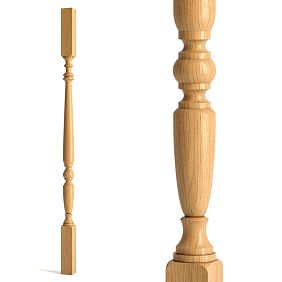
A baluster is a vertical support element of a staircase, terrace, or balcony railing, connecting the base (step, landing, sub-baluster rail) to the handrail (rail). The word comes from the Italian 'balaustro', which in turn derives from the Greek 'balaustion' — pomegranate flower, whose shape resembles a classic turned baluster with expansions.
Functionally, balusters perform three tasks. The first is safety: balusters create a barrier preventing falls from the staircase, especially critical for children and the elderly. Building codes regulate the maximum distance between balusters (in Russia, SP 54.13330.2016 — no more than 150 mm horizontally, so a child cannot squeeze through). The second is structural strength: balusters distribute lateral load on the handrail, ensuring railing rigidity. The third is aesthetics: balusters set the visual rhythm of the staircase, create play of light and shadow, and define the style.
Structurally, a baluster consists of three parts. The base (shoe) — the lower part attached to the step or sub-baluster rail, usually widened to increase the contact area. The body (shaft) — the central part, which can be a simple cylinder or have a complex turned/carved profile. The top (capital) — the upper part supporting the handrail, often with decorative elements.
Historically, balusters appeared in the Renaissance as an element of architectural order. Before that, stair railings were crude wooden or stone parapets without decorative elaboration. Italian masters of the 15th-16th centuries began turning balusters from marble, copying antique vase and column forms. The shape became a canon: expanding base, narrowed middle, expanded top — proportions close to the golden ratio. This canon has survived to this day in classical balusters.




Types of balusters by manufacturing technology: from lathe to master's chisel
Our factory also produces:


Turned balusters: symmetrical classic
Turning is the basic technology for manufacturing balusters, where a rotating workpiece is processed with a cutting tool, creating bodies of revolution. On a lathe, any shapes symmetrical about an axis can be obtained: spheres, disks, cones, cylinders, concave and convex smooth transitions.
Baluster turning technology: a square-section solid wood block (usually 60×60, 70×70, 80×80 mm) 900-1200 mm long is secured in the lathe chuck. The machine spins the workpiece up to 2000-3000 revolutions per minute. The master brings the cutting tool, removing shavings and forming the profile. For serial production, copiers — templates — are used to automatically form the profile. For unique items, the tool is controlled manually.
Profiles of turned balusters are infinitely diverse. The simplest is a cylinder of constant diameter (smooth baluster). More complex: baluster with a sphere (spherical expansion in the center), with a vase (expansion with concave sides), with disks (several thin disks separated by bridges), with rings (protruding horizontal ribs), combined (alternation of different elements).
Advantages of turned balusters: production efficiency (high manufacturing speed — 10-15 minutes per baluster), geometric precision (all balusters in a series are identical), moderate price, classic aesthetics (turned forms tested by centuries), versatility (suitable for most interiors).
Disadvantages: form limitations (only bodies of revolution), lack of uniqueness (serial products), less artistic expressiveness compared to carving.
Get Consultation
Carved balusters: artistic uniqueness
Carving turns a baluster into a sculpture. Carved elements are created manually by carvers or on CNC milling machines using digital models. Carving can be flat (relief up to 5 mm), relief (relief 5-20 mm), openwork (pierced elements through and through), volumetric (three-dimensional forms).
Technology of carved balusters: the base form is turned on a lathe or cut from a block, then the carving pattern is applied. The master carver sequentially removes wood with chisels and gouges, creating the ornament. Alternatively — the workpiece is placed on a CNC milling machine, which, according to a digital model, cuts the carving with cutters of different profiles.
Typical carved elements: plant ornaments (leaves, grape clusters, flowers), geometric patterns (diamonds, triangles, braids), figurative images (animals, birds, mythological creatures), abstract compositions.
Oak balustersare ideal for carving: hard wood holds fine details without chipping, expressive grain emphasizes the volume of the carving, durability measured in centuries.
Advantages of carved balusters: high artistic value, uniqueness (especially with hand carving), possibility of creating thematic compositions, status (carved balusters are a sign of a premium interior).
Disadvantages: high price (hand carving is 3-5 times more expensive than turning), long manufacturing time (from several days to weeks), demanding wood species (only hardwoods without knots), maintenance difficulty (dust accumulates in the recesses of the carving).
Flat (milled) balusters: modern geometry
Flat balusters are made from boards 40-80 mm thick, cut or milled to shape. The form can be any: rectangle, trapezoid, complex curvilinear silhouette. This is a modern type of baluster, popular in minimalist and Scandinavian interiors.
Technology: a solid wood board is milled on a CNC machine, creating the contour. Edges are processed — rounded or chamfered. The surface is sanded. Through-cutting is possible — creating holes inside the silhouette for lightness and decoration.
Shapes of flat balusters: rectangular plank of constant width (the most laconic option), widening towards the bottom or top (visual stability), with shaped cutouts (round, oval, geometric holes), with wavy edges (organic forms).
Advantages of flat balusters: modern minimalist look, material savings (board is thinner than a block), manufacturability (fast CNC production), possibility of creating avant-garde forms.
Disadvantages: lower strength compared to turned balusters (board is narrower than a block), limited aesthetics (two-dimensionality vs. three-dimensionality), narrow stylistic applicability (only modern interiors).
Combined balusters: synthesis of materials
Combined balusters combine wood with other materials — metal, glass, stone. Classic version: wooden turned body with metal (wrought, cast brass or bronze) inserts or overlays. Modern version: glass vertical panel in a wooden frame.
Wood-metal: wooden base complemented by metal decorative elements — wrought scrolls, cast rosettes, relief overlays. Metal can be patinated (bronze, brass with a greenish patina), chrome-plated (cold shine), blackened (matte black).
Wood-glass: transparent or frosted glass panels are installed between wooden posts or inside a wooden frame. Creates a feeling of lightness, airiness, visual openness of space.
Advantages of combined balusters: visual variety (play of textures), possibility of creating unique designs, functionality (glass is easy to clean, metal is strong).
Disadvantages: high price (complex manufacturing), weight of the structure (metal adds weight), installation complexity (requires professional installation).
Materials for wooden balusters: species and their characteristics
The choice of wood species determines the strength, durability, appearance, and price of balusters.
Oak: monumentality of centuries
Oak — the king of staircase constructions. Brinell hardness 3.7-3.9 (high), density 700 kg/m³. Texture is large-pored with expressive annual rings and medullary rays (light stripes on a radial cut). Color from light yellow to dark brown, bog oak is almost black.
Advantages of oak balusters: maximum strength (withstands intensive loads without deformation), moisture resistance (tannins protect from rot — can be used on open terraces), durability (centuries of service), prestige (oak is associated with solidity, status), expressive texture (emphasized by oil or varnish).
Disadvantages: high price (2-3 times more expensive than beech, 4-5 times more expensive than pine), significant weight (an oak baluster weighs 3-5 kg vs. 2-3 kg for beech), processing difficulty (hardness complicates carving, requires sharp tools).
Application: classic staircases in private houses, cottages, estates; staircases with high traffic (public buildings); open terraces and porches; prestigious interiors in classic, baroque, English, country styles.
Beech: pinkish warmth and uniformity
Beech — a hardwood species, close to oak in strength (hardness 3.8), but with a different aesthetic. Density 680 kg/m³. Texture is fine-pored, uniform without large pores. Color is light with a characteristic pinkish, peach tint, which intensifies under oil.
Advantages of beech balusters: high strength, beautiful warm shade (creates a cozy atmosphere), uniform structure (ideal for turning and carving — cuts cleanly, without chips), more affordable price compared to oak (20-30% cheaper).
Disadvantages: hygroscopicity (beech actively reacts to humidity, can warp with fluctuations — not recommended for open spaces without protective treatment), lower moisture resistance compared to oak.
Application: internal staircases in residential houses, sleeping floors, children's areas (eco-friendliness); classic and modern interiors in warm tones. Beech is ideal for carved balusters — dense wood holds thin carving details 2-3 mm thick without risk of breakage.
Ash: light strength and contrast
Ash surpasses oak in strength and elasticity (hardness 4.0-4.1). Density 700 kg/m³. Texture is contrasting with pronounced annual rings, creating a striped, dynamic pattern. Color from light beige to grayish-brown.
Advantages of ash balusters: maximum strength and impact resistance (withstands extreme loads), expressive contrasting texture (effective in modern interiors), light shade (visually lightens the staircase).
Disadvantages: high price (comparable to oak or more expensive), demanding protective treatment (without coating can darken from UV), limited availability (less ash is harvested than oak).
Application: modern staircases in loft, Scandinavian, contemporary styles, where visual energy of texture is important; staircases with high loads (commercial objects); light interiors.
Pine: affordable softness
Pine — the most affordable species in price, but soft (hardness 1.6-2.5). Density 500 kg/m³. Texture is pronounced with annual rings, many knots. Color light yellow with a golden tint.
Advantages of pine balusters: low price (basic level), ease of processing (soft wood cuts easily), availability, pleasant coniferous aroma.
Disadvantages: low strength (dents from impacts, scratches appear easily), knotty (knots can fall out, darken), resinousness (drops of resin can appear), low durability (15-20 years vs. 50+ for oak).
Application: budget-friendly garden staircases, temporary structures, staircases with low traffic. Pine balusters are often painted with opaque paint, hiding the wood grain and knots.
Baluster dimensions: standards and variability
Height: from tread to handrail
Baluster height is determined by the staircase railing height, which is regulated by building codes. In Russia, SP 54.13330.2016 sets the minimum railing height for interior staircases at 900 mm, and for exterior staircases or those with a drop of more than 1 meter — 1200 mm.
Baluster height = railing height - handrail thickness. For example, with a 900 mm railing and a 60 mm handrail, the baluster height is 840 mm. Standard baluster heights: 800, 850, 900, 950, 1000, 1100 mm. Non-standard sizes are custom-made.
Important: when installing on an inclined staircase flight, balusters are cut at the bottom and top to match the slope angle, so they are purchased with a height allowance of 50-100 mm.
Diameter (cross-section): balancing strength and aesthetics
The diameter of a turned baluster or the side of a square cross-section is a critical parameter for strength. Balusters that are too thin (less than 40 mm) may not withstand lateral loads, while those too thick (over 100 mm) look bulky.
Standard cross-sections: 40×40, 45×45, 50×50, 60×60, 70×70, 80×80 mm. For turned balusters, the minimum diameter (usually at the waists) and maximum diameter (at the swellings) are specified.
Rule for selecting diameter: for lightweight interior staircases with a 900 mm railing, 45-50 mm is sufficient; for more heavily loaded and higher railings (1000-1200 mm) — 60-70 mm; for massive staircases in classic interiors — 70-80 mm.
Visually, thick balusters give a staircase solidity and massiveness, suitable for classic styles. Thin ones convey lightness and elegance, suitable for modern minimalist interiors.
Installation spacing: safety and rhythm
The horizontal distance between balusters is regulated by safety standards: no more than 150 mm (to prevent a child from squeezing through). In practice, a spacing of 100-150 mm is used.
The number of balusters per tread depends on the tread width and chosen spacing. Standard options:
-
1 baluster per tread: for tread widths of 250-300 mm and thick balusters (70-80 mm). Simple installation, minimal material, but large gaps (unsafe for children, requiring additional horizontal bars).
-
2 balusters per tread: the most common option. With a tread width of 250-300 mm, the distance between balusters is 100-150 mm (meets standards). Optimal balance of safety, aesthetics, and cost.
-
3 balusters per tread: for wide treads (over 300 mm) or design solutions. Creates a frequent rhythm, maximum safety, but requires more material and installation time.
An alternative to frequent balusters is solid glazing (glass panels between sparse posts) or horizontal bars (several horizontal rods between balusters).
Baluster styles: from palatial Baroque to Scandinavian simplicity
Classic: carving, symmetry, nobility
Classical style (Baroque, Rococo, Empire, Neoclassical) requires balusters with decorative carving, symmetrical turned profiles, and complex shapes. Characteristic elements: vases (swellings with concave sides), balls, column balusters (miniature imitations of architectural columns), carved floral ornaments (acanthus leaves, grape clusters).
Materials: oak, walnut (dark noble woods). Finish: clear varnish (highlights the grain), staining in dark tones (wenge, mahogany), patination (artificial aging with gilding of individual elements).
Proportions of classical balusters: clear three-part structure (expanded base, narrowed middle, expanded top), symmetry of elements, proportions close to the golden ratio. Height typically 900-1000 mm, diameter 60-80 mm.
Application: houses and apartments in classical styles, estates, museums, representative buildings, premium-class restaurants.
Modern (Art Nouveau): organic lines
Art Nouveau features smooth asymmetrical lines, plant motifs, and a departure from strict symmetry.balusters for staircasesBalusters in the Art Nouveau style have curved S-shaped silhouettes, carved elements in the form of irises, lilies, dragonflies, and wavy flowing forms.
Characteristic techniques: asymmetrical placement of carved elements, combination of straight and curved lines, naturalistic carving (imitation of natural forms — branches, vines), combination of wood with wrought iron inserts.
Materials: oak, walnut, ash. Finish: oil with patina (creates an aged effect), tinting in non-standard shades (greenish, gray-brown), combination of natural wood and painted elements.
Application: eclectic interiors, retro styling, custom designer projects, art spaces.
Minimalism: Pure Geometry
Minimalism rejects decoration, leaving only form and function. Balusters in minimalist interiors are laconic geometric volumes: rectangular planks of constant cross-section, square rods without turning or carving, simple-form cylinders.
Characteristic techniques: absence of decor, perfectly smooth surface, strict proportions, rhythmic repetition of identical elements, monochrome (one color, often white, gray, black).
Materials: any wood species, as the texture is often concealed by opaque paint. If the texture is preserved — light species (beech, ash) under transparent oil.
Finish: white or black enamel (creates smooth monochrome surfaces), transparent matte oil (preserves the light shade of wood), wax (creates a velvety surface).
Application: modern apartments, lofts, Scandinavian interiors, high-tech (in combination with metal and glass).
Country and Provence: rustic simplicity
Rustic styles value naturalness, simplicity, and craftsmanship. Balusters in country or Provence style are turned forms of medium complexity (without excessive decor, but with characteristic elements — disks, collars), often painted in light pastel tones or distressed.
Characteristic techniques: simple turned profiles (2-3 elements), artificial aging (brushing, patination, distressing), painting in pastel colors (white, cream, lavender, mint) with the wood grain showing through, combination of painted and natural elements (e.g., painted body and natural top).
Materials: beech (pinkish hue), oak, pine. Finish: white paint with a distressed effect (shabby chic), colored enamels in pastel tones, oil with white pigment (lightening the texture).
Application: country houses, suburban cottages, kitchens in Provence style, Mediterranean-style interiors.
Calculating the number of balusters for a staircase: the math of safety
Accurate calculation of the number of balusters is critical for budgeting and ensuring safety.
Initial data for calculation
Need to know: number of steps in the staircase (N), width of each step tread (B, typically 250-300 mm), length of stair landings (L, if any), chosen number of balusters per step (K, typically 1, 2, or 3).
Calculation formula
Total number of balusters = N × K + balusters on landings + corner posts.
Balusters on landings are calculated based on the landing length and the baluster installation spacing. Spacing = (step width) / (number of balusters per step + 1). For example, with a width of 280 mm and 2 balusters per step: spacing = 280 / 3 ≈ 93 mm. Number of balusters on a landing of length L = L / spacing.
Corner posts (support posts) — thicker elements (typically 100×100 or 120×120 mm), installed at the beginning and end of a flight, at turns. Typically, 2-4 posts are required per staircase.
Calculation example
Staircase with 15 steps, step width 280 mm, 2 balusters per step, one landing 1200 mm long.
-
Balusters on steps: 15 × 2 = 30 pieces.
-
Installation spacing: 280 / 3 ≈ 93 mm.
-
Balusters on landing: 1200 / 93 ≈ 13 pieces.
-
Support posts: 3 pieces (start, landing, end).
Total: 30 + 13 = 43 balusters + 3 posts.
It is recommended to purchase balusters with a 5-10% surplus in case of defects, installation errors, future replacements.
Baluster installation: technology of reliable fastening
Correct installation of balusters is critical for the safety and durability of the railing.
Preparation: marking and cutting
Marking the position of balusters on steps and landing. A string stretched between the start and end points of the handrail installation is used — it shows the line of the balusters' top ends. The installation centers for each baluster are marked, considering the chosen spacing.
Cutting balusters at an angle. On sloped stair flights, balusters are installed vertically, so their top and bottom ends are cut at an angle equal to the flight's slope angle (typically 30-45°). The cut is made on a miter saw with a swivel table.
Ways of mounting to steps
Fastening with dowels (wooden pins). A hole 8-12 mm in diameter and 40-50 mm deep is drilled at the baluster's installation center. A wooden dowel (a round rod made of hardwood) is inserted into the hole with PVA glue. A corresponding hole 40-50 mm deep is drilled in the baluster's bottom end. The baluster is placed onto the dowel, with additional glue applied. The connection is strong but non-demountable.
Fastening with threaded rods. A metal threaded rod M8 or M10, 80-120 mm long, is screwed into the step. The rod passes through the riser or is fastened into a threaded insert pre-installed in the step. A blind hole matching the rod's thread is drilled from the bottom of the baluster. The baluster is screwed onto the rod. Advantage: demountable connection (the baluster can be removed for repair). Disadvantage: requires precise vertical alignment of the rod.
Mounting to a sub-baluster rail. A sub-baluster rail is a horizontal plank 30-50 mm thick, which is attached along the edge of the steps. Balusters are attached to the sub-baluster rail with screws from below (through the sub-baluster rail into the end of the baluster) or with dowels. Advantage: simplified installation (all balusters are at the same level), possibility of installation on a stringer staircase (where there is no stringer for attachment). Disadvantage: the sub-baluster rail visually weighs down the structure.
Handrail installation
The handrail is laid on the upper ends of the balusters, cut at the required angle. Handrail attachment to balusters:
Attachment with screws from below. Pockets (recesses at a 45° angle) are milled into the sides of the balusters, into which long screws (70-100 mm) are screwed, passing into the handrail. The screw heads are hidden in the pockets. The pockets are closed with wooden plugs or left open (on the inside of the railing).
Attachment with glue. The upper ends of the balusters are coated with polyurethane glue, the handrail is laid and pressed with a weight for a day. Additionally, finishing nails (thin headless nails) are used, driven through the handrail into the balusters at an angle. The heads are countersunk, the holes are filled with putty.
Use of metal ties. Special metal elements are inserted into grooves milled into the ends of the balusters and the handrail, tightening them with screws. Provides a strong connection without visible fasteners.
Painting and varnishing balusters: protection and decoration
The finish coating protects the wood from moisture, dirt, wear, emphasizes the texture or creates a color solution.
Varnishing: hard protection
Polyurethane or alkyd varnish creates a hard transparent film that protects the wood and emphasizes the texture. Technology: balusters are sanded with P220-P320 sandpaper, dusted, primed (optional), coated with the first layer of varnish, after drying lightly sanded with P400, coated with the second and third layers.
Varnish can be glossy (creates shine, deepens color), semi-matte (balance), matte (noble restraint). For stairs, semi-matte or matte is recommended — gloss shows fingerprints and scratches.
Oil treatment: naturalness
Oil (linseed, tung, special furniture oils) penetrates the wood without creating a film. Gives a matte silky surface, emphasizes the texture, deepens the color. Technology: sanding with P220, abundant application of oil, rubbing, removal of excess after 15-20 minutes, drying for 24 hours, second layer.
Oil is tactilely more pleasant than varnish but requires renewal every 2-3 years.
Painting: color solutions
Opaque paint (acrylic enamel) hides the texture, creating a uniform color. Technology: sanding, priming, sanding with P320, first coat of paint, drying, light sanding, second and third coats.
Colored balusters allow the staircase to be integrated into any color concept: white for Scandinavian interiors, black for loft, pastel for Provence.
Baluster care: preserving beauty
Regular dry cleaning once a week: wiping with a dry cloth or vacuuming with a soft attachment. Wet cleaning once a month: wiping with a slightly damp (not wet) cloth.
Varnished balusters: wipe with furniture polish every six months to restore shine. Scratches on the varnish are sanded with fine sandpaper and re-varnished.
Oiled balusters: apply a fresh layer of oil every 2-3 years (without sanding if the surface is not damaged). Scratches are sanded and re-oiled.
Painted balusters: dirt is removed with a mild soapy solution. Paint chips are touched up with a brush. In case of severe wear — complete repainting (sanding, primer, paint).
Baluster prices in 2026
Prices depend on wood species, profile complexity, presence of carving, and finish.
Simple turned balusters (2-3 elements):
-
Pine, height 900 mm: 350-600 rub/piece
-
Beech, height 900 mm: 800-1400 rub/piece
-
Oak, height 900 mm: 1200-2200 rub/piece
Complex turned balusters (4-5 elements):
-
Beech, height 900 mm: 1400-2500 rub/piece
-
Oak, height 900 mm: 2000-3500 rub/piece
-
Ash, height 900 mm: 2200-4000 rub/pc
Carved balusters:
-
Beech with medium complexity carving: 2500-4500 rub/pc
-
Oak with medium complexity carving: 3500-6000 rub/pc
-
Oak with high complexity carving (handmade): 6000-15000 rub/pc
Flat milled:
-
Beech, height 900 mm: 700-1200 rub/pc
-
Oak, height 900 mm: 1000-1800 rub/pc
Coating (if not included in base price):
-
Varnishing: +150-300 rub/pc
-
Oil: +100-200 rub/pc
-
Enamel painting: +200-400 rub/pc
Support posts:
-
Beech 100×100 mm, height 1200 mm: 2500-4000 rub/pc
-
Oak 100×100 mm, height 1200 mm: 3500-6000 rub/pc
Professional baluster installation: 300-800 rub/pc (depending on mounting complexity and region).
Frequently Asked Questions about Balusters
How many balusters are needed for a 13-step staircase?
When installing 2 balusters per step: 13 × 2 = 26 balusters plus balusters on landings (if any) plus 2-3 support posts. Total approximately 28-30 balusters + posts. It is recommended to purchase with a 10% reserve, i.e., 30-33 balusters.
What distance should be between balusters?
According to building code SP 54.13330.2016 — no more than 150 mm horizontally (so a child cannot squeeze through). In practice, 100-150 mm is used, which corresponds to 2 balusters per step with a width of 250-300 mm.
Is it possible to install balusters only on every second step?
Technically possible, but safety must be ensured: either use thick balusters (80+ mm) with spacing between them up to 150 mm, or add horizontal bars between balusters. For staircases in homes with children, installing at least 2 balusters per step is recommended.
Oak or beech — which is better for balusters?
Oak is stronger, more moisture-resistant, more prestigious, but 30-50% more expensive and heavier. Beech is strong, has a beautiful warm hue, better suited for carving, more affordable in price, but less moisture-resistant. For interior staircases in dry rooms — beech is optimal. For open terraces, porches — oak is preferable.
How to attach balusters to a wooden staircase?
The most reliable method — on wooden dowels 10-12 mm in diameter with PVA glue. Alternative — metal studs M8-M10. On stringer staircases, a baluster rail is used, to which balusters are attached from below with screws or dowels.
Is it possible to paint balusters white?
Yes. Balusters are sanded with P220-P320 sandpaper, primed with opaque primer, after drying lightly sanded with P320, coated with white acrylic enamel in 2-3 layers with intermediate drying and light sanding. White balusters are a classic of Scandinavian and Provence interiors.
How long do wooden balusters last?
With proper installation and care: pine — 15-20 years, beech — 30-40 years, oak — 50-100 years and more. Protective coating (varnish or oil) is critical, which needs to be renewed every 3-5 years for oil and every 10-15 years for varnish.
Is it necessary to treat balusters with a protective compound?
Absolutely. Unprotected wood darkens from UV rays, absorbs moisture (swells/dries out), gets dirty, loses appearance. Minimum — transparent oil or varnish. For wet rooms and open spaces — special moisture-protective compounds.
Where to buy quality solid wood balusters?
From specialized wooden product manufacturers. Company STAVROS offers over 50 models of solid oak, beech, ash balusters — turned, carved, with or without coating, in various styles from classic to modern.
Can I order balusters in non-standard sizes?
Yes, most manufacturers accept custom orders. You specify the required height, diameter, wood species, coating type. Production of unique carved balusters based on your sketches is possible. The cost of a custom order is 20-40% higher than standard products, production time is 2-4 weeks.
Company STAVROS: a quarter century of craftsmanship in woodworking
A staircase is the heart of a home. It connects levels not only physically but also symbolically — earthly and sublime, private and public, past and future. Balusters are the ribs of this heart; they support the structure, protect, create rhythm. Choosing balusters is a choice between gray utility and architectural statement, between cheapness and an investment in beauty for decades.
STAVROS knows everything about staircases. For a quarter century, the company has been creating staircase components from solid noble woods — oak, beech, ash. Over these years, invaluable experience has been accumulated: which baluster profiles are the most durable, which wood holds carving best, which coating lasts longer, how to avoid cracks and deformations. This experience is embodied in every baluster leaving the production workshops.
The STAVROS production base in the Moscow region is a complex of high-tech workshops. CNC lathes turn balusters of any complexity: from simple cylinders to exquisite profiles with five-six elements. Copying machines ensure absolute identity of all balusters in a series — a crucial condition for the visual harmony of a staircase. Milling centers create carved elements based on digital models, reproducing floral ornaments, geometric patterns, custom compositions with millimeter precision.
But technology does not replace the master's hand. In STAVROS workshops, virtuoso carvers work, capable of manually creating a unique carved baluster based on a customer's sketch. Carving is not a mechanical process; it is feeling the material, understanding how the chisel will move along the oak's annual rings, how the wood will respond to the cutter's touch. Each hand-carved baluster is unique — barely perceptible differences in carving depth, in line smoothness make it a work of art.
Raw materials are selected meticulously. Solid oak is purchased from trusted suppliers in the Krasnodar region — wood with a density of 700-720 kg/m³, expressive texture, free from rot and deep cracks. Beech comes from the Caucasus — pinkish wood with a uniform fine-pored structure, ideal for turning and carving. Ash from central Russia — contrasting striped texture with maximum strength. All wood undergoes chamber drying to 8-10% moisture content — a guarantee against deformations and cracks during operation.
The technological cycle is fine-tuned to the second. Blanks after drying rest for at least a week, stabilizing geometry. Turning creates the basic shape in 8-12 minutes for simple profiles, up to 30 minutes for complex ones. Sanding — four stages with P80, P120, P180, P220 sanding belts — brings the surface to silk smoothness, without burrs or fuzz. Coating is applied in special chambers with controlled temperature and humidity: oil is rubbed in manually with cotton rags, varnish is sprayed with paint sprayers followed by drying in thermal chambers, paint is applied in three layers with intermediate sanding.
Quality control is ruthless. Incoming control rejects wood with defects. Operational control checks geometry after turning — tolerance ±0.5 mm. Final control assesses the surface under bright light — any roughness, missed spot in coating, color unevenness sends the baluster for rework. Only perfect products receive STAVROS packaging and marking.
The range of balusters is huge: over 50 models of various styles. Classic turned with vases, balls, disks — for traditional interiors. Carved with floral ornaments, grape clusters, geometric patterns — for luxurious Baroque and Empire staircases. Minimalist cylindrical and square — for modern Scandinavian and loft spaces. Custom models with unique profiles — for designer projects.
All balusters are available in several coating options: uncoated (for customer's own finishing), with oil (natural, emphasizing texture), with varnish (matte or semi-matte, protective), with paint (white, black, gray, colored). Heights from 800 to 1200 mm, cross-sections from 45×45 to 80×80 mm. Non-standard sizes are made to order in 2-3 weeks.
Complete set: balusters are complemented by support posts, handrails of various profiles, sub-baluster rails, post finials, fastening elements (dowels, studs, metal ties), coatings for self-finishing. Everything needed to create a staircase from foundation to final decor.
Logistics is impeccably streamlined: delivery in Moscow and Moscow region — by own transport on the day of order or next day, to Russian regions — by trusted transport companies with cargo tracking, to CIS countries — by international carriers. Balusters are packed in shrink film protecting against scratches, ends are covered with cardboard corners against chips. Fragile carved elements are additionally wrapped in bubble wrap.
Consultation support — what distinguishes STAVROS from faceless online stores. Specialists will help select balusters to match your interior style, calculate the required quantity considering staircase geometry, recommend optimal coating for operating conditions, explain installation nuances. In the Moscow showroom, samples of all models are presented — you can see, touch, assess processing quality, compare wood species, match them to your flooring and wall samples.
For professionals — construction companies, furniture factories, design bureaus — STAVROS offers special conditions: wholesale discounts from 15%, deferred payment, priority production of large orders, technical support at all project stages, free delivery for orders above a certain amount.
Choosing STAVROS, you choose a quarter century of experience, impeccable quality, honest relationships. Create staircases that become architectural focal points of the interior, that are safe for children and comfortable for adults, that serve generations, preserving beauty and strength. With STAVROS balusters, your staircase is not just a path between floors, it is art embodied in wood.