












































































Article Contents:
- Wood vs. Sound: The Physics of Comfort
- Slats with Gaps: The Architecture of Sound Absorption
- Bedroom and Study: Zones Where Silence is Critical
- Polyurethane Camouflage: Beauty Without Compromise
- Baseboard as a Sound Barrier: Protection from Downstairs Neighbors
- Home Theater: Wood as an Acoustic Tool
- Acoustics and Aesthetics: When Function Becomes Beauty
- Mistakes That Kill Acoustics
- Frequently Asked Questions
- Conclusion: Silence as a Luxury
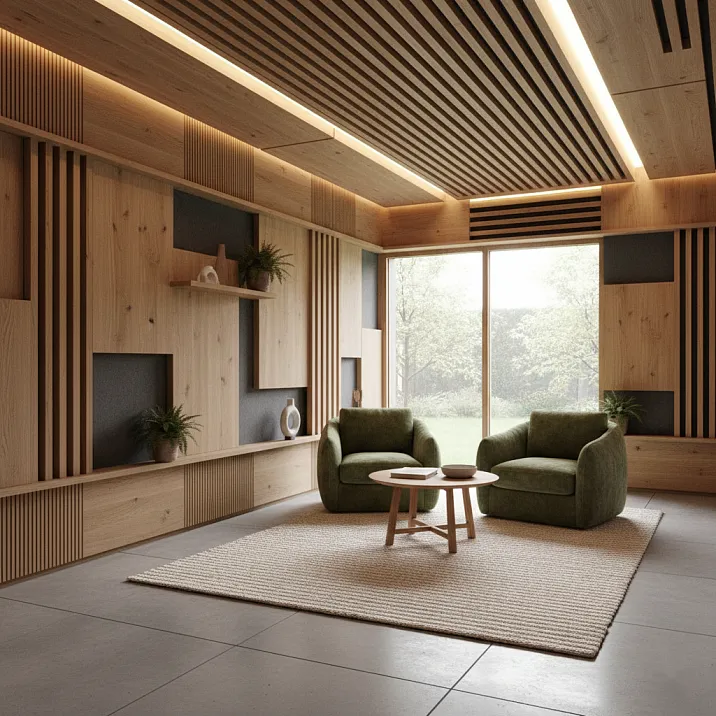
Silence in the modern city is a luxury. The noise of the street, neighbors' conversations, the hum of household appliances create a constant acoustic background from which there is no hiding. But there is a material that has been used for centuries in theaters, concert halls, and libraries to create the perfect sound environment. Wood. It doesn't just absorb noise—it transforms the acoustics of a space, making the sound soft, spacious, and comfortable. Let's explore how to properly use wooden finishes to create acoustic comfort in a living space.



Wood vs. Sound: The Physics of Comfort
Why does an echoey empty room with concrete walls become tiring within five minutes? Hard, smooth surfaces reflect sound waves almost completely. Sound hits a wall, bounces off, hits the opposite wall, bounces again. Reverberation occurs—multiple reflections where sounds overlap, creating a hum and echo. The reverberation time in an untreated room reaches 1.5-2 seconds. This means that every sound continues to be heard for another one and a half seconds after the source has stopped.
Wooden wall claddingradically changes the acoustic picture. Wood is a porous material with a fibrous structure. When a sound wave hits a wooden surface, part of the energy is reflected, but a significant part penetrates the wood's structure. The wood fibers begin to vibrate, converting sound energy into heat. It dissipates, disappears. The sound does not return to the room with the same intensity—it becomes softer, quieter, more pleasant to the ear.
The sound absorption coefficient of various materials is measured from 0 (total reflection) to 1 (total absorption). Concrete has a coefficient of 0.01-0.02—it reflects 98-99% of sound. Drywall—0.03-0.05. Wood—0.10-0.15 for dense species like oak and up to 0.25-0.35 for soft species like pine. The difference is colossal. A room with wooden finishing on one or two walls absorbs 10-15 times more sound than bare concrete.
Frequency-dependent absorption is an important nuance. Wood is especially effective in the mid and high-frequency range (500-4000 Hz)—exactly where human speech, clattering dishes, furniture creaks, and household appliance noise reside. Low frequencies (bass, traffic hum) wood absorbs less effectively, but it also doesn't reflect them as resonantly as concrete or glass. As a result, the room's sound spectrum becomes balanced—no piercing highs, no booming lows.
The thickness of a wooden element affects the acoustic effect. Thin cladding of 10-12 mm provides minimal absorption—it resonates itself, adding a ringing quality.Wooden panels 20-40 mm thickprovide a noise level reduction of 10-15 dB—a noticeable difference that is immediately audible. Massive elements 50-80 mm thick work as acoustic traps, absorbing even some low frequencies.
The wood species determines the absorption intensity. Dense species (oak, ash, beech) have a density of 700-900 kg/m³, absorb sound moderately, but create a warm, noble sound. Medium-density species (birch, cherry) with a density of 600-700 kg/m³ absorb more while maintaining strength. Soft species (pine, spruce, cedar) with a density of 450-550 kg/m³—maximum absorption, but less wear resistance. The choice depends on the room's purpose and the required balance between acoustics and durability.




Slats with Gaps: The Architecture of Sound Absorption
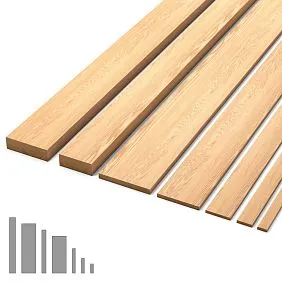
Racks for internal wall cladding—is not just a fashionable trend. It is a highly effective acoustic system that works on several physical principles simultaneously. When wooden slats are mounted with a gap from the wall and with spaces between them, a three-dimensional structure is created where sound waves are scattered, reflected at different angles, and partially absorbed.
The working mechanism of a slat system is more complex than that of a solid panel. A sound wave hits a slat—part is reflected, part is absorbed by the wood. But a significant part passes between the slats into the air gap behind them. There, the wave reflects off the base wall at an unpredictable angle, passes between the slats again, partially exits back, but now with different characteristics—weakened, scattered. Multiple re-reflections in the space between the slats dampen the wave's energy.
Optimal parameters for a slat system for acoustics are calculated based on room size and problematic frequencies. A slat cross-section of 30×40 mm or 40×50 mm—the golden mean between strength and acoustic efficiency. A spacing between slats of 40-80 mm creates a ratio of slat surface to voids of approximately 1:1 or 1:2. With closer spacing (slats every 20 mm) the system works almost like a solid wall—the acoustic effect weakens. With wider spacing (slats every 100+ mm) insufficient density—sound passes through with minimal scattering.
The air gap between the slats and the base wall is critically important. Minimum 30 mm, optimally 50-70 mm. This gap creates a resonant cavity in which sound waves of certain frequencies are damped especially effectively. The calculation of the resonant frequency depends on the cavity depth—the larger it is, the lower the frequencies that are absorbed. A 50 mm gap ensures absorption in the 500-2000 Hz range—the main spectrum of household noises.
Sound-absorbing filling behind the slatsenhances the effect by 2-3 times. Acoustic foam, mineral wool, felt panels 30-50 mm thick are placed in the air gap. The material absorbs sound waves, preventing them from reflecting off the base wall back. The sound absorption coefficient of a slat system with sound-absorbing filling reaches 0.60-0.80—this is the level of professional acoustic panels.
Vertical or horizontal slat arrangement affects the nature of sound scattering.vertical plankswork better with lateral reflections—sound coming from sources at ear level (TV, speakers) is scattered more effectively. Horizontal slats work with vertical reflections—sound from the ceiling and floor. Ideally, combine—one wall with vertical slats, another with horizontal. This creates multi-directional scattering.
The angle of slats relative to the wall is an advanced technique for specific tasks. Slats installed not perpendicular to the wall, but at a 15-30 degree angle, create directional diffusion. Sound reflects not back to the source, but to the side. Used in home theaters and music rooms where controlling the direction of reflected waves is important.
Our factory also produces:



Bedroom and study: areas where silence is critical
The bedroom is a space where acoustic comfort affects sleep quality. External noises even at 30-40 dB (quiet conversation) disrupt deep sleep phase, lead to frequent awakenings, and reduce rest quality.Wooden wall panels in the bedroomcreate a sound cocoon that reduces external noise penetration and dampens internal sounds.
A wall bordering a noisy neighbor, an elevator shaft, or a busy street is a priority for wooden cladding. A solid oak or ash panel 30-40 mm thick, installed on a frame with a 50 mm gap filled with mineral wool density 40-50 kg/m³, reduces penetrating noise level by 15-20 dB. This is significant — street noise of 70 dB becomes 50-55 dB, which is already tolerable for sleep.
The bed headboard is the point where acoustic treatment provides maximum comfort for the sleeper. A panel 120-150 cm high and 180-220 cm wide behind the headboard works as an acoustic screen. It absorbs sounds coming from the wall and creates a sense of security. Soft upholstery over the wooden panel enhances the effect — fabric absorbs high frequencies, wood absorbs mid frequencies, resulting in broadband absorption.
The bedroom ceiling is often an ignored surface acoustically. But it's the ceiling that creates maximum reverberation — sound reflects from above, adding boominess. Cladding the ceiling with wooden slats 10-20 mm thick spaced 30-50 mm apart reduces reverberation time from 1.2-1.5 seconds to 0.5-0.7 seconds. The bedroom sounds quieter, softer, more comfortable.
The study is a space where speech intelligibility and concentration are important. Excessive reverberation smears sounds, makes speech in video conferences unclear, and hinders focus.Wooden study finishingsolves the problem by creating an acoustically comfortable work environment.
The wall behind the desk is the ideal place for a slat panel. Sound from voice, keyboard, and computer speakers reflects off this wall back. If the wall is concrete, reflection is sharp, creating echo. A slat panel with a 50 mm gap and sound-absorbing filling absorbs 60-70% of sound, returning only soft, diffused reflection. Speech sounds clearer, work is more comfortable.
Bookshelves are an acoustic bonus in the study. Books with their uneven spines work as diffusers, scattering sound. Wooden shelves enhance the effect — they themselves absorb sound, and the uneven book surface adds diffusion. A bookshelf with books on wooden shelves is a budget acoustic panel that works as well as specialized solutions.
The study floor is a source of impact noise that irritates downstairs neighbors and hinders concentration. Wooden floor (parquet, solid board) on resilient underlay reduces impact noise by 12-18 dB compared to laminate or tile. A carpet over wooden floor adds another 5-8 dB absorption. Silence in the study is key to productivity.
Get Consultation
Polyurethane masking: beauty without compromise
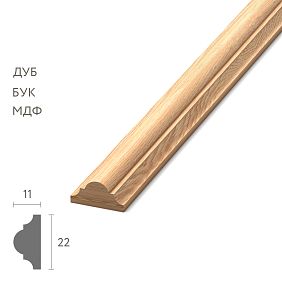
Specialized acoustic panels are effective but often look utilitarian — perforated boards, porous surfaces, industrial aesthetics. In residential interiors, especially classical or neoclassical, they are inappropriate.Moldingsmade of polyurethane solves the problem — it masks acoustic panels, turning them into decorative elements.
Integration technique is simple: an acoustic panel is mounted on the wall — a slat system with sound-absorbing filling or a ready perforated panel. The panel is painted to match the wall color, becoming visually invisible. Then a polyurethane frame of moldings is mounted around the panel perimeter — it creates decorative framing, turning the functional element into an architectural detail.
Polyurethane moldings 50-80 mm wide create a clear boundary between the acoustic panel and the rest of the wall. The molding can be simple rectangular or complex profiled — with ogees, beads, ornaments. Painted in contrasting color (white molding on colored wall) or matching tone (molding same color but with slight relief), it creates visual interest, distracting attention from the panel's functional filling.
Overlay decor on acoustic panel is an advanced technique. Polyurethane overlays — rosettes, cartouches, corner elements — are mounted over slat or perforated panels. They are attached on thin stands, creating an air gap of 10-15 mm between decor and panel. Sound passes through gaps to the acoustic surface, gets absorbed, but visually the panel looks like solid stucco composition.
Ceiling coffers with acoustic filling are a luxurious solution for living rooms and studies. The ceiling is divided by moldings into rectangular sections 80×80 cm or 100×100 cm. Inside each section, an acoustic panel is placed — perforated drywall or wooden slat insert on sound-absorbing base. Moldings create classical ceiling architecture, while filling works acoustically. Visually — palace luxury, acoustically — professional studio.
Hidden acoustic panels behind decorative grilles are a compromise between effectiveness and aesthetics. Wooden carved grille or metal perforated panel is mounted 20-30 mm from the wall, behind which an acoustic panel is installed. The grille allows sound to reach the absorbing surface but visually creates a decorative accent. Used in music rooms, home theaters where maximum acoustic effectiveness is important.
Polyurethane cornices with acoustic function — dual purpose of one element. A cornice 150-250 mm wide is mounted under the ceiling not flush with the wall, but with a 50-70 mm gap. Sound-absorbing material is placed in the gap. Sound reflecting from upper wall parts and ceiling enters the gap, gets absorbed. Visually — classic ceiling cornice, functionally — acoustic trap for high frequencies.
Baseboard as sound barrier: protection from downstairs neighbors
wooden baseboardis perceived as a decorative element covering the wall-floor joint. But acoustically, a tall solid baseboard is an additional barrier that reduces structural noise penetration from downstairs neighbors and lateral noise through walls.
Structural noise — vibrations transmitted through building structures. A downstairs neighbor turns on music, low-frequency vibrations transmit through floor slab, walls, penetrate your apartment. A regular thin baseboard 50-60 mm high doesn't hinder this.Tall wooden baseboard 100-150 mm18-24 mm thick creates additional mass and resilient layer between wall and floor.
Wood dampens vibrations due to internal fiber friction. When vibration passes through wood, fibers shift relative to each other, energy converts to heat. Solid oak baseboard density 750-900 kg/m³ works as a damper, reducing oscillation amplitude by 15-25%. This is noticeable — bass frequencies from neighbor's music become quieter, less intrusive.
Resilient padding between baseboard and wall enhances vibration isolation effect. Cork, felt, or foam polyethylene tape 3-5 mm thick is installed along the entire baseboard length on the wall side. Vibrations traveling along the wall are absorbed by the resilient padding, not transmitted to the baseboard and further into the room. The effect is modest — reduction of 3-5 dB, but combined with other measures gives noticeable improvement.
The air gap between the skirting board and the floor is a contentious point. From an acoustic perspective, a 1-2 mm gap is beneficial—it breaks the rigid connection between the floor and skirting, reducing vibration transmission. However, from an aesthetic standpoint, the gap is undesirable—dust accumulates there, and the crack is visible. The compromise is an elastic sealant that fills the gap while maintaining elasticity, avoiding a rigid connection.
Skirting boards made from softwoods (pine, cedar) are more effective for vibration isolation than those from hardwoods (oak, ash). Paradoxically, softer wood absorbs vibrations better due to greater internal elasticity. However, hardwoods are stronger, more durable, and look better. The choice depends on priorities—acoustics or wear resistance.
Combining a tall wooden skirting board with a sound-insulating floor is a systematic approach to combating structural noise. A floor on an elastic underlay (4-6 mm cork or specialized vibration isolation membrane) isolates vibrations from the slab. A tall skirting board dampens vibrations traveling along the walls. Combined, structural noise reduction reaches 20-30 dB—neighbors' music ceases to be a problem.
Home Theater: Wood as an Acoustic Tool
A home theater imposes maximum demands on acoustics. Here, not only silence and absence of echo are important, but also proper sound distribution, dialogue clarity, bass depth, and spatial effects.Wooden Elements in a Home Theater—not decoration, but an acoustic tool tuned for a specific task.
The side walls of a theater require diffusing surfaces. Sound from speakers should not reflect back sharply—this creates unwanted repetitions and blurs the soundstage. Slat panels with variable spacing—slats alternating with gaps unevenly: 40 mm slat, 60 mm gap, 50 mm slat, 40 mm gap—create chaotic diffusion. Sound reflects at different angles, not focusing at a single point.
The rear wall of a theater should absorb maximum sound. Rear speakers are placed here; sound from them should not reflect back to viewers, creating echo. A solid wooden panel 40-50 mm thick with soft upholstery over it is the optimal solution. Wood absorbs mid frequencies, upholstery fabric absorbs highs; combined absorption coefficient reaches 0.70-0.85.
The front wall behind the screen and speakers is an area requiring balance. Too much absorption kills detail, making sound dull. Too much reflection creates resonances that distort sound. Wooden panels with partial perforation—holes 5-8 mm in diameter spaced 20-30 mm apart—create the needed balance. Some sound passes through holes and is absorbed by sound-absorbing material behind the panel; some reflects off the wooden surface, preserving liveliness.
The theater ceiling is critical for low frequencies. Bass reflects off the ceiling, creating standing waves—areas where bass is amplified and areas where it disappears. Wooden coffers with variable depth—some sections 100 mm deep, others 150 mm, others 200 mm—break up standing waves. Each section resonates at its own frequency; combined, bass is distributed evenly throughout the room.
Bass traps in corners are a mandatory element of a professional theater. Room corners are zones of low-frequency accumulation. Wooden corner structures filled with dense mineral wool (80-100 kg/m³), sized 50×50 cm along the entire corner height, absorb bass, preventing buildup. Result—clean, controlled low frequencies without humming.
Acoustics and Aesthetics: When Function Becomes Beauty
The best solutions are those where acoustic function is inseparable from visual beauty. A slat wall in a living room is not just a sound absorber but also an expressive architectural element. A tall wooden skirting board is not only a vibration isolator but also a noble framing of space. Wooden panels in a bedroom are simultaneously acoustic protection and tactile comfort.
Wood color influences acoustic perception. Dark wood (wenge, stained oak) visually absorbs not only light but also creates a sense of sonic density. The room feels intimate, quiet, protected. Light wood (ash, maple, birch) creates a sense of airiness—sound is perceived as more open, spatial, even though physical absorption is the same.
Surface texture is a detailed but important parameter. Smoothly sanded wood reflects some high frequencies, preserving sound brightness. Brushed wood with pronounced grain texture diffuses high frequencies more effectively, making sound softer. Rustic treatment preserving natural irregularities creates maximum diffusion—each irregularity acts as a micro-diffuser.
Combining wood with textiles is a classic acoustic technique. Wooden panels on walls plus heavy curtains on windows, carpet on floor, soft furniture—create optimal acoustic balance. Wood works in mid frequencies, textiles in highs, carpet absorbs impact noise. The room sounds balanced across the spectrum.
Plants as a complement to wooden finishes enhance acoustic comfort. Large plants with broad leaves (monstera, ficus, palms) diffuse sound; their uneven surfaces act as diffusers. Placed between wooden panels or near slat systems, plants add naturalness and vitality while improving acoustics.
Mistakes That Kill Acoustics
Fully cladding all walls with wood sounds appealing but is acoustically incorrect. If all surfaces absorb sound equally, the room becomes too dead—sound lacks reflections, losing volume and spatiality. The correct approach is to treat 40-60% of surfaces. One or two walls—wood; others—painted or wallpapered. Ceiling partially wooden, floor with carpet. Balance absorption and reflection.
Ignoring low frequencies is a common mistake. Wood poorly absorbs bass, and if special bass traps are not provided, low frequencies will hum, creating discomfort. In room corners, especially in theaters and music rooms, corner absorbers are mandatory—wooden structures with sound-absorbing fill.
Lack of an air gap behind wooden panels reduces effectiveness by half. A panel glued directly to the wall works only through material absorption. A panel on a frame with a 50 mm gap acts as a resonator, absorbing sound in the gap. Always mount wooden finishes on a frame with an air space.
Thin decorative slats 10-15 mm thick without sound-absorbing fill—visual effect without acoustic benefit. They resonate, adding ringiness instead of absorption. For acoustics, slats with a minimum cross-section of 30×40 mm with a gap from the wall and sound-absorbing material behind them are needed.
Incorrect choice of sound-absorbing material reduces effect. Ordinary insulation (foam, extruded polystyrene) is unsuitable for acoustics—it reflects sound. Fibrous materials are needed—mineral wool, acoustic felt, specialized acoustic panels. Density 40-60 kg/m³ for residential use, 80-100 kg/m³ for professional.
Frequently asked questions
Does Wood Really Improve Acoustics or Is It a Myth?
This is a scientifically proven fact. Wood has a sound absorption coefficient of 0.10-0.35 depending on species and thickness, which is 10-30 times higher than concrete or drywall. Slat systems with gaps and sound-absorbing fill achieve coefficients of 0.60-0.80, comparable to professional acoustic panels.
Which Wood Species Is Best for Acoustics?
Softwoods (pine, spruce, cedar) absorb sound more effectively due to porous structure. Hardwoods (oak, ash, beech) absorb moderately but create more noble sound. For residential spaces, medium-density species—birch, alder—are optimal, balancing absorption and strength.
Is an Air Gap Needed Behind Wooden Panels?
Absolutely essential for maximum acoustic effect. A 50-70 mm gap turns the panel into a resonator that absorbs sound in the air space. A panel glued directly to the wall works half as effectively.
Can wooden finishing be used in an apartment for soundproofing against neighbors?
Yes, but with limitations. Wood effectively absorbs airborne noise (speech, music, TV), reducing it by 10-15 dB. Structural noise (impacts, footsteps) requires vibration-isolating decoupling — elastic pads, floating floors. A combination of wooden finishing and vibration isolation provides a reduction of 20-30 dB.
How to calculate the amount of wooden finishing to improve acoustics?
Treat 40-60% of the room's surfaces. For a 20 m² room (4×5 m), the total wall area is about 36 m² (excluding windows and doors). Treat 15-20 m² — one or two walls completely or all walls partially. This is sufficient for noticeable acoustic improvement without overloading.
Do slatted panels actually work or are they just decor?
They work with proper construction. Slats with a cross-section of 30-40 mm, spaced 40-80 mm apart, with a 50 mm gap from the wall and sound-absorbing filling provide an absorption coefficient of 0.60-0.70. Thin decorative slats without a gap and filling are just decor, with minimal acoustic effect.
Does wood absorb low frequencies (bass)?
Weakly. Wood is effective in the 500-4000 Hz range (mid and high frequencies). For low frequencies, special bass traps are needed — corner structures with dense sound-absorbing filling or resonant panels tuned to specific frequencies.
Does the thickness of a wooden panel affect acoustics?
Yes, significantly. A 10-12 mm panel works weakly and may even resonate. A 20-30 mm panel provides good mid-frequency absorption. A 40-50 mm panel absorbs some low frequencies. For maximum effect, a thickness of 30-50 mm is optimal.
Can acoustics be improved without large-scale finishing?
Yes, local measures provide a noticeable effect. A 2×3 meter slatted panel behind a sofa or TV, tall wooden skirting boards around the perimeter, a wooden ceiling in the central part — each measure reduces reverberation and improves comfort.
How does wood affect music sound quality?
Positively. Wood removes harsh high frequencies while preserving depth and volume. Music sounds warmer, more natural, and more comfortable for extended listening. Concert halls are finished with wood precisely for this reason.
Conclusion: Silence as a Luxury
Acoustic comfort is an invisible but critically important component of quality of life. We don't notice good acoustics, but we instantly feel bad acoustics — booming, echo, intrusive reverberation tires, creates stress, and reduces concentration.Wooden room finishing— a natural way to create acoustic well-being without complex technological systems.
rails for interior wall finishing, Wooden panels, tall floor skirting boards— every element works to create sound comfort. Together they form an acoustic environment where silence becomes a natural state, and sounds — music, speech, household noises — sound balanced, without irritation or fatigue.
Beauty and functionality merge in wooden finishing. A slatted wall is an expressive architectural element and an effective sound absorber. Wooden panels in a bedroom — tactile comfort and acoustic protection. A massive skirting board — a noble frame and a vibration-isolating barrier. You don't have to choose between aesthetics and acoustics — wood provides both.
STAVROS specializes in manufacturing wooden elements for acoustically comfortable interiors.Solid Wood Planksof various cross-sections and species — from pine to oak, from simple to profiled.Wall Panels20-40 mm thick, made from solid wood or laminated wood with perfect geometry for acoustic applications.Baseboards80 to 200 mm high, capable of functioning as vibration-isolating elements.
All STAVROS products are made from selected wood with 8-12% moisture content, ensuring dimensional stability and absence of deformation. Processing precision on modern equipment allows maintaining dimensions with an accuracy of up to 0.5 mm — critical for acoustic constructions where gaps and element spacing are calculated with high precision.
STAVROS consultants will help design an acoustic system for your room — calculate the required treatment area, select optimal slat sizes and spacing, and recommend sound-absorbing materials. We work with architects, designers, professional home theater installers, providing technical support at all project stages.
Create a space where sound works for comfort, and silence becomes a luxury available every day, with STAVROS — a partner who understands the physics of sound and the beauty of wood.


