Article Contents:
- Interior Mirror — More Than a Reflection
- Definition: Mirror as a Decorative Element
- From Utility to Aesthetics
- Mirror as a Work of Art
- Central Accent of the Room
- Features of an Interior Mirror
- Exclusive Frame: Carving, Gilding
- Non-Standard Sizes and Shapes
- Artistic Value
- Unique Design
- Interior Mirror in Different Styles
- Classic: Carved Gilded Frames
- Baroque: Opulence and Luxury
- Art Nouveau: flowing botanical lines
- Art Deco: Geometry and Glamour
- Eclecticism: Mixing Eras
- Placement of an Interior Mirror
- As a Standalone Accent
- In a Composition with Other Art Objects
- Opposite a Light Source
- In a Niche with Lighting
- Above a Fireplace or Console
- Antique Interior Mirrors
- Antique Value
- Museum Quality
- History and Provenance
- Restoration and Preservation
- Wall placement
- Height: Mirror Center at Eye Level
- Proportions: Matching Wall Size
- Lighting: Accent Lighting or Natural Light
- Surroundings: Furniture and Decor
- Creating a Mirror Gallery
- Composition of Mirrors of Different Sizes
- Symmetry vs asymmetry
- Frames in one style or mix
- Mirrors + paintings: an eclectic solution
- Questions and Answers
- How does an interior mirror differ from an ordinary one?
- What style of mirror to choose for a modern interior?
- Can you hang an antique mirror in a modern interior?
- How to determine the value of an antique mirror?
- What size mirror is suitable for a 20 sq.m. living room?
- Is it necessary to place a mirror opposite a window?
- How much does a custom interior mirror cost?
- How to care for a gilded frame?
- Can you create a gallery only from mirrors without paintings?
- Is professional installation needed for a large mirror?
- Conclusion
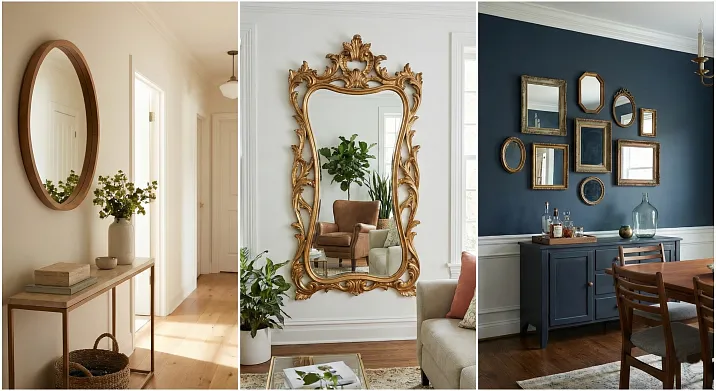
When does a mirror cease to be just a reflective surface and become art? The moment its frame, shape, and placement begin to speak not only of function but also of style, taste, and the owner's status.Mirror with frame— is not a utilitarian item for daily rituals; it is a decorative element capable of becoming the compositional center of a space, a visual dominant, an art object that shapes the atmosphere of a room.
In modern interiors, where every item carries not only practical but also aesthetic weight, the mirror becomes a tool for creating accents. It works with space, light, proportions, creates visual effects that cannot be achieved by other means.Wall-Mounted Interior Mirror in Frame— is a work where the frame is as important an element as the mirror surface itself, where form and content merge into a single artistic object.


Interior mirror — more than a reflection
What makes an ordinary mirror an interior one? It is the transition from utility to decorativeness, from function to form, from necessity to aesthetics. An interior mirror is created not just to look at oneself before leaving — it exists as an element of interior composition, as an object around which space is built.




Definition: mirror as a decorative element
An interior mirror is a mirror whose primary function is not to reflect a person, but to decorate space. It can reflect a room, enhance light, create visual depth, but most importantly — it must be beautiful in itself. The frame of an interior mirror is often a work of decorative art: hand-carved, gilded, patinated, complex profiles, non-standard shapes.
The dimensions of an interior mirror are usually significant — from 80 cm on the smaller side to 200 cm or more. These are large-format objects that cannot be overlooked, that announce themselves, occupy visual space, demand attention. Unlike a functional mirror in a bathroom or hallway,interior mirrorit is placed where it will be seen, appreciated, where it will become part of the visual narrative of the room.
Our factory also produces:


From Utility to Aesthetics
The history of mirrors is the history of transforming a utilitarian item into a status decorative object. The first mirrors were small, expensive, used exclusively functionally. With the development of production technologies, mirrors increased in size, became more accessible, but simultaneously turned into luxury items.
In the Baroque era, mirrors in palace interiors served a decorative function: they multiplied the light from candles, visually expanded the space of state halls, reflected the luxury of the setting. The frames of these mirrors were so complex, expensive, artistically significant that the mirror was perceived as furniture, as a work of art. The Hall of Mirrors at Versailles is the culmination of this tradition: 357 mirrors, framed in gilded frames, created the effect of infinite space filled with light and luxury.
Today we are returning to this understanding of the mirror — not as a utilitarian thing, but as a decorative object capable of defining the character of an interior.A classic mirrorin a carved gilded frame — is not a tool for makeup; it is a statement about style, taste, respect for traditions.
Get Consultation
Mirror as a work of art
When does a mirror become art? When its frame is created by a master carver, each element of the ornament is worked by hand, when gilding and patination techniques are applied, when the shape of the mirror is unique, not mass-produced.An antique mirror in a frameFrom the 18th-19th centuries — undoubtedly a work of art, an antique item possessing historical and artistic value.
But modern mirrors can also be art. When a designer creates a unique shape, a craftsman carves the frame according to a custom sketch, when rare wood species are used, when the frame itself is a sculpture — the mirror transcends decorative and applied art and becomes an art object. Such mirrors are created as one-of-a-kind pieces, for a specific interior, as part of the artistic concept of the space.
The central accent of a room
An interior mirror often becomes the focal point of a room — the element that first catches the eye, around which the rest of the composition is built. Placed above a fireplace, a console, on a free wall,a mirror in a decorative framecreates a visual center that draws attention.
Why is a mirror so effective as an accent? Because it is dynamic. A painting is static — its image does not change. A mirror is alive — the reflection in it constantly updates depending on the time of day, lighting, and people's movement. It is dynamic decor that doesn't become tiresome, that is perceived anew each time. Plus, the frame itself, if executed with quality, is a work of art worthy of contemplation.
Signs of an interior mirror
How to distinguish an interior mirror from an ordinary functional one? There are several signs that unmistakably reveal a mirror created for decoration, not for utilitarian use.
Exclusive frame: carving, gilding
The frame of an interior mirror is not just a border protecting the edge of the mirror glass. It is an independent decorative element, often more visually significant than the mirror itself. Hand-carved details, complex multi-level profiles, gilding with gold leaf, patination, distressing — all these techniques transform the frame into a work of decorative art.
Carved Mirror FramesFrames of classical and Baroque styles are distinguished by an abundance of details: floral ornaments, acanthus scrolls, rosettes, cartouches, festoons. Each element is carved by hand or milled on high-precision equipment, then sanded, primed, gilded, patinated. This is a labor-intensive process requiring skill, experience, and artistic taste.
Gilding is a separate topic. Gilding with gold leaf (the thinnest sheets of real gold) is an ancient technique that creates a warm, deep glow impossible to imitate with paint.Luxurious mirrorA mirror in a gilded frame is a symbol of prosperity, taste, and adherence to the traditions of high decorative art.
Non-standard sizes and shapes
A functional mirror is usually rectangular, vertical, of a size sufficient to reflect a person. An interior mirror can be any shape: oval, round, arched, polygonal, even freeform. Sizes vary from compact 60×80 cm to monumental 150×250 cm and larger.
The shape of an interior mirror is often dictated by style. Oval mirrors are characteristic of Classicism and Neoclassicism — their smooth lines create elegance and softness. Round mirrors are popular in modern interiors — the geometric purity of the circle, the absence of corners, creates calmness and centeredness. Arched mirrors refer to Gothic, Romanesque style — their verticality and arch shape create an upward aspiration, monumentality.
Non-standard shapes — polygons, asymmetrical forms, mirrors with complex contours — are used in avant-garde, eclectic interiors, where uniqueness and the absence of templates are valued. Such a mirror cannot be bought in a regular store — it is custom-made according to an individual sketch.
Artistic value
An interior mirror possesses artistic value — it is an object that can be contemplated, analyzed, and evaluated in terms of composition, proportions, and quality of execution. The frame can be executed so masterfully that the mirror is perceived as a museum exhibit.
Artistic value is comprised of several factors: quality of materials (solid wood of valuable species, gold leaf, high-quality mirror glass), craftsmanship (precision of carving, quality of finish), uniqueness of design (original shape, author's ornament), historical or stylistic authenticity (adherence to the canons of a specific era).
Antique mirrors from the 18th-19th centuries possess not only artistic but also historical value. They have survived centuries, are witnesses to their era, and carry the spirit of the time.An antique mirrorwith an authentic frame is a rarity, a collectible item, an investment.
Unique Design
Mass production stamps out identical mirrors by the thousands. An interior mirror is unique — it is created individually, from a sketch, often as a single piece. Even if a standard frame profile is used, the combination of the mirror's size, shape, finish option, and placement method creates uniqueness.
Uniqueness is the key quality of an interior mirror. The owner of such a mirror knows: no one else has exactly the same item. It is an exclusive, created specifically for their interior, taking into account the room's proportions, style, color palette, and personal preferences. You cannot buy such a mirror off the shelf — you order it from craftsmen, discuss details, wait for its creation. And the result justifies the expectations: an item that becomes a family heirloom.
Interior mirrors in different styles
The stylistic variety of interior mirrors is immense. Each era, each artistic movement created its own forms, ornaments, proportions. The choice of a mirror's style is determined by the overall style of the interior.
Classic: carved gilded frames
Classical style is symmetry, proportionality, the use of antique motifs, restrained luxury.mirror in a classic frameFeatures clear proportions, a medium-width profiled frame (8-12 cm), and carved decoration based on classical motifs: meander, palmettes, acanthus, laurel wreaths.
Color schemes for classical frames: natural wood (oak, walnut) under clear varnish, dark stain (ebony), gilding (gold on white primer or natural wood), white enamel with gold accents. Shapes: vertical and horizontal rectangles, ovals, less commonly circles.
A classical mirror is versatile. It suits living rooms, dining rooms, studies, and halls in classical, neoclassical, and traditional styles. Such a mirror never goes out of fashion—classicism is timeless, relevant for decades, centuries. It is an investment in beauty that will not depreciate.
Baroque: Opulence and Luxury
Baroque is the style of palatial luxury, theatricality, and visual abundance.Mirror in Baroque style— is an opulent carved frame with abundant decoration: scrolls, volutes, cartouches, putti (angel figures), garlands of flowers and fruits, fantastical creatures.
Baroque mirror frames are wide (12-20 cm), complex, and multi-layered. The carving is deep, relief, creating strong contrasts of light and shadow. Gilding is abundant, often solid—the entire frame is covered in gold. Shapes: ovals, rectangles with wavy edges, complex composite forms.
A Baroque mirror is a choice for interiors unafraid of luxury, where pomp is valued, and where there is space for monumental forms. Living rooms with high ceilings, grand halls, dining rooms—places where a Baroque mirror reveals its full splendor. It is not for minimalist spaces—Baroque demands scale, magnificence, palatial grandeur.
Art Nouveau: flowing botanical lines
Art Nouveau (Art Nouveau) — a style from the turn of the 19th-20th centuries, characterized by flowing, undulating lines, plant motifs, asymmetry, and the rejection of right angles. Mirrors in the Art Nouveau style have unusual, organic shapes: wavy edges, plant ornaments, stylized flowers (irises, lilies, poppies).
Art Nouveau frames are often asymmetrical, of varying widths on different sides. Decoration: stylized plants, female figures with long hair, dragonflies, butterflies—symbols of Art Nouveau. Materials: wood, often combined with metal (copper, bronze), glass (stained glass inserts).
Art Nouveau color palette: natural wood tones, muted colors (green, brown, ochre), patinated bronze. An Art Nouveau mirror is a choice for interiors in the Art Nouveau style, eclectic spaces where uniqueness, artistry, and rejection of templates are valued.
Art Deco: Geometry and Glamour
Art Deco — a style of the 1920s-1930s, combining geometric forms, luxurious materials, shine, and glamour. Mirrors in the Art Deco style are distinguished by clear geometry: octagons, stepped forms, sun rays, zigzags.
Art Deco frames are often narrow, profiled, with clear facets. Materials: wood (black ebony, light maple), metal (chrome-plated steel, brass), mirror inserts (a frame of several mirror strips framing the central mirror). Finish: glossy, shiny—Art Deco loves radiance.
A mirror in the Art Deco style is ideal for glamorous interiors, modern classicism, interiors with Art Deco elements. It adds graphic quality, clarity, and shine. Placed in a bedroom, living room, or hallway, such a mirror creates the atmosphere of the 1920s—the era of jazz, cocktails, and elegance.
Eclecticism: mixing eras
Eclecticism — the conscious mixing of styles, eras, forms. An eclectic mirror can combine elements of different styles: Baroque carving with modern proportions, a classical shape with avant-garde finishing. It is a game, an experiment, a rejection of canons.
In eclectic interiors, a mirror can be provocative, unexpected: an ultra-modern mirror in a minimalist frame in a classical interior, or conversely—a Baroque gilded mirror in a loft. These contrasts create tension, interest, uniqueness.
Eclecticism requires taste, a sense of proportion. Ineptly mixed styles look tasteless. Properly balanced eclecticism creates a rich, multi-layered interior where each item has its own history, where the combination of the uncombinable becomes the highlight of the space.
Placement of an Interior Mirror
Where and how to place an interior mirror so it reveals its potential? Placement is critically important—even the most beautiful mirror, hung incorrectly, will not achieve the desired effect.
As an Independent Accent
An interior mirror is self-sufficient—it does not need the company of other decorative elements. Placed on a free wall as the sole large object,framed mirrorit creates a powerful visual accent.
Rules for placing a mirror as an independent accent:
-
The wall must be large enough so there is free space around the mirror (at least 30-40 cm on each side)
-
The mirror is placed at eye level: the center of the mirror at a height of 150-160 cm from the floor
-
No other large objects on this wall—only the mirror
-
Lighting must be well-considered: either natural light from a window, or accent lighting
-
What is reflected in the mirror is important: beautiful furniture, a window, light—good; clutter, a dull wall—bad
A mirror as an independent accent works in minimalist interiors where restraint is valued, visual noise is absent, and every item is significant.
In composition with other art objects
A mirror can be part of a composition: surrounded by paintings, photographs, other mirrors. This creates a gallery wall, visual richness, and perceptual complexity.
Composition options:
-
Symmetrical: mirror in the center, identical paintings or photographs on the sides
-
Asymmetrical: mirror offset from the center, with objects of different sizes arranged chaotically around it
-
Mirror + paintings of the same size in identical frames — creates rhythm and structure
-
Several mirrors of different sizes — creates a play of reflections and visual complexity
In a composition, it's important to maintain balance: the mirror should not get lost among other objects, but it should not overpower them either. Frames are best chosen in the same style or consciously mixed if the interior is eclectic.
Opposite a light source
Placementmirror opposite a windowor opposite a lamp — a classic technique for multiplying light. The mirror reflects light, distributes it throughout the room, and makes the space brighter.
The effect is maximum if:
-
The mirror is large (at least 100 cm on the shorter side)
-
Placed exactly opposite a window or lamp
-
Reflects not only light but also a beautiful view from the window (if the view is uninteresting — the technique doesn't work)
-
High-quality mirror surface without distortions
This technique is especially important in dark rooms, rooms lacking natural light. One properly placed mirror can visually double the amount of light, making the room more spacious and airy.
In a niche with lighting
A mirror in a niche is an architectural solution that creates an effect of depth, a portal to another space. The niche is illuminated with built-in lights (LED strips around the perimeter, spotlights), and the mirror reflects the light, creating a glowing frame.
Such placement turns the mirror into a light object, functioning like an art installation. The lighting can be warm (for classic interiors) or cool (for modern ones), adjustable in brightness, creating different effects depending on the time of day and mood.
A mirror in a niche with lighting is a choice for dramatic interiors that are not afraid of drama, where the mirror should be not just decor but a central element, a light dominant that attracts attention.
Above a fireplace or console
Traditional placement — above a fireplace or decorative console. This is a classic composition, tested for centuries, working flawlessly.
Why it works:
-
Fireplace or console — a natural compositional center
-
The mirror enhances this center, creates a vertical axis
-
Symmetry (console + mirror) calms and structures
-
The mirror can reflect a chandelier, creating an additional light effect
-
Decorative objects are placed on the console, which are reflected in the mirror, creating visual richness
The size of the mirror should correspond to the size of the console: a mirror wider than the console looks disproportionate. Ideally, the width of the mirror is equal to or slightly less (by 10-20%) than the width of the console.
Antique interior mirrors
Antique mirrors are a special category where artistic value combines with historical significance. These are items that have survived decades or centuries, carrying the spirit of their era.
Antique value
An antique mirror in a framefrom the 18th-19th centuries are collectible items possessing not only decorative but also investment value. The price of an antique mirror depends on the era of creation, country of origin, condition, artistic quality of the frame, and provenance (ownership history).
Most valuable are:
-
Mirrors from the Louis XIV, XV, XVI eras (French, 17th-18th centuries) – lavish carved gilded frames
-
Italian Baroque mirrors from the 17th-18th centuries – carving, gilding, sometimes with wood or glass inlays
-
English mirrors from the Georgian era (18th century) – restrained elegance, quality carving
-
Venetian mirrors with engraving on the mirror surface (18th-19th centuries) – finest craftsmanship
An antique mirror requires careful handling, professional appraisal before purchase, and sometimes restoration. But it is an investment that only appreciates over the years.
Museum quality
What does 'museum quality' mean? It is a level of execution that meets museum exhibit standards: flawless carving, authentic gilding techniques (gold leaf), historical accuracy of ornaments, preservation or quality restoration.
Museum-quality mirrors were created by court masters, the best carvers of their era. They were intended for palaces, aristocratic mansions, and luxurious interiors. Each such mirror is a work of art reflecting the aesthetics of the era, the creator's skill, and the patron's status.
Today, museum-quality mirrors can be found at auctions, through antique dealers, and in private collections. Prices start from several thousand euros and can reach hundreds of thousands for exceptional specimens.
History and provenance
Provenance is the ownership history of an item. For an antique mirror, provenance is critically important: it confirms authenticity, increases value, and makes the item part of history.
A mirror that belonged to a famous historical figure, an aristocratic family, or was located in a known palace has historical value surpassing its artistic value. Documented provenance (purchase receipts, mentions in inventory lists, photographs in interiors) significantly increases the price.
When buying an antique mirror, it is important to verify its origin, request documents confirming authenticity. The market is full of fakes and stylizations made to look old. A genuine antique mirror shows signs of age: wear on the gilding, restoration traces, manufacturing techniques characteristic of the era.
Restoration and preservation
An antique mirror often requires restoration: strengthening the frame, restoring lost carving fragments, renewing gilding, replacing the mirror surface (if the original is broken or heavily tarnished).
Restoration must be professional, respecting the original. The goal is not to make the item 'like new,' but to stop deterioration, preserve authenticity, and restore lost elements using historical techniques. Crude restoration with modern materials devalues antiques.
Preserving an antique mirror requires proper conditions: stable humidity (40-60%), absence of direct sunlight (fades gilding), careful handling. A properly preserved mirror will last for centuries more, becoming a family heirloom passed down through generations.
Wall Placement
Technical aspects of placinga wall mirrorare no less important than aesthetic ones. Improper mounting can lead to the mirror falling, injuries, and destruction of a valuable item.
Height: at eye level, the center of the mirror
Optimal placement height: the center of the mirror at eye level of a standing person of average height – 150-165 cm from the floor. At this height, the mirror is perceived naturally, without creating a sense of being suspended or too low.
Exceptions:
-
Mirror above a console or fireplace: lower edge at a height of 10-20 cm above the console surface
-
Full-length mirror: lower edge at a height of 30-40 cm from the floor
-
Mirror above a sofa: lower edge at a height of 20-30 cm above the sofa back
A mirror placed too high creates a sense of detachment from the space. One placed too low visually weighs down the space and reduces the perceived ceiling height.
Proportions: Matching Wall Size
The mirror size should be proportional to the wall size. A small mirror on a large wall gets lost and looks out of place. A too-large mirror on a small wall creates a feeling of crampedness and clutter.
Rule: The mirror should occupy 50-75% of the wall's width (or the section of wall between windows, doors, corners). If the wall is wide (over 3 meters), you can place two mirrors symmetrically or create a composition of a mirror and artwork.
Mirror height relative to wall height: For vertical mirrors, the height can be 60-80% of the floor-to-ceiling height (accounting for baseboards and cornices). For horizontal mirrors, the height typically does not exceed 100-120 cm.
Lighting: Backlighting or Natural Light
Lighting critically affects the perception of a mirror. Insufficient lighting makes the mirror dark and unexpressive. Excessive lighting creates glare and hinders seeing the reflection.
Lighting options:
-
Natural light from a window is the best option, but the mirror should not be directly opposite the window at a right angle (creates glare).
-
Wall sconces on the sides of the mirror — a classic solution that provides even illumination.
-
Top lighting (a light fixture above the mirror) — suitable for mirrors above a console, fireplace.
-
Built-in lighting in the frame — a modern solution that creates a striking light outline.
Light color temperature is important: warm light (2700-3000K) suits classic interiors, cool light (4000-5000K) suits modern ones. Adjustable lighting allows changing intensity and color depending on the time of day.
Surroundings: Furniture and Decor
What is located near the mirror affects its perception. A mirror does not exist in isolation — it is part of an interior composition.
Successful surroundings:
-
A console or dresser under the mirror with decorative objects (vases, sculptures, candles).
-
Armchairs or a sofa opposite the mirror (creates a cozy area).
-
Potted plants near the mirror (greenery reflects, adding freshness).
-
Paintings or photographs on adjacent walls (creates a gallery atmosphere).
Unsuccessful surroundings:
-
Clutter that is reflected in the mirror.
-
Too much furniture creating visual crampedness.
-
An unattractive wall opposite, reflected in the mirror.
-
Items that are stylistically mismatched.
When planning mirror placement, consider what will be reflected in it. A mirror doubles the visible space — ensure it doubles beauty, not chaos.
Creating a Mirror Gallery
Several mirrors combined into a composition create a gallery wall — a complex, multi-layered decorative effect.
Composition of mirrors of different sizes
A gallery of mirrors of different sizes creates dynamism and visual interest. A large central mirror is surrounded by several smaller ones, or several medium-sized mirrors are arranged asymmetrically.
Composition rules:
-
An odd number of elements (3, 5, 7) is perceived as more harmonious
-
Mirrors should be connected by a common frame style (or a deliberate contrast)
-
Distance between mirrors: 10-20 cm
-
The overall composition should fit into a rectangle or square (visually)
A composition of mirrors of different sizes is suitable for eclectic, modern interiors where a creative approach and unconventional solutions are valued.
Symmetry vs asymmetry
A symmetrical composition (two identical mirrors on either side of a central element, four mirrors in a square) creates order, stability, and classical harmony. An asymmetrical composition (chaotic placement of different mirrors) creates dynamism, modernity, and creative disorder.
The choice depends on the interior style:
-
Classical, neoclassical, traditional — symmetry
-
Modern, eclectic, boho — asymmetry
-
Minimalist — either a single mirror or strict symmetry
Asymmetry requires artistic flair. A poorly executed asymmetrical composition looks like an accident. Proper asymmetry — like art.
Frames in one style or a mix
Mirrors in a gallery can have frames in one style (all classical, all modern) or a deliberate mix of styles (baroque + minimalist + art nouveau).
A unified style creates integrity, calmness, and tradition. A mix of styles creates eclecticism, surprise, and individuality. The choice depends on the overall interior concept and the owner's boldness.
If a mix is chosen, it is important to have a unifying thread: a common frame color, a common size range, a common principle (all mirrors are round, but with different frames). Without a unifying element, the composition falls apart into unrelated objects.
Mirrors + paintings: an eclectic solution
Mixing mirrors and paintings on one wall is a bold eclectic solution that creates a rich, multi-layered composition. Paintings are static, mirrors are dynamic — this creates contrast and interest.
Rules for mixing:
-
Frames should be stylistically compatible
-
Mirrors should not dominate numerically (maximum 30-40% of the total number of objects)
-
Consider what is reflected in the mirrors (other paintings, the opposite wall)
-
The overall composition should be balanced in visual weight
Mirrors + paintings — a choice for creative, unconventional interiors where the owner is not afraid of experiments, where every wall is a canvas for artistic expression.
Questions and answers
How does an interior mirror differ from an ordinary one?
An interior mirror is created primarily for decorating space, not for utilitarian use. It has an exclusive frame (carving, gilding), non-standard sizes or shapes, artistic value, and unique design.
What style of mirror to choose for a modern interior?
For a modern interior, mirrors with thin minimalist frames, geometric shapes (circle, octagon), with finishes in natural wood, black or white enamel are suitable. Art Deco also works well in modern spaces.
Can an antique mirror be hung in a modern interior?
Yes, this is an eclectic technique that creates contrast and individuality. An antique Baroque mirror in a minimalist loft is a bold but effective solution that emphasizes the uniqueness of both elements.
How to determine the value of an antique mirror?
Value is determined by the era of creation, country of origin, condition, quality of carving and gilding, and provenance. An expert appraisal by an antique dealer or auction house is necessary.
What size mirror is suitable for a 20 sq.m. living room?
For a 20 sq.m. living room, a mirror sized from 100×150 cm to 120×180 cm is suitable. The size depends on ceiling height, wall size, and the presence of other furniture.
Is it necessary to place a mirror opposite a window?
No, it is one technique for multiplying light, but not mandatory. A mirror can be placed on any wall where it will look harmonious and reflect a beautiful space.
How much does a custom interior mirror cost?
The price depends on size, complexity of the frame, material, and finish. A simple mirror in a wooden frame 80×100 cm — from 15,000 rubles. A large mirror with a carved gilded frame 120×180 cm — from 80,000 to 250,000+ rubles.
How to care for a gilded frame?
Wipe with a dry soft cloth, avoid moisture, do not use chemical agents. For heavy soiling — contact a restorer.
Can you create a gallery using only mirrors without paintings?
Yes, a gallery of several mirrors of different sizes and shapes creates an interesting decorative effect, especially in modern and eclectic interiors.
Is professional installation necessary for a large mirror?
Yes, a mirror weighing more than 15-20 kg requires professional installation with reinforced fasteners, consideration of wall type, and proper load calculation. Safety is critically important.
Conclusion
Mirror with frame— is the transformation of a utilitarian object into a work of art, function into aesthetics, necessity into luxury. When a mirror acquires an exclusive frame, when it becomes the central accent of a room, when it is chosen not to look at oneself but to create beauty — it transitions into the category of art objects.
The history of interior mirrors spans centuries — from the palace halls of Versailles to modern minimalist spaces. Each era created its own forms, ornaments, and styles, but one thing remained unchanged: a mirror in a worthy frame is a sign of taste, an understanding of beauty, and respect for the traditions of decorative art.
The variety of styles — from classical restraint to Baroque opulence, from the flowing lines of Art Nouveau to the geometry of Art Deco — allows one to find a mirror for any interior, any aesthetic concept. The main thing is to understand that an interior mirror is not a background, but the main protagonist around which the space is built.
Placing an interior mirror requires thoughtfulness: height, lighting, surroundings, what is reflected — all this influences perception. A correctly placed mirror multiplies light, expands space, creates visual depth, and works as dynamic decor, constantly changing its content.
Antique mirrors add a dimension of history, provenance, and connection to the past.An antique mirror— is not just decor, it is an artifact that has survived decades or centuries, carrying within it the spirit of the era, the craftsmanship of long-gone carvers and gilders, and the stories of its owners. Such a mirror transforms a modern interior into a space filled with history.
Mirror galleries, compositions of mirrors with paintings, symmetrical and asymmetrical placements — all these are tools for creating unique interiors, where the owner is not afraid to experiment, where every wall is an opportunity for artistic expression.
The company STAVROS has been creating interior mirrors for over two decades, combining the traditions of classical craftsmanship with modern requirements for quality and functionality. The STAVROS assortment features mirrors of all styles — from strict classicism to opulent Baroque, from restrained neoclassicism to modern minimalism.
Eachmirror in a classic frame from STAVROS is made from selected solid oak or beech — species that guarantee strength, stability, and nobility of texture. Carved elements are created on high-precision 3D milling equipment based on historical samples, then finished by hand by master carvers, ensuring detail, depth of relief, and artistic execution.
Frame finishing is performed using traditional technologies: gilding with gold leaf or imitation gold leaf, patination with natural compounds, tinting with eco-friendly stains, coating with professional varnishes that protect against moisture, UV radiation, and mechanical damage. Each stage is controlled by masters, guaranteeing museum-quality execution.
STAVROS offers ready-made solutions — mirrors of standard sizes from the catalog, ready for immediate shipment, and custom manufacturing based on customer sketches. The ability to choose size (from compact 60×80 cm to monumental 150×250 cm), shape (rectangular, oval, round, arched, custom), frame profile (over 50 options), and type of finish allows creating a mirror that perfectly matches a specific interior.
Consultations with STAVROS professional designers help choose the optimal solution: determine size, shape, frame style, finish option, and placement method, taking into account room proportions, lighting, existing furniture, and overall style. Designers can create a sketch of the mirror placement in the interior, propose compositional solutions, and calculate necessary fasteners.
Each product undergoes multi-stage quality control: the geometry of the frame is checked (perfect 90-degree angles, no warping), the quality of carving (clarity of details, depth of relief), uniformity of finish, and reliability of the mirror glass mounting. STAVROS uses premium-class mirror glass 4-6 mm thick with a silver amalgam coating, providing perfect reflection without distortion, moisture protection, and durability.
Packaging for transportation is done professionally: the frame is protected with bubble wrap, corners are reinforced with cardboard pads, and the mirror is packed in a wooden crate, preventing damage during transport. Delivery is carried out throughout Russia by specialized services with experience in transporting fragile goods.
STAVROS provides a warranty on all products: the frame is guaranteed for 5 years (against deformation, cracking, coating peeling, subject to compliance with operating rules), the mirror glass — for 3 years (against tarnishing, amalgam peeling). Warranty service includes replacement of defective elements, restoration of damaged areas, and care consultations.
Create an interior whereframed mirror— is not just a functional item, but an art object, a compositional center, a work of decorative art, reflecting your individuality, taste, and understanding of beauty. Where every morning begins with the contemplation of beauty, where space is filled with light, depth, and visual richness created by a correctly chosen and placed mirror.
STAVROS — where the traditions of European craftsmanship meet modern technology, where every mirror is created as a work worthy of being passed on to future generations, where they understand that true luxury lies not in price, but in the quality of execution, nobility of materials, artistic value, and the ability of an object to become part of a family's life for decades, preserving beauty, functionality, and relevance regardless of changing fashions.