Article Contents:
- Living room: center of social life
- Entryway: First Impression
- Bathroom: territory of functionality
- Bedroom: Territory of Rest
- Forms and frames: choosing a style
- Classic frames: traditions and luxury
- Neoclassicism: elegant restraint
- Minimalist solutions: minimalism in form
- Interior panel: wooden soul of space
- Types of wooden panels
- Placement and scale
- Functional panels
- Panels and moldings: synthesis of elements
- Frame made of moldings around the panel
- Panel composition in molding layout
- Combinations with rails and baseboards: harmony of heights
- Rails and mirrors: verticals and reflections
- Panel in rail composition
- Baseboards and heights: vertical logic
- Proportions and rhythm: mathematics of beauty
- Mirror mounting: safety first
- Installation and Maintenance: Practical Aspects
- Panel installation: reliability and aesthetics
- Protection during finishing work
- Painting moldings around the mirror
- Care for mirrors and panels
- Care for mirrors and panels
- At what height to hang a mirror in the hallway?
- Popular Questions and Answers
- Can a mirror be hung opposite a window?
- What mirror is better for the bathroom?
- How to mount a heavy mirror on drywall?
- How to mount a heavy mirror on drywall?
- What size panel should be chosen for the wall above the sofa?
- Can a wooden panel be combined with polyurethane moldings?
- How to care for a wooden panel?
- What distance should be between panels in a composition of multiple elements?
- Is a frame needed for a modern mirror?
- Can panels be mounted on wallpaper?
- How to combine the color of the mirror frame with other interior elements?
- What lighting is better for a mirror?
- How to choose the shape of a mirror for a specific interior?
- Ready-made solutions for quick transformation
- Foyer in a day
- Living room in the evening
- Bedroom: headboard zone
- Bathroom: functional beauty
- Stylistic combinations
- Classic: grandeur and symmetry
- Neoclassicism: balance of tradition and modernity
- Scandinavian style: bright simplicity
- Loft: industrial aesthetics
- Minimalism: purity of lines
- Conclusion
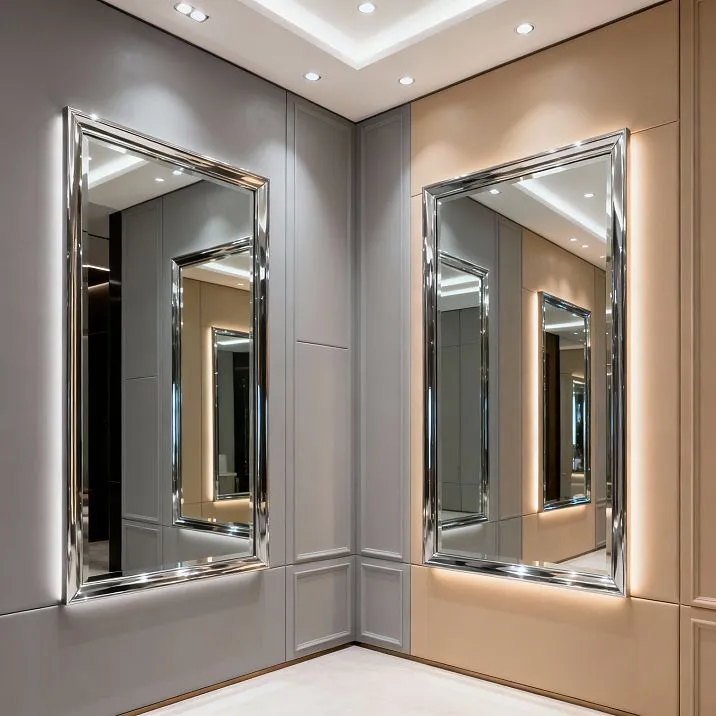
Creating a harmonious interior is like assembling a puzzle, where each element plays its role in the overall picture.Interior mirrorMirrors and wooden panels belong to the category of details that can instantly transform a space, adding depth, light, and character. These decorative elements work like the final touches of an artist — without them, the composition appears unfinished, but with them, the interior achieves completeness and individuality. Properly selected and placed mirrors expand the boundaries of a room, multiply natural lighting, and create visual effects. Wooden panels introduce the warmth of natural material, form accent zones, and fill the space with coziness and elegance.


Mirrors in different rooms: functionality and aesthetics
Each room in the house has specific requirements for mirror placement. Understanding the specifics of different zones allows for the most effective use of mirror surfaces, avoiding typical mistakes and creating harmonious compositions.




Entryway: first impression
The foyer is the home’s calling card, the first space guests see and where homeowners return home to.wall-mounted interior mirrorsHere, mirrors perform multiple functions simultaneously. The practical necessity is obvious — the ability to assess one’s appearance before leaving, adjust one’s hairstyle, and check the harmony of one’s look. But the decorative role is equally significant.
Foyers often suffer from insufficient natural lighting and compact dimensions. A properly placed mirror solves both problems. A large vertical mirror full-length visually raises the ceiling, creating an illusion of height. A horizontal mirror above a console table expands the space, making a narrow hallway feel more spacious. A mirror placed perpendicular to the light source — a window in an adjacent room or artificial lighting — reflects light beams, filling the foyer with light.
It is critically important to avoid placing a mirror directly opposite the entrance door. This creates an unpleasant effect for incoming guests, causing psychological discomfort. The optimal placement is on a side wall near the entrance. This way, the mirror is accessible when leaving, and does not create visual aggression when entering. The height of the bottom edge of the mirror from the floor — 40-50 centimeters for vertical models, 90-100 centimeters for horizontal models above consoles.
The mirror style in the foyer sets the tone for the entire interior. A heavy carved frame made of dark wood signals a classic taste of the homeowners. A minimalist mirror in a thin metal frame or even without one indicates a preference for modern aesthetics. A mirror inan interior framemade of natural wood creates a warm, welcoming atmosphere, ideal for Scandinavian or eco-style interiors.
Our factory also produces:


Living room: center of social life
The living room is the most public space in the house, a place for family evenings and receiving guests. Mirrors here play primarily a decorative role, becoming full-fledged works of art. The size of the living room allows using large-format mirrors, creating compositions from multiple mirror surfaces, experimenting with shapes and frames.
Classic placement — above the sofa or fireplace. The mirror in this position becomes a compositional center, attracts attention, and organizes the space around it. The mirror size should correspond to the dimensions of the furniture beneath it — usually, the mirror width is 60-80 percent of the sofa or mantel width. Mounting height — 20-30 centimeters from the top of the sofa back or mantel to the bottom edge of the mirror.
Modern trend — a mirror wall or a significant portion of it. This solution radically changes the perception of space, visually doubling it. This technique is especially effective in living rooms with a beautiful view from the window — a mirror wall placed perpendicular to the window reflects the landscape, making it part of the interior. At night, the mirror surface multiplies the light from chandeliers and lamps, creating a festive, celebratory atmosphere.
Compositions of multiple mirrors of different sizes — another popular approach. A group of three to five mirrors of different shapes, united by a common stylistic frame, creates a dynamic, lively composition. It is important to maintain visual balance — larger elements are placed lower or in the center, smaller ones — higher or at the edges. The distance between mirrors in a group — 10-20 centimeters. The overall composition should fit within an imaginary rectangle or square.
Placing a mirror between windows — an elegant designer trick that creates an illusion of an additional window. The mirror shape can match the shape of real windows to enhance the effect or contrast with them. This method is especially suitable for living rooms with two to three windows on one wall — a mirror in the wall niche harmonizes the rhythm and adds symmetry.
Get Consultation
Bedroom: territory of rest
The bedroom requires a particularly delicate approach to mirror placement. This is an intimate space for rest and recovery, where any irritating factors are undesirable.Mirror with framein the bedroom should be functional without causing psychological discomfort.
It is absolutely not recommended to place a mirror opposite the bed, where sleeping people may be reflected. This creates subconscious unease and disrupts deep sleep. Waking up at night and seeing one’s reflection in dim light causes fear, even if rationally understanding it is one’s own reflection. Such micro-stresses accumulate and affect the quality of rest.
The optimal mirror placement in the bedroom — on a side wall perpendicular to the bed, or on the wall with the headboard above the bed. The mirror above the headboard should be small, decorative, and securely mounted. Round or oval shapes are preferable, creating a soft, calm impression. A composition of two small mirrors symmetrically placed at the sides of the headboard — an elegant solution for classic interiors.
A functional full-length mirror in the bedroom is usually placed in the wardrobe zone, if space permits. Mirror doors on built-in wardrobes solve two tasks at once — allowing to assess one’s appearance full-length and visually expanding the room. For compact bedrooms, a mirror on a movable floor stand is suitable, which can be rotated to the desired angle and stored away when needed.
Makeup table with mirror — a traditional element of a woman’s bedroom. The mirror here has a clearly defined function; its size and shape are dictated by practical needs. A round or oval mirror with a diameter of 50-70 centimeters provides comfortable viewing when applying makeup or styling hair. Additional perimeter lighting around the mirror creates ideal conditions for cosmetic procedures.
Bathroom: a territory of functionality
In the bathroom, a mirror is an absolute necessity — its presence is not debated. The question is about size, shape, and design. Traditional placement — above the sink at a height of 100-120 centimeters from the floor to the bottom edge. The mirror width usually corresponds to the sink or cabinet width beneath it, with a permissible slight excess of 10-20 centimeters on each side.
The mirror shape in the bathroom is determined by the overall style of the room. A horizontally oriented rectangular mirror — a universal option suitable for most interiors. A round or oval mirror softens the room’s geometry and adds elegance. A vertically oriented rectangular mirror visually raises the ceiling, working well in bathrooms with low ceilings.
Moisture resistance — a critically important characteristic of a bathroom mirror. A standard mirror with an amalgam coating on glass quickly deteriorates from constant contact with steam and condensation — dark spots appear, and the coating peels off. Special mirrors for humid areas have protective coatings preventing moisture penetration. An alternative — a mirror in a sealed frame, where the glass edges are shielded from moisture contact.
Mirror cabinet — a practical solution for the bathroom, combining mirror and storage functions. Behind the mirror door are shelves for cosmetics, medicines, and household chemicals. This is especially valuable in compact bathrooms, where every centimeter counts. Built-in lighting in the mirror cabinet provides directional face illumination necessary for shaving or makeup.
A spacious bathroom allows using additional mirrors beyond the main one above the sink. A full-length mirror on a free wall creates a sense of spaciousness and allows assessing oneself fully after a shower. A mirror wall or its fragment visually doubles the room, which is especially effective when combined with beautiful finishes or decorative items.
Shapes and frames: choosing a style
The mirror shape and frame design determine its character, stylistic affiliation, and degree of influence on the interior. Understanding the specifics of different options helps make an informed choice that aligns with the overall design concept.
Classic frames: traditions and luxury
A classic mirror frame — a work of decorative art, often no less important than the mirror surface itself. Heavy frames made of natural wood with carving, gilding, or patina create a sense of luxury, connection to history, and cultural traditions. Such mirrors become independent interior accents, organizing the space around them.
The width of a classic frame is usually 10-20 centimeters, and for especially formal variants, it can reach 30-40 centimeters. The frame profile is complex, multi-tiered, alternating protrusions and recesses, smooth and relief sections. Carved elements — plant motifs, acanthus scrolls, rosettes, garlands — cover the frame entirely or accentuate corners and central parts of the sides.
Color solutions for classic frames lean toward noble shades of natural wood — from light walnut to dark wenge. Gilding — with gold leaf or imitation — adds grandeur, making the mirror the centerpiece of a formal interior. Silvering creates a cooler, more refined atmosphere. Patination — artificial aging with wood texture exposure and darkening of recesses — gives the frame a noble vintage appearance.
Classic mirror shapes are most often rectangular with vertical orientation, proportions close to the golden ratio. The top may have an ornamental finish — arched, triangular, or broken pediment. Oval mirrors in classic frames are especially elegant, their smooth lines soften the interior’s rigidity. Circular mirrors in heavy carved frames — rare but found in baroque interiors.
Neoclassicism: elegant restraint
The neoclassical style in mirror design maintains a connection with classical traditions but interprets them more restrainedly and concisely. Frames remain noticeable and expressive but lose excessive ornamentation. This is a balance between the grandeur of classicism and the functionality of modernity, ideal for city apartments where one desires elegance without museum heaviness.
The width of a neoclassical frame is usually 5-12 centimeters — sufficient to frame the mirror without overpowering it. The frame profile is simplified compared to classicism but retains volume and plane play. Carved elements are used sparingly — small rosettes in corners, restrained ornament along the perimeter, central composition at the top. Geometric motifs, symmetrical compositions, and strict lines prevail.
The color palette of neoclassical frames leans toward light, neutral shades. White or ivory — the most popular options — create a fresh, airy impression. Gray in all shades — from pearl to graphite — adds sophistication and a modern tone. Light natural wood species — oak, beech, white walnut — maintain a connection to nature while retaining overall restraint.
Mirror shapes in neoclassical design are varied. Rectangles with clear proportions, circles and ovals with proper geometry, octagons, and rhombuses — any shape with clear construction logic. Sizes vary from compact tabletop mirrors to large wall compositions. The versatility of neoclassicism allows integrating such mirrors into virtually any interior.
Minimalist solutions: minimalism of form
Modern mirror framing often completely rejects traditional frames or reduces them to a minimum. A mirror panel with beveled edges, a thin metallic trim, a narrow wooden strip — the frame becomes a technical element, not claiming a decorative role. All attention is focused on the purity of form, the quality of the mirror coating, and the method of integration into the space.
Frameless mirrors require perfect edge finishing. A bevel — a slanted edge — not only protects sharp corners but also creates a beautiful light refraction around the perimeter. The bevel width is usually 1–2 centimeters, the angle of bevel 30–45 degrees. Multiple bevels — several parallel slopes — add decorative appeal while preserving minimalist aesthetics.
Thin wooden frames, 2–5 centimeters wide, from
Thin wooden frames 2-5 centimeters wide frominterior molding— a compromise between classicism and minimalism. Natural wood brings warmth, tactility, and a connection to nature. A simple profile without carving or ornamentation preserves minimalism. Staining in neutral colors or preserving the natural wood texture with protective coating — both options work depending on context.
Minimalist mirror shapes strive for ideal geometry. The circle — the most popular shape in recent years — embodies harmony and completeness. Diameters from 40 to 120 centimeters cover the entire spectrum of needs. Rectangles and squares with aspect ratios of 1:1, 2:3, 3:4 — mathematical purity of proportions. Unusual shapes — drop, half-moon, asymmetrical compositions — for bold contemporary interiors.
Interior panel: the wooden soul of space
Interior panelTypes of wooden panels
Relief panels are created from wooden elements of varying thickness, forming a three-dimensional composition. These can be geometric patterns made from strips of different depths, creating play of light and shadow. Plant motifs carved from solid wood — leaves, flowers, branches — for nature-inspired interiors. Abstract compositions from irregular planks, imitating natural forms of bark, stone, or water.
Mosaic panels are assembled from small wooden elements — squares, rectangles, rhombuses — forming complex patterns. It is possible to use wood of different species and shades, creating color play. End-grain mosaic from branches and trunks of different diameters forms an expressive texture, each element of which is unique. Such panels are especially suitable for eco-style, loft, Scandinavian interiors.
Carved panels — works of wooden art requiring high craftsmanship. Subject compositions with landscape, animal imagery, ornamental motifs with plant scrolls, geometric carving with regular patterns — each variant creates its own atmosphere. Depth of carving ranges from several millimeters of low-relief technique to 5–10 centimeters of three-dimensional sculptural carving, defining the expressiveness of the panel.
Panel from battens — a modern solution enjoying high popularity. Parallel wooden planks, fixed to a base with equal spacing or in a chaotic pattern, create a rhythmic surface. Battens can be oriented vertically to visually increase height, horizontally to expand space, diagonally to create dynamism. Different batten widths, alternating thick and thin elements add complexity.
Paneled wall art - a modern solution popular for its appeal. Parallel wooden planks mounted on a base with equal or irregular spacing create a rhythmic surface. Planks can be oriented vertically to visually increase height, horizontally to expand space, or diagonally to create dynamism. Varying plank widths and alternating thick and thin elements add complexity.
Placement and scale
Sizeof interior panel on the wallis critically important for harmonious integration into the interior. A too small panel disappears on a large wall, while a too large one overwhelms the space. General rule: the panel should occupy 40–60 percent of the wall’s width or the width of the furniture module above it. For a 3-meter-wide wall, an optimal panel size is 120–180 centimeters.
Composition of multiple panels requires thoughtful arrangement. Triptych — three panels forming a single composition — is a classic option for decorating a wall above a sofa. The central panel is usually larger than the side ones or all three are of equal size. Distance between panels in a triptych — 10–20 centimeters. Asymmetric composition with panels of different sizes creates a modern dynamic solution, requiring precise calculation of mass balance.
Composition of multiple panels requires thoughtful arrangement. A triptych - three panels forming a unified composition - is a classic option for wall decoration above a sofa. The central panel is usually larger than the side ones or all three are of equal size. The distance between panels in a triptych is 10-20 centimeters. An asymmetrical composition using panels of different sizes creates a modern, dynamic solution requiring precise calculation of mass balance.
Color solution of wooden panel affects its perception and role in the interior. Natural wood tones with transparent protective coating — a universal option, highlighting the natural beauty of the material. Staining in dark colors — wenge, stained oak, black wood — adds drama, contrasts with light walls. Painting in white or gray while preserving visible wood texture creates a Nordic, restrained look.
Functional panels
Wooden panel can combine decorative and practical functions. Panel with integrated shelves becomes a storage system for books, decorative items, plants. Shelf depth is usually shallow — 15–25 centimeters — sufficient for placing photo frames, small vases, souvenirs. Shelves can be seamlessly integrated into the panel’s relief or contrast with the main surface.
Panel with hooks and hangers — a practical solution for entryways. Wooden base with beautiful texture or carving becomes a backdrop for functional elements. Metal, wooden, or combined hooks are arranged on the panel in one or two rows. Such a solution transforms a utilitarian hanger into a decorative object, setting the style of the entire entryway.
Panel with backlighting creates an additional source of soft diffused light. LED strip, mounted along the perimeter or in recesses of the relief, illuminates the wall, creating a floating object effect. Built-in spotlights accentuate individual composition elements, creating play of light and shadow. Such a solution is especially effective in bedrooms or living rooms to create evening ambiance.
Acoustic panels made of wood with perforation or relief surface improve the acoustic environment of the room. They absorb excessive sound reflections, eliminate echo, making acoustics comfortable. This is especially relevant for living rooms with home theaters, music rooms, offices, where speech clarity during video conferences is important. Decorative function combines with practical utility.
Panel and molding: synthesis of elements
Combining wooden panel with polyurethane or wooden molding creates rich, multi-layered compositions, uniting the warmth of natural material with the clarity of architectural lines. This approach allows quickly achieving the effect of expensive classic finishing at a reasonable budget and minimal labor costs.
Frame made of molding around the panel
The simplest way to integrate a panel into the interior is to frame it with molding, creating a clear boundary that highlights the panel from the wall plane. The molding is selected according to the interior style and the nature of the panel itself. For classic interiors, relief moldings with ornamentation are suitable. For modern spaces — simple smooth profiles. For eco-interiors — simple wooden strips.
The width of the molding is determined by the size of the panel — the larger the panel, the wider the frame can be. For panels sized 80-100 centimeters, the optimal molding width is 5-8 centimeters. For large panels 150-200 centimeters, moldings 10-15 centimeters wide can be used. A too wide molding around a small panel creates imbalance, while a too narrow molding around a large panel becomes lost.
The color solution for the molding frame can vary. A contrasting option — white molding around a dark wooden panel on a light wall — clearly highlights the panel, making it the focal point. Molding in the wall’s tone creates a softer frame, leaving the panel as the main element. Molding in the panel’s tone unifies them into a single whole, contrasting with the wall.
Installation of the molding frame around the panel is performed in a strict sequence. First, a marking is made on the wall to determine the position of the panel and molding. Then the panel is mounted — on adhesive, self-tapping screws, or a combination of fasteners depending on weight. After securely fixing the panel around the perimeter, with a 3-5 centimeter offset, the moldings are glued. The angles of the moldings are cut at 45 degrees for perfect joints. Joints are spackled, and the moldings are painted.
Panel composition in a molding grid
A more complex option — creating several molding frames on the wall, within which panels are placed, forming a rhythmic composition. This technique imitates classical boiserie, creating architectural complexity and structuring the wall plane. Implementation of such a solution is possible within one evening if ready-made elements and simple tools are available.
Planning begins with determining the number and size of frames. For a wall 3-4 meters wide, 3-5 vertically oriented frames are optimal. The height of the frames is usually 1.5-2 times greater than the width. Distances between frames and from the outermost frames to the corners should be equal to maintain symmetry. Marking is done with a pencil using a level and tape measure.
Mounting moldings begins with vertical elements, then horizontal ones are added. Adhesive is applied to the back of the molding, the element is pressed firmly against the wall and secured. Angles are cut with a saw at 45 degrees. After installing all moldings and the adhesive drying, joints are spackled and moldings are painted. Then wooden panels are mounted inside each frame — all identical for a rhythmic composition or varied for a more free solution.
The interior space within the frames can be interpreted differently. The classic option — the panel fills the entire frame from molding to molding. A modern approach — the panel is smaller than the frame, leaving a wall background around it, creating an airy layer. You can alternate frames with panels and empty frames, which contain only a color- or wallpapered background accent.
Additional elements enrich the composition. A horizontal molding at 1/3 the height from the floor divides the wall into a base and main zone. A top molding under the ceiling creates a frieze zone. Vertical moldings in the room’s corners, imitating pilasters, add architectural logic. The result is a complex, rich composition that creates a palace-like interior effect.
Combinations with planks and baseboards: harmony of height
Integrating mirrors and panels into the interior requires considering all existing elements — plank panels, baseboards, casing, cornices. Harmonious combination of different components by height, proportions, and color creates a cohesive, thought-out image.
Plank panels and mirrors: verticals and reflections
Plank panels — a popular element in modern interiors, creating an expressive textured surface. Combining a plank wall with a mirror requires attention to detail. The mirror can be placed on the plank surface, interrupting the rhythm of the planks, or on a smooth wall adjacent to the plank zone.
Mounting a mirror directly onto planks is possible if the planks are wide enough and the structure is secure. The mirror is mounted to several planks simultaneously, distributing the load. A small gap forms between the mirror and planks, which can be accentuated with backlighting — an LED strip behind the mirror creates an eye-catching light outline. This solution works with medium-sized mirrors weighing up to 5-7 kilograms.
A more reliable option — creating a smooth zone within the plank wall for mounting the mirror. A section of the wall remains without planks, and the mirror is mounted on the base surface using the traditional method. Planks frame the mirror, creating an interesting interplay between smooth and textured, reflective and matte surfaces. The smooth zone’s size must exactly match the mirror’s size or exceed it by 5-10 centimeters on each side.
Color interaction between planks and mirror frame affects overall perception. A frame in the same tone as the planks creates a monolithic composition, with the mirror naturally integrated into the plank surface. A contrasting frame — for example, dark on light planks or white on wooden — highlights the mirror, making it an accent. Absence of a frame on a mirror mounted on a plank wall emphasizes material, form, and texture contrasts.
Panel in a plank composition
Wooden panel and plank wall — related elements, both using wood, both creating a textured surface. Their combination requires differentiation; otherwise, the panel will merge with the planks and lose its accent role. Differentiation can be achieved through element orientation — vertical planks and horizontal panel strips. Surface character — smooth planks and carved panel. Color — light planks and dark panel.
Mounting a panel on a plank wall is technically similar to mounting a mirror. Either the panel is mounted directly onto the planks if they are wide and strong enough. Or a smooth section is created for the panel, which is mounted onto the base wall. The second option is preferable for heavy, bulky panels, while the first suits light compositions.
Especially interesting is the combination of a panel made of vertical planks on the wall with horizontal planks. The perpendicular orientation of elements creates visual interaction, making the panel clearly readable against the wall background. Different plank thicknesses between the panel and wall add complexity. Contrasting wood species or staining enhance differentiation.
Baseboards and heights: vertical logic
Baseboard — an important element that completes finishing, concealing the technological gap between the wall and floor. Baseboard height affects the perception of the room’s proportions. Standard baseboard height of 6-10 centimeters suits most interiors. Tall baseboards 15-25 centimeters create a classic, formal look. Minimalist baseboards 3-5 centimeters high are almost invisible and do not distract attention.
The color coordination of baseboards, door casings, window trim, mirror frames, and panel molding creates a unified system of frames organizing the interior. All elements in one color — a classic solution creating cohesion. All elements in natural wood of the same species — an eco-friendly, warm option. A contrasting system — dark baseboards and casings with light mirror frames — a more complex, modern solution.
Color coordination of baseboards, door casings, window trim, mirror frames, and panel molding creates a unified framing system organizing the interior. All elements in one color - a classic solution creating cohesion. All elements in natural wood of the same species - an eco-friendly, warm option. Contrasting system - dark baseboards and casings with light mirror frames - a more complex, modern solution.
Proportions and rhythm: mathematics of beauty
A harmonious interior adheres to certain proportional relationships. The golden ratio, rule of thirds, modular grid — these principles apply to the placement of mirrors, panels, and other elements. The height of placing main accents on the wall usually falls within the 1/3 or 2/3 zone from floor to ceiling — these are natural focal points for the viewer’s gaze.
The width of the mirror or panel should correspond to the width of the furniture beneath it in a ratio of approximately 2/3. For a sofa 180 centimeters wide, the optimal panel width above it is 120 centimeters. The mirror may be wider or narrower depending on the task, but extremes — a panel significantly wider than the sofa or too narrow — create imbalance.
The rhythm of repeating elements — several mirrors in a row, a series of panels, alternating planks — should be regular or meaningfully irregular. Random intervals appear careless. Equal distances between elements create a calm, orderly rhythm. Gradual changes in intervals or element sizes according to a specific law — progression, decrease — create dynamics and direction.
Mounting and Care: Practical Aspects
The beauty of mirrors and panels in interior design depends not only on proper selection and placement, but also on the quality of installation, reliability of mounting, and proper care. Technical aspects are often left out of sight, but it is precisely these that determine longevity and safety of use.
Mirror Mounting: Safety First
Mirrors are fragile and potentially hazardous elements requiring secure mounting. The mounting method depends on the size, weight of the mirror, and type of wall. Lightweight mirrors weighing up to 5 kilograms can be adhered using special mirror adhesive or double-sided mounting tape. Medium-sized mirrors weighing 5-15 kilograms require combined mounting — adhesive plus mechanical supports. Heavy mirrors weighing over 15 kilograms are mounted on special brackets.
Mirror adhesive is applied in dots or in a snake-like pattern to the back of the mirror. It is important to use specialized adhesive that does not damage the mirror coating. Universal mounting adhesives may react with the mirror coating, causing its destruction. After applying the adhesive, the mirror is firmly pressed against the wall and secured with supports until the adhesive fully cures — usually 24 hours.
Mirror mounting brackets come in various types. Decorative metal clips visible around the mirror perimeter simultaneously secure and decorate. Hidden brackets mounted on the back of the mirror provide mounting without visible elements. For heavy mirrors, French hooks — metal profiles, one mounted on the wall and the other on the mirror — are used, which interlock with each other.
The type of wall is critically important for choosing mounting hardware. Concrete and brick walls allow any type of mounting and can withstand significant loads. Gypsum board partitions require special butterfly or Molly anchors that distribute the load. For heavy mirrors on gypsum board, it is advisable to install built-in supports during the partition installation phase. Wooden walls allow the use of screws, which securely hold the load.
Mounting Panels: Reliability and Aesthetics
Wooden panels are usually lighter than mirrors of similar size, but still require secure mounting. The mounting method depends on the panel's construction. Panels on solid backing — plywood, MDF — are mounted as a single panel. Panels without backing, assembled from separate elements, require mounting each element or creating a supporting frame.
Adhesive mounting is suitable for small, lightweight panels weighing up to 3-5 kilograms. Liquid nails type mounting adhesive is applied in dots to the back of the panel. After pressing the panel against the wall, it is secured with supports or painter’s tape until the adhesive dries. This method provides a clean result without visible mounting hardware, but does not allow easy removal of the panel.
Mechanical mounting on hidden brackets is a more reliable and flexible method. Metal bracket hooks are attached to the back of the panel, and corresponding hooks or a hook bar is mounted on the wall. The panel is simply hung and easily removed when needed. This method is suitable for panels of any weight, provided the mounting hardware is properly selected.
Through-mounting with screws through the panel’s front surface is the most reliable but visually compromising method. Screw heads remain visible, even if they are recessed and filled. This method is used for very heavy panels or when mounting hardware is part of the design — for example, decorative metal screws in an industrial style.
Protection During Finishing Work
Mirrors and wooden panels are sensitive to damage during finishing work nearby. Wall painting, molding installation, and other operations require protection of already installed elements. The mirror is covered with polyethylene film secured with painter’s tape around the perimeter. It is important to prevent adhesive tape from contacting the mirror surface — tape is applied to the frame or to the wall around frameless mirrors.
Wooden panels are also protected with film, especially during wall painting nearby. Paint splashes on wood are difficult to remove without leaving marks; it is easier to prevent them from occurring. If the panel is coated with varnish or wax, accidental paint drops can be carefully removed with a solvent, but this risks damaging the finish.
When installing molding around panels or mirrors, care is required. Molding trimming is done before installation, and only final fitting is done on-site. Adhesive is applied so as to avoid it extruding onto the panel or mirror. If extrusion occurs, the adhesive is immediately removed with a damp cloth before it dries.
Spreading joint compound near mirrors requires special care. Joint compound splashes on mirrors dry and are difficult to remove; they may scratch the surface during cleaning. Work is done in small portions of compound with immediate removal of excess. After the compound dries, sanding is performed with mirror protection — dust from sanding settles on all surfaces, and it is difficult to remove it from the mirror without streaks.
Painting Molding Around Mirrors
Painting molding around mirrors is done after full installation and joint compound application, but requires protection of the mirror surface. Painter’s tape is applied along the edge of the mirror, creating a clear boundary. Choosing quality tape with moderate adhesion is important — overly sticky tape may damage the mirror coating upon removal, while too weak tape may allow paint to seep under the tape.
Painting Molding Around Mirrors
Painting moldings surrounding the mirror is done after full installation and spackling, but requires protection of the mirror surface. Painter's tape is applied along the mirror's edge, creating a clear boundary. Choosing quality tape with moderate adhesion is important - overly sticky tape may damage the amalgam upon removal, while too weak tape may allow paint to seep under the tape.
Painting is done with a brush; using a roller is risky due to possible splashes. The first layer is applied thinly, with special care at the edge near the mirror. After the first layer dries, a second, thicker layer is applied. Tape is removed while the paint is still slightly elastic — this results in a cleaner edge without paint peeling.
If paint gets on the mirror, its removal depends on the paint type and drying time. Fresh water-based paint is easily wiped off with a damp cloth. Dried paint is soaked with warm soapy water, then gently scraped off with a plastic scraper. Fully dried paint is removed with specialized solvents that do not damage the mirror coating, or mechanically with a sharp blade at a minimal angle.
Care for Mirrors and Panels
Mirrors require regular cleaning to maintain their shine and clarity of reflection. Dust is removed with a dry, soft microfiber cloth or a special mirror cleaning cloth. Dirt, stains, and fingerprints are cleaned with glass cleaning solution or a solution of water with a small amount of vinegar or ammonia. The cleaning solution is sprayed onto the cloth, not directly onto the mirror, to avoid liquid seeping over the edges and damaging the mirror coating.
Wiping is done in circular motions or vertical strokes from top to bottom. Horizontal wiping often leaves streaks. After wet cleaning, the mirror is polished with a dry cloth until all moisture is removed and the ideal shine is achieved. Cleaning frequency depends on the level of contamination — in bathrooms, weekly cleaning is required, while in living rooms, cleaning once a month is sufficient.
Wooden panels require less care. Dust is removed with a dry cloth or vacuum cleaner with a soft attachment. Raised areas and recessed areas are cleaned with a soft brush. Wet cleaning is only permissible for panels with water-resistant finishes — varnish, oil, or wax. Unprotected wood is afraid of moisture, may deform, and develop stains.
The protective coating of wooden panels is renewed every few years depending on the type of coating and usage conditions. Oil-based wax requires more frequent renewal — every 1-2 years, while varnish lasts 3-5 years. The surface is lightly sanded with fine-grit sandpaper to remove dirt and improve adhesion, then a new layer of protective finish is applied. This refreshes the panel’s appearance and restores the wood’s protection.
Popular questions and answers
At what height should a mirror be hung in the hallway?
For a full-length mirror in the hallway, the optimal height for the bottom edge is 40-50 centimeters from the floor, and the top edge at 180-200 centimeters. For a horizontal mirror above a console table, the bottom edge is placed at 90-110 centimeters from the floor, corresponding to 20-30 centimeters above the table surface. The center of any mirror should approximately align with the eye level of a standing person — 150-160 centimeters from the floor.
Can a mirror be hung opposite a window?
Practically, a mirror opposite a window creates glare from sunlight, which may be uncomfortable. From a design perspective, such placement does not visually expand the space - the mirror reflects the window, which is already present. More effective is placing the mirror perpendicular to the window on an adjacent wall - it reflects the light beam, brightening the room without creating direct glare.
Which mirror is better for the bathroom?
For the bathroom, a mirror with moisture protection is required - a special coating on the back or a sealed frame covering the glass ends. Size is determined by the sink or cabinet dimensions - the mirror width is usually equal to or 10-20 centimeters wider. Shape can be any, but a horizontally oriented rectangular mirror is more practical. Built-in lighting ensures comfortable face illumination for hygiene procedures.
How to mount a heavy mirror on drywall?
Special butterfly or Molly anchors, which expand behind the drywall sheet and distribute the load, are used to mount heavy mirrors on drywall. One butterfly anchor withstands 5-8 kilograms; for a 15-20 kg mirror, 3-4 mounting points are required. It is more reliable to install wooden backing plates in the drywall frame during installation, then mount the mirror using standard screws into the backing plates.
What size panel should be chosen for the wall above the sofa?
Widthinterior panelThe panel above the sofa should be 60-80 percent of the sofa's width. For a standard 180 cm wide sofa, an optimal panel size is 110-140 cm. The panel height is usually half to two-thirds of its width for horizontal orientation. The panel is mounted 20-30 cm above the top of the sofa backrest, with its center at 130-150 cm from the floor.
Can wooden paneling be combined with polyurethane moldings?
Combining wooden paneling with polyurethane moldings is not only possible but very effective. Polyurethane moldings create a clear architectural frame, while wooden paneling adds warmth from natural material. Moldings are usually painted in neutral colors - white, gray, beige - contrasting with the natural wood tone. Such a composition combines classic molding architecture with modern wooden decor aesthetics.How to care for wooden paneling?
Wooden paneling with protective coating requires minimal maintenance. Dust is removed with a dry soft cloth or vacuum cleaner with brush attachment. Recessed areas are cleaned with a soft brush. Wet wiping is only permissible for paneling coated with varnish or oil - using slightly damp cloth without excess water. Every 1-3 years, depending on the coating type, it is recommended to renew the oil or wax protective layer to preserve appearance and protect the wood.
What distance should be between panels in a composition of multiple elements?
When creating a composition of multiple panels, the optimal distance between elements is 10-20 centimeters for medium-sized panels (60-100 cm). For large panels over 120 cm, the distance may increase to 25-30 cm. Too small gaps visually merge elements, while too large gaps disrupt the composition. It is important to maintain equal distances between all elements for rhythmic consistency.
Is a frame needed for a modern mirror?
Modern aesthetics often imply abandoning traditional frames.wall-mounted interior mirrorsFrameless or with minimal metallic trim is ideal for minimalist and Scandinavian interiors. The edges of such a mirror are beveled - angled edges creating beautiful light refraction. A frameless mirror appears lighter, airier, and does not distract attention from the reflection and surrounding interior.
Can panels be mounted on wallpaper?
Technically possible, but strongly discouraged for panels weighing more than 2-3 kilograms. Adhesive or fasteners hold onto wallpaper, which in turn holds onto the wall, and the strength of the connection is determined by the weakest link. A heavy panel may rip off the wallpaper along with itself. The correct method is to mount the panel on a prepared base surface before wallpapering or cut out wallpaper at the mounting location and then attach it to the edges of the panel after installation.
The mirror frame can coordinate with other framing elements - baseboards, door casings, cornices - creating a unified system. All elements in one color - a classic solution for a cohesive interior. A frame matching the furniture tone links the mirror to the room's ambiance. A contrasting frame - dark on light background or vice versa - makes
an accent. A metallic frame coordinates with light fixture hardware and door handles.Mirror with frameaccent. The metal frame combines with the lighting fixtures and door handles.
What lighting is better for a mirror?
Ideal lighting for a mirror is even, diffused, without harsh shadows. For mirrors in the bathroom and at the vanity, optimal lighting is fixtures on both sides at face level or built-in perimeter lighting. Lighting from above creates shadows under the eyes and chin, which is uncomfortable during makeup or shaving. For decorative mirrors in the living room or hallway, general room lighting is suitable; additional lighting is not necessary but can create an eye-catching accent.
How to choose the shape of a mirror for a specific interior?
The shape of the mirror should match the overall style of the interior. Classic interiors tend toward vertically oriented rectangular mirrors and oval mirrors in carved frames. Modern spaces prefer round mirrors, squares, and asymmetrical shapes. A horizontal rectangular mirror visually expands the space, while a vertical one increases the height. A round mirror softens the angularity of a room, creating a harmonious, calm impression.
Ready-made solutions for quick transformation
Creating a finished interior using mirrors and panels does not require months of work and an army of specialists. With proper planning and ready-made elements, you can transform a space in one or two days. Let's consider several scenarios for quick decorating of different rooms.
Hallway in one day
Morning begins with preparing the wall — cleaning and priming. While the primer dries, unpack the elements —Interior mirrorin a frame, console table, wooden panel with hooks for clothes. By lunchtime, marking is done — the position of the console table is determined, the mirror above it, and the panels on the sides.
Installation begins with mounting the console table, if wall-mounted. Then mark and hang the mirror above the table — the center of the mirror should be 30-40 centimeters above the table surface. On the side wall, mount the panel with hooks at a height of 150-160 centimeters to the center. By evening, the hallway is transformed — a functional zone with a mirror for checking appearance, a table for keys and small items, convenient hooks for clothes.
Additional touches — molding frames around the mirror and panels — are added at your discretion on the second day. Molding is cut, glued, joints are spackled after the glue dries, and then painted. Result — an elegant hallway with thoughtful functionality and harmonious decor, created by your own hands over the weekend.
Living room in one evening
Quickly updating the living room focuses on the accent wall behind the sofa. Friday evening is dedicated to planning — choosing a composition of moldings and panels, calculating dimensions, purchasing materials. Saturday begins with marking the wall — three vertical molding frames of the same size, symmetrically placed.
Installing moldings takes 2-3 hours including cutting corners. After gluing all elements, there is a break for the glue to set. Sunday morning — spackling joints, sanding after drying, painting the moldings. While the paint dries, wooden panels are mounted inside the molding frames — three identical or three different ones, united by a common theme.
By Sunday evening, the composition is complete. The accent wall transforms the entire living room, creating architectural depth and structuring the space. The sofa receives a worthy frame, and the interior achieves completeness. One weekend of work yields results comparable to professional decorating.
Bedroom: headboard zone
Transforming the headboard zone — a quick way to refresh the bedroom. A wooden panel above the headboard creates a warm focal point, uniting the bed with the rest of the interior. The panel size is determined by the bed width — typically 100-140 centimeters for a double bed 160-180 centimeters wide.
Installing the panel takes minimal time — marking the position, mounting brackets on the wall, hanging the panel on the brackets. An advanced option — framing the panel with molding or creating a symmetrical composition of two panels on either side of the headboard. Additional lighting — wall sconces on both sides of the bed at the panel level — highlights the decor, creating a cozy evening atmosphere.
Alternative scenario — mirror above the dresser opposite the bed. This placement is psychologically safe and functionally convenient for morning routines. A horizontal mirror 80-100 centimeters wide is mounted 20-30 centimeters above the dresser. Framing with molding adds architectural interest and connects the mirror to the wall.
Bathroom: functional beauty
Updating the bathroom focuses on the sink area. Replacing a standard mirror with a mirror in an attractive frame instantly changes the character of the room. A moisture-resistant wooden frame or a polyurethane frame with wood imitation withstands bathroom conditions, bringing warmth to the often cold space covered in tiles.
The mirror size corresponds to the width of the sink or cabinet — for a standard sink 50-60 centimeters wide, a 60-70 centimeter wide mirror is suitable. The mounting height — 100-120 centimeters from the floor to the bottom edge — ensures comfortable viewing for all family members. Additional lights on both sides of the mirror or built-in lighting improve functionality.
Wooden panels in the bathroom are possible only with a quality moisture-resistant coating and good ventilation. A small panel 40x60 centimeters on a free wall adds coziness and softens the coldness of the tile. The panel is placed away from direct water contact — opposite the bathtub, on the wall with towel racks, next to the washing machine.
Stylistic combinations
Mirrors and panels are universal, but their specific execution strongly depends on the interior style. Understanding the characteristics of different styles helps choose elements that perfectly match.
Classic: grandeur and symmetry
A classic interior requires mirrors in heavy carved frames made of natural wood or quality imitation. Gilding, patina, and complex frame profiles — mandatory attributes. The shape is usually a vertical rectangle or oval. Placement is symmetrical — centered on the wall, flanked by paired lights, consoles, and decorative elements.
Wooden panels in classic style — carved compositions with botanical motifs, narrative scenes, ornamental reliefs. Wood of noble species — oak, walnut, mahogany — treated with oil or lacquer to reveal texture. Framing panels with moldings is mandatory, and moldings must be proportionate to the interior scale — wide, relief, richly decorated.
Neoclassicism: balance of tradition and modernity
Neoclassical style uses more restrained versions of mirrors and panels. Mirror frames retain volume but lose excessive ornamentation. Light tones — white, ivory, gray — predominate over dark wood and gilding. Shapes remain classic but are simplified and geometricized.
Panels in neoclassicism tend toward geometric compositions made of wooden elements of regular shapes. A mosaic of contrasting-tone rectangles, a relief composition of planks forming a strict pattern. Carving is used sparingly — restrained ornament along the perimeter, a small central motif. Framing with thin, elegant moldings completes the composition.
Scandinavian style: light simplicity
Scandi-style interiors prefer round or oval mirrors in thin wooden frames made of light-colored woods—birch, beech, pine. The frame can be natural with a transparent finish or painted in white, gray, or pastel tones. Mirror sizes are medium, not monumental—diameter 50–80 centimeters. Frameless mirrors with beveled edges are also appropriate in a Scandinavian context.
Wooden panels in Scandi style are maximally simple, highlighting the natural beauty of the material. Unfinished boards preserving texture and natural imperfections, compositions of branches, panels made of thin slats. Colors are light—whitewashed oak, light pine, bleached wood. Minimal processing, maximum natural aesthetics. Moldings are rarely used; if used, they are the simplest, thin, light-colored ones.
Loft: industrial aesthetics
Loft interiors love large mirrors in rough metal frames or without frames at all. Shape is usually rectangular, proportions may be non-standard—elongated narrow mirrors, horizontal panoramic variants. Frame made of black metal, weathered steel, copper with patina. Mounting may be deliberately rough, visible, as part of the aesthetic—bolts, chains, metal brackets.
Wooden panels in loft style—often unfinished boards, old barn doors, fragments of rough wood preserving natural cracks and knots. End-grain mosaic from splices of different diameters, compositions from boards of varying thickness. Dark woods or artificial aging of light wood. Combination of wood and metal—frames from metal angles, inserts of rusted iron. Moldings are not used; they are replaced by metal profiles.
Minimalism: purity of lines
Minimalist interiors prefer frameless mirrors with regular geometric shapes. Circle is the most popular shape, embodying simplicity and perfection. Square, rectangle with clear proportions. Edges are beveled or simply polished. No decoration, no embellishments—only a clean mirror surface. Mounting is hidden, inconspicuous.
Wooden panels in minimalism—geometric compositions from perfectly processed elements. Parallel slats of equal width with equal spacing, mosaic of squares or rectangles of one size. Color is uniform—natural light wood or painted in neutral tones. No carving, no embellishments. Moldings are not used; panels are mounted flush with the wall or with a minimal gap for backlighting.
Conclusion
Mirrors and interior panels—finishing touches that transform a set of furniture and finishing materials into a true home with character and soul.Interior mirrorMirrors and interior panels expand space, multiply light, create depth. Wooden panels bring warmth of natural material, create a focal point, fill the room with coziness. Thoughtful combination of these elements with moldings, slats, and other interior components creates harmonious, balanced compositions.
Variety of shapes, sizes, stylistic solutions allows selecting ideal options for any interior—from grand classic to minimalist. Round mirrors soften the geometry of modern spaces. Rectangular mirrors in carved frames support classic grandeur. Frameless variants create lightness and airiness. Wooden panels—from simple slat compositions to intricate carved artworks—add volume, texture, tactile quality.
Practical aspects of working with mirrors and panels are accessible even to non-professionals when basic rules are followed. Proper choice of fasteners ensures reliability and safety. Careful marking guarantees symmetry and balance. Careful installation with protection of elements during finishing work preserves them in perfect condition. Regular maintenance extends service life and maintains appearance at an optimal level.
Speed of interior transformation using mirrors and panels—their key advantage. In one weekend, you can completely change the character of an entryway, create an accent wall in a living room, refresh the headboard zone in a bedroom. No large-scale renovation work, dirt, noise. Ready-made elements are mounted on existing finishes, instantly creating the effect of a thoughtfully designed space.
Combination of mirrors and panels with interior moldingand moldings opens up boundless compositional possibilities. Molding frames structure space, create architectural logic. Wooden molding unites various elements into a single system.Interior frameadds nobility, completeness. Combination of different materials—wood, polyurethane, metal—creates rich, multi-layered solutions.
STAVROS company offers a wide selection ofwall-mounted interior mirrorsin various styles—from classic ones in carved gilded frames to modern minimalist variants. High-quality materials, precise execution, variety of sizes and shapes allow finding the ideal solution for any interior.Interior panels for wallsmade of natural wood, crafted with skill and attention to detail, become genuine works of decorative art.
Professional consultants from STAVROS will help select elements according to the specifics of a particular interior, calculate the required amount of materials, recommend optimal mounting methods. Convenient logistics, flexible delivery conditions, quality guarantees make working with the company comfortable and reliable. Years of experience, thousands of completed projects, grateful customer reviews confirm STAVROS’s reputation as a reliable partner in creating beautiful interiors.
Transform your home into a space reflecting your individuality, taste, and pursuit of beauty.Interior mirrors in frameand wooden panels—quick accents creating completeness, harmony, beauty. Every reflection in the mirror will remind you of attention to detail, every glance at the panel will bring joy from contemplating the nobility of natural wood. Create an interior where it’s pleasant to live, inspiring, calming, energizing—an interior that can truly be called home.