Article Contents:
- Evolution of Decorative Thinking: From Function to Art
- Psychology of Corner Perception
- Architectural Genetics of Styles
- Material Science in the Context of Decorative Solutions
- Wood: Living Beauty in Every Detail
- Polyurethane: Technological Revolution
- Typology of Decorative Corner Solutions
- Interior Systems: Harmony of Interior Space
- Facade Solutions: The Face of Architecture
- Professional Installation — Guarantee of Results
- Modern Equipment: Precision to the Micron
- Quality control systems: perfection as a standard
- Design Concepts and Stylistic Directions
- Neoclassicism: eternal elegance
- Modern minimalism: beauty of simplicity
- Eco Style: Harmony with Nature
- Functional features and technical characteristics
- Protective Functions: More Than Beauty
- Acoustic Properties: Silence as Comfort
- Climate adaptations
- Economic Aspects and Investment Appeal
- Impact on property value
- Payback Periods and Lifespan
- Trends in development and innovative solutions
- Digital technologies in design
- Personalization and customization
- Smart Materials and Coatings
- Practical recommendations for selection and use
- Criteria for Professional Selection
- Installation: the art of invisible perfection
- Maintenance and Restoration
- Conclusion: The Art of Details as a Philosophy of Perfection
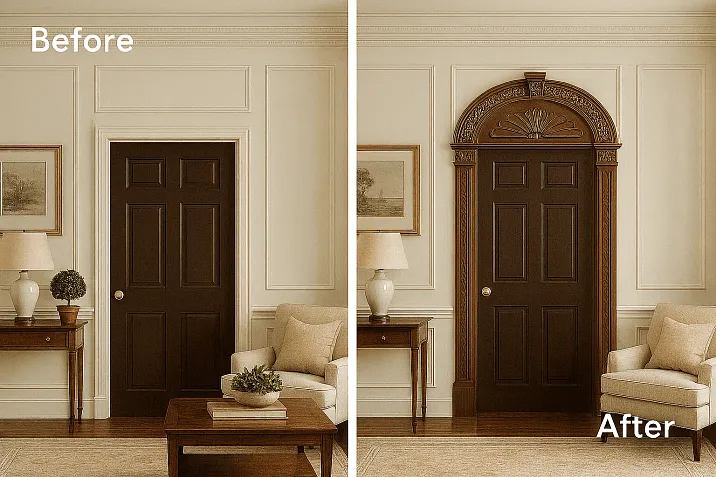
There are elements in architecture and design that, like a magic wand, can transform an ordinary room into a true masterpiece. Decorative corner elements — precisely such details. At first glance, unnoticed, they create that very atmosphere of luxury and completeness which distinguishes a professionally executed interior from amateur work.
Imagine a violinist playing on a poorly tuned instrument. The melody is recognizable, but something cuts the ear, disturbing the enjoyment of music. Similarly, an interior without properly finished corners — everything seems in place, yet there is no harmony. and frames create a home atmosphere, making it truly cozy and individual. This is an investment in beauty, which pays off every day through aesthetic pleasure from admiring the beautiful. solve this problem fundamentally, creating that very music of space which captivates and delights.


Evolution of Decorative Thinking: From Function to Art
When ancient masters first began to use Corner decorative elements in their creations, they likely did not anticipate the revolution they would bring to the understanding of beauty. Initially born from practical necessity to conceal joints and protect vulnerable areas of construction, these elements quickly became a powerful tool of artistic impact.




Psychology of Corner Perception
The human brain is constructed in a remarkable way. We subconsciously seek signs of order and perfection in our surrounding space. An unrefined corner creates a sense of incompleteness, even if everything else is executed flawlessly. This is explained by evolutionary characteristics of our perception — in nature, ideal angles are extremely rare, and their presence in an interior signals the brain that the environment is man-made and of high quality.
Decorative corner elements operate on a subconscious level, creating a sense of stability and reliability. That is why special attention is paid to the quality of corner joints in luxury hotels, elite clubs, and reputable offices.
Our factory also produces:
Architectural Genetics of Styles
Each historical era brought its own understanding of the beauty of corner solutions. Gothic cathedrals amazed with the complexity of carved details, where each Mold Corner Element told a whole story. The Renaissance introduced mathematical precision in proportions, while baroque brought theatrical opulence of forms.
Modern design does not reject history, but reinterprets it through the prism of new technologies and materials. Wooden Corner Elements today can be manufactured with micron-level precision, inaccessible to masters of the past, while preserving all the warmth and nobility of the natural material.
Get Consultation
Material science in the context of decorative solutions
Wood: living beauty in every detail
Wood has been and remains the king of decorative materials. Its unique ability to 'breathe', change over time, and acquire a noble patina makes Wooden Corner Elements an unmatched choice for creating living, animated interiors.
Each wood species has its own character. Oak — aristocratic restraint and centuries-old wisdom. Ash — dynamic energy of growth. Walnut — warm elegance. Beech — democratic reliability. Choosing wood for corner elements, we choose the soul of the future interior.
Modern processing technologies allow to fully reveal the potential of wood. Vacuum drying stabilizes the material, eliminating deformations. Impregnation with protective compositions extends the life of products for decades. Precise mechanical processing ensures ideal geometry.
Polyurethane: Technological Revolution
Corner Polyurethane Element — this is a triumph of modern chemistry. A material that can imitate any texture, take on the most complex forms, and yet remain lightweight, strong, and durable.
Polyurethane corner elements open previously unseen possibilities for designers. The most complex reliefs, delicate scrolls, precise geometric constructions — all this becomes accessible and economically justified.
A special advantage of polyurethane — its water resistance. Corner Ceiling Element Made of polyurethane, they can be installed in bathrooms, pools, saunas without concerns about longevity.
Typology of decorative corner solutions
Interior systems: harmony of interior space
Corner elements for walls create a visual framework of the room. They define the rhythm of space, set the scale, and form compositional centers. A properly designed system of corner elements can visually increase ceiling height, expand a narrow room, or, conversely, add intimacy to a spacious hall.
works in close coordination with lighting. The play of light and shadow on relief surfaces creates a living, constantly changing picture. Morning light reveals some details, evening lighting — others. This makes the interior dynamic and interesting for prolonged viewing.
Corner element for ceiling has special significance in the composition of the interior. The ceiling — this is the 'fifth wall', and its decoration fundamentally affects the perception of the entire space. High-quality ceiling corner elements create a sense of completeness, grandeur, and respectability.
Facade solutions: the face of architecture
Facade Corner Elements operate under extreme conditions. They must withstand temperature fluctuations from -40 to +60 degrees, resist ultraviolet radiation, rain, snow, hail. At the same time, maintaining an impeccable appearance for years and decades.
Facade Corner Elements — this is the building's calling card. They form the first impression, create status, demonstrate taste and the owner's financial capabilities. Therefore, saving on facade elements always results in significant losses — both financial and reputational.
Modern facade systems are high-tech constructions, where each element is designed for specific loads and operating conditions. Fasteners, sealants, protective coatings — everything works as a single organism, ensuring longevity and reliability.
Technological aspects of production and installation
Modern equipment: precision down to the micron
Production of high-quality of decorative corner elements today — this is a symphony of advanced technologies. Multi-axis machining centers are capable of creating the most complex three-dimensional surfaces with precision unattainable by manual work.
CNC milling allows obtaining perfectly repeatable elements, which is critically important for creating large decorative compositions. Imagine a grand staircase with hundreds of identical balusters — even the slightest deviation in dimensions immediately becomes noticeable and destroys the impression.
Laser scanning and 3D modeling open opportunities for creating elements based on individual sketches. Previously complex original works can now be reproduced in exact copies, preserving all nuances of the creative concept.
Quality control systems: perfection as a standard
Each stage of production Buy corner molding Monitored by modern measuring systems. Coordinate measuring machines check geometry with accuracy to hundredths of a millimeter.
Surface quality control includes assessment of roughness, presence of defects, uniformity of paint or protective coating. Special microscopes reveal the slightest structural material disruptions that could cause premature failure.
Durability tests simulate multi-year operational conditions over several days. Climate chambers create extreme temperature regimes, UV lamps simulate solar exposure, vibration stands check resistance to mechanical loads.
Design concepts and stylistic directions
Neoclassicism: eternal elegance
Neoclassical style never goes out of fashion. Its foundation is harmony of proportions, noble restraint of forms, quality of execution. Decorative corner elements In neoclassical interiors — this is intricate craftsmanship, where every line, every curve adheres to strict canons of beauty.
Golden ratio, order systems, classical ornaments — all of this finds reflection in modern decorative elements. Wall decorative ornaments In neoclassical style, they create a sense of aristocratic refinement, taste, and education.
The color palette of neoclassicism is built on combinations of white, cream, and golden tones. These colors emphasize the nobility of forms, creating a sense of light and spaciousness. Corner Element for Molding May be executed in gilding or patination techniques, adding historical depth to the interior.
Modern minimalism: beauty of simplicity
Minimalism seems the opposite of ornamentation, but this is a misleading impression. In a minimalist interior, every detail is of great importance, as there is nothing superfluous that could distract attention. decorative interior ornaments In minimalist spaces, they must be ideal.
Geometric purity of lines, ideal surface treatment, precision of joints — these are the requirements of minimalism for decorative elements. There is no room for compromises or approximations. Each angular element must be technically perfect and aesthetically flawless.
Materials for minimalist interiors are chosen based on their natural qualities. Unprocessed wood, polished metal, matte glass — each material must speak its own language, not pretending to be something else.
Eco-style: harmony with nature
Ecological thinking permeates all spheres of life, including interior design. Wooden Corner Elements In ecological interiors — these are not merely decorative details, but a philosophical statement on the harmony between man and nature.
Natural materials, natural forms, earthy colors create an atmosphere of unity with nature. Wood with preserved texture, unprocessed edges, traces of natural growth — all of this emphasizes the material’s origin.
Ecological requirements extend not only to the materials themselves but also to the processing methods. Water-based varnishes, formaldehyde-free adhesives, recycled packaging — every aspect of production must comply with principles of sustainable development.
Functional features and technical characteristics
Protective functions: more than beauty
Decorative corner elements Perform an important protective function. Corners are the most vulnerable areas of any finish. Here mechanical loads concentrate, structural movements manifest, and installation defects become apparent.
A quality corner element distributes loads, compensates for thermal deformations, protects the main finish from damage. This is especially important in public buildings with high foot traffic, where corners are constantly subjected to impact.
Decorative Accents for Furniture Also perform a protective function. They protect edges from chipping, corners from wear, surfaces from scratches. At the same time, they transform utilitarian furniture into applied art pieces.
Acoustic properties: silence as comfort
Decorative elements with complex profiles have sound-absorbing properties. The textured surface breaks up sound waves, prevents standing waves and echoes. This is especially important in rooms with hard finishing materials — marble, ceramic, glass.
Acoustic calculations show that a properly designed system of decorative elements can reduce noise levels by 3–5 dB, significantly enhancing comfort in the room. This is critically important for concert halls, theaters, and conference rooms.
Climate adaptations
Different climatic conditions impose specific requirements on decorative elements. In high-humidity conditions, material biostability is crucial. In regions with sharp temperature fluctuations, thermal stability is critical. In industrial zones, chemical resistance is required.
Modern protective coatings allow decorative elements to be adapted to any operating conditions. Hydrophobic compositions repel moisture, antiseptics prevent biological damage, UV filters protect against fading.
Economic aspects and investment attractiveness
Impact on property value
Quality decorative finishing significantly affects the market value of real estate. Statistics show that investments in quality finishing using decorative accents pay off at the time of sale at a ratio of 1:3 or even 1:5.
Potential buyers immediately assess the quality of finishing by the condition of corners and joints. Perfectly finished transitions create an impression of expensive renovation, professional approach, attention to detail. This allows positioning the property in a higher price segment.
Commercial real estate is especially sensitive to the quality of decorative finishing. Offices, stores, and restaurants with quality finishing attract more financially capable tenants, allowing for higher rental rates.
Payback periods and service life
Quality Decorative corner elements last for decades without loss of consumer properties. Initial investments are spread over a long period of operation, making them economically justified.
Cheap analogs require replacement every 3-5 years, which ultimately costs more than quality items. Moreover, replacing decorative elements involves compromising the integrity of the finishing, necessitating cosmetic repairs and temporary inconveniences.
Preventive maintenance of quality decorative elements is minimal. Periodic cleaning and renewal of protective coating every 10-15 years — that’s all required to maintain the original appearance.
Trends in development and innovative solutions
Digital technologies in design
Modern design of decorative systems is unthinkable without the use of digital technologies. CAD systems allow creating accurate 3D models, conducting strength calculations, and simulating material behavior under various conditions.
Virtual reality opens new possibilities for project presentation. The client can "walk" through the future interior, evaluate how decorative elements will look in real scale, under different lighting, from various viewpoints.
Augmented reality allows "trying on" decorative elements against the existing interior. Special applications overlay images of elements onto the real space captured by a smartphone camera, significantly simplifying the selection process.
Personalization and Customization
Modern consumers increasingly demand individual solutions. Mass production gives way to small-batch and custom manufacturing according to individual projects. CNC technologies make this economically viable.
Parametric design allows creating families of elements with adjustable parameters. The basic shape remains unchanged, while dimensions, proportions, and detailing adapt to specific project requirements.
3D printing opens opportunities for creating prototypes of complex elements. The client can receive a full-scale sample, evaluate it in real scale, and make adjustments before starting mass production.
Smart Materials and Finishes
The development of nanotechnology introduces entirely new properties into decorative elements. Self-cleaning coatings are based on the lotus principle — a special microstructure on the surface prevents dirt from adhering, and it washes away with ordinary rain.
Photocatalytic coatings not only self-clean but also purify the air around them, breaking down harmful organic compounds under light. This is especially relevant for large cities with unfavorable environmental conditions.
Chromogenic materials change their properties depending on external conditions. Thermochromic coatings change color with temperature changes, photochromic coatings — with changes in lighting. This opens new possibilities for creating dynamic, adaptive interiors.
Practical recommendations for selection and operation
Criteria for professional selection
Choosing of decorative corner elements — is an art requiring deep knowledge and practical experience. The first criterion is conformity to the overall stylistic concept of the interior. Elements must not only match the style but also enhance its distinctive features.
Scale — the second most important criterion. In small rooms, large elements will overwhelm the space, while in spacious halls, thin profiles will disappear and fail to fulfill their compositional role.
Material quality and manufacturing determine the durability and appearance of elements. Quality wood has a uniform structure, minimal knots, stable moisture content. The surface must be perfectly finished, without chips, scratches, or unevenness.
Installation: the art of imperceptible perfection
The quality of installing decorative elements determines the final result no less than the quality of the items themselves. Surface preparation must be ideal — any irregularities, cracks, or contamination will become visible after installing the elements.
Marking requires mathematical precision. Minor deviations in angles lead to noticeable gaps or misalignments. Professional installers use laser levels, precise measuring tools, and special marking fixtures.
Fastening must ensure reliable connections for the entire service life. The choice of fasteners depends on the base material, weight of decorative elements, and operating conditions. Modern adhesives and mechanical fasteners provide connections stronger than the material itself.
Maintenance and restoration
Proper care extends the life of decorative elements several times over. Regular dust cleaning prevents its absorption into material pores. Using soft brushes and special compositions prevents surface damage.
Periodic renewal of protective coatings — varnishes, paints, impregnations — is a mandatory condition for longevity. Modern coatings not only protect the material but also highlight its natural beauty.
Local repair of minor damages prevents their spread and development. Modern restoration materials allow removing chips, scratches, and scuffs almost invisibly.
Conclusion: The art of details as a philosophy of perfection
In a world where speed is often valued above quality, and economy above beauty, Decorative corner elements they remain the stronghold of true values. They remind us that true craftsmanship is revealed in details, that beauty requires patience and investment, that quality always pays off.
Each corner element is a small masterpiece, created by the hands of a master and modern technologies. It embodies centuries-old craftsmanship wisdom and the latest scientific achievements. It serves not merely as decoration, but as a testament to taste, status, and understanding of true values.
Investing in quality decorative elements is investing in the future. They create a space where it is pleasant to live and work, one to be proud of, which will delight for many years. It is an investment in one’s own well-being and a legacy for future generations.
STAVROS Company understands the philosophy of perfection better than anyone else. We don’t just produce decorative elements — we create tools for realizing the dream of a beautiful home. Our products carry the traditions of craftsmanship multiplied by modern technologies. Each element undergoes strict quality control, every detail is perfected to perfection. STAVROS is the guarantee that your home will become a place where beauty and comfort merge into a harmonious whole.