












































































Article Contents:
- Anatomy of stair railing: understanding the basics
- Posts: structural giants of staircase construction
- Balusters: elegant guardians of safety
- Wood species: material selection as the foundation of quality
- Oak: the standard of strength and prestige
- Ash: modern elegance
- Beech: Universality and Accessibility
- Coniferous species: an economical solution
- Manufacturing Technologies
- Material preparation
- Turning: classical technology
- Milling: complex shapes and decoration
- Artistic carving
- Design styles and architectural directions
- Classical styles
- Modern directions
- Ethnic Motifs
- Technical requirements and regulations
- Strength characteristics
- Geometric parameters
- Installation and mounting
- Preparatory work
- Post mounting
- Newel Installation
- Maintenance and care
- Regular Cleaning
- Updating protective coating
- Economic Aspects
- Pricing factors
- Long-Term Economic Efficiency
- Innovations and modern technologies
- Digital design
- Laser technologies
- Composite materials
- Ecological Aspects
- Sustainable forestry
- Zero-waste production
- The future of staircase elements
- Smart technologies
- New Materials

Every staircase tells a story. The story of the house, its owners, their taste and understanding of beauty. But what transforms an ordinary functional structure into a work of architectural art? The answer lies in the details — in those very elements that create the character and soul of the staircase space. Railings and balusters for wooden staircases — these are not just functional safety components, but artistic elements capable of radically transforming the perception of the entire interior.
Imagine a staircase without railings — bare steps leading nowhere. Now add elegant wooden posts adorned with carved balusters, and the space instantly acquires character, style, individuality. It is precisely these elements that create the bridge between functionality and aesthetics, between necessity and beauty.
In the world of modern architecture, where technologies develop at cosmic speed, wooden staircase elements remain an island of traditional craftsmanship. They embody centuries of experience of carpenters and turners, adapted to modern safety and design requirements. Each post, each baluster carries the imprint of human hands and the warmth of natural material.


Anatomy of a stair railing: understanding the basics
Before diving into the world of aesthetics and design, it is important to understand the technical side of the issue. A staircase railing is a complex engineering system, where each element performs its specific role.




Posts: structural giants of staircase construction
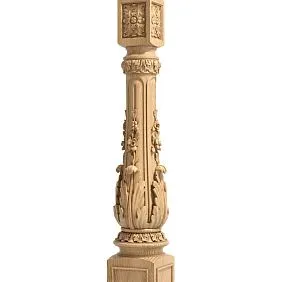
Posts are the main load-bearing elements of the railing. These are powerful vertical supports that bear the main load from handrails and ensure the rigidity of the entire system. Standard post sizes range from 80×80 mm to 120×120 mm in cross-section, with a height of 1200 to 1500 mm.
The placement of posts is strictly regulated by building codes. They are installed at the beginning and end of each flight of stairs, as well as at turns and landings. The distance between posts should not exceed 2 meters to ensure the necessary rigidity of the structure.
Our factory also produces:



Balusters: elegant guardians of safety
Balusters are vertical elements that fill the space between posts. Their main function is to create a continuous safety barrier, preventing falls from the stairs. The standard height of balusters is 900 mm, which corresponds to safety requirements for residential premises.
The distance between balusters is critically important for safety. According to building codes, the gap should not exceed 150 mm. In homes with small children, it is recommended to reduce this distance to 120 mm.
Get Consultation
Wood species: material selection as the foundation of quality
The choice of wood species determines not only the appearance of future posts and balusters, but also their performance characteristics, durability, and cost.
Oak: the standard of strength and prestige
Oak posts and balusters are the choice of those who value quality above all. The density of oak wood reaches 700-800 kg/m³, providing exceptional strength and longevity. Natural tannins in oak create a natural protection against pests and fungal damage.
The color palette of oak is strikingly diverse — from light golden to rich brown tones. Expressive texture with clearly defined growth rings creates a unique visual effect, especially when using transparent lacquered finishes.
Oak elements require a special approach during processing. The hardness of the wood demands higher standards for tools and the craftsman’s skill. But the result exceeds all expectations — oak posts and balusters serve for centuries, gradually acquiring a noble patina.
Ash: modern elegance
Ash stair elements are distinguished by exceptional impact resistance and flexibility. Light-colored wood with contrasting dark veins creates a modern and dynamic visual impression. The density of ash is 650-750 kg/m³, providing an excellent balance of strength and workability.
A distinctive feature of ash is its ability to bend without fiber damage. This property is especially valued when creating curved elements and complex architectural forms. Ash is excellent for staining and painting, expanding design possibilities.
Beech: Universality and Accessibility
Beech posts and balusters combine high quality with reasonable cost. Uniform wood structure ensures even processing and predictable results. The density of beech is 650-700 kg/m³, making it an ideal material for turning and milling.
Beech is well-suited for thermal treatment, which imparts a noble chocolate tone to the wood and increases dimensional stability. Thermally treated beech elements practically do not deform under changes in humidity and temperature.
Coniferous species: an economical solution
Spruce and larch are more affordable options for manufacturing stair elements. The soft structure of coniferous species simplifies processing and reduces production costs. Natural resins provide additional protection against moisture and pests.
Larch is especially valued for its resistance to moisture and biological damage. High resin content makes it practically immune to rot, which is especially important for stairs in high-humidity environments.
Manufacturing Technologies
Creating quality posts and balusters for wooden staircases is a complex multi-stage process requiring highly skilled craftsmen and modern equipment.
Material Preparation
The process begins with careful selection of timber. Each log undergoes visual inspection to identify defects: knots, cracks, resin pockets, and other wood imperfections. Only samples with uniform structure and proper fiber alignment are selected.
Drying is a critically important stage, determining the stability of finished products. In specialized drying chambers, wood is brought to a moisture content of 8-12%, ensuring minimal deformation during use. The drying process may take from several weeks to several months depending on the species and size of the logs.
Turning: classical technology
Turning remains the primary method for manufacturing round balusters. Modern CNC lathes allow creating items with micron-level precision in repeating shapes.
The turning process begins with centering the blank. The block is secured in the lathe chuck precisely along the axis, eliminating wobble and ensuring perfect symmetry of the finished product. Rough turning is performed with a wide cutter to give the blank an approximate shape.
Finishing requires using special profile cutters. Each cutter is designed to create a specific element of shape: rounds, coves, chamfers, bevels. The craftsman sequentially forms all profile details, achieving perfect conformity to the drawing.
Milling: complex shapes and decoration
Milling opens up wide possibilities for creating posts and balusters of non-standard shapes. Multi-axis milling centers allow processing blanks at any angle, creating the most complex three-dimensional surfaces.
Helical grooves are a popular decorative element, giving balusters dynamism and expressiveness. Special fixtures allow cutting spirals with different pitches and depths, creating unique visual effects.
Polygonal sections are formed using special milling cutters that create facets with perfectly flat surfaces and sharp edges. Such balusters are especially popular in modern interiors.
Artistic Carving
Carved posts and balusters represent the pinnacle of woodworking craftsmanship. Each item is created individually, taking into account the characteristics of the wood and the artistic concept.
Modern CNC machines allow realizing the most complex ornaments and compositions in wood. Three-dimensional modeling enables creating detailed projects, which are then reproduced with the highest precision in the material.
Design styles and architectural directions
The choice of style for posts and balusters should harmonize with the overall interior concept and architectural features of the building.
Classic styles
Classicism assumes the use of columns and balusters with strict geometric forms and minimal decoration. Clear proportions, noble restraint, and high-quality craftsmanship are the main characteristics of classical items.
Baroque and Rococo require richly decorated elements with lavish ornamentation. Plant motifs, scrolls, and complex profiles create an atmosphere of luxury and refinement. Such items are often gilded or patinated to enhance their decorative effect.
Modern interior styles also use oak skirting boards, but in a different interpretation. Minimalism prefers simple rectangular profiles without decorative elements. Smooth surfaces with matte finish create a sense of strictness and elegance.
Minimalism dictates its own rules — simple geometric forms, absence of unnecessary decoration, emphasis on material quality and precision of execution. Columns and balusters in the minimalist style often have square or rectangular cross-sections with perfectly smooth surfaces.
Scandinavian style prefers light wood species with natural finish. Simple forms, functionality, and eco-friendliness are the main principles of this direction.
Ethnic motifs
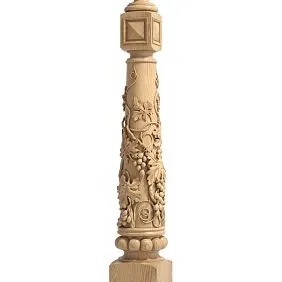
Russian style is characterized by rich carving with plant and geometric ornaments. Traditional motifs — grapevine, oak leaves, geometric patterns — create a unique national character.
Eastern styles introduce into the design of stair elements the philosophy of harmony and balance. Smooth lines, symbolic ornamentation, and use of contrasting wood species create an atmosphere of Eastern wisdom.
Technical requirements and standards
When designing and manufacturing stair railings, it is necessary to strictly adhere to technical requirements and construction standards.
Strength characteristics
Columns and balusters must withstand a horizontal load of at least 100 kg/m applied to the handrail. This requirement ensures safety during support on the railing and accidental impact loads.
Vertical load on columns may reach 200-300 kg depending on the staircase construction and handrail mounting method. Strength calculation must consider not only static loads but also dynamic impacts.
Geometric Parameters
The height of the railing should be at least 900 mm for residential premises and at least 1100 mm for public buildings. These requirements ensure safety during movement along the staircase.
The distance between vertical elements of the railing should not exceed 150 mm. This requirement is especially important for preventing injuries to children.
Installation and Mounting
Correct installation of columns and balusters is the guarantee of safety and longevity of the entire staircase structure.
Preparation Work
Before beginning installation, carefully check the geometry of the staircase structure. All steps must be strictly horizontal, and their dimensions must be identical. Any deviations may lead to problems during railing installation.
Marking installation points is done using a construction string and level. All mounting points must be positioned strictly along the line and at equal distances from each other.
Mounting newels
Columns are installed first as primary load-bearing elements of the structure. There are several ways to mount columns depending on the staircase construction.
Mounting to the floor is done using anchor bolts or metal plates. A hole is drilled in the base of the column for the mounting element, which is then secured to the floor or load-bearing structure.
Mounting to steps requires special precision, as it is necessary to ensure the verticality of the column on an inclined base. Special adjustable brackets are used, allowing compensation for the angle of inclination.
Installing balusters
Balusters are installed between columns with even spacing. The most common method is mounting on metal spikes with a diameter of 8-10 mm.
A central hole is drilled to a depth of 60-80 mm in the end part of the baluster. A similar hole is made in the step or underbaluster. The spike is screwed into the baluster and inserted into the base hole using adhesive.
Care and Maintenance
Proper care of wooden columns and balusters extends their service life and preserves their original beauty.
Regular cleaning
Wooden surfaces should be regularly cleaned of dust and dirt using a soft cloth or specialized wood care products. Avoid using aggressive cleaning agents that may damage the protective coating.
Special attention should be paid to joints and decorative elements where dust and dirt may accumulate. For cleaning hard-to-reach areas, use soft brushes or special attachments.
Updating protective coating
Protective coatings require periodic renewal. The frequency of renewal depends on the intensity of use and the type of coating. Oil-based coatings require more frequent renewal but are easier to apply.
Before applying a new coating, the surface must be thoroughly cleaned and lightly sanded with fine-grit sandpaper. This ensures better adhesion of the new coating.
Economic Aspects
The cost of columns and balusters varies widely depending on many factors.
Pricing Factors
The primary pricing factor is the type of wood. Items made from oak or ash are significantly more expensive than pine or birch equivalents. However, the higher price is justified by the material’s durability and prestige.
Processing complexity also affects the cost. Simple turned elements are cheaper than carved items with rich decoration. Handmade work always increases the price compared to machine production.
Long-term economic efficiency
Quality wooden columns and balusters are an investment for decades. With proper care, they maintain their functionality and aesthetic appeal, and often even increase in value over time.
Saving on quality may result in higher costs in the future. Cheap items made from poor-quality wood quickly lose their appearance and require replacement.
Innovations and modern technologies
Modern technologies open new possibilities for creating posts and balusters for wooden staircases.
Digital Design
3D modeling allows creating detailed staircase railing projects taking into account all interior features. Virtual reality allows "walking" through the future staircase even before production begins.
Parametric design automatically adapts the design to specific dimensions and requirements, significantly speeding up the development process and reducing the likelihood of errors.
Laser technologies
Laser cutting and engraving open up new possibilities for decorating wooden elements. The laser allows creating the most intricate ornaments with micron-level precision, unattainable by traditional methods.
Laser processing is also used to create hidden joints and technological holes with perfect geometry.
Composite materials
The development of gluing technologies has enabled the creation of composite posts and balusters from multiple layers of wood. Such items have increased dimensional stability and strength compared to solid counterparts.
Glued elements practically do not deform under changes in humidity and temperature, which is especially important for large posts and complex architectural forms.
Ecological aspects
Modern production of stair elements increasingly pays attention to ecological issues.
Sustainable Forestry
Using wood from certified forests guarantees sustainable forestry and forest resource regeneration. Certification by FSC or PEFC confirms that the wood comes from forests managed according to ecological standards.
Consumers are increasingly preferring products made from certified wood, which encourages manufacturers to obtain the appropriate certifications.
Waste-free production
Modern production strives to minimize waste. Sawdust and shavings are used to produce pellets and briquettes, while offcuts are used to manufacture small details.
Waste recycling technologies are constantly improving. New methods for using wood waste in construction and composite material production are being developed.
Future of stair elements
Industry development prospects are linked to further automation of production, adoption of new materials and technologies.
Smart Technologies
Integrating posts and balusters into smart home systems opens up new possibilities. Built-in sensors can monitor the condition of the structure, while integrated lighting ensures comfortable stair illumination.
Wireless charging devices built into handrails will allow charging mobile devices directly on the stairs. Such innovations transform functional elements into high-tech components of modern homes.
New materials
Development of new composite materials based on wood opens prospects for creating elements with improved properties. Nanotechnologies allow modifying the wood structure at the molecular level.
Biomimetic materials, mimicking the structure of natural objects, may possess unique properties — self-cleaning, color change, adaptation to environmental conditions.
Quality posts and balusters for wooden staircases are an investment in safety, beauty, and longevity. They create a unique atmosphere in the home, highlight the owner’s status, and demonstrate commitment to quality and tradition.
Modern technologies allow creating items that combine traditional wood beauty with innovative properties. The future of stair elements is linked to further technological development, expanded design possibilities, and increased ecological responsibility.
When choosing posts and balusters, it is important to consider not only aesthetic preferences but also technical requirements, operating conditions, and long-term prospects. Quality items from reputable manufacturers guarantee that your staircase will serve faithfully for many decades.
STAVROS has been a recognized leader in the production of exclusive posts and balusters for wooden staircases for many years. Our craftsmen combine centuries-old woodworking traditions with modern technologies, creating items that become true works of art. Modern equipment, strict quality control at every production stage, and use of only premium wood from certified forests guarantee flawless quality of each item. We offer a full range of services — from design consultation to manufacturing unique elements according to individual projects. Choosing STAVROS means investing in quality, reliability, and beauty, and receiving a guarantee that your staircase will become a source of pride for many years.





