Article Contents:
- Construction first: rigid module vs. flexible base
- When a straight wall is your main asset
- Flexible base: a tool for non-standard geometry
- Slat material: three options with different application logic
- MDF for painting: color freedom without limits
- Solid oak: living texture and durability
- Solid beech: for precise color with natural material
- What defines the character of the surface: slat spacing and profile
- Application by surface type: straight walls, radii, and furniture fronts
- Straight walls: accent zones and continuous cladding
- Columns: closed cylinder requires only flexible format
- Arches: continuity of rhythm through transition
- Radius walls: arc without compromises
- Furniture fronts: flexibility as a competitive advantage
- Application by rooms
- Living room: TV zone and open-plan zoning
- Bedroom: headboard as an architectural technique
- Hallway and corridor: first impression and spatial optics
- Cabinet: Concentration and Dignity
- Commercial Interior: Atmosphere as Strategy
- How to Choose Between Painted MDF and Solid Wood: A Decision-Making System
- Technical Parameters: What to Check Before Purchase
- Installation: Correct Sequence Without Errors
- Lighting as an Ally of Slatted Surfaces
- Acoustics: The Invisible Advantage of Slatted Surfaces
- Compatibility with Other Materials
- FAQ: answers to the most frequently asked questions
- About the Company STAVROS

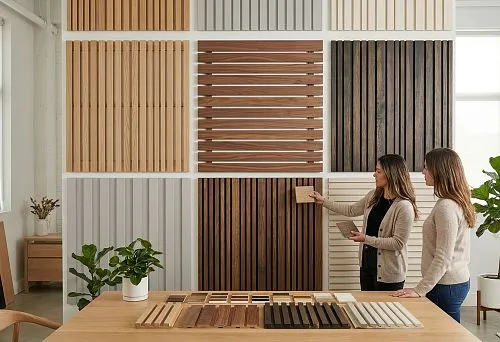
There are questions that sound simple but hide a true architectural fork in the road. 'Which slatted wall panels to choose for interior finishing?' is exactly such a question. The answer depends on three things: the geometry of the surface you want to clad, the material that determines aesthetics and durability, and the module construction—rigid or flexible. Understanding the logic of this choice once means making confident decisions not only in the current project but in every subsequent one. This is precisely what this article is dedicated to—not a general overview, but a practical analysis that leads to a concrete result.
To begin with—the starting point:wall panels made of slats for interior finishingtoday they are represented by fundamentally different designs. A rigid module on an MDF backing and a flexible panel on a fabric base are not variations of the same product. They are different tools created for different tasks. Mixing them based on the principle of 'what is cheaper' or 'what looks better in the photo' means risking the result.





Design first: rigid module versus flexible base




When a straight wall is your main asset
A rigid slatted wall panel on an MDF backing is a classic of thoughtful installation. The slats are fixed to the board with precise factory spacing. The structure is monolithic: lift it, apply it to the wall, level it, and secure it. Minimum operations - maximum precision. The slat spacing is uniform along the entire length, and the ends are calibrated for seamless joining. The result: a continuous vertical rhythm across several adjacent modules, perceived as a single surface.
The rigid format is preferable in most standard residential and commercial situations: straight walls in living rooms, bedrooms, studies, hallways, corridors. Where geometry poses no complications, it is flawless. Precise geometry, stable behavior, predictable results. The same principle applies to straight furniture fronts.
But as soon as a column, arch, rounded corner, or radius vault appears, the rigid monolith gives up. Not because it's bad, but because the board doesn't bend. Attempting to glue it to a curved surface means either cutting it into strips with visible seams or deforming it, causing the slats to deviate from the axis. Neither is an acceptable result.
Our factory also produces:


Flexible base: a tool for non-standard geometry
Flexible wall panels made of slatsThis is a fundamentally different design. The slats are fixed to an elastic fabric base with maintained spacing between each batten. It is precisely the gaps between the slats that provide the main functional property: the panel bends across - along the radius of a column, along an arched vault, around a rounded corner - while the slatted rhythm remains unchanged. Not a single slat shifts, the spacing is not disrupted, and the surface looks like a single continuous covering.
Three situations in whichwall panels made of slats on a fabric base— the only correct answer:
-
The surface curves. Cylindrical column, arched opening, radius wall, rounded corner transition — anywhere flat geometry is absent.
-
Pattern continuity across the transition is needed. A straight wall leads into an arch — the slat rhythm must continue through the entire transition without a seam.
-
Curved furniture facade. Radius cabinet, curved kitchen island, rounded corner shelving unit — here the form needs to be clad, not resisted.
At the same time, the flexible format works on straight walls just as well as the rigid one — it's simply that for a flat surface its advantage is not decisive. The choice between formats on a straight wall is already a question of budget, logistics, and installer preference.
Get Consultation
Slat material: three options with different application logic
MDF for painting: color freedom without limits
Wall panels made of slats for painting— this is MDF with a density of 750–850 kg/m³ with a smooth, uniform surface. No knots, no resin pockets, no areas with different absorbency. The surface accepts paint evenly, predictably, without stains.
Model PAN-002 in the STAVROS catalog is a primed MDF panel on a fabric base. Primed means the slats are already coated with two layers of polyurethane primer-isolator. Pores are sealed. Adhesion of the finish coating is ensured. The panel is ready for paint application without any additional preparation on your part. This significantly simplifies work on site: install — paint. Without intermediate stages.
Primed MDF slatted panel— the right choice for projects where color is the main design tool. Any RAL, NCS, Pantone shade — without restrictions. For furniture applications — polyurethane and acrylic enamels applied in a paint booth. For interior walls — water-based paints on acrylic or latex base: eco-friendly, no strong odor, quick-drying, allow wet cleaning after drying.
A separate scenario — monochrome interior: the panel is painted to match the wall, creating a clean relief rhythm without a color accent. The wall "comes alive" only through the play of light and shadow from the slatted profile. This is one of the most sophisticated design techniques, which at the same time requires nothing more than careful color matching.
Solid oak: living texture and durability
Oak slatted wall panels— this is about the natural grain pattern, which cannot be reproduced by veneer, film, or any coating on MDF. Oak with a density of 700–750 kg/m³ has a hardness that, in commercial spaces with intensive use, is a direct argument in favor of this material. Under transparent oils — a warm golden tone, natural matte finish, tactile warmth of natural wood. Under tinting — a range from light Scandinavian beige-gray to rich wenge and expressive graphite.
Oak — the choice for interiors where the materiality of the surface is as important as its visual image. It is requested for living rooms with high ceilings, offices with a representative function, country houses with natural aesthetics, restaurants and bars where atmosphere is created through texture. The semi-round profile of solid oak molding diffuses light differently than a rectangular one — softer, warmer, with a smooth play of light and shadow under side lighting.
It is important to understand: "wood-like" is not a shade, it is the character of the surface. MDF can be painted any warm brown, but it will not acquire a natural grain texture. If a living texture is the goal of the design concept — the choice is obvious.
Solid beech: for precise color with natural material
Beech is a less porous, finer-grained wood with a uniform neutral structure. This is precisely why it occupies an intermediate position between MDF and oak: it is natural wood, but with a surface that accepts opaque coatings better than oak. Beech under enamel does not "reveal" the grain through layers of paint — the surface remains smooth, uniform, without the open porosity characteristic of oak. At the same time, the tactile sensation of real wood is preserved: this is not MDF, this is a living material.
Beech panels are a practical option for design concepts with a color accent over natural wood: a black slatted wall, a dusty pink tone in the bedroom, a rich emerald in the living room.
What defines the character of the surface: the spacing and profile of the slats.
Two parameters that designers know by heart but often underestimate when choosing independently: the spacing between slats and the profile of the batten. These are precisely what determine the mood of the surface.
Narrow, tight spacing creates a rich, almost monolithic texture—heavy, prestigious, architectural. Suitable for offices, meeting rooms, lobbies, spaces with high ceilings where a pronounced material weight is needed.
Wide, airy spacing is about lightness, openness, a Japanese pause. Scandinavian minimalism with large gaps between slats turns the wall into an almost transparent screen. In small rooms, this spacing does not overload the space.
Medium spacing is a universal balance. For most residential interiors, this is the optimal ratio of decorative richness and spatial lightness. Works equally well with oiled oak and matte-painted MDF.
A rectangular batten profile gives a clear, sharp shadow at the boundary between the slat and the gap. A strict, architectural character—for modern interiors, minimalism, loft.
A semicircular profile diffuses light more softly, providing a smooth shadow transition. A warmer, more natural character—for classic, Scandinavian, wabi-sabi styles.
Both parameters are determined when choosing a specific model. Before ordering a large volume—be sure to order a sample and check how the panel behaves in the light of your space.
Application by surface type: straight walls, curves, and furniture fronts.
Straight Walls: Accent Zones and Full Cladding
On a flat surfaceSlatted panels for interior finishingthey work in two modes. The first is an accent zone: one wall as the visual center of the room. Behind the TV, behind the bed, behind the sofa — wherever the gaze is directed. The second mode is full cladding: all walls in a slatted texture create an architectural shell for the space. This is a bolder technique, requiring precise selection of tone and lighting, but when executed correctly — exceptionally expressive.
An important detail about vertical rhythm: parallel slats work as an optical illusion — the eye follows along the vertical lines and perceives the ceiling as higher. This is not theory, it's the practice of thousands of completed projects. In low rooms, this effect is especially valuable.
Columns: A Closed Cylinder Requires Only a Flexible Format
A column is the absolute limit for a rigid panel. It is physically impossible to cover a closed cylinder with a monolithic module without rough seams.Slatted panels for interior finishing of radius wallson a fabric base wrap around the column along the entire perimeter: the only joint is hidden in the least noticeable point — usually on the back side or in a corner. The slatted rhythm closes into a ring, and the column transforms from an architectural inconvenience into a full-fledged accent element.
A technical point to check before ordering: the minimum working bend radius of the specific model. Not all panels are equally flexible — the density of the fabric base, the width of the gap, and the thickness of the slat determine the minimum radius at which bending is possible without deformation. Measure the column's diameter, calculate the radius (diameter / 2), and check with the manufacturer.
Arches: Continuity of Rhythm Through the Transition
An arched opening with slatted cladding is one of the most striking architectural techniques. The slats follow the curve of the vault, maintaining an even pitch, and smoothly transition into the adjacent straight walls. To implement this technique, you needa modular wall panel made of slatson a flexible base with precise end geometry — only this way does the slatted rhythm continue through the transition without shifting.
Practical advice before installation: make a cardboard template of the arch, place it against the panel, and check the layout of the slats at the transition points. This takes ten minutes but prevents errors during actual installation.
Radius walls: an arc without compromises
A smooth wall arc — in an office with a non-standard layout, in a restaurant with a radius hall, in an apartment with curvilinear partitions — requires either manual cutting of a rigid panel into narrow strips with inevitable visible seams, or a flexible format. With the same labor costs, a flexible panel yields an incomparably cleaner result: the surface is uniform, there are no seams, and the slatted rhythm is continuous throughout the entire curve.
Furniture fronts: flexibility as a competitive advantage
Slatted panels for furniture and interiors— is a separate and very vibrant story. A straight furniture front — cabinets, dressers, cabinets, kitchen islands, wardrobe systems — is clad with a rigid format: quickly, precisely, without unnecessary operations. A curved front — a radius cabinet, a bent corner shelving unit, a rounded kitchen island — requires exclusively a flexible panel on a fabric base.
A slatted front does for furniture what a slatted wall does for an interior: it breaks up a monolithic volume into a lively architectural rhythm. A floor-to-ceiling sliding wardrobe with slatted fronts ceases to be a neutral rectangle and becomes an object in the space. A kitchen island with a slatted end is no longer just 'kitchen furniture' but a designer detail.
Application by rooms
Living room: TV zone and open-plan zoning
Slat wall panels for living room interior finishing— the most in-demand scenario. The area behind the TV is the architectural center of the living room. The slatted surface here works as a backdrop: the vertical rhythm doesn't compete with the screen but creates the right architectural context for it. LED strip lighting behind the panel or along the slatted surface enhances the effect: the wall ceases to be flat—it begins to work with light.
In apartments with an open plan, decorative slat wall panels solve the zoning task without partitions: the slatted texture on the wall behind the sofa visually separates the living room from the dining area, creating a sense of distinct spaces while maintaining visual openness.
Bedroom: headboard as an architectural technique
The headboard is the most personal architectural detail of the bedroom.Slat wall panels for bedroom interior finishingwork here most effectively. The slatted texture behind the bed creates a cozy cocoon feeling—especially with a warm wood tone and soft oil finish. The semicircular profile of the batten combined with bedside lamps gives that very 'velvety' play of light and shadow.
Optimal format for the bedroom: a panel not covering the entire wall, but fragmentary—behind the bed from floor to ceiling or from the headboard to a height of 1.2–1.5 m above the mattress. An accent zone without overloading the rest of the space. The side walls remain neutral—and the slatted area works as an independent architectural object.
Hallway and corridor: first impression and spatial optics
In the hallwayslatted wall panels for interior finishingThey serve a dual role. Decorative — they create the character of the first space a guest sees. And functional — they protect the wall from mechanical damage in a high-traffic area.
Vertical slat rhythm optically elongates the hallway in height — one of the most effective techniques for narrow corridors with low ceilings. For hallways, a wear-resistant finish is recommended: polyurethane enamel or hard lacquer — resistant to mechanical stress and easy to clean.
Interesting format: a slat panel at a height of 1.2 m as a lower wall belt, above — a smooth painted surface. A classic 'panel' solution interpreted through slat texture — modern, functional, without excessive decorativeness.
Study: concentration and dignity
In the study, a slatted wall is not decoration, but atmosphere. Dark oak with a tint on the wall behind the desk creates an environment that can be described in one word: seriousness.Wall panels made of slats for interior finishing of a study— it's about a space where one thinks, makes decisions, works at a high level. Such a study is perceived fundamentally differently than a neutral office.
Commercial interior: atmosphere as strategy
Wall panels made of slats for interior finishing of an officeFor commercial spaces, slat paneling serves as a branding tool. A reception desk with dark oak slat panels says 'we are a serious company.' A restaurant with slatted walls says 'we thought about the space.' A cafe with slatted ceilings and walls creates an atmosphere that brings customers back.
For commercial spaces with curved walls, columns, arched transitions—which are far more common in commercial architecture than in standard residential construction—slat panels for interior wall finishingon a flexible basis become a standard tool for the project team.
How to choose between paintable MDF and solid wood: a decision-making system
Here is a working scheme that applies to most projects.
Step one: what matters more—precise color or natural texture?
Precise color from a palette →slat panels for interior finishing designed for paintingmade of MDF.
Natural texture, live fiber → solid oak.
Step two: what is the intensity of use?
Residential interior with light load → both materials work.
Commercial space with high traffic → solid oak with hard lacquer is preferable for durability.
Step three: is there curvilinear geometry?
Only straight walls → rigid or flexible format, any material.
Columns, arches, radius surfaces → only flexible fabric base.
Step four: what is the budget?
MDF is more affordable. Solid oak is more expensive. The difference is justified by the difference in aesthetics, tactility, and lifespan. Do not look for 'the cheapest wall slat panels' — a panel with a loose fabric base that tears during installation on a column results in rework and double costs.
Technical parameters: what to check before purchase
Before orderingbuy slatted wall panelsin the required volume — be sure to request a sample. A sample is not a marketing tool, but a working one: it is on a real sample that you can see how the tint behaves in the light of your room, how accurate the ends are, and what the density of the fabric base is.
Sample technical inspection checklist:
-
Slat spacing: measure at several points — it should be the same along the entire length.
-
Sanding quality: surface without tears, scratches, or milling marks. 'Prestige' level — hand sanding, requires no finishing; 'Standard' — machine sanding at a more attractive price.
-
Fabric base: dense, without delamination. Bend the sample — is there any crunching or cracking? Stretch it crosswise — is there any elasticity reserve?
-
End-to-end joint: place two samples end-to-end — rail to rail, without a gap. This is the only way to check the joint before installation.
-
Reglue grade: 'for enamel' — without color and texture matching, for opaque coatings; 'for tinting' — with matching, for semi-transparent coatings that reveal the wood grain.
Installation: correct sequence without errors
A good panel installed incorrectly won't deliver the desired result. Installation is an extension of the selection process.
Surface preparation. The wall must be clean, dry, degreased, and free of crumbling areas. Plastered and primed drywall, concrete, or plaster serve as the working surface. For loose surfaces, use a deep-penetration primer. If level variations exceed 5 mm per linear meter, level with putty.
Layout. The first vertical line from the corner is the foundation. The first panel must be perfectly level. An error in the first module accumulates across the entire surface—check the level after every third or fourth module.
Fastening. For rigid panels, use mounting adhesive around the perimeter of the backing and diagonally. For flexible panels, apply contact adhesive to the fabric backing with additional fixation using micro-pins from a pneumatic gun. Fastening points are puttied and sanded as needed.
Installation on curved surfaces. Apply adhesive to both the backing and the surface. Work gradually—maintain pressure for 5–10 seconds on each bend section. Do not try to secure the entire panel at once: the material should conform to the surface shape smoothly.
Joining. End to end, slat to slat—without gaps or overlaps. Precise factory spacing ensures seamless continuation of the pattern.
Finishing. For MDF panels, use finishing paint or enamel. For oak panels, apply tinting, stain, or clear varnish according to the manufacturer's technology.
Lighting as an ally of the slatted surface
A slatted wall and directional light are a pair that creates visual magic. Without lighting—a good wall. With proper lighting—an object that interacts with the space around the clock.
Directional spotlights at an acute angle to the surface create sharp shadows in the gaps. Slats become strips of light, gaps become strips of shadow. The surface gains volume and depth that it lacks under direct lighting.
LED strip behind the panel when mounted on a frame with an air gap — diffused ambient light shining through the gaps between slats. One of the most atmospheric techniques: soft glow from within the wall with no visible source. Especially effective for curved walls, columns, and niches.
LED in gaps with pre-installed cable routing — pinpoint linear lighting along the slat rhythm. A delicate, almost weightless effect for bedrooms and restaurant halls.
Plan lighting and paneling simultaneously: adding hidden wiring after installation is significantly more difficult.
Acoustics: the invisible advantage of slatted surfaces
What is rarely discussed when choosingslatted panels for walls and ceilings— their acoustic effect. Vertical slats scatter sound waves, disrupting direct reflection from a flat wall. Result: reduced reverberation, less echo, improved speech clarity.
In open-plan living rooms — reduced booming. In meeting rooms — improved speech intelligibility. In restaurants with high ceilings — a sense of intimacy despite a full dining room. When mounted on a frame with acoustic absorption behind the panel, the effect is enhanced: decorativewall slat panel for interior finishingtransforms into a functional acoustic screen.
Compatibility with other materials
flexible slat panels for wallsand slatted modules integrate organically into multi-layered interior concepts. Several combinations that work in most projects:
| Material | What it pairs with | Effect |
|---|---|---|
| Oiled oak | Natural stone, cotton textiles | Natural warm envelope |
| Dark-tinted oak | Matte metal, concrete | Industrial-premium contrast |
| MDF with white enamel finish | Pastel walls, linen curtains | Scandinavian lightness |
| MDF for dark paint | Marble, brass | Modern Classic |
| Beech for matte enamel | Glass, polished steel | Modern minimalism |
FAQ: answers to the most frequently asked questions
How does a rigid slatted wall panel differ from a flexible one?
Structurally: rigid – slats on an MDF board, monolithic. Flexible – slats on a fabric base with gaps allowing bending. Rigid – for flat surfaces, flexible – for curved and flat surfaces simultaneously.
Can slatted panels be used in the bathroom?
Only moisture-resistant options: moisture-resistant MDF with waterproof coating or solid dense wood (oak, beech) with multiple layers of yacht varnish. Regular MDF without special protection is not used in constantly humid environments.
How to calculate the number of panels?
Divide the surface area (width × height) by the area of one module. Add 10–12% for cutting and joining. For complex geometry (columns, arches), allocate 12–15%. The entire volume should be from a single production batch: solid oak may vary in tone between batches.
Can an MDF slatted panel be painted after installation?
Yes. With water-based paints — directly on site. For polyurethane enamels, painting before installation in a paint booth is recommended: the coating quality is significantly higher. Primed panels (PAN-002) are ready for finishing without additional preparation.
What is the minimum bending radius for a flexible panel?
Depends on the specific model: thickness of slats, gap width, and density of the fabric base. Check with the manufacturer for each model before ordering — and always specify the curvature radius of your surface.
Can rigid and flexible formats be combined in one interior?
Yes, and it is the optimal strategy. Use rigid modules on flat planes, and flexible ones on transitions and curved surfaces. With the same pitch and slat width, the transition between formats is visually unnoticeable.
Is a frame needed for slatted panels?
On a flat base (drywall, plastered wall) — direct adhesive mounting is sufficient. For significant unevenness, when it's necessary to hide utilities or place acoustic absorption — mounting on a frame of metal profiles or wooden slats, leveled.
How to care for slatted panels after installation?
Dry or slightly damp soft cloth, without abrasive cleaning agents. MDF under enamel can be repaired locally by repainting if necessary. Solid wood under oil is refreshed every 3–5 years — applying a new layer of oil with a soft cloth without dismantling.
What is the current price of wall slat panels?
Currentwall slat panels priceare listed in the catalog and updated daily. The cost depends on the material (MDF, oak, beech), level of sanding, and order volume. Items in stock are shipped within 3 business days, custom manufacturing — 5–10 business days.
Is there a showroom where samples can be viewed in person?
Yes. STAVROS showrooms operate in Saint Petersburg and Moscow. Here you can personally evaluate samples, compare finishes, check the quality of polishing, and receive project consultation.
About the company STAVROS
When it comes to high-end wooden and MDF decor — in Russia, there is a manufacturer that professionals turn to again and again. That is STAVROS.
The history of STAVROS began in 2002: two artists — Andrey Ragozin and Evgeny Tsapko — founded a workshop for carved wooden products. Their work was quickly noticed: within a year, the masters were invited to participate in the reconstruction of the Konstantinovsky Palace in Strelna. This was followed by the restoration of the interiors of the Hermitage, the Alexander Palace, the Trinity-Izmailovsky Cathedral, and the Sheremetev Mansion. For over twenty years — an unwavering principle: each product is created with a flawless understanding of artistic laws and the requirements of interior styles.
Today, STAVROS producesbuy slatted wall panelswhich can be either rigid modules or flexible panels on a fabric base — in MDF for painting, solid oak, and solid beech. Standard formats for residential and commercial interiors, custom solutions for non-standard sizes, custom finishes, and project volumes. Precise edge geometry, consistent batch color, durable fabric backing — these are not marketing promises, but standards verified with every order. Delivery across Russia and CIS countries from a single unit. Showrooms in Saint Petersburg and Moscow — for those who prefer to make decisions with a sample in hand.