Article Contents:
- What 'wood-paneled' means in interior design
- Where a wood-paneled wall looks best
- In the living room
- In the bedroom
- In the hallway and corridor
- In the study
- In the dining area
- In commercial spaces
- Full paneling or accent wall: what to choose
- What wood panels are suitable for such finishing
- Smooth panels
- Slatted panels
- Relief panels
- Modular panels
- Panels with pronounced wood grain texture
- What materials to choose
- Solid wood
- MDF with Wood Finish
- Veneered panels
- Combined Solutions
- How to choose color and texture of panels
- How to choose panel format for the room
- How to incorporate wooden panels into interior style
- Modern style
- Minimalism
- Scandinavian interior
- Jatoba
- Neoclassicism
- Warm, natural interior
- What to combine with a wall covered in wooden panels
- How lighting affects the perception of panels
- What tasks does such finishing solve
- Common mistakes when using wooden panels
- What to choose for different tasks
- For an accent wall
- For a cozy bedroom
- For a modern living room
- For the hallway
- For a warm natural interior
- For a small room
- Algorithm: How to Choose and Implement Wood Panel Cladding
- FAQ: Answers to Popular Questions
- About the Company STAVROS

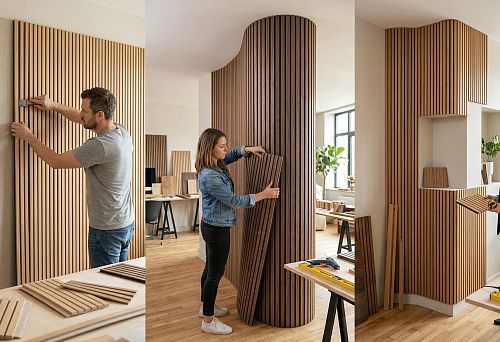
There is one visual technique that always works in any context: a wall clad in wood panels. Not because it's trendy—though it is indeed trendy right now. But because wood on a wall makes an interior warmer, deeper, and more material. It adds what neither paint, plaster, nor the most expensive wallpaper can provide: natural texture, a living pattern, a tactile sense of quality.
However, cladding walls with wood panels is not the only or always obvious scenario. Sometimes one accent plane is enough. Sometimes full coverage is needed. Sometimes panels only work in a specific zone. This article breaks down all scenarios: where it's appropriate, which panels to choose, how to select color and texture, and how to avoid making the interior feel heavy.
What 'Clad in Wood Panels' Means in Interior Design
When people say 'a wall clad in wood panels,' they usually mean one of three scenarios.
The first is full cladding: the entire wall surface from baseboard to cornice is completely covered with wood panels. This option is used in studies, hunting lodges, classic interiors with boiserie, and country houses with a pronounced natural character.
The second is partial cladding: a lower panel belt up to a height of 90–120 cm, with a neutral painted surface above. A classic architectural solution that combines decorative effect and practicality. Widely used in hallways, dining rooms, and studies.
The third is an accent wall: one plane clad in wood panels against a backdrop of neutral walls. This is the most in-demand and safe technique in modern interiors. It provides maximum visual impact with minimal finishing area.
All three scenarios work. The choice depends on the room, the task, and the desired result. The more wood—the more substantial and dense the interior feels. The less wood—the lighter and more contemporary.




Where Does a Wall Clad in Wood Panels Look Best
Our factory also produces:


In the living room
The living room is the main space for wooden finishes. The wall behind the sofa, the TV area, and the surface at the room entrance — all three options work.Wooden slat panelscreate a modern rhythm and depth; smooth veneered ones provide a noble, calm background. A wall paneled with wood in the living room unites furniture, lighting, and decor into a single composition — this is what makes the space cohesive.
Get Consultation
In the bedroom
The bedroom is the second most popular place for wooden paneling. The wall behind the bed headboard, paneled with wood, is an accent that replaces a separate headboard and simultaneously an architectural solution that sets the character for the entire room. Light natural shades work especially well here: they don't overwhelm perception and create a cozy atmosphere.
In the hallway and corridor
The hallway is the first thing a guest sees, and it's here that wooden panels work as a statement about the interior as a whole. The lower paneling belt in the corridor is both practical and stylish. Vertical slatted panels visually elongate the narrow space. Finishing in the hallway doesn't require a large area — precision of detail is important here.
In the study
The study is a space where wooden paneling works as a tool for creating atmosphere. Dark walnut, rich oak, merbau veneer — all of this creates a sense of weight and status.boiserie wall systemsin a study with wooden panels and built-in cabinets is a classic solution that never goes out of style.
In the dining area
The dining room benefits from a warm, intimate atmosphere. Three walls paneled with wood, or one accent surface behind the dining table — both options work. Slatted paneling adds liveliness, smooth paneling adds calm coziness.
In commercial spaces
Meeting rooms, reception areas, hotel lobbies, restaurants, and showrooms — wooden wall paneling creates an atmosphere of status and thoughtfulness. For commercial projects, the possibility of replication is especially valuable:MDF panels with precise geometryallow you to replicate a single solution in multiple rooms without losing quality.
Full wall cladding or an accent wall: what to choose
This is one of the key questions—and the answer depends on several parameters.
When one wall is enough: in most residential interiors, an accent wall is the optimal choice. It creates the desired visual effect, doesn't overload the space, and leaves breathing room. This is especially relevant for apartments with compact rooms.
When full cladding is appropriate: in country houses with high ceilings, in studies, in classic interiors with boiserie, in dining rooms and fireplace halls. Here, full cladding creates exactly the feeling it's intended for: density, completeness, architectural integrity.
When it's better to use panels locally: for a specific functional zone—behind the headboard, around the TV, in a niche, on a column. This is a targeted, expressive technique without overall burden on the room.
How to avoid making the interior too heavy: the rule is simple—the larger the area of wooden cladding, the lighter the shades and calmer the texture should be. Dark walnut on three walls in a small room is a risk. Light oak on the same area is cozy.
Which wooden panels are suitable for such finishing
Smooth Panels
Smooth surface without relief—a universal option. Creates a monolithic, solid plane. Works well in classic wall systems with moldings, in Scandinavian and minimalist interiors, in rooms with rich decor where the wall should be a calm background.
Rack panels
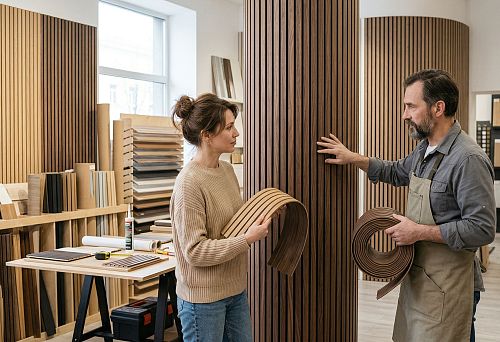
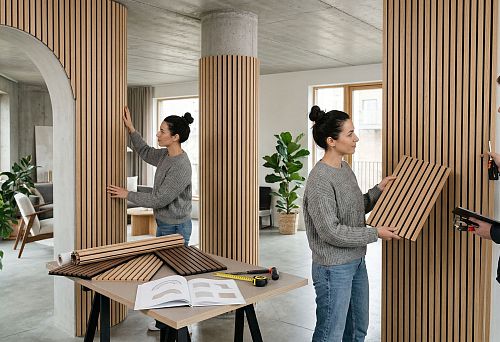
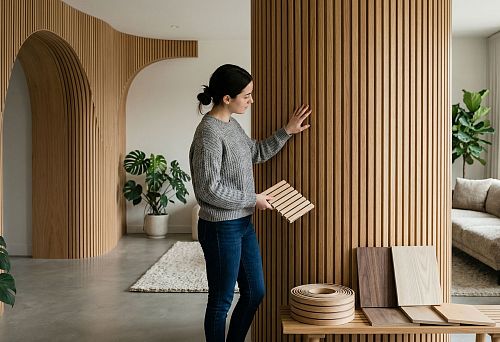
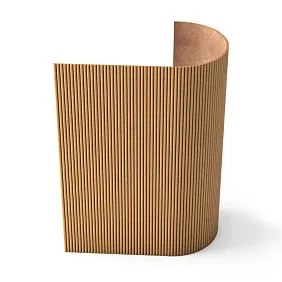
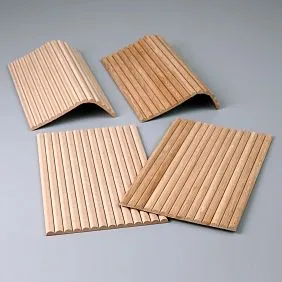
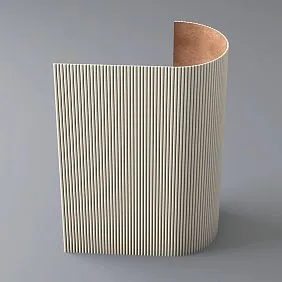
Wooden slat panels—the most in-demand format for modern wall cladding. Parallel slats with equal spacing on a backing create a linear rhythm that lives with the light: one look in the morning, another in the evening. Vertical slats stretch the space upward. Horizontal ones widen it. Cladding with slatted panels is an architectural solution, not just a finish.
Relief panels
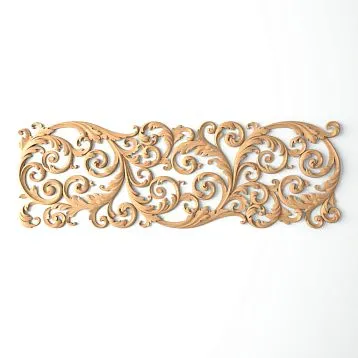
Volumetric decorative pattern on the surface — geometry, coffers, waves, rhombuses. Under side lighting, the relief is maximally expressive. Suitable for classic and neoclassical interiors, in areas with intentional decorative emphasis. Require moderation: one wall is enough.
Modular Panels
Modular systems of individual elements, allowing for unique layouts: combine smooth and slatted zones, form non-standard rhythm, add inserts from other materials. For authorial projects without standard solutions.
Panels with pronounced wood texture
Veneered panels or solid wood products with emphasized natural grain — the most 'lively' format. Curly grain, shade variations, unique pattern of each sheet. Such a surface creates a sense of real wood — tactile, warm, natural. Self-sufficient decor, requiring no additions.
Which materials to choose
Solid wood
Natural solid wood — oak, walnut, ash, beech, cherry, pine.Solid Wood Itemspossess unique natural grain and can be restored: the surface can be renewed several times. Solid wood is chosen for wall cladding where material authenticity and long-term investment are important.
When to choose: for studies, country houses, premium living rooms, projects with a natural, organic character.
MDF with wood finish
MDF — a board made of pressed wood fraction with perfect stable geometry. Does not warp, does not crack, accepts painting, veneer, and decorative finishes well. For slatted systems, MDF is the best substrate. Indispensable where precision of forms and reproducibility are needed.
When to choose: for commercial projects, for painting in any color, for slatted claddings with precise geometry, for smaller budgets without loss of result quality.
Veneered panels
A thin slice of natural wood on an MDF or plywood base. Appearance - like solid wood. Stability - better than solid wood. Wide selection of species: oak, walnut, maple, cherry, zebrano, wenge. Wall cladding with veneered panels is a balance between aesthetics and practicality.
When to choose: when you need a natural visual effect at a lower cost and better stability compared to solid wood.
Combined Solutions
Solid oak slats on an MDF base, veneered panels with metal inserts, MDF systems with carved decorative overlays. This combination provides both the practicality of the base and the richness of the finish. Optimal for custom design projects.
How to choose the color and texture of panels
Light wood shades - whitewashed oak, light ash, birch - add warmth without overwhelming the space. Best choice for small rooms and light interiors.
Warm natural tones - honey oak, cherry, medium-saturation walnut - create a cozy, lively atmosphere. Work well in bedrooms, living rooms, and studies with warm lighting.
Dark deep textures - wenge, dark walnut, merbau - an expressive accent on one wall. Used sparingly in small spaces. Require good lighting, otherwise the space 'shrinks'.
Calm wood grain - uniform texture without pronounced fibers. For modern minimalism and interiors with accent furniture.
Active texture - emphasized natural pattern, swirls, contrasting shade transitions. Self-sufficient decor that requires no additions. One wall with such texture is already a complete interior solution.
Combination with furniture, flooring, and doors: work within one color temperature. Warm wood with warm floors and facades. Not necessarily the same species - tonal harmony is important. This creates a sense of a thoughtful system, not a random collection of materials.
How to choose panel format for a room
For a small room: vertical slatted panels — they visually stretch the ceiling. Light shades. One accent wall, no more. Medium slat spacing — not too tight (creates a cramped feel) and not too sparse (loses rhythm).
For a spacious living room: you can work more broadly — several accent zones, large format, bold tones. Here, dark walnut on one wall looks appropriate, and slatted cladding on two adjacent planes — organically.
For a narrow hallway: horizontal slats or vertical panels of small width. A lower cladding belt is a good solution: it doesn't overload but creates the desired effect.
For a relaxation area: smooth veneered panels or slatted ones with a soft rhythm. Muted natural shades.
For a TV zone: slatted or smooth panels with a pronounced texture. Cladding the area around the screen visually 'anchors' it — turning it into an independent architectural plane.
For a bedroom: smooth veneered or slatted panels behind the bed headboard. Height — from the area directly behind the bed to the full height of the wall. Light or natural tones.
How to integrate wooden panels into the interior style
Modern style
Conciseness, clarity, control over details. Slatted panels with an even rhythm, neutral shade of oak or ash, matte finish without shine. No decorative excesses — only rhythm and texture.
Minimalism
Maximum restraint. Smooth panels in the same tone as the wall — for painting or with a thin veneer without a pronounced pattern. If slats — then sparse, with wide spacing, minimal profile.
Scandinavian interior
Honest texture, light natural wood, natural irregularity. Birch, ash, light oak with matte oil finish. A wall clad in wooden panels in a Scandinavian interior is a natural theme, not a decorative technique.
Japandi
Precision and silence. Narrow vertical slats of ash or oak with natural toning, medium spacing, no decoration for decoration's sake. This is where solid wood slats on an MDF backing work perfectly: the geometry of the base plus the living texture of the slat.
Neoclassicism
Structured wall systems: moldings, coffers, cornices, decorative overlays.wall panels boiserieMDF with enamel in cream, white, or powder tones — a classic neoclassical answer to wall cladding.
Warm natural interior
Veneered or slatted solid wood panels in shades of honey oak, walnut, cherry. Oil or wax finish. It is in this context that a wall clad in wooden panels reveals its full potential.
What to combine a wall clad in wooden panels with
With paint. Wooden cladding on one wall — neutral paint on the others. The paint shade should support the warm palette of the wood or create an intentional contrast. Anthracite, green, blue tones paired with natural oak — this works.
With textiles. Rugs, cushions, and curtains in natural tones: olive, terracotta, cream, mustard. They soften the texture of the wood and add tactile variety.
With glass. Matte glass softens the contrast. Mirror glass adds depth and visually expands the space.
With metal. Brass, bronze, and matte black details — furniture legs, lighting fixtures, handles, frames — create an exquisite contrast with warm wood. Metal emphasizes the natural value of the material.
With stone. A natural alliance: marble, limestone, slate, or stone-look porcelain paired with wooden panels creates a rich natural material system.
With soft furnishings and light. A sofa in neutral tones against a wooden wall is always a winning combination. A floor lamp or sconce next to slatted cladding creates side lighting that brings the wall to life.
How light affects the perception of panels
Light is the second material without which wooden cladding does not fully reveal itself.
Side lighting is the main ally of slatted cladding. It creates a sliding play of light and shadow between the slats, making the plane three-dimensional and sculptural. A wall clad in wooden panels becomes a living surface under side lighting.
Warm light (2700–3000 K) enhances the golden and amber tones of wood. Perfect for living spaces. A wall clad in wooden panels under warm light in the evening provides that very feeling of coziness for which it's all done.
Cool light (4000 K and above) neutralizes the warm hue. Suitable for offices; for residential interiors, it requires caution.
Accent lighting for texture. An integrated LED strip behind or beneath slatted panels creates a glowing effect—one of the most spectacular nighttime techniques. The texture of wood is perceived much more strongly under accent lighting.
How to avoid a sense of darkness and heaviness: dark wooden panels require a sufficient number of light sources. If the cladding is dark—use neutral adjacent surfaces, a light ceiling, and spot lighting. This creates balance.
What tasks does such finishing solve?
A wall clad in wooden panels is not just decoration. It is a tool that solves specific tasks:
-
Accent. One wooden plane draws the visual center of the room to itself. The other surfaces become a neutral background.
-
Zoning.Rafter panels on a partition or part of a wall divide space without physical barriers.
-
Creating coziness. Wood on the wall changes the emotional perception of a room—the space becomes warmer and more comfortable physiologically.
-
Visual rhythm. Slatted cladding adds rhythmic organization to a space—a linear structure that is legible from any distance.
-
Unifying space. A unified wooden system on several surfaces—a wall, a niche, a partition—creates a sense of architectural integrity.
-
A more expensive-looking interior. Natural materials are associated with quality. A wall clad in wooden panels elevates the visual level of the entire room.
Common mistakes when using wooden panels
A list of the most frequent mistakes:
-
Covering the entire room with panels without understanding the purpose. Wood should be an accent. Fully covering all four walls without architectural logic is not cozy, it's claustrophobia.
-
Choosing too dark a texture for a small room. Dark wenge in a small bedroom visually shrinks the space.
-
Ignoring lighting. Without proper light, paneling loses half its expressiveness.
-
Not considering the interior style. Heavy classical panels with moldings do not go with loft furniture.
-
Mixing incompatible wood shades. Two or three different tones without systematic logic ruin the integrity.
-
Not considering furniture, floor, and doors. Panels, doors, and flooring should form a coordinated system of tones.
-
Using too active a relief in a small space. Relief paneling in a small room is visual noise.
-
Not planning transitions. How will the panel fit into a corner? What will be at the ceiling? How to design the junction with a niche? — all this should be decided before installation.
-
Choosing panels only from photos. Color and texture look different under various lighting. Always request samples.
-
Doing finishing without an overall concept. First — understand what you want to achieve. Then — choose the material.
What to choose for different tasks
For an accent wall
Solid oak slatted panels or veneered with natural texture. One tone, one slat direction, one plane — no mixing of formats.
For a cozy bedroom
Smooth veneered panels or slatted panels with a soft rhythm behind the bed headboard. Light or natural shades: bleached oak, honey ash, delicate cherry. Matte finish.
For a modern living room
MinimalistRafter panelswith an even rhythm, neutral oak shade, vertical direction. TV zone or wall behind the sofa — no more than one accent plane.
For the hallway
Lower cladding belt 90–120 cm high — practical and stylish. Vertical slats full height in a narrow corridor — visually expand the space.
For a warm, natural interior
Veneered or solid wood slatted panels in shades of walnut, cherry, or honey oak. Oil or wax finish, natural texture without excessive processing.
For a small room
One accent wall — no more. Light or natural shade, vertical slat rhythm, medium spacing. Dark tones — only with good lighting and only on one plane.
Algorithm: How to Choose and Install Wood Paneling
A simple sequence that works for any project:
-
Determine where paneling is needed—an accent wall, full zone finishing, or a local technique in a niche/behind a headboard
-
Choose the material—solid wood for natural texture, MDF for painting and geometry, veneer for balance
-
Choose the format—smooth, slatted, relief, or modular panels
-
Select the shade and texture — to match the style, lighting, furniture, and floor
-
Consider the style and lighting—each format and tone works in its own context
-
Move on to selecting specific panels—with an understanding of all previous steps
A wall covered with wood paneling isn't difficult. What's difficult is making the right choice without understanding the task. When the task is clear, everything else falls into place.
FAQ: Answers to popular questions
Where is it best to have a wall covered with wood paneling?
In the living room — a TV zone or the wall behind the sofa. In the bedroom — behind the headboard of the bed. In the hallway — the lower belt. In the study — full paneling or an accent wall.
Is it better to do full paneling or an accent wall?
In most residential interiors, an accent wall is the optimal choice. Full paneling is appropriate in country houses, studies, and classic projects with sufficient space volume.
Which panels are better for a living room?
Slatted with a smooth rhythm — for a modern interior. Smooth veneered — for a calm, noble background. Relief — for neoclassicism and art deco.
Are wooden panels suitable for the bedroom?
Perfectly suitable. Panels behind the headboard of the bed are one of the most advantageous techniques in the bedroom.
Which panel colors are best for a small room?
Light: bleached oak, ash, birch. Calm rhythm, one accent wall.
What to choose: smooth, slatted, or relief panels?
Smooth — for a neutral background. Slatted — for a modern accent. Relief — for classic and decorative zones. In moderation.
Can wooden panels be used in the hallway?
Yes. The lower paneling is practical and beautiful. Vertical slats work well in a narrow hallway.
How to combine panels with furniture and flooring?
Work within the same color temperature. Warm wood goes with warm flooring and furniture. Consistency in tones creates a cohesive look.
Are dark wood panels suitable for a modern interior?
Yes, with proper lighting and on one accent wall. Dark tones require good lighting and neutral adjacent surfaces.
How to avoid overloading the interior with wooden finishing?
One accent wall. Light shades in small spaces. A calm rhythm and neutral adjacent surfaces.
Can panels be combined with paint and stone?
Yes. Wood pairs organically with paint, stone, metal, and glass. One material dominates—the others complement.
What mistakes are most commonly made when choosing?
Covering all walls without a concept, choosing based only on photos, not considering lighting, mixing uncoordinated shades, using too bold a texture for a small room.
About the company STAVROS
If you want to implement an interior with walls clad in wood paneling—from one accent plane to a full finishing system—contact STAVROS.
STAVROS is a Russian manufacturer with over 20 years of experience creating wood and MDF products for interiors. The range includes—slatted panels made of MDF and solid oak, boiserie wall systems, Custom solid wood products, moldings, cornices, baseboards, and decorative overlays. Production is carried out according to individual dimensions, with a wide selection of wood species and finishes.
Full cycle: consultation, measurement, production, delivery, installation. Showrooms in Moscow and St. Petersburg. Samples for evaluation before ordering. Work with designers, architects, and direct clients.