












































































Article Contents:
- Philosophy of Connections: When Technology Becomes Art
- Evolution of Connecting Elements
- Classification by Functional Purpose
- Polyurethane Joint Materials: The Science of Precision
- Material Technical Specifications
- Manufacturing Technologies
- Profile Geometry: The Mathematics of Beautiful Connections
- Principles of Profiling
- Optimization for Various Styles
- Installation Features: Secrets of Professional Installation
- Preparation operations
- Adhesives and Connection Technologies
- Mounting Quality Control
- Design Solutions: Joints as Compositional Elements
- Accentuating Joints
- Rhythmic Constructions
- Stylistic Adaptation: Joints for Different Eras
- Classical Traditions
- Baroque opulence
- Modern Interpretations
- Technological Innovations: The Future of Joints
- Adaptive Joints
- Intelligent systems
- Economic Aspects: Investment in Quality
- Lifecycle Cost Calculation
- Impact on property value
- Regional specificity of application
- Northern Regions
- Southern Regions
- Seismically active zones
- Quality Control and Standardization
- Quality management systems
- Testing and Certification
- Conclusion
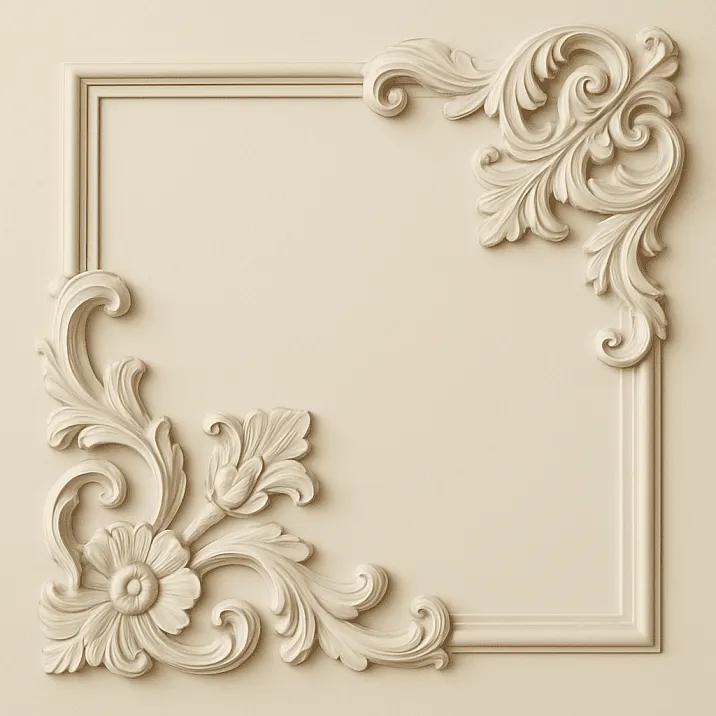
There are details in architecture that are whispered about. They do not shout their presence, do not demand admiring glances, but precisely they determine whether an interior will look professional or amateurish. Mold Intermediate Element — one of such unnoticed heroes of the decorative world, without which even the most refined composition can turn into a ridiculous accumulation of elements.
What makes an experienced designer spend hours studying catalogs of joints? Why are professional installers willing to pay extra for high-quality connecting elements? The answer is simple: the joint determines the quality of the entire work. It either makes joints invisible, creating an illusion of compositional unity, or turns every connection into a painfully noticeable defect.
In the world of modern polyurethane moldings, joints are undergoing a true revolution. New materials, precise manufacturing technologies, and deep understanding of architectural principles allow creating connecting elements that not only solve technical problems but also become full-fledged participants in decorative compositions.


Philosophy of Connections: When Technology Becomes Art
Have you ever thought about how many connections are hidden in a typical interior? Every molding turn, every transition from one profile to another, every intersection of horizontal and vertical elements requires a special solution. And here, joints step onto the stage — elements that transform a set of scattered details into a harmonious architectural symphony.
Modern Mold Intermediate Element — it is not just a technical element, but the result of a deep analysis of space geometry. Engineers and designers work closely together, creating elements that take into account material properties, installation specifics, and aesthetic requirements of various architectural styles.




Evolution of Connecting Elements
The history of joints goes back to deep antiquity. Roman architects already understood the importance of quality transitions between architectural elements. But if then each joint was carved by hand by a master stonemason, today precision is measured in fractions of a millimeter, and production is based on industrial methods.
The revolutionary moment was the emergence of polyurethane technologies. The material allowed creating joints of any complexity with perfect geometric repeatability. There is no longer a need to individually fit each element — modern joints ensure precise profile alignment right from the factory.
Our factory also produces:


Classification by functional purpose
Transition joints solve the problem of connecting elements with different profiles. Imagine a situation: you need to connect a wide cornice with a narrow molding. A simple joint will look crude and unprofessional. A transition joint creates a smooth transformation from one cross-section to another, making the connection visually logical and aesthetically appealing.
Corner joints are a separate category of elements requiring special craftsmanship in production. Corner decorative elements They must ensure perfect alignment of all profile lines when rotated 90 degrees. Any inaccuracy will be noticeable to the naked eye.
Compensating inserts eliminate assembly errors and natural material deformations. Even in the highest-quality construction, absolute dimensional accuracy is impossible. Special inserts allow compensating deviations within 5-10 millimeters while maintaining the flawless appearance of the composition.
Get Consultation
Polyurethane Insert Materials: The Science of Precision
Polyurethane, as a material for producing inserts, possesses a unique set of properties making it practically ideal for this task. High molding precision allows reproducing the finest profile details with deviations no greater than 0.2 millimeters. Dimensional stability guarantees that elements do not deform during operation.
Material Technical Specifications
The density of modern polyurethane for inserts is 400-600 kg/m³, providing an optimal strength-to-weight ratio. The material withstands compressive loads up to 15 MPa and bending loads up to 8 MPa, which is more than sufficient for any interior applications.
The linear expansion coefficient does not exceed 7×10⁻⁵ per degree Celsius, practically eliminating the formation of gaps at joints during temperature changes. Water absorption is less than 0.5% by volume, allowing the use of inserts in rooms with high humidity.
Special attention is paid to the chemical resistance of the material. Polyurethane inserts do not interact with most modern finishing materials and paints, eliminating the risk of deformation or color change during operation.
Production Technologies
Modern inserts are manufactured by injection molding in high-precision aluminum molds. The process temperature is 60-80°C, ensuring complete material polymerization and eliminating residual stresses.
Quality control is performed at every stage of production. Laser scanning of finished items detects geometric deviations at the hundredth of a millimeter. Such precision is unattainable with manual manufacturing and guarantees perfect element alignment on-site.
The surface of inserts undergoes special treatment ensuring optimal adhesion with bonding agents and coatings. Surface micro-roughness is 2-4 micrometers, which is optimal for most applications.
Profile Geometry: The Mathematics of Beautiful Joints
Creating a quality insert begins with a deep analysis of the geometry of the connected elements. Each profile line must have its continuation in the insert element. This requires not only artistic sense but also serious mathematical calculations.
Profiling Principles
The radii of curvature in inserts must match the radii of the main elements with precision to 0.1 millimeter. Any deviation will be noticeable as a line break, disrupting the smooth transition. Modern software allows calculating complex transitional curves taking into account all profile features.
Surface angles also require precise adherence. A difference of 1-2 degrees may radically alter the lighting and shadow characteristics on the element, making the insert noticeable against the overall composition background.
Optimization for Different Styles
Each architectural style has its own profiling characteristics. Classical inserts are characterized by smooth transitions and complex curved surfaces. Moldings for painting In classical execution, they require corresponding inserts with traditional proportions and detailing.
Modern styles, on the contrary, tend toward clear geometric forms and minimal decorative elements. Inserts for such compositions are distinguished by their simplicity of form and strictness of lines.
Ethnic styles require a special approach to insert design. Here, not only the technical quality of the connection but also compliance with cultural traditions of architectural element decoration is important.
Installation Features: Secrets of Professional Installation
The quality of insert installation determines the success of the entire project. Even the most perfect element can be ruined by improper installation. Professional installers develop special technologies guaranteeing an ideal result.
Preparation Operations
Precise marking is the foundation of quality installation. Each insert must be installed strictly at the designated point, observing all angular and linear dimensions. Modern laser devices allow marking with precision down to 1 millimeter.
Surface preparation is equally important. The base must be cleaned of dust, dirt, and loose particles of old finishes. Surface moisture must not exceed 4%, which is controlled by special instruments.
Adhesive Agents and Fastening Technologies
The choice of adhesive depends on the base material and operating conditions. For polyurethane inserts, optimal are one-component polyurethane adhesives, providing elastic bonding. Setting time is 10-15 minutes, allowing adjustment of the element's position during installation.
For heavy inserts, combined fastening — adhesive plus mechanical fastening — is used. Self-tapping screws are installed flush and then masked with putty. Such a connection withstands loads up to 50 kg per linear meter.
Installation Quality Control
Each installed joint is checked against several parameters. Geometric accuracy is controlled using templates and measuring instruments. Joint quality is visually assessed at various angles of illumination.
Special attention is paid to gap control. The allowable gap between the joint and the main element must not exceed 0.5 millimeters. Larger gaps are filled with elastic putty followed by painting.
Design Solutions: Joints as Compositional Elements
Modern designers increasingly consider joints not as technical elements, but as full-fledged participants in decorative compositions. Properly selected and positioned joints can radically alter the perception of space.
Accentuating Joints
Some joints are intentionally made noticeable, transforming them into decorative accents. Contrasting coloring, unusual surface texture, additional decorative elements — all of this turns a technical element into a work of art.
and frames create a home atmosphere, making it truly cozy and individual. This is an investment in beauty, which pays off every day through aesthetic pleasure from admiring the beautiful. can be integrated into joint construction, creating unique compositional solutions. Carved elements, gilding, patination — the arsenal of methods is practically limitless.
Rhythmic Constructions
A series of identical joints can create a rhythmic structure organizing space. Even spacing of joints forms a calm metric row. Variable rhythm with different intervals creates dynamism and movement.
Playing with scale also yields interesting results. Gradual increase or decrease in joint size creates a perspective effect, visually altering the proportions of the room.
Stylistic Adaptation: Joints for Different Eras
Each historical era developed its own principles for organizing architectural decoration. Modern joints must meet not only technical requirements but also stylistic canons of the chosen style.
Classical Traditions
Classic Mold Intermediate Element must conform to strict proportional relationships developed by ancient masters. A modular system based on the column's diameter determines the dimensions of all compositional elements.
The classical order system demands special attention to details. Each element has its place in the overall hierarchy, and joints must support this system without disrupting architectural logic.
Baroque Opulence
Baroque allows greater freedom in interpreting joints. Complex curved forms, rich ornamentation, play of light and shadow — all of this is reflected in the design of connecting elements.
Corner Polyurethane Element in the baroque style often becomes an independent decorative artwork, not inferior in complexity to the main compositional elements.
Modern Interpretations
The 21st century has brought a new understanding of the role of joints in interior design. Minimalism requires extreme simplicity of form, high-tech — integration with building technical systems. Loft allows for deliberately rough surface finishes, imitating industrial aesthetics.
Eco-style prioritizes the naturalness of materials and textures. Even polyurethane moldings should imitate natural materials—wood, stone, metal.
Technological Innovations: The Future of Joints
Advancements in technology open new possibilities for improving joints. 3D printing allows creating elements of any complexity without limitations imposed by traditional molding methods.
Adaptive Joints
Joints with variable geometry can adapt to installation inaccuracies and building deformations. Special compensators automatically select gaps, maintaining an ideal appearance of the connection.
Telescopic joints allow connecting elements with variable distances between them. Such solutions are especially relevant during reconstruction of old buildings with non-standard geometry.
Intelligent Systems
Joints with built-in sensors can monitor the condition of the connection and signal the need for maintenance. Monitoring systems allow preventing damage at an early stage.
Integration with "smart home" systems opens opportunities for creating dynamic compositions. Joints with adjustable lighting can change the character of decoration depending on the time of day or the owner's mood.
Economic aspects: Investment in quality
Using quality joints is an investment in long-term prospects. Saving on connecting elements often results in significantly higher costs for redoing poorly executed work.
Lifecycle Cost Calculation
Total ownership cost includes not only initial expenses for purchase and installation, but also maintenance costs throughout the entire service life. Quality joints practically require no maintenance for 20-25 years.
Material savings may lead to the need to replace elements as early as 3-5 years after installation. In this case, the costs of dismantling old and installing new elements far exceed the initial savings.
Impact on property value
Professionally executed molded decoration with quality connectors significantly increases property value. Buyers are willing to pay extra for visible quality of finishing, understanding that they won't need to invest in repairs in the coming years.
Regional Specificity of Application
Climate conditions in various regions require adaptation of connectors to local characteristics. Temperature fluctuations, humidity, seismic activity — all these factors influence the choice of materials and installation technologies.
Northern Regions
Extremely low temperatures require the use of special frost-resistant compositions. Polyurethane must retain elasticity at temperatures down to -40°C. Adhesives also require special formulations.
Large daily temperature fluctuations during transitional seasons create significant stresses in materials. Connectors must have increased compensatory capabilities.
Southern Regions
High temperatures and intense UV radiation require the use of light-stabilized materials. Polyurethane must contain special additives that prevent polymer degradation under sunlight exposure.
Increased humidity in coastal areas requires additional protection against biological damage. Antiseptic additives prevent the growth of mold and fungi.
Seismically active zones
Earthquakes create dynamic loads that standard connectors are not designed to withstand. Special elastic elements can absorb seismic vibrations, preventing damage to decorative finishes.
Connectors for seismically active areas have reinforced mounting structures and are made from specially elastic materials.
Quality control and standardization
Connector production requires strict quality control at every stage of the technological process. Modern standards set stringent requirements for geometric accuracy, strength characteristics, and the appearance of products.
Quality management systems
Leading manufacturers implement quality management systems according to ISO 9001 standards. This ensures the stability of product characteristics and continuous improvement of technological processes.
Incoming raw material inspection excludes the use of materials that do not meet technical requirements. Intermediate control at each production stage allows timely detection and correction of deviations.
Testing and certification
Each batch of connectors undergoes comprehensive tests for strength, durability, and dimensional accuracy. Accelerated aging tests allow predicting material behavior throughout its entire service life.
Product certification confirms compliance with safety and environmental requirements. Modern connectors do not contain toxic substances and can be used in children's and medical facilities.
Conclusion
World molded decoration connectors — it is a remarkable universe of technical precision and artistic taste. Each element, no matter how insignificant it may seem, plays an important role in creating a harmonious space. The quality of connectors not only determines the technical perfection of installation but also the aesthetic perception of the entire composition.
Modern manufacturing technologies allow creating connectors that fully solve the tasks of professional construction and design. Precision manufacturing, material stability, and thoughtful geometry — all this makes modern polyurethane connectors indispensable elements of quality finishing.
When choosing connectors for your project, remember: saving on small details often leads to bigger problems. Quality connecting elements are an investment in the longevity and beauty of your interior. They function for decades, subtly maintaining the integrity of decorative compositions and creating the feeling of professionally executed work.
Portfolio buy connectors We can provide elements for any task — from simple transitional connections to complex multi-level compositions. Each project is unique, and each requires an individual approach to selecting connecting elements.
For many years, STAVROS has remained a leader in producing and supplying high-quality decorative products. Our experience, modern technologies, and deep understanding of professional needs allow us to offer top-quality connectors at competitive prices. Trust the experts — and your project will receive the technical perfection that distinguishes true craftsmanship from amateurism.





