Article Contents:
- Concept of 'Linear Interior' Based on Wood
- Role of Boards: Verticality and Zoning
- Planed and Decorative Boards: Levels of Detailing
- Oak and Beech Species: Texture and Saturation
- Floor Skirting Board: Structural Line
- Ceiling Skirting and Profiles: Upper Finish
- Combination with Trim Elements
- Conclusion: Linear Interior by STAVROS
- Frequently Asked Questions

Modern interior design rejects excessive ornamentation in favor of clean lines, functionality, and honest materials.Wooden boards in interiorBecome not just decoration, but a structuring element, creating spatial organization.Wooden planks for wall decorationForm vertical and horizontal rhythms, zone space, create accents.Floor baseboard woodActs as a grounding line, anchoring the composition.Ceiling baseboard woodenCompletes the space from above.Wooden profileEnsure neat transitions and joints. All theseTrimming ItemsInteract, creating the concept of 'linear interior,' where wood manifests through line graphics, not massive forms. Let's explore how to build a system of wooden elements in a modern space.


Concept of 'Linear Interior' Based on Wood
Linear interior is a space organized by a system of parallel and perpendicular lines. Unlike classical interiors, where volumes, masses, and closed forms dominate, the modern approach operates with lines — vertical, horizontal, diagonal.Wooden railsBecome the primary tool for creating this linear structure.
The philosophy of linear interior traces back to constructivism and minimalism of the 20th century, where form was determined by function, and decoration was rejected in favor of honest display of construction and material. A wooden board is an elementary form, stripped of everything superfluous: rectangular cross-section, straight lines, natural wood texture without staining. Many such boards, organized according to a certain rule, create a structure — rhythmic, orderly, visually strong.
Vertical lines dominate in modern interiors. They visually increase the height of the room, create a sense of upward movement and dynamism.Planed wooden stripWidth 20-40 mm, installed vertically with a 50-100 mm interval, forms a fence of parallel lines. This fence can cover the entire wall from floor to ceiling or occupy a fragment — an accent zone behind the sofa, headboard of the bed, or area near the fireplace.
Horizontal lines calm, create stability, visually expand space. Horizontal boards are less popular, but no less effective. They slow down vertical gaze movement, forcing it to glide along the wall, exploring width. This technique works in narrow spaces — corridors, entryways — where visually pushing walls apart is needed.
Diagonal lines introduce dynamism, energy, breaking the static of rectangular rooms. Diagonal placement of boards at 30-60 degree angles creates directional movement, breaks conventional geometry, making the interior unique. This solution requires precise calculation and careful installation, but the result justifies the effort.
Spatial role of linear structures — zoning without erecting load-bearing walls. A board partition divides space while maintaining visual connection between zones. Light and air penetrate through gaps between boards, keeping space open yet functionally divided. This is especially valuable in studio apartments, lofts, open-plan offices, where flexible organization without heavy partitions is needed.
Acoustic role of linear structures — improving acoustic environment. Board panels on walls and ceilings scatter sound waves, reduce reverberation, making the room acoustically comfortable. An air gap forms between boards and base surface, acting as a resonator absorbing mid and high frequencies. Installing sound-absorbing mats behind boards enhances the effect.
Aesthetic role of linear interior — creating visual interest through rhythm, not decoration. Modern design rejects excessive ornamentation, but this does not mean the interior must be dull. Rhythm of parallel boards creates rich visual texture that changes depending on lighting. In the morning, side light emphasizes relief, casting long shadows. During the day, diffused light equalizes the structure. In the evening, directional lights create dramatic play of light and shadow.




Role of Boards: Verticality and Zoning
Buy wooden skirting boardServes not just as a decorative material, but as a tool for creating spatial structure. Vertical boards on an accent wall transform a flat surface into a volumetric surface with rhythm, depth, and tactility. The wall stops being a background and becomes an active interior element, attracting attention and setting the mood.
The dimensions of the slats determine the scale of the structure. Thin slats 15-25 mm wide create an elegant, almost graphic structure — numerous fine lines forming a dense texture. This solution is suitable for compact spaces where it is important not to overload the area. Medium slats 30-40 mm — a universal solution, creating a clear rhythm without excessive bulk. Wide slats 50-70 mm form a substantial, expressive structure, suitable for spacious rooms with high ceilings.
The spacing between slats affects the degree of visual permeability. Dense arrangement with a 20-40 mm gap creates almost a solid surface, through which only silhouettes are visible. Such a construction zones well, ensures privacy, but retains light penetration. Medium spacing with a 60-100 mm gap — a balance between openness and zoning. Sparse arrangement with a 120-200 mm gap — more decorative solution, creating rhythm but not zoning space.
Zoning with slats — an alternative to load-bearing walls and glass partitions.form the architecture of walls and ceilings, creating a play of light and shadow.On a timber frame, they create a vertical screen separating the sleeping area from the living room in a studio, the workspace from the relaxation zone in an office, the waiting area from the main space in an office. Slatted partition is lightweight — does not require reinforcement of floors, quickly assembled — installation in one day, transformable — easily dismantled when changing the layout.
Functional capabilities of slatted structures are expanded through integration of additional elements. Between slats, hidden shelves 150-200 mm deep are mounted for storing books, small appliances, decorative items. LED strips in the gaps turn the wall into a source of soft diffused light. Textile screens attached to the back of the slats provide privacy without disrupting air circulation.
Accent zones — another application of vertical slats. Instead of covering the entire wall with slats, a fragment — an area behind the TV, the headboard of the bed, the fireplace zone, the entrance area — is highlighted. This fragment becomes a compositional center attracting attention. The remaining walls remain neutral — painted in one color, without additional structural elements. The contrast between the accent slatted zone and calm walls creates dynamism, visual interest, without overloading the space.
Our factory also produces:


Sawn and decorative slats: levels of detail
Planed wooden strip— a basic element of modern interior design. Sawn slat has precise dimensions (tolerance ±0.5 mm), rectangular cross-section, smooth surface after multi-stage sanding. This is a universal semi-finished product that can be used in its natural form under transparent coating or painted in any color. Sawn slat — the basis of minimalist interiors, where form is stripped of all excess.
Decorative slats have profiled cross-sections — rounded edges, bevels, grooves, complex multi-level profiles. Profiling creates play of light and shadow, adds visual interest, complicates perception.form the architecture of walls and ceilings, creating a play of light and shadow.— suitable for interiors where detail is needed — neoclassicism, Scandinavian style with traditional elements, Japanese style with its attention to detail.
Combination of sawn and decorative slats creates a multi-level structure. Main mass — sawn slats forming the background, rhythmic texture. Accents — decorative slats with profile, installed at certain intervals — every fifth, every tenth. These accent slats stand out due to profile, may be of different width or color. This solution creates complexity, visual richness, avoiding monotony.
Vertical and horizontal combination — another technique for creating complex structures. Main field — vertical sawn slats. Across them, several decorative slats with increased cross-section run horizontally, creating intersections, nodes, visual anchors. These horizontal elements divide the vertical structure into tiers, create hierarchy, guide the gaze.
The thickness of slats affects the visual weight of the structure. Thin slats 10-15 mm thick create a light, lacy structure, almost weightless. Medium thickness 18-22 mm — a balance between lightness and solidity. Thick slats 25-35 mm form a massive, expressive structure, creating strong shadows, emphasizing the materiality of wood.
Surface treatment of slats determines their tactile quality and visual perception. Smooth sanded surface — for minimalism and modern interiors, where purity of form is valued. Rough brushed surface — for loft and industrial styles, where material texture is emphasized. Burned surface (yakisugi technique) — for Japanese and ethnic interiors, where material acquires graphite color and velvet texture.
Slat coloring can be natural under transparent varnish or oil, toned with stains to change hue, painted in solid colors to hide texture. Choice depends on interior concept. Natural wood emphasizes connection with nature, eco-friendliness, naturalness. Toned wood creates desired color palette while preserving texture visibility. Painted slats function as graphic elements, where line geometry is important, not material.
Get Consultation
— choice for interiors where expressive texture and maximum durability are important. Oak texture is active: pronounced annual rings create linear structure, heartwood rays on radial cut form characteristic "mirrors", natural color variations create a lively surface. Under transparent varnish or oil, this texture becomes the main decorative element.
oak lumberOak density 700-800 kg/m³ and hardness 3.7-4.2 units on Brinell ensure resistance to mechanical damage. Oak slats do not chip during installation, do not wear during use, retain geometry for decades. This is critical for slatted partitions exposed to accidental impacts, and baseboards that contact vacuum cleaners, mops, furniture legs.
Oak color varies from light golden in young wood to dark brown in mature wood. Toning expands the palette. Grey oak — modern, urban tone, popular in minimalist interiors. White oak — light, Scandinavian variant, creating a sense of cleanliness and spaciousness. Walnut oak — dark, saturated tone, forming a dramatic, contrasting image.
— feature more uniform texture without sharp contrasts. Beech density 650-680 kg/m³ and hardness 3.2-3.5 units slightly lower than oak, but still provide high strength. Beech color — warm rose-beige — creates a cozy atmosphere. Beech texture is less pronounced, making it a universal background that does not compete with other interior elements.
Oak parquetBeech is ideal for painting. Uniform structure without pronounced annual rings evenly absorbs paint, creating a smooth, monochromatic surface. White, grey, black beech slats — classic minimalism, where wood texture is hidden, and form works as pure geometry. Oak under dense paint retains texture visibility, which may be desirable effect or unwanted artifact depending on concept.
Combining oak and beech in one interior is possible but requires caution. Texture differences are noticeable even under identical coloring. Safe approach — use one species for all slatted structures or paint everything in solid colors, minimizing texture differences. Contrasting combination — natural oak slats, painted beech — requires precise design and may become an interesting design technique.
Stability of oak and beech slat dimensions under humidity fluctuations is high with proper drying. Wood dried to 8-10% moisture content reacts minimally to air humidity changes. This is critical for slatted structures, where even slight warping of individual elements disrupts the geometry of the entire system. Quality drying — guarantee of longevity and unchanged appearance.
Baseboard for floor: supporting line
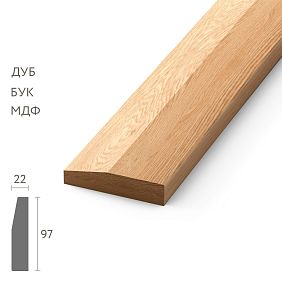
— not just an element hiding the gap between wall and floor in modern interiors. It is a supporting line visually grounding the space, creating a transition from vertical planes to horizontal ones. Modern baseboard differs from classic — it is lower (40-80 mm vs 100-150 mm), simpler in profile, often painted to match walls, blending into them or merging with floor covering.
Floor baseboard woodHeight of modern baseboard is determined by minimalist philosophy "just enough." Minimum height 40 mm is sufficient to protect lower wall section and hide the gap. Medium height 60-70 mm — universal solution for most modern interiors. Increased height 80-100 mm is used in rooms with ceilings over 3 meters, where low baseboard would be lost.
Profile of modern baseboard is simplified to minimum. Rectangular cross-section with minimal rounding radius 1-2 mm on top edge — most common variant. Baseboard with single bevel at 45-degree angle — slightly more decorative solution. Baseboard with soft rounding radius 5-8 mm — for interiors where tactile softness and safety (children's rooms, elderly care facilities) are needed.
Color solution for baseboard follows several logics. Baseboard in wall color — popular solution in minimalism, creating effect of infinite vertical plane receding into floor. Wall and baseboard are perceived as one whole, boundary blurred. Baseboard in floor color — traditional approach, visually expanding floor. Contrasting baseboard — white on grey walls, black on white — graphic solution, emphasizing boundary between planes.
Material of baseboard in quality interiors — solid oak or beech. Wooden baseboard creates tactile connection with slatted structures, door casings, parquet flooring. All wooden elements from one species form material unity, subconsciously perceived and creating sense of wholeness, thoughtfulness, quality.
Modern baseboard is mounted using hidden method without visible fasteners. Adhesive mounting with polyurethane glue or liquid nails — for perfectly flat walls. Mounting on hidden mounting strip with clips — for walls with minor irregularities. Strip compensates irregularities, baseboard clicks into place evenly. Traditional mounting with finish nails, countersinking and filling — most reliable, but requires careful finishing work.
Modern baseboard is mounted using hidden method without visible fasteners. Adhesive mounting with polyurethane glue or liquid nails — for perfectly flat walls. Mounting on hidden mounting strip with clips — for walls with minor irregularities. Strip compensates irregularities, baseboard clicks into place evenly. Traditional mounting with finish nails, countersinking and filling — most reliable, but requires careful finishing work.
Baseboard corners in modern interiors are mitered at 45 degrees with precision to 0.5 degrees. Any deviation creates a noticeable gap, spoiling the impression. Professional installers use miter saws with laser guides, ensuring absolute accuracy. After cutting, the pieces are joined, glued, and if necessary, micro-gaps are filled with wood-tone acrylic sealant.
Ceiling baseboard and profiles: top finish
Ceiling baseboard woodenIn modern interiors, ceiling baseboards (casing, cornice) are used selectively — not in all rooms or always. Minimalism tends toward rejecting ceiling cornices, leaving the wall-ceiling junction clean and undecorated. However, in some cases, a ceiling baseboard is functionally necessary: to conceal uneven junctions, to organize hidden lighting, or to create a visual closure of the space.
Ceiling baseboard dimensions in modern interiors are more modest than in classic styles. Width 40–70 mm instead of 80–120 mm in classic styles. Projection from the wall 30–50 mm. The profile is simplified — a concave curve connecting wall and ceiling with a smooth arc, or a simple 45-degree bevel. Complex multi-level profiles with grooves and dentils are not used — they contradict minimalist aesthetics.
Hidden lighting behind the ceiling baseboard — a popular technique in modern design. The cornice is mounted 50–80 mm from the ceiling, forming a niche. An LED strip is installed in the niche. Light is directed upward, reflected off the ceiling, creating soft, diffused illumination. The ceiling appears to rise, making the room seem taller. Adjustable brightness and color temperature allow changing the atmosphere.
Wooden profileCeiling cornices are made from solid oak or beech. Wooden cornices create a material connection with baseboards and rail systems. The top and bottom of the room are framed by wood — this creates a visual frame within which the interior unfolds. Even if the cornice is painted white, the tactile warmth of wood is felt upon close contact.
Profile made of woodUsed for finishing transitions between different planes and materials. Corner profiles protect exterior wall corners from damage. Connecting profiles cover joints between cladding panels. Transition profiles compensate for height differences between various floor coverings. All these profiles, made from the same wood species (oak or beech), create a system where each element is coordinated with the others.
Installing ceiling cornices requires precision. Walls and ceilings are rarely perfectly flat — deviations of 3–5 mm over 2 meters are typical. The cornice must fit tightly, without gaps. Each element is pre-fitted, adjusted, and if necessary, compensating elements are inserted. Mounted with adhesive and additional hidden screw fasteners. After installation, mounting points are spackled, sanded, and painted.
Ceiling cornice color usually matches ceiling color — most often white. This creates visual unity, making the cornice appear as part of the ceiling plane. Contrasting color — cornice in wall color or natural wood tone — emphasizes the wall-ceiling junction, making it visually significant. Choice depends on concept: dissolving boundaries or highlighting them.
Combination with baseboard elements
Trimming ItemsLinear elements — including rails, baseboards, cornices, casings, profiles, moldings, trim, and strips. Creating a cohesive modern interior requires coordinating all these elements into a unified system. The basic principle — material unity, simplified profiles, minimal decoration.
Material unity means all wooden baseboard elements are made from the same species — oak or beech. This ensures identical texture, density, and reaction to light. Even if some elements are painted in solid colors and others left natural, the common material base creates a connection, subconsciously perceived as wholeness.
Simplified profiles — a hallmark of modern design. Unlike classic interiors with their complex multi-level profiles, modern elements have simple cross-sections — rectangle, beveled rectangle, rectangle with one rounded corner. This simplicity aligns with the minimalist philosophy 'form follows function,' where decoration is absent or reduced to a minimum.
Minimal decoration does not mean absence of visual interest. Interest is created through element combinations, scale play, texture and color contrasts.Wooden railsOn accent walls, they create a rhythmic structure.baseboard for floorandCeiling corniceThey frame the space from above and below.Wooden profilesAt corners and joints, they ensure neat detailing. Together, they create a complex, thoughtfully designed environment.
The color palette of modern interiors with wooden baseboards leans toward monochromatic or restrained contrasts. White, gray, beige, black — base colors. Natural wood — oak, beech — acts as a warm accent. Popular combinations: white walls, natural oak rails, gray floor; gray walls, white baseboards and cornices, black rails; beige walls, light beech elements, white ceiling.
Scale hierarchy of elements creates visual logic. Largest elements — rail panels and partitions — form the primary spatial structure. Medium elements — baseboards and cornices — frame the room. Smaller elements — profiles, moldings — refine details, ensuring neat joints. This hierarchy must be obvious: large elements dominate, small ones complement, nothing competes.
Designing a comprehensive system begins with the concept. The style is defined (minimalism, Scandinavian style, Japanese minimalism, industrial loft), the wood species is chosen (oak or beech), and the finish is decided (natural, stained, painted). Sketches and 3D visualizations are created, showing interaction of all elements. Samples are ordered, assembled into mockups, and evaluated. Upon approval of the concept, an order is placed for the full set production.
Conclusion: Linear interior by STAVROS
Modern wooden interior — it is a system of linear elements that create spatial organization through rhythm, not mass. STAVROS offers a full range of baseboard elements for modern interiors:Wooden planks for wall decoration, Baseboards for floors, Ceiling Molding, Wooden profiles.
Premium oak and beech wood, kiln-dried to 8±2%, high-precision processing on modern equipment, professional finishes — STAVROS standards. All items from the same wood batch with a unified processing process, guaranteeing compatibility.
oak lumber, Beech rails, Sawn railsAvailable from stock in Saint Petersburg and Moscow with delivery across Russia. Custom sizes and profiles can be manufactured.
Frequently asked questions
Which wood species is better for modern interiors — oak or beech? Oak for expressive texture, beech for uniformity and staining. Both are durable and eco-friendly.
What is the optimal spacing between rails? 60–100 mm — a universal solution. Less for greater privacy, more for decorative effect.
Can oak rails be painted white? Yes, but the texture will remain visible. For a perfectly smooth surface, beech is better.
How much does a board wall 10 m² cost? 40,000–80,000 rubles with materials and installation depending on the species and complexity.
How to care for wooden boards? Regular dry cleaning, wet wiping once a week. Reapply finish every 5–7 years.
Is a ceiling skirting board necessary in minimalism? Not necessarily. It is used for hidden lighting or to cover uneven joints.
Can you install boards yourself? Technically possible, but for an ideal result, professionals are recommended.