Article Contents:
- Anatomy of a wide baseboard
- Visual weight at the base: psychology of perception
- Harmony with the cornice: top and bottom in dialogue
- Color solutions: from classic to avant-garde
- Wood species for wide baseboards
- Profiles of wide baseboards
- Installation of wide baseboards: features of the technology
- Wide baseboards in different interior styles
- Economics of wide solutions
- Care for Wide Baseboards
- Wide baseboard and floor coverings
- Technical nuances
- Frequently Asked Questions
- Conclusion

There are interior details that work on a subconscious level. You don't notice them immediately, but they shape the overall impression of the space. A wide baseboard is one of such details. Enter a room with high ceilings and wide wooden baseboards — and you immediately feel: here everything is serious, here nothing was compromised, every decision was thought out. This effect is called "expensive walls," although in reality it's about correct proportions, about the balance between top and bottom, about how architectural elements interact with each other.
wide wooden baseboardThis is not simply an enlarged version of a standard baseboard. It is an independent architectural element that changes the perception of space. It visually weights the lower part of the walls, creating a sense of solidity and stability. It forms a horizontal line that visually expands the room. It creates a dialogue with the ceiling cornice, framing the space from above and below. And all this works only under one condition: proportions must be correct. An overly wide baseboard in a low room will crush the space. An overly narrow one in a high room will dissolve, failing to perform its function.


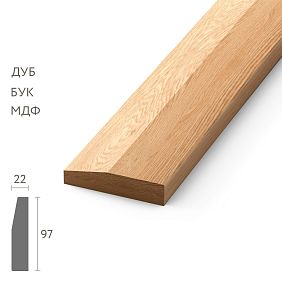


Anatomy of a wide baseboard
When we talk about a wide baseboard, what exactly do we mean? In professional circles, there is a conditional classification. A narrow baseboard — up to 40 millimeters in height, this is the minimum that hides the technological gap between the floor and the wall. Standard — from 40 to 70 millimeters, a universal option for most rooms. Wide — from 80 to 150 millimeters, this is already a full-fledged architectural element.
wide wooden baseboardA baseboard 100-120 millimeters high — the golden middle for rooms with ceilings from 2.8 to 3.5 meters. It is expressive enough to create the desired visual effect, but not so massive as to overload the space. The profile of such a baseboard is usually more complex than a standard one — protrusions, grooves, panels create a play of light and shadow, adding volume.
The thickness of a wide baseboard also matters. Standard thickness — 15-18 millimeters, suitable for most cases. But for truly high baseboards (from 120 mm), sometimes an increased thickness up to 20-25 millimeters is used. This adds additional solidity, especially if a complex profiled shape is used.
The length of the planks is standard — 2-2.5 meters for solid wood. This is the optimal size, allowing to minimize the number of joints on long walls. Although some manufacturers offer planks up to 3 meters, working with them is more difficult — greater weight, higher risk of deformation during transport and storage.




Visual weight at the base: psychology of perception
A wide baseboard creates what architects call visual weight at the base. This is not a metaphor, it is a real psychological effect. The human eye perceives the proportions of a room through the relationship of mass. If the lower part of the wall appears solid, massive, the space seems stable, reliable, expensive. If the lower part is thin, weak — there is a sense of temporariness, incompleteness.
Imagine a classic European house from the 19th century. High ceilings, massive wooden baseboards 15-20 centimeters high, often with carved elements. The walls seem monolithic, solid, as if they will stand for another century. Now imagine a modern apartment with 2.7-meter ceilings and a thin 5-centimeter plastic baseboard. The feeling is completely different — temporary housing, budget renovation, compromise solutions.
wooden baseboards for floorWide-profile baseboards work specifically to create a sense of solidity. They form a powerful horizontal line at the base of the wall, which becomes the visual foundation of the interior. This line attracts the gaze, sets the rhythm of the space, creates a frame within which the entire interior composition unfolds.
This effect works especially strongly in high rooms. If the ceilings are higher than three meters, a standard baseboard simply disappears, dissolves into the space. The room seems unfinished, as if something is missing. A wide baseboard solves this problem — it is expressive enough to be noticeable, creating the necessary visual balance.
The color of a wide baseboard enhances or weakens the effect of weight. A dark baseboard against light walls creates maximum weight — contrast makes it even more noticeable, even more massive. A white baseboard on white walls works more softly — weight is present, but it is delicate, unobtrusive. A baseboard in the same tone as the walls creates minimal weight, working more to increase wall height than to create solidity.
Our factory also produces:
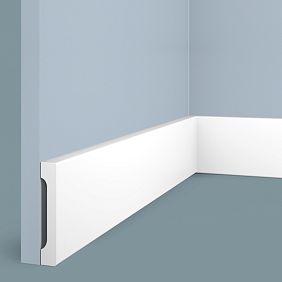
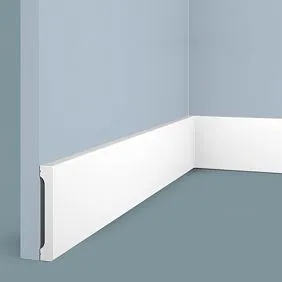
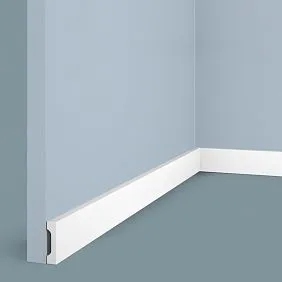
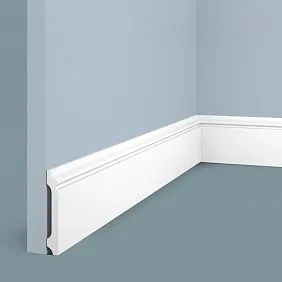

Harmony with the cornice: top and bottom in dialogue
A wide baseboard does not exist on its own — it must be part of a general architectural composition. And the most important partner in this dialogue is the ceiling cornice. The top and bottom of the room must correspond to each other in scale, style, and degree of ornamentation. This creates a sense of thoughtfulness and wholeness in the interior.
Classic rule: the width of the baseboard and cornice should be proportional to each other. If the baseboard is wide — the cornice should also be expressive. If the cornice is simple and narrow — a wide baseboard will look disproportionate. Specific numbers depend on ceiling height, but the general principle is: the ratio is approximately 1:1 or 1:1.2 between the height of the baseboard and cornice.
For example, for a room with 3-meter ceilings, the optimal solution is: baseboard 100-120 mm,wooden cornicecornice 100-140 mm. For 3.5-meter ceilings: baseboard 120-150 mm, cornice 130-160 mm. These proportions create a harmonious frame for the space, where top and bottom visually balance each other.
The profile style should also match. If the skirting board has a classic ornamental profile with protrusions and grooves, the cornice should be similar in character — with analogous decorative elements. If the skirting board is minimalist and rectangular, the cornice should also be simple. Mixing styles is possible, but requires refined taste and professional understanding of composition.
Material — another factor of harmony.Wooden baseboardBest matches with a wooden cornice. The wood species can be the same — this creates maximum unity. Or different, but close in tone — this adds nuances, making the composition more complex and interesting. Combining wood at the bottom and polyurethane at the top also works, especially in modern interiors, but requires careful selection of color and texture.
In very high rooms (from 3.5 meters), you can use an additional horizontal element — a frieze or molding at about one-third or half the wall height. This creates additional spatial division, making the space more intimate and human-scale.polyurethane wall moldingsor wood in such cases should be smaller in scale than the skirting board and cornice, but should match them in style.
Get Consultation
Color solutions: from classic to avant-garde
The color of a wide skirting board — this is a powerful tool that can either enhance the "expensive walls" effect or completely destroy it. Let's consider the main color solution strategies.
White skirting board — classic, never going out of fashion. A wide white skirting board against any wall creates a sense of freshness, cleanliness, elegance. It visually increases ceiling height, making the room brighter. Especially good in classic interiors, where it matches white door casings, cornices, and moldings.buy wooden skirting boardwhite — means choosing a safe solution.
Black skirting board — bold, dramatic solution. A wide black skirting board against light walls creates a powerful graphic contrast. It maximally emphasizes the lower part, making it the dominant element of the interior. This is a choice for modern spaces with high ceilings, where expressiveness and character are valued. A black skirting board requires appropriate surroundings — dark flooring or dark furniture will support it, creating a cohesive composition.
Natural wood with transparent lacquer finish — choice for those who appreciate the natural beauty of the material. A wide skirting board made of oak, ash, or walnut with pronounced texture becomes a standalone decorative element. Color can vary from light gold to dark brown, depending on species and staining. Such a skirting board best matches with wooden flooring — either in tone or with slight contrast.
In the same color as the walls — a solution that visually increases wall height. A wide skirting board painted in wall color blends with them, creating the impression that the wall begins not from the floor, but 10–15 centimeters lower. This is especially effective in rooms with standard ceilings of 2.7–2.8 meters, where every centimeter of height counts.wooden baseboards for flooringin the same color as the walls — a subtle technique that works at a professional level.
In the same color as the floor — a classic solution that creates visual continuity of the flooring. The skirting board and floor are perceived as a single surface, visually expanding the floor area. This is especially effective in large rooms, where horizontal extension is important.
Contrasting colors — an avant-garde solution for bold interiors. Blue, green, terracotta, burgundy — a wide skirting board in bright color becomes an accent that sets the tone for the entire space. Such a solution requires a professional approach and refined sense of color. But if done correctly, the result is strikingly original.
Two-tone solutions — when a wide skirting board has two colors: main and accent in protruding or recessed profile elements. This adds additional depth, emphasizing the profile's architecture. A classic example — white skirting board with gold patina in recesses. Or dark blue with silver accents.Moldings decorationoften uses such techniques.
Wood species for wide skirting boards
Choosing wood species for a wide skirting board is determined not only by aesthetic preferences but also by technical requirements. A wide profile is more demanding in material quality than a narrow one — any defects, deformations, or structural inconsistencies will be more noticeable.
Oak — an undisputed leader for premium wide skirting boards. Hardness, density, geometric stability — all this is critical for a tall profile. An oak wide skirting board does not warp, does not crack, and retains its ideal shape for decades. Oak's texture is expressive and noble, especially on a large surface of a wide profile. The color range from light gold to dark chocolate allows selecting a shade to match any interior.
Ash — similar in characteristics to oak, but has a lighter, cooler tone and clearly pronounced texture. Ash wide skirting board — choice for modern interiors where the natural beauty of wood is valued without excessive drama. The wide profile surface allows the beauty of ash fibers to fully express itself.
Beech — warm, dense wood with fine, uniform grain. Beech wide skirting boards are suitable for classic interiors. They paint well, accept any staining, from light to almost black.Wooden balusters priceand beech skirting boards are approximately in the same range — this is the golden middle ground between affordability and quality.
Larch — a unique option for rooms with high humidity or temperature fluctuations. A wide larch skirting board can be installed even in unheated rooms, verandas, or winter gardens — it does not fear moisture, becoming only harder over time. Color ranging from golden-yellow to reddish-brown adds warmth to the interior.
Spruce — budget option, but rarely used for wide skirting boards. The softness of the wood makes the wide profile vulnerable to mechanical damage. Additionally, spruce has an uneven structure with alternating hard and soft layers, which may cause warping of the wide profile. If choosing spruce, only select the highest grade with dense structure and definitely with protective coating.
Walnut — an elite choice for exclusive interiors. A wide walnut skirting board with its rich dark-brown color and refined texture becomes a work of art. The price corresponds to status, but the result is worth it.Furniture for bedrooms in classic stylemade of walnut requires the same walnut skirting boards.
Profiles of wide skirting boards
The shape of the profile of a wide skirting board determines its character and stylistic affiliation. The wider the skirting board, the more complex its profile can be — there is room for decorative elements.
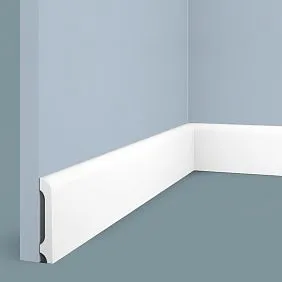
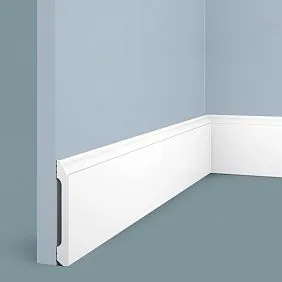
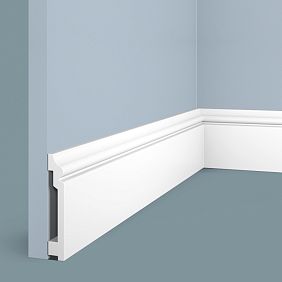
Classic ornamental profile — a system of protrusions, grooves, and rounded edges that create play of light and shadow. Such a profile is characteristic of classic, neoclassical, and traditional interiors. A wide skirting board with a classic profile may include several levels: lower rounded section, central flat surface, upper protrusion with a fillet. This is a complex architectural form that requires precise manufacturing and skillful installation.
Minimalist rectangular profile — simplicity of shape with great height creates a strong graphic effect. Wide baseboard without decorative excesses, simply a tall rectangular strip — this is a choice for modern, minimalist, Scandinavian interiors. The simplicity of the shape is compensated by material quality and precision of execution.
Beveled profile — when the upper part of the baseboard has a 30-45 degree angle slope. This creates dynamism, directing the gaze along the wall. A wide baseboard with beveling looks modern but not aggressive. Suitable for transitional styles between classic and modern.
Profile with cable channel — a practical solution for modern interiors. A wide baseboard with an internal cavity allows hiding wires, cables, and communications. The front panel is removable, providing access to the contents without dismantling the entire baseboard.Wooden wall decormust harmonize with the functional baseboard.
Stepped profile — when a wide baseboard has multiple height levels, creating a step effect. This is a complex architectural form, characteristic of rich classical interiors. Each step can be additionally decorated — with carving, patina, or gilding.
Profile with carved elements — the highest level of craftsmanship for wide baseboards. Carving can be surface-mounted (individual carved elements attached to the base profile) or integrated (carved from a single plank).Carvedelements turn the baseboard into a piece of decorative art.
Installation of wide baseboards: technology specifics
Installation of a wide baseboard differs from standard installation. Greater weight, larger surface area, greater visible surface — all this creates additional requirements for the technology.
Wall preparation is critical. For a wide baseboard, walls must be as flat as possible. Any unevenness, bump, or depression will cause the baseboard to not fit tightly, creating gaps. If walls are not ideal, they must be leveled with plaster or spackle in the exact area where the baseboard will be mounted — a 15-20 cm high strip from the floor.
Mounting must be secure. A wide baseboard is heavier than standard, so the mounting spacing must be smaller — 30-40 cm instead of the usual 50-60. Use self-tapping screws 40-50 mm long with 6-8 mm plastic anchors. Holes in the baseboard must be countersunk — enlarged with a larger diameter drill bit so that the screw head is fully recessed.
Material acclimatization is mandatory. A wide profile is more sensitive to humidity changes than a narrow one.wooden skirting board purchaseand immediately install — mistake. It must rest in the room for at least 72 hours, preferably a week. This is especially important if the baseboard is delivered from a cold warehouse in winter or from a humid space in summer.
Corners require special attention. A wide profile is harder to cut precisely — any error at the corner is more noticeable. Professionals use a miter saw with a laser guide and make test cuts on offcuts before the final trimming. Corner joints must be glued with PVA or acrylic sealant for monolithic connection.
Final joint finishing is critical for wide baseboards. All joints, corner connections, and mounting points must be treated with wood putty followed by sanding. After that — painting or varnishing with mandatory treatment of the joint areas.installing polyurethane moldingand wooden baseboards are similar in principle, but wood requires more careful preparation.
Wide baseboards in different interior styles
Wide baseboards are inherently versatile, but their application methods vary significantly across different styles.
Classic style — a natural environment for wide baseboards. Here, they are not just suitable, they are mandatory. Height from 100 to 150 mm, complex shaped profile, white color or natural wood with deep lacquer.Classic furniture pricesand wide baseboards go hand in hand. This is especially true for styles such as Empire, Baroque, Classicism, where architectural details play a key role.
Neoclassicism allows for a more restrained approach. Wide baseboards exist, but the profile is simpler, with less decoration. Height 80-100 mm, clean lines, white or light color. This is a modern interpretation of classical traditions, where proportions are preserved but excessive decoration is omitted.
Art Deco loves contrasts and graphics. Here, a wide baseboard is often made black or dark brown against light walls. The profile can be either classic or geometric, angular. Patina, gilding, and metallic inserts are often used.
Scandinavian style uses wide baseboards, but painted white with a simple profile. Height 80-100 mm, matte finish, no decoration. This creates a clean, bright, airy atmosphere characteristic of Scandinavian interiors.Wooden boards in interioroften coexist with such baseboards.
Loft rarely uses wide baseboards, but if it does, it is done in the most brutal way. Rough untreated wood or, conversely, metal profiles. Height can be any, but the style is distinctly industrial. Sometimes a wide baseboard is intentionally aged to create an effect of long-term use.
Provence and country styles love wide wooden baseboards with an aged effect. Patina, wear marks, slightly uneven surface — all this creates an atmosphere of a French village or American ranch. Height 80-120 mm, natural wood or painted in pastel tones.
Modern minimalism uses wide baseboards, but with a minimalist profile. Sometimes hidden mounting is used, where the baseboard is recessed into the wall, creating a shadow line instead of a protrusion. This requires special wall preparation, but the effect is impressive — clean lines while maintaining functionality.
Economics of wide solutions
A wide baseboard costs more than a standard one. This is obvious — more material, more complex processing, higher requirements for wood quality. But how much more expensive is it, and is this difference justified?
Material cost increases by approximately 40-60% compared to a standard baseboard of the same species. If a standard oak baseboard 60 mm high costs 1000 rubles per meter, a wide 100 mm baseboard will cost 1400-1600 rubles. This is logical — almost twice as much wood, plus more complex profiling.
The installation cost is also higher. Professional installation of a wide skirting board will cost 20-30% more than standard. This is due to its greater weight, the complexity of cutting wide profiles, and the need for more frequent fastening. On average, installation of a wide skirting board costs 200-350 rubles per linear meter compared to 150-250 for standard.
Consumables — fasteners, sealant, putty, varnish — are also required in greater quantities. Plus 20-30% to the standard estimate. But in absolute terms, this is not much — several thousand rubles for an apartment.
The return on investment in wide skirting boards is not financial, but aesthetic. You won't get money back directly, but you'll get a qualitatively different interior. A room with wide wooden skirting boards looks more expensive, respectable, and thoughtfully designed. This is the case where details create an impression.
An alternative to expensive solid wood — veneered wide skirting boards. A base made of inexpensive wood, covered with a thin layer of noble species. Visually almost indistinguishable from solid wood, but cost 1.5-2 times less.to buy wooden baseboardveneered — a reasonable compromise between price and quality.
Care for wide skirting boards
The large visible surface area of a wide skirting board requires more careful maintenance than standard. Any dirt, scratches, or coating defects are more noticeable.
Regular dry cleaning is mandatory. At least once a week, vacuum the skirting boards with a soft attachment or dry a microfiber cloth. Dust should not accumulate, especially in the recesses of the profiled shape.
Wet cleaning is permissible, but with caution. The cloth must be well wrung out, almost dry. Use special wood-specific cleaners, free of aggressive solvents. No excess water — it may penetrate under the varnish coating and cause wood swelling.
Protection against mechanical damage is important. A wide skirting board is a large flat surface that is easy to scratch when moving furniture, hit with a vacuum cleaner, or bump into a suitcase. Be careful with any manipulation near walls.
The coating needs periodic renewal. Varnished wide skirting boards require renewal every 7-10 years. Oil-based ones — every 3-5 years. Painted ones — every 5-7 years. The large surface area of a wide skirting board makes the renewal process more labor-intensive, but also more noticeable — a fresh coating immediately transforms the interior.
Local repair of scratches and chips is easier on a wide skirting board than on a narrow one. More working space, easier to sand and repaint. Minor defects are repaired with wood putty, sanding, and local repainting.Wooden furniture handleand skirting boards require similar care methods.
Wide skirting board and floor coverings
Choosing a wide skirting board should take into account the type of floor covering. Not all combinations work equally well.
Parquet and solid wood planks — ideal partners for a wide wooden skirting board. Natural wood on the floor and a wide wooden profile on the wall create a harmonious unity. The species can match — this is maximum integration. Or be different but similar in tone — this adds nuance.with a classic profile creates a sense of solidity, reliability.of the same species as the parquet — classic style.
Laminate pairs well with wide wooden skirting boards if the color is chosen correctly. For wood-style laminate, choose a skirting board of similar shade. For modern concrete or stone-style laminate — use neutral-colored painted skirting boards.
Ceramic tile and tile — cold, hard materials. A wide wooden skirting board adds warmth and softens the visual perception. This works well in loft, industrial, and eclectic interiors. The contrast of materials creates an interesting dynamic.
Cementitious floors and microcement — modern finishes that pair well with wide skirting boards of minimalist profile. A single-tone smooth floor surface requires a striking border, and a wide skirting board handles this task well.
Carpet — a covering traditionally hidden under skirting boards. In this case, a wide skirting board must have a special shape — with a lower edge that presses the carpet edge down. Or use an additional pressing strip.
Technical nuances
A wide skirting board creates certain technical features that must be considered during design and installation.
Doors and their opening may conflict with a wide skirting board. If the door opens inward, its bottom edge may hit the skirting board. This must be planned in advance. Either slightly raise the door on hinges, or trim the bottom edge, or cut a notch in the skirting board at the door opening location.
Heating radiators often stand close to the wall. A wide skirting board may not fit under the radiator legs. Options: either make a complex cutout with each leg cut out, or cut the skirting board before the radiator.Decorative brackets for shelvessometimes used for decorating such transitions.
Built-in furniture — kitchens, sliding wardrobes — have a base that must align with the skirting board. Ideally, the base height matches the skirting board height. If not — plan the transition. Either a smooth cut or a decorative strip.
Stairs require special treatment for a wide skirting board.buy wooden balusters for the staircaseand skirting boards must be planned simultaneously to consider their interaction. The skirting board either approaches the first step or smoothly transitions into a decorative element of the staircase.
A warm floor creates additional thermal expansion of the floor covering. The compensatory gap must be larger than standard — 12-15 mm instead of 10. A wide skirting board easily conceals such a gap, but must be attached only to the wall, never to the floor.
Frequently asked questions
From what height is a skirting board considered wide?
A skirting board is considered wide at 80 millimeters high. The standard range for wide skirting boards — 80-150 mm. For rooms with ceilings 2.8-3 meters high, 100-120 mm is optimal. For higher ceilings — 120-150 mm. Skirting boards over 150 mm are rarely used, only in exceptional cases for very high entrance halls.
Can a wide skirting board be used in an apartment with standard 2.7-meter ceilings?
Yes, but with limitations. The maximum height of the skirting board for such ceilings is 80-90 mm. A higher one will look disproportionate and visually reduce the room's height. If you really want a wide skirting board with low ceilings, paint it to match the wall color — this will soften the effect of heaviness.
How to choose the width of the cornice for a wide skirting board?
General rule: the cornice should be approximately the same width or slightly wider. If the skirting board is 100 mm — the cornice should be 100-120 mm. If the skirting board is 120 mm — the cornice should be 120-140 mm. This creates a visual balance between the top and bottom. A cornice narrower than the skirting board will look disproportionate.
Is installation of a wide skirting board more expensive compared to a standard one?
Yes, 20-30% more. A wide skirting board is heavier, requires more frequent mounting, is harder to cut at angles. Additionally, the larger visible surface area requires more careful finishing of joints. In absolute terms, the difference is 50-100 rubles per linear meter.
Can a wide skirting board be used without a cornice?
Yes, but not always desirable. A wide skirting board without a matching cornice creates imbalance — heavy bottom, light top. This may work in modern minimalist interiors where the ceiling is intentionally left bare. But in classic interiors, a cornice is essential for harmony.
Which wide skirting board is better for humid rooms?
For bathrooms, kitchens, and toilets, choose skirting boards made from moisture-resistant species — oak, larch. Or use moisture-resistant MDF. A high-quality lacquer finish in multiple layers is mandatory. The ends of the skirting boards must be especially carefully painted — through these areas, wood absorbs moisture most quickly.
What if the walls are very uneven?
A wide skirting board requires flat walls. If the unevenness is minor (up to 5 mm), it can be hidden by locally leveling the wall in the area where the skirting board is mounted. If the unevenness is greater, you will either need to fully level the walls or opt for a standard or flexible skirting board instead.
How long does a wide wooden skirting board last?
With proper care — for decades. A skirting board made of solid oak or ash with a quality lacquer finish will last 30-50 years without replacement. Only periodic refreshment of the finish is needed — every 7-10 years. A wide skirting board is more durable than a narrow one — greater thickness provides extra strength.
Can wide and standard skirting boards be combined in one apartment?
Highly undesirable. This creates visual chaos and disrupts the interior's integrity. If necessary (for example, in rooms of different heights), the transition should occur at doorways, where changing the skirting board is less noticeable.
How does a wide skirting board affect the visual height of the ceiling?
A dark wide skirting board on light walls visually lowers the ceiling. Light or matching wall color — practically no effect or even increases the visual height, pushing the floor boundary back. If the ceiling is low but you want a wide skirting board — paint it to match the wall color.
Conclusion
A wide wooden skirting board is not simply an enlarged version of a standard decorative element. It is an architectural tool capable of radically changing the perception of the interior. It creates that very feeling of 'expensive walls,' when the space appears thoughtfully designed, solid, and status-conscious. Visual heaviness at the bottom makes the room feel stable and reliable. Harmony with the ceiling cornice creates a unified composition where top and bottom engage in dialogue. Thoughtfully chosen color solutions enhance the effect, add depth, and create the desired mood.
But all these effects work only when proper proportions are maintained. A wide skirting board requires appropriate ceiling height, a specific room scale, and thoughtful selection of other interior elements. This is not a universal solution for any space, but a specialized tool for specific tasks. Professional understanding of these nuances distinguishes good design from mediocre.
wide wooden baseboardIt is an investment in interior quality. Yes, it is more expensive than standard. Yes, its installation is more complex. Yes, it requires more careful maintenance. But the result justifies all the investments. A room with properly selected and correctly installed wide skirting boards looks completely different — more expensive, more respectable, more professional.
Choosing the wood species, profile, color, and finish method — all this requires attention and understanding. Each decision affects the final result. An oak skirting board with natural texture creates one atmosphere, a whitewashed beech one — completely different. A classic decorative profile speaks of traditional values, a minimalist rectangular one — of a modern approach.
STAVROS offers a full range of wide wooden skirting boards for the most demanding projects. From classic profiles 100-120 mm high to exclusive items up to 150 mm high. Solid oak, ash, beech, larch — your choice. Any finish options — from natural wood under lacquer to complex patinas and gold leaf. In-house production allows controlling every stage — from wood selection to final finishing.
In the STAVROS catalog, you will find not only wide skirting boards, but also all elements for creating a harmonious architectural composition:Ceiling Molding, Moldings, decorative elements, staircase componentsAll made of natural wood, all with proper proportions, all designed to create interiors with the 'expensive walls' effect.
STAVROS consultants will help you select the optimal skirting board height for your room, calculate the ratio with the cornice, recommend the wood species and finish method. Because STAVROS is not just selling materials — it is expertise in creating quality interiors. Choose a professional approach, choose the right proportions, choose STAVROS.