Article Contents:
- Furniture Hardware: Small Details with Great Value
- Functionality Above All: How Hardware Changes the Experience of Using Furniture
- Aesthetic component: how hardware affects the appearance of furniture
- Durability and Reliability: An Investment in Quality
- Variety of furniture hardware: from basic elements to innovative solutions
- Hinges and Opening Systems: Technologies of Silence and Smoothness
- Drawer Guides: From Simple Wheels to High-Tech Systems
- Lift Mechanisms: Revolutionizing Space Organization
- Decorative Hardware: From Classic to Avant-Garde
- Where to Buy Furniture Hardware: Criteria for Choosing a Supplier
- Specialized Stores: Advantages of a Professional Approach
- Online Stores: Convenience and Wide Selection
- Construction and Furniture Hypermarkets: Accessibility and Comprehensive Solutions
- Manufacturers and Distributors: Direct Path to Quality
- Criteria for Choosing a Reliable Furniture Hardware Supplier
- Practical Tips for Choosing and Installing Furniture Hardware
- How to Properly Select Hardware for Different Types of Furniture
- Technical Nuances: Dimensions, Loads, Compatibility
- Tools and Materials for Installation: Professional Approach
- Step-by-Step Instructions for Installing Common Types of Hardware
- Trends and Innovations in the World of Furniture Hardware
- Modern Technologies: "Smart" Hardware for the 21st Century

Imagine a cabinet that opens absolutely silently, smoothly, and with no effort at all. Kitchen drawers that extend fully, allowing access even to the most distant corners. Doors that never slam, but softly and elegantly close on their own. All of this is not science fiction, but reality accessible to everyone thanks to modern furniture hardware. But where you can buy furniture hardwarewhich will truly transform your furniture and make using it a genuine pleasure? Let’s explore this question and learn how to choose hardware that will become the perfect finishing touch for your interior.


Furniture Hardware: Small Details with Great Value
When we talk about furniture, the first things that come to mind are material, color, shape. However, it is the hardware, these small, often unnoticed elements, that determine how functional, durable, and convenient your furniture will be. Let’s dive into this amazing world and learn how to choose the right hardware for different types of furniture.




Functionality Above All: How Hardware Changes the Experience of Using Furniture
Modern furniture hardware is high-tech mechanisms capable of radically changing your interaction with furniture. Take, for example, drawer extension systems. Simple roller guides, which were used for decades, today give way to ball-bearing and tandem systems, providing:
- Full drawer extension (100% access to contents)
- Smooth and silent operation even when fully loaded
- High load capacity (up to 80 kg per pair of guides)
- No sagging even after many years of use
- Soft-close function
- Push-to-open function
Hinges for doors have also undergone revolutionary changes. Modern hinges with dampers not only prevent doors from slamming, but also protect facades from damage, extending the lifespan of furniture. They are equipped with a 3D adjustment system, allowing facades to be perfectly aligned even with uneven cabinet bodies.
Lift mechanisms for upper kitchen cabinets turn the opening process into a real pleasure. They compensate for the door’s weight, allowing it to be opened with a single light movement. At the same time, the door locks in any position and closes smoothly with a light touch.
But where you can buy furniture hardware of this level? It is important to choose trusted suppliers offering products from leading manufacturers with quality guarantees and technical support.
Our factory also produces:


Aesthetic component: how hardware affects the appearance of furniture
In addition to functionality, hardware plays a crucial role in shaping the aesthetic appearance of furniture. Handles, hooks, decorative inserts — these are the elements we see and interact with daily.
The modern market offers an incredible variety of decorative hardware:
- Minimalist aluminum profile handles, creating a "invisible" effect
- Exquisite brass handles with patina for classic interiors
- Handmade ceramic handles that give furniture a unique character
- Leather hinges and handles for creating a cozy atmosphere
- Glass and crystal elements for luxurious interiors
- Handles integrated into the facade for ultra-modern design
Choosing decorative hardware is an opportunity to give furniture individuality, making it a reflection of your taste and style. For example, replacing standard handles with vintage brass ones can completely transform an ordinary chest, turning it into a stylish interior piece.
It is important to remember that decorative hardware should not only look beautiful but also be convenient to use. Ergonomics is a key factor, especially for elements you interact with daily.
Get Consultation
Durability and reliability: an investment in quality
Quality furniture hardware is not just a purchase, but a long-term investment. The price difference between premium and budget hardware can be significant, but it fully justifies itself in the long run.
High-class hinges are tested for 100,000 opening-closing cycles, guaranteeing more than 20 years of flawless operation under average usage. They are made from high-quality steel with a multi-layer anti-corrosion coating, providing protection even in high-humidity conditions.
Premium-grade guides are equipped with precision ball bearings, ensuring smooth operation even under maximum load. Their design includes special dampers that prevent damage during abrupt closing.
Lift mechanisms from leading manufacturers are equipped with gas dampers designed for tens of thousands of cycles without loss of efficiency. They feature a finger safety system and adjustable opening force depending on the facade weight.
Solving, where you can buy furniture hardwarePay attention to the manufacturer's reputation, warranty availability, and technical support options. Quality hardware will last for decades, while cheap alternatives will need replacement within a few years.
Variety of furniture hardware: from basic elements to innovative solutions
The modern market of furniture hardware is impressive in its variety. From the simplest hinges to complex multi-functional systems — the choice is vast. Let’s examine the main categories of hardware and their features.
Hinges and opening systems: technologies of silence and smoothness
Hinges are, perhaps, the most common element of furniture hardware. They enable the opening and closing of cabinet, drawer, and chest doors. Modern hinges are high-tech devices with multiple functions.
Types of hinges by mounting method:
- Surface-mounted hinges — the door fully covers the frame. Such hinges are visible when the door is closed and are often used as a decorative element.
- Semi-surface-mounted hinges — the door partially covers the frame. This is the most common type of hinge for built-in furniture.
- Inset hinges — the door fully fits into the frame. Such hinges provide the cleanest possible exterior appearance of the furniture.
- Corner hinges — special hinges for corner cabinets, providing a larger opening angle.
Innovative features of modern hinges:
- Soft-close systems (soft-close) — an integrated damper slows down the door movement in the last centimeters, ensuring smooth and silent closing. This not only enhances user comfort but also prevents damage to facades.
- Push-to-open systems — allow doors to be opened with a light press on the facade, especially relevant for furniture without handles. The mechanism works via a special spring that pushes the door out upon pressing.
- Hinges with 165-170° opening angle — provide maximum access to cabinet contents. Particularly relevant for corner solutions and cabinets with internal pull-out systems.
- Hinges with integrated damper — a compact solution requiring no separate damper installation. Ideal for small doors and situations with limited space.
- Three-plane adjustment — allows perfect facade alignment even with uneven frames. Adjustment is done via screws and does not require door disassembly.
Technical specifications of quality hinges are impressive: load capacity up to 25-30 kg per pair, service life up to 100,000 opening-closing cycles, corrosion resistance due to multi-layer electroplating with a thickness of 12-15 microns.
Drawer guides: from simple rollers to high-tech systems
Guides determine how easily and smoothly drawers will slide out. Modern systems ensure not only comfortable use but also significantly increase the usable space within the drawer.
Main types of guides:
- Roller guides — the simplest and most economical option. They provide partial drawer extension (usually up to 3/4 depth) and limited load capacity (up to 15-20 kg). Main drawback — potential sagging over time.
- Ball-bearing guides — a more advanced system providing smooth operation via ball bearings. They can be partial or full extension, with load capacity up to 30-35 kg. Distinguished by high reliability and longevity.
- Tandem (hidden) guides — installed under the drawer bottom and not visible when the drawer is pulled out. They provide full extension, high load capacity (up to 50 kg), and exceptional smoothness. Ideal for kitchen drawers and other situations requiring maximum access to contents.
- Hidden mounting guides – installed under the side walls of the drawer and fully concealed. This premium solution ensures not only functionality but also aesthetics.
Innovative features of modern guides:
- Soft-close systems – prevent drawer slamming and protect contents from damage during abrupt closure.
- Push-to-open systems – allow drawers to be opened easily by pressing the front panel without handles.
- Synchronizers – ensure even drawer movement even when pressing one end of the front panel.
- Three-plane adjustment – allows perfectly aligning drawer fronts relative to each other and the furniture frame.
- Drop-down safety systems – prevent drawer from falling out upon excessive extension.
Technical specifications of premium guides include load capacity up to 50-80 kg per pair, up to 80,000 open-close cycles, resistance to side loads and deformation.
Lift mechanisms: revolution in space organization
Lift mechanisms for upper kitchen cabinets and other types of furniture – an innovative solution significantly enhancing usability and ergonomics.
Main types of lift mechanisms:
- Hinged (vertical) – door lifts upward and locks horizontally. Ideal for tall and narrow cabinets.
- Folding – door folds in half when opened. Optimal for cabinets of medium height and width.
- Parallel – door moves parallel to the cabinet frame. Suitable for wide cabinets with low height.
- Swing-hinged – combined mechanism providing maximum access to cabinet contents.
Advantages of lift mechanisms:
- Space-saving – when opened, the door does not occupy space in front of the cabinet, which is especially important in small rooms.
- Safety – eliminates the risk of hitting an open door, which is relevant for passageways and kitchens.
- Ease of access – an open door does not obstruct access to cabinet contents.
- Ergonomics – mechanisms compensate for door weight, making opening easy even for heavy fronts.
- Aesthetics – create a modern, technological look for furniture.
Modern lift mechanisms are equipped with gas or spring dampers, ensuring smooth movement and door locking in any position. They feature adjustable opening force depending on the front weight and can be equipped with soft-close and push-to-open systems.
Technical specifications of quality lift mechanisms include load capacity from 3 to 20 kg (depending on model), up to 60,000 open-close cycles, adjustable opening force and locking angle.
Decorative hardware: from classic to avant-garde
Decorative hardware – these are elements that not only perform a functional role but are also an important part of furniture design. Handles, hooks, decorative plates – all of these shape the furniture’s exterior appearance and style.
Variety of furniture handles:
- Classic pull handles – traditional solution suitable for most furniture styles. Made from various materials (metal, wood, plastic) and available in numerous design variations.
- Buttons and push-button handles – compact solution for small fronts. Can be minimalist or decorative.
- Inset handles – recessed elements into the front, creating a "clean" surface effect. Ideal for modern minimalist interiors.
- Profiled handles – aluminum profiles integrated into the front edge. Create a "invisible" effect and provide comfortable grip along the entire front length.
- Decorative handles – exclusive designer solutions becoming accent elements of furniture. Can imitate various objects, have complex shapes, inlays.
Materials for decorative hardware:
- Metals – from simple steel to refined brass and bronze. Metal handles can have various finishes (chrome, nickel, gold, patina) and textures (glossy, matte, brushed).
- Wood – a warm, natural material that creates a cozy atmosphere. Wooden handles can be made from various types (oak, beech, walnut, exotic woods) and have diverse finishes.
- Ceramics and porcelain – materials that allow creating unique, handcrafted elements with painting, glaze, and relief.
- Glass and crystal – create an effect of lightness and luxury. They can be transparent, matte, colored, or feature internal decorative elements.
- Leather and textile – unusual materials that add tactile variety and coziness.
The choice of decorative hardware should be based not only on aesthetic preferences but also on practical considerations. Handles should be easy to use, match the size and weight of doors, and harmonize with the overall interior style.
Where to buy furniture hardware: criteria for selecting a supplier
Choosing where to buy furniture hardware is no less important than choosing the hardware itself. The reliability of the supplier affects the quality of the product, level of service, and availability of professional consultation and technical support.
Specialized stores: advantages of a professional approach
Specialized furniture hardware stores – these are places where you will find not only a wide selection but also expert support in choosing.
Advantages of specialized stores:
- Professional consultation – specialists will help you select hardware that best meets your requirements, explain technical features and installation nuances.
- Guaranteed quality – the reputation of a specialized store directly depends on the quality of the products offered, so here you are more likely to find original hardware from reputable manufacturers.
- Ability to see and test hardware – many stores have display samples that allow you to evaluate the appearance, material, and mechanism quality.
- Comprehensive solutions – the ability to purchase all necessary components in one place, ensuring compatibility and stylistic unity.
- Technical support – consultations on installation, adjustment, and maintenance of hardware.
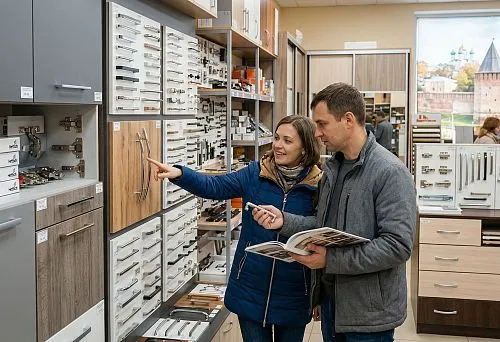
where you can buy furniture hardware High quality with professional support? The company "Stavros" offers a wide range of hardware from leading global manufacturers, guaranteeing quality, reliability, and durability of each item.
Online stores: convenience and wide selection
In the era of digital technology, online stores are becoming an increasingly popular place to buy furniture hardware.
Advantages of online stores:
- 24/7 availability – the ability to make purchases at any convenient time, without leaving home.
- Wide selection – online platforms usually offer a broader range than physical stores, thanks to the absence of space limitations.
- Easy search and filtering – the ability to quickly find desired items based on specified parameters (type, material, color, price).
- Detailed descriptions and photos – comprehensive information on technical specifications, dimensions, materials, and included components.
- Customer reviews – the opportunity to learn other users' opinions on the quality and functionality of the hardware.
- Home delivery – saving time and effort, especially when purchasing heavy or bulky hardware sets.
However, when purchasing online, it is important to choose reputable platforms to avoid counterfeit or low-quality products.
Construction and furniture hypermarkets: accessibility and comprehensive solutions
Large home improvement and furniture hypermarkets (Leroy Merlin, OBI, IKEA) also offer furniture hardware in their selection.
Advantages of hypermarkets:
- Physical presence in most major cities – the opportunity to purchase hardware without waiting for delivery.
- Comprehensive solutions for repair and furnishing – the opportunity to purchase hardware together with other materials and tools.
- Demonstration stands – the opportunity to see hardware in action, evaluate its functionality and quality.
- Regular promotions and discounts – the opportunity to purchase hardware at a favorable price.
- Convenient return and exchange policies – consumer protection in case of defects or non-conformity with expectations.
However, it should be noted that the hardware selection in hypermarkets is usually limited to mass-market models, and the level of consultants' expertise may be insufficient for complex technical questions.
Manufacturers and distributors: direct path to quality
Some manufacturers and official distributors of furniture hardware work directly with end consumers, offering their products without intermediaries.
Advantages of working with manufacturers and distributors:
- Authenticity guarantee – eliminates the risk of purchasing counterfeit or fake products.
- Full assortment – access to the entire product line, including new arrivals and specialized solutions.
- Professional technical support – consultations from specialists directly involved in the development and production of hardware.
- Ability to order custom solutions – adapting hardware to specific requirements and projects.
- Competitive prices – absence of intermediary markups allows obtaining more favorable terms.
This option is especially relevant for professionals in the furniture industry, interior designers, and large projects where significant volumes of hardware are required.
Criteria for selecting a reliable furniture hardware supplier
Regardless of the purchase format, it is important to evaluate the supplier's reliability based on several key criteria:
- Reputation and experience – companies proven over time usually value their reputation and offer quality products and services.
- Assortment – a wide selection of hardware in various types, styles, and price categories allows finding the optimal solution for any project.
- Product quality – presence of quality certificates, warranty obligations, and information about the manufacturer.
- Service level – consultants' professionalism, readiness to answer technical questions, assistance in selecting hardware.
- Delivery and payment terms – transparent pricing policy, convenient payment methods, reliable and timely delivery.
- After-sales service – technical support, possibility of replacing or returning the product in case of defects.
- Customer reviews – opinions of real buyers about product quality and service level.
Solving, where you can buy furniture hardwarePay attention to companies that do not merely sell products but offer comprehensive solutions including consultation, optimal selection, technical support, and warranty service.
Practical tips for selecting and installing furniture hardware
Even the highest-quality hardware will not realize its potential without proper selection and correct installation. Let us consider practical recommendations that will help you avoid common mistakes and get the most out of your furniture hardware.
How to properly select hardware for different types of furniture
Hardware selection should be based on the type of furniture, its purpose, style, and usage characteristics.
For kitchen furniture:
- Hinges with dampers – prevent door slamming and protect fronts from damage. For kitchens, hinges with enhanced moisture resistance and temperature stability are recommended.
- Full-extension guides – ensure access to all contents of drawers. For kitchen drawers, especially lower ones storing heavy dishes, guides with a load capacity of at least 30 kg are recommended.
- Lift mechanisms for upper cabinets – make access to contents easier and prevent impacts with open doors. Choose mechanisms with adjustable opening force depending on the door's weight.
- Pull-out systems for corner cabinets – maximize the use of hard-to-reach corner space. Modern systems (carousel, magic corners) provide full access to contents.
- Handles made of moisture-resistant materials – metal or plastic handles are preferred, as they are resistant to dirt and easy to maintain.
For wardrobes and cabinets:
- Hinges with 165-170° opening angle – provide maximum access to cabinet contents.
- Sliding systems – save space in front of cabinets. Choose systems with smooth operation and soft-close mechanisms.
- Pantographs (closet lifts) – provide convenient access to high shelves. Choose models with gas dampers compensating for clothing weight.
- Pull-out baskets and drawers – organize space inside the cabinet. For heavy items, choose systems with high load capacity.
- Handles matching interior style – for classic interiors, choose brass or bronze handles; for modern interiors, minimalist metal or integrated handles.
For children's furniture:
- Safe mechanisms – without sharp edges, with finger protection.
- Soft-close systems – prevent injuries from accidental door slamming.
- Locks and latches – for cabinets containing potentially hazardous items.
- Bright, ergonomic handles – easy for small hands, without small parts that may break off.
- Durable guides – withstand active use and require no complex maintenance.
For office furniture:
- Guides with high durability – for frequently used drawers.
- Central locking systems – for document protection.
- Cable management – systems for organizing and concealing wires.
- Ergonomic handles – for comfortable use throughout the workday.
- Adjustable feet – to compensate for floor unevenness and ensure stability.
Technical nuances: dimensions, load capacities, compatibility
When selecting hardware, it is important to consider technical parameters ensuring proper operation and longevity.
Dimensions and proportions:
- Hinges – choose based on door thickness and mounting type. Standard cup hinges are designed for 16–22 mm thick doors.
- Guides – length should match cabinet depth. For full extension, choose guides 10–15 mm shorter than cabinet depth.
- Handles – size should match door size. For large doors, prefer long handles (200 mm+); for small drawers, compact buttons or pull tabs.
- Lift mechanisms – choose according to door weight and size. Manufacturers usually specify recommended parameters for each model.
Loads and strength:
- Hinges – consider door weight and usage intensity. For heavy doors, install additional hinges (typically 2 per door up to 1000 mm, 3 up to 1800 mm, 4 up to 2200 mm).
- Guides – load capacity must exceed expected load with a safety margin. Consider not only the weight of contents but also the weight of the drawer itself.
- Lift mechanisms – must precisely match door weight. A weak mechanism won’t hold the door; an overly strong one will make closing difficult.
- Feet and legs – load capacity must match furniture weight including expected load.
Compatibility and interchangeability:
- System approach – prefer using hardware from one manufacturer to ensure full compatibility.
- Mounting standards – most manufacturers adhere to certain standards, ensuring interchangeability of basic components.
- Adapters and converters – allow integration of components from different systems when needed.
- Universality – some types of hardware (e.g., standard cup hinges) are compatible with products from different manufacturers.
Installation tools and materials: professional approach
The right set of tools and materials is the guarantee of quality installation of furniture hardware.
Basic tools:
- Drill – for quick and accurate screwing. A model with torque adjustment is recommended to prevent over-tightening.
- Drill with drill bit set – for preparing holes for fasteners. Special wood drill bits of various diameters are required for working with wood and MDF.
- Router – for milling recesses for cup hinges and other inset elements. A compact model with a router bit set is suitable for home use.
- Marking templates – ensure accurate positioning of holes for hinges, handles, and guides. Universal templates and specialized ones for specific hardware types are available.
- Tape measure, square, level – for precise measurements and checking horizontal/vertical alignment.
- Pencil, marker, painter’s tape – for marking.
- Screwdriver set – for adjusting mechanisms.
- Hammer with rubber cap – for carefully fitting parts.
Consumables:
- Screws of various sizes – for fastening hardware. Choose screws recommended by the hardware manufacturer.
- Dowels and anchors – for mounting heavy furniture to walls.
- Wood glue – for strengthening joints.
- Wax pencil – for masking minor defects and screw heads.
- Lubricant – for ensuring smooth operation of mechanisms.
Specialized tools for professional installation:
- Drilling guides – ensure accurate positioning and drilling angle.
- Press for installing cup hinges – guarantees perfect seating of the cup into the prepared hole.
- Laser level – for precise marking on large areas.
- Edge router – for processing edges and creating bevels.
- Clamps and vices – for secure fixation of parts during processing and assembly.
Investing in quality tools pays off in precision, speed of work, and longevity of results.
Step-by-step instructions for installing main types of hardware
Correct installation of hardware is the guarantee of its longevity and flawless operation. Let’s consider the main stages of installing the most common types of hardware.
Installing cup hinges:
- Marking – determine the position of hinges on the door (usually 100–150 mm from the top and bottom edges). Use a template for accurate marking.
- Drilling the hole for the cup – use a 35 mm diameter router bit to drill a hole 12–13 mm deep. To prevent chipping at the exit, place a piece of wood under the part.
- Drilling holes for screws – use a 2–3 mm drill bit to pre-drill holes for screws.
- Installing the hinge cup – insert the cup into the prepared hole and secure it with screws. Do not overtighten screws to avoid damaging the material.
- Install the hinge plate – attach the hinge plate to the cabinet frame, ensuring correct positioning relative to the hinge.
- Mounting the door – connect the hinge parts by snapping them together or securing with a special screw (depending on the construction).
- Adjustment – use the adjustment screws to set the door position in three planes: height, depth, and width.
Installing drawer slides:
- Marking – determine the position of the slides on the side walls of the cabinet and drawer. Use a template or ruler for accurate marking.
- Mounting to the cabinet – attach the slides to the side walls of the cabinet, ensuring parallel alignment and equal height on both sides. Use a level to check horizontal alignment.
- Mounting to the drawer – install the corresponding parts of the slides on the drawer side walls, ensuring parallel alignment and correct positioning relative to the cabinet parts.
- Installing the drawer – insert the drawer into the cabinet, aligning the slide parts.
- Adjustment – adjust the drawer front position using adjustment screws (if provided by the construction).
Installing handles:
- Marking – determine the position of the handles on the fronts. For consistency, use a template or ruler. For two-point handles, accurately maintain the distance between the holes.
- Drilling holes – drill holes of the required diameter (usually 4-5 mm) through. To prevent chipping at the exit, place a piece of wood under the part.
- Installation – insert screws from the inside of the front, tighten the handle, and secure. Do not over-tighten the screws to avoid damaging the front.
Installing lift mechanisms:
- Marking – determine the position of the mechanism on the side wall of the cabinet and the front according to the manufacturer's instructions.
- Mounting the cabinet part – attach the mechanism base to the side wall of the cabinet, following the specified dimensions and position in the instructions.
- Mounting the front part – install the corresponding part of the mechanism on the door, ensuring correct positioning relative to the cabinet part.
- Connecting – connect the mechanism parts according to the instructions.
- Adjustment – adjust the opening and closing force according to the weight of the front using adjustment screws.
Trends and innovations in furniture hardware
The world of furniture hardware is constantly evolving, offering increasingly sophisticated and innovative solutions. Let's consider current trends and technological novelties that define the future of this industry.
Modern technologies: "smart" hardware for the 21st century
Technological progress transforms furniture hardware, making it more functional, convenient, and integrated into modern lifestyles.
Electromechanical opening systems allow opening and closing furniture without physical contact. They are activated by a light touch on the front or via a remote control. Such systems are especially relevant for:
- Kitchen cabinets, when hands are occupied or dirty
- Furniture for people with disabilities
- Highly located cabinets, access to which is difficult
Integration with "smart home" systems elevates furniture functionality to a new level:
- Voice control for opening and closing cabinets
- Programming usage scenarios (e.g., automatic closing of all cabinets before leaving the house)
- Monitoring status (notifications about unopened doors or extended drawers)
- Integration with security systems (automatic locking of certain cabinets when "away from home" mode is activated)
Biometric access systems provide security and control over access to furniture contents:
- Fingerprint scanners for unlocking cabinets containing valuables or documents
- Face recognition for personalized access to different cabinet compartments
- Voice recognition systems for controlling furniture
Built-in lighting has become an essential part of modern furniture:
- Automatic activation when opening a cabinet or drawer
- Brightness and color temperature adjustment
- Integration with the room's general lighting system
- Decorative lighting that highlights furniture design
Monitoring and self-diagnostic systems enhance furniture usability and maintenance:
- Sensors tracking number of open/close cycles to predict maintenance needs
- Monitoring shelf and drawer load to prevent overloading
- Temperature and humidity control inside cabinets to protect contents
- Automatic notifications for mechanism replacement or adjustment
These innovative technologies don't just make furniture more convenient—they transform our interaction with it, making it more intuitive, personalized, and secure.