Article Contents:
- History of rosettes in architecture
- Ancient world
- Middle Ages and Renaissance
- Classicism and modernity
- Wooden rosettes - classicism in details, expressive carving
- Wood species
- Carving technique
- Finishing and painting
- Polyurethane rosettes - easy installation, variety of forms
- Advantages of polymer material
- Production and assortment
- Comparison: weight, texture, cost, durability
- Weight and mounting
- Texture and aesthetics
- Cost and availability
- Durability and maintenance
- Application in interiors of different eras
- Classical styles
- Historical directions
- Modern interiors
- Mounting and painting recommendations
- Preparing the ceiling
- Mounting wooden rosettes
- Mounting polyurethane rosettes
- Painting rosettes
- Conclusion - aesthetics of form as the language of space

A rosette is a decorative element with radial symmetry, inscribed in a circle, symbolizing harmony, perfection, and completeness. This architectural motif has undergone a thousand-year evolution from sacred symbols of ancient civilizations to a universal decorative element in modern interiors. The rosette reproduces the natural beauty of a blooming flower, viewed from above - concentric petals create visual energy, attract the gaze, and center the composition. The symbolism of the perfect circle, combined with the organic beauty of plant forms, imbues the rosette with a special aesthetic power.
The history of the rosette demonstrates remarkable cultural continuity. Ancient Egypt admired stylized lotus flowers, Assyria - daisies and margarites, Greece - acanthus and palmettes, Rome adopted the Hellenic tradition, enriching it with new forms. Byzantium preserved the ancient heritage, passing it on to medieval Europe. Gothic architecture transformed the rosette into monumental circular windows - roses, filling churches with colored stained glass light. The Renaissance revived classical forms, Baroque complicated them with lavish ornamentation, Classicism returned strict harmony of proportions.
Modern technologies have expanded the possibilities for creating rosettes.Wooden rosettespreserve the traditions of handcraft, embody the nobility of natural material, uniqueness of each piece.polyurethane rosettesoffer a practical alternative - ideal geometry, accessible price, ease of installation. The choice of material is determined by interior style, usage conditions, budgetary possibilities, and personal preferences of the owner.
A properly selected rosette becomes a compositional center of the ceiling or wall, attracting attention and structuring space. It can be a large-scale element dominating the interior or a delicate accent subtly enriching the surface. Size, degree of ornamentation, character of decoration - naturalistic or stylized, symmetrical or dynamic - create different perceptions of the same space.



History of rosettes in architecture
The rosette as a decorative motif emerged simultaneously in several ancient civilizations that had no direct contact with each other. This indicates the universality of the perception of radial symmetry as a manifestation of harmony and perfection. The circle is the oldest sacred symbol, representing the sun, eternity, and the cyclical nature of existence. Plant ornamentation symbolizes life force, fertility, and connection with nature. The combination of these motifs created one of the most enduring decorative elements in human culture.




Ancient world
Egyptian rosettes reproduced the lotus flower - a sacred plant symbolizing rebirth and eternal life. The lotus, opening at dawn and closing at sunset, symbolized the daily cycle of the sun and resurrection after death. Stylized images of the lotus adorned column capitals, temple ceilings, and pharaohs' sarcophagi. Concentric rows of petals created complex geometry, mesmerizing with mathematical precision of proportions.
Assyrian and Persian rosettes used motifs of local flowers - daisies, marguerites, irises. The geometric abstraction of natural forms reached a high degree of abstraction - rosettes transformed into regular polygons, stars, complex interlacing lines. These ornaments decorated royal palaces, city gates, becoming symbols of royal power and divine protection.
Ancient Greek rosettes achieved classical perfection of form. Architects of the Doric order placed gilded bronze rosettes on friezes between the cornice and architrave. Funerary steles were adorned with carved stone rosettes symbolizing remembrance of the departed. Vegetal motifs - acanthus, palmettes, anthemions - were stylized into recognizable yet conventional forms, creating a balance between naturalism and geometry.
Roman architecture adopted the Greek tradition, enriching it with new forms. Rosettes decorated coffered ceilings - each coffer was centered with a rosette, creating a rhythmic structure. Tuscan and composite orders used rosettes as applied elements. The technique of casting in bronze allowed creating complex multi-layered compositions with detailed rendering of the smallest elements.
Our factory also produces:



Middle Ages and Renaissance
Byzantine masters preserved the ancient heritage, imbuing rosettes with Christian symbolism. The circle symbolized divine perfection, eternity, God's all-seeing eye. Rosettes adorned reliquaries - ivory boxes for storing relics. Gilded rosettes on dark wood or ivory created a precious glow, emphasizing the sacredness of the contents.
Romanesque style used rosettes sparingly, preserving the strictness of forms. Stone rosettes on church portals, wooden ones on coffered ceilings created a rhythmic structure without excessive ornamentation. Geometric clarity, massiveness, monumentality corresponded to the spirit of the era - the immutability of faith, the strength of the church.
Gothic architecture transformed the rosette into a monumental circular window - the rose. Huge stained-glass roses on western facades of cathedrals reached 10-13 meters in diameter, filling churches with colorful mystical light. Stone lacework of interlacing created complex geometry - radial, star-like, combined. The rose symbolized the heavenly kingdom, divine light penetrating the earthly world.
Renaissance revived ancient rosette forms, placing them in ceiling coffers imitating ancient Roman interiors. Reliefs and painted rosettes at the centers of square or octagonal coffers created mathematically precise compositions. Proportions adhered to laws of harmony - the golden section, musical intervals. Rosettes became embodiments of rational beauty, apprehended by reason.
Get Consultation
Classicism and Modernity
Classicism of the 17th-18th centuries established the rosette as a mandatory element of interior decoration.Ceiling decorationincluded a central rosette under a chandelier, creating a visual frame for lighting. Practical function - protection of the ceiling from candle soot and gas lamps. Rosettes captured all dirt, were periodically repainted, preserving the freshness of the interior. Mirrors were inserted into rosettes, enhancing the light of weak illumination.
Baroque transformed rosettes into lavish compositions. Multi-layered reliefs with garlands, putti, shells created theatrical ornamentation. Gilding, bright polychromy, deep shadows intensified drama. Sizes of rosettes reached 1-1.5 meters in diameter to match the scale of palace interiors. Handmade plaster rosettes were created by specialized sculptors.
Rococo lightened Baroque opulence, creating elegant asymmetrical compositions. Rosettes became smaller, ornamentation lighter, colors lighter - pastel pinks, blues, pistachios with silvering. Shells - irregularly shaped - dominated the decor. Multiplicity of rosettes compensated for the reduction in size of each - ceilings were covered with a scattering of decorative elements.
Classicism returned the strictness of proportions while preserving ornamentation. Rosettes reproduced ancient motifs - acanthus, laurel wreaths, palmettes. Symmetry, mathematical precision, noble restraint of form. White plaster rosettes on colored ceilings - a characteristic feature of classical interiors. Sizes were coordinated with room proportions according to architectural orders' canons.
Modernism liberated the rosette from symmetry, creating organic asymmetrical forms. Stylized plants with curved stems, irises, poppies, water lilies. Fluid lines, rejection of geometric regularity, expression of forms. Modern rosettes more resembled living plants than stylized ornaments. Naturalism achieved botanical accuracy while preserving decorative conventionality.
Contemporary design reinterpreted tradition. Minimalism rejected ornamentation, preserving only the geometry of the circle. Art Deco geometricized forms, creating graphic compositions from zigzags, trapezoids, concentric circles. Postmodernism ironically quotes historical forms, placing classical rosettes in unexpected contexts. Contemporary design freely experiments with scale, materials, and meanings.
Wooden rosettes - classic in detail, expressive carving
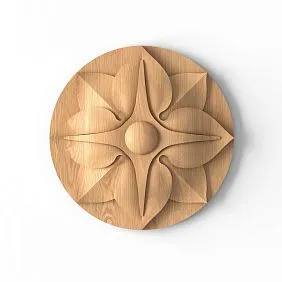
Natural wood remains the benchmark material for manufacturing decorative rosettes.Wooden rosettesThey embody traditions of handcraft, uniqueness of natural material, tactile value of solid wood. Each wooden rosette is unique due to the unique grain pattern, making it impossible for two absolutely identical pieces to exist.
Wood species
Linden is traditionally used by carvers to create the finest ornaments. Soft, uniform wood without pronounced texture is ideal for detailed carving. Linden does not crack when drying, does not warp, and easily accepts any processing. Masters carve linden rosettes with delicate multi-layered petals, fine veins, creating an illusion of a living flower. Light natural color of linden is universal - suitable for staining, toning, gilding.
Beech combines sufficient softness for carving with good strength. Fine, uniform texture ensures clean carving without chips or scratches. The pinkish hue of unprocessed wood creates a warm tone. Beech stains excellently, accepting any shade. After steam treatment, it acquires a rich honey color. Ideal for enameling - uniform structure creates a perfectly smooth surface without texture showing through paint.
Oak represents the premium segment of wooden rosettes. Hard wood is difficult to process, requiring sharp tools and professional carving skills. However, the result is impressive - carved oak rosettes possess phenomenal durability, lasting for centuries. Expressive coarse-grained texture adds additional decorative value. Color ranging from light honey to dark chocolate allows selecting a tone to match interior concept. Stained oak acquires a noble black color with silver reflections.
Walnut is an elite material for exclusive rosettes. Dark brown color with purple hues, wavy texture with beautiful reflections create a luxurious appearance. Wood is sufficiently hard for precise carving, but not excessively so - experienced carvers create complex multi-layered compositions. Walnut rosettes become works of decorative art, emphasizing the elite status of the interior.
Carving technique
Relief carving creates three-dimensional images by removing the background around petal ornaments. Relief depth varies from 10-15 mm for low relief to 40-60 mm for high relief. The master sequentially forms the volume - first rough carving of the main relief with chisels and gouges, then detailing each petal, modeling volumes, final refinement of small elements - veins, stamens, transitions between petals.
Openwork carving completely removes the background, creating a through ornament. This is the most complex and effective technique for rosettes. Petals must be strong enough not to break, yet thin enough to create lightness. Openwork rosettes are especially expressive against contrasting ceiling or wall backgrounds. Through carving creates a play of light and shadow, changing depending on lighting.
Multi-layered carving creates depth of composition. Several layers of petals are arranged at different levels - lower row of large petals, middle row of smaller ones, upper central element with stamens. Each layer is carved separately, then layers are glued together, creating a volumetric composition up to 80-100 mm deep. Such rosettes acquire sculptural quality, becoming three-dimensional objects.
Contour carving creates a pattern by cutting contour lines of petals of varying depth and width. The technique is less labor-intensive than relief carving, but requires precision and confidence in hand. Contour carving creates graphic decoration, clearly readable from afar. Suitable for geometrically stylized rosettes with clear lines without smooth transitions.
Modern technologies complement hand carving. CNC machines perform rough material removal, forming the main relief according to 3D models. Final finishing - detailing each petal, smoothing transitions, creating liveliness of lines - is performed manually by the carver. Combined technology optimizes the price-to-quality ratio while preserving the artisanal character of the product.
Finishing and painting
Sanding reveals the beauty of texture, creates smoothness of petal surfaces. Sequential processing with sandpaper of increasing grit - from P120 to P240 - removes tool marks, levels the surface. Final sanding with P320 creates a silky finish. Carved rosettes require manual sanding - access of abrasive to all recesses between petals is critical for quality.
Staining with stains emphasizes texture, changes wood color. Water-based or spirit-based stains penetrate the structure, color the fibers, making the pattern more contrasting. Light woods are stained to resemble valuable ones - linden to walnut, beech to mahogany. Multi-color effects are possible - applying different shades to different petal rows, creating a gradient from dark center to light edges.
Patina creates an effect of noble antiquity. The base paint layer is applied to the entire rosette, then partially sanded off from the petal ridges after drying. The recesses remain dark, the ridges lighten — creating an illusion of aged patina. This technique is popular for Provence, shabby chic, and vintage interior styles. Patinated rosettes appear as antique items found during the restoration of an old house.
Gilding — the pinnacle of luxury in decorating carved rosettes. Classical mercury gilding covers the carving with ultra-thin gold leaves of 0.0001 millimeters thickness. The technology is labor-intensive — the surface is primed with special compounds, covered with mordant glue, and gold leaves are applied. After drying, the gold is polished with an agate tooth to create a mirror-like sheen. Modern imitations — gold paints, gold leaf — create a visually similar effect at a more affordable price.
Enameled coloring hides texture, creating a uniform painted surface. Acrylic, alkyd, and oil paints form a durable coating of the desired color. Traditional white is universal for classic interiors. Colored rosettes — matching wall tones, or contrasting accent colors — create modern expressiveness. Multi-layer painting with intermediate sanding creates a perfectly smooth surface.
Polyurethane rosettes — simple installation, variety of forms
Modern polyurethane has revolutionized productiondecorative outletsThe precision casting method allows reproducing any forms with jewel-like accuracy unattainable by hand carving. The technology ensures absolute identity of elements, which is important when replacement or creating symmetrical compositions from multiple rosettes is required.
Advantages of polymer material
Ideal geometry — key advantage of casting technology. Each petal is absolutely identical to its neighbors, radial symmetry is mathematically precise, concentric rows are maintained with micron accuracy. For wooden rosettes, minor deviations are inevitable — this is a sign of handwork. Polyurethane creates perfect geometry, conforming to classical ideals of harmony.
Complex forms do not affect cost. A simple geometric rosette made of concentric circles and a complex composition with multi-layered petals, stamens, and leaves cost the same when comparable in size. For wood, carving complexity is critical — the labor intensity of a complex ornament is dozens of times higher than that of a simple one. Polyurethane makes complex historical forms accessible to a broad audience.
Phenomenal lightness simplifies mounting on ceilings. A large wooden rosette with a diameter of 600–800 millimeters weighs 3–5 kilograms, requiring secure mounting with screws or anchors. A polyurethane equivalent weighs 500–800 grams — it adheres easily and does not impose load on the ceiling. One person can install the rosette alone, without helpers or ladders.
Water resistance allows using polyurethane rosettes in rooms with high humidity. Bathrooms, pools, saunas can be decorated without risk. The material does not absorb moisture, does not swell, and never deforms. Wooden rosettes in humid conditions quickly lose their appearance, crack, and develop mold even with quality protective treatment.
The longevity of quality polyurethane is measured in decades. The material is not susceptible to biological damage, does not attract insects, and does not rot. Temperature fluctuations typical of unheated rooms do not cause deformation. Service life of 30–50 years without loss of aesthetic or functional qualities. No periodic treatment with protective compounds or repainting is required.
Production and assortment
Creating a master model — the first stage of production. The sculptor creates a reference sample of the rosette from clay, plasticine, or dense polyurethane foam. All details are refined — shape of each petal, depth of relief, transitions between elements. The casting method allows reproducing details as small as fractions of a millimeter. The master model is approved by the client, and can be adjusted if necessary.
Mold production is carried out from silicone or special molding polyurethane. The master model is coated with a release agent and filled with molding compound. After polymerization, the mold is cut open, and the master model is removed. The silicone mold precisely reproduces all nuances of the surface of each petal. Mold lifespan — 500–1000 castings, then a new mold must be produced.
Casting is performed using a two-component polyurethane system. Components are mixed in precise proportions and poured into the mold. A chemical reaction begins — the mass foams, filling the mold. The process takes 10–20 minutes depending on the rosette size. Inside, a porous light structure forms, and on the surface — a dense smooth shell 2–3 millimeters thick with detailed relief work.
Removal from the mold is performed after complete polymerization. The elastic silicone mold is peeled away, and the ready rosette is extracted without damage. Gates — technological elements — are removed. The surface is inspected for defects. Quality items require no further work and are ready for mounting after painting. Defects — bubbles, underfills — are rejected.
Variety of forms is measured in hundreds of options. Classic rosettes reproduce historical styles — ancient acanthus, Renaissance palmettes, Baroque lavish compositions, classical strict forms. Floral rosettes imitate specific flowers — roses, lilies, sunflowers, daisies. Geometric rosettes create abstract compositions from concentric circles, stars, polygons.
Sizes vary from miniature 100–150 millimeters for small rooms to monumental 1000–1500 millimeters for high ceilings in palace interiors. Standard sizes 300–800 millimeters suit most residential spaces. Relief depth ranges from flat 5–10 millimeters to volumetric 50–80 millimeters, determining expressiveness of light and shadow play.
Comparison: weight, texture, cost, longevity
Objective comparison of wooden and polyurethane rosettes helps make a well-considered decision when choosingstucco decorationfor a specific project.
Weight and mounting
Weight of a wooden rosette with a 600 mm diameter made of linden is 2–3 kg, made of oak — 4–5 kg. Mounting on the ceiling requires secure fastening — combination of carpentry glue and screws. Fastening points are placed in ornament recesses, where they are less noticeable. Screws are screwed into the ceiling through the rosette body, screw heads are pressed down and masked with putty. The process is labor-intensive and requires a helper holding the rosette while tightening the screws.
Weight of a polyurethane rosette of the same size — 400–600 grams. Mounting is performed exclusively with glue — special polyurethane or universal liquid nails. Glue is applied to the back side, the rosette is pressed against the ceiling, held for 30–60 seconds until it sets. One person can easily handle it alone. For safety, large rosettes use painter’s tape to secure the element until the glue fully sets.
Texture and aesthetics
Texture of natural wood creates uniqueness for each rosette. Grain pattern, growth rings, natural color variations make the item individual. Living surface with slight fiber roughness creates tactile appeal. Upon close inspection, the work of the carver is visible — characteristic tool marks, minor symmetry deviations, indicating handcrafted nature.
Polyurethane surface is absolutely smooth and perfectly flat. Symmetry is mathematically precise, all petals are identical. This may be perceived as an advantage — perfect form corresponds to classical ideals, or as a disadvantage — synthetic nature, absence of handcrafted liveliness. After quality painting, from a distance of 2–3 meters, differences are imperceptible — on the ceiling, a polyurethane rosette visually indistinguishable from wooden one.
Cost and accessibility
Price of a wooden carved rosette with a 600 mm diameter starts from 5000–8000 rubles for linden with simple form, 10000–15000 rubles for medium complexity, 20000–40000 rubles for complex multi-layer compositions. Oak rosettes are 50–100 percent more expensive. Exclusive hand-carved artworks may cost 50000–100000 rubles. Production time ranges from several days for simple forms to several weeks for complex ones.
Price of a polyurethane rosette of the same size — 1000–3000 rubles depending on complexity. Complexity of form affects price insignificantly — main cost is determined by size and volume of material. Accessibility is 3–10 times higher than wooden analogs, making decoration mass-market. Wide assortment is available in stock — rosette is purchased on the day of request, no waiting for production is required.
Durability and maintenance
Wooden rosettes, when properly maintained, serve for decades. Quality protective treatment and stable operating conditions — temperature 18-24 degrees, humidity 40-60 percent — ensure preservation. Periodic inspection is required, and protective coating should be renewed every 10-15 years if necessary. Restoration of damaged areas is possible — the craftsman repairs chips, cracks, and refreshes the coating.
Polyurethane rosettes require almost no maintenance. Service life of 30-50 years without loss of quality. They are not afraid of temperature and humidity fluctuations and retain their shape under any conditions. Dirt is removed with damp cleaning. In case of serious damage, the rosette is replaced entirely — local restoration is difficult. Low cost makes replacement economically justified.
Application in interiors of different eras
Stylistic affiliation determines the character of rosettes — their shape, ornamentation, scale, placement. Different eras created unique traditions for using this decorative element.
Classic styles
Neoclassicism uses strict symmetrical rosettes with classical motifs. Acanthus leaves, palmettes, Ionic columns, laurel wreaths create noble restraint. The central rosette under the chandelier, 600-800 millimeters in diameter, dominates the ceiling. Color is white on colored ceilings or matching ceiling tone with gilded protruding elements. Placement is strictly at the center of the room, coinciding with the geometric center.
Empire requires solemnity and grandeur. Rosettes are large — 800-1200 millimeters — with military symbolism — laurel wreaths, torches, swords, shields. Egyptian motifs — sphinxes, pyramids — are woven into the composition. Gilding is mandatory — full or accent on protruding elements. Colors — white with gold, dark green with bronze. Several rosettes on the ceiling create a rhythmic structure of palace halls.
Baroque transforms rosettes into lavish theatrical compositions. Multi-layered reliefs with garlands, putti, shells, scrolls. Asymmetric dynamic forms create movement. Sizes are monumental — up to 1500 millimeters to match the scale of palace interiors. Gilding, bright polychromy, deep shadows. Rosettes become the main decorative elements, dominating the interior.
Rococo lightens Baroque opulence. Elegant asymmetric compositions with rocaille — irregularly shaped shells. Pastoral motifs, amours, flowers. Sizes are smaller — 400-600 millimeters — but multiplicity compensates for scale. Colors are pastel — pink, blue, pistachio with silvering. Several rosettes on the ceiling create a scattered decorative effect.
Historical styles
Gothic uses rosettes reproducing stone lace of stained glass roses. Pointed arch forms, trilobes, four-lobes, complex interlacing geometry. Wooden ceilings are decorated with carved rosettes imitating stone carving. Natural dark wood tones with accents of gilding. Vertical dynamism, upward thrust even in horizontal ceiling plane.
Renaissance revives classical forms with humanist content. Proportional symmetrical compositions with vegetal garlands, putti, mythological motifs. Mathematical precision of proportions, adherence to laws of harmony. Natural wood of valuable species with delicate gilding. Placement in centers of coffers, creating rhythmic ceiling structure.
Modernism creates organic asymmetric forms. Stylized plants with flowing curved stems. Irises, poppies, lilies — characteristic flowers of the style. Abandonment of radial symmetry, fluid lines, expressiveness of forms. Natural wood with accents of gold, silver. Modernist rosettes more resemble living plants than geometric ornaments.
Modern interiors
Neoclassicism adapts classical forms to modern proportions. Rosettes retain classical motifs but become more restrained, without excessive ornamentation. Sizes are smaller — 400-600 millimeters — matching the scale of modern apartments with 2.7-3 meter ceilings. Colors are light — white, gray, beige. Gilding is used sparingly, only on key elements.
Minimalism rejects ornamentation, retaining only the geometry of the circle. Rosettes are extremely minimalist — concentric circles, simple radial lines without decoration. Colors are monochromatic — white matching ceiling tone, creating barely noticeable relief. Sizes are minimal — 200-400 millimeters, sufficient for framing built-in lighting fixtures. Function — masking mounting holes, decorative effect is secondary.
Eclecticism freely mixes styles and eras. Classical rosettes are painted in modern colors — graphite, emerald, indigo. Baroque forms are scaled down for small spaces. Historical motifs are combined with modern materials and colors. The key — presence of a unifying idea, professional sense of measure, understanding of architectural laws.
Recommendations for installation and painting
Professional approach to installation and painting ensures longevity, aesthetics, and functionality of the rosette. Installation errors lead to peeling, deformation, and destruction of decoration.
Ceiling preparation
Surface leveling requires eliminating significant unevenness. Areas with height differences over 5 millimeters are plastered. The ceiling must be flat in the contact zone with the rosette — within a circle 20-30 millimeters larger than the rosette’s diameter. Center is marked by intersection of room diagonals or according to lighting plan.
Cleaning from dirt, dust, and whitewash is critical for adhesive bond. Old whitewash is completely removed — it holds nothing and will peel off with the rosette. Surface is degreased with solvent. Loose areas are strengthened with deep-penetration primer. Primer is applied one day before installation and fully dries.
Lamp center marking coincides with rosette center. Lamp hook or mounting bar is pre-installed in the ceiling. Wiring hole in the rosette center is drilled beforehand to the required diameter. Rosette is fitted without glue — alignment of holes, fit to ceiling, visual impression are checked.
Installation of wooden rosettes
Adhesive composition — reinforced carpentry PVA or polyurethane glue. PVA is applied generously to the entire back surface of the rosette. Polyurethane glue is applied in zigzag or dots — it expands upon contact with air, filling the space. Glue must be fresh — old glue loses its properties.
Rosette is pressed against the ceiling with even pressure around the entire circumference. Assistant supports the rosette while the craftsman tightens screws. Screws 40-60 millimeters long are screwed into the ceiling structure through the rosette body at 4-6 points. Points are placed symmetrically in ornament recesses. Screw heads are pressed down 2-3 millimeters.
Mounting points are masked with wood putty in wood tone. Putty is pressed into recesses above screw heads and leveled flush. After drying, it is sanded with fine-grit sandpaper. If rosette is painted, masking is done with finishing putty for painting.
Installation of polyurethane rosettes
Special polyurethane glue or universal liquid nails are applied to the back side. Lightweight rosettes up to 500 millimeters in diameter are fixed with dot application — glue drops around the circumference every 50-70 millimeters and several drops in the center. Large heavy rosettes require continuous zigzag application.
Rosette is pressed against the ceiling with even pressure. Rosette is held by hand for 30-60 seconds until glue sets. Excess glue around the perimeter is immediately wiped with a damp sponge — dried glue is difficult to remove. For safety of large rosettes, painter’s tape is used — strips crisscrossed from rosette to ceiling secure the element until glue fully sets after 12-24 hours.
Gap between rosette and ceiling is sealed with white acrylic sealant. Sealant is squeezed from a gun into the gap and smoothed with a wet finger or rubber spatula. After drying, the joint becomes invisible. Sealing is mandatory — gap collects dust and looks unattractive.
Painting rosettes
Wooden rosettes are primed with white acrylic primer. Brushes of varying widths work the relief—wide brushes for flat areas, narrow ones for recesses between petals. The primer fills wood pores, creating an even white base for paint. After drying, the surface is sanded with fine-grit sandpaper.
Painting is done with acrylic enamels in two coats. The first coat is primer, applied thinly. After drying for 2–4 hours, the second finish coat is applied. Paint is applied with brushes without excess—thick layers will seep into recesses and blur ornament details. For deep, dark colors, a third coat is required.
Polyurethane rosettes do not require priming. Acrylic paints are applied directly to the material. The polyurethane surface is perfectly smooth, allowing paint to lay evenly. Two coats are sufficient for a dense finish. Rosettes are often painted before installation—easier to paint the backside and edges. After installation, only visible areas are touched up if needed.
Imitation gilding is done with gold paints or gold leaf. Gold paint is applied to the entire relief or only to protruding petals for contrast against the base color. The dry-brush technique—using a semi-dry brush with a small amount of gold paint—passes only over raised areas, leaving recesses in the base color. This creates an effect of aged gilding.
The result—form’s aesthetics as the language of space
Rosette—more than a decorative element. It is a language through which architecture speaks of beauty, harmony, perfection. Radial symmetry embodies the idea of order in chaos, structure in amorphousness, meaning in randomness. Concentric petals create visual energy, centering the gaze and organizing space. A rosette on the ceiling becomes the compositional center from which the entire interior architecture is built.
Wooden rosettes—chosen by admirers of tradition, handmade craftsmanship, natural beauty. The uniqueness of each piece, the living texture of wood, the tactile warmth of solid material create special value. Wooden carved rosettes are ideal for historical interiors, classical stylizations, luxury projects. The investment is justified by longevity, restorability, and unmatched aesthetic of handcrafted work.
polyurethane rosettes—a practical solution for a wide range of projects. Affordable pricing makes decoration mass-market, democratizing beauty. Ideal geometry aligns with classical ideals of harmony. Lightweight construction simplifies installation to a level of do-it-yourself. Moisture resistance opens applications in any conditions. Vast assortment satisfies any stylistic requests.
decorative rose outlets—transform interiors with minimal investment. A smooth ceiling gains architectural expressiveness. Chandeliers receive proper framing. Spaces acquire completeness, thoughtfulness, stylistic definition. A properly chosen rosette becomes a key element, defining the character of the entire space.
Relief Decoration—after quality painting, polyurethane rosettes visually indistinguishable from plaster moldings or wooden carving. Patination, gilding, multi-layered painting create an illusion of antiquity. For ceiling elements 2.7–3 meters high, material differences are imperceptible. Budget savings do not mean sacrificing aesthetics—polyurethane delivers quality at an accessible price.
Ceiling decoration—shapes the perception of the entire interior. The ceiling is the largest unoccupied plane in the room, visible from any point. Decorating ceilings with rosettes transforms them from technical surfaces into architectural elements. Classical interiors are unthinkable without ceiling decoration. Modern spaces use rosettes sparingly, but their presence has a significant effect.
Choice between wood and polyurethane is determined by project style, budget, and usage conditions. Historical interiors, luxury mansions benefit from the nobility of wooden carving. Modern apartments, budget projects, humid spaces prefer practical polyurethane. Combining materials optimizes the balance between aesthetics and cost.
Rosette scale corresponds to room proportions. Ceilings 2.7–3 meters high require rosettes 400–600 mm in diameter. High ceilings 3.5–4.5 meters—rosettes 700–1000 mm. Oversized rosettes overwhelm small rooms; small ones vanish on large ceilings. Professional design finds proportional harmony, creating visual balance.
Product quality is critical to final impression. Cheap polyurethane rosettes with blurred details and uneven surfaces ruin any concept. Poor-quality wood with knots, cracks, and rough carving looks cheap. Investing in quality elements from reputable manufacturers pays off through aesthetics and longevity.
STAVROS offers the widest range of rosettes in natural wood and polyurethane for any styles and budgets. Hand-carved wooden rosettes based on traditional and original designs. European-quality polyurethane systems with detailed relief work. Professional consultations will help select the optimal solution, considering all project specifics.
55.47 $