Article Contents:
- Why the national character of the interior is important today
- Russian designer furniture: from origins to modernity
- Traditions of Russian furniture art
- What makes furniture Russian
- Modern production of designer furniture in Russia
- Russian stucco: architectural poetry in the interior
- History of stucco decoration in Russia
- Technologies for creating stucco decoration
- Elements of stucco decoration and their functions
- How to combine Russian furniture and Russian stucco
- Principles of harmonious combination
- Stylistic directions
- Functional zones and their design
- Practical aspects of creating an interior with a national character
- Material selection
- Working with color
- Lighting
- Textiles and Decor
- Mistakes when creating an interior with a national character
- Over-decorating
- Mixing incompatible styles
- Ignoring proportions
- Incorrect Material Selection
- Russian designer furniture in different rooms
- Entryway: First Impression
- Bedroom: Intimacy and Peace
- Dining Room: A Family Gathering Place
- Study: a space for work and reflection
- Bedroom: Territory of Rest
- Modern trends in Russian furniture design
- Minimalism with a national accent
- Author's approach
- Eco-friendliness and locality
- How to choose a manufacturer
- Quality Criteria
- Ordering Process
- Care for Russian designer furniture and stucco
- Solid Wood Furniture
- Care for moldings
- Budget for creating an interior with a national character
- What Makes Up the Cost
- How to optimize costs
- Answers to popular questions
- Is it possible to combine Russian furniture with modern interior styles?
- How to Care for Carved Furniture?
- How long does it take to make custom furniture?
- Is it possible to use stucco in rooms with high humidity?
- How to determine the quality of carving?
- Is Russian furniture suitable for small apartments?
- How to combine furniture from different eras?
- Does stucco require special care?
- Can it be installed

Does anything truly ours, native, capable of resisting globalization and standardization exist in the modern world? In a space where cultural boundaries are blurring, where Scandinavian minimalism coexists with Japanese wabi-sabi, and American loft style permeates apartments in Moscow's new buildings, a legitimate question arises: where is our identity?
The answer lies in reviving traditions, turning to roots, in the bold decision to fill a home with items that carry the code of national culture.Russian designer furnitureandRussian StuccoThey become not just furnishings—they transform into a manifesto, a statement of belonging to a great cultural tradition that created palaces and estates, temples and terems.


Why national character in interior design is important today
We live in an era where standard solutions dominate everywhere. Walk into an apartment in Moscow, New York, or Shanghai—and you'll likely see similar interiors: white walls, Scandinavian furniture from IKEA, a neutral palette. Convenient? Absolutely. Functional? Yes. But where is the soul? Where is the individuality of the space, reflecting your history, your roots, your belonging to a particular culture?
National character in interior design is not nostalgia for the past or an attempt to preserve life in museum-like settings. It is a conscious choice for authenticity, a way to maintain a connection with ancestors, an opportunity to pass down to children not just beautiful things, but the values and meanings embedded in every patternof carved furniture, in every swirl of stucco decoration.
Production of designer furnitureIn Russia, it is experiencing a true renaissance. Masters are turning to ancient techniques, studying archives, restoring lost technologies. Simultaneously, they boldly experiment with forms, adapting traditional motifs to the needs of modern individuals. The result is impressive: furniture that organically fits into contemporary interiors while retaining a recognizable national character.




Russian designer furniture: from origins to modernity
Our factory also produces:


Traditions of Russian furniture art
Russian furniture art has deep roots, dating back to pre-Petrine Rus'. At that time, furniture was massive, solid, lavishly decorated with carvings and paintings. Chest-teremkas, benches with high backs, tables made from solid oak planks—all of this embodied a philosophy of solidity, durability, and connection to the land.
With the arrival of European influences in the 18th century, Russian furniture was enriched with new forms and decorative techniques. Elegant consoles, elegant canapés, and refined secretaires appeared. But even when borrowing Western models, Russian masters always added something of their own—a special plasticity of lines, recognizable ornaments, combinations of wood species.
The golden age of Russian furniture occurred in the 19th century, when entire suites were created in estates, reflecting the owner's status and aesthetic preferences. Karelian birch, bog oak, walnut, mahogany—materials were selected with particular care. Carving became increasingly virtuosic, inlay more refined, and forms more diverse.
Get Consultation
What makes furniture Russian
This question is not as simple as it seems at first glance. Russian designer furniture is a multifaceted concept. It is not only about the geographical location of production but also about the philosophy of approach, the use of specific materials, and the application of traditional woodworking techniques.
First, it's working with local wood species. Oak, ash, birch, linden, pine—trees that have grown on Russian soil for centuries and have been used by craftsmen to create furniture. Each species has its own character, its own energy. Oak symbolizes strength and longevity, birch—purity and light, ash—flexibility and resilience.
Second, it's carving. The art of decorative wood carving is a hallmark of Russian furniture production. Floral ornaments, geometric patterns, depictions of animals and birds—all of this is created by hand, turning each piece of furniture into a work of art.Carved furnitureIt is not just beautiful—it carries within it the cultural code, encrypted in symbols and images.
Third, it's the scale and solidity of forms. Even modern Russian designers, working in contemporary styles, often preserve this characteristic feature: furniture should not look fragile or temporary. It is built to last for centuries, just as the houses and temples of ancestors were built.
Modern production of designer furniture in Russia
Today'sProduction of designer furnitureIn Russia, it is a symbiosis of tradition and innovation. Workshops are equipped with high-precision machinery that allows for perfect geometric forms, yet the finishing and decoration are often done by hand.
Russian furniture manufacturers work with both classical directions and contemporary styles. You can order a luxurious suite in the Empire style with gilded carvings and silk upholstery, or choose a laconic set in the spirit of Scandinavian minimalism, but made from domestic oak and carrying subtle national accents.
A special place is occupied by authorial furniture. Designers create unique projects in which they reinterpret traditional forms, experiment with wood processing technologies, and combine various materials. Such furniture becomes an art object capable of setting the tone for the entire interior.
An important trend in recent years is turning to regional traditions. Northern carving differs from Central Russian, Siberian motifs are unlike those from the Volga region. Modern masters study these differences and create furniture that reflects the diversity of Russian culture.
Russian stucco: architectural poetry in the interior
History of Stucco Decoration in Russia
Stucco came to Russia with European architects in the 18th century, but very quickly acquired national characteristics. While in Western Europe stucco decoration developed gradually, evolving from Renaissance to Baroque and then to Classicism, in Russia all these styles overlapped, giving rise to a unique phenomenon —Russian stucco.
The palaces of St. Petersburg, Moscow mansions, estates across the country — everywhere stucco decoration played a key role in shaping the interior's appearance. Ceiling rosettes, from the center of which luxurious chandeliers descended, cornices with complex profiles framing the transition from wall to ceiling, panels with narrative compositions, pilasters and columns dividing the space into zones — all this created a sense of solemnity and grandeur.
Russian stucco masters did not simply copy Western models; they brought their own vision. Motifs close to folk art appeared in the ornaments — ears of grain and grapevines, oak leaves and hop cones. Even in strictly classical interiors, one could find these recognizable details that made the stucco truly Russian.
Technologies for Creating Stucco Decoration
Traditionally, stucco was made from gypsum. A master would manually sculpt a model of the future decorative element, then a mold was taken from it, into which a gypsum solution was poured. After hardening, the product was extracted, refined, mounted in place, and, if required, painted or gilded.
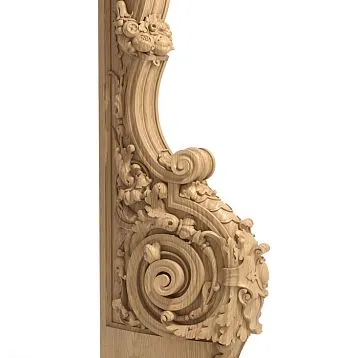
Modern technologies have expanded the arsenal of materials. Today, stucco is made not only from gypsum but also from polyurethane, glass composite, and even wood. Each material has its advantages. Gypsum preserves authenticity; its texture is unique. Polyurethane is lighter, easier to install, and not afraid of humidity. Glass composite combines lightness with strength. Wooden carved stucco is a separate direction, where sculptural processing of solid wood creates three-dimensional compositions of incredible beauty.
It is important to understand that genuine Russian stucco is always handcrafted, even if modern materials are used. Casting the basic form can be mechanized, but the final refinement, giving individuality, smoothing transitions, creating patina — all this is done by the hands of a master.
Elements of Stucco Decoration and Their Functions
Stucco in the interior is not just decoration. Each element carries functional and aesthetic load.
Cornices frame the space, create compositional completeness, and visually adjust the ceiling height. A wide cornice with a complex profile can 'lower' a too-high ceiling, making the room cozier. A narrow, elegant cornice, on the contrary, will add airiness.
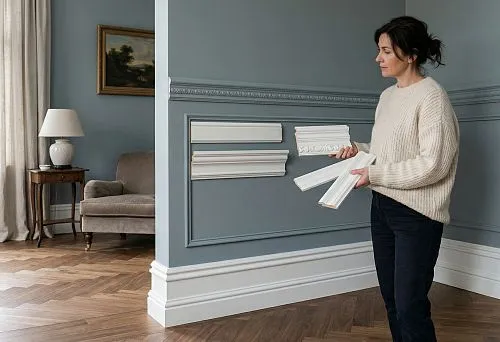
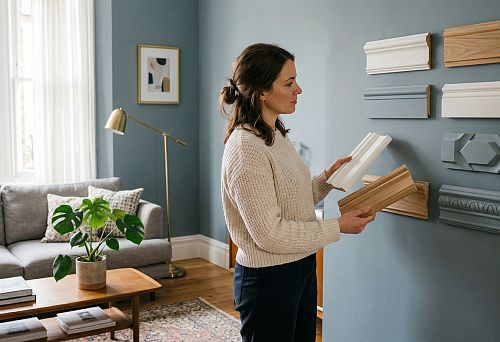
Moldings divide walls into zones, create frames for decorative inserts, and help hide joints of different materials. With their help, you can create the effect of wall panels without using expensive materials.
Rosettes are traditionally placed on the ceiling at the chandelier mounting point. But their function is not only decorative — a rosette visually centers the space, creating a focal point.
Pilasters and columns are used for zoning large spaces, framing door and window openings, and creating a rhythmic structure of the space. Indesigning a house in Russian stylethey play a special role, referencing the architecture of classical estates.
Consoles and brackets not only support shelves or cornices but also serve as independent decorative elements, demonstrating the craftsmanship of execution.
How to Combine Russian Furniture and Russian Stucco
Principles of harmonious combination
Creating an interior with a national character requires a subtle sense of proportion and a deep understanding of style. You cannot simply fill a room with carved furniture, cover the walls with stucco, and expect a harmonious space. The result of such an approach will be a museum exhibition or theatrical scenery, not a living, comfortable space for habitation.
The first principle is stylistic unity. If furniture of theClassic FurnitureEmpire type is chosen, then the stucco should correspond to that era: strict, symmetrical, with motifs characteristic of Empire style — laurel wreaths, torches, military attributes. If preference is given to furniture in Russian style with folk motifs, the stucco can be simpler, with plant ornaments, without excessive pomp.
The second principle is scale. In small rooms, massive carved furniture combined with abundant stucco will create an overloaded effect. Delicacy is needed here: elegant moldings, one or two pieces of furniture with carved decor, the rest — more laconic. In spacious rooms, on the contrary, small details will get lost; here, large forms, expressive carving, and large-scale stucco compositions are appropriate.
The third principle is color harmony. Traditional Russian stucco was often executed in white, creating a contrast with colored walls. Furniture could be natural wood color, tinted, or painted. It is important that these elements do not clash with each other but complement one another.
Stylistic directions
Russian Classicism — this is the gold standard for those who want to create an interior with a national character. Here, furniture made of solid oak or walnut, with moderate carving and correct proportions, is appropriate. Stucco — white or ivory-colored, with classical ornaments. Color palette — warm, noble: beige, golden, deep brown tones.
Russian Modern — a direction that emerged at the turn of the 19th-20th centuries, when Russian artists and architects sought new forms of expressing national identity. Here, smooth, flowing lines, plant ornaments, and stylization of ancient Russian art are characteristic. Furniture can be of unusual shapes, with asymmetrical carving. Stucco — with motifs of irises, water lilies, stylized birds.
Modern Interpretation — the most complex and interesting direction. Here, designers take traditional elements and reinterpret them in a modern key. For example, they simplify carving to graphic lines, use contrasting combinations of materials (wood and metal, stucco and concrete), play with scale, enlarging or, conversely, miniaturizing traditional motifs.
Functional Zones and Their Design
Living Room — the main reception room of the house, where the national character can manifest itself fully. Here, a furniture set with carved elements is appropriate: sofa, armchairs, coffee table, console. On the walls — moldings creating a panel structure. On the ceiling — cornice and rosette. It is important not to overdo it: if the furniture is very decorative, the stucco should be more restrained, and vice versa.
Dining Room — a place for a large table made of solid wood, preferably with carved legs. Chairs can have carved backs, upholstered in fabric with plant ornaments. On the walls — moldings framing mirrors or decorative panels. A ceiling cornice will add solemnity. A sideboard or cabinet with carved decor will become a functional and beautiful addition.
Study — a room where solid, substantial furniture is appropriate. A massive desk, wooden bookcases, a leather armchair. The molding here can be more strict, geometric. Coffers — recesses framed by molded profiles — are suitable for the ceiling.
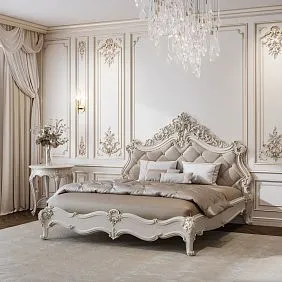
Bedroom — an intimate area requiring a more delicate approach. A bed with a carved headboard can become the central element. A dresser, a vanity, bedside tables — all from the same collection. The molding here can be elegant, airy. A ceiling cornice, molding frames on the walls — enough to create an atmosphere.
Practical aspects of creating an interior with a national character
Material Selection
Creating an interior with a national character begins with choosing the right materials. For Russian design furniture, this is primarily natural wood. No imitations, laminated panels, or veneer will create the right feeling.
Oak — a classic of furniture production. Durable, long-lasting, with an expressive texture. The color can vary from light golden to dark brown depending on the treatment. Ideal for solid wood furniture — tables, cabinets, beds.
Ash — similar to oak in strength, but has a lighter, cooler tone. Good for modern interpretations of classical forms.
Beech — a hardwood, easy to work with, has a delicate pinkish hue. Often used for making chairs, small furniture items.
Birch — a characteristically Russian species. Light, pale, with a delicate texture. Karelian birch with its unique moiré pattern is considered an elite material.
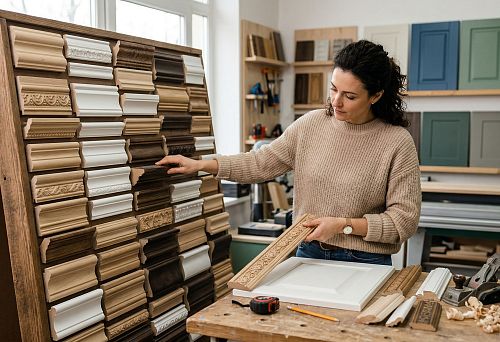
For molding, the choice of material depends on the task and budget. Plaster gives the most authentic result but requires professional installation. Polyurethane is more practical but can look less noble. The solution lies in proper finishing: quality painting, patination, gilding can ennoble any material.
Working with color
The color palette of an interior with a national character should be noble and restrained. This does not mean you need to abandon color altogether, but bright, garish tones are not appropriate here.
Base colors: all shades of beige, ivory, cream, light gray. These tones create a neutral background against which carved furniture and molding look expressive.
Accent colors: deep, saturated shades — emerald, burgundy, sapphire, golden ochre. They are used in doses — in furniture upholstery, textiles, individual decorative elements.
Wood color: natural wood tonalities — from light honey to dark chocolate — are themselves full-fledged color accents. It is important that all wooden elements in the interior are in the same color scheme or form a thoughtful composition.
Molding color: traditionally white, but variations are possible — ivory, light beige, matching the wall color (tone-on-tone or half a tone lighter). An interesting solution is patinated molding, where a dark patina is created in the recesses, emphasizing the relief.
Lighting
Proper lighting is critically important for an interior with a national character. Carved furniture and molding are revealed only with correctly positioned light, which emphasizes volume and creates a play of light and shadow.
Central lighting — a traditional chandelier, preferably quite massive, with crystal or glass pendants. It is placed in the center of the ceiling rosette and becomes an important decorative element.
Wall sconces — placed symmetrically on both sides of a mirror, fireplace, or between windows. Their style should echo the chandelier. The light from sconces creates a cozy, intimate atmosphere.
Hidden lighting — a modern addition to a classic interior. LED strips placed behind cornices or in niches create soft, diffused light, emphasize the room's architecture, and highlight molded elements.
Accent lighting — directional spotlights or track lights can be used to highlight particularly valuable items: paintings, sculptures, individual elements of carved furniture.
Textiles and decor
Textiles play an important role in creating the national character of an interior. These are not only functional elements (curtains, furniture upholstery) but also decorative ones (pillows, bedspreads, tablecloths, rugs).
Fabrics — natural ones are preferred: linen, cotton, silk, velvet, jacquard. Synthetics can be used, but only high-quality ones with a noble texture. Colors — within the chosen palette. Patterns — floral, geometric, in classic cases — damask, 'paisley', stripes.
Rugs — an important element of a Russian interior. This can be a Persian or Turkish handmade rug with a traditional pattern, or a modern rug in an ethnic style. The main thing is the quality of execution and compliance with the overall style.
Decorative elements: vases, candlesticks, boxes, figurines. Here you can turn to traditional Russian crafts — Gzhel, Khokhloma, Zhostovo trays, Palekh boxes. But it is important not to turn the interior into a folk art exhibition. A few accents are enough.
Mistakes when creating an interior with a national character
Excessive decoration
The most common mistake is the desire to use all available elements at once.Carved furniture plus abundant molding plus rich textiles plus many decorative items — and the interior turns into an overloaded space where the eye has nothing to rest on.
Professionals know: an interior should have accents and a background. If the furniture is very decorative, the walls should be restrained. If the walls have a complex molded composition, the furniture should be more laconic. Balance is the key to harmony.
Mixing incompatible styles
Another frequent problem — eclecticism not for the better. Yes, modern design allows for mixing styles, but it must be a conscious, professional mix. You cannot combine carved furniture in Russian folk style with Baroque molding and Provence-style textiles. The result will be stylistically undefined and tasteless.
If you want eclecticism, you need to choose one dominant style and carefully introduce elements of other styles, but in such a way that they harmonize in scale, color, and character of decor.
Ignoring proportions
Proportions are the foundation of any harmonious interior. In a small room, a massive set with large carvings and wide plaster cornices will look ridiculous. In a tall, spacious hall, elegant furniture and thin moldings will get lost.
You need to correlate the scale of decorative elements with the dimensions of the room. In standard apartments, medium-sized furniture with moderate decor and small-scale plasterwork is appropriate. In country houses with high ceilings, you can afford more large-scale solutions.
Incorrect material choice
Trying to save on materials is a path to failure. Imitation wood, plastic 'moldings,' cheap hardware—all of this instantly gives itself away and kills the impression of the interior. It's better to do less, but with quality, than a lot, but with second-rate materials.
If the budget is limited, it's worth choosing several key elements made from natural materials—for example, a solid wood dining table and several plaster moldings—and making the rest a neutral background. Over time, you can supplement the interior with new quality items.
Russian designer furniture in different rooms
Entryway: first impression
The hallway sets the tone for the entire house. Functional items made of solid wood are appropriate here: a coat rack, a bench or ottoman, a console with a mirror, a shoe rack. If space allows, you can install a wardrobe with carved doors.
Moldings in the hallway are often used moderately—a ceiling cornice, framing a mirror with molding. This room is usually small, and an abundance of decor can make it feel cramped. However, you can emphasize the quality of materials and the craftsmanship of the furniture.
Living room: the heart of the home
In the living room, Russian designer furniture reveals itself in full. Here you can create a full-fledged interior ensemble: a sofa and armchairs with carved decor, a coffee table, a console, a wardrobe or shelving unit for books and decorative items.
Decorative Elements in Interior DesignMoldings in the living room include plaster cornices, a ceiling rosette, wall moldings, possibly pilasters or half-columns if the room is large enough. It's important to create a balance between the furniture and the architectural decor.
A fireplace, even a decorative one, fits perfectly into the concept of an interior with a national character. It can be framed with a plaster portal, and the mantelpiece can be used to place decorative items.
Dining Room: A Place for Family Gathering
The center of the dining room is the dining table. For an interior with a national character, this should be a solid wood table, large enough to gather the whole family. Carved legs, possibly a carved apron, add decorativeness. Chairs with carved backs, possibly with upholstered seats, complete the ensemble.
A sideboard or china cabinet is a traditional piece of furniture for the dining room. It stores dishes, table linens, and decorative items. A sideboard with glass doors and carved decor becomes not only functional but also a decorative element.
Moldings in the dining room can be quite expressive—this is a formal room where some solemnity is appropriate. A cornice with a rich profile, moldings framing a mirror or decorative panel create the right atmosphere.
Study: a space for work and reflection
The study requires solid, substantial furniture. A massive desk, a comfortable chair, bookcases or shelving units are essential elements. All of this can be made with elements of carving, but more restrained than in the living room.
Moldings in the study are often used to create a coffered ceiling—this solution gives the room respectability and solidity. Wall moldings that create a paneled structure or frame bookshelves are appropriate.
Bedroom: territory of rest
In the bedroom, Russian designer furniture should create an atmosphere of coziness and tranquility. A bed with a carved headboard is the central element. This can be a tall, impressive headboard with rich carving or a more modest but elegant one.
Nightstands, a chest of drawers, a dressing table complement the setting. If the room allows, you can install a wardrobe with carved doors or an open wardrobe with carved elements.
Moldings in the bedroom should be delicate. A cornice, possibly wall moldings creating a frame at the head of the bed. Too active decor in the bedroom can interfere with relaxation.
Modern trends in Russian furniture design
Minimalism with a national accent
A modern trend is the simplification of forms while preserving the national character. Designers create furniture with laconic silhouettes but use traditional materials and techniques. For example, a dining table may have a simple rectangular tabletop and straight legs, but it will be made of solid oak with an expressive texture, and the joints of parts will be made using traditional joinery methods.
Carving is present in such products but becomes more graphic and laconic. Instead of lush Baroque curls—strict geometric patterns or stylized plant motifs. Such furniture fits organically into modern interiors but retains a connection with tradition.
Author's approach
More and more designers are creating unique furniture pieces that become art objects. This is not mass production but one-of-a-kind items, each of which is unique. Masters experiment with forms, combine different types of wood, and use complex processing techniques.
Such furniture is expensive, but it becomes a real investment—both financial and emotional. These are works of art that are passed down through generations, becoming family heirlooms.
Sustainability and locality
The modern consumer pays more and more attention to the origin of materials and the environmental friendliness of production. Russian designer furniture made from local wood species, created by small workshops with a minimal carbon footprint, meets these demands.
Moreover, local production means the possibility of personal contact with the master, participation in the creation process, and making changes to the project. This is a completely different level of involvement compared to buying faceless factory furniture.
How to Choose a Manufacturer
Quality criteria
ChoosingProduction of designer furnitureor a workshop for making moldings, it's important to pay attention to several key points.
Work experience — how many years the company has been on the market, what projects have been implemented, whether there is a portfolio. A serious production is always ready to show examples of their work.
Materials — what types of wood are used, where the raw materials are sourced from, how quality is controlled. A conscientious manufacturer openly talks about materials and can provide certificates.
Technologies — what equipment is used, what wood processing technologies are applied, whether there is manual finishing. The combination of modern equipment and manual labor is a sign of quality production.
Individual approach — whether the manufacturer is ready to work on individual projects, whether changes can be made to standard models, how flexible the interaction process with the customer is.
Guarantees — what guarantees the manufacturer provides, how possible problems are resolved, whether there is after-sales service.
Order process
Ordering quality furniture or moldings is a process that requires time and attention.
First stage — consultation. You discuss your wishes with a designer or manager, show the room layout, photos of the existing interior if available. A professional asks clarifying questions and offers options.
Second stage — project. Based on the consultation, a project is created: sketches of furniture or molding elements, visualizations, technical drawings. You approve the project, possibly making adjustments.
Third stage — production. After project approval and contract signing, manufacturing begins. The timeline depends on the complexity of the order — from several weeks to several months.
Fourth stage — delivery and installation. A quality manufacturer organizes not only delivery but also professional installation. This is especially important for moldings, which require special installation skills.
Fifth stage — after-sales service. A good manufacturer stays in touch even after the work is completed, ready to help with questions about operation, maintenance, and possible repairs.
Care for Russian designer furniture and moldings
Solid wood furniture
Wooden furniture requires careful but not complicated care. Regular dry cleaning with a soft cloth removes dust. Every few months, you can use special wood polishes that nourish the material and maintain its shine.
It's important to protect furniture from direct sunlight, which can cause fading, and from excessive humidity, which can lead to deformation. Optimal air humidity is 40-60%.
Scratches and minor damage can be masked with special wax pencils or mastics matching the wood tone. Serious damage requires professional restoration.
Care for moldings
Plaster moldings are quite fragile and should not be subjected to mechanical impact. Cleaning is done with a soft brush or vacuum cleaner with a delicate surface attachment. If the molding is painted with quality paint, you can carefully wipe it with a slightly damp cloth.
Polyurethane moldings are more practical — they can be washed and are not afraid of humidity. But they also require care: abrasive agents can damage the surface.
Over time, white moldings may yellow. In this case, professional repainting is needed. This is not a complicated procedure but requires certain skills so that the paint applies evenly and doesn't seep into the relief recesses.
Budget for creating an interior with national character
What makes up the cost
Creating an interior using Russian designer furniture and Russian moldings is not a cheap pleasure. But it's important to understand what makes up the price and where you can and cannot save.
Design — the work of an interior designer who will create the concept, select furniture, moldings, finishing materials, develop drawings and visualizations. This can cost from several tens to several hundred thousand rubles depending on the project complexity.
Furniture — prices vary greatly. A simple solid wood table can cost 50-100 thousand rubles. A hand-carved dining table — 300-500 thousand and above. A living room furniture set — from half a million to several million rubles.
Moldings — cost depends on material and complexity. A simple polyurethane cornice — several thousand rubles per linear meter. Handmade plaster moldings — tens of thousands per square meter. Individual molded panels can cost hundreds of thousands of rubles.
Installation — furniture installation, molding mounting, finishing work. This can make up 20-30% of the material cost.
Additional elements — textiles, decor, lighting also require budget.
How to optimize expenses
If the budget is limited, you can create an interior with national character in stages.
Stage one — basic room finishing with neutral quality materials. This will create a good background for future decor.
Stage two — installation of main molding elements: ceiling cornice, possibly wall moldings. This will immediately change the character of the room, giving it architectural expressiveness.
Stage three — acquisition of key solid wood furniture pieces. For example, for the living room — a sofa and coffee table, for the dining room — a dining table and chairs.
Stage four — complementing the interior with carved elements, more expensive furniture, additional moldings.
Such a phased approach allows spreading out costs over time while achieving a harmonious result.
Answers to Popular Questions
Can Russian furniture be combined with modern interior styles?
Absolutely! Modern design actively uses eclectic techniques. A carved wooden table looks excellent in a minimalist interior with concrete walls, creating an expressive contrast. Classical moldings can become an accent in a loft. The main things are a sense of proportion and a professional approach to combining elements.
How to care for carved furniture?
Carved furniture requires more thorough care than smooth furniture. Dust accumulates in the recesses of the carving, which needs to be regularly removed with a soft brush or a vacuum cleaner with an appropriate attachment. Using wood polishes helps preserve beauty and protect the material. It is important to avoid moisture getting into deep carved elements.
How long does it take to manufacture custom furniture?
Timelines depend on the complexity of the order. A simple furniture item can be manufactured in 3-4 weeks. A complex set with a large volume of hand-carved work — 2-3 months or more. When ordering, it is important to discuss timelines with the manufacturer in advance and include a time buffer.
Can moldings be used in rooms with high humidity?
Gypsum moldings do not tolerate humidity well, so in bathrooms and other damp rooms it is better to use polyurethane moldings, which are not afraid of water. Another option is wooden carved trim treated with special moisture-protective compounds.
How to determine the quality of carving?
High-quality carving is distinguished by clarity of lines, cleanliness of execution, absence of chips and irregularities. All elements of the ornament should be worked out uniformly, without 'blurred' areas. Transitions should be smooth, the surface — smooth. If the carving is done by hand, slight individual differences between elements are acceptable — this is a sign of handwork, not a defect.
Is Russian furniture suitable for small apartments?
Yes, but you need to choose the scale correctly. For small rooms, choose furniture of moderate size with unobtrusive carving. One or two expressive pieces can become accents, while the rest of the furnishings should be more laconic. Moldings in small rooms are used in measured doses — a cornice and, possibly, a mirror frame.
How to combine furniture from different eras?
If you have antique furniture or items inherited from relatives, they can be combined with new products. The key is commonality of style or scale. For example, an antique Empire-style chest of drawers can coexist with a modern table if they are close in wood color and finishing character. It is important to avoid chaotic mixing — each item should have its place in the overall composition.
Does molding require special care?
Regular dry dusting is the main requirement. Every few years, repainting may be required, especially in rooms where people smoke or cook — white molding can yellow from tobacco smoke and kitchen vapors. Mechanical damage to molding requires professional restoration.