Article Contents:
- What are wooden carved overlays and where are they used
- Overlays for furniture and facades
- Overlays for doors
- Decorative Elements for Walls and Ceilings
- When a carved overlay is appropriate and when it's better to choose other decor
- Which wooden carved overlays to choose for different tasks
- For kitchen facades and cabinets
- For dressers, nightstands, and classic furniture
- For doors and interior panels
- For accent decor in classic and neoclassic styles
- How to choose material — oak or beech
- When is it better to choose oak
- When beech is suitable
- What to consider when choosing texture and finish
- What is more important — pattern, durability, or compatibility with furniture
- How to select the shape and pattern of a carved overlay
- Central overlays
- Floral ornament
- Which pattern suits classic style
- How not to overload a facade or door with decor
- How to buy carved wooden overlays in Moscow and not make a mistake
- Check where the overlay will be placed
- Verify dimensions and proportions
- Choose the material for the task
- Consider availability in Moscow and delivery times
- Compare category, subcategory, and product card
- Comparison table: oak, beech, and MDF for carved overlays
- Common mistakes when choosing carved wooden overlays
- Choosing only by photo
- Do not consider the scale of the facade or door
- Choose too active an ornament
- They don't look at the material and texture
- They confuse interior overlays with universal decor without tying it to the task
- FAQ: answers to popular questions about carved wooden overlays
- Where to buy carved wooden overlays in Moscow?
- Which overlays are suitable for furniture?
- What's better for carved overlays: oak or beech?
- Are carved overlays suitable for doors?
- Can overlays be used for walls and ceilings?
- How to choose the size of a decorative overlay?
- Which overlays are better for a classic interior?
- Can I buy wooden overlays in stock in Moscow?
- How to choose an overlay for a kitchen or cabinet facade?
- How does a decorative overlay differ from other wooden decor?
- About the manufacturer
You look at a furniture facade — and something is off. It's neat, clean, functional. But faceless. Without character. Without that feeling that behind it lies personality, taste, history. It is at this moment thatcarved wooden overlays in Moscow— a low-cost but powerful tool that transforms a mass-produced item into an author's piece.
But choosing an overlay is not 'take a pretty one and screw it on'. There is a logic to it: material, shape, ornament, scale, style. It's easy to make a mistake — and then instead of an accent, you get dissonance. This article is written so you can understand the topic once and for all: from the first question 'what is it' to the final 'where to buy and not lose out'.


What are carved wooden overlays and where are they used
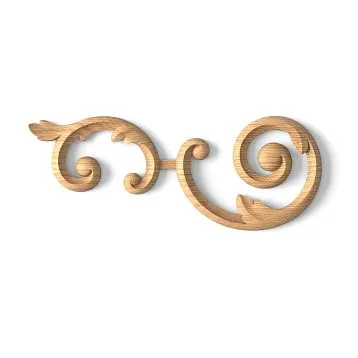
A decorative wooden overlay is a three-dimensional ornamental element that is attached to a surface: a furniture facade, a door leaf, a wall panel, a ceiling plane. It does not bear a structural load — its task is purely decorative: to create relief, denote an accent, add style.
Essentially, a carved overlay is the language of architectural decor, transferred to the scale of furniture and interiors. In classic palace interiors, this language spoke through stucco on walls and ceilings, through carved furniture details, through ornamented portals. Today, the same principle works in city apartments, private houses, and offices — just in a more accessible format.
The STAVROS catalog features over 400 models of wooden carved overlays in various artistic styles, sizes, and shapes, crafted from solid oak and beech. This is not just a 'product volume'—it's a real toolkit for designers or private clients who need to find the right option for a specific task.




Overlays for furniture and facades
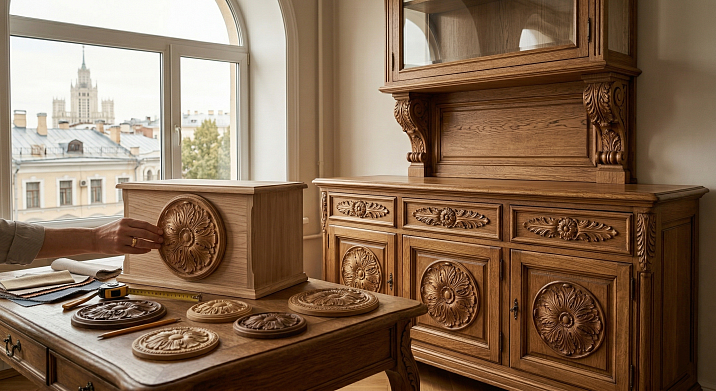
A furniture facade is the main stage for a carved overlay. A cabinet, chest of drawers, sideboard, kitchen set, wardrobe, or library—all these pieces gain a fundamentally different level of perception when their facades are adorned with natural wood decor.
Decorative overlays for furniture and facadesMade from oak and beech, they are attached to the surface with glue—PVA-D3, construction adhesive, or double-sided tape—and then painted along with the facade or left in their natural state under a clear finish. This allows for working with both old furniture (updating without replacement) and new pieces that need final decorative refinement.
Overlays are especially effective on kitchen facades. A central carved overlay on the upper cabinet door, symmetrical corner elements on lower cabinets, accent decor on the hanging cabinet's pediment—a few well-chosen details can radically change the kitchen's appearance. And this is without replacing facades, without renovation, and without significant costs.
Our factory also produces:


Overlays for doors
An interior door with carved overlays is a level that is immediately noticeable. There's no need to explain that there's 'something special' here—it's visible at first glance. A central overlay on the door's upper panel, ornamental inserts in the lower rectangular field, corner elements at the corners of the door leaf—each of these solutions works.
Wooden overlays on doors are attached in the same way as on furniture: glue plus mechanical fastening if necessary. They are painted along with the door or left in their natural tone as a contrasting accent. The second option—a dark oak overlay on a white door—creates a strong visual impression in classic and neoclassical interiors.
Get Consultation
Decorative elements for walls and ceilings
On walls, wooden overlays are used in two ways. First, as independent focal accents: an overlay in the center of a wall niche, corner elements in a decorative frame, accent decor above a fireplace. Second, as part of a wall paneling system: overlays create horizontal and vertical rhythms, forming molding fields.
On ceilings, overlays serve as architectural accents in coffered systems, as decor at beam intersections, or as independent ceiling ornaments. Proper scaling is important here: a ceiling overlay must be designed for perception from a distance, meaning the pattern should be large and legible.
When is a carved overlay appropriate, and when is it better to choose other decor?
Honest answer: an overlay is appropriate where the interior already has or plans to have a decorative language. If the space is intentionally ascetic, with clean planes and minimal details, a carved overlay will be a lonely outsider. It needs company: moldings, profiles, ornamented handles, a common stylistic approach.
But if the interior has at least an initial decorative message—classical forms, natural materials, profiled trims—the overlay will pick up and enhance this language. It doesn't invent style; it reveals what has already been declared.
Which carved wooden overlays to choose for different tasks
The overlay market is diverse. Choosing 'by beauty' from a catalog is an approach that only works until the overlay arrives, is installed, and turns out to be the wrong scale, the wrong style, the wrong texture. The right choice starts with the task, not with a photo.
For kitchen fronts and cabinets
The kitchen is the most demanding space for decorative overlays. Three things are important here: compatibility of the ornament with the kitchen style, the size of the overlay relative to the front, and resistance to painting and surface cleaning.
For classic and neoclassical kitchens, overlays withfloral ornamentationwork best: leaves, scrolls, floral motifs. They softly 'round out' strict rectangular fronts and add organic warmth to them.
For more strict and restrained kitchens — geometric or neutral overlays with clear relief and minimal ornamentation. Such overlays create an accent without active decorative expression.
An important practical point: kitchen fronts are typically painted with enamel. The overlay must be made of a material that accepts enamel well — beech or MDF. An oak overlay with a transparent finish on a painted front is an interesting contrasting solution, but it requires a conscious design choice.
Ideas for decorating kitchen fronts with specific layout options can be found in the sectionSTAVROS furniture fronts— ready-made project solutions with specific overlays are presented there.
For chests of drawers, cabinets, and classic furniture
Classic furniture — cabinets with framed fronts, chests of drawers with profiled drawers, sideboards with glazed upper doors — creates the perfect environment for carved overlays. Here, the overlay works not as an added element, but as a logical addition to the existing decorative program of the product.
For a chest of drawers made of solid wood or MDF with profiled frames on the drawers — a central overlay on the upper part of the body front or symmetrical overlays on large drawers. Proportions: the overlay occupies no more than one-third of the width and one-quarter of the height of the corresponding field.
For bedroom furniture — beds, nightstands, headboards — overlays work as accent ornamentation: one or three elements along the horizontal axis of the headboard, symmetrical inserts on nightstands.
For doors and interior panels
Door overlays are a separate application scenario that requires special attention to size and shape. A standard interior door with a width of 700–800 mm and a height of 2000 mm has strictly defined proportions of the front panels. The overlay must fit into this panel without overloading it.
For the upper panel of the door (typically a horizontal rectangle), horizontal decorative overlays or small central elements work better. For the lower vertical panels — overlays with a vertical orientation. Corner elements in the corners of the door leaf complete the composition and create a system of point accents.
For accent decor in classic and neoclassical styles
In classic and neoclassical interiors, carved wooden overlays serve as an architectural language. Here they are not 'decoration,' but an essential element of the stylistic system. Classic without carving is an incomplete classic.
For strict classicism — rich floral ornamentation, acanthus leaves, symmetrical scrolls, multi-level relief. For neoclassicism — a cleaner pattern, fewer details, more space between elements. In both cases, the key word is systematicity: overlays must be coordinated with moldings, cornices, baseboards, and other interior decor elements.
How to choose the material — oak or beech
Wood is a living material with character. Both oak and beech are solid wood, natural texture, durability. But they are different species with different properties, and the choice between them is not arbitrary.
When is it better to choose oak
Oak is a species with pronounced large grain, high density, and a warm golden-brown tone. Solid oak overlays look 'substantial' and 'serious' even in small sizes: the material's texture adds physical credibility to them.
Oak is the right choice for studies and libraries with dark finishes, for furniture in English classic style, for interiors where the natural texture of wood is a conceptual design element. Under transparent oil coating, an oak overlay produces a lively, non-uniform pattern that cannot be reproduced by any artificial material.
Oak is also the preferred choice when the overlay is installed on solid wood furniture of the same species: matching the wood species provides perfect color and texture compatibility without additional tone adjustment.
When Beech is Suitable
Beech is a more uniform and soft species. Its grain is fine, the surface is smooth. This makes beech an ideal material for fine, detailed carving: small petals, thin lines, jewelry-like transitions—all of these come out significantly more precise in beech than in oak.
For enamel painting, beech provides a more even, uniform coating. This is precisely why for white, gray, and cream interiors, where overlays will be painted to match the color of facades or walls, beech is the preferred material. Beech is also somewhat more affordable in price for the same sizes and ornament.
Decorative overlays made of oak and beechin the STAVROS catalog are available in both materials for most serial models. Please specify the availability of the desired material when placing your order.
What to Consider When Choosing Texture and Finish
Key question: what finish coating is the overlay designed for?
If transparent coating (oil, wax, varnish): choose oak for pronounced texture, beech—for a calmer and more neutral surface. Both species accept transparent coatings well.
If painting with opaque enamel: choose beech or MDF. The uniform structure of beech provides a perfectly smooth layer without 'texture breakthrough.' MDF is an affordable alternative on a limited budget but is inferior to solid wood in durability and tactile feel.
If staining with wood stain or pigmented oil: only solid wood. MDF without natural fiber accepts stain unpredictably—the result looks unnatural.
What matters more—pattern, strength, or compatibility with furniture?
The answer depends on the scenario. For a decorative accent where the overlay is installed in a calm area without mechanical impact—pattern and ornament are most important. For overlays in the kitchen or hallway, where accidental impacts and loads are possible—material strength takes priority: oak is preferable to beech.
For furniture made from a specific wood species—material compatibility is mandatory with a transparent finish. With full painting, texture compatibility does not matter: under enamel, oak, beech, and MDF look the same.
How to choose the shape and ornament of a carved overlay
Shape and ornament are the most 'visible' part of the choice. They create the first impression. But here too, logic is more important than intuition.
Central overlays
Central decorative overlays—the most common type. They are installed in the center of a facade, door, panel, or wall field. Their task is to create a visual center, a 'focal point,' around which the rest of the facade space is organized.
A central overlay works well as a single element on a large facade—for example, on a double cabinet door 600 mm wide and 900 mm high. Or as a dominant element in a system of several overlays, where the central one is larger and the side or corner ones are smaller.
Floral ornament
Floral ornament — leaves, flowers, scrolls, branches — is the most "lively" and organic type of carving. It fits well into any interiors with natural materials: wood, stone, linen, cotton. Floral ornament softens the geometry of rectangular facades and adds warmth.
STAVROSOverlays with floral ornamentationare presented in dozens of variations: from simple single leaves to complex multi-element compositions with scrolls and floral heads.
Which pattern suits classic style
For a classic interior — acanthus leaves, petal rosettes, symmetrical floral motifs with clear axial symmetry. The ornament should be recognizable and "readable": the viewer should understand that it is classic.
For neoclassicism — the same arsenal, but in a more restrained execution: fewer details, more space within the ornament, clear lines. Strict geometric ornament — meander, Greek key, checkerboard pattern — is also appropriate in a neoclassical space.
For eclecticism — mixing is possible: florals with geometry, natural motifs with architectural forms. But the mixing should be deliberate, not random.
How not to overload a facade or door with decor
This is the most important practical advice. An overlay is not "more means better." One correct overlay in the right place has a greater effect than five overlays placed chaotically.
Rules that work:
-
On a facade up to 450 mm wide — maximum one central overlay
-
On a facade 450–700 mm — central overlay or two symmetrical corner elements
-
On a door — no more than two overlays: upper and lower in the corresponding fields
-
The overlay ornament should not be more prominent than the molding frame ornament
How to buy carved wooden overlays in Moscow without making a mistake
Buying carved overlays is not a spontaneous decision. Or rather, it can be spontaneous — but then there's a high risk of error. A proper purchase requires several steps.
Check where the overlay will be placed
It sounds obvious — but this is the step most often skipped. Furniture, door, wall, ceiling — each of these surfaces dictates its own requirements for shape, size, and ornament. An overlay for a cabinet facade and an overlay for a wall composition are different products.
Verify dimensions and proportions
Measure the installation area. Record the width and height of the field where the overlay is planned. Compare with the product dimensions from the catalog. Proportionality is the key criterion: an overlay that 'floats' in the middle of a large facade or, conversely, occupies almost the entire field area, doesn't work decoratively or aesthetically.
Select material for the task
Transparent coating — oak or beech. Opaque enamel — beech or MDF. Furniture from a specific wood species — preferably the same species with transparent coating. Wet area — only treated solid wood with moisture-resistant coating.
Consider availability in Moscow and delivery times
STAVROS manufactures and suppliesdecorative wooden overlays in Moscow— catalog serial items are available for quick shipment. This is important for projects with fixed deadlines: designers and builders know that "the overlay is needed by Monday" is a quite realistic requirement.
Compare category, subcategory, and product card
The STAVROS website catalog structure is built so you can move from general to specific: first the general category of overlays, then filtering by shape, ornament, or purpose, then the specific product card with dimensions and photos. This path gives confidence that the choice is made consciously, not just by the first appealing photo.
Comparison table: oak, beech, and MDF for carved overlays
| Parameter | Solid oak | Beech array | MDF |
|---|---|---|---|
| Wood texture | Pronounced, large grain | Soft, uniform | Absent |
| Under transparent coating | Excellent | Good | Not suitable |
| For enamel painting | Good | Excellent | Good |
| Thread detailing | Good | Good | Good |
| Mechanical strength | Maximum | High | Medium |
| Moisture resistance (when treated) | Good | Good | Low |
| Price level | Above average | Medium | Affordable |
| Best use | Natural interior, study, dark finish | Neoclassical, light painting, fine carving | Economical projects for painting |
Common mistakes when choosing carved wooden overlays
These mistakes happen every day. Not because people are uneducated — but because choosing 'by eye' online has its pitfalls.
Choosing based only on photos
Photos in the catalog are taken under specific conditions: lighting, background, scale — all of this affects the perception of size and detail. An overlay that looks 'moderate' in a promotional shot may turn out to be significantly larger or smaller than expected in reality. Always read the technical specifications: width, height, thickness, projection.
Do not consider the scale of the facade or door
An 80×120 mm overlay on a 600×900 mm front — correct. The same overlay on a 300×400 mm front — overload. A 200×300 mm overlay on the same door — again an error, now in the other direction. Proportions are not a matter of taste, they are geometry.
Choose too active an ornament
A dense, fine, saturated pattern looks good only under certain lighting conditions and when viewed up close. On a cabinet facade in the depths of a living room, such an overlay will turn into a dark 'spot with details'. For medium and long-distance viewing, a pattern with clear, large elements and space between them is needed.
They don't look at the material and texture
'Wooden overlay' is not the same for oak and for MDF. Different materials mean different behavior under the finish, different tactile value, different service life. Clarify the material before purchase, not after.
They confuse interior overlays with universal decor not tied to a specific task
A carved overlay is not a universal decorative element 'for beauty in general'. It is a specific product for a specific place. An overlay for a furniture facade will not always suit a door. A central overlay is not always organic in a corner position. The shape, size, and pattern must correspond to the specific application scenario.
FAQ: answers to popular questions about carved wooden overlays
Where to buy carved wooden overlays in Moscow?
STAVROS is a manufacturer with its own production and online store. Serial models made of solid oak and beech are available in stock with delivery in Moscow. Catalog — on the websitestavros.ru in the overlays section.
Which overlays are suitable for furniture?
For furniture fronts — compact-sized central and horizontal overlays with a clear pattern. The size is selected proportionally to the front field. Material for painting — beech or MDF; for transparent coating — oak or beech.
What is better for carved overlays: oak or beech?
Oak — for natural texture, dark tints, studies, and classic styles. Beech — for fine detailed carving and enamel painting. When fully painted in an opaque color, the difference in the final appearance is insignificant.
Are carved overlays suitable for doors?
Yes, this is one of the main applications. For doors, it is important to correctly select the size according to the door leaf fields and orientation (horizontal or vertical overlay). Fastening — structural adhesive.
Can overlays be used for walls and ceilings?
Yes. On walls — as point accents or elements of wall molding systems. On ceilings — in coffered compositions or as independent decor. For ceilings, a larger and more readable pattern shape is important.
How to choose the size of a decorative overlay?
Measure the installation field. The overlay width — no more than 1/3 of the field width, height — no more than 1/2 of the field height. This is a guideline that works in most standard situations.
Which overlays are better for a classic interior?
For classic styles — overlays with floral ornamentation: acanthus leaves, petals, symmetrical scrolls. Material — oak or beech. Finish — tinting or enamel with patina. Size — proportionate to the scale of the furniture and room.
Can I buy wooden overlays in stock in Moscow?
Yes. STAVROS keeps a serial range in stock and provides delivery in Moscow and the Moscow region within short timeframes.
How to choose an overlay for a kitchen or cabinet front?
Determine the kitchen style, front size, and type of finish. For classic kitchens — botanical ornament, beech for painting. For modern ones — concise geometric overlays. Check out ready-made ideas in the section decor ideas for furniture fronts.
How does a decorative overlay differ from other wooden decor?
An overlay is a volumetric point or linear element with ornamentation for a specific surface. Molding is a linear profile that works in length. A rosette is a centrally symmetrical accent. A cornice is a horizontal finishing element. Each type of decor solves its own task, and the correct choice depends on the installation location and decorative goal.
About the manufacturer
If you are looking for wherebuy carved wooden overlays in Moscow with confirmed quality and real production — the choice is obvious.
STAVROS is a Russian manufacturer of solid wood products with 24 years of experience. Over 400 models of decorative overlays in oak and beech in the serial catalog, filtered by shape, ornament, purpose, and size. Made in Russia, shipped from a Moscow warehouse, delivery across the country.
STAVROS clients include private customers, interior designers, architectural studios, and furniture manufacturers. Over 24 years, it's not just product volume — it's experience reflected in the quality of every item.
Go tocatalog of carved solid wood overlays and find the right product by shape, ornament, and size. Or visit STAVROS main page and submit a request — specialists will help select overlays for your specific project, facade, door, or interior.