Article Contents:
- What Types of Wood Carving Can Be Ordered in Moscow
- Carved Appliqués for Furniture
- Carved Elements for Doors and Portals
- Wall, Ceiling, and Panel Decor
- Elements for Staircases and Classic Interiors
- What Ordering Options Are Available
- From a Finished Product in the Catalog
- Based on Your Sample
- Based on a Sketch or Photo
- Custom project for interior
- What determines the price of wood carving in Moscow
- Size of the item
- Complexity of ornament and detailing
- Wood species
- Type of production: standard product or custom order
- Quality of processing and finishing
- Order volume
- What affects the cost the most
- Why small complex ornament can be more expensive than large decor
- When oak is more expensive but more cost-effective in the result
- When you can save on a standard element
- Why catalog orders are often cheaper than custom projects
- What prices can be considered as a benchmark
- What is more cost-effective: ready-made carved elements or custom-made ones
- When it is enough to choose a product from the catalog
- When an order based on an individual sample is needed
- When it makes sense to create an exclusive project
- How not to overpay for customization unnecessarily
- Which materials to choose for the order
- Oak
- Oak
- Other wood species for the project
- How the material affects the price and appearance
- How to order wood carving in Moscow without mistakes
- Prepare dimensions
- Understand where the product will be used
- Choose material
- Provide photo, sketch, or example
- Clarify deadlines, finishing, and delivery
- Common mistakes when ordering wood carving
- No exact dimensions
- Too complex decor chosen for a small surface
- Material chosen based only on price
- Finishing not considered
- Did not separate decorative task from structural
- Custom Wood Carving: When It's Really Your Option
- FAQ: Answers to Popular Questions About Custom Wood Carving in Moscow
- About the Company STAVROS

Two search queries that appear together — 'custom wood carving Moscow' and 'wood carving price Moscow' — are entered by people with a very specific goal. Not to read about the craft's history. Not to find a beginner's course. But to understand: can they order the needed carved element for their project, how much will it cost, and what affects the price. This article answers precisely these questions — without fluff, but with the necessary details.
The market for carved decor in Moscow today offers different formats: from unique handmade pieces by author-masters to a wide catalog of serial solid wood products with the possibility of ordering by sketch or sample. To choose correctly — and not overpay where it's unnecessary — you need to understand the pricing logic and order formats. Here we will break down everything: from product typology to the factors that make one overlay three times more expensive than another that looks similar.



What Kind of Wood Carving Can Be Ordered in Moscow
Before talking about price, you need to understand what exactly can be ordered. Under 'wood carving' in the Moscow commercial context lies a very wide range of products — from a small decorative overlay for a kitchen drawer front to architectural capitals for a grand hall. The customer's task is to determine exactly what they need even before sending an inquiry to the manufacturer.




Carved appliqués for furniture
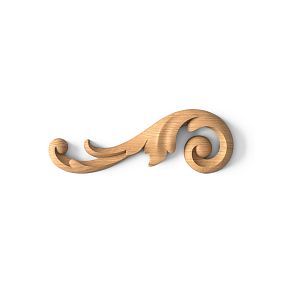
Wooden carved appliqués— this is the most in-demand category of orders for furniture projects. These are decorative solid wood elements that are mounted directly onto the surface of a front, drawer, cabinet, wardrobe, or chest of drawers. They can be central (emphasizing the center of a panel), corner (framing the joints of frames), frame (forming a contour around a panel), and combined.
The key advantage of an overlay is its mounting versatility: it is glued onto a finished surface without milling or repainting the entire front. This allows updating existing furniture or adding decor to a serial product without major intervention in its structure. When ordering an overlay, it is important to specify the exact width and height of the front, the panel thickness, and the wood species from which the furniture is made.
Our factory also produces:




Carved Elements for Doors and Portals
A door opening is one of the most advantageous zones for carved decor. Several types of products work here simultaneously: architraves around the perimeter of the opening, architrave cornices above the door, corner elements, decorative rosettes above the portal, and carved overlays on the door leaf itself.
Carved and shaped window and door trimsMade from solid oak or beech, they transform any doorway, giving it a complete architectural appearance. Three parameters are important when ordering trim: width (usually 60–120 mm for standard doors), thickness (should cover the gap between the frame and the wall), and profile type — straight, shaped, or with a carved ornament. Starting prices for moldings and trims in the catalog begin at 1,720 rubles per item.
Get Consultation
Wall, ceiling, and panel decor
Carved decor on walls and ceilings is an interior solution of a different scale. Moldings form framing systems, rosettes accentuate the ceiling under a chandelier, cornices create a smooth transition between the wall and ceiling. For large projects, the cost is calculated not per piece, but by the linear meter of moldings and cornices plus individual elements — rosettes, capitals, decorative inserts.
It's important to consider: ceiling decor requires not only the correct size but also the correct weight. For large surfaces, a combination of solid wood (in visible accent areas) and MDF (for long linear elements) is often used. This reduces the load on the surface and simplifies installation without losing visual quality.
Elements for stairs and classic interiors
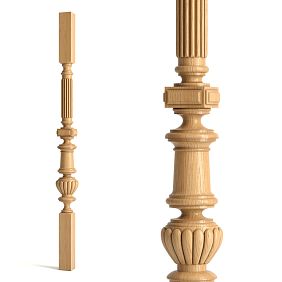
Wooden capitalsCapitals, pilasters, decorative carved balusters, architectural friezes, and ornamental panels — this is a category of products for serious classic interiors. Such an order requires more detailed elaboration: drawings or at least precise measurements are needed, an understanding of the space's style, and coordination of the ornament. Starting prices for capitals in the catalog are from 2,650 rubles for geometric shapes, higher — for complex classic profiles with ornamentation. For stairs, symmetry and precision of execution are especially important: an error in size of even 5 mm is unacceptable here.
What ordering options are available
The question 'how to order wood carving in Moscow' in practice breaks down into four different scenarios. Each has its own logic, its own price, and its own advantages.
Based on a ready-made item from the catalog
The fastest and most predictable path. You select the desired element inthe catalog of wood and MDF products, see exact dimensions, material, shape, starting price, and availability. If the product fits — you order it and receive it within the nearest days. No surprises: you know exactly what you'll get.
This option is optimal for most standard tasks: decorating a kitchen or cabinet facade, installing trim, adding molding in the living room, ordering a set of capitals for pilasters. For an order volume of several units — this offers the best value for money. The STAVROS catalog includes over 4,000 models across 39 product groups, so for most typical tasks, the right element can be found without any custom production.
Based on your sample
This format is relevant when you have existing decor — a piece of trim, a furniture overlay, a photo of a product from a magazine or a site. STAVROS accepts orders based on customer-provided samples: a specialist examines the sample, clarifies parameters, and calculates the manufacturing cost. This is convenient for restoration, when decor needs to be reproduced, and for custom furniture projects, where details must precisely match existing elements.
The cost based on a sample will be higher than the catalog equivalent: here you pay not just for the product, but also for the work of reproducing it, considering the specifics of the pattern.
Based on a sketch or photo
If you have your own idea — a hand-drawn ornament, a designer's sketch, a photo from an interior album, or a reference from Pinterest — that's also a viable basis for an order. The manufacturer translates the visual material into a technical file, coordinates it with the customer, and launches production. This approach requires a bit more time during the coordination stage but offers complete freedom in choosing patterns and shapes.
For an order based on a sketch, it's important to provide as precise data as possible: dimensions of the desired product, level of detail, preferred wood species, and type of finish. The more precise the technical specifications — the fewer coordination iterations and the more accurate the final cost.
Custom project for interior
The most complex and expensive format. When a task goes beyond a standard product and involves designing a decorative system for a specific space—for example, wall cladding in a neoclassical style, a series of custom panels for a study, or a full set of decor for a grand staircase—it is a custom project. This is a collaborative effort between the designer, client, and manufacturer. Cost and timelines are determined individually after a complete technical specification. This is precisely the approach STAVROS refers to in the section aboutexclusive products: here, manual carving methods are combined with modern machining technologies, and each item is considered a unique piece.
What determines the price of wood carving in Moscow
This is where most clients get lost. The same request—'how much does wood carving cost'—can receive an answer ranging from several hundred rubles to several tens of thousands. And this is not market fluctuation; these are different products with different parameters. Let's examine each factor separately.
Product size
The most obvious but often underestimated factor. A 100×150 mm overlay and a 400×600 mm overlay with the same pattern can differ in cost several times over—simply due to the volume of material and processing time. When ordering, always specify exact dimensions: even a small difference in size significantly changes the calculation.
Another nuance: non-standard sizes are generally more expensive than standard ones. If a catalog element of 250×180 mm costs one amount, the same pattern in a 310×195 mm format will require custom production—and the price will increase proportionally.
Complexity of ornament and detailing
This is perhaps the main pricing factor—and the least obvious one. The more details in the pattern, the finer the cut, the more complex the contour—the longer and more expensive the production. Moreover, the relationship is non-linear: a very small, detailed ornament can be more expensive than large relief decor because it requires more operations and has a higher defect rate.
Geometric ornaments with clear straight lines are one price story. Floral ornaments with smooth curves, transitions, and undercutting are another. Complex three-dimensional carving with deep relief, multiple plane levels, and fine details are a third. Understanding this gradation helps to plan the budget wisely.
Tree species
Oak is more expensive than pine. Beech is slightly lower in price than oak, but it also belongs to hard, valuable species. The cost of the material is not only the purchase price of the wood but also the labor costs for its processing: hardwoods are more difficult to cut, wear out tools faster, and require more operations during final sanding.
In the STAVROS catalog, the main species are oak and beech. For specific projects, it is possible to select other species according to the client's wishes. All other parameters being equal, a product made of oak will cost more than an equivalent made of softwood—and this is justified: it will last significantly longer, holds relief better, and looks richer under any finish.
Type of production: standard product or custom order
A catalog item is serial production. The tooling is already ready, the technological process is refined, and production time is minimal. This is precisely why a standard product is always cheaper than a custom one, all other parameters being equal.
A custom order involves developing technical documentation, setting up equipment for a new pattern, a test run, approval with the client, and only then serial launch (or piece production). All of this costs money and time. Therefore, before placing a custom order, it always makes sense to check the catalog: often the needed element is already there.
Quality of processing and finish
STAVROS directly indicates that the price categories of products are also related to the quality of processing. This is an important nuance. The same product can be supplied 'for finishing' (clean, untreated surface that the client tones themselves) or with a finish from the manufacturer—stain, varnish, white enamel, patina.
Finish adds cost, but it is often a reasonable investment: professional application of coating in production conditions looks different than self-painting on-site. This is especially relevant for products with complex relief, where even manual application of stain into the recesses of the ornament is a non-trivial task.
Order volume
Large volume means savings per unit. If you order not one overlay, but a set of 20 identical elements, or molding with a total length of 50 meters, the cost per unit will be lower than with a piece order. This is especially important for designers working with multiple projects and for furniture manufacturers who need decor in a constant assortment.
What has the strongest impact on cost
This is not a duplication of the previous section, but its practical continuation. Here are specific scenarios that help understand pricing logic through real examples.
Why a small intricate ornament can be more expensive than a large decorative element
Many clients intuitively think: a small product means cheaper. This only works under otherwise equal conditions. But if a small product with delicate openwork ornamentation requires more tool passes, meticulous manual finishing, and has a higher defect rate in production — its cost may well exceed that of a large but geometrically simple decorative element. That's why when discussing an order, it's important to look not at size, but at complexity.
When oak is more expensive but more cost-effective in the long run
The price difference between oak and more affordable wood species per unit can be 15–30%. But an oak product, with proper care, will last several decades, won't warp from humidity fluctuations, and won't lose its relief over time. For furniture that is used actively — kitchen fronts, door casings, staircase elements — oak pays for itself within a few years. For decorative panels in less stressed areas, the difference is less critical.
When you can save on a standard element
If the task is standard — a catalog element will almost always be cheaper than custom production. This applies to overlays for furniture fronts, casings of standard sizes, moldings, and trim. It's not worth placing a custom order where there's a catalog item with a minor difference in size or pattern. A small modification of a ready-made element (trimming, width adjustment) will be significantly cheaper than full production 'from scratch'.
Why ordering from a catalog is often cheaper than a custom project
Mass production benefits from economies of scale. The manufacturer has already allocated the costs for development, tooling, and technology across the entire series. When buying a ready-made product, you only pay for the material and production of that specific item — without overhead costs for development. A custom project includes these costs in full, plus time for coordination. The logic is simple: if your task can be met by the catalog — use the catalog.
What prices can serve as a benchmark
A direct price list without calculation is an illusion of transparency. The real cost of custom carved decor depends on too many variables to provide a universal price table. But benchmarks can—and should—be given.
In the STAVROS catalog, starting prices for individual items begin at 1,720–2,110 rubles for moldings, door surrounds, and small overlays. Wooden capitals in geometric design start at 2,650–2,670 rubles. More complex decor sets start at 25,980 rubles and above. These are catalog prices for ready-made serial products.
As for individual orders—the range here is wider. Simple overlays based on a client's sample may cost slightly more than catalog equivalents. Complex exclusive items with custom ornamentation, non-standard sizes, and finishing—are many times more expensive. A specific cost calculation is made after clarifying all parameters: size, ornament, wood species, quantity, type of finish.
For designers and furniture manufacturers working with STAVROS on a regular basis, special conditions exist—this is worth clarifying during the first contact.
What is more cost-effective: ready-made carved elements or custom manufacturing
This is an eternal question with no single correct answer. It all depends on the task.
When it is enough to choose an item from the catalog
If the task is standard—to decorate kitchen fronts of typical size, install door surrounds on doors of standard width, add moldings in the living room, or order capitals for pilasters with typical center-to-center distance—the catalog fully covers it. This is faster, cheaper, and more predictable. STAVROS has over 4,000 models in its catalog, so the chance of finding a suitable item without custom production is very high. Always start with the catalog.
When a custom order based on an individual sample is needed
This format is necessary for restoration work — when it is essential to accurately reproduce lost or damaged decor. It is also relevant when working with custom furniture projects, where the decor was created for a specific object and has no catalog equivalents. The cost is higher, but the result is more precise.
When does it make sense to create an exclusive project
An exclusive order is justified only when dealing with a truly non-standard space or a design task that cannot be solved with mass-produced items. A grand hall with unique proportions, a custom furniture collection, a project for a large facility with a branded visual code — this is the realm of individual production. Here, the quality of carving takes center stage, and the price is a consequence of complexity and uniqueness.
How to avoid overpaying for unnecessary customization
The golden rule: first — a full review of the catalog, then — a request for individual production. Many customers proceed to custom work without ensuring that the needed item is not in the catalog. This leads to unnecessary costs and loss of time. If the desired ornament is in the catalog but in a slightly different size — ask about the possibility of adjustment: often this is feasible within a standard order.
Which materials to choose for an order
The choice of wood species is not only a matter of budget but also of long-term results. Let's examine each option in detail.
Oak
Oak is the benchmark for decorative applications in interiors. Its hardness, pronounced texture, resistance to mechanical impact, and durability make it the first choice for furniture fronts, door trims, staircase elements, and any areas with active use. Oak carved decor takes stain, varnish, oil-wax, and white enamel well — it is equally expressive in its natural tone and under any coating. STAVROS uses oak as the primary species for most items in the catalog.of wood and MDF products.
Beech
Beech is slightly lighter than oak, with a more uniform and fine texture. It is somewhat softer to work with, allowing for more delicate and elegant relief. Beech takes painting in any tone well, making it especially in demand where the decor is planned to be painted white or any pastel color. Beech products are popular for kitchen fronts in light palettes, door decor, and furniture in Scandinavian, Provencal, and classic styles.
Other wood species for the project
For specific projects, STAVROS is willing to consider other wood species—depending on the client's wishes and the technical capabilities of production. Linden is soft, cuts well, and is traditionally used for parts with very fine relief. Pine is more budget-friendly and suitable for decoration in areas without active load. The choice of a non-standard species is always agreed upon separately.
How material affects price and appearance
To put it plainly: oak is more expensive but wins in durability and visual expressiveness. Beech is slightly more affordable, excelling in the delicacy of its grain and versatility of tinting. MDF is stable and technologically advanced, the best choice for paintable and ceiling elements. This is not a hierarchy of 'better or worse,' but a set of tools for different tasks. An experienced craftsman or order manager will help select the species for a specific project, budget, and operating conditions.
How to order wood carving in Moscow without mistakes
A good order begins long before you click the 'Place Order' button. Here is a step-by-step algorithm that saves both money and nerves.
Prepare the dimensions
Take measurements with a tape measure—not by eye, not 'approximately.' For furniture decor: width and height of the facade or panel, thickness of the base. For molding: length of each section, room perimeter, height to the ceiling. For door decor: width of the opening, wall thickness, width of the door frame. For non-standard areas—it's better to make a drawing or plan with markings.
Understand where the product will be used
Kitchen—a high-humidity area: hardwoods with moisture-resistant coating are needed. Living room and study—moderate conditions: you can choose based on aesthetics. Ceiling—lightness of the product and reliability of fastening are critical. Staircase—load and wear: oak is preferred. This simple analysis immediately narrows down the choice of material and product type.
Choose the material
After clarifying the operating conditions, proceed to selecting the wood species. If in doubt, request a consultation from the manufacturer. At STAVROS, material selection consultation is part of the order processing: a specialist will help match the task, wood species, and budget.
Provide a photo, sketch, or example
If your order is non-standard, prepare visual materials. This could be a photo of the object, a screenshot from an interior album, a designer's drawing, or simply a hand-drawn sketch with proportions indicated. The more specific the visual request, the more accurate the cost estimate and the fewer coordination iterations.
Clarify timelines, finishing, and delivery
Don't forget to ask several practical questions before placing the order: what are the production timelines for this item, is it in stock or made-to-order, in what form is it supplied (unfinished or with coating), what are the delivery options for Moscow and the Moscow region. These details may seem secondary, but they determine whether the decor will be installed on time or become the cause of a delay for the entire project.
Common mistakes when ordering wood carving
Each of these mistakes occurs regularly, and each costs either money, time, or disappointment.
No exact dimensions
The most common problem. The order is placed 'by eye' or using approximate values, and as a result, the decor either doesn't fit on the facade or looks too small or too large. The rule is one: take measurements before ordering, double-check them, and only then submit the request.
Too complex decor chosen for a small surface
Rich ornamentation on a small facade looks overloaded and creates visual chaos. For narrow and low panels — a delicate pattern, possibly only corner accents without a central element. The scale of the decoration must be proportionate to the plane.
Material chosen solely by price
Choosing the cheapest wood species for the kitchen is a common mistake. Soft wood under kitchen humidity and mechanical loads quickly loses its shape, the relief gets 'beaten up', and the coating cracks. Saving on material in a high-traffic area results in replacing the decor in 2–3 years.
Finishing not taken into account
Ordering an item 'for finishing' — and facing the fact that in its finished state it poorly accepts the chosen varnish or stains unevenly. Before ordering without a coating, make sure you have experience with DIY finishing or a specialist who will do it. The alternative is to order the item with a factory-applied finish.
Did not separate the decorative task from the structural one
Sometimes a client wants a carved element to look decorative and perform a structural function simultaneously — for example, to conceal a joint, support a hanging part, or close a gap. Decoration is not intended for structural loads. If there is a structural task — solve it with separate means, and add decoration on top of the finished structural solution.
Custom wood carving: when it is truly your option
Let's return to the question many start with: 'I need carved decor — is this even my case?'
The answer is simple: if you have furniture, doors, walls, or an interior that you want to make expressive, not standard — Custom wood carving in Moscow— this is exactly your option. At the same time, 'custom' does not always mean 'individually made from scratch'. In most cases, it is simply selecting the desired element from a large catalog and delivering it for a specific project. It is precisely this approach — through a catalog and professional consultation — that makes carved decor accessible not only for ceremonial mansions but also for city apartments, country houses, and commercial interiors.
FAQ: answers to popular questions about custom wood carving in Moscow
Can I order wood carving according to my own sketch in Moscow?
Yes. STAVROS accepts orders both according to the client's ready-made sample and according to a sketch or photograph. To calculate the cost, you need to provide visual material and specify the desired dimensions, wood species, and type of finish.
What does the price of wood carving depend on?
Key factors: product size, complexity of the ornament, wood species, type of order (catalog or individual), quality of processing, and presence of final finishing. The larger, more complex, and more exclusive — the higher the cost.
What is cheaper: a ready-made element or an individual order?
A ready-made element from the catalog is almost always cheaper than an individual order, all other parameters being equal. Serial production allows to significantly reduce the unit cost. An individual order is justified only for non-standard sizes or an author's ornament.
Can I order only one element?
Yes. STAVROS also works with individual orders. The minimum order is not limited to one item, so you can purchase even a single overlay or socket.
What types of wood are available?
Main ones: oak and beech. For specific projects, other types of wood can be selected. The availability of a particular type can be clarified when placing an order.
How quickly is the cost calculated?
For catalog items, the cost is indicated directly on the product page. For custom orders, the calculation is made after clarifying the parameters: size, complexity, material, volume. The standard timeframe for calculating a custom order is 1–3 business days after receiving the complete technical specifications.
Can I order a large batch?
Yes, and it's more cost-effective: with a large volume, the unit cost of the item decreases. This is relevant for designers, furniture manufacturers, and development projects.
Is wood carving suitable for furniture and doors?
This is one of the main applications. Carved overlays for furniture fronts and door trims are the most popular order categories. The choice of item type depends on the style, size, and material of the base.
How can I understand the approximate budget before calculation?
Refer to the STAVROS catalog prices: starting positions from 1,720–2,110 rubles for moldings and small overlays, from 2,650 rubles for capitals. Complex decorative sets and exclusive products — from 25,000 rubles and above. An individual calculation clarifies the amount for a specific task.
What needs to be sent for a cost estimate?
A photo or sketch of the desired product, exact dimensions, preferred wood species, and type of finish. The more accurate the initial data — the faster and more precise the calculation.
About the company STAVROS
STAVROS is a Russian manufacturer and distributor of carved decor made from solid wood, MDF, and polyurethane for furniture and interiors, with over 24 years of experience in the market. The company is one of the leaders in the production of carved decor and components for furniture and interiors in Russia.catalog of productsincludes over 4,000 models in 39 product groups: carved overlays, moldings, cornices, architraves, capitals, rosettes, pilasters, trim, decorative panels, and much more. Production is located in St. Petersburg and works with both serial products andexclusive ordersbased on customer samples and sketches — using manual and machine carving methods.
For Moscow customers, STAVROS offers a showroom with product samples, professional consultation on selecting the type of product, wood species, and finishing option, as well as delivery in Moscow and the Moscow region. If you want to order custom carved wood decor in Moscow and understand the cost for your project — start with the catalog or contact a company specialist for a consultation.