Article Contents:
- What Types of Wood Carving Can Be Ordered in Moscow Region
- Carved Window Trims and House Carving
- Carved Elements for Facade and Entrance Group
- Interior Decor: Panels, Overlays, Cornices, Moldings
- Carved Elements for Furniture, Doors, and Stairs
- For Which Objects in Moscow Region Wood Carving Is Most Often Ordered
- For private house
- For a Cottage
- For a Dacha and Countryside Project
- For apartments and urban interiors
- What Ordering Options Are Available
- From a Finished Product in the Catalog
- Based on Your Sample
- From a photo or sketch
- Fully custom project
- What carved elements are most often ordered for homes and facades
- Baseboards
- Frieze, cornice, overlay elements
- Decor for porches, portals, and entrance groups
- House carving for wooden homes
- What is ordered for interiors and furniture
- Carved overlays for facades and furniture
- Panels and Decorative Inserts
- Cornices, moldings, trim
- Capitals, pilasters, rosettes
- Which materials to choose for the order
- Oak
- Oak
- Other wood species for the project
- How material affects appearance and durability
- What to prepare before ordering
- Sizes
- Photo of the object or installation site
- Pattern examples
- Understanding the task: facade, interior, furniture
- Preferences for material and style
- How to choose the right finish for the object
- For facade and exterior
- For interior
- For furniture
- For doors, stairs, and portals
- Ready-made solution or custom carving: what to choose
- When a standard position is sufficient
- When an order based on a sample is needed
- When an individual project is indispensable
- How not to overpay for unnecessary customization
- Mistakes when ordering wood carving in the Moscow region
- No exact dimensions
- Choosing an overly complex ornament without reference to the object
- The style of the house or interior is not taken into account
- Confusing facade and interior decor
- Thinking about installation and element joining too late
- FAQ: Answers to Common Questions About Custom Wood Carving in the Moscow Region
- About the Company STAVROS

The query 'custom wood carving in the Moscow region' is not about a hobby or searching for courses. It comes from a specific person with a specific task: they've built a house in the Moscow suburbs, started a renovation in a country cottage, are working on interior finishing, or want to add character to a wooden facade. They need to understand: can they order custom carved elements for their project, what exactly is made, from what materials, based on what initial data—and how the whole process works.
That's exactly what we'll cover here. Without unnecessary fluff, without historical digressions—just the practicalities of ordering carved wooden decor for properties in the Moscow region: for houses, cottages, dachas, facades, interiors, and furniture.
Demand forcustom wood carvingin the Moscow suburbs is steadily growing. There's an explanation for this: country houses and cottages in the Moscow region are built in classical, neoclassical, Russian, and mixed styles, where wooden decor is not a whimsical detail but a structural element of the image. Carved window trims, friezes along the roof perimeter, overlay elements on the entrance group, cornices, and moldings in the interior—these are the details that turn a solid house into a true country estate.


What kind of wood carving can be ordered in the Moscow region
To get oriented in the possibilities, you first need to understand what exactly is produced to order. The range is wider than it might seem at first glance.




Carved trims and house carving
Applied wood carving—this is historically the most in-demand type of decor for country construction. Trims, pediment boards, eaves, frieze planks, brackets—all of this is classic house carving, which has its roots in the Russian tradition of wooden architecture but works perfectly in modern country construction. Openwork carving on trims creates that recognizable silhouette that immediately conveys the character of the house.
When ordering carved window trims for the Moscow region, it's important to consider the specifics of the object. For a wooden house, there is one geometry of fastening; for stone and brick, another. The dimensions of the trims are taken for specific window and door openings: an error of more than 5–10 mm is unacceptable here. If you have non-standard opening sizes, this is exactly the case when you need an order based on individual templates, not buying a ready-made item from the catalog.
Our factory also produces:


Carved elements for the facade and entrance group
The facade of a house is its face. And carved decor here works completely differently than in the interior: it must withstand atmospheric loads, interact with the architectural proportions of the house, and be readable from a distance. For facade application, larger elements are typical: carved cornice planks, decorative brackets, overlay ornaments on the pediment, shaped friezes.
The entrance group is a separate and very important zone. A carved portal above the entrance door, carved pylons, decorative overlays on columns, ornamental inserts in porch elements—all this creates the first impression of the house and its owners. For objects in the Moscow region, where the country style often gravitates towards representativeness, such decor is especially appropriate.
Get Consultation
Interior decor: panels, overlays, cornices, moldings
Inside a house or cottage, carved wooden decor works by different rules. Here, the coordination of all elements is important: moldings should echo the window trims, cornices should correspond to baseboards, overlay elements on furniture should repeat the ornament of door elements.
Carved wooden elements — house carving and decorative overlayscover a very wide range of interior products: overlays for kitchen fronts, decorative inserts for cabinets, ceiling rosettes, capitals for pilasters, carved panels for decorating a fireplace area or an accent wall. All of this can be ordered either from ready-made catalog items or according to individual sizes for a specific object.
Carved elements for furniture, doors, and stairs
Furniture and doors in a country house often have non-standard sizes: wide door openings, tall cabinets, a staircase with geometry suited to specific architecture. It is precisely for such objects that an individual order of carved elements is relevant: overlays on door panels, elements for decorating stair stringers, decorative railings, balusters with carved ornament.Carved decorative elements for home made of wood and MDFare produced both according to standard projects and according to individual technical specifications.
For which objects in the Moscow region is wood carving most often ordered
The Moscow region market is a special context. It's not like in Moscow: different scales, different styles, different needs.
For a private house
A private house is the largest object in terms of the need for carved decor. A comprehensive approach is needed here: decor for the facade, window and door trims, molding for the interiors of several rooms, elements for the staircase, overlays for furniture. Ordering all this from different places is irrational. A single manufacturer that works with both facade and interior elements is the optimal choice. STAVROS produces products for both exterior and interior decoration, which allows maintaining a unified style and material throughout the entire house.
For a cottage
A cottage in the Moscow region is most often a representative country property with a claim to classicism or neoclassicism. Here, wooden carved decor is not an option, but part of the architectural language. Voluminous cornices, rich trims with ornamentation, capitals on entrance pylons, decorative friezes, carved panels in the living room, staircase decor — all this creates the feeling of a wealthy, well-thought-out home. For a cottage, decor is most often ordered in large sets, so the manufacturer's ability to handle large volumes without loss of quality and deadlines is important.
For a dacha and country project
A dacha is a more democratic and cozy format. Light openwork carving on trims, simple decorative strips, carved elements on the veranda and gazebo are appropriate here. For dacha use, ready-made catalog items are often suitable: several sets of trims, a cornice for the veranda, decorative slats and corner strips. If the dimensions are standard — no custom order is needed.
But if the dacha is built with character — with narrow non-standard windows, a high porch, unique proportions — then a custom order based on photos and measurements becomes the only reasonable solution.
For apartments and urban interiors
Even owners of Moscow apartments furnishing their interiors 'from scratch' often look for custom wood carving in the Moscow region — simply because the production facilities are located here. Urban apartments typically involve compact orders: several overlays for the kitchen, door trims for interior doors, moldings for an accent wall. Here, a custom order is appropriate for non-standard facades or original designs. For standard tasks — a ready-made catalog.
What ordering options are available
This is a key block for those just starting to understand the topic. There is no single 'correct' way to order carved decor. There are four fundamentally different paths.
Based on a ready-made item from the catalog
The simplest and fastest path. You go to thecatalog of carved decorative items, select the desired model, check the dimensions, and place an order. Ready-made items are produced in series, so lead times are minimal and the price is the most affordable. For most standard tasks — furniture overlays, standard-sized door trims, cornices, and moldings — the catalog fully meets the need.
It's important to understand: 'from the catalog' does not mean 'the same for everyone'. One overlay model may be available in several sizes and two types of wood. The choice within the catalog is much wider than it seems at first glance.
Based on your sample
This format is indispensable for restoration and when working with existing decor. If you have an element — a fragment of a trim from an old house, an overlay from antique furniture, a part brought from another site — the manufacturer can study the sample, take its parameters, and produce an exact copy or a series of similar elements. STAVROS accepts orders based on client-provided samples: a specialist analyzes the provided sample, determines the ornament, material, and technique, then calculates the cost and lead times.
From a photo or sketch
A physical sample is not always available. But if there is a photograph — from a magazine, a site, the internet — that is already a working technical specification. In addition to the photo, the desired dimensions of the item and material preferences are needed. Based on this, the manufacturer develops a technical file, agrees on it with the customer, and launches production. For non-standard interior projects and original facade solutions — this is the optimal format.
A hand-drawn sketch is also acceptable: if you understand the ornament but don't have a ready reference — describe the idea, sketch it out, indicate the key proportions. A professional technologist will convert this into a production file.
Fully custom project
The most complex and expensive format — for non-standard objects with unique architectural solutions. For example: a cottage in the Moscow region with custom architecture, where all windows are of non-standard proportions and all facade decor is developed from scratch for the specific house. Or an interior of a study with custom panels, sockets, and a carved fireplace, which must form a unified design system.
For such an order, detailed drawings, a floor plan, or at least precise measurements of all surfaces with photographs of the object are required. The timeline and cost are determined individually, after the complete technical specification.
Which carved elements are most often ordered for the house and facade
The Moscow region market provides a very clear picture of demand. Let's examine the most in-demand items.
Door Casings
Carved wooden window surrounds are the absolute leader in orders for country houses in the Moscow region. They frame window and door openings, serve as an architectural accent, and create the character of the facade. In the Moscow region, surrounds with floral ornamentation or in the style of folk carving are most often ordered — this is the traditional image of a Russian country house.
To order surrounds, the following are needed: precise dimensions of each opening (width, height), wall thickness (determines the width of the surround), type of house (wooden or stone). Wood species — oak or beech for permanent structures; for dacha applications, coniferous species with appropriate impregnation are sometimes used. Howoak wooden window surroundsfit with the overall decor of the house — it's important to think about this at the start, not after installation.
Frieze, cornice, applied elements
A frieze is a horizontal band of applied decoration along the perimeter of a facade or along the roof cornice line. It is one of the most expressive elements of house carving: it sets the horizontal rhythm, decorates the transition from wall to roof, and makes the silhouette of the house more complete. Carved cornice planks, soffits, and bargeboards are all part of the traditional facade ensemble.
For frieze elements, length accuracy is especially important: they are cut to fit the specific perimeter of the building, and a sizing error results in unsightly joints or a material shortage. When ordering, always measure the lengths separately for each span, not the total perimeter.
Decor for the porch, portal, and entrance group
The entrance group is what every guest sees. A carved portal above the entrance door, brackets under the canopy, applied ornaments on columns or pylons, carved figured details create a solemn and representative image of the entrance. For cottages in a classical style, this is practically a mandatory finishing element.
House carving for a wooden house
For a wooden house, wood carving is an organic material language: wood decorates wood.House carving and facade decorcovers the entire spectrum: from openwork fretwork on window surrounds to three-dimensional applied ornaments on the gable. For a wooden house, wood species compatibility is especially important: decorative overlays made of oak on a pine wall will require additional surface preparation and proper fastening.
What is ordered for interior and furniture
The interior of a country house in the Moscow region is a space often conceived on a grand scale. High ceilings, wide corridors, open living rooms, formal studies — here, carved wooden decor unfolds in all its glory.
Carved overlays for facades and furniture
Kitchen, living room, bedroom, study — in each of these zones, furniture with carved wooden overlays creates a sense of craftsmanship and refined taste. Overlays made of solid oak or beech are mounted onto ready-made fronts without requiring furniture disassembly. This allows updating an existing set or customizing mass-produced furniture for a bespoke interior.
In the Moscow region, where country houses are often built from scratch and furnished turnkey, such orders are especially relevant: the designer creates a unified concept, and carved overlays are ordered to fit the exact dimensions of the fronts.
Panels and decorative inserts
Carved wooden wall panels are decor that radically changes the perception of space. Behind the sofa in the living room, behind the headboard in the bedroom, in a library cabinet niche, around the fireplace — everywhere, a carved solid wood panel creates an accent that cannot be replicated with other materials. Panels are produced to individual dimensions for a specific wall or niche.
Cornices, moldings, millwork
Trim products made of oak, beech, and MDF— cornices, moldings, baseboards, battens — this is linear decor that creates rhythm and structure in an interior. For a country house in the Moscow region, millwork is often ordered in significant volumes: several rooms of 50–70 linear meters each. That is why, for such orders, the manufacturer's ability to handle large volumes with a uniform profile and wood species is important.
Capitals, pilasters, rosettes
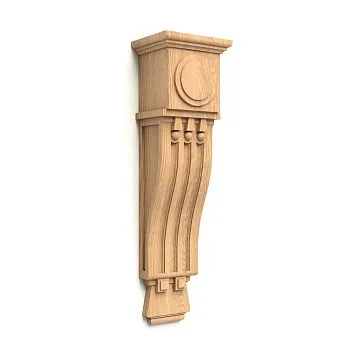
Capitals made of wood and polyurethane— this is architectural decor for formal areas: living room, hall, study. Capitals top pilasters or columns and create a sense of scale and classical architectural correctness. Ceiling rosettes for chandeliers are a classic accent that visually raises the ceiling height. For cottages in a classical style, these are practically indispensable finishing elements.
Which materials to choose for an order
This is not an abstract question about preferences. The choice of material directly affects the result, durability, and cost of products.
Oak
Oak is the first choice for most tasks in a country house. Hard, expressive in texture, resistant to humidity and mechanical loads — it is suitable for architraves, cornices, facade elements, furniture overlays, and moldings. Oak decor under clear varnish reveals the rich texture of the fiber, creating a lively, warm image. Under stain — it takes on any tone from light wheat to dark mocha. For facade applications, oak with proper impregnation and coating lasts for decades.
In the catalogof wood and MDF productsSTAVROS oak is one of the key species. Most catalog items are available specifically in oak.
Beech
Beech is a more delicate species with a uniform fine-grained texture. It is somewhat softer than oak to work with, allowing for the creation of fine relief with high detail. Beech decor is especially good under white enamel or light coatings. For a wooden house in a classic or Scandinavian style — beech provides exactly that image: warm, natural, lively.
Other wood species for the project
Applied wood carvingTraditionally, it was made from different species depending on the task. For house carving and facade elements, coniferous species were often used — they are easy to process and hold coatings well. For figured interior elements with fine detail — linden, alder, ash. For premium projects — walnut with its rich dark brown texture. When ordering, you can discuss with the manufacturer the choice of species for a specific project.
How material affects appearance and durability
Simple decision-making scheme:
| Task | Recommended Wood Species |
|---|---|
| Facade decor, architraves, street cornices | Oak with impregnation and varnish |
| Interior decor under varnish / stain | Oak or beech |
| White enamel / paint finish decor | Beech or MDF |
| Thin decorative molding for interiors | Beech, linden, walnut |
| Ceiling decor, lightweight elements | MDF |
What to prepare before ordering
One of the main reasons orders get delayed or turn out wrong is incomplete initial data. Let's break down what needs to be prepared.
Dimensions
This is the absolute minimum. For casings — width and height of each opening, wall thickness. For overlays — width and height of the facade or panel, base thickness. For moldings — length of each section separately. For panels — width and height of the wall or niche. Do not sum up or round: every centimeter matters.
Photo of the object or installation location
Photography provides context. Even a poorly taken phone photo gives the manufacturer important information: proportions, base material, overall style, existing decor. For a facade order — a photo of the entire facade. For interior — a photo of the wall or room as a whole. This helps avoid mistakes in choosing scale and pattern.
Pattern examples
If you want a specific pattern — show it. A photo from another project, a screenshot from a magazine, a hand drawing, a link to a product in a catalog — any of these formats will help the manufacturer understand the visual task. Words like 'something classic with a floral pattern' are too vague. A picture is specific.
Understanding the task: facade, interior, furniture
Specify exactly what the products are needed for. For facade and interior applications — different technical requirements: different coating types, different processing densities, different material humidity tolerances. The manufacturer must know the application context before production begins.
Material and style preferences
Is there a preference for wood species? What tone is planned for the coating? Is final finishing needed from the manufacturer or will the product be supplied 'raw' for independent painting? What is the overall style of the object — classic, neoclassical, folk, modern with wooden accents? These questions should be considered in advance.
How to choose the right execution for the object
Not all products are equally appropriate in every context. Here is a practical selection logic.
For facade and exterior
Facade decor must be designed for outdoor operating conditions: temperature fluctuations, humidity, ultraviolet radiation. For exterior applications, appropriate impregnation and a finishing coating are mandatory. The ornament for facade decor is typically larger and more graphic than for interiors: it should be legible from a distance of 5–10 meters. Small details on the facade simply get lost.
For interior
Interior decor operates under completely different conditions. Here, the ornament can be significantly more delicate and detailed because it is viewed from a close distance. The finishing coating does not require protection from the atmosphere: oil, wax, varnish, enamel. Consistency with other decorative elements in the room is important.
For furniture
Furniture decor is a special story. The overlay must be proportionate to the facade, compatible with the base material, and fit organically into the overall style of the furniture ensemble. For furniture, dimensional accuracy and cutting quality are especially important: any irregularities and inaccuracies will be visible during use.
For doors, stairs, and portals
Doors and stairs are high-load areas. For door decor, resistance to mechanical impacts and compatibility with the door leaf coating are important. For stairs, symmetry of elements and dimensional accuracy are crucial: no pair of balusters should differ in height by more than 1–2 mm. For fireplaces and portals, fire resistance of the coating and compliance with requirements for distance from heat sources are essential.
Ready-made solution or custom carving: what to choose
Almost all customers ask this question. The answer is always individual, but there is clear logic.
When a standard item is sufficient
If the task is standard — openings of typical sizes, facades from a standard range, classic moldings for rooms with ceiling heights of 2.7–3.0 m — ready-made items from the catalog cover it completely. This is faster, cheaper, and more predictable. Always start by browsing the STAVROS catalog — over 4,000 models are highly likely to contain what you need.
When a custom order from a sample is needed
During restoration, when working with non-standard objects, when it's necessary to accurately reproduce existing decor — ordering from a sample becomes the only reasonable option. The manufacturer takes your sample, analyzes it, and produces exact copies in the required quantity.
When an individual project is indispensable
Unique architecture, an author's interior design project, non-standard dimensions throughout the object, an original pattern — these are situations where custom production is indispensable. It is precisely for such tasks that STAVROS develops and producesexclusive wooden productsbased on the customer's or designer's sketches — using both manual and modern machine carving methods.
How to avoid overpaying for unnecessary customization
The most common financial mistake is ordering custom production where a ready-made item would suffice. Before discussing manufacturing 'from scratch,' always browse the entire catalog in the category of interest. Often, the needed product already exists, just in a slightly different size — and a small on-site adjustment solves the issue without custom production.
Mistakes when ordering wood carving in the Moscow region
Here are the mistakes that are repeated on country properties again and again — and which are easy to avoid if you know about them in advance.
No exact dimensions
"Approximately 90 by 60" is not a size for a production order. A 2-centimeter error renders the product unsuitable for installation on a specific facade. Measure everything with a tape measure, double-check, and provide the manufacturer with exact numbers.
An overly complex ornament was chosen without reference to the object.
A rich baroque ornament on a modest country house is dissonance, not decoration. The ornament should match the scale and character of the building. For a small house—delicate pierced geometry or a light floral motif. For a representative cottage—a more saturated relief with pronounced details.
The style of the house or interior was not taken into account.
Decor should be a continuation of the architectural and interior concept, not a contrast to it. If the house is built in a Scandinavian spirit—carved platbands with a Russian 'rooster' will create disharmony. If the interior is minimalist with pinpoint accents—a rich Baroque overlay on the kitchen facade will stand out.
They confuse facade and interior decor.
Interior decor for the outdoors will not survive even one winter: warping, cracking of the coating, loss of shape. Facade decor without appropriate treatment, installed indoors, will simply be more expensive than analogues without necessity. Always check with the manufacturer for which conditions the product is intended.
They think about installation and joining of elements too late.
"We'll install the platbands, and then figure out the cornice"—a classic story that ends in rework. All decorative elements need to be planned in the system even before installation: the platband and cornice must be coordinated in profile, moldings must join with baseboards in corners, overlays must align with the facade axis. Planning before installation will save both money and time.
FAQ: answers to popular questions about custom wood carving in the Moscow region
Can I order custom wood carving based on my own sketch?
Yes. STAVROS accepts orders based on customer sketches, photographs, and samples. Based on the provided material, a specialist develops a technical file, coordinates it with the customer, and launches it into production.
Do you make carved elements for a private house in the Moscow region?
Yes. Manufacturing and delivery of carved elements for private houses and cottages in the Moscow region is one of STAVROS's main areas of focus. The company works with both standard catalog items and custom orders of any complexity.
Can I order custom-sized carved window surrounds?
Yes. Non-standard sizes for window and door openings are common for country houses. Surrounds are manufactured to the customer's exact dimensions. For calculation, please provide the width and height of each opening and the wall thickness.
What can be custom-made for interior decor?
Practically the entire spectrum of interior wooden decor: furniture overlays, carved panels, cornices, moldings, baseboards, surrounds, rosettes, capitals, pilasters, decor for fireplace portals and staircases.
What types of wood are used for carved elements?
The main types are oak and beech. For specific tasks, other species are possible: linden, alder, ash, coniferous for exterior applications, walnut for premium projects. The choice of wood is discussed for each specific project.
What is better: to choose a product from the catalog or to create your own project?
If the task is standard — the catalog. Faster, cheaper, more predictable. A custom order is justified for non-standard sizes, unique ornamentation, or a complex author's project.
Can I order a single element, not a set?
Yes. STAVROS accepts orders for a single item. Individual piece orders are available both from the catalog and for custom manufacturing.
Is carved decor suitable for a house facade?
Yes, and this is one of the key applications. For facade use, products with appropriate impregnation and coating must be used. Oak with weather-resistant varnish or oil is the optimal choice for exterior decor.
Can elements be made from a photograph?
Yes. A photograph with clear proportions and desired dimensions is a sufficient technical specification to start work. If the photograph is detailed — the manufacturer can reproduce the ornament with high accuracy.
What data is needed to start work?
Minimum: exact product dimensions (or the opening on which the decor is mounted), place of application (facade, interior, furniture), preferences for wood species and, if available, a visual reference for the ornament. This is enough for a preliminary calculation.
About the company STAVROS
STAVROS is a leading Russian manufacturer of carved decor made from solid wood, MDF, and polyurethane with over 25 years of experience. The company works with customers across Russia, including Moscow and the Moscow region, and produces a full range of carved decor: from furniture overlays and moldings to facade house carvings and exclusive interior projects.
For customers from the Moscow region, STAVROS offers:
-
a wide catalog of ready-made products made from solid oak, beech, and MDF;
-
Carved wooden elements— from traditional house carvings to modern interior accents;
-
custom manufacturing based on customer samples, photographs, and sketches;
-
production of large sets for projects in the Moscow region;
-
delivery across all of Russia, including suburban properties in the Moscow region;
-
consultation on selecting the type of product, material, and order format.
STAVROS is not just a store for carved decor, but a manufacturing company with a full cycle: from technical documentation development to final production. If you needcustom wood carving in the Moscow regionFor your home, cottage, dacha, facade, or interior — contact our company's specialists to select a solution for your task and receive a cost estimate.