Article Contents:
- What are decorative wall slats and why are they needed
- Accent function
- Visual Zoning of Space
- Working with room proportions
- Wall decor without overload
- Where to use decorative wall slats
- Slats in the living room
- Slats in the bedroom
- Slats in the hallway
- Reiki in the office
- Reiki in the TV zone
- Reiki behind the sofa, bed, or console
- What types of decorative wall slats are there
- Narrow slats: the thinnest line in the interior
- Medium and universal slats
- Wide and accent slats
- Flat and three-dimensional options
- Vertical and horizontal orientation
- How to choose the material for decorative wall slats
- Natural wood slats: why it matters
- Oak
- Oak
- What to choose for painting and for tinting
- How material changes the character of a wall
- How to choose the dimensions of decorative wall slats
- Slat Width
- Thickness of slat
- Rail length
- Spacing Between Slats
- How not to make a wall visually heavy
- How to choose decorative slats to match the interior style
- Modern style
- Minimalism
- Neoclassicism
- Scandinavian Style
- Warm modern interior
- Interior with natural materials
- Vertical or horizontal slats: which is better for a wall
- When to choose vertical layout
- When is horizontal layout appropriate
- How direction changes perception
- How to choose layout for ceilings and geometry
- How to properly place decorative slats on the wall
- Full wall coverage
- Fragment on an accent zone
- Around the TV zone
- In the bed area
- With niches and lighting
- How to combine decorative slats with other interior elements
- With Furniture
- With moldings and cornices
- With panels
- With doors and portals
- With warm backlighting
- Installing decorative slats on the wall: what to consider in advance
- Foundation Preparation
- Wall marking
- Choosing the spacing and layout pattern
- Methods for attaching decorative slats
- Joining elements and precise geometry
- Common Installation Mistakes
- What influences the choice of slats for a specific wall
- Room size
- Ceiling height
- Lighting
- Interior color
- Presence of furniture against the wall
- Wall's role: background or accent
- When to choose ready-made slats and when to order custom ones
- If a standard size fits
- If you need a specific material or finish
- If a non-standard project is important
- If you need a complex wall composition
- How to calculate the number of slats — checklist
- What affects the price of decorative wall slats
- Material
- Dimensions and volume of material
- Finish
- Availability or custom production
- Purchase Volume
- Typical mistakes when choosing decorative wall slats
- Choosing without considering wall area
- Too dense layout
- Inappropriate slat size for the specific task
- Ignoring Interior Style
- Installation direction error
- Mismatch between furniture and wall decor shades
- FAQ: popular questions about decorative wall battens
- Conclusion
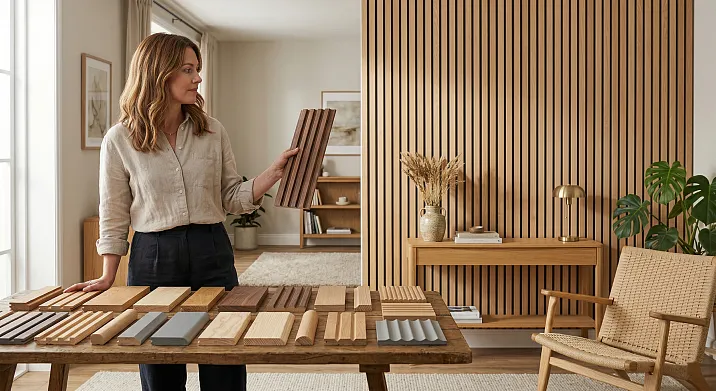
Imagine: you enter a room and immediately sense — something here is resolved. It doesn't shout, doesn't press, doesn't try to impress with overly expensive molding. Just one wall lives differently: vertical lines set the rhythm, light glides between the stripes, space gains depth. This is the work ofDecorative slats on the wallmade of natural wood — one of the few finishing materials that is simultaneously an architectural element and an artistic tool.
Why specifically a wall? Because the wall is the first thing a person sees upon entering a room. A flat painted surface, even in a perfect color, remains neutral. A wall with wooden battens — that's already character. Texture. Living material. Decor that doesn't age or go out of fashion, because natural wood is never 'outdated'.
In this article — a specific practical breakdown: where, how, and whichDecorative louvered panels on the wallwork best, what you need to know before buying, what mistakes to avoid, and how to make a choice confidently — with an understanding of every parameter.

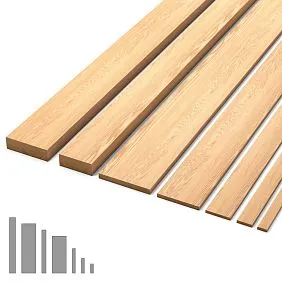
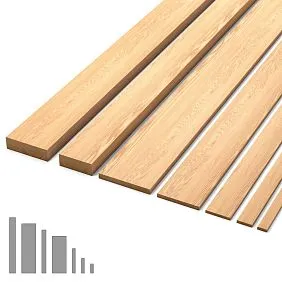

What are decorative wall battens and why are they needed
A decorative batten is a longitudinal wooden profile with a straight, flat, or rectangular cross-section. On a wall, it performs several functions simultaneously, and calling it 'just decoration' would be an oversimplification.




Accent function
Battens highlight one plane in space, turning it from the background into the main 'participant' of the interior. An accent wall no longer requires painting, expensive wallpaper, or stained glass. Wooden battens with the right spacing and proper material achieve the same effect—more precisely, more organically and durably.
Our factory also produces:


Visual zoning of space
In studios and open-plan layouts, battens on one of the walls create a visual zone boundary. Not a partition, not a wall, but a clear sense: here is the living room, there is the home office. Zoning without losing light and without construction work.
Get Consultation
Working with room proportions
Vertical battens elongate the space upward—this is especially valuable in apartments with standard ceilings of 2.4–2.6 m. Horizontal battens widen narrow rooms in perception. This is not an illusion—it is a real optical correction used by professional interior designers.
Wall decor without overload
One of the main fears during finishing is 'overloading' the interior with details. Wooden battens do not 'shout.' They create a rhythm—unobtrusive, almost architectural. A wall with battens looks well-crafted but not overloaded if the spacing and profile width are chosen correctly.
Where to use decorative wall battens
Battens in the living room
The living room is a space for living and for impressions. An accent wall behind the sofa with vertical oak or beech battens is one of the strongest techniques in modern residential interiors. Battens establish an axis, create a focal point, and make the wall 'alive' without heavy moldings or complex structures. For large living rooms, battens with widths of 70×7 and 90×10 mm are suitable—they are noticeable on a large scale. For smaller ones—40×5 or 24×5 mm.
Reiki in the bedroom
Behind the headboard, reiki create a sense of coziness, warmth, and 'intimate' architecture. This is an area where a person desires peace, softness, and natural materials. Light beech with transparent oil or varnish, narrow reiki in a vertical layout with even spacing—and the bedroom gains character that cannot be achieved with any paint.
It's important not to overdo it here: reiki occupy only the area behind the bed, the other three walls remain neutral.
Reiki in the hallway
The hallway is the first impression of an apartment. It's a small space that needs to be resolved precisely. Wooden reiki on the wall in the hallway is practical (the lower part of the wall is protected from mechanical damage) and stylish. Formats like 24×5 or 40×5 mm in a vertical layout are appropriate here—they don't narrow the space and create a visual sense of height.
Reiki in the study
The study is a place of concentration. Reiki made of dark oak with a walnut-toned finish on one wall create a sense of weightiness, significance, and professional space. This is no accident: wooden wall decor is associated with quality and seriousness—it's no coincidence that wood has been the material of studies, libraries, and meeting rooms for centuries.
Reiki in the TV zone
The TV wall is a focal point in the interior. A vertical layout of reiki around the TV niche, with integrated LED lighting behind the profiles, is a professional designer technique. The reiki frame the screen, creating a 'frame' and depth.Wooden reiki for an accent wall70×7 or 90×10 mm cross-section — the optimal choice for the TV zone.
Battens behind the sofa, bed, or console
In all three scenarios, the logic is the same: furniture stands against the wall, and the wall should 'respond' to it. Battens create this dialogue between the object and the plane. The width of the batten field generally corresponds to the width of the furniture plus 20–40 cm on each side — this creates the feeling of a finished architectural niche without actual structures.
What types of decorative wall slats are there
Narrow battens: the finest line in the interior
15×5 and 24×5 mm cross-section — this is the minimal format where a wooden element is still clearly readable on the wall. Narrow battens create a fine vertical or horizontal graphic: with a frequent pitch (every 25–35 mm) — an almost solid texture effect; with a wide pitch (70–100 mm) — a light, even rhythm. Ideal for small spaces, for Scandinavian and Japanese styles, for interiors with a high content of air and 'white' space.
Medium and universal battens
40×5 mm cross-section — the most popular format. Noticeable enough to create a visual structure, yet restrained enough not to compete with furniture. This is the format most often chosen for living rooms, hallways, and studies. 70×7 mm batten — the next level: a pronounced profile with good shadow under side lighting, suitable in rooms with ceilings from 2.7 m.
Wide and accent battens
90×10 mm cross-section — this is already a full-fledged volumetric plank with a noticeable profile height. Under accent lighting, it creates deep relief and an expressive play of shadows. Used in large spaces, in rooms with high ceilings, in areas with directed lighting.
The 60×23 and 80×23 mm formats are massive architectural profiles. On the wall, they function as a framing element: niches, portals, accent panels with pronounced volume. This is not background decor—this is architecture.
Flat and volumetric options
Flat slats (5 mm thick) create an almost imperceptible relief, a soft texture without pronounced shadow. Volumetric slats (10–23 mm) create a lively play of light and shadow that changes depending on the lighting angle. The first option is for background, delicate decor. The second is for accent zones with directional lighting.
Vertical and horizontal orientation
Both directions work—when properly tied to the task. Vertical is height, strictness, the 'architectural spine' of the wall. Horizontal is movement, width, dynamism. Choosing the direction is not an aesthetic whim, but a decision that changes the perception of the entire room.
How to choose the material for decorative wall slats
Natural wood slats: why it matters
Natural wood is a living material. The texture of the fibers, tonal transitions, and slight surface roughness all create a sense of warmth and authenticity that cannot be fully reproduced in synthetic analogues. When a person touches a wall with wooden slats—they feel: this is real.
Wooden Planks for Walls from STAVROS are made from two main species—oak and beech. This is a fundamental choice, dictated both technologically and aesthetically.
Oak
Oak is a dense, hard, durable wood with a pronounced grain. Golden-brown and honey tones, large clear fibers, characteristic texture with 'mirrors' in radial cut. Oak slats on the wall are class, weightiness, natural luxury. Oak looks especially good in dark finishes: walnut, wenge, tobacco, cognac.
Oak is the best choice for translucent finishes: tinting, oils, clear varnish. Its texture is too valuable to cover with opaque paint.
Beech
Beech is a fine-grained, uniform wood with a delicate warm tone. It features an even texture without large transitions and sands well. Beech slats are an ideal base for enamel painting: the surface becomes smooth, and the paint applies without 'tears' or unevenness.
For white, cream, or pastel enamel, beech is unbeatable. For neoclassical, Scandinavian, and modern classic styles, it's exactly beech.
What to choose for painting and for tinting
| Task | Material |
|---|---|
| White / pastel enamel | Beech |
| Dark tint / varnish | Oak |
| Neutral tint | Beech or oak |
| Natural color | Both options |
| Clear oil | Oak (more expressive) |
How material changes the character of a wall
Beech batten in white enamel is lightness, purity, modern classicism. Oak batten with tinting is depth, warmth, natural richness. The same size, the same layout — but different sensations. It is precisely the material and finish that determine whether a wall will be 'substantial' or 'airy'.
How to choose the sizes of decorative battens for a wall
Size is not an abstract characteristic. Each parameter of a batten directly affects how the finished wall will look. A mistake in size is difficult to correct after installation.
Slat width
Width (the first cross-section parameter — for example, 40 mm in position 40×5) determines how wide a strip is visible on the wall.
-
15 mm — the thinnest line, almost a graphic element
-
24 mm — a thin strip with good readability
-
40 mm — a universal format, works in any room
-
70 mm — a noticeable plank, good for high walls
-
90 mm — large element, architectural scale
Rule: the larger the wall area, the wider the slat can be. In a small room, wide slats compress the space.
Slat thickness
Thickness (the second parameter — for example, 5 mm in the 40×5 position) determines the volume and protrusion above the wall surface.
-
5 mm — minimal relief, light texture
-
7 mm — moderate volume with noticeable shadow under side lighting
-
10 mm — pronounced relief, good play of shadows
-
23 mm — massive profile, architectural projection
For most wall decor, 5–10 mm is sufficient. Options with 23 mm are for portals, frames, heavy structures.
Slat length
The RK-001 slat from STAVROS comes in a standard length of 2400 mm. This is a precisely calculated format:
-
Standard room height 2400–2600 mm → the slat covers the wall almost without waste
-
For horizontal application on a wall 3–4 m wide — joints are necessary but well predictable
-
Length is a multiple of standard furniture and construction modules
If the wall is higher than 2400 mm — battens are joined. Joints are planned in advance, staggered — so they don't align into a horizontal line.
Spacing between battens
Spacing — the distance from one batten to the next — is the main parameter determining the visual 'density' of the wall.
| Step | Effect |
|---|---|
| 15–25 mm | Almost solid texture, dense rhythm |
| 30–50 mm | Even layout, classic look |
| 60–90 mm | Free rhythm, 'breathing' wall |
| 100+ mm | Sparse verticals, maximum lightness |
Minimum spacing — equals the width of the batten. If spacing is smaller — the wall visually 'closes up', the space between battens is lost.
How to avoid making a wall visually heavy
Three simple rules:
-
Battens only on one wall in the room (the rest are neutral)
-
Spacing is always greater than the width of the batten
-
With a light color, you can take a wider batten; with a dark tint, the spacing is made slightly larger so the wall 'breathes'
How to choose decorative battens to match the interior style
Modern style
Strict geometry, clean lines, nothing superfluous. For a modern interior, thin battens in white enamel or natural beech are suitable. Layout is vertical, with even spacing, without mixing formats. Battens here are an architectural element, not a decorative ornament.
Minimalism
Minimalism is not the absence of decor, but decor reduced to its essence. Thin beech battens (15×5 or 24×5 mm) in the color of the wall (tonal decor) are an example of perfect minimalist finishing. The wall looks detailed, but the eye doesn't 'stumble' over anything superfluous.wood trim itemsin neutral tones is exactly what a minimalist project needs.
Neoclassicism
Neoclassicism loves system. Here battens work in tandem with moldings and cornices: battens set the rhythm on the plane, moldings frame the field. A cross-section of 40×5 or 70×7 mm in a walnut tint with matte varnish is the recognizable language of neoclassicism. ProperWooden interior moldingsin a unified material brings everything together into a system.
Scandinavian style
Light beech, transparent oil, minimal processing. Scandinavian interiors value material honesty: slight texture irregularity, natural tone transitions. Narrow slats (15×5, 24×5 mm) with wide spacing on a white wall — a classic Scandinavian technique.
Warm contemporary interior
Yellow and beige tones, natural fabrics, light wood furniture. Beech slats with 'wheat' or 'linen' tinting on such a wall — it's a continuation of the palette, its textural depth. The wall ceases to be just a background and becomes part of a warm, cozy atmosphere.
Interior with natural materials
Wood, stone, linen, jute — interiors where every material speaks of nature. For such a space, the best choice is oak slats with transparent oil or wax. The wood texture is open, alive, 'breathing'. A wall with such slats becomes part of the room's natural story.
Vertical or horizontal slats: which is better for a wall
This is one of the main questions that arises before purchase — and the answer depends on the specific room.
When to choose vertical layout
Vertical means height. Strictness. Rhythm that 'lifts' the space. That's why vertical slats are most often used:
-
in rooms with standard ceilings (2.4–2.6 m) — to visually add height
-
in the bedroom behind the headboard — to create a sense of calm and a vertical 'anchor'
-
in modern and minimalist interiors — where a strict line is a stylistic principle
-
in TV zones — where the vertical creates a 'frame' around the screen
When is a horizontal layout appropriate
Horizontal is movement, width, extension. It is appropriate:
-
in narrow and long corridors — slats visually expand the space
-
in rooms with very high ceilings (3+ m) — where the space needs to be 'grounded'
-
in a study or work area — a horizontal layout creates a sense of stability, concentration
How direction changes perception
The same set of slats, the same cross-section, the same color — but a different direction. A vertical layout makes a room taller and more austere. A horizontal one — wider and calmer. This effect works regardless of the interior style and is pure optical mechanics.
How to choose layout for ceilings and geometry
Ceilings below 2.5 m → vertical or diagonal
Ceilings above 3 m → horizontal is acceptable, vertical also works
Narrow room → horizontal for expansion
Square room → any direction, depends on the task
How to properly place decorative slats on the wall
Completely covering the entire wall
Total coverage of one wall is the boldest and most 'architectural' option. The slats run from floor to ceiling, from corner to corner. This format requires precise calculation of spacing—errors accumulate and result in a noticeable shift by the end of the wall. However, the outcome is a full-fledged 'wooden wall' that transforms the entire space.
Fragment on an accent zone
The most common and flexible format. The slats occupy only part of the wall: behind the sofa, behind the bed, around the TV. The advantage is minimal material consumption with maximum visual impact. The width of the slat field usually matches the width of the furniture or exceeds it by 20–40 cm on each side.
Around the TV area
A TV niche framed with slats in a vertical layout and backlighting is one of the most popular requests. An important nuance: the slats should extend beyond the TV on each side by at least 30–40 cm, otherwise the accent is lost. The ideal cross-section for a TV wall is 70×7 or 90×10 mm.
In the bed area
The slatted field behind the bed is made wider than the headboard itself—by about 50–80 cm on each side—and rises to the ceiling or to the cornice level. Thin slats (24×5 mm) with a spacing of 40–60 mm create a delicate background that does not 'compete' with the bed's decor but supports it.
With niches and lighting
Slats and lighting are a winning combination. An LED strip behind the slats (between the slat and the wall) creates soft, diffused light. Lighting between the slats (directed) accentuates the relief and texture.Wall decorative slatscombined with LED lighting create an effect that cannot be achieved with any paint.
How to combine decorative battens with other interior elements
With furniture
Slats on the wall 'converse' with the furniture: wooden furniture and wooden slats speak the same material language. It's important to choose one wood species or one tonal group. Light beech on the wall next to dark oak cabinets creates dissonance. Beech on the wall with beech furniture, or dark oak on the wall with oak fronts creates unity.
With moldings and cornices
Slats and moldings are a natural system. Moldings frame the slatted field, define its boundaries, and create a 'frame'. Inwooden moldings from STAVROSBattens and moldings are produced in the same wood species — beech and oak — so a unified system is created without issues of tonal coordination.
Classic scheme: molding around the perimeter of the field, with vertical battens inside. This imitates a wall panel without heavy joinery.
With panels
Battens enhance wall panels: wooden battens are mounted on an MDF base at the desired spacing — resulting in a 'volumetric' panel. This exact construction is used in modern neoclassical interiors: lightweight, quick to install, with an expressive result.
With doors and portals
Wooden battens on the wall, from which doors with wooden casings and portals 'grow' — this is a unified wooden story of the space. For such a combination, it is especially important thatmoldings, cornices, and baseboardsthey are made from the same wood species as the battens on the wall.
With warm lighting
Warm white light (2700–3000 K) accentuates the natural wood texture, enhancing the feeling of warmth. For oak battens — perfect. For beech in white enamel — neutral white (3500–4000 K) is better, it maintains freshness and modernity.
Installing decorative battens on the wall: what's important to consider in advance
Foundation Preparation
Battens are mounted on a solid, dry, level base. Acceptable surfaces: concrete, drywall, MDF, plywood, level plaster. Base moisture content — no higher than 12%. Excess moisture causes the batten to warp within several months.
The surface is primed. All unevenness and cracks are eliminated before installation.
Wall marking
Marking is the most critical stage. For vertical layout, a laser level is used: each line for the batten is set with a vertical laser plane. An error of even 2 mm accumulates across the entire wall and creates a 'floating' pattern.
For horizontal layout — a horizontal level. Calculation starts from the center of the wall (or from the center of the accent area), not from the corner.
Selection of spacing and layout scheme
Spacing is calculated based on the width of the batten and the desired visual density. Before installation, a paper or digital sketch is made indicating all dimensions. The layout is checked 'on paper' before the first fastener is driven into the wall.
Methods for fastening decorative battens
-
Mounting adhesive (liquid nails): for thin and light battens (5–7 mm) on a level base. Simple and neat.
-
Finish nails / nailer: fast, reliable, the nail head is almost invisible. Optimal for serial installation.
-
Anchor nails: for installation into concrete or brick.
-
Hidden cleats: for demountable structures or a maximally clean surface without visible fastening points.
-
Screws into the frame: when mounting on a wooden frame — reliable, with allowance for wall unevenness.
For large formats (60×23, 80×23 mm) — only mechanical fastening. Adhesive cannot handle such weight.
Joining elements and precise geometry
Corner joints — at 45°. Straight joints when extending length — staggered, so joints do not align in a single horizontal line. Ends are sanded and coated with the same composition as the front surface.
Typical installation mistakes
-
Installation on a damp substrate → warping after 2–3 months
-
Only adhesive for large slats → delamination
-
Marking from the corner, not from the center → broken rhythm at the edges
-
Skipped primer → loss of adhesion
-
Failure to maintain a temperature gap in long horizontal joints → cracks due to humidity changes
What influences the choice of battens for a specific wall
Room size
Small room (up to 12 m²) → narrow battens (15×5, 24×5 mm), wide spacing, light tones
Medium room (12–25 m²) → universal formats (40×5, 70×7 mm), moderate spacing
Large room (25+ m²) → wide battens (90×10 mm), denser layout is acceptable
Ceiling height
Ceilings below 2.5 m → vertical battens, thin formats, light shades
Ceilings 2.5–3 m → any format
Ceilings above 3 m → large battens look proportional, horizontal layout is acceptable
Lighting
With accent and side lighting, volumetric battens (10–23 mm) create expressive relief. With uniform general lighting, the difference in thickness is almost invisible — thin formats can be used.
Interior color
Light interiors — beech in white enamel or natural light tone. Dark and deep interiors — oak with tinting, dark formats. Contrast solution (dark battens on a light wall or light battens on a dark wall) — an accent, designer technique.
Furniture against the wall
If furniture is placed against the wall, the slatted field is 'framed' to the width of the furniture. The slats should be visible above and on the sides of the furniture; otherwise, the work is lost. The minimum 'overhang' of the slatted field beyond the furniture is 20–30 cm on each side.
Wall's role: background or accent
If the wall is a background → narrow slats, tonal color, quiet rhythm
If the wall is an accent → wide slats, contrasting color, dense rhythm or lighting
When to choose ready-made slats and when to order custom
If a standard size fits
The RK-001 slat from STAVROS comes in seven standard cross-sections with a length of 2400 mm. For most tasks in residential and commercial interiors, this range covers the need. Several items are in stock, ready for shipment without waiting.
If a specific material or finish is required
Choosing between beech and oak, between 'for enamel' and 'for tinting' — this is a refinement within the existing range. The required wood species is typically in stock or produced within 5–10 working days.
If a non-standard project is important
If none of the standard sections fit the technical specifications — custom-sized production is possible. This is relevant for object projects, furniture manufacturing, and design studios with specific calculated parameters.
If a complex wall composition is needed
For large objects with extensive slatted surface areas, multiple formats within one system, or integrated niches and lighting — ordering a project-specific kit is optimal. This ensures batch uniformity in tone and texture.
How to calculate the number of slats — checklist
Before purchasingdecorative wall slatsNeed to know:
-
Wall height (or slatted field height) → determines the length of each slat
-
Field width → determines the total number of slats
-
Slat width and spacing → formula: field width ÷ (slat width + spacing) = number of slats
-
Rail length = 2400 mm; if the height is less — there is a remainder that can be used in another zone
-
Add 10–15% for trimming and fitting
What affects the price of decorative wall slats
Material
Oak is approximately 40–60% more expensive than beech for identical cross-sections. This is due to the difference in raw material cost and processing labor intensity. Beech slats in the 15×5×2400 mm format start from 410 rubles, oak slats — from 610 rubles. For larger cross-sections, the price is proportionally higher.
Dimensions and material volume
A 90×10 mm slat contains 12 times more material than a 15×5 mm slat of the same length — and costs accordingly. Choosing a cross-section is a choice not only of visual effect but also of budget.
Finish
Slats 'for enamel' and 'for tinting' cost the same in the basic version. A finished painted or tinted product is more expensive but saves time and the painter's work on site.
Availability or custom production
Items in stock — shipped immediately, without a surcharge for urgency. Custom production — 5–10 business days. Delivery across Russia via SDEK, pickup in Moscow and St. Petersburg.
Purchase volume
For bulk orders of large quantities — wholesale terms. For design studios and furniture manufacturers, this is a fundamental economic argument.
Typical mistakes when choosing decorative wall slats
Selection without considering wall area
A 90×10 mm batten in a small hallway is not decor, it's pressure. A thin 15×5 mm batten in a huge hall is a loss that simply isn't visible. The scale of the batten and the scale of the wall must match.
Too dense layout
When the spacing is less than the width of the batten, the space between the slats is lost. The wall turns into a 'clad' surface that presses and narrows the room. Especially critical in small spaces.
Inappropriate batten size for the specific task
Thin battens for the TV zone — too delicate: next to the TV, this format gets lost. Wide battens behind the bed headboard — too heavy for a relaxation zone.
Ignoring the interior style
Oak battens with dark tinting against white Scandinavian furniture — a style conflict. The choice of color and wood species for the batten should be based on the existing context.
Error in installation direction
Horizontal battens in a small room with a low ceiling — this is the fastest way to make the space look 'squashed'. Vertical orientation in such a case works much better.
Mismatch between furniture shade and wall decor
Battens in the same tonal group as the floor, furniture, and doors create harmony. Battens that are 'accidentally' a different tone create a sense of an unfinished interior, even if everything is technically done correctly.
FAQ: Popular questions about decorative wall battens
Which battens are best to choose for a living room?
For a living room, battens with a cross-section of 70×7 or 90×10 mm made of oak with a tint are optimal. Vertical layout behind the sofa with a spacing of 50–70 mm creates a strong accent. For a more restrained result — 40×5 mm made of beech in the wall's tonal color.
Which decorative battens are suitable for a bedroom?
For a bedroom, narrow battens (24×5 or 40×5 mm) made of light beech are recommended. Vertical layout behind the headboard, spacing 40–60 mm. This creates a delicate background that adds warmth without visual load.
What's better — thin or wide battens?
Thin (15×5, 24×5 mm) — for small rooms and delicate decor. Wide (90×10 mm) — for large planes and accent zones with lighting. In standard rooms (14–20 m²), the 40×5 or 70×7 mm format is optimal.
What distance should be between battens on the wall?
Minimum spacing equals the width of the slat. Working range is from 30 to 80 mm. The larger the spacing, the 'lighter' and more airy the wall. Recommended spacing for most tasks is 40–60 mm.
Are wooden slats suitable for a small room?
Yes — if you choose the right format. Narrow slats (15×5, 24×5 mm) in a vertical layout visually increase the ceiling height. The color should be light, tonal with the wall background. Slats only on one wall.
Can slats be installed only on part of a wall?
Yes, and this is one of the best techniques. A slatted field behind furniture (sofa, bed, console) creates maximum visual effect with minimal material consumption.
Which slats are better for a TV zone?
Section 70×7 or 90×10 mm, vertical layout, dark tint or contrasting color. LED backlighting behind the slats enhances the effect. The slatted field should extend beyond the edges of the TV by at least 30–40 cm on each side.
Can slats be combined with moldings?
Yes — and this is one of the best solutions in a neoclassical interior. The molding frames the slatted field, creating a 'frame'. It is important to use the same wood species: slats andWooden moldingsin the same material from the same manufacturer.
How to choose the color of decorative slats for a wall?
Tonal color (close to wall color) — a delicate background. Contrast color — an accent. For painting in any desired color — choose beech slats: a smooth surface for enamel. For natural texture — oak with tinting.
When is it better to buy ready-made slats, and when to order custom ones?
Ready-made — when one of the standard RK-001 sections (15×5 to 80×23 mm) fits. Custom order — for non-standard parameters or large batches. Production time — 5–10 business days, delivery across Russia via SDEK.
Conclusion
A wall with wooden slats is not a repair project or a designer's whim. It is a solution that changes the character of a space. Properly selectedDecorative slats on the wallset the rhythm, correct proportions, and bring a living texture into the interior that no paint or wallpaper can replace.
The choice is simple if you proceed sequentially: first — the wall (which one, where, what role it plays), then — the slat format (narrow, medium, wide), next — the material (beech for enamel, oak for tinting), and only after that — the purchase. It is precisely this logic that yields a result you can be proud of.
STAVROS is a Russian manufacturer of wooden decorative slats, moldings, cornices, baseboards, and millwork made from solid oak and beech. The RK-001 slat is available in seven standard sections with a length of 2400 mm — from the thinnest 15×5 mm to the massive 80×23 mm, in beech and oak versions, for enamel and for tinting. Custom production — 5–10 business days. Delivery across all of Russia via SDEK, pickup in Moscow and St. Petersburg. The full range of woodenwall decor made from natural wood— on the official website stavros.ru.