Article Contents:
- What is a Wooden Batten: Precise Definition and Differences from Related Concepts
- Types of Wooden Battens by Profile and Purpose
- Types of Wooden Battens by Degree of Processing
- Wood Species for Battens: What to Choose and Why
- Pine Batten: Affordability and Versatility
- Oak Batten: Durability and Status
- Ash, Larch, Birch: Alternatives with Character
- Wooden Battens in Interior Design: The Full Range of Applications
- Batten Wall Panels: The Wall as an Architectural Element
- Batten Ceilings: The Third Dimension of Interior Design
- Batten Partitions: Space Without Walls
- Picture Rail Molding: The Frame as a Work of Art
- Door and Opening Decoration: Batten as Framing
- Battens and Structural Applications
- Wooden Batten on the Wall: Design Solutions and Their Implementation
- Vertical Battens: The Classic Rhythm
- Horizontal Battens: Expanding Space
- Diagonal and Mixed Layouts
- Color and Finish: From Natural to Black
- Wooden Batten Price: What Determines the Cost
- How to Install Wooden Batten on a Wall Yourself: A Step-by-Step Guide
- Tools and Materials: What You Need to Prepare
- Step one: surface preparation
- Step Two: Marking
- Step Three: Installing the Battens
- Step Four: Cutting the Battens
- Step Five: Attaching the Battens
- Step six: finishing
- Wooden Battens in Different Interior Styles: Where They Work Best
- Scandinavian Style: Lightness and Naturalness
- Japanese Wabi-Sabi: Imperfection as Value
- Loft: Contrast and Graphics
- Classic: Batten as Molding
- Modern Minimalism: Batten as Texture
- Wooden Battens and Decorative Systems: Systems Thinking
- Caring for Wooden Battens in Interior Design: Simple Rules for Longevity
- Where to Buy Wooden Battens: How to Choose a Reliable Supplier
- FAQ: Answers to the Most Common Questions About Wooden Battens

There are objects whose simplicity is deceptive.Wooden plank— is exactly one of them. At first glance, it's just a thin strip of wood, nothing special. But once you find yourself in a space where wooden battens are used skillfully, you realize: they are the ones that set the rhythm of the interior, create depth, and transform a wall from a flat surface into an architectural statement. A batten is a line. And a line in design is movement, direction, emotion.
Today, wooden battens are experiencing a real peak in popularity. Designers use them in projects of any scale—from a one-room apartment to a corporate lobby. They are mounted on walls, ceilings, turned into partitions, frames, and accent panels. Battens fit into Scandinavian minimalism and Japanese wabi-sabi, classic and loft styles. They are equally organic in a country house made of timber and in a city apartment with panoramic windows.
But for a wooden batten to work exactly like that, and not turn into a set of unevenly nailed slats, you need to understand it. Understand it as a material, as a structural element, and as a design tool. That is precisely what this article is about.


What is a Wooden Batten: Precise Definition and Distinction from Related Concepts
Terminological clarity is not pedantry but a practical necessity. When you go to a building market or place an order online, a vague understanding of what exactly you need leads to the wrong material being delivered. Therefore, let's clarify precisely.
A wooden batten is a lumber or profiled product made from solid wood with a small cross-section, where the width significantly exceeds the thickness. This is the fundamental difference between a batten and a block: a block has sides of the cross-section that are close in size or equal, while a batten has one side substantially thinner than the other. Typical profiles: 10×40, 10×50, 12×50, 15×50, 20×60, 20×80, 25×100 mm. Length is typically 2–3 meters for planed products, up to 6 meters for sawn ones.
Battens are often confused with molding and planks. Molding is a profiled product with a figured front surface, created primarily for decorative functions. A plank is a wide, thick board with a chamfer, mainly for exterior facade cladding. A batten is something in between: a simple, straight profile without complex milling, and it is precisely this simplicity that gives it versatility.




Types of Wooden Battens by Profile and Purpose
Straight batten — the most common type. Rectangular cross-section, straight edges, no milling. Used in lathing, decorative batten panels, partitions, and ceiling structures. This is the basic option suitable for 80% of tasks.
Chamfered batten — a chamfer is cut at a 45° angle on one or two longitudinal edges. This small change provides a significant decorative effect: when laid batten to batten, the chamfers form expressive V-shaped seams that create a play of light and shadow. A popular technique in wall and ceiling finishing.
Rounded batten — one or two longitudinal edges are rounded. Used in places where the batten will be visible and touched by hand: handrails, railings, decorative grilles.
Profiled batten — with a milled front surface: semicircular, wavy, stepped. Essentially, on the border between a batten and molding. Used in furniture production, finishing door and window openings, and decorative friezes.
Glazing bead — the thinnest batten with a rectangular or triangular cross-section, width and thickness of 10–20 mm. Indispensable for securing glass in frames, sealing joints and gaps, and decorative framing of small details.
Cove molding — a batten with a quarter-round or semicircular profile. Historically, this is an element that conceals the joint of two surfaces at a right angle. Wooden cove moldings in the interior of a bathhouse, sauna, or wooden house are a classic solution that looks neat and organic.
Our factory also produces:


Types of Wooden Battens by Degree of Processing
Sawn batten — straight from the saw, surfaces are rough, geometry is approximate. Used in rough constructions where appearance is not important.
Planed batten — processed on four sides, surfaces are smooth and even. This is the main material for decorative work. Planed battens take stain, oil, and varnish well—and look respectable under any of these finishes.
Sanded batten — additionally machine-sanded. The surface is perfectly smooth, pleasant to the touch. Used in furniture production and exposed interior structures.
Kiln-dried batten — moisture content reduced to 8–14%. Stable geometry, minimal risk of warping. This is exactly the type of batten needed for decorative wall panels and ceiling structures where warping is unacceptable.
Get Consultation
Wood Species for Battens: What to Choose and Why
The wood species determines the character of the batten—its appearance, strength, behavior during processing, and durability. Let's consider the main options available on the market.
Pine Batten: Affordability and Versatility
Pine batten is the most common option. Pine is lightweight, relatively soft, easy to work with any tool, and accepts fasteners easily. Natural resin content provides a certain degree of biological protection. Color—warm amber with expressive annual rings. Under clear oil or varnish, a pine batten looks lively and warm.
There is one limitation: softness. Pine scratches and dents upon contact with sharp objects, so for surfaces with intensive mechanical load (floors, countertops) it's better to choose hardwoods. For wall and ceiling decorative structures — pine slats are optimal in terms of price and quality.
Oak slats: durability and status
Oak slats belong to the premium segment. Dense, hard, with a pronounced fibrous texture and a rich color range from light yellow to dark brown. Oak is practically scratch-resistant, stable against deformation with humidity changes, and unafraid of mechanical loads.
In interiors, oak slats are used where durability and visual weight are important: slatted partitions in living rooms, decorative screens in studies, framing for fireplace portals, ceiling panels. Next to oak slats, elements made from the same solid wood look organic — a unified material creates a cohesive spatial image.Balusters for staircasemade from the same solid wood — a unified material creates a cohesive spatial image.
Ash, larch, birch: alternatives with character
Ash — elastic, viscous, with a large fibrous texture. Light color with a slight golden hue. Bends well, therefore used in curved structures. Larch — dense, very moisture-resistant. Larch slats are preferable for bathrooms, kitchen areas, any rooms with high humidity. Birch — an affordable hardwood with a light, uniform tone, takes paint and tinting well. Birch slats are used in furniture production and in decorative structures of the economy segment.
Wooden slats in interior: the full range of applications
This is where the most interesting part begins. Wooden slats in interior are not just a building material. They are a tool for shaping space, and with proper use, they achieve effects unattainable with any other material.
Slatted wall panels: the wall as an architectural object
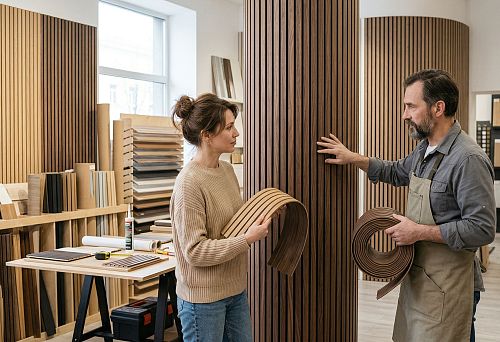
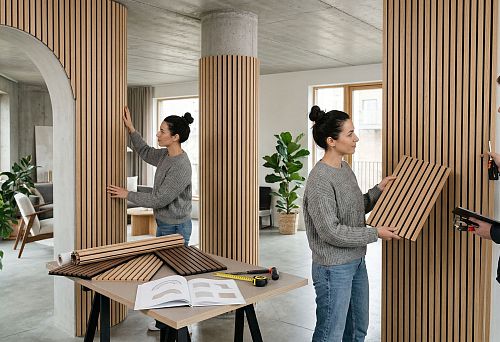
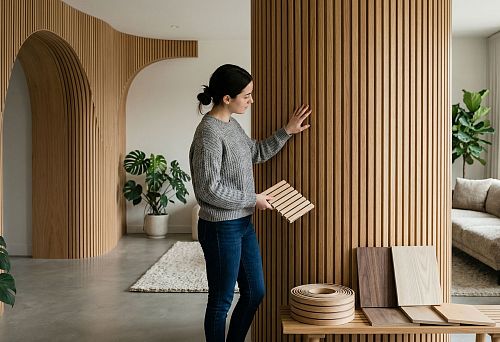
Decorative wooden slats on the wall are one of the most sought-after techniques in modern design. Vertical slats, evenly spaced across the entire wall plane or on an accent section, create rhythm and depth. Horizontal ones add visual width to the space. Diagonal ones add dynamism and movement.
The working principle is simple: slats are attached to the wall or to a pre-mounted batten with a certain spacing, creating a three-dimensional relief. The play of light and shadow between the slats changes depending on the lighting angle — in the morning the panel looks one way, in the evening under spot lighting — completely different. It's a living, breathing interior element.
For slatted wall panels, slats with a cross-section of 15×60, 20×60, or 20×80 mm are most often used. The spacing between slats ranges from 15 to 40 mm depending on the desired effect: the smaller the spacing, the denser and more substantial the panel looks. Larger spacing creates lightness and airiness.
A dark background is often placed behind the slatted panel — painted black or dark gray MDF or drywall. The dark background, visible through the light slats, creates a depth effect, making the wall visually richer and more saturated.
Slatted ceilings: the third dimension of interior
The ceiling is the most undeservedly forgotten surface in most apartments. White plaster from wall to wall is not a solution, it's a capitulation to the task. Wooden slats on the ceiling are a completely different story.
A slatted ceiling made of wooden planks with a spacing of 30–50 mm, concealing all engineering — wiring, ventilation, light fixtures — looks clean, modern, and yet warm. Add bottom-up lighting — and the ceiling becomes the main decorative element of the room.
For ceiling structures, geometric stability is especially important: any warping of the slat is immediately noticeable. Therefore, kiln-dried material with a moisture content of no more than 12% is mandatory here. Pine and larch are the optimal choice in terms of price-to-stability ratio.
Slatted partitions: space without walls
Open floor plans are the reality of modern housing. And the main question of an open plan is how to zone the space without destroying its unity. A slatted partition made of wooden planks is the perfect answer. It doesn't separate — it delineates. The space remains open, light penetrates freely, but the zones gain outlines.
An article aboutslatted partitions made of oakon stavros.ru examines this application in maximum detail — with examples of design solutions and installation diagrams. If you are planning to zone an apartment with wooden slats, this material will be an excellent guide.
For partitions, slats of larger cross-section are used — 20×60, 25×80, 30×80 mm. The height of the structure can be any — from half-wall to ceiling. Mounting is to horizontal metal or wooden guides at the top and bottom. The spacing between slats is 15–30 mm for light zoning, 8–12 mm for more pronounced space separation.
Picture frame molding: the frame as a work of art
A separate story isPicture frame strippicture frame molding. This is a thin profile slat used to make frames for paintings, mirrors, photographs. The molding profile can be simple rectangular, shaped, with a bevel, with rounding, with a classic wave. Color — natural wood, tint, gold, silver.
Wooden molding is not just a frame, it's the architecture of the image. A correctly chosen frame doubles the value of a painting. An incorrect one devalues it. For watercolors and graphics, choose thin, laconic molding made of light wood. For oil paintings with a dark palette — wide gilded profile. For photographs in a modern interior — planed pine or oak without coating.
On stavros.ru in the sectionframes made of woodpicture frame molding a wide assortment of ready-made frames for paintings and mirrors is presented — and all of them are made precisely from high-quality profile slats made of solid wood.
Door and Opening Decor: Batten as Framing
Wooden battens are used for decorating door and window openings — as part of architraves, moldings, pilasters. Here, the batten acts as a linear accent, emphasizing the verticals and horizontals of the interior architecture. This looks especially effective in classic interiors, where the batten is combined with profilewooden casingsand cornice groups.
In modern interiors, battens are used differently: several parallel thin slats around the perimeter of a door opening instead of a traditional architrave — concise, geometric, contemporary. This technique is especially popular in Scandinavian and minimalist styles.
Battens and Structural Applications
Battens are an indispensable element of lathing for finishing materials: under cladding, drywall, decorative panels, facing tiles. Thin battens 10×40 or 15×50 are used as counter-battens in ventilated systems. Battens 20×40 and 25×50 — the main size for wall and ceiling lathing in residential spaces.
In this capacity, the batten works in tandem with other structural elements — wooden blocks and millwork. Properly installed batten lathing creates an ideal base forwooden baseboard, moldingand cornice groups, which then complete the finish.
Wooden Batten on the Wall: Design Solutions and Their Implementation
A wall with wooden battens is a separate design genre, with its own rules, techniques, and pitfalls. Let's examine it in detail.
Vertical Battens: The Classic Rhythm
Vertical arrangement is the most common option. Verticals visually raise the ceiling, giving the room elegance and solemnity. A wall with vertical battens is perceived as a colonnade in miniature — architectural, orderly, rhythmic.
The choice of batten width and spacing determines the character of the space. Narrow battens 15–20 mm with a small spacing of 15–20 mm — a dense, almost fabric-like relief, creating a sense of soft, enveloping texture. Wide battens 40–60 mm with a spacing of 30–50 mm — a clear graphic structure, close to an architectural solution. Very wide battens 80–100 mm — almost panels, massive and weighty.
For living rooms, the optimal height for a batten wall is from the baseboard to the cornice or to the ceiling, without breaks. Partial finishing — for example, only the lower third of the wall — is perceived as incompleteness, unless intended as a deliberate technique (e.g., a paneled zone in a classic interior).
Horizontal Battens: Expanding Space
Horizontal batten layout visually expands the space. This is especially valuable in narrow rooms — hallways, entryways, small offices. Horizontal battens create a sense of movement along the wall, dynamics, speed. In modern design, this technique is actively used in bedrooms: a horizontal batten wall behind the bed headboard is one of the most popular accent solutions.
Technically, horizontal battens are mounted either directly on the wall or on vertical lathing made of blocks. The second option is preferable: it creates a ventilation gap and allows for more precise leveling of the horizontal.
Diagonal and Mixed Layouts
Diagonal battens — for the bold. This is a technique that works only with a confident design decision: a random diagonal looks chaotic, an intentional one — dynamic and unexpected. A diagonal layout at 45° creates maximum tension on the wall surface. A herringbone pattern (parquet layout) — a calmer, more decorative option.
Mixed layouts — different directions of battens on one wall — require precise calculation and a confident hand from the designer. But with skillful execution, they yield a result that cannot be replicated with any other materials.
Color and Finish: From Natural to Black
Wooden battens in an interior look fundamentally different depending on the color solution. Natural wood under clear oil — warmth, organic feel, vitality. Stained dark walnut or wenge — weightiness, depth, elegance. White or cream paint — lightness, Provence, Scandinavian purity. Black color — maximum graphic quality, modern loft, designer boldness.
A special technique — ombre: a smooth transition from light to dark along the height of the wall. The lower battens are stained as saturated as possible, the upper ones — almost natural. This effect requires careful execution but looks stunning.
Wooden Batten Price: What Makes Up the Cost
The price question is always relevant. The price of wooden battens depends on several factors, and understanding this relationship allows for informed decisions when purchasing material.
Wood species is the main price parameter. Pine is the most affordable option. Larch — about 40–60% more expensive than pine. Ash and beech — even more expensive. Oak — 2–3 times more expensive than pine and higher depending on quality and grade.
The degree of processing also significantly affects the price. Sawn batten — the cheapest. Planed — 20–40% more expensive. Sanded and profiled — another 30–50% higher than planed. Kiln-dried batten with documented moisture content — with an additional premium for stability.
Cross-section and length add to the price non-linearly: narrow thin battens (10×40, 15×50) per cubic meter can be more expensive than wide ones due to more cuts. Long blanks (4–6 m) cost more than standard three-meter ones. Non-standard profiles — with chamfers, rounding, milling — are more expensive than straight ones by the cost of additional processing.
Grade gives a significant spread within the same species: an 'Extra' grade batten without knots and defects can cost twice as much as a third-grade batten from the same pine.
When calculating the budget for a batten wall or ceiling, it's important to consider not only the cost of the batten itself but also fasteners, primer, finish coating, and tools. On average, materials for a batten wall panel with an area of 10 m² range from 4,000 to 15,000 rubles depending on the chosen species and quality — and this is without including the cost of installation.
How to Attach a Wooden Batten to a Wall Yourself: A Step-by-Step Guide
Installing wooden battens is a task you can tackle on your own. With basic tool-handling skills and a clear plan, the result can be as good as professional work.
Tools and Materials: What You Need to Prepare
Before starting, you need to prepare: a miter saw or circular saw (for precise crosscuts and angled cuts), a level (preferably laser), a hammer drill or screwdriver, wall plugs and screws, wood glue (liquid nails or acrylic-based construction adhesive), filler or decorative paste for concealing fastener holes, sandpaper, and a finish (oil, varnish, paint).
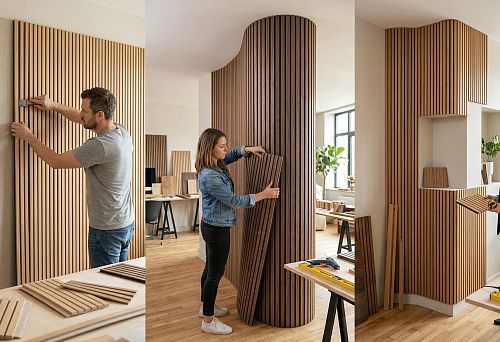
Step one: surface preparation
The wall for the battens must be level, dry, and dust-free. Base irregularities up to 5–7 mm can be compensated for with a lath framework. Larger unevenness must be corrected with plaster or filler before installation. If a dark background behind the battens is planned, paint the wall the desired color before installing the slats.
Step two: marking
Marking is a key stage that determines the final result. Using a level and pencil, mark horizontal or vertical lines for attaching the framework (if needed) or for direct batten attachment. For vertical battens, horizontal guides are placed at the top and bottom of the wall, and for heights over 2.5 m, also in the middle. For horizontal battens, use vertical guides spaced 50–80 cm apart.
Step Three: Installing the Framework
If the wall is uneven or a ventilation gap is needed, install a framework made of 20×40 mm or 25×50 mm wooden battens. Attach them to the wall using wall plugs and screws, aligning them to a single plane with a laser level. This is the most labor-intensive stage, but it determines the accuracy of the final result.
Step Four: Cutting the Battens
Cut the battens to size with a miter saw. Cutting accuracy is critical: uneven ends at joints are immediately noticeable. When working with long battens, it's important to account for expansion gaps: leave 3–5 mm at the ends adjacent to walls and floors for expansion. To conceal these gaps, useWooden baseboardandCeiling Skirting— they neatly cover all technical offsets.
Step Five: Attaching the Battens
Battens are attached in two ways — either with glue plus finishing nails, or with screws and filling the holes. The combined method (glue plus hidden fasteners) is the most reliable. Apply glue in a zigzag pattern to the back of the batten, press the batten to the surface, then additionally secure it with finishing nails through the face side, followed by filling the holes.
When using screws, it's important to avoid splitting the batten: drill pilot holes slightly smaller than the screw diameter before driving them in. Countersink the screw heads 1–2 mm below the surface, then fill and sand.
Step six: finishing
After installation, sand all battens — first with 100-grit, then 150-grit. Remove dust. Apply the finish: oil, varnish, paint, or stain. Oil is applied in two to three coats with intermediate sanding. Varnish — in three coats with drying per instructions. Paint — after priming.
Finishing is not just about aesthetics, but also protection: wood on the wall will be in contact with room air, changing humidity, and dust. Without a finish, it will darken and gather dust within just a few months.
Wooden Battens in Different Interior Styles: Where They Work Best
Battens are a flexible material not tied to a single style. But in each style, they have their own character.
Scandinavian style: lightness and naturalness
Light pine battens under clear oil, vertical layout, minimal spacing — this is the quintessence of Scandinavian aesthetics. No extra elements, no excess. Wood as the main material, white or light gray wall background, live plants in wooden pots. Here, the batten is not a decoration, but the surface itself, the main character of the interior.
Japanese Wabi-Sabi: Imperfection as a Value
In the Japanese approach, battens are chosen with character: with small knots, tool marks, uneven tone. The space between battens is made sufficiently large so each slat is perceived separately. The finish is clear or smoky oil, emphasizing the natural texture. No varnishing, no gloss. Just living wood in its honest beauty.
Loft: Contrast and Graphics
In a loft interior, battens work on contrast. Dark battens made of stained oak or tinted pine against a backdrop of unplastered brick or concrete — this is a strong visual impact. Or the opposite: light battens on a black background — maximum graphic quality, almost Japanese calligraphy in the interior. Often in lofts, battens are combined with metal elements —furniture handlesmade of wood with metal inserts, with tubular shelf structures.
Classic: Batten as Molding
In a classic interior, wooden battens are used differently — not as an independent decorative element, but as part of a complex profile system. The batten is incorporated into panel wall cladding, into molding frames, into cornice groups. Here, profile accuracy and finish quality are important: under patinated paint, under gilding, under glossy varnish. Together withwith polyurethane moldingsandwooden cornicesthe batten creates a rich, layered classic finish where each element supports the overall theme.
Contemporary Minimalism: Batten as Texture
In a minimalist interior, battens are a way to add texture without decoration. A monochrome interior with a wooden batten wall reads completely differently than just a white room: depth appears, a sense of warmth emerges, and what designers call the 'tactility' of space appears. Battens are chosen to match the wall color or with minimal contrast — and this creates an effect of organic relief, not a foreign insert.
Wooden Battens and the Decorative System: Systems Thinking
A professional approach to interior design with wooden slats is not just 'nailed slats to the wall and done.' It's about creating a system where each element supports the others.
A slatted wall panel looks complete when its bottom edge is coveredwith a wooden floor skirting board, and the top edge —a wooden moldingor with a cornice. Without this framing, even perfectly installed slats look unfinished — like a painting without a frame.
If slats are used on walls, it's logical to continue the wooden theme in other elements:Wooden trimaround the perimeter of rooms,wooden furniture handlesin the same species or a similar tone,furniture legssolid wood,Frames for paintingsmade of natural wood. Material unity is the main principle of professional design.
On stavros.ru, a full range is presentedsolid wood productsthat allows building exactly such a system: from slats to millwork, from furniture handles to stair balusters — all in one material, all in one quality.
Caring for wooden slats in the interior: simple rules for a long life
Wooden slats in the interior do not require complex care — but they do require attention. A few simple rules will keep the structure looking fresh for years.
Regular cleaning: dust collects in the gaps and longitudinal grooves of the slats. Remove it with a soft dry brush or a vacuum with a soft attachment. Wet cleaning — rarely and moderately: excessive moisture harms wood. Coating renewal: oil coating is renewed every 2–3 years; varnish, when scratches and wear appear — as needed. Humidity control in the room: optimal range is 45–60%. Too dry air (in winter with intensive heating) leads to cracking; too humid — to swelling and deformation of the slats.
Where to buy wooden slats: how to choose a reliable supplier
Requirements for a wooden slat supplier are roughly the same as for any other lumber supplier. The seller must be able to confirm the material's moisture content instrumentally. The grade and species must match the stated ones. Slats must be straight, without twisting or warping — this is visible to the naked eye right in the store or warehouse. Compliance documents are a sign of a serious company.
Onstavros.ruWooden slats from solid wood with clear characteristics are presented: planed, from graded wood, with even geometry and quality surface — exactly what is needed for decorative interior work. Here you will also find the entire related assortment: skirting boards, moldings, cornices, millwork — everything to make working with wood systematic and yield predictable results.
FAQ: answers to the most popular questions about wooden slats
How does a slat differ from a batten?
A batten has both sides of its cross-section close in size (e.g., 40×40 or 50×50 mm). A slat has a width significantly exceeding its thickness (e.g., 15×60 or 20×80 mm). A slat is flat, a batten is volumetric.
Which slat is best for a decorative wall panel?
Planed dry kiln-dried slat from pine or oak with a cross-section of 15–20×60–80 mm. Moisture content no higher than 12%. Surface smooth, without cracks or knots in visible places. For oil or varnish — grade 'A' or 'AB'.
Is lathing needed under slats on a wall?
If the wall is even — slats can be mounted directly on the wall. If the base has irregularities exceeding 5–7 mm — lathing made of battens is essential to level the plane.
How to calculate the number of slats for a wall?
Divide the wall area by the sum of the slat width and the step (gap) between slats. For example: wall 10 m², slat 40 mm, gap 20 mm — need 10,000 mm / 60 mm = about 167 rows. Multiply by the wall height — get linear meters. Add 10–15% for cutting and waste.
Can wooden slats be installed in a bathroom?
Yes, under conditions: slats made of larch or teak (resistant species), mandatory antiseptic treatment for wet areas, quality water-repellent finish (yacht varnish or special oil for wet zones). Room ventilation is mandatory.
What gap between slats to choose for a partition?
Depends on the desired 'transparency'. Spacing 8–12 mm — almost solid surface, barely visible through. Spacing 15–20 mm — light zoning, space can be seen through the partition. Spacing 25–40 mm — the partition rather defines a zone than separates it.
What is the best way to finish wooden wall battens?
For a natural look — oil or wax, they penetrate the wood structure without forming a film. For maximum protection — 3 coats of water-based varnish. For a colored solution — acrylic paint over primer. In high-humidity areas — yacht varnish or special oil for wet zones.
How to hide fasteners when installing battens?
Several methods: finishing nails with a 1–1.5 mm head, countersunk into the wood and filled; screws driven into the batten end through a rear guide (concealed mounting); special concealed clips for thin battens. The cleanest result — mounting adhesive plus concealed fasteners from the back side.
What batten length is optimal for a room with a height of 2.7 m?
For vertical layout — a 3 m batten, from which the required size is cut, accounting for expansion gaps (10 mm at the bottom and top). For horizontal layout — the length is determined by the wall width; for walls up to 3 m, a three-meter batten is used, for wider walls — a six-meter one or staggered joints are made.