Article Contents:
- Slat vs block: difference not only in sizes
- Wood species: oak, beech, ash in the context of operation
- Wooden slats in interior: verticals, horizontals, partitions
- Facade slats: protection and architectural expressiveness
- Sizes and cross-sections: how to choose proportions
- Quantity calculation: mathematics without errors
- Slat installation: flawless installation technology
- Finishing treatment: oil, varnish, paint
- Wooden slat price: what affects the cost
- Errors in selection and installation: what to avoid
- Frequently Asked Questions
- Can slats from different wood species be used in one interior?
- What spacing between slats is optimal for improving acoustics?
- How much does professional slat installation cost?
- Is vapor barrier needed when cladding walls with slats?
- Can oak slats be painted in light tones without losing texture?
- How to join slats lengthwise without visible seams?
- Which wood species is better for facade — oak or larch?
- How long does slat cladding last in interior?
- Can slats be mounted on drywall without framing?
- How to maintain wooden slats during operation?
- Conclusion: wooden element system by STAVROS

Look at a modern interior that leaves an impression. Why does one room seem orderly while another appears chaotic? The secret lies in lines. Vertical ones create height, horizontal ones create width, diagonal ones create movement.Wooden plankis not just a solid wood plank, but a tool of architectural thinking capable of transforming space without demolishing walls. Today we'll explore how to choose slats and blocks for interior and facade, which wood species work in which conditions, how to calculate quantity and avoid mistakes with cross-sections.



Slat vs block: difference not only in sizes
Many confuse slats with blocks, considering the difference purely nominal. However, the difference is functional and structural.Wooden blockis an element with cross-section where both dimensions are comparable: 40×40, 50×50, 60×40 millimeters. The block serves a structural role — used to assemble framing lattices, support frames for cladding, load-bearing elements of partitions. The block works in compression and bending, bearing loads from overlying structures.
A slat has one side significantly smaller than the other: 20×40, 30×50, 40×80 millimeters. Its main purpose is decorative surface finishing, creating rhythmic structures, zoning without building solid partitions. The slat is attached to the base with its flat side, the narrow side faces the space. This forms vertical or horizontal lines that guide the eye, divide planes, create volume where there was a flat wall.
Structurally, the block is stiffer — square or near-square cross-section provides resistance to lateral loads. The slat is more flexible in its narrow plane, allowing compensation for minor base irregularities during installation. The cost per linear meter of block is higher due to greater wood volume, but the piece consumption when creating framing is lower than slats for decorative cladding.




Wood species: oak, beech, ash in the context of operation
Choosing a wood species is not a matter of aesthetics, but a calculation of durability for specific conditions. Interior applications have one set of requirements, facades have completely different ones.
Oak leads in terms of overall properties. A density of 700 kilograms per cubic meter makes oak battens resistant to wear, dents, and scratches. High tannin content gives oak natural resistance to moisture, fungi, and insects—a critical property for facade applications. Oak's texture is expressive: contrasting annual rings and medullary rays create a noble pattern, enhanced by transparent oils and varnishes. Color ranges from light golden to dark brown. Oak darkens over time, acquiring a patina of nobility. The drawback is its hardness complicates processing, requiring pre-drilling for nails, and its high cost.
Beech is an alternative with a density of 650 kg/m³ and a uniform, fine-grained texture without sharp transitions. Beech battens create a calm background, where rhythm and geometry are more important than the individuality of each slat. A light shade with a pinkish undertone visually lightens the space. Beech is easier to process—milling, sanding, and painting require less time. It takes stains well, imitating more expensive species. A critical drawback is hygroscopicity. Beech actively reacts to humidity changes, swelling in damp environments and shrinking in dry ones. For interiors with a stable microclimate, this is not a problem, but for facades, beech is unsuitable without special impregnation.
Ash combines the strength of oak and the workability of beech. Density is 680 kg/m³, but increased elasticity allows bending ash battens for curved structures. The texture is bright with distinct annual rings, color is light with a yellowish or grayish tint. Ash accepts stains well, creating any shade from natural to exotic. Moisture resistance is average—sufficient for interiors, but facade use requires a protective coating.
Pine is a budget option for painted structures. Density is 500 kg/m³, soft, easy to work with, but prone to dents and scratches. The texture is contrasting with expressive resin pockets. Pine battens are used under opaque paint, where texture is not important. For facades, pine requires antiseptic treatment and UV protection, otherwise it quickly loses color and cracks.
Our factory also produces:


Wooden battens in the interior: vertical, horizontal, partitions
Wooden boards in interiorThey solve tasks that wallpaper or paint cannot handle. They create a third dimension on a flat wall, form rhythmic structures, hide engineering utilities, and improve room acoustics.
Vertical placement visually raises ceilings. Battens with a cross-section of 20×40 or 30×50 millimeters are installed with a spacing equal to their width or a multiple of it—a 40-millimeter batten, a 40-millimeter gap. This creates a 'one-to-one' rhythm that visually stretches the space. A room height of 2.7 meters visually increases to 3 meters thanks to the guiding verticals. Bottom or top lighting enhances the effect—light glides along the batten edges, creating a play of shadows.
Horizontal placement expands narrow rooms. Battens are mounted at a height of 1.2-1.5 meters from the floor, creating a horizontal belt that 'pushes apart' the walls. This works in corridors, narrow bedrooms, elongated living rooms. The spacing between battens can be uneven—alternating narrow and wide gaps creates a dynamic rhythm that breaks monotony.
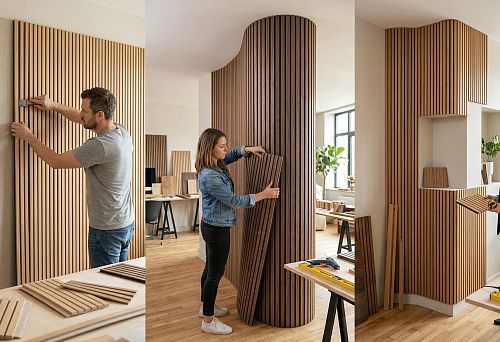
Batten partitions zone space without losing light and air. A frame made of 40×40 millimeter blocks is assembled from floor to ceiling, onto which vertical battens with gaps are attached. Such a structure separates the sleeping area from the living room, the study from the dining room, but maintains a visual connection between zones. The degree of privacy is regulated by the batten spacing—close spacing creates an almost solid wall, wide spacing creates a transparent screen.
Ceiling battens reduce the visual height of overly tall rooms and hide engineering systems. Battens are suspended on metal hangers from the base ceiling with a gap of 100-200 millimeters, inside which electrical wiring, ventilation, and air conditioning pipes are laid. Gaps between battens provide access to utilities without dismantling the entire structure.
Get Consultation
Facade battens: protection and architectural expression
Wooden battens on a facade perform a dual function: they protect the main structure from atmospheric influences and create the architectural plasticity of the building. A facade batten works in extreme conditions—temperature fluctuations from minus thirty to plus thirty-five degrees, direct UV exposure, rain, snow, wind loads.
Requirements for facade battens are stricter than for interior ones. Minimum thickness of 20 millimeters—thinner planks warp from moisture. Wood moisture content of 12-14 percent—over-dried wood cracks in the sun, wet wood shrinks after installation, creating gaps. Mandatory protective treatment—impregnation with antiseptics against fungi and insects, coating with oil or varnish with UV filters to protect against fading.
Vertical installation of facade battens visually elongates the building, creates rhythmic verticals characteristic of Scandinavian architecture. Battens with a cross-section of 40×80 or 50×100 millimeters are mounted on a horizontal lathing made of blocks with a spacing of 600-800 millimeters. A gap of 30-50 millimeters between battens provides facade ventilation—air circulates between the cladding and the wall, removing condensation.
Horizontal installation creates traditional cladding in the style of American houses. Battens are laid with an overlap using the tongue-and-groove principle, protecting joints from water ingress. The lower edge of each batten is cut at an angle for water runoff. Installation is done from bottom to top, ensuring proper overlap.
Combined installation—vertical battens on one part of the facade, horizontal on another—creates a complex architectural composition, highlighting the functional zones of the building. The entrance group is framed by verticals, side walls are clad with horizontals. The contrast in directions is readable from a distance, making the building memorable.
Dimensions and cross-sections: how to choose proportions
The cross-section of a batten determines its visual mass and structural strength. How not to make a mistake with the size?
For wall panels in interiors, battens of 20×40, 25×50, 30×60 millimeters are optimal. Such a cross-section creates expressive relief without visual heaviness. A thickness of 20-30 millimeters provides rigidity—the batten does not sag between fastening points with a spacing of 600 millimeters. A width of 40-60 millimeters forms a sufficient area of flat face where light plays.
For ceiling structures, lighter battens of 15×40, 20×50 millimeters are used. Thickness is reduced to decrease weight—suspended systems have load limitations. Width is preserved for visual expressiveness. The length of standard battens is 2-3 meters, allowing coverage of most rooms without joints.
For facades, massive battens of 40×80, 50×100, 60×120 millimeters are required. A thickness of 40-60 millimeters resists warping from moisture and thermal deformation. A width of 80-120 millimeters creates expressive verticals or horizontals, readable from the street.
Blocks for frames are chosen based on load. For light cladding, 40×40 millimeters is sufficient. For heavy panels, ceramic tiles, natural stone, blocks of 50×50 or 60×60 millimeters are required. The installation spacing of blocks is inversely proportional to the load—the heavier the cladding, the denser the frame.
Quantity calculation: mathematics without errors
How many battens are needed for a wall? The answer depends on the installation scheme and gap size.
Formula for vertical cladding: wall length divided by the sum of batten width and gap width. A wall 4 meters long, batten 40 millimeters, gap 40 millimeters: 4000/(40+40)=50 battens. Wall height 2.7 meters—each batten 3 meters long is cut to 2.7 meters. Waste is 10 percent from each batten. Total linear footage: 50 battens × 3 meters = 150 linear meters. Add 10 percent for defects and cutting—total 165 linear meters.
For horizontal cladding, calculate by height. A wall 2.7 meters high, batten 50 millimeters, gap 50 millimeters: 2700/(50+50)=27 battens. Wall length 4 meters—each batten 4 meters. Total linear footage: 27 battens × 4 meters = 108 linear meters plus 10 percent = 119 linear meters.
For a block frame, calculate by spacing. Vertical studs with 600-millimeter spacing: 4000/600=7 studs 2.7 meters high. Horizontal crossbars at three levels (bottom, middle, top): 3 crossbars 4 meters each. Total block linear footage: (7×2.7)+(3×4)=18.9+12=30.9 meters plus 10 percent = 34 meters.
Don't forget fasteners. For battens, finish nails 50-60 millimeters long or 4×50 millimeter screws are used. Consumption: 2 nails per fastening point, point spacing 600 millimeters. A batten 2.7 meters long has 5 fastening points—10 nails. For 50 battens, 500 nails are required plus a 20 percent reserve = 600 pieces.
Batten installation: technology for flawless installation
The quality of installation determines how long the structure will last and how even it will look.
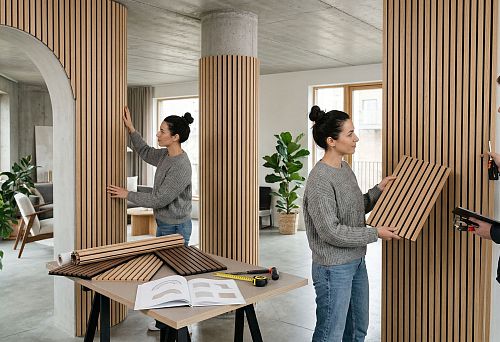
Base preparation is critical. The wall must be level with deviations of no more than 3 millimeters per meter of length. Large irregularities are compensated by installing a frame made of battens leveled with a spirit level. The frame is attached to the wall with dowels every 400-600 millimeters. Wooden wedges are placed under each batten in areas of unevenness to adjust the plane.
Marking is done using a laser level. For vertical battens, a vertical line is marked at the beginning of the wall, then every 600 millimeters — the locations for installing the frame battens. For horizontal battens, a horizontal line is marked at the lowest point, then distances are measured upward, taking into account the height of the batten and the gap.
Cutting battens is done with a miter saw with fine teeth for a clean cut without chips. The ends are sanded with fine-grit abrasive to remove burrs. If a batten is installed flush against the ceiling or floor, the end is cut at a 90-degree angle with an accuracy of tenths of a millimeter.
Mounting is done using either a concealed or exposed method. Concealed mounting involves driving nails or screws at a 45-degree angle into the side edge of the slat, sinking the head into the wood, and masking the fastener location with the next slat. Exposed mounting involves hammering nails into the face edge, sinking the heads 2-3 millimeters, and filling the holes with wood-colored putty.
Gaps are maintained with an accuracy of 1 millimeter. Calibration spacers — wooden or plastic strips with a thickness equal to the gap — are used for this. The spacer is placed between the already fixed and the batten being installed, ensuring uniformity of all gaps.
Finishing: oil, varnish, paint
Untreated wood is vulnerable to dirt, moisture, and ultraviolet light. A finish coating protects and reveals decorative qualities.
Oil with hard wax is the optimal choice for interior battens. The oil penetrates the structure, strengthening the surface layer from within. The wax fills the pores, creating a protective barrier. The coating is breathable — the wood retains its ability to regulate humidity. Tactilely, an oiled surface is warm and pleasant. Applied in 2-3 coats with intermediate sanding using 320-400 grit abrasive. Renew every 3-5 years.
Varnish creates a hard film on the surface. Polyurethane varnish provides high resistance to abrasion, scratches, and moisture. For interior battens, matte or semi-matte is recommended — gloss creates glare and shows fingerprints. Applied in 3 coats with intermediate sanding using 320-400 grit. Durability: 10-15 years.
Paint conceals the grain, allowing for any color. For battens, water-based acrylic paint is used — eco-friendly, odorless, and fast-drying. Primer is mandatory to equalize absorbency. Paint is applied in 2 coats with intermediate sanding. The color can be matte or semi-matte.
Exterior battens require compositions with UV filters. Oil for exterior use with added pigments that block ultraviolet light. Yacht varnish on an alkyd or polyurethane base with high elasticity to compensate for wood's thermal expansion. Renew every 3-5 years depending on climate and exposure.
Wooden batten price: what affects the cost
Price of wooden stripdepends on wood species, cross-section, processing quality, length, and finish coating.
Wood species is the primary pricing factor. Pine batten 20×40 millimeters costs 80-120 rubles per linear meter. Beech of the same cross-section — 180-250 rubles. Oak — 280-400 rubles. The 3-4 times difference is explained by wood density, processing complexity, and material prestige.
Cross-section affects price proportionally to volume. A 20×40 millimeter batten contains 800 square millimeters of wood per linear meter. A 40×80 batten contains 3200 square millimeters — four times more. Accordingly, the price increases approximately fourfold for the same species.
Processing quality adds 20-40 percent to the cost. Planed batten without sanding — base price. Machine-sanded — plus 20 percent. Hand-sanded — plus 40 percent. The difference in surface smoothness is critical for transparent coatings.
Finish coating doubles the price. Batten without coating — base cost. Batten with oil — plus 100 percent for material and labor. Batten with varnish — plus 120 percent due to multi-layer application. Painted batten — plus 80-100 percent.
Length affects logistics. Standard length 2-3 meters — base price. Non-standard length 4-6 meters requires special transport — surcharge of 15-25 percent. Short battens 1-1.5 meters are made from offcuts, may be 10-20 percent cheaper, but require more joints during installation.
Mistakes in selection and installation: what to avoid
Typical errors compromise the result even with quality material.
Mismatch between wood moisture content and operating conditions. Battens with 18-20 percent moisture content, after installation in a heated room, dry out and shrink in cross-section. Gaps between battens increase, forming cracks at joints. Solution: purchase battens with 10-12 percent moisture content for interiors, 12-14 percent for exteriors.
Lack of acclimatization before installation. Battens brought from a cold warehouse to a warm house must rest for at least 48 hours to equalize temperature and humidity. Installation immediately after delivery leads to deformations after acclimatization.
Insufficient frame rigidity. Spacing of battens over 800 millimeters creates a risk of sagging under their own weight or accidental pressure. For battens with a cross-section of 20-30 millimeters, the maximum frame spacing is 600 millimeters. For battens 40-50 millimeters, 800 millimeters is acceptable.
Use of low-quality fasteners. Ordinary construction nails leave rusty stains on wood. Oak battens oxidize steel fasteners, creating dark spots. Solution: finish nails without heads, galvanized or stainless steel.
Lack of expansion gaps at ends. Long sections of batten cladding (over 3 meters) require expansion joints 2-3 millimeters wide every 3 meters for thermal expansion. Lack of joints leads to warping in summer and cracking in winter.
Frequently Asked Questions
Can battens made from different wood species be used in the same interior?
Yes, contrasting species create visual dynamics. Oak battens against a beech wall stand out with dark grain, forming accent lines. It is important to consider the difference in expansion coefficients — fastening must allow independent movement of elements. Combining species with significantly different hygroscopicity in rooms with variable humidity is not recommended.
What spacing between battens is optimal for improving acoustics?
Sparse cladding with gaps equal to or greater than the batten width partially absorbs sound when sound-absorbing material is placed behind the battens. Optimal spacing — batten 40 millimeters, gap 40-60 millimeters. Acoustic wool or foam 50-100 millimeters thick is installed behind the battens. The sound absorption coefficient of such a structure is 0.4-0.6, reducing reverberation time by 30-40 percent.
How much does professional batten installation cost?
Installation cost depends on the complexity of the structure and the region. For vertical wall cladding on a finished frame — 400-600 rubles per square meter. For installation with frame fabrication — 800-1200 rubles per square meter. For ceiling structures — 1000-1500 rubles per square meter due to the complexity of working at height. The cost of materials is usually equal to or slightly higher than the cost of labor.
Is vapor barrier needed when cladding walls with slats?
Depends on the wall construction. If slats are mounted on a frame with an air gap to the base wall, vapor barrier on the room side is recommended to prevent condensation in the gap. If slats are attached directly to the wall without a gap, vapor barrier is not required. For exterior facades, a windproof membrane under the slats is mandatory.
Yes, use white semi-transparent paint or tinting oil. The oak grain will remain visible, but the color will change to white with a slight translucency of the wood pattern. Apply in a thin layer, controlling the degree of opacity. For a completely white opaque color, use a covering acrylic enamel in 2-3 coats.
Yes, use white translucent paint or tinting oil. The oak grain will remain visible, but the color will change to white with a slight transparency of the wood pattern. Apply in a thin layer, controlling the coverage level. For a fully white opaque color, use a covering acrylic enamel in 2-3 coats.
How to join slats lengthwise without a visible seam?
The joint is made on a bevel at a 30-45 degree angle. The ends of both slats are cut at mirror-opposite angles, forming a diagonal seam when joined. Such a joint is less noticeable than a straight one. The joint area is glued with wood glue and clamped. After drying, the joint is lightly sanded for leveling. Under a transparent finish, the diagonal joint is practically invisible.
Which wood species is better for a facade — oak or larch?
For facades in climates with high humidity, larch is preferable. It contains natural resins that repel water and does not require frequent coating renewal. Oak for facades requires high-quality protection with oil containing UV filters and renewal every 3-4 years. Larch is 30-40 percent cheaper than oak with comparable performance properties.
How long does slat cladding last in an interior?
With proper installation and care — 30-50 years without replacement. Oak and beech slats with oil finish retain their appearance for decades. Renewing the oil every 5 years maintains protection. Painted slats require repainting every 10-15 years. The main enemy of durability is humidity above 70 percent, causing deformation and fungal damage.
Can slats be mounted on drywall without a frame?
Yes, if the drywall is fixed to a metal frame with stud spacing of 400 millimeters. Slats are fastened with screws 35-40 millimeters long, hitting the metal studs. If the drywall is on a wooden frame, screws must enter the wooden studs. Fastening only into the drywall without hitting the frame is unacceptable — pull-out under the weight of the slats.
How to care for wooden slats during operation?
Regular dry cleaning — removing dust with a soft brush or vacuum with a brush attachment. Once a month — wet cleaning with a slightly damp cloth without excess water. For oiled slats — renew oil every 3-5 years. For varnished slats — monitor coating integrity, local restoration if wear appears. Avoid direct water contact, especially on the ends.
Conclusion: the wooden element system from STAVROS
Creating a harmonious interior or expressive facade from disparate slats is impossible — you need a system where each element is coordinated with others by species, cross-section, processing, and finish. The company STAVROS has specialized for over twenty years in manufacturing solid wood millwork, including a full range of slats and battens for any application.
The STAVROS assortment includes slats and battens made of oak, beech, ash, pine in dozens of cross-section options — from miniature 15×30 millimeters for decorative panels to massive 60×120 millimeters for facade cladding. Each product is made from selected wood, kiln-dried to optimal moisture content of 10-12 percent for interiors, 12-14 percent for facades.
STAVROS production is equipped with modern four-sided planers, ensuring perfect slat geometry — dimensional deviation does not exceed 0.3 millimeters per meter of length. Multi-stage sanding creates a smooth surface ready for finishing. The ability to manufacture slats of non-standard cross-sections and lengths to custom orders opens up possibilities for unique architectural solutions.
STAVROS offers slats with various finish options: untreated for self-finishing, oiled with eco-friendly linseed oil and hard wax compositions, varnished with matte polyurethane varnish, painted in a wide color palette. This allows obtaining a product ready for installation, saving time on finishing.
Additionally, STAVROS manufactures all necessary millwork elements for comprehensive finishing — baseboards, moldings, cornices, trims, glazing beads, casings. Purchasing all elements from one manufacturer guarantees compatibility by species, shade, processing quality, which is critical for creating a cohesive interior.
STAVROS works with both professionals — architects, designers, construction companies — and private clients implementing projects independently. Technical support includes consultations on selecting cross-sections, calculating required material quantities, recommendations on installation and finishing. Delivery across all of Russia ensures product accessibility regardless of the object's geography.
Choosing STAVROS products means choosing quality proven by thousands of completed projects. These are slats and battens that will last for decades, maintaining shape, color, and decorative properties. This is the choice of those who understand the difference between cheap material and a long-term investment in beauty and reliability.