Article Contents:
- What decorative wall slats can be purchased today
- Individual decorative slats
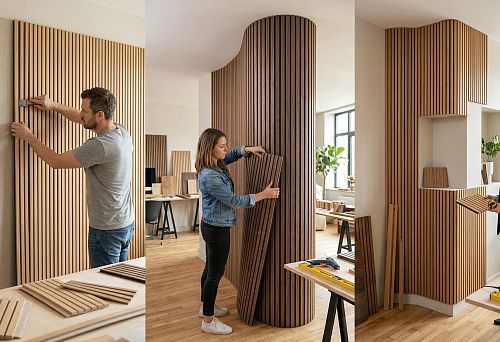
- Slats for accent walls
- Slats for TV zones
- Slats for local decorative finishing
- Narrow, wide, flat and volumetric profiles
- When to buy decorative slats for walls
- If you need an accent wall without remodeling
- If you want to add the warmth of natural material
- If you need to visually change proportions
- If you require a modern but not overloaded finish
- How to choose a decorative wall slat before purchase
- By room and application scenario
- By interior style
- By wall size
- By material, shade, and installation type
- Which wall slats to buy for different rooms
- living room
- for the bedroom
- For the hallway
- For Office
- For TV zone
- For commercial interiors
- What material is best to buy a decorative wall slat from
- Natural wood: when you need the real thing
- Oak: open texture and strength
- Beech: uniformity and purity
- What is better for painting
- What is better for tinting
- How to choose the size of decorative wall slats
- Slat Width
- Slat thickness and relief
- Rail length
- Spacing Between Slats
- How size affects wall perception
- When narrow slats are better, and when more massive ones
- Vertical or horizontal slats: what to buy for a wall
- When vertical arrangement is better
- When is horizontal layout appropriate
- How direction affects proportions
- How to choose for ceilings and area
- How to choose wall slats to match interior style
- Modern style
- Minimalism
- Neoclassicism
- Scandinavian interior
- Warm, natural interior
- Ready-made decorative slats or custom order: which is better to buy
- When a ready-made standard size is suitable
- When ready-made slats are better
- When an individual order is needed
- When non-standard color is important
- What affects the price of decorative wall slats
- Material: the main factor
- Size and profile
- Finish: "under enamel" or "under tint"
- Quality of sanding
- Purchase volume
- How to avoid mistakes when buying decorative wall slats
- Don't buy based on photos alone
- Consider furniture near the wall
- Calculate spacing and layout in advance
- Compare not only price but also material
- Plan installation before purchase
- What questions to ask yourself before buying wall slats
- FAQ: answers to common questions before purchase
- Conclusion

You've already decided. The decision is made. The wall will have slats — and that's right. One thing remains: don't make a mistake with the choice. Because between "slats on the wall — beautiful" and "slats on the wall — exactly what's needed" — there's a big difference. One slat makes the interior cohesive and lively. Another — looks random. The difference isn't in price. The difference is in understanding: material, width, spacing, direction, wood species, shade — for a specific wall, for a specific room.
This article is a commercial guide. Not inspiration, not an abstract review. A specific answer to the question: what decorative wall slat to buy so that the result meets expectations. From material selection to layout spacing, from wood species to color — we'll break it all down step by step.


What decorative wall slats can you buy today
The market offers slats in several fundamentally different formats — and understanding them is important before purchase, not after.




Individual decorative slats
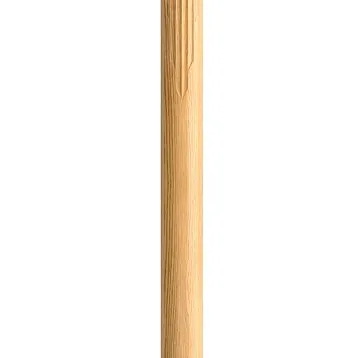
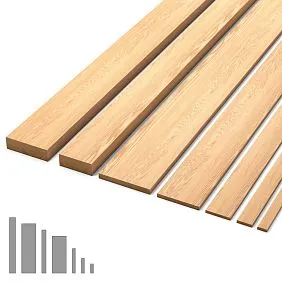
These are individual slats of the same cross-section, mounted on the wall one by one. You determine the spacing, layout, and arrangement yourself. Maximum freedom: non-standard rhythms, mixed profiles, variable spacing.Decorative slat RK-001— an 80×7 mm profile made of oak or beech — is available in several cross-sections: narrow, medium, wide, flat, with a slightly rounded end. This is a basic, universal product for any interior task.
Our factory also produces:


Slats for an accent wall
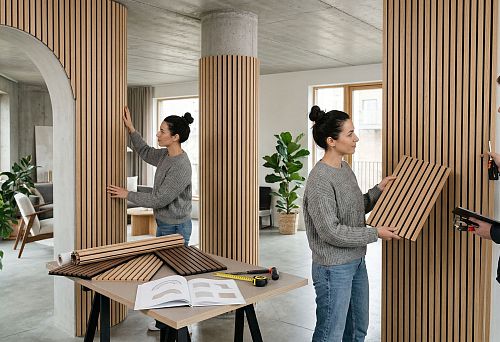
When the task is one wall, one zonal accent, one clear slat rhythm — slats of the same cross-section with equal spacing are used. No 'play' with arrangement. Pure, predictable geometry. This is the most popular and foolproof format.
Get Consultation
Slats for a TV zone
The TV zone is the focal point. Here, slats serve a specific function: they frame the screen, create a 'frame', and add depth. In such a scenario,decorative slats for the TV zoneare chosen slightly larger than for a calm accent wall — because from a distance of 3–4 meters, a thin slat 'gets lost'.
Reiki for local decorative finishing
Niches, portals, door frame trims, headboard areas, wall fragments in corridors — all these are local scenarios. Here, area is not important, but precision is: the correct width, the correct profile.
Narrow, wide, flat and volumetric profiles
| Format | Section | Character | Application |
|---|---|---|---|
| Narrow flat | 15–24×5 mm | Light, delicate | Bedroom, small rooms, background |
| Medium | 40×5 mm | Universal | Any rooms and tasks |
| Wide flat | 70×7 mm | Expressive | Living room, TV area, large walls |
| Wide volumetric | 80–90×10 mm | Architectural, strong | Large spaces, commercial |
| Volumetric with relief | 60–80×23 mm | Sculptural | Portals, niches, framing |
When to buy decorative wall slats
If you need an accent wall without remodeling
Reiki is a quick and reversible way to change a wall. Not painting, not wallpaper, not plaster. Reiki is mounted on a finished surface and can be dismantled if desired. Perfect for rental housing—with the owner's consent—and for those who want to update the interior without major renovation.
If you want to add the warmth of natural material
Wood on the wall is not just texture. It's the physics of perception: a natural surface absorbs and reflects light differently than any synthetic coating. A room with wooden slats feels warmer—literally, not just visually.
If you need to visually change proportions
Low ceilings? Vertical slats lift the gaze. A narrow and long room? Horizontal slats on the end wall 'widen' it. This is optical physics that works regardless of taste.
If a modern but not overloaded finish is required
Reiki is decor that doesn't shout. With the right choice of tone and profile, they create a texture that you feel but don't 'see' at first glance. A delicate accent. Exactly what distinguishes a thoughtful interior from an overloaded one.
How to choose decorative slats for a wall before buying
By room and application scenario
This is the first question—before any others. Where is the slat going? The living room behind the sofa, the bedroom at the headboard, the hallway, the office, the TV area? Each space has its own task and its own optimal format. There's no such thing as 'slats in general'—there are slats for a specific scenario.
By interior style
Style defines the breed, color, and profile.
-
Minimalism — MDF with matte enamel, thin profile, neutral or tonal color
-
Scandinavian — light oak, transparent oil, narrow or medium profile
-
Modern — oak or MDF, dark tint or white enamel, medium and wide profile
-
Neoclassical — oak with walnut or milk coffee tint, paired withmoldings and cornices
-
Eco and natural interior — solid wood with oil coating, live texture without opaque finishes
By wall size
The scale of the wall and the scale of the slat must match. A narrow 15-millimeter slat on a 4×2.7 m wall is almost invisible from a distance of 4 meters. A wide 80-millimeter slat in an 80 cm wide niche feels oppressive.
Proportion rule: the width of the slat should not exceed 1/30 of the wall height. With a standard ceiling of 2.4 m — the optimal maximum is about 80 mm.
By material, shade, and installation type
These three parameters are interconnected—and we will examine them in detail in separate sections below.
Which wall slats to buy for different rooms
For the living room
Living room—the main space. Here, slats should 'speak'—not shout, but be noticeable. For the wall behind the sofa: slats 40–70 mm, vertical rhythm, spacing slightly wider than the slat. For the TV wall: 70–80 mm, possibly dark tint, framing the screen with an overhang of 35–40 cm on each side.
Example: oak slat 70×7 mm in 'tobacco' tint on the wall behind a gray sofa—this is already a complete interior look. Without additional decor, without paintings, without shelves. The slat works on its own.
For the bedroom
In the bedroom—delicacy. The headboard area of the bed is the best and most natural point of application. Slats 24–40 mm, calm tone, vertical. Color—matching the bedding textiles or slightly warmer. Goal: create a soft background, not an accent.
Wall decorative slatsBeech in white enamel—an ideal option for a light bedroom in Scandinavian or minimalist style. Neutral, clean, without 'heaviness'.
For the hallway
Hallway—a narrow, short, functional space. Here, slats work in several roles at once: they form the visual image of the apartment's 'face,' conceal mechanical damage on the lower part of the wall, and create a sense of thoughtful interior design where no one usually expects it.
Format: slats 24–40 mm, vertical, panel height up to 90–120 cm. Above the slats—a neutral painted wall. Add a console and a mirror—and the hallway is ready.
For an office
A study requires material with character. Light slats don't work here—only dark oak tints: graphite, wenge, tobacco, chocolate. Slats 40–70 mm, vertical, possibly covering the entire wall behind the workspace. Nearby—moldings to match the tintfrom the same breed.
Result: an atmosphere where you want to work. Not a 'workroom,' but a study.
For the TV zone
The TV zone is the focal point of the living room. Several important rules before purchasing slats for this scenario:
-
The slat field extends beyond the TV by at least 35–40 cm on each side
-
Slats are wider than for a calm accent wall — from 50 to 80 mm
-
When planning lighting — the gap between the slats and the wall is provided in advance
-
Tone — either a dark contrasting one or tonal to the wall (not medium)
For commercial interiors
Offices, reception areas, meeting rooms, waiting areas, showrooms, cafes — in commercial spaces, wooden slats convey quality. Natural material in a corporate environment is a meaningful statement: attention to detail, resistance to trends, respect for the people in this space.
For serial commercial projects —slatted panels made of MDF and solid oakin panel format. Faster installation, more precise geometry, easier scaling across multiple sites.
What material is best for buying decorative wall slats?
Natural wood: when you need the real thing
Natural wood on the wall is not 'wood-look decor'. It is wood. A living surface that interacts with light, has a scent, has a history in its grain. MDF creates a 'slat effect'. Natural oak or beech create a 'slat'.
The difference is in tactile feel, durability, response to staining and oiling. And—yes—in price. But unlike many other materials, wood does not lose its appearance over the years. A properly finished oak slat looks the same ten years later as on the day of installation.
Oak: open grain and strength
Oak slat RK-001— large open pores, pronounced natural grain, golden-brown base tone. Density 700–750 kg/m³. Janka hardness — about 5.5 kN.
Oak is the perfect material for staining: semi-transparent finishes highlight the grain, making the pattern even more expressive. Under oil — it lives, breathes, slightly changes tone depending on the lighting. It is the most 'interior-friendly' of the available materials.
Beech: uniformity and purity
Beech is fine-grained, uniform, creamy-pink. Closed pores, an excellent base for enamel. No defects, no porosity — enamel lays perfectly smooth. This is precisely why beech slats are the first choice for white, pastel, gray, lavender, and any delicate color schemes.
Beech is slightly less resistant to humidity fluctuations than oak. In bathrooms and kitchens — only with moisture-resistant coating.
What is better for painting
Beech — no alternative. Fine homogeneous structure, perfectly smooth surface, minimal preparation. Matte enamel of any RAL lays without pores and tears.
What is better for tinting
Oak. The open large pore 'accepts' tinting in multiple layers: the color penetrates the surface, rather than lying on top. The result is vibrant, with depth and transitions.
How to choose the size of decorative wall slats
Slat width
Width is about scale. The larger the room, the wider the slat can be. The smaller — the narrower.
| Room area | Recommended slat width |
|---|---|
| Up to 12 m² | 15–24 mm |
| 12–20 m² | 24–40 mm |
| 20–30 m² | 40–70 mm |
| 30+ m² | 70–90 mm |
Batten thickness and relief
Batten thickness creates relief. With side lighting, a thick batten casts a deep shadow—the surface 'comes alive'. A thin batten (5–7 mm) gives a more neutral, 'ruled' effect.
-
5–7 mm — texture, minimal relief
-
10–15 mm — moderate volume, good play of shadows
-
20–23 mm — pronounced architectural surface
Slat length
Standard length is 2400 mm. This exactly matches the standard room height: batten from floor to ceiling without horizontal joints. For ceilings above 2400 mm—battens are extended, joints are planned in a staggered pattern.
Length also affects quantity calculation: multiply the wall width by the number of battens per linear meter—you get the quantity in pieces.
Spacing between battens
Spacing is the 'air' between the planks. Too little spacing (less than the batten width)—the wall 'closes up', feels oppressive. Too much spacing (more than 2–3 batten widths)—the pattern falls apart, the rhythm is lost.
Optimal spacing: equal to the batten width ± 30%. For example, a 40 mm batten—spacing 30–55 mm. This is the 'golden rhythm' that works in most interiors.
How size affects wall perception
Thin slats with wide spacing → lightness, airiness, delicacy. Wide slats with narrow spacing → strength, architectural quality, seriousness. The same wall — a fundamentally different feel.
When are narrow slats better, and when are more massive ones?
Choose narrow ones when: a small room, you need a background not an accent, Scandinavian or minimalist style, bedroom.
Choose wide ones when: a large space, you need a strong visual accent, commercial interior, TV area, study.
Vertical or horizontal slats: what to buy for a wall
When is vertical orientation better?
Vertical — the standard and most effective option for 90% of interiors. Slats draw the eye upward. The room appears taller. The space — slimmer. Especially important in apartments with ceilings of 2.4–2.6 m, where every technique of vertical accent literally 'lifts' the room.
Verticalform the architecture of walls and ceilings, creating a play of light and shadow.In hallways, living rooms, studies, bedrooms — it's always a correct solution.
When is a horizontal layout appropriate
Horizontal slats expand the space horizontally. Perfect for narrow rooms with high ceilings, where the width seems insufficient and the height — excessive. In bathrooms with high ceilings — horizontal rhythm creates a feeling of 'enclosure' and coziness.
Important note: horizontal installation requires a perfectly level surface. The slightest deviation from horizontal on one slat — is noticeable from anywhere in the room.
How direction affects proportions
| Direction | Effect |
|---|---|
| Vertical | Ceiling appears visually higher |
| Horizontal | Room appears visually wider |
| Diagonal | Dynamics, a rare authorial technique |
How to choose for ceilings and area
-
Standard ceilings 2.4–2.7 m → always vertical
-
High ceilings 3+ m in a narrow room → horizontal possible
-
Square room with equal proportions → vertical for strictness or horizontal for a non-standard solution
How to choose wall slats to match the interior style
Modern style
Clear geometry, neutral tones, no ornament. Slats in a modern style are architecture in themselves. No moldings, no 'frames'. Vertical layout, slats 40–70 mm, dark-toned oak or white enamel beech. Contrast is deliberate and unambiguous.
Minimalism
In minimalism, the batten should be 'almost invisible'—tonal, delicate. MDF matching the wall color or one shade darker/lighter. Slim profile 15–24 mm, wide spacing. Texture is present, accent is not. Exactly what a space that values silence needs.
Neoclassicism
Here the batten works within a system. Batten surface + framing moldings from the same wood species = panel system. Moldings create a 'frame' around the batten field. Battens 40–70 mm, oak toned to walnut, matte lacquer. Fromthe STAVROS classic trim catalogit's easy to select moldings that precisely match the oak battens in wood species and tone.
Scandinavian interior
Honest material, natural tone, without opaque coatings. Light oak with transparent oil. Batten 24–40 mm. Scandinavian interior is about 'the honesty of wood,' and solid wood batten here is more accurate than any painted MDF.
Warm natural interior
Oak toned to wheat or warm walnut. Linen textiles. Wooden parquet.Wall battens made of natural woodorganically fit into this natural story—especially if the wood species matches that of the furniture or floor.
Ready-made decorative battens or custom order: which is better to buy
This is a practical question many ask too late—after already placing an order.
When a ready-made standard size fits
The standard rail length of 2400 mm covers most residential spaces. If your ceilings are 2.4 m, ready-made rails in stock solve the task without waiting for production. STAVROS keeps some items in constant stock—shipment within 3 business days.
When ready-made rails are better
-
Standard room height (2.4 m)
-
Standard profiles (RK-001 in catalog sizes)
-
No non-standard color tasks
-
Fast shipment needed
When an individual order is needed
-
Non-standard rail length (ceilings 2.6, 2.8, 3.0 m and above)
-
Non-standard profile or cross-section
-
Specific RAL or tinting to match a sample required
-
Large-scale custom project with special requirements
STAVROS custom production time is 5–10 business days. For bulk orders for commercial projects, it is agreed upon individually.
When a non-standard color is important
For orders over 150,000 rubles, STAVROS offers factory painting of products in the desired RAL color. This is more cost-effective than painting on-site: factory coating is more uniform, durable, and requires no additional preparation during installation.
What affects the price of decorative wall slats
Material: the main factor
Oak is more expensive than beech, beech is more expensive than MDF. This is an objective difference in raw material cost and processing. With the same cross-section, an oak slat costs more than an MDF equivalent—but it delivers a fundamentally different result. Before purchasing, decide: do you need the effect or the material?
Size and profile
The larger the cross-section, the more material used. An 80×10 mm slat costs more than a 24×5 mm one at the same length. A complex profile with a chamfer or rounding is more expensive than a simple rectangular one.
Finish: 'for enamel' or 'for tinting'
Under enamel - slats are glued without color and texture matching. Suitable only for opaque coatings. More affordable price.
For tinting - slats are selected by color and texture. For semi-transparent coatings where the wood is 'visible'. More expensive, but justified if tinting or oil is planned.
Sanding quality
STAVROS offers two levels of sanding:
-
Standard - machine sanding, affordable price
-
Prestige - hand sanding, products do not require refinement before coating
For object projects with strict installation deadlines, the 'Prestige' level saves time on preparation.
Purchase volume
For large volume orders - wholesale terms. For design bureaus, construction companies and developers, STAVROS works on long-term partnership terms.
How not to make a mistake when buying decorative slats for the wall
Don't buy based on photos alone
Photography does not convey scale. What looks like a 'delicate thin slat' in the photo may turn out to be a 60-millimeter plank in reality. And vice versa. Always check technical dimensions and correlate them with the actual dimensions of your wall.
Consider furniture near the wall
A slat doesn't exist in a vacuum. It lives next to a sofa, bed, wardrobe. The slat's tone should 'converse' with the furniture's tone — match, support, or deliberately contrast. Random contrast is a source of constant discomfort.
Calculate the spacing and layout in advance
Before purchasing, make a simple calculation:
-
Wall width ÷ (slat width + spacing) = number of slats
-
Check that the edge slats are not 'cut' at the wall to less than half their width
This will eliminate excess scraps and unsightly finishing strips at the edges.
Compare not only price but also material
Cheap slats of dubious origin may be made from damp or improperly dried wood — they will warp within six months. Check the wood's moisture content (no more than 12–14%) and whether the manufacturer has quality control.
Plan installation before purchase
If backlighting behind the slats is planned — a gap from the wall is needed. If mounting on an uneven surface — a frame is needed. If slats run up to the ceiling — precise length is needed. All this is determined before, not after purchase.
What questions to ask yourself before buying wall slats
Six questions that save time and money:
-
Where exactly will the slat be? — wall, zone, room
-
What is the area of the slat field? — width and height in mm
-
Accent or background? — profile and tone depend on the answer
-
What interior style? — determines wood species and color
-
Which color already dominates? — floor, doors, furniture
-
Ready-made slats or custom order? — depends on length and deadlines
FAQ: answers to common questions before purchase
Which decorative slat is best to buy for a wall?
Depends on the room and task. For a bedroom — narrow slat 24–40 mm in a tonal color. For a living room — 40–70 mm, possibly darker. For a TV zone — 50–80 mm with pronounced relief. For an entrance hall — 24–40 mm vertically.
Which slats are suitable for the living room and bedroom?
For the living room — 40–70 mm slats, oak for tinting or MDF for enamel. For the bedroom — 24–40 mm, beech for pastel enamel or light oak. The bedroom requires delicacy, the living room — expressiveness.
What is better for a wall — narrow or wide slats?
Narrow — for small spaces, delicate backgrounds, Scandinavian style. Wide — for large spaces, strong accents, offices, and commercial interiors. The scale of the slats should match the scale of the space.
Which slats to choose for a TV zone?
50–80 mm, vertical layout, dark tinting or contrasting color. The slatted field should extend beyond the TV by 35–40 cm on each side. Optionally — integration of LED lighting behind the slats.
What is better: oak or beech?
Oak — for tinting and oil, lively texture, expressive grain. Beech — for enamel, uniform surface, perfect base for any color. The choice depends on whether you want to see the wood texture or need a solid painted surface.
When is it better to buy ready-made slats, and when to order custom ones?
Ready-made — for standard ceiling heights (2.4 m) and typical profiles. Custom — for non-standard length, special color, complex profile, or large object project.
How to match the color of slats to furniture and flooring?
The starting point is always the flooring. Slats are selected in the tonal group of the floor or slightly lighter. Furniture — supports, does not compete. A contrasting solution works only with a conscious choice and strong design intent.
What is considered the optimal spacing between battens?
Spacing = batten width ± 30%. A 40 mm batten → 30–55 mm spacing. The gap should not be less than the batten width — otherwise the wall becomes 'closed off'.
Are slats suitable for a small room?
Yes, but with limitations. Only narrow profile (15–24 mm), light rhythm, wide gap, light tone, vertical layout. No dark tints or tight spacing.
How to avoid mistakes with the quantity when purchasing?
Formula: (wall width in mm) ÷ (batten width + spacing) = number of battens. Add 5–10% for cutting and fitting. With standard ceilings (2.4 m) — 1 batten per vertical position. For higher ceilings — extension or custom length order.
Conclusion
Buying decorative wall battens and getting a beautiful result is not a matter of luck. It's a matter of making the right choice before purchase: material for the task, size for the room, tone for the interior, spacing for the scale.
Oak batten provides a lively texture and durability. Beech under enamel — precise color and uniformity. Narrow batten — delicacy. Wide batten — architectural strength. Vertical — height. Horizontal — width. Every choice is a decision. And every decision works when it's made for a specific wall, not for a beautiful picture.
STAVROS — a Russian manufacturer with a history since 2002. Wooden batten RK-001 made of oak and beech,batten panels PAN-001, moldings, cornices and a full range of wooden millwork — in stock and made to order. Two levels of sanding — Standard and Prestige. Two types of glue-up — for enamel and for tinting. Shipping from warehouse — within 3 working days. Custom production — 5–10 working days. Delivery across Russia via SDEK and DPD from 1 piece. Showrooms in Saint Petersburg and Moscow. Full rangedecorative planks for walls— on stavros.ru.