Article Contents:
- Why the corridor requires a special approach to finishing
- What slatted panels bring to the corridor: seven specific effects
- Visual lengthening and widening
- Texture under artificial lighting
- Corridor acoustics
- Durable surface
- Unified material language of the hallway
- Hiding Wall Defects
- Easy to update
- Materials for slatted panels in the corridor: what to choose and why
- High-density MDF
- Solid oak and ash
- MDF veneered
- What to avoid in the corridor
- Parameters of slatted panels for the corridor: width, gap, direction
- Slat width for the corridor
- Gap in the corridor
- Direction of slats in the corridor
- Design scenarios: slatted panels in different types of corridors
- Narrow long corridor in a standard apartment
- Wide hallway in a private house
- Corridor in an office or public space
- Corridor with an arch or curved elements
- Styles and tonal solutions for slatted panels in the corridor
- Light Scandinavian corridor
- Dark accent corridor
- Natural wooden corridor
- Two-tone corridor
- Lighting slatted panels in the corridor: three strategies
- Strategy 1: LED strip in the gaps
- Strategy 2: wall sconces between slats
- Strategy 3: directional ceiling light
- Wall finishing with slat panels in the corridor: full and partial
- Full cladding
- Accent Wall
- Panel on the lower part of the wall
- Installation of slat panels in the corridor: step-by-step instructions
- Preparation: tools and materials
- Step 1: marking and lathing
- Step 2: installation of starter profiles
- Step 3: installation of the first slat
- Step 4: installation of the paneling
- Step 5: trimming near door openings
- Step 6: finishing elements
- Wooden slatted panels in the corridor and adjacent elements
- Slatted panels in the corridor: options for different budgets
- Caring for slatted panels in the corridor
- FAQ: answers to key questions about slatted panels in the corridor
- About the Company STAVROS

The corridor is underestimated. It is considered a utilitarian space—just a passage from one place to another. A coat rack, mirror, shoe rack—and a door to the room. That is why most hallways and corridors in Russian apartments look the same: painted or wallpapered walls with inevitable wear near the light switch, a mark from a handle on the wall next to the door, yellowish corners from time.
Meanwhile, the corridor is the first and last thing you see every day. It is the space that sets the tone for the entire home even before you open the door to the living room. Three seconds of first impression shape the perception of the whole house. Those three seconds are about the corridor.
Slatted panels in the corridor are a solution that radically changes the transit zone: turns a flat painted surface into an architectural one, adds depth to a narrow space, creates a rhythm that guides the eye, and provides a surface capable of withstanding real use without losing its appearance. This is not a decorative whim—it is a functional and aesthetic investment with a result for twenty years.
Why the corridor requires a special approach to finishing
The corridor is the most challenging place in the apartment in terms of operating conditions. Let's break down specifically what happens to surfaces in this space.
Mechanical load. Every day, people pass by the corridor walls with bags, outerwear, and backpacks. Doorway corners take hits. The wall area near the light switch and next to the coat rack are zones of constant tactile contact. Wallpaper here wears out in 2–3 years; paint—gets scratched, rubbed, loses its appearance in 4–5 years.
Moisture and temperature fluctuations. The front door is a source of cold air in winter. Outerwear brought from outside dries in the hallway. With poor ventilation — condensation on the walls, especially in corners. The finishing material must withstand all this without deformation or loss of appearance.
Narrowness of space. A standard corridor in a city apartment is 1.2–1.8 m wide and 3–6 m long. The space is narrow and elongated. Flat, smooth walls enhance this feeling: a tunnel without depth or character. Finishing with relief and rhythm is the only way to visually expand and enliven such a space.
Lack of natural light. Most corridors in apartments have no windows. Artificial light is the only source. Improper finishing under artificial side lighting turns corridor walls into a dull, monotonous plane. A textured surface under the same lighting creates a play of shadows, depth, and architectural character.
Exactly thereforeslatted panels in the corridor— is the answer to all the listed challenges at once: mechanical strength, textured surface, visual expansion, expressiveness under any lighting.




What slatted panels bring to a corridor: seven specific effects
Before discussing parameters and materials — let's establish what exactly happens to a corridor whenSlatted wall panels.
Our factory also produces:




Visual lengthening and widening
Vertical slats are an architectural technique that increases the perceived height of a room. The eye follows the vertical lines upward, making the ceiling seem higher. Horizontal slats in a long corridor work differently: they guide the eye along the long axis, visually expanding the space horizontally.
Get Consultation
Texture under artificial lighting
A wall sconce or recessed ceiling light angled onto a slatted wall creates a distinct shadow pattern. Each slat casts a soft shadow into the gap. The wall ceases to be flat and gains volume. This effect works 24/7 in any hallway, regardless of natural light.
Hallway Acoustics
A narrow space with hard walls is a hallway with an unpleasant 'echo'. Conversation in the entryway, the sound of a closing door, footsteps—all reflect off hard surfaces and create a booming resonance.decorative slatted panelsSlats made of MDF or wood diffuse sound, reducing the sharpness of reflections. The hallway becomes acoustically softer.
Durable Surface
MDF with a quality finish or solid wood with a hard wax oil—surfaces that withstand mechanical contact without noticeable marks. In case of an accidental bump from a backpack or bag—no dents or scratches visible from a distance. The baseboard at the bottom and the molding at the ceiling protect the most vulnerable areas.
A Unified Material Language for the Entryway
The slatted wall sets the material tone for the entire hallway space. A mirror in a built-in frame made from the same slats, a wooden console, wooden coat hooks—all work as an ensemble, not as a random collection of items.
Hiding wall defects
Uneven walls, marks from removed furniture, cracks, and stains—all disappear behind the slatted construction. Installation on a batten frame allows for leveling wall irregularities up to 50–80 mm without resorting to expensive plastering.
Ease of Renewal
Slatted wall in the hallway, made ofslatted panels for paintingcan be repainted in a new shade without dismantling. If you want to refresh the interior after ten years — sanding, priming, new matte enamel. The result — a new space with minimal effort.
Materials for slatted panels in the hallway: what to choose and why
The hallway is a space with high mechanical load. This means that material selection must prioritize surface durability.
High-density MDF
slatted MDF panelis the most practical and functional choice for the hallway. A density of 780–850 kg/m³ ensures high mechanical strength of the surface: such a slat will not deform from accidental contact with a sharp object and will not show visible dents from medium-force impacts. The main advantage for the hallway is absolute geometric precision. MDF slats have perfect edges, uniform width, and a smooth surface ready for painting in any shade.
MDF Slatted Wall Panelfor the hallway — under matte enamel in a neutral or accent shade. Emission class E0 or E1 — for residential spaces. Slat thickness — at least 16–18 mm for hallways with high traffic.
Solid oak and ash
Solid wood for the hallway — premium level. Oak with a hardness of 3.7–4.0 kN/mm² on the Brinell scale — the hardest among common species. A scratch that would leave a mark on MDF will pass over solid oak without visible traces. An oil-finished surface can be spot-repaired if locally damaged, without replacing the slat.
Oak Slat Panelin the hallway with a dark tint — is an architectural statement that places the entire subsequent interior in the context of high taste. Upon first stepping into the apartment — the feel of natural wood and confident materiality.
Veneered MDF
A compromise between the practicality of MDF and the authenticity of solid wood. A stable base carries natural wood veneer — unique fiber texture with the precise geometry of industrial production. For hallways with moderate load and high aesthetic requirements — the optimal combination of characteristics.
What to avoid in the hallway
PVC battens for the hallway are a controversial choice. Under mechanical impact, thin-walled PVC deforms irreversibly. The synthetic nature of the surface is obvious upon close inspection—and in an entryway, close inspection is inevitable. For a residential hallway, MDF or wood is always preferable.
Parameters of batten panels for the hallway: width, gap, direction
Parameters of batten panels for the hallway are not an abstract technical choice. Each decision has a specific visual consequence in a specific space.
Width of batten for the hallway
Narrow hallway (up to 1.4 m): battens 30–50 mm. Narrow battens with a moderate gap create a frequent rhythm that visually activates the space and distracts attention from the crampedness. It's important not to overdo it: a gap less than 8 mm with a narrow batten creates a 'comb'—an overloaded surface without air.
Medium-width hallway (1.4–1.8 m): battens 40–70 mm. A universal range. A 50 mm batten with a 14–16 mm gap is a classic solution with refined proportions that works in most styles.
Wide entryway (from 1.8 m): battens 60–100 mm. Wide battens with a moderate gap create a monumental, confident rhythm. Here, the grain pattern on a wide veneer or solid wood batten becomes an independent decorative element.
Gap in the hallway
A gap of 12–18 mm is the most practical range for a hallway. This gap is narrow enough so that debris and dust do not accumulate deep inside the structure, and wide enough for the shadow pattern to be expressive. A very wide gap (30+ mm) in a hallway is undesirable: the exposed supporting base accumulates dust, which is difficult to clean in a confined space.
Practical rule for the hallway: the gap should not exceed 40% of the batten width—then the surface looks 'closed,' and dust is not a constant problem.
Direction of battens in the corridor
Vertical — a classic for hallways and corridors. Vertical battens psychologically guide the eye from floor to ceiling, increasing perceived height. In a long corridor, a vertical rhythm creates a sense of movement along the space — a dynamic, but not anxious rhythm.
Horizontal — for a wide hallway. Horizontal battens make the space visually wider and more stable. In a hallway with non-standard height (above 3.2 m) — horizontal battens 'ground' the space, creating coziness.
Mixed — an accent section with vertical battens against a general horizontal direction, or vice versa. A complex solution requiring professional design — but when executed correctly, it creates an exceptional visual result.
Design scenarios: batten panels in different types of corridors
Corridors vary. The type of space determines the design strategy — let's examine specific scenarios.
Narrow long corridor in a standard apartment
Parameters: width 1.2–1.4 m, length 4–6 m, ceiling height 2.6–2.7 m. One long wall is the working wall. The opposite wall has doors to rooms.
Solution:slatted panels for wallson the long blank wall. Vertical battens 40 mm with a 14 mm gap. Tone — light, soft: powder white, warm beige. The supporting base is 2–3 shades darker than the battens. Effect: the wall is deep, the space is significantly wider than it actually is.
Lighting: LED strip at skirting board level, directed upward along the battens. Soft warm light 2700 K from below creates a 'floating' effect of the battens and provides lower accent lighting, which works as a night light.
Completion:Wooden baseboardin the tone of the battens at the floor.Pogonazh iz massiva— molding at the ceiling. A mirror in a frame that matches the width of the batten — a unified material ensemble.
A spacious hallway in a private house
Parameters: width 2.5–3.5 m, ceiling height 3.0–3.5 m. Several walls; a staircase to another room is possible.
Solution:MDF Slatted Wall Panelon the accent wall opposite the entrance — batten width 60–80 mm, horizontal direction. Dark tone — anthracite, deep blue-gray — creates a focal point. The remaining walls — solid paint in a matching neutral tone.
If there is a staircase in the hallway —balusters for staircasesmade of solid oak in the same tone as the battens. A unified vertical material concept — battens on the wall and the wood of the staircase — is an architectural gesture that unites the levels.
A corridor in an office or public space
Commercial use requires a different approach: quick installation, uniformity, compliance with corporate standards. For this scenario —slatted modular wall panelReady-made modules with factory precision are installed 2–3 times faster than piece-by-piece assembly. Parameters for an office corridor: 50 mm slats, 14 mm gap, MDF in corporate color according to RAL.
Corridor with an arch or curved elements
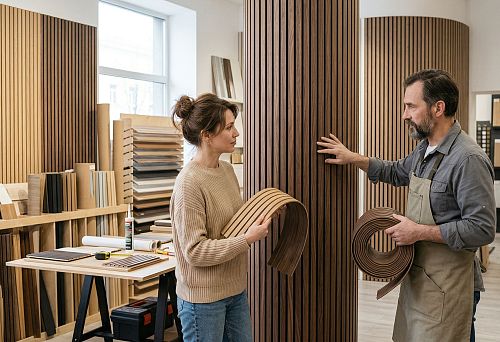
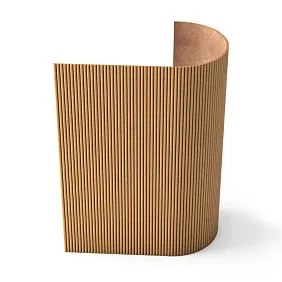
An arch in a corridor is an architectural gift that most people ignore.soft slat panelson a flexible base allow cladding an arched opening with the same slats as straight walls — a unified visual language without 'gaps' or transitions. This solution transforms an arch from an architectural accident into an intentional design element.
Styles and tonal solutions for slatted panels in a corridor
Choosing a tone is the most emotionally charged decision. The corridor is the first to greet: the tone sets the mood.
Light Scandinavian corridor
Slats with white tinting on MDF or veneer. Supporting base — soft gray or warm white. Flooring — light laminate or engineered board in wood tone. Minimalist accessories — wooden hooks, frameless mirror or in a narrow wooden frame.
Effect: the space is open, clean, airy. Artificial light reflects off light surfaces — a corridor without a window appears significantly brighter.
Dark accent corridor
Reiki in anthracite, coal, or deep green. The supporting base is even darker — creating maximum depth. Warm 2700 K backlighting from the gaps.
A dark corridor — a bold and memorable solution. Psychologically: a feeling of being enveloped, secluded, intimate. With proper lighting — it doesn't oppress, but embraces.decorative slatted wall panelsIn a dark tone with backlighting — this is a corridor that makes an impression from the first step.
Natural wooden corridor
Transparent oil on oak or ash veneer — a honey-amber tone with a lively grain pattern. Wooden floor matching the tone of the reiki.Wooden baseboardMade of solid wood.Furniture HandlesOn a shoe cabinet made of the same wood.
This is a corridor where you breathe differently — like in a wooden house. The biophilic effect of natural materials in the first space of the home — the strongest possible first impression.
Two-tone corridor
The lower part of the wall (up to a height of 90–110 cm) — reiki of one tone; the upper part — another. Or: the lower part — solid paint as a 'panel', the upper part — reiki panels. This technique visually divides a high wall and creates a sense of scale in a space with non-standard ceiling heights.
Lighting for slatted panels in the corridor: three strategies
Lighting is a co-author of the slatted wall. Without proper lighting, even excellent slats lose half their potential.
Strategy 1: LED strip in the gaps
A thin LED strip (8–10 mm wide) is placed in the gap between the slats or behind them at the level of the supporting base. The light emerges as a narrow strip—vertical glowing lines between the slats. The 'floating slat' effect—when the slat appears not attached to the wall but hanging in the air.
Temperature: 2700 K (warm)—for a cozy, residential hallway; 3000–3500 K (neutral)—for a corridor in an office or modern apartment.
Strategy 2: wall sconces between the slats
A wall-mounted light fixture installed in the gap of the slatted panel—or recessed into the gap. The light falls along the wall, emphasizing the relief of the slats and creating pronounced shadows. With two sconces at opposite ends of a long corridor—uniform side lighting without shadows from a person on the wall.
Strategy 3: directional ceiling light
Ceiling spotlights directed at a 30–45° angle to the slatted wall. Grazing light maximally emphasizes the relief: gaps turn into deep shadows. The wall looks sculptural and expressive. This technique requires thoughtful placement of spotlights—the angle of incidence is critical.
Combining strategies 1 and 3—basic and accent lighting simultaneously—yields the most complete result.
Wall finishing with slatted panels in the corridor: full and partial
Should you cover the entire corridor with slatted panels or limit it to an accent area? Both strategies have their own logic.
Full cladding
Wall finishing with slatted panelson all walls of the corridor creates a 'wrapped' space effect. In a narrow corridor, this works in two ways: on one hand — it enhances the sense of depth and materiality; on the other — it can create overload with high slat density.
Recommendation: for full cladding — choose lighter tones and moderate gaps. A monochrome scheme (slats and supporting base in similar tones) reduces the visual aggression of a dense surface.
Accent Wall
One long wall — slatted; the others — solid paint or neutral wallpaper. This is the most common and, perhaps, the most elegant solution. The slatted accent wall focuses attention, while the other walls 'recede'.
An accent wall in the hallway opposite the entrance door — the first thing a guest sees. This is where the slatted panel works with maximum effect.
Panel on the lower part of the wall
Slatted panels from the baseboard to a height of 1.0–1.2 m — a classic 'panel' scheme. Above — paint or wallpaper. The lower part of the corridor wall is the most vulnerable in terms of mechanical damage. The slatted panel here protects exactly the area that needs protection.
Installation of slatted panels in the corridor: step-by-step instructions
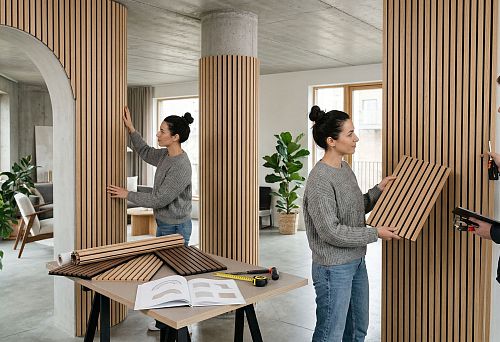
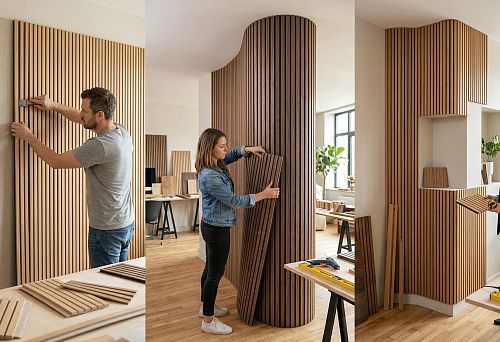
installation of slatted panelsInstalling panels in a corridor is a task that can be done independently with basic construction skills and the right tools.
Preparation: tools and materials
Minimum required:
-
Laser level (not a bubble level — laser accuracy is critical)
-
Screwdriver with a set of bits
-
Jigsaw or miter saw
-
Tape measure, pencil, square
-
UD 27×28 metal profile for guides or 40×50 mm wooden beam
-
Butterfly dowels or anchor dowels depending on the wall type
-
Clips or finishing nails for attaching slats
-
Starting corner PVC or wooden profiles
Step 1: marking and framing
Using a laser level, we mark the horizontal lines of the battens—perpendicular to the direction of the slats. For vertical slats—horizontal guides with a spacing of 400–500 mm. All guides are set strictly in the same plane.
An important nuance for the hallway: in a narrow space, every millimeter of the structure's depth matters. The minimum batten—UD profile 27 mm plus slat 18 mm—totals 45 mm from the finished wall. If the wall is even—direct mounting without battens using adhesive + finishing nails is possible, saving 25–30 mm in width.
Step 2: installing the starter profiles
Corner profiles around the perimeter: at the ceiling, at the floor, in the corners. The starter profile determines the starting point for laying the slats. The levelness of the starter profile is the foundation of the entire result.
Step 3: mounting the first slat
The most critical step. The first slat is checked with a level twice—before and after fixing.How to install slatted panelsCorrect method: using clips fastened to the batten with a screw, gripping the side edge of the slat—a hidden fastener with no visible marks on the front plane.
Step 4: mounting the paneling
Slats are installed sequentially, each fixed with a clip. When using a modular system—the entire module is attached to the batten.DIY Batten PanelsInstalled in 1–2 days for a hallway with wall area of 10–15 m².
Step 5: trimming at doorways
In the hallway, there are always doorways, sockets, and switches. The slats are trimmed with a jigsaw or miter saw. The cut line is strictly perpendicular to the axis of the slat. The corner of the entrance opening is covered with a special corner profile or wooden trim.
Wooden door casingmade from the same wood or MDF as the slats — the final touch that unites the doorway and the slatted wall into a single architectural frame.
Step 6: finishing elements
-
Wooden baseboardat the base of the slatted structure — covers the expansion gap and creates a clear transition from floor to wall
-
Ceiling molding at the top edge — masks the gap at the ceiling
-
Corner profiles — finish interior and exterior corners
-
Sockets and switches are moved to the final depth of the structure
Wooden slatted panels in the hallway and adjacent elements
The slatted wall in the hallway is the center of the architectural composition, but not the entire composition. A well-designed hallway works as an ensemble.
Wooden slat panelsin the hallway organically combine with wooden flooring: one wood species, one oil, one rhythm. If the floor is dark oak, the slats are in the same tone or slightly lighter. Tonal contrast is acceptable but should be intentional, not accidental.
A console in the hallway made from the same slat material as the rails is not just a functional piece, but a tangible bridge between the wall and functional furniture. If the interior plans to useclassic furniture— a slatted wall in a classic style (slats with a bevel in the warm tone of oak) creates the perfect context for its installation.
A mirror in a slatted frame is a full-fledged design object. The frame, made from the same slats as the wall, unites the functional item and the architectural surface. The size of the mirror is chosen so that the frame does not compete with the rhythm of the wall but continues it.
If there is a staircase in the house —Pogonazh iz massivafor handrails,balusters for staircasesin a unified tone with the hallway slats — an architectural gesture that unites the space vertically. This detail is always noticed and always appreciated.
Slatted panels in the hallway: options for different budgets
Good news: a slatted panel in the hallway is available in a wide price range without sacrificing functionality.
| Segment | Material | Finish | Estimated cost with installation |
|---|---|---|---|
| Base | MDF 16 mm | Factory enamel, 1 tone | 1800–2500 RUB/m² |
| Medium | MDF 18 mm, veneer | Oil or tinting | 3500–5500 RUB/m² |
| Premium | Oak solid wood | Hard wax oil | 7000–15000 RUB/m² |
| Commercial | Modular MDF system | RAL enamel | 2500–4500 RUB/m² |
Important: saving on slat thickness in the hallway is a mistake. Using 12 mm slats instead of 18 mm in a high-traffic entryway will cause dents in 2–3 years. It's better to reduce the area of slat cladding (limit to one accent wall) and use a high-quality profile.
Care for slat panels in the hallway
The hallway requires regular cleaning — and the slatted panel must withstand this without losing its appearance.
MDF with enamel: a damp microfiber cloth, neutral detergent if necessary. No abrasives. Minor scratches on matte enamel are practically invisible — the matte surface diffusely scatters light, masking damage.
Veneered MDF with oil finish: dry or slightly damp soft cloth along the grain. Every 1–2 years — apply a thin layer of hard wax oil to refresh the coating.
Solid wood: the same rules as for veneer. For deep scratches — spot sanding with 220-grit sandpaper and applying oil to the damaged area. Restoration is unnoticeable.
The main rule for the hallway: immediate removal of dirt. Wet shoe marks, dirty streaks from bags — clean them right away. Dried-on dirt on a slatted surface will require more effort.
FAQ: answers to the main questions about slatted panels in the hallway
Which slatted panels are better for the hallway — MDF or wood?
For a high-traffic hallway, MDF with a density of 780+ kg/m³ or solid oak — both options are good. MDF is more practical and cheaper; solid wood is more durable and noble. Veneered MDF is the optimal compromise.
Can slatted panels be installed in the hallway independently?
Yes. With a laser level, cordless drill, and jigsaw, installation in a hallway of 10–15 m² is 1–2 days of work. DIY installation saves 30–40% of the total project cost.
How to visually widen a narrow hallway using slatted panels?
Light-colored slats + dark base structure — maximum visual depth. Vertical slats on the long wall — create a sense of movement inward. Bottom LED lighting — makes the space feel airier.
Is a batten frame needed or can they be glued directly?
For uneven walls (variation over 3 mm per 2 m) — a batten frame is mandatory. For even walls — adhesive installation with finishing nails is acceptable; saves 25–30 mm of hallway width. For solid wood — only a batten frame, to ensure ventilation.
How many slatted panels are needed for a hallway?
Measure the area of the walls you plan to cover. Add 10–15% for cutting — hallways have many doorways and short sections. With modular installation, waste is minimal.
Are slatted panels in a hallway practical? Won't I be constantly cleaning them?
Practical. A 12–18 mm gap does not accumulate dust intensely. Weekly vacuuming with a soft brush attachment and monthly damp wiping are sufficient. This is significantly easier than keeping textured wallpaper clean.
Are slatted panels suitable for a hallway with dark tones?
Yes. A dark hallway with proper lighting is a bold, stylish, and very memorable solution. The key condition: sufficient lighting. Without proper light, dark slats feel oppressive; with it — they create an atmosphere of coziness and seclusion.
Can slatted panels be combined with tiles in a hallway?
Yes. The lower part of the wall is ceramic tile; the upper part is slats. The joint is finished with decorative molding or a metal transition piece. The tile protects the most heavily loaded lower zone; the slats create architectural character in the upper part.
What should be done with sockets and switches in the hallway when installing slatted panels?
Before installation, the electrical boxes are extended to the depth of the future structure. The standard electrical box extender is 10–25 mm. After installing the slats, a decorative socket or switch plate is installed.
About the company STAVROS
A hallway you want to tell guests about immediately is no accident. It's the result of the right material choice and professional production. STAVROS creates exactly such solutions.
STAVROS is a Russian manufacturer of wooden architectural elements for interiors. Full production cycle, precise CNC equipment, strict quality control at every stage. In the catalog for hallways and entries:Slatted wall panelsslatted panels made of MDF and solid oak in a wide range of parameters and finishes;slatted modular wall panel3D panels for quick installation on commercial projects;Wooden slat panelssolid wood panels made of oak and ash with oil finishes;soft slat panelsflexible panels for arches and curved elements;Wooden baseboardfrom solid wood and MDF;Pogonazh iz massiva— moldings, trims, cornices;Furniture Handlesmade from natural wood;balusters for staircaseshandcrafted;Classic Furniturefor comprehensive interior design.
STAVROS works with private clients, designers, architects, and developers across Russia. Samples of finishes, professional consultation on selecting parameters for a specific corridor, delivery, and full support—from the first question to the final result. The first impression of your home deserves the best material. Choose STAVROS.