







































Article Contents:
- The hallway as an architectural challenge: what hinders and what helps
- Why slatted panels are perfect for the hallway
- Vertical rhythm 'lifts' the ceiling
- Light-colored slats 'expand' a narrow corridor
- Slats conceal wall defects
- Natural material reduces the anxiety of the 'threshold'
- Slatted panels are durable under mechanical loads
- Where exactly to use slatted panels in the hallway
- Wall opposite the entrance door: the main accent
- Side walls of the corridor: technical and decorative choice
- Wall with a hanger: a 'background' surface
- Hallway ceiling: an unconventional but impressive move
- Materials for slatted panels in the hallway: selection priorities
- MDF: the optimal choice for the hallway
- Natural solid wood with lacquer coating
- Moisture-resistant MDF + natural solid wood: a combined system
- PVC: for hallways with extreme humidity
- Color solutions for slatted panels in the hallway
- White: most effective for dark hallways
- Natural oak: warmth at the entrance
- Dark tones: for bold and spacious hallways
- Color matching the sliding wardrobe
- Slat panel parameters for the hallway: specific numbers
- Slat width for the hallway
- Gap between slats
- Height of the slatted field
- Slat orientation
- Slat panels and hallway lighting: allies
- LED backlighting behind slats
- Track lighting above a slatted wall
- Lighting cornice
- Hallway style and slatted panels: specific looks
- Modern minimalism
- Scandinavian and Nordic style
- Japandi: Japanese minimalism with natural warmth
- Neoclassicism and Art Deco
- Loft and Industrial
- Slatted panels and a mirror in the hallway: the perfect union
- Mirror "in slats"
- Mirror on a slatted background
- Full-wall mirror with slatted panels on side walls
- Installation of slatted panels in the hallway: specifics
- System for finishing a slatted field in the hallway
- Common mistakes when finishing a hallway with slatted panels
- Frequently Asked Questions About Slatted Panels in the Hallway
- Can slatted panels be installed over tiles in the hallway?
- How much will the hallway shrink after installing slats on battens?
- How to clean slatted panels in the hallway?
- Are slatted panels in the hallway practical for a family with children?
- Are modular slatted panels suitable for the hallway?
- Is it worth installing a slatted ceiling in the hallway along with the walls?
- Conclusion
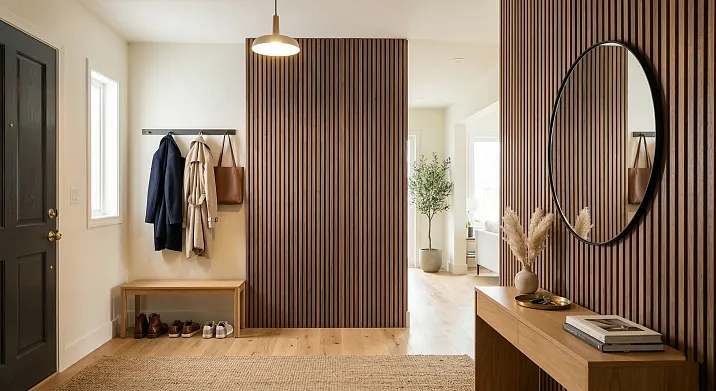
There is a rule in residential architecture: the hallway sets the tone for the entire house. A person crosses the threshold—and within the first three seconds, they get a comprehensive impression of the character of this house, whether it has taste, thoughtfulness, warmth. This works on a reflex level, bypassing conscious analysis. The hallway speaks before the owner has time to utter a word.
And here's the paradox: the hallway is the most ignored room during renovation. It's done 'on a leftover basis.' Tile on the floor, painted walls, a standard cabinet. No character, no message. A neutral transit zone.
Slatted panels in the hallway interior radically change this logic. They transform a 'transit' space into a space with character. From the very first second after opening the door—rhythm, material, play of shadow. Not neutrality, but a statement.
But the hallway is a specific space. Small, often dark, with high humidity (wet shoes, winter clothing), and subject to mechanical stress on the walls. So, the discussion aboutslatted panels in hallway interiorsis not just about aesthetics. It's about how to make it beautiful and long-lasting under conditions that are not kind to beauty.

The hallway as an architectural challenge: what hinders and what helps
Before talking about slatted panels, let's honestly outline the task conditions. A hallway in a Russian apartment is typically:
Small area. A typical hallway is 3–6 sq. m. A 'sausage' corridor is 1.2–1.5 m wide. Any finishing system that visually 'eats up' space is an enemy.
Low or standard ceiling height. 2.4–2.6 m. Rarely higher. The ceiling feels oppressive if the space is narrow.
Lack of natural light. Hallways without windows are the norm. All lighting is artificial. This means the finishing material must 'work' specifically under artificial lighting.
Mechanical stress. The corner of the wall where you lean while putting on boots. The spot brushed by a bag. The wall behind the coat rack. The hallway is a zone of constant everyday 'abuse' of surfaces.
Humidity. Wet shoes, umbrellas, winter jackets with wet snow. The hallway is a transition zone between outdoor and indoor humidity levels.
It is precisely these conditions that shape the requirements for slatted panels in the hallway. And it is on these conditions that we will base our selection.




Why slatted panels are ideal for the hallway
Slatted panels possess properties that turn the hallway's limitations into advantages.
Our factory also produces:
Vertical rhythm 'lifts' the ceiling
Vertical slats are the main visual technique for increasing the perceived ceiling height. The eye follows the vertical lines upward—and the brain 'reads' the room as taller. In a hallway with a 2.4 m ceiling, vertical slatted panels from floor to ceiling make the space visually taller by 20–30 centimeters in subjective perception.
This is not a trick or an illusion—it is a fundamental principle of visual perception that professional designers have been using for decades.
Get Consultation
Light-colored slats 'widen' a narrow corridor
White or light-colored slatted panels in a narrow corridor reflect light, making the walls 'glow'. A dark corridor 1.3 m wide with white slatted panels is perceived as wider—the light flow is multiplied by the reflective surfaces.
Slatted wall panelsWhite or ivory color in the hallway is one of the most effective techniques for optically expanding the space without physical intervention in the layout.
Slats conceal wall defects
Hallways in old houses often have uneven walls, traces of many layers of old wallpaper, and cracks in the corners. The slat system on the battens completely conceals the wall—you install a new surface over any defects. This is not 'covering up,' but 'creating anew.'
Natural material reduces the 'threshold anxiety.'
Psychologically, the hallway is a transition zone between the public (street) and private (home). This transition can feel like a stressful moment, especially after a hectic day. Natural material on the walls—wooden slats with a living tone—reduces 'threshold anxiety,' creating a sense of 'arrived home.' The biophilic effect works immediately, at first glance.
Slat panels are durable under mechanical loads
Wooden slat panelsand MDF slats with a lacquer coating are significantly more durable than wallpaper and drywall surfaces. A local impact from a bag on a lacquered slat results in a scratch that can be locally restored. The same impact on wallpaper causes a tear and a stain, requiring replacement of the panel.
Where exactly to use slat panels in the hallway
The hallway is not a single space. It consists of several functional zones, each with its own 'status' for slat finishing.
Wall opposite the entrance door: the main accent
The wall you see when opening the door is the main one in the hallway. The first visual 'impact.' This is where slat panels create the maximum effect.
Here, you can 'run' the slats from floor to ceiling, creating a full slat field. This wall is not in the zone of direct mechanical contact (not a corner, not the shoe-putting-on area), so natural solid wood is possible here without special restrictions.
This wall is the spot for a built-in mirror in a slatted frame, key hooks on a slatted background, and a small console with decor. The slats become the 'stage' for the entire hallway interior.
Side walls of the hallway: technical and decorative choice
The side walls of the hallway are the areas with the highest mechanical loads. This is where bags bump against, people lean when putting on shoes, and suitcases are dragged. Therefore, for the side walls, a practical choice is:
-
MDF slats with lacquer coating— more resistant to mechanical damage than wood with an oil coating
-
Slats on the lower part of the wall (wainscoting up to a height of 110–120 cm) — protection for the most vulnerable zone
-
Lower belt of slats + neutral upper part — a classic solution for hallways with active use
For wainscoting in the hallway: slats at the bottom (110 cm), a horizontal molding at the border, a neutral painted wall at the top. This is both practical (protection of the lower zone) and architecturally sound.
Wall with a coat rack: a 'background' surface
The wall where coats and jackets hang is usually hidden behind clothing. Here, slatted panels work as an 'architectural background,' visible in peripheral vision. Clothing hooks can be mounted directly into the slats — this is elegant: the hook 'grows' out of the slatted field.
Technically: hooks in natural wood slats are mounted into pre-drilled holes. For MDF — special dowels within the panel thickness (minimum 18 mm). Load per point: no more than 5–7 kg when mounted into a slat.
Hallway ceiling: unconventional, but impressive move
Batten panels for ceilingsIn the hallway — an unconventional but professionally justified solution. In a narrow corridor where walls 'press' from all sides, a slatted ceiling perpendicular to the corridor axis 'expands' the space horizontally. Psychologically: the gaze moves across the corridor, not along it — the narrowness ceases to be felt.
Requirement: ceiling slats — at least 16–18 mm thick to avoid sagging. Mounting on a metal frame. With a 2.4 m ceiling — the ceiling slat system 'takes up' 4–6 cm of height (frame + slat).
Materials for slatted panels in the hallway: selection priorities
The hallway imposes stricter requirements on the material. Humidity, mechanical stress, lack of natural light — all these factors must be considered.
MDF: optimal choice for the hallway
MDF Slatted Wall Panel— the most practical choice for the hallway based on a combination of factors. Moisture-resistant MDF (MR MDF) is resistant to moderate moisture. Lacquer or enamel coating — durable, easy to clean. Any RAL color — precise match to the concept.
Special advantage of MDF in the hallway:paintable slatted wall panelsMDF slats allow repainting the entire hallway in a different shade after several years without dismantling the slats. Changing the color — a complete renewal of the hallway's look without renovation.
Natural solid wood with lacquer coating
Natural oak or ash with 2–3 layers of polyurethane lacquer — a durable, moisture-resistant, natural surface. In an entryway with normal ventilation — an excellent choice for the main accent wall.
Limitation: oil coating is not recommended for the entryway — under conditions of wet shoes and umbrellas, oil impregnation does not sufficiently protect against moisture. Only lacquer coating for wooden slats in the entryway.
Wooden slat panelsOn the accent wall of the entryway — a natural first impression that immediately signals to a guest: people with good taste live here.
Moisture-resistant MDF + natural solid wood: combined system
Professional solution: side walls of the corridor and lower zones — moisture-resistant MDF with lacquer. The main accent wall opposite the entrance — natural oak. This is 'zoning' by material: practicality where it's needed, naturalness — where it's visible.
PVC: for entryways with extreme humidity
If the entryway adjoins a bathroom, regularly gets wet from damp clothing, and lacks normal ventilation — PVC slats. Absolutely waterproof. For such extreme conditions — the only sensible choice. Aesthetically — below MDF and wood, but functionally — flawless.
Color solutions for slat panels in the entryway
The color of slat panels in the entryway is a fundamental choice that determines whether the space will 'expand' or 'shrink'.
White: most effective for dark hallways
White slatted panels (RAL 9003, RAL 9010, or RAL 1013) — in a dark hallway without a window, they provide the maximum light reflection coefficient. The wall literally 'glows' under artificial lighting. White vertical slats from floor to ceiling — a classic image of a dark hallway transformed into a bright and tall space.
Whitedecorative slatted wall panelsIn a hallway with a dark backing (black felt or fabric) — black-and-white contrast. Graphic, modern, very expressive.
Natural oak: warmth at the entrance
The warm amber tone of natural oak (or MDF with a 'natural oak' finish) creates a sense of coziness from the first step into the hallway. It's not a 'cold transit,' but a 'warm welcome.' It is the wooden tone that best accomplishes the task of 'hello, I'm glad you're home.'
Natural oak in the hallway — a classic that never goes out of style. Regardless of the design direction in the main rooms — the natural tone of the hallway works as a neutral warm transition.
Dark tones: for bold and spacious hallways
Anthracite, dark green, graphite — for hallways with an area of 8 sq. m or more and sufficient lighting. In a dark color, a narrow corridor 'collapses.' Dark slats — for spacious hallways with natural lighting or powerful artificial lighting.
Exception: a dark accent wall opposite the entrance (one wall) with light side walls — works even in a small hallway. Creates 'depth' of perspective.
Color matching the sliding wardrobe
Reiki in the exact color of the built-in wardrobe facade - a monochrome 'furniture-wall' solution. The wardrobe 'dissolves' into the wall surface. The hallway appears more spacious: there is no visual 'break' between the furniture and the wall.
This technique is especially effective with paintable slats in the facade color: a uniform matte tone on the slats and facades is a professional designer technique.
Slat panel parameters for the hallway: specific numbers
The hallway requires specific slat panel parameters. Let's consider optimal values for different tasks.
Slat width for the hallway
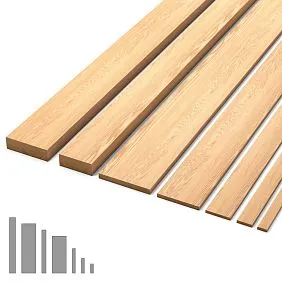
15–20 mm — for very narrow corridors (up to 1.2 m wide) and low ceilings (2.4 m). The thin, frequent rhythm does not 'overload' the limited space.
25–30 mm — optimal for most hallways with a ceiling of 2.4–2.6 m. Expressive enough, delicate enough.
35–40 mm — for hallways with an area of 8+ sq. m and a ceiling of 2.6–2.8 m. An expressive, 'adult' rhythm.
Important rule for the hallway: the smaller the room, the narrower the slat. In a 3 sq. m space, a 50 mm slat will be overwhelming. A 20 mm slat will delicately enliven it.
Gap between slats
For the hallway — standard gap 12–18 mm. With a narrow gap (12–14 mm): the surface is dense, the slats dominate, the substrate is barely visible. With an 18 mm gap: the substrate is more actively present, the surface 'breathes'.
A wide gap (20–25+ mm) in the hallway is undesirable. In a small space, wide gaps create a 'holey' effect that visually fragments already limited walls.
Height of the slatted field
From floor to ceiling — ideal for hallways with low ceilings. Continuous vertical lines maximally 'pull' the space upward.
Wainscoting (90–120 cm) — for side walls with mechanical loads. The upper part of the wall is a neutral color matching the slats or a light neutral tone.
Full slatted field only on an accent wall — other walls are neutral. A pinpoint accent without full coverage.
Slat orientation
Vertical — to increase perceived height. Mandatory for ceilings up to 2.6 m.
Horizontal — to expand the space lengthwise. In a long narrow corridor, horizontal slats 'stretch' the perspective, making the corridor visually wider. Paradoxically, it works: the horizontal rhythm 'eliminates' the feeling of a 'tube'.
Diagonal — for unconventional accents. Appropriate only on one wall of a small hallway as a pinpoint artistic gesture.
Slatted panels and lighting in the hallway: allies
Hallway lighting is a separate and fundamental topic. Slatted panels and lighting in the hallway should be designed together.
LED backlighting behind the slats
Built-in LED strip behind the slatted wall in the hallway is one of the most functional and aesthetic techniques. Light emerges through the gaps between the slats, creating soft, diffused illumination along the entire height of the wall.
Practical function: when entering a dark hallway at night, a motion sensor activates, and the slatted wall 'lights up' with a soft, warm glow. Not a blinding spotlight, but delicate, natural lighting.
Technically: the gap for LED backlighting should be at least 20–22 mm. With a narrow 12 mm gap, the light is barely visible. Temperature: 2700–3000K — warm, homely. 4000K — neutral, 'task' lighting.
For more details on installation and mounting of slatted panels with lighting, see the slatted panel mounting instructions.
Track lighting above the slatted wall
A directional track spotlight, installed on the ceiling at a 30–40° angle to the slatted wall, creates expressive chiaroscuro in the gaps. Each slat casts a shadow. The surface becomes sculptural, three-dimensional.
For natural wooden slats — warm track lighting at 2700K brings out the golden tone of the wood, emphasizing the natural grain pattern. A hallway under such lighting feels like a theatrical stage.
Lighting cornice
a polyurethane cornice with a built-in groove for an LED strip along the top edge of the slatted field — a 'hidden' light source. Light 'flows' down from the cornice along the slats from top to bottom. Effect: the slatted wall appears self-illuminating, with no visible source.
For windowless hallways — this is one of the most impressive lighting solutions: artificial light creates a sense of 'daylight' volume.
Hallway style and slatted panels: specific looks
Slatted panels in interior designHallway slatted panels adapt to any style — with the right parameters.
Modern minimalism
White MDF slats 25–30 mm. Narrow gap 12–15 mm. White backing — the surface is perceived as monolithic with delicate relief. Or dark backing — black-and-white contrast.
Addition: mirror in a thin metal frame against a slatted background. Hooks made of matte stainless steel. Light ceramic floor.
Look: strict, clean, cool. Hallway as a 'gateway' between the street and modern space.
Scandinavian and Nordic style
Thin slats 20–25 mm made of natural birch or light ash with white oil (for the main accent wall) or MDF 'under light wood' with a matte finish (for side walls). Gap 12–15 mm.
Addition: wooden console, mirror in a wooden frame, woven shoe basket.
Look: warm, natural, cozy. Home begins with wood.
Japandi: Japanese minimalism with natural warmth
Dark 20–25 mm slats of stained oak (tobacco or dark walnut tone). Narrow 12 mm gap. Natural-toned felt underlay. On side walls — neutral warm gray.
Addition: black matte metal hooks, frameless flat mirror, ceramic plant pots at the entrance.
Vibe: meditative, deep, 'silent'. Japanese house entryway in an urban apartment.
Neoclassicism and Art Deco
Slatted wainscoting: tobacco or walnut oak, 35–40 mm slats, slatted field height 110 cm. Horizontal molding at the border with the neutral wall section.
Solid wood molding— a mandatory element in a classic solution. Without molding, slatted wainscoting looks 'truncated'.
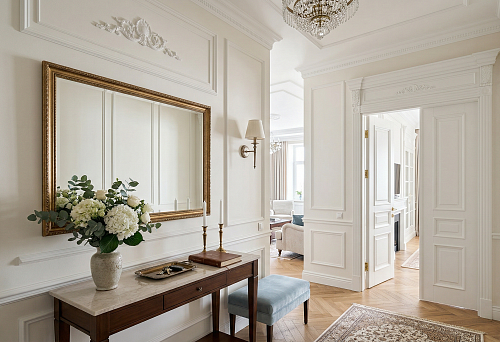
Addition: mirror in gilded or patinated frame, console with marble top, herringbone parquet floor.
Vibe: aristocratic, warm, substantial.
Loft and industrial
Dark 40–50 mm MDF slats with matte anthracite or black finish. Gap 20–25 mm. Underlay — black felt.
Applicable only in spacious entryways (from 8 sq. m) with active artificial lighting — track spotlights are mandatory.
Addition: metal 'pipe' hooks, concrete floor, strict black-and-white mirror.
Style: brutalist, urban, conceptual.
Slatted panels and mirror in the hallway: a perfect union
A mirror is an essential element in a hallway. And slatted panels create the perfect backdrop for it.
Mirror 'in slats'
A mirror integrated into a slatted field — slats on both sides of the mirror form a frame. The slats are mounted flush with the mirror edges. Result: the mirror as part of the slatted rhythm — not 'inserted' into the wall, but 'emerging' from it.
Technically: the mirror is attached to the wall before mounting the slats. The slats are mounted flush with the mirror edges. The gap between the slat and the mirror is 1–2 mm, filled with clear silicone.
Mirror on a slatted background
A standard framed mirror hung on a slatted wall — the slats serve as a background. A simple, professionally looking technique: the slats give the mirror an 'architectural context'.
Mirror frame color: matching the slats (monochrome) or contrasting. A metal frame (copper, brass, matte silver) on wooden slats — an expressive material contrast.
Full-wall mirror with slatted panels on side walls
In a narrow hallway — a mirror on the end wall (visually doubles the space) + slatted panels on side walls. The surface of the slats reflects in the mirror — the space is 'multiplied'. One of the most effective techniques for a narrow hallway.
Installation of slatted panels in the hallway: specifics
installation of slatted panelsin the hallway has several features compared to other rooms.
Mandatory ventilation gap. The hallway is an area of humidity fluctuations. Ventilation gap between the wall and the substrate of the slatted system: minimum 20 mm. Without it — condensation.
First slat at the entrance. With vertical installation — the first slat is installed at one of the wall ends. If the wall starts at the door opening — the first slat is mounted along a laser vertical from the door casing or with an offset from it. A straight first slat is the key to a straight entire field.
Bypassing sockets and switches. In the hallway, there is typically a switch by the door. Slats around it: either the switch is 'hidden' in the gap between slats (relocated to the required depth), or the slats are cut to its dimensions with installation of a decorative frame.
Corner transitions. Hallway corners require a solution: butt joint (slats from both walls meet in the corner, ends joined), with a corner profile, or overlapping. A professional solution is a corner profile made of natural wood or metal, concealing the slat ends in the corner.
FullStep-by-step guide for DIY installation of slatted panels— in the professional guide.
System for finishing the slatted field in the hallway
A slatted hallway is a system, not just a set of planks on the wall. Finishing the perimeter determines whether the result will look 'professional' or 'done at home on the weekend'.
Baseboard.solid wood baseboardIn line with the slatted panels—a bottom trim piece that conceals the mounting gap. In the hallway, the skirting board height: 60–80 mm for a ceiling height of 2.4–2.6 m. Not higher: a tall skirting board in a small hallway 'eats up' the height.
Cornice.a polyurethane corniceAlong the top edge of the slatted field—covers the top end of the slats. With LED lighting—a cornice with a groove for the LED strip.
Door casings. Slatted panels in the hallway 'meet' the door openings.Wooden door casings made of solid woodOn the door opening, matching the slats—ties the slatted field to the door architecture.
Furniture handles.Wooden furniture handlesOn the sliding wardrobe, matching the slatted panels—detailed correspondence that creates a sense of a 'well-thought-out system,' not a collection of disparate elements.
Common mistakes when finishing a hallway with slatted panels
Slats too wide for a small hallway. In a 3 sq. m space, 50–60 mm slats are overwhelming. Follow the rule: slat width ≤ corridor width (cm) ÷ 60.
Dark slats in a hallway without a window. Without powerful artificial lighting, dark slats turn the hallway into a 'dark tunnel.' For dark hallways—only light tones or a dark accent on one wall with powerful track lighting.
Installation without a level. The first slat 'shifted' by 3 mm—by the end of the wall, the deviation becomes critical. Only a laser level.
Lack of perimeter finishing. Slats without skirting and cornice — an unfinished system. It is the finishing that makes the result 'expensive'.
Hooks not designed for the slat. Standard wall hooks on a 16 mm MDF slat under a 5 kg load — a risk. Either hooks with a large support surface, or mounting to the batten through the slat.
Frequently asked questions about slatted panels in the hallway
Can slatted panels be installed over tiles in the hallway?
Yes, provided the tiles are firmly attached to the wall. The slatted system on battens is installed over any flat surface, including tiles. The tiles then serve as a 'flat base'.
How much will the hallway shrink after installing slats on battens?
Battens + ventilation gap + underlay (if any) + slat = 35–55 mm from each wall. In a corridor 130 cm wide with slats on two sides — the working width will be reduced to 120 cm. This is acceptable. If the corridor width is less than 110 cm — slats on both sides are not advisable.
How to clean slatted panels in the hallway?
MDF with varnish: damp cloth, neutral detergent. Natural wood with varnish: damp cloth without abrasives. Periodically — special polish for varnished wood. Marks from shoes or backpack: remove immediately, before they dry.
Are slatted panels in the hallway practical for a family with children?
MDF with varnish or enamel is quite practical. Children's fingerprints, backpack smudges—everything wipes off with a damp cloth. Natural wood with an oil finish is vulnerable to scratches. For families with children—slats with a high-gloss lacquer finish and a taller baseboard (80–90 mm) to protect the lower zone.
Is modular slatted panelfor the hallway?
Yes, if the wall width is a multiple of the module width (or with minimal trimming of the edge elements). Modular panels are convenient because they are ready for installation: the slats are fixed to the backing with proper gaps. For the hallway—quick and precise installation.
Is it worth doing a slatted ceiling in the hallway along with the walls?
In a spacious hallway (from 8 sq. m)—yes, with the correct ratio: ceiling slats are perpendicular to the wall slats. This creates a three-dimensional natural 'volume'. In a small hallway (3–5 sq. m) with a 2.4 m ceiling—a slatted ceiling 'lowers' the space. Here—only wall slats, the ceiling is left neutral and light.
Conclusion
The hallway is the first word your home speaks to everyone who crosses the threshold. Slatted panels in the hallway interior turn that word from a mumbled 'w-well, hello' into a confident, warm, and memorable greeting. The natural rhythm of the slats, the play of shadow in the gaps, the warm tone of wood or the precise color of matte enamel—all of this works in the first three seconds. Before the guest has even taken off their shoes.
Correctly chosenSlatted wall panelswith a competent finishing system—solid wood baseboard, a polyurethane corniceand matching trim—create a hallway that looks like the work of a professional design studio. Because it's based on professional solutions and quality materials.
Full range of slatted panels made from natural oak, ash, birch, and pine, MDF slats for painting,Pogonazh iz massivacornices, moldings, andWooden furniture handles— in the STAVROS company catalog.
STAVROS — manufacturing decorative interior solutions with attention to every detail. Slatted panels that transform the hallway from a 'transit corridor' into the first chapter of your home's story. Professional consultation on material, color, and parameters — because the hallway deserves no less attention than the living room. After all, it speaks first.