Article Contents:
- When a slatted partition is better than a solid wall: an honest comparative analysis
- Four zoning tasks — and how slats solve them
- Open and closed construction: two architectural types
- How slatted panels work for zoning: principles and diagrams
- First principle: partition as an extension of the wall
- Second principle: partition as a separate volume
- Third principle: slatted zoning without a full partition
- Slat parameters for partitions: calculation table
- Where decorative polyurethane elements are appropriate: a systematic approach
- Upper partition framing
- Lower partition base
- Partition side ends
- Decorative overlays on partition slats
- How to unify partitions, walls and ceiling into a single system
- Triple unity: material — scale — color
- Through slat system in open-plan layout
- Ceiling "arrow" above partition
- Solutions for apartment, studio and office: three specific scenarios
- Scenario one: 38 sq.m. studio, zoning without losing light
- Scenario two: two-room apartment, study in the bedroom
- Scenario three: open-plan office, meeting room zoning
- Zoning and decorating mistakes: analysis of failed solutions
- Mistake one: partition without architectural completion
- Mistake two: slats of different tones on the partition and accent wall
- Mistake three: partition in the wrong place
- Mistake four: slats too dense on a small partition
- Mistake five: mixing polyurethane decor of different profiles
- Mistake six: partition without expansion gaps
- Error Seven: Acoustic Illusion
- About the Company STAVROS
- FAQ: Answers to Popular Questions

There is a question that arises for everyone planning a renovation without demolishing walls: how to divide the space so it doesn't turn into a box? A solid drywall wall solves the problem of separation—and simultaneously kills the air, light, and sense of volume.Slat panels for partitions—is the answer that allows zoning without losing spatial breath. Anddecorative polyurethane elements—is what turns a constructive solution into an architectural statement. Let's consider this tandem with all seriousness—technically, aesthetically, practically.
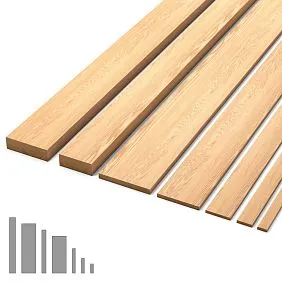
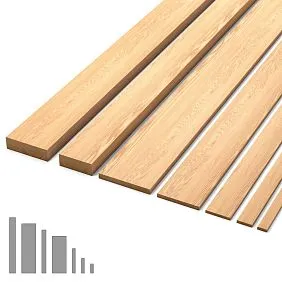


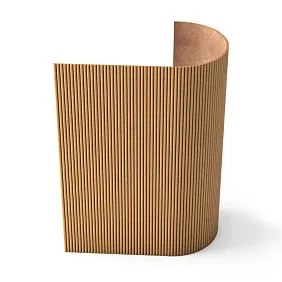
When a Slatted Partition is Better Than a Solid Wall: An Honest Comparative Analysis
Before deciding on the type of partition, it's worth asking yourself one direct question: why do you need a boundary at all? The answer determines everything.




Four Zoning Tasks—and How Slats Solve Them
Task one: visual separation. You want to designate zones—work and living, kitchen and living room, children's and parents' bedroom—without erecting a physical barrier. A slatted partition handles this flawlessly: the vertical rhythm of the slats clearly marks the boundary, while not blocking the view, light, and air. The eye understands: here is one space, there is another. But the feeling of a single volume remains.
Task two: acoustic separation. You want to reduce sound transmission between zones. An open slatted structure without backing is acoustically transparent—it does not isolate sound. But a slatted panel on an acoustic backing of mineral wool already provides a noticeable reduction in reverberation and partial sound absorption. For full acoustic isolation—only a solid structure.
Task three: creating an architectural accent. A partition as a design element, not just a building component. Here, the slatted construction is unrivaled. It works as a sculptural volume, interacts with light, creates texture. A solid wall is a surface. A slatted partition is an architectural object.
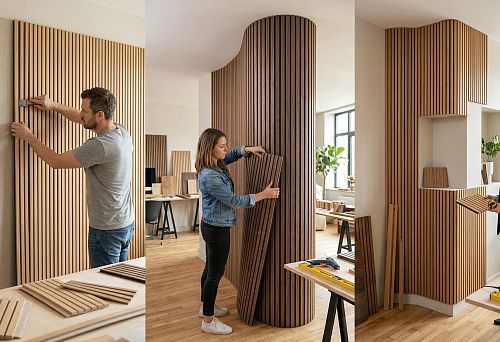
Task four: mobility and reversibility. You don't want irreversible structural solutions. A slatted partition on a metal frame can be dismantled in a few hours without damaging the walls or floor. A solid wall is a major undertaking to demolish.
A slatted partition is the optimal choice for the first, third, and fourth tasks. For full acoustic isolation — no. Understanding this prevents all future disappointment.
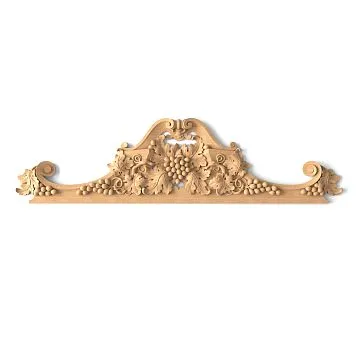
Our factory also produces:


Open and closed construction: two architectural types
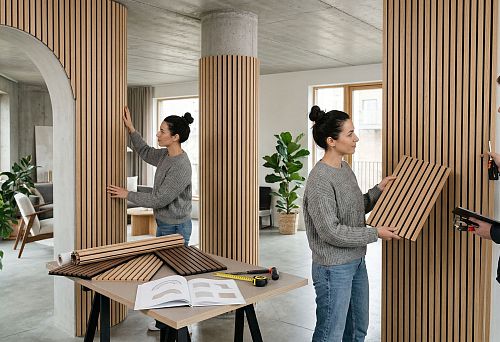
An open slatted partition — slats on a frame without backing. Through-type: light passes through, the space is visually unified, the boundary is only indicated. This is a solution for studios, combined spaces, open floor plans.
A semi-open slatted partition — slats on a solid or partially solid backing. The lower part is solid (MDF panel or glass insert), the upper part is slatted. Or vice versa. Provides visual and partial acoustic separation while maintaining light permeability in the open zone.
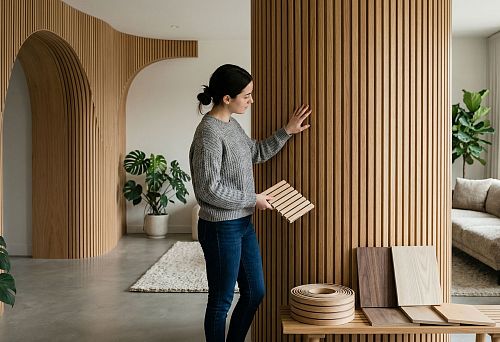
The choice between the two types is a question of balance between separation and openness.Slatted panels in interior designallow this balance to be varied over a very wide range: from an almost transparent structure with thin slats and wide gaps to an almost solid one — with wide slats and minimal gaps.
Get Consultation
How slatted panels work for zoning: principles and diagrams
Zoning with slatted panels is not just 'putting up a partition'. It is a thoughtful work with spatial scenarios, movement routes, light flows, and visual perspectives.
Principle one: partition as an extension of the wall
The most elegant technique. An accent slatted wall in the living room continues into the partition between the living room and the hallway—using the same wood species, the same tone, and the same slat width. The boundary between the wall and the partition is not explicitly perceived: visually, it is a single architectural plane that simultaneously serves as the wall of one zone and the partition of another.
This technique requires precise alignment of all parameters: slat width, gap, orientation, tone, finish. The slightest discrepancy will cause the effect to be lost.
Principle two: partition as a separate volume
The partition is highlighted as an independent architectural object—with a contrasting tone, different material, or different slat orientation. For example: the apartment walls are neutral white, while the slatted partition is dark-toned oak with 80 mm vertical slats. The partition becomes a sculpture in the space—it does not blend into the background but dominates.
This technique requires confidence in the design concept and a good understanding of scale: a too dark and massive structure in a small studio can psychologically overwhelm the space.
Principle three: slatted zoning without a full partition
Sometimes a fragmentary slatted element is sufficient—not from floor to ceiling, but, for example, at a height of 1.6–1.8 m. This creates a boundary at the perception level of a standing person while preserving the visual connectivity of the space above. Especially effective for zoning a kitchen and living room in a studio: a slatted 'parapet' behind the bar counter at a height of 120–130 cm delineates the kitchen area without isolating it.
Slat parameters for a partition: calculation table
| Task | Batten width | Gap | Orientation | Structure height |
|---|---|---|---|---|
| Light visual zoning | 30–50 mm | 15–25 mm | Vertical | To the ceiling |
| Accent partition | 60–90 mm | 10–15 mm | Vertical | To the ceiling |
| Bar counter / parapet | 40–70 mm | 12–18 mm | Vertical | 100–140 cm |
| Wide gap — maximum transparency | 25–40 mm | 25–35 mm | Vertical | To the ceiling |
| Horizontal orientation | 50–80 mm | 15–20 mm | Horizontal | To the ceiling |
Where decorative polyurethane elements are appropriate: a systematic approach
decorative polyurethane elementsIn a system with a slatted partition, it is not an addition. It is an essential part of the architectural logic. The partition creates a vertical plane — polyurethane decor creates its framing, its upper and lower boundaries, its connection with the ceiling, floor, and side walls.
Upper framing of the partition
The point where the slatted partition meets the ceiling is an area that requires a solution. An open gap looks technical. A direct joint without framing is crude. A polyurethane ceiling cornice, installed along the top perimeter of the partition, creates a clean architectural boundary.
For a modern style: a straight cornice 50–70 mm. For neoclassical: a cornice with a roundover 80–100 mm. The cornice is mounted on acrylic adhesive + silicone sealant along the ceiling-partition joint line. Cornice joints at the external corners of the partition are resolved using corner blocks or precise 45° miter cuts.
Lower base of the partition
The lower boundary of the slatted partition is a polyurethane skirting board 60–100 mm. It solves three tasks: it conceals the expansion gap at the floor (mandatory for wooden structures — 10–12 mm), creates a lower architectural line, and visually 'grounds' the partition — giving it a sense of stability.
Side ends of the partition
Open side ends of a slatted partition are an area that often remains unfinished. Solution options:
Corner molding. A vertical molding 40–60 mm along the entire height of the side end. Covers the cuts of the slats and frame, creates a clean vertical line.
Decorative pilaster. A vertical polyurethane element with a three-dimensional profile, mounted on the end of the partition. Turns a technical end into an architectural accent. Especially effective in classical and neoclassical interiors.
Half-column. A decorative polyurethane half-column on the side end of a freestanding partition — a radical, but exceptionally expressive technique for rooms with high ceilings (from 3 m) in a classical style.
Decorative overlays for partition slats
polyurethane decorative elementscan be mounted directly onto partition slats — creating an additional relief accent. For example: thin horizontal polyurethane strips-‘belts’ intersect vertical wooden slats at a height of 1.2 m — creating a geometric ‘grid’ from wooden and polyurethane rhythms. This is a non-trivial and very expressive technique.
How to unify partitions, walls, and ceiling into a single system
A single slatted partition is an element. A system of slatted partitions and wall panels, unified throughPolyurethane architectural decoration— is an interior. The difference is fundamental.
Triple unity: material — scale — color
For a partition, accent wall, and ceiling system to ‘speak the same language’, three conditions of unity are needed:
Unity of material. The slats of the partition and the slats of the accent wall are the same wood species, same finish, same tone. Even if these are different rooms or different sides of one partition — material unity creates a sense of integrity.
Unity of scale. The width of the partition slat, the width of the cornice, the height of the baseboard — all three parameters are in proportional relation. Cornice = 80–130% of the slat width. Baseboard = 80–120% of the cornice width. This is not a mathematical ritual — it is a working visual harmony.
Unity of decorative color. All polyurethane elements of the system are one color. Typically, white. This is a neutral background that does not compete with the wood but frames it.
Through slatted system in an open-plan layout
In a studio apartment or an open-plan apartment, a slatted system can permeate the entire space:
-
Accent wall in the living room → slatted partition between kitchen/living room → slatted kitchen backsplash panel (moisture-resistant MDF) — one continuous line of slatted rhythm.
-
Along the upper perimeter of the entire open space — a ceiling cornice made of polyurethane with a uniform profile.
-
Along the lower perimeter — a baseboard of the same profile.
This creates a sense of a designed, not an accidental interior. This is exactly how professional design solutions work.
Ceiling 'arrow' above the partition
A technique practiced in commercial interiors and complex apartment projects: a ceiling slatted box, stretching from the partition to the wall perpendicularly, marks the continuation of the partition boundary on the ceiling. This visually enhances zonal division — even in an open space, zones feel clearly demarcated.
Around the perimeter of such a box — a polyurethane molding, coordinated in profile with the other decorative elements of the system.
Solutions for apartments, studios, and offices: three specific scenarios
First scenario: 38 sq.m. studio, zoning without losing light
Task: separate the sleeping area from the living room without a solid wall. Area 38 sq.m., ceiling height 2.7 m, one window in the living room.
Solution: slatted partition on a metal frame, height up to the ceiling 2.7 m, width 1.8 m. Solid oak slats, natural tone, 65 mm × 2700 mm, 18 mm gap. Open construction (no backing) — maximum transparency. Frame — 60×27 mm metal profile, anchored to the floor and ceiling.
Polyurethane decor: 75 mm straight cornice along the top perimeter of the partition (joins with the room's perimeter ceiling cornice as a single run). 70 mm skirting board along the partition base. 50 mm corner moldings on both side edges.
Lighting: warm white LED strip behind the partition's top edge (under the cornice) — creates soft lateral illumination, orienting the zone.
Result: the sleeping area is defined, light from the living room window penetrates both zones, the sense of a unified volume is preserved. If needed — the structure can be dismantled in a few hours.
Second scenario: two-room apartment, study in the bedroom
Task: delineate a work area in an 18 sq.m. bedroom without turning it into a 'storage room with a computer'.
Solution: slatted partition 1.6 m high (not to the ceiling), width 2.2 m. MDF slats for white enamel finish, 45 mm, 12 mm gap. Horizontal orientation of slats — creates visual expansion of the small room. Backing: anthracite MDF behind the slats (for contrast with the white slats).
Above the partition (1.6–2.6 m) — open space. This preserves the visual connection between the bedroom and the study area.
Polyurethane decor: 35 mm horizontal molding along the partition's top edge (creates a 'shelf' above the work area and frames the top edge of the structure). 65 mm skirting board along the base.
Result: the study area is psychologically separated—and this is felt physically. At the same time, the bedroom did not turn into a dark, partitioned box.
Scenario three: open-plan office, meeting room zoning
Task: allocate a meeting zone in an 80 sq.m. open space without building walls.
Solution: three slatted partitions on a frame, forming a U-shaped contour of 3.0 × 2.5 m. MDF slats, graphite enamel RAL 7016, 70 mm, 10 mm gap. Backing: acoustic felt panel behind the slats for partial sound absorption inside the meeting zone. The fourth side is an open entrance.
Polyurethane decor: straight cornice 80 mm along the upper perimeter of the U-shaped structure—visually encloses the zone into a single volume. Baseboard 75 mm. On the external corners of the U-shaped system—polyurethane corner blocks 45 × 45 mm.
Ceiling element: acoustic suspended panel above the meeting zone—a rectangular 'island' 3.0 × 2.5 m on metal hangers. Polyurethane molding along the perimeter of the acoustic panel visually connects the ceiling element with the partition system.
Result: the meeting zone reads as a separate space even without closed walls. Acoustics inside are improved. Visually—it is the most expressive object in the office space.
Errors in zoning and decorating: analysis of failed solutions
Errors in creating slatted partitions are predictable. Most of them can be avoided by knowing them in advance.
First error: partition without architectural completion
A slatted partition stands in the space, and its top end simply rests against the ceiling 'as is'—with a gap, without molding, without framing. This looks like unfinished work. A polyurethane cornice is not a luxury, but an essential element of completeness. Without it, no partition looks professionally done.
Second mistake: slats of different tones on the partition and accent wall
Chose an 'almost identical' wood tone—and ended up with two competing shades in one field of view. A monitor does not convey the real tone. Samples under the same lighting are the only reliable tool for checking compatibility. Two 'almost identical' wood tones in an interior are worse than two fundamentally different ones.
Third mistake: partition in the wrong place
A partition blocking the only source of natural light is a planning error, not a decor one. A slatted structure in such a place only slightly mitigates the problem. The partition should be placed parallel to the light flow—not across it.
Fourth mistake: too dense slats on a small partition
Wide slats with minimal gaps (80 mm, 8 mm gap)—this is almost a solid structure. On a narrow partition of 1.2–1.5 m, it creates a 'fence' feeling. A narrow partition requires delicate slats (30–50 mm) with relatively wide gaps (15–20 mm)—for lightness and transparency.
Fifth mistake: mixing polyurethane decor of different profiles
A cornice with a scotia (classical profile) + a straight-line baseboard (modern profile) + an ornamented molding on the side ends (baroque)—three different architectural languages on one structure. Stylistic unity of decor is not optional. All polyurethane elements of one system should belong to the same architectural style.
Sixth mistake: partition without expansion gaps
A wooden structure without gaps at the floor and ceiling will deform due to seasonal humidity changes. An 8–12 mm expansion gap at the floor and ceiling is mandatory for any wooden partition. It is covered by baseboards and cornices. Without it, deformation of the slats or peeling of the finish will appear within 1–2 seasons.
Mistake seven: acoustic illusion
People often expect acoustic insulation from slatted partitions and are disappointed. An open slatted structure without backing does not insulate sound at all. With acoustic felt backing, it reduces reverberation within the area but does not isolate it from external sounds. For real acoustic insulation, a solid structure with mineral wool filling is needed. A slatted partition is a tool for spatial design, not sound insulation.
About the company STAVROS
When the task is to create a slatted partition that looks thoughtful, complete, and organically integrated into the interior architecture, the choice of material manufacturer becomes crucial. STAVROS is a Russian manufacturer that offersSlat panels for partitionssolid oak and MDF slats in a full range of widths (from 25 to 150 mm), profiles, and finishes. Simultaneously, STAVROS produces a complete set ofArchitectural decoration from polyurethanecornices, baseboards, moldings, corner blocks, pilasters, overlays — more than 200 profiles for all styles and scales.
The key advantage of STAVROS: slatted panels and polyurethane decor are developed as a complementary system. Scales are coordinated, profiles are stylistically compatible, color solutions are designed as a single collection. The buyer gets not an assortment from different sources, but a system ready to work together. STAVROS specialists consult on selecting a kit for a specific project, help calculate quantities, and offer ready-made style solutions for the task. Because a good partition starts not with a slat — but with understanding the task. And STAVROS helps with both stages.
FAQ: Answers to popular questions
Is it possible to install a slatted partition without drilling the floor and ceiling?
Special frame systems with spring or wedge expansion between the floor and ceiling are possible — without anchor fastening. But such a frame is designed only for lightweight structures (MDF slats without backing). For heavy partitions with acoustic backing — anchor fastening is mandatory.
What is the minimum width of a slatted partition at which it looks organic?
From 1.0–1.2 m — sufficient for the partition to be perceived as an independent object. Already 0.6–0.8 m looks like a 'curtain' rather than a partition. The optimum for most interiors: 1.5–2.5 m.
Can shelves or light fixtures be attached to a slatted partition?
Yes, if the frame is designed for additional load. Wall-mounted shelves are fixed to the metal frame via guides installed behind the slats. Light fixtures — to the same guides or to the top chord of the frame. When designing a partition with shelves, the load is factored into the frame calculation from the outset.
Do polyurethane partition elements need to be painted?
The basic white color of polyurethane is a finished result with white walls and light wood. With colored walls or in a non-white interior, acrylic painting to the required shade is essential for visual cohesion. Without painting, basic polyurethane looks like a 'construction blank'.
How to join the cornice on the partition with the cornice around the perimeter of the room?
If they are the same profile — a direct joint on the ceiling, cut at 90°. If different profiles — a transition block or an architectural 'break' technique (a decorative rosette at the junction point) is needed. The optimal solution is to initially choose the partition cornice and perimeter cornice from the same profile.
Can a slatted partition be made on wheels (mobile)?
Technically — yes, for lightweight structures without ceiling mounting. A mobile slatted screen on two support posts with casters is a full-fledged decorative zoning solution. However, such a structure is not attached to the ceiling → requires stable lower supports and is limited in height (no more than 1.8–2.0 m without risk of tipping over).
How long does it take to install a 2 × 2.7 m slatted partition?
Experienced installer: frame – 2–3 hours, slats – 3–4 hours, decor (cornice, baseboard, corner moldings) – 1–2 hours. Total: 6–9 hours for a fully finished structure. DIY installation without experience: 1.5–2 working days including marking, fitting, and adjustments.