Article Contents:
- Why a frame around the TV is needed
- Frame Styling: From Restrained Classicism to Baroque
- Chest of Drawers Under the TV: Function and Form
- Console: An Alternative to a Chest of Drawers
- Armchairs Around the TV Zone: Creating a Viewing Area
- Wall Décor Around the TV Zone
- TV Zone Lighting: Light and Shadow
- Color Harmony: From Monochrome to Contrast
- Hiding Technology: Wires, Set-Top Boxes, Speakers
- Integration with the rest of the interior
- Frequently Asked Questions
- What Size Frame is Suitable for a 55-Inch Screen?
- Can a Frame Be Used with an Already Installed Television?
- How to Choose a Frame Style to Match Existing Furniture?
- Is a Chest of Drawers Needed Under the TV if There is a Frame?
- How to Avoid Screen Glare from Lighting?
- Can a Frame Be Painted a Different Color After Purchase?
- Conclusion
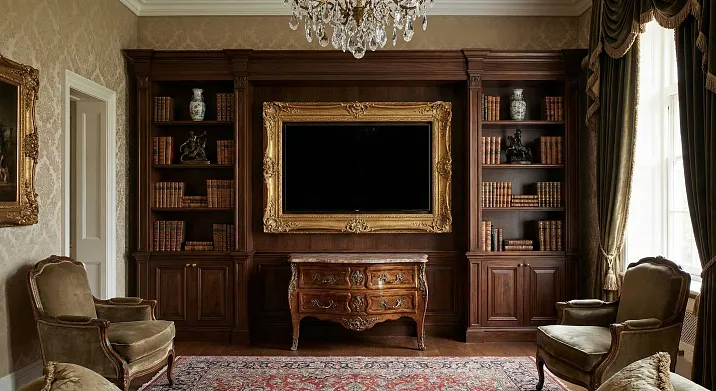
A television in a classic interior is always a challenge. The black screen, technological casing, wires, set-top boxes—all of this clashes with carved consoles, velvet armchairs, gilded moldings. Can modern technology be reconciled with the aesthetics of past centuries without turning the living room into a museum with an alien object? Yes, if you usea TV zone frameas an architectural tool that integrates the screen into the overall composition, connects it withclassic furnitureand transforms the inevitable presence of technology into a decorative element.
A decorative frame around the television works like a portal—it frames the screen, turning it from a technical device into a painting, an element that follows the laws of classical composition. The carving on the frame echoes the carving on the chest of drawers under the TV, the profile of the frame matches the moldings on the walls, and the color and patina support the overall palette. The television ceases to be an alien object and becomes part of a thoughtful interior where every detail is in its place.


Why a frame around the television is needed
Why does a modern flat screen hanging on a wall look out of place in a classic living room? Because it lacks context, a visual connection with its surroundings. A classic interior is built on the repetition of forms, ornaments, materials—each item responds to another. A television without a frame exists on its own, does not participate in this dialogue, and disrupts the integrity.
The frame creates context. It turns the rectangle of the screen into an architectural element that follows the general rules of composition. The profile of the frame—the same moldings as on the walls, the same carving as on the furniture. The color of the frame—matching the wooden elements of the interior or in contrast, but thoughtfully so. The proportions of the frame correspond to the proportions of the molding panels in other parts of the living room. All of this creates visual unity.
Psychologically, the frame calms the gaze. In a classic interior, we expect to see a painting in a frame, a mirror in a frame, a panel in a frame. A television in a frame does not violate this expectation; on the contrary, it satisfies it. When the screen is off, the frame makes it less noticeable—it is not a black hole on the wall, but a framed surface that can be perceived as a dark panel or mirror. When the screen is on, the frame visually limits it, preventing the image from dominating the space.
Functionally, the frame can include shelves, niches for storage, spaces for speakers, or decorative items. This turns the TV zone into a comprehensive solution where technology, storage, and décor are combined in a single structure. There is no need to find separate places for set-top boxes, discs, remotes—everything is hidden inside or next to the frame without disrupting visual cleanliness.




Frame Styling: From Restrained Classicism to Baroque
TV Zone Framemust match the style of the interior; otherwise, instead of integration, there will be conflict. Classicism is not homogeneous—there is strict classicism with straight lines and minimal décor, there is lavish Baroque with an abundance of carving and gilding, there is elegant neoclassicism balancing between restraint and decorativeness. The frame must speak the same language as the rest of the interior.
For strict classicism, frames with a simple profile, geometric moldings, and minimal carving are suitable. A rectangular frame with clear lines, possibly with small corner overlays—rosettes, square elements. The color is restrained—white, cream, natural wood without patina. Such a frame does not draw attention to itself; it works as a frame organizing the space around the screen.
For Baroque, the frame becomes an independent decorative object. A complex profile with multi-level protrusions, abundant carving—acanthus leaves, scrolls, floral garlands. Gilding on the carving, patination, an aging effect. The upper part of the frame may be adorned with a cartouche or crown, the side parts—with vertical overlays or pilasters. Such a frame dominates, turning the TV zone into a focal point of the living room.
Neoclassicism requires balance. The frame has classical proportions but restrained decor. Carving is present but not excessive—small botanical motifs, concise rosettes, strict lines. The color may be light with a slight patina, creating a sense of nobility without opulence. Such a frame is elegant, does not overwhelm the space, yet does not get lost against the furniture.
Proportions are important to consider. The size of the frame is determined by the screen size and ceiling height. In a room with ceilings of 2.7-3 meters, a massive Baroque frame would be overwhelming; it's better to choose a more restrained option. In a hall with ceilings of 3.5-4 meters, a concise frame would get lost; here, an expressive, richly decorated structure is appropriate.
Our factory also produces:


TV console: function and form
A TV rarely hangs on an empty wall—a console, dresser, or low cabinet is usually placed beneath it. This piece of furniture is critical for creating a cohesive TV zone; it must match the frame in style, scale, and color. The console not only stores items but becomes the foundation of the composition, a visual support for the frame and screen.
Stylistic correspondence begins with carving. If the frame has botanical ornaments, the console should also feature carved elements—on the fronts, legs, or plinth. The motifs don't have to be identical but should be related—both use acanthus, both have scrolls, both are executed in the same technique. This creates a visual connection, a sense that the frame and console were made for the same interior.
The proportions of the console are determined by the size of the frame. The width of the console is usually equal to or slightly greater than the width of the frame, creating a stable base. A console that is too narrow will make the frame appear to be floating in the air, without visual support. One that is too wide will break the composition, looking like a separate element unconnected to the TV zone.
The height of the console is usually 60-80 cm, which corresponds to the optimal TV placement height for viewing. A taller console will raise the screen too high, which is uncomfortable. A lower one will create excessive distance between the console and the frame, visually breaking the connection between them.
The color of the console is coordinated with the color of the frame. Both made from natural wood of the same species create material unity. Both painted in the same tone—white, cream, gray—create color unity. A dark console with a light frame, or vice versa, creates contrast, but within a well-thought-out palette where the contrast serves the composition rather than destroying it.
Functionally, the console stores equipment—set-top boxes, media players, routers—hiding them behind the fronts. The back panel of the console should have openings for cables, ensuring ventilation and access. Inside the console, a cable management system can be organized to prevent wires from becoming chaotic. This is practical and maintains visual cleanliness.
Get Consultation
Console: an alternative to a dresser
A console—a narrow table on high legs—is a classic alternative to a dresser under a TV. A console is visually lighter, creates a sense of airiness, and doesn't clutter the space. In small living rooms or where visual lightness is important, a console is preferable to a massive dresser.
The elegant legs of the console—carved or turned—echo the legs of armchairs and tables in the living room. This creates compositional unity at the detail level. The console's tabletop can be made of wood, marble, or glass—depending on the style. For classic styles, wood or marble is preferable; glass is for more modern interpretations.
The width of the console usually matches the width of the frame or is slightly less. The depth of the console is small—30-40 cm—enough to place small items but not create massiveness. The height of the console is 70-90 cm, which allows placing the TV at a comfortable viewing height.
The console may have one or two drawers for storing remotes, discs, and cables. But its main purpose is decorative—vases, figurines, books, and candles are placed on the tabletop. This turns the TV zone into a decorative composition where technology does not dominate but coexists with aesthetic objects.
Paired with the frame, the console acts as a visual base but does not dominate. The frame remains the main element; the console supports it, creating completeness. It is important that the style of both elements is unified—carving, color, and proportions should speak the same language.
Armchairs around the TV zone: creating a viewing area
Armchairs are a key elementof furniture and interior itemsin a living room with a TV. They determine where and how viewing will take place, create comfort, and support the style. The placement of armchairs relative to the TV zone is critical for functionality and visual balance.
Symmetrical arrangement—two armchairs on either side of the console or dresser—creates a classic composition. The armchairs flank the TV zone, framing it like columns frame a portal. This emphasizes the central axis, making the viewing area organized and orderly. The armchairs should be identical or related in style, creating a visual pair.
Asymmetrical arrangement—one armchair to the side, a sofa opposite—is a more relaxed, lived-in composition. The armchair can be an accent, differing in upholstery or shape from the sofa, but remaining within the overall style. This creates dynamism, interest, and prevents the interior from feeling static.
The distance between the armchairs and the TV is determined by the screen size. For a 50-55 inch screen, the optimal distance is 2-2.5 meters. For 65-75 inches—3-3.5 meters. Closer is uncomfortable for the eyes; farther away, image detail is lost. The armchairs should be positioned so that the screen is at or slightly above eye level when seated.
The style of the armchairs is coordinated with the frame and console. The carved armrests of the armchairs echo the carving on the frame. The upholstery of the armchairs—velvet, jacquard, tapestry—corresponds to the overall textile program of the interior. The color of the upholstery can be neutral or accent, but in any case, it should be well-considered and integrated into the overall palette.
Functionally, armchairs should be comfortable for prolonged sitting. A high back supports the neck, wide armrests provide support for the arms, and a soft seat ensures comfort. Classic armchairs usually have well-proportioned dimensions based on centuries of experience, making them ergonomic by nature.
Interior wall decor around the TV zone
interior wall decoraround the TV completes the composition, connecting the TV zone with the rest of the living room space. Moldings, panels, and overlays create an architectural context in which the frame and furniture become part of a unified system, not a random collection of items.
Moldings around the frame form a panel within which the TV zone is located. A rectangular panel made of moldings frames the frame, creating an additional level of structuring. The panel size is 20-40 cm larger than the frame on each side, creating a visual pause, a transition from the frame to the wall. The profile of the panel moldings should match the frame profile or be slightly simpler to avoid competition.
Panels on the wall behind the TV create a background, enhancing the significance of the TV zone. Wooden panels made of oak or beech, painted in a contrasting color, make the zone an accent. Panels can be smooth or paneled, depending on the style. It is important that the panels do not overload the composition; they should work as a background, not as an independent element.
Overlays—carved decorative elements—are placed at key points in the composition. A rosette above the frame, symmetrical overlays on its sides, corner elements in the molding panel—all this enhances decorativeness and creates visual accents. The ornament on the overlays should echo the carving on the frame and furniture.
The color of the wall decor is determined by the overall palette. Moldings in the same tone as the wall create a soft relief, barely noticeable but structuring. Contrasting moldings—white on a colored wall, dark on a light one—create a graphic effect, more expressive. The choice depends on the desired intensity of the accent on the TV zone.
The decor should not be limited to just the wall with the TV. Moldings, panels, and overlays are also used on other walls of the living room, creating unity. But the wall with the TV zone can be slightly more saturated with decor, highlighted, to emphasize its importance as a compositional center.
TV Zone Lighting: Light and Shadow
Lighting is critical for the perception of both the television and the surrounding composition. Incorrect light creates glare on the screen, hides the carving on the frame, and makes the zone uncomfortable for viewing. Proper lighting highlights the architecture, creates atmosphere, and ensures comfort.
General living room lighting — a chandelier or ceiling lights — should be adjustable. During movie viewing, the light is dimmed to avoid creating glare on the screen and to prevent distraction. At other times, the brightness can be higher to highlight the interior.
Accent lighting for the frame — LED strip or spotlights directed at the frame — highlights it, emphasizes the carving, and creates volume. The light should be soft, not creating harsh shadows. The color temperature is warm — 2700-3000K — for classic interiors where coziness is important.
Undercabinet lighting for the dresser or console creates a floating effect, visually lightens the furniture. An LED strip hidden under the lower part directs light onto the floor. This is especially effective in the evening when the main light is dimmed.
Wall sconces on the walls on either side of the TV zone create symmetrical lighting, supporting the classic composition. The installation height of the sconces is at the level of the top of the frame or slightly higher. The design of the sconces should match the interior style — classic lampshades, carved or cast bases.
It is important to avoid direct light on the screen. Fixtures should be positioned so that light falls on the frame, furniture, walls, but not on the screen itself. This prevents glare and ensures comfortable viewing at any time of day.
Color Harmony: From Monochrome to Contrast
The color scheme of the TV zone defines its character — calm and neutral or expressive and dramatic. In a classic interior, color is not just paint, but a system where every shade has meaning and a role.
A monochrome palette — frame, dresser, wall decor in one color or close shades — creates a calm, elegant composition. All white or all cream is a classic solution where the emphasis is on forms, proportions, carving, not on color. The black screen in this palette becomes a graphic accent but does not disrupt the harmony.
A contrasting palette — a light frame on a dark background or a dark frame on a light wall — creates a more expressive composition. Contrast emphasizes architectural lines, makes the frame more noticeable, and turns the TV zone into a focal point. But moderation is important — excessive contrast can be aggressive and tiring.
Accent colors are introduced through textiles — upholstery of armchairs, pillows, curtains. Deep emerald, burgundy, sapphire add luxury but are used sparingly. The TV zone itself — the frame, dresser, wall decor — remains neutral, background, allowing textiles and accessories to create color accents.
It is important to consider how color affects the perception of space. Light tones expand, make the living room more airy. Dark tones compress but add depth and drama. In theliving room 2025 interiorgravitates towards light neutral palettes that create calm, but classic style also allows for more saturated, rich colors.
Hiding Technology: Wires, Set-Top Boxes, Speakers
A modern television rarely exists on its own — it is connected to set-top boxes, media players, gaming consoles, speakers, routers. All of this must be hidden to avoid disrupting the visual purity of the classic interior. Hiding technology is not just practicality, but a necessity for preserving aesthetics.
Wires are hidden in the wall or behind furniture. Ideally, wire routing is planned during the renovation stage — cable channels in the wall, outlets behind the TV at the required height. If the renovation is already done, wires can be hidden behind the dresser or console, run down to the baseboard, disguised with decorative cable channels matching the wall color or moldings.
Set-top boxes and routers are placed inside the dresser, behind closed fronts. It is important to ensure ventilation — the back panel of the dresser should have holes, the fronts should not be airtight. An infrared extender allows controlling the equipment without opening the fronts, preserving visual cleanliness.
Speakers are the most problematic element. Modern soundbars can be placed on the dresser or console, but their design rarely matches classic style. An alternative is built-in speakers in the frame or in panels on the sides of the television, hidden behind decorative grilles. This requires planning, but the result is acoustics that is not seen but heard.
Remotes are stored in a drawer of the dresser or in a decorative box on the countertop. Charging stations are placed inside the furniture, wires should not be visible. Every detail is thought out so that the TV zone looks like part of a classic interior, not a cluster of technology.
Integration with the rest of the interior
The TV zone should not exist in isolation; it is part of the living room and must be integrated into the overall composition. This is achieved by repeating forms, patterns, colors, and materials in different parts of the room.
Moldings on the wall with the television are repeated on other walls, creating rhythm. Panels around the frame echo panels behind the sofa or around windows. The molding profile is uniform throughout the living room, creating integrity.
Carving on the frame finds an echo in the carving on the furniture — not only on the dresser but also on armchairs, tables, consoles. The patterns are not identical but related, using a common visual language. This creates a feeling that all items are created for one space.
The color of the frame and dresser corresponds to the color of other furniture in the living room. If all the furniture is made of natural oak, the TV zone is also oak. If the interior is painted white, the frame and dresser are also white. Exceptions are possible, but they must be justified — an accent TV zone in a contrasting color, standing out but not conflicting.
Textiles — curtains, upholstery of armchairs, pillows — also work towards integration. Fabrics are repeated in different parts of the living room, creating color and texture connections. The upholstery of armchairs in the TV zone echoes the sofa upholstery, curtains contain the same shades as the pillows.
Frequently asked questions
What frame size is suitable for a 55-inch screen?
The frame should be 15-25 cm wider and taller than the screen on each side, creating a visual pause. For 55 inches (diagonal 140 cm, dimensions approximately 122×69 cm) the optimal frame size is 150-170 cm in width and 95-115 cm in height. This creates a proportional framing, does not overwhelm the screen, but also does not get lost against its background.
Can a frame be used with an already installed television?
Yes, frames can be made for an existing television. It is important to accurately measure the screen dimensions and bracket so that the frame fits perfectly. Some frames are mounted directly to the wall around an already hanging television, others require reinstallation of the bracket. It is better to consult with frame manufacturers.
How to choose a frame style to match existing furniture?
Analyze the carving on the furniture—what motifs predominate, floral or geometric, how abundant is the carving. The frame should use similar motifs in the same volume. If the furniture is restrained, the frame should also be restrained. If the furniture is lavish, the frame can be expressive. The frame color is chosen to match the wood tone of the furniture or in contrast, but a thoughtful one.
Is a chest of drawers needed under the TV if there is a frame?
A chest of drawers is functionally necessary for storing equipment and visually creates a base for the composition. A TV in a frame on an empty wall looks unfinished, hanging in the air. A chest of drawers or console underneath completes the composition, connects it to the floor, makes it stable. At a minimum, a console is needed almost always.
How to avoid screen glare from lighting?
Light fixtures should not be directed at the screen. A chandelier over the viewing area is positioned so that light falls on the chairs, not the TV. Sconces are placed on the sides, with light directed at the walls or upwards. During viewing, the main light is dimmed. Anti-glare film on the screen also helps, but proper placement of light fixtures is more important.
Can the frame be painted a different color after purchase?
Yes, wooden frames can be repainted. The surface is first sanded, primed, then paint or patina is applied. This allows adapting the frame to a changed interior. It's better to entrust repainting to professionals to avoid damaging the carving and to get a quality finish. Some manufacturers offer a repainting service.
Conclusion
TV Zone Frame— is not a decorative whim, but a necessary tool for integrating modern technology into a classic interior. It turns the TV from a foreign object into part of the composition, connects it withclassic furniture— chests of drawers, consoles, armchairs — through repetition of forms, ornaments, colors. The frame creates an architectural context in which the screen ceases to dominate, becomes a framed surface, subject to the laws of classical aesthetics.
The choice of frame depends on the interior's style — restrained for classicism, lavish for baroque, balanced for neoclassicism. A chest of drawers or console under the TV completes the composition, creates a visual base, provides functional storage. Armchairs around the TV area determine viewing comfort, support the style through carving and upholstery.interior wall decor— moldings, panels, overlays — connects the TV area with the rest of the living room space, creates architectural unity.
Lighting emphasizes the frame's carving, creates atmosphere, ensures comfortable viewing without glare. Color harmony — monochrome or contrasting — determines the character of the composition, from calm elegance to expressive drama. Hiding technology — wires, consoles, speakers — preserves visual cleanliness, prevents modern devices from destroying the classical aesthetic.
Integration of the TV area into the overall interior is achieved through repetition of elements, creating visual connections between different parts of the living room. The frame does not exist in isolation; it is part of a system where each item responds to another, where forms, ornaments, colors work in unison. This turns a potential problem — the presence of a TV in a classic interior — into a solution where technology and aesthetics do not conflict, but coexist harmoniously.
STAVROS specializes in creatingframes for the TV area, which turn the TV into an organic part of a classic interior. Each frame is made of solid oak or beech, decorated with hand carving, can be painted any color or patinated to create an effect of noble antiquity. A variety of styles — from restrained classic to lavish baroque — allows finding a solution for any interior. RTV-008 frames are distinguished by elegant proportions, refined carving, built-in shelves and glass doors, which add functionality and visual complexity.Classic Furniture— STAVROS — chests of drawers, consoles, armchairs, tables — is created in the same stylistic key as the frames, ensuring compositional integrity. The possibility of customization — manufacturing frames and furniture to individual sizes and design — opens the way to creating unique TV areas, fully corresponding to your vision.Furniture and interior itemsfrom STAVROS — is an investment in quality, durability, and aesthetic perfection that will delight for decades. Professional designers will help select a frame, furniture, and wall decor, creating a TV area where modern technology does not disrupt the harmony of the classic interior, but becomes part of it. Let your living room become a space where past and present coexist in perfect balance, where the TV is not a foreign blot but a framed element of a thoughtful composition, where every detail speaks of your taste and understanding of true beauty.