Article Contents:
- Neurophysiology of Rhythm: How the Brain Processes Repeating Structures
- Golden Ratio in Slat Spacing: The Mathematics of Harmony
- The Influence of Slat Thickness on Spatial Perception
- Vertical Slats and the Sensation of Height: Optical Illusions
- Order, Symmetry, and the Perception of Quality
- The 'Visual Metronome' Effect: Rhythm as a Perception Timer
- Psychology of Wood Color and Texture: Naturalness as a Status Marker
- Zoning Space with Rhythm: How Slats Divide Without Partitions
- Light, Shadow, and Volume: How Slats Create Three-Dimensionality
- Acoustics: How Slats Affect the Sound of a Space
- Choosing Wood Species: From Pine to Oak
- Installation: From Battens to Adhesive
- Frequently Asked Questions

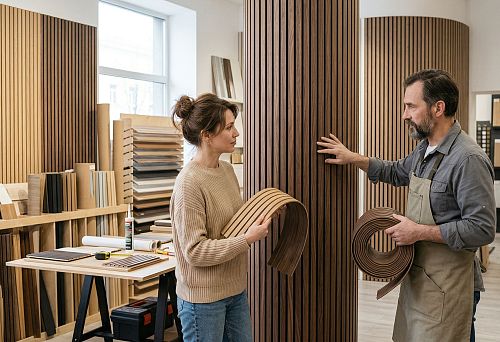
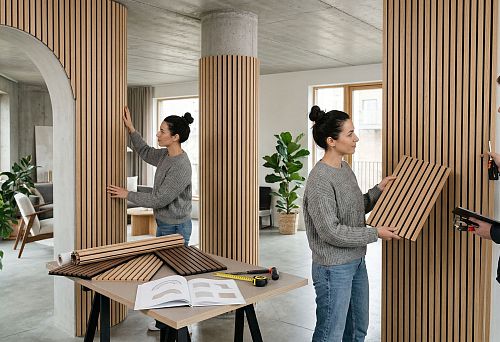
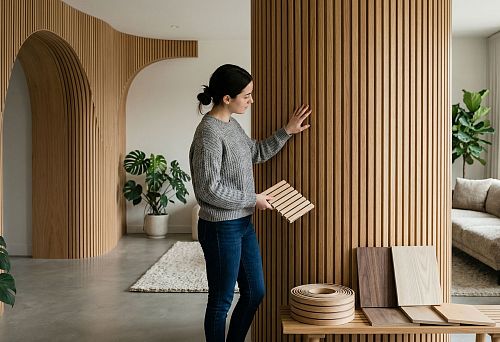
The wall is covered in white paint. A neutral, boring, silent surface that the eye glides over without stopping. Now the same wall, but withwith wooden boards in the interior— vertical oak slats 40 millimeters wide, installed at 60-millimeter intervals, from floor to ceiling at a height of 2.7 meters. What has changed? Formally — 45 slats have been added. In reality — the entire character of the space has changed. The wall has ceased to be a background, transforming into an architectural object. The eye catches the rhythm of the verticals, reading it like a musical score, where each slat is a note, and the intervals between them are pauses. The brain recognizes repetition, symmetry, order and instantly sends a signal: this is expensive, this is quality, this is well-considered. Why?
Neurophysiology of rhythmic structure perception explains that the human brain is evolutionarily tuned to seek patterns, regularities, repetition — a survival mechanism that allowed ancestors to recognize threats (a predator moves rhythmically), find resources (a fruit tree grows vertically), and navigate space (vertical tree trunks create structure). The modern brain retains this tuning. When the eye sees a rhythmic structure —Racks on the Wall, columns, arches, stripes — the cortical areas responsible for pattern recognition, prediction, and reward are activated. The brain derives pleasure from predictability (the next slat will be in 60 millimeters — correct, expectation confirmed, dopamine), from order (all slats are the same width — the system is stable), from completeness (the last slat reaches the ceiling — the composition is finished).
Vertical lines are perceived by the brain as symbols of growth, upward movement, aspiration to the sky — archetypes ingrained over millennia of observing trees, mountains, towers, temples. Verticality is associated with strength (a column holds up a roof), dignity (a person stands vertically), stability (a vertical structure is more stable than a horizontal one). Therefore,Modern interiorwith vertical slats is subconsciously perceived as more status-oriented, expensive, and well-considered than a similar one without them. This is not a rational assessment (slats cost 1500-3000 rubles per linear meter, a 10-square-meter wall requires 15,000-30,000 — not an astronomical sum), but an emotional, intuitive, instantaneous one. The eye saw the rhythm of verticals — the brain read: luxury.


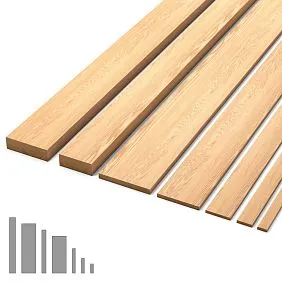

Neurophysiology of Rhythm: How the Brain Processes Repeating Structures
Rhythm — the temporal or spatial repetition of elements with predictable intervals. Musical rhythm: a drumbeat every second. Visual rhythm: a slat every 60 millimeters. The brain processes rhythm in several zones simultaneously: the visual cortex recognizes the repetition of elements (slats are identical), the parietal cortex measures intervals (the 60 mm spacing is constant), the prefrontal cortex predicts continuation (the next slat will be in 60), the limbic system assesses emotional significance (order is pleasant, chaos is anxiety-inducing).
Studies in neuroaesthetics (the neuroscience studying the perception of beauty) show that regular rhythmic patterns activate the dorsolateral prefrontal cortex — an area associated with the feeling of pleasure from predictability. When the brain sees a slat, it instantly predicts: the next one will be in 60 millimeters. If the expectation is confirmed (the next one is indeed in 60), dopamine — the reward neurotransmitter — is released. If the expectation is not met (the next one is in 80 or missing), dissonance arises, a slight anxiety, a feeling of incompleteness. Therefore, a wall with evenly spacedslats on a wallis perceived as more harmonious, pleasant, and calmer than a wall with uneven spacing (unless it's a deliberate artistic technique, but a mounting error).
The 'visual metronome' effect — a term describing how rhythmic vertical structures set the pace, speed, and dynamics of spatial perception. A metronome in music beats regular strokes, synchronizing performance. Slats in an interior perform a similar function: they set the rhythm along which the eye glides along the wall, reading one-two-three-four, like a musician reading measures. A fast rhythm (20 mm wide slats with 30 mm spacing) creates a fast tempo — dynamism, activity, restlessness. A slow rhythm (60 mm slats with 120 mm spacing) creates a slow tempo — calm, solidity, monumentality. A medium rhythm (40 mm slats with 60 mm spacing) — a balance between dynamism and tranquility, optimal for residential interiors where activity without aggression is important.
Why are vertical slats perceived as more luxurious than horizontal ones? Verticality requires greater room height for visual expressiveness. A vertical slat 2.7 meters high (from floor to ceiling) creates a long continuous line that the eye reads entirely from bottom to top, sensing scale. A horizontal slat 3 meters long (along the wall) is read from left to right but does not create a sensation of height, aspiration. Verticality visually raises the ceiling (the eye follows upward, the ceiling seems higher), horizontality expands the wall (the eye follows along, the wall seems longer). Verticality is associated with the architecture of palaces, temples, where height symbolizes power, wealth (high ceilings — a sign of status, low ones — of poverty). Horizontality is associated with earthliness, practicality, modesty. Therefore, verticalWooden boards in interiorare read by the brain as more premium, status-oriented, luxurious.




Golden Ratio in Slat Spacing: The Mathematics of Harmony
The Golden Ratio (φ, phi, approximately 1.618) — a mathematical proportion found in nature (the spiral of a nautilus shell, the arrangement of sunflower seeds, the proportions of the human body) and art (the facade of the Parthenon, paintings by Leonardo da Vinci, compositions by Bach). The Golden Ratio is perceived by the brain as harmonious, natural, pleasant — an evolutionary tuning related to recognizing natural patterns signaling safety and abundance. When an object's proportions are close to the Golden Ratio, the visual cortex processes them faster, the prefrontal cortex evaluates them as pleasant, and the limbic system releases dopamine. When proportions are far from the Golden Ratio (too elongated or squashed), processing slows down, slight discomfort arises, a feeling of 'something is wrong'.
How to apply the golden ratio to batten spacing? Consider the ratio of batten width to the gap width between battens. If a batten is 40 millimeters wide, the gap according to the golden ratio should be 40×1.618 ≈ 65 millimeters. The total pitch (batten + gap) = 40+65 = 105 millimeters. On a wall 3000 millimeters wide, 3000÷105 ≈ 28 battens fit. Alternative calculation: if the gap is 40 mm, the batten according to the golden ratio should be 40÷1.618 ≈ 25 mm. Pitch 25+40 = 65 mm, on 3000 mm, 46 battens fit — a more frequent rhythm.
In practice, designers rarely calculate the golden ratio precisely but intuitively aim for proportions close to 1.5-1.7 between the batten and the gap. Popular combinations: batten 30 mm + gap 50 mm (ratio 1.67, close to φ), batten 40 mm + gap 60 mm (1.5, slightly below φ), batten 50 mm + gap 80 mm (1.6, almost exactly φ). These proportions are perceived as more harmonious than equal ones (batten 40 + gap 40 = ratio 1.0 — too regular, monotonous) or too contrasting ones (batten 20 + gap 100 = 5.0 — disjointed, chaotic).
An interesting effect occurs when the golden ratio is applied not to batten spacing but to dividing a wall. A wall 2.7 meters high is divided by the golden ratio into two parts: the lower part 2700÷1.618 ≈ 1670 mm, the upper part 2700-1670 = 1030 mm. If the batten panel occupies only the lower part (from the floor to a height of 1670 mm), the composition is perceived as more harmonious than at an arbitrary height (e.g., 1500 or 2000 mm). The upper part of the wall remains smooth painted, the lower part — textured with battens. Such division is visually 'correct,' the brain reads it as complete, balanced.
Why is the golden ratio perceived as harmonious? Neuroaesthetics hypothesis: the brain is evolutionarily tuned to recognize the golden ratio because it occurs in natural objects associated with life, growth, reproduction (plants, animals, humans). An object with golden ratio proportions is subconsciously read as 'alive,' 'natural,' 'healthy.' An object with disrupted proportions — as 'artificial,' 'dead,' 'incorrect.' ThereforeRacks on the Wallspacing close to the golden ratio is perceived as more pleasant, luxurious, higher quality than with arbitrary spacing, even if the observer is unaware of the golden ratio and cannot articulate why one wall is liked and another is not.
Our factory also produces:


The influence of batten thickness on space perception
Thickness (width) of a batten determines the visual weight, massiveness, dominance of the batten structure. Thin battens 20-30 millimeters wide create a light, airy, graphic texture — lines are noticeable but not overwhelming, the wall remains airy. Medium battens 40-50 mm create a balanced texture — expressive enough to be an accent, delicate enough not to overload. Thick battens 60-80 mm create a massive, monumental, sculptural texture — battens dominate, the wall turns into an architectural object, a relief.
Psychological perception of thickness: thin battens are associated with elegance, sophistication, modernity (minimalism, Scandinavian style, Japanese), thick ones — with solidity, tradition, reliability (loft, rustic, brutalism). Thin battens are suitable for small rooms 12-20 square meters, where thick ones would overload the space. Thick battens are optimal for spacious rooms 30-60 sq.m, high ceilings 3.0-4.0 meters, where thin ones would get lost, appear fragile, disproportionate to the scale.
Influence of thickness on rhythm: with the same pitch (batten + gap = 100 mm), a thin batten of 20 mm creates a rhythm of 20:80 (batten occupies 20% of the pitch, gap 80%), a thick one of 60 mm — a rhythm of 60:40. The first rhythm is light, fast, almost transparent — the wall 'breathes,' visible through the gaps. The second rhythm is dense, slow, heavy — the wall is 'closed,' gaps are narrow, battens dominate. Visually, thin battens with wide gaps expand the space (a lot of air between lines), thick ones with narrow gaps compress it (little air, a lot of mass).
Thickness also influences tactile perception, although battens are usually not touched by hand (installed high). But the brain predicts tactile sensations visually: a thin batten feels smooth, sliding, cold (metal, glass), a thick one — warm, rough, massive (wood, stone). Even if both battens are made of oak, a thick 60 mm one is perceived as 'warmer,' 'more wooden,' than a thin 20 mm one, because more material is visible, more texture, more mass.
Interesting effect: variable batten thickness on one wall (e.g., alternating thin 30 mm and thick 50 mm) creates a complex, irregular rhythm, visual intrigue, dynamics. The eye cannot predict the next batten (will it be thin or thick?), the prefrontal cortex activates more strongly (needs to analyze the pattern), the limbic system releases dopamine from novelty. But such a technique requires skill: an incorrect sequence will create not intrigue but chaos. It is optimal to alternate in golden ratio proportion: two thin, one thick (2:1 ≈ φ), or three thin, two thick (3:2 ≈ φ).
Get Consultation
Vertical battens and the sensation of height: optical illusions
Vertical lines visually raise the ceiling — a classic architectural technique known for millennia (columns of Greek temples, Gothic vaults, skyscrapers). Mechanism: the eye follows the vertical line from bottom to top, reaches the ceiling, the brain records the height as significant (because the eye traveled a long way up). Horizontal lines visually lower the ceiling (the eye moves horizontally, does not reach the ceiling, height is not emphasized). Absence of lines (smooth wall) is neutral (height is perceived realistically, without enhancement, without lowering).
Experimental verification: room 4×5 meters, ceiling height 2.7. Wall A — smooth white. Wall B — vertical oak battens 40 mm with a pitch of 60, from floor to ceiling. Subjects are shown the walls in turn, asked to visually estimate the ceiling height. Average estimate for wall A: 2.65 meters (slightly underestimated). For wall B: 2.85 meters (overestimated by 15 centimeters). Objective height is the same, but vertical battens create an illusion of additional height.
Why is height important? High ceilings are associated with status, luxury, prestige (palaces, mansions, penthouses have ceilings 3.5-5.0 meters), low ones — with poverty, crampedness, discomfort (Khrushchev-era apartments, barracks, basements — ceilings 2.4-2.5). Therefore, a technique that visually raises the ceiling instantly increases the perceived value of the space.Wooden boards in interiorVertical battens perform this function: a room with 2.7-meter ceilings, clad in vertical battens, is perceived as more spacious, expensive, status-worthy than an identical one without battens.
Additional effect: vertical battens structure the space vertically, creating visual 'floors.' If battens run from the floor to a height of 1.5 meters (panel zone), then interrupt, then continue from 2.0 to 2.7 (zone under the ceiling), a three-level composition is created: lower level (batten panel), middle (smooth wall), upper (batten strip under the ceiling). The brain reads this as complex architecture, multi-layeredness, thoughtfulness — signs of luxury (simplicity is cheap, complexity is expensive).
Opposite effect: horizontal battens visually widen the wall but lower the ceiling. Horizontal lines force the eye to move along the wall left to right, not upward. The ceiling remains out of focus, seems closer, lower. Horizontal battensRacks on the Wallare suitable for narrow long spaces (corridors, galleries), where visual widening is needed, not raising. But for living rooms, bedrooms, studies, where height is important (creates a sense of freedom, air, spaciousness), vertical battens are preferable.
Order, symmetry, and the perception of quality
The human brain is evolutionarily tuned to value symmetry, order, regularity — signs of health, stability, reliability. A symmetrical face is perceived as more beautiful than an asymmetrical one (symmetry signals genetic health). A symmetrical building is perceived as more solid than an asymmetrical one (symmetry signals thorough construction, durability). A regular rhythm of battens is perceived as higher quality than an irregular one (regularity signals installation precision, professionalism).
Why is order associated with luxury? Because creating order requires effort, time, resources. Installing battens with a perfectly equal pitch of 60 millimeters on a wall 3 meters long is more difficult than installing them with an approximately equal pitch (58-62 mm). It requires marking, measuring, alignment, control — an additional 2-3 hours of the craftsman's work. If the client is willing to pay for these hours, they value quality, perfectionism, details — signs of high status. If not, they accept approximation — a sign of economy, haste, low standard. The brain reads the uniformity of batten pitch as an indicator: expensive object (craftsman spent time) or cheap one (craftsman rushed).
Symmetry enhances the effect: if a batten panel occupies the central part of the wall symmetrically (equal sections of smooth wall remain on the left and right), the composition is perceived as complete, balanced, harmonious. If the panel is shifted left or right asymmetrically (accidentally or due to an error), slight discomfort arises, a feeling of incompleteness. Symmetry is not mandatory for modern interiors (asymmetry can be an artistic technique), but if symmetry is broken unintentionally, the brain records it as a defect.
Interesting neuroaesthetics research: subjects were shown images of interiors with regular and irregular rhythmic structures (battens, stripes, tiles), brain activity was measured using fMRI. Regular rhythms activated the medial prefrontal cortex — an area associated with the sensation of pleasure, reward, positive evaluation. Irregular rhythms activated the anterior cingulate cortex — an area associated with error detection, conflicts, anxiety. Conclusion: the brain derives pleasure from regularity, becomes anxious from irregularity, even if it does not consciously notice the difference.
The 'visual metronome' effect: rhythm as a perception timer
A metronome in music sets the tempo: 60 beats per minute — slow, calm, 120 — fast, energetic, 180 — very fast, anxious. A visual metronome (rhythmic battens) performs a similar function: sets the speed at which the eye 'reads' the space. A frequent rhythm (battens 20 mm with a pitch of 30, 33 battens per meter of wall) — a fast metronome, the eye quickly switches from batten to batten, the brain processes a lot of visual information per unit time, a sensation of dynamics, activity, restlessness arises. A rare rhythm (battens 60 mm with a pitch of 120, 8 battens per meter) — a slow metronome, the eye slides slowly, the brain processes little information, a sensation of calm, monumentality, stasis arises.
Optimal rhythm for residential interiors: medium (battens 40 mm with a pitch of 60-80, 12-16 battens per meter) — a balance between activity and rest. Dynamic enough not to be boring, calm enough not to irritate. For offices, coworking spaces, cafes, a more frequent rhythm is suitable (stimulates activity, communication, work). For bedrooms, libraries, meditation spaces — a rarer one (calms, promotes concentration, rest).
The visual metronome influences time perception: a space with a frequent rhythm seems 'faster' (time flows more intensely, many events), with a rare one — 'slower' (time stretches, few events). This is a subjective sensation, not measurable by clocks, but affecting comfort. A person spending 8 hours in an office with a frequent batten rhythm gets more tired than in an office with a rare rhythm or without battens — visual information overload. A person sleeping in a bedroom with a rare batten rhythm sleeps deeper than in a bedroom with a frequent one — the brain is not distracted by processing the rhythm.
Rhythm also synchronizes movement: a person walking along a wall with vertical battens involuntarily synchronizes their step with the rhythm of the battens (the foot lands when the eye passes the next batten). If the rhythm coincides with the natural walking pace (60-80 steps per minute, step 80-100 cm, battens with a pitch of 8-10 cm at eye height create a rhythm of 8-10 'beats' per step), pleasant synchronization occurs — a sensation of harmony, ease of movement. If the rhythm does not coincide (too frequent or rare), synchronization is disrupted, slight discomfort arises.
Psychology of wood color and texture: naturalness as a status marker
Wood is a material evolutionarily linked to safety, resources, and life. Ancestors built shelters from wood, made fire by rubbing wood, and fed on tree fruits. The modern brain retains a positive association: wood = warmth, protection, nature, life. Plastic, metal, concrete = cold, artificiality, technology, death (a hyperbole, but the emotional assessment is precisely that). Therefore,Wooden boards in interiorare perceived as warmer, cozier, and more humane than plastic, metal, or painted MDF (although MDF is also made from wood, its texture is hidden by paint).
The natural texture of wood (annual rings, medullary rays, color variations) is a marker of authenticity, quality, and expense. The texture is unique: each slat differs in pattern because it is cut from different parts of the trunk. The brain recognizes uniqueness as value (unique = rare, mass-produced = cheap). A painted surface (MDF enamel) is uniform: each slat is identical, with no pattern. The brain recognizes uniformity as mass production, industrialism, cheapness.
The color of wood influences perception: light species (ash, natural beech, whitewashed oak) are associated with purity, modernity, Scandinavian style, and eco-friendliness. Medium tones (natural oak, walnut) — with classicism, solidity, and tradition. Dark tones (fumed oak, wenge, black) — with luxury, drama, and premium status. The most expensive interiors use either very light wood (rare, requires selection, 30-50% more expensive than medium tones) or very dark wood (requires deep staining, multi-layer finishing, 40-60% more expensive). Medium tones are more affordable but less status-oriented.
Tactile texture (roughness, smoothness) is also important, although slats are usually not touched. But the brain predicts tactility visually. Slats with a matte oil finish are perceived as warm, alive, and tactilely pleasant (you want to touch them). Slats with glossy varnish are perceived as cold, glass-like, and distant (you don't want to touch them, they are slippery). ModernArchitectural decorationprefers matte finishes (naturalness, eco-friendliness, and tactility are valued higher than gloss).
Zoning space with rhythm: how slats divide without partitions
Classic zoning involves partitions made of drywall, glass, or sliding doors. Problems: a partition blocks light (darkens the far zone), air (disrupts circulation), and visual connection (zones are isolated, space is fragmented). Slat zoning — verticalRacks on the Wallor a freestanding slat partition — divides space visually, but not physically. Light passes through the gaps between the slats (if the gap is 60 mm and the slat is 40 mm, then 60% of the area is transparent), air circulates freely, and visual connection is preserved (you can see through the slats, but not clearly — zones are separated but connected).
Psychological mechanism: the brain perceives the vertical structure of slats as a boundary, a barrier (the archetype of a palisade, a fence), but simultaneously as permeable (gaps between slats = passages). Ambivalence arises: zones are different (on this side of the slats is the living room, on that side is the dining room), but unified (light, air, and gaze pass freely). This feeling of unity in separation is optimal forof modern interioropen-plan layouts (studios, lofts, apartments without partitions), where functional differentiation is needed without isolation.
A slat partition emphasizes zoning with rhythm: a person moving from the living room to the dining room through a slat partition feels a change in rhythm (first open space, then vertical lines of slats "pulsate" around, then open space again). This visual marker is psychologically stronger than simply changing wall color or floor material (less noticeable). Slats create an event, a ritual of transition — "I am crossing a boundary, entering another zone." This increases awareness and reduces the chaos of open-plan layouts (where everything is mixed, boundaries are blurred, functions get confused).
Additional effect: a slat partition hides what should not be constantly visible (kitchen area, work desk, sleeping area in a studio), but does not isolate completely (like a solid wall). Someone looking from the living room sees the slats, vaguely discerns the kitchen through the gaps — the kitchen is present but does not dominate visually. This is delicacy, tactfulness, characteristic ofinterior psychologyof Japanese, Scandinavian type, where directness (a solid wall — "kitchen is completely hidden") and openness (absence of a wall — "kitchen is fully visible") are extremes, and the golden mean is semi-transparency.
Light, shadow, and volume: how slats create three-dimensionality
A smooth painted wall is flat, two-dimensional. Light falls on it uniformly, reflects uniformly, there is no shadow (if the wall is not textured with plaster). The eye perceives it as a neutral background, does not linger. A wall with vertical slats is relief-like, three-dimensional. Light falls on the slats, creating shadows in the gaps (if a slat protrudes 20 mm from the wall, a gap depth of 20 creates a shadow 10-15 mm wide with side lighting). Shadows create volume, depth, movement. The eye perceives the wall as an active object, lingers, explores.
Light dynamics: natural light from a window changes throughout the day (low side light in the morning, overhead at noon, side again in the evening), shadows on the slats move, change in length and intensity. The wall "lives" — in the morning, slats cast long horizontal shadows to the right, in the evening to the left, at noon short vertical ones. This is a picturesque effect, characteristic of architecture (Gothic cathedrals, where columns and arches create a play of light and shadow), transferred to the interior.Wooden boards in interiorturn the wall into an architectural element, comparable to columns, pilasters, friezes.
Artificial lighting enhances the effect: spotlights directed along the slatted wall from above or below create dramatic long shadows (a 2.7-meter-high slat casts a shadow 1-2 meters long with a light fixture 20 cm from the floor). This is theatricality, staginess, characteristic of premium interiors of restaurants, hotels, showrooms. Residential interiors rarely use such dramatic lighting (too expressive for daily life), but moderate lighting (fixture 1 meter from the floor, shadows 30-50 cm long) is quite appropriate.
Light color influences the perception of slats: warm light (2700-3000K, yellowish) enhances the warm tone of wood (natural oak becomes golden, cozy), cold light (4000-5000K, white) enhances texture and graphic quality (natural oak becomes gray-brown, modern). Designers recommend warm light for classic, Scandinavian, country interiors (where wood should be warm, alive), and cold light for minimalism, loft, high-tech (where wood should be neutral, graphic).
Acoustics: how slats affect the sound of a space
Smooth hard surfaces (concrete, glass, tile, painted drywall) reflect sound almost completely — creating echo, reverberation, acoustic discomfort (voices sound hollow, music gets smeared, footsteps are loud). Soft porous surfaces (carpets, curtains, upholstered furniture, acoustic panels) absorb sound — creating deadness, sounds are muffled, acoustics are "dead." Wooden slats are an intermediate option: wood partially absorbs sound (porous structure, especially in pine, ash), partially reflects (hard surface), and gaps between slats scatter sound (sound waves pass through, reflect off the back wall at an angle, return unevenly).
Acoustic effect of a slatted wall: reduces reverberation by 20-40% compared to a smooth wall (depends on gap width, slat thickness, wood species). Sound becomes cleaner, clearer, more comfortable for speech and music perception. Especially noticeable in rooms with high ceilings (3.0+ meters), large area (40+ square meters), and hard materials (concrete, glass), where acoustics are initially problematic. A slatted wall covering 10-15 square meters significantly improves acoustics without installing special acoustic panels (expensive, often unattractive).
Psychological perception of acoustics: a space with good acoustics (voices sound natural, music is clear, footsteps are not hollow) is perceived as more comfortable, expensive, and higher quality than one with poor acoustics (hollow echo is associated with an empty warehouse, train station, basement — low-status spaces).Racks on the Wallimprove not only visual perception (rhythm, texture) but also acoustic perception — a comprehensive enhancement of environmental quality.
Interesting application: home theaters, music rooms, recording studios often line walls with wooden slats not only for aesthetics but also for acoustics. Slats with 40-60 mm gaps work as diffusers — they scatter sound evenly throughout the room, preventing standing waves (acoustic resonances at certain frequencies that create humming, booming). Professional acoustic panels cost 5000-15000 rubles per square meter, wooden slats 2000-4000 — cheaper, more beautiful, more functional.
Choosing wood species: from pine to oak
Pine — an affordable species (slats 2000-2500 rubles per square meter of installed wall), soft (density 500 kg/m³), light (yellow-white), resinous. Pine slats are easy to install (lightweight, bend without cracking) but scratch easily, dent, and yellow from UV light (after 2-3 years in sunlight, they become amber). Pine is optimal for temporary projects, country houses, budget interiors where price is important, and durability is not critical. For premium interiors, pine is not prestigious or solid enough.
Beech — mid-range (slats 3000-4000 rubles per square meter), a hard species (density 650 kg/m³), uniform texture (fine pores, almost no visible pattern), light pink color. Beech slats are durable (withstand impacts, do not scratch easily), take finishes well (accept stains, enamels evenly), but are hygroscopic (absorb moisture, swell with humidity fluctuations of 40-70%, require a stable microclimate). Beech is optimal for interior spaces with heating, ventilation, where a balance of price and quality is needed, along with the possibility of painting.
Ash — similar to oak in hardness (density 700 kg/m³), lighter (white-yellow, cream), with a pronounced contrasting texture (dark annual rings on a light background). Ash slats are elastic (withstand bending, vibrations better than oak), beautiful (texture is more noticeable than natural oak), modern (light wood is characteristic of Scandinavian, Japanese, minimalist styles). Price is comparable to oak (slats 4000-5500 per square meter).
Oak — a premium species (slats 5000-7000 rubles per square meter), the hardest (density 750 kg/m³), with an expressive texture (large pores, medullary rays, color iridescence). Oak slats withstand mechanical loads, are moisture-resistant (contain tannins), durable (50+ years without degradation), prestigious (oak is a symbol of solidity, status). OakWooden boards in interior— the choice for premium projects, classic, English, study styles.
Installation: from battens to adhesive
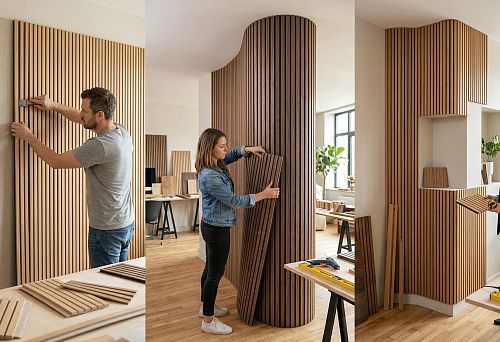
Mounting slats on battens is the classic method. Battens are horizontal 40×20 mm bars, attached to the wall with dowels at 50-70 cm vertical intervals (on a 2.7-meter-high wall — 4-5 horizontal bars). Slats are attached to the battens with screws, nails, or clips (metal brackets, invisible from the outside). Advantages of battens: reliability (slats hold firmly, do not peel off), leveling capability (battens compensate for wall irregularities up to 20 mm), ventilated gap (air circulates between the wall and slats, preventing mold, fungus). Disadvantages: labor-intensive (installing battens + installing slats takes 6-10 hours per 10 square meters), space reduction (battens "consume" 40-50 mm of room depth).
Adhesive mounting is the modern method. Polyurethane adhesive or liquid nails is applied to the back of the slat in a zigzag pattern, the slat is pressed against the wall, held for 1-2 minutes until it sets. Advantages: speed (installing 10 square meters takes 3-5 hours), space saving (adhesive thickness of 2-3 mm does not reduce depth), aesthetics (fasteners are not visible, surface is smooth). Disadvantages: requires a perfectly flat wall (irregularities over 3-5 mm create gaps, slats peel off), impossibility of removal (glued slats cannot be removed without damage), risk of peeling (if adhesive is low-quality, wall is dusty, slats will peel off in a year or two).
Combined method — adhesive + screws. Adhesive provides adhesion over the entire area, screws (1-2 per slat, screwed in from the top, heads countersunk, covered with wood-colored plugs) act as insurance against peeling. The combined method is optimal for heavy thick slats 60-80 mm, long slats 3+ meters, walls with minor irregularities of 3-10 mm.
Hidden clip fastening is the premium method. Clips (metal brackets) are attached to the battens with screws, the slat is fitted onto the clips via a side groove, the next slat covers the clips — fasteners are completely invisible. Advantages: aesthetics (no screws or plugs visible), possibility of removal (slats can be taken off, clips remain). Disadvantages: high cost (clips cost 30-50 rubles each, 200-300 pieces needed per 10 square meters = additional 6000-15000), complexity (requires milling a groove on the slats, increasing slat cost by 20-30%).
Frequently asked questions
Why do vertical slats appear more expensive than horizontal ones?
Vertical lines visually raise the ceiling, create a sense of height, upward aspiration — archetypes associated with palaces, temples, high status. Horizontal lines widen the wall but do not create a sense of height, associated with groundedness, practicality. The brain is evolutionarily tuned to value height as a sign of resources, safety (a tall tree is visible from afar, a high mountain protects from enemies). Therefore, verticalRacks on the Wallare subconsciously read as more status-oriented.
What gap between slats is optimal for perception?
The golden ratio (φ ≈ 1.618) between slat width and gap width creates a harmonious rhythm: slat 40 mm, gap 65 mm (ratio 1.625). Practically, proportions of 1.5-1.7 are popular: slat 30 + gap 50 (1.67), slat 40 + gap 60 (1.5), slat 50 + gap 80 (1.6). These ratios are perceived as more pleasant than equal (1.0 — monotonous) or too contrasting (3.0+ — disjointed).
How much does it cost to clad a wall with wooden slats?
Material (oak slats 40×20 mm): 5000-7000 rubles per square meter of installed wall (depends on gap width — the wider, the fewer slats needed). Craftsman labor: 2000-4000 rubles per square meter (mounting on battens is more expensive, on adhesive is cheaper). Battens, fasteners, adhesive: 500-1000 per square meter. Total for a 10-square-meter wall: material 50,000-70,000 + labor 20,000-40,000 + consumables 5000-10000 = 75,000-120,000 rubles. Expensive, but the effect is disproportionate to the cost — the wall transforms from a neutral background into an architectural object, a center of attention, a status marker.
How to care for wooden panels?
Wipe with a dry microfiber cloth once a week (dust gets trapped in gaps, spoils appearance). Vacuum with a narrow attachment once a month (extracts dust from gaps). Refresh the finish once a year: oiled slats — wipe with oil (1 coat), varnished slats — polish with polish. Avoid wet cleaning with excess water (wood absorbs moisture, swells). Avoid direct sunlight (ultraviolet fades wood, especially light species — after 3-5 years ash, beech yellow).
Can slats be installed in bathrooms, kitchens?
In bathrooms — not advisable (high humidity 70-90%, wood absorbs, swells, molds). If installing — only from moisture-resistant species (larch, teak, oak), with protective treatment of yacht varnish in 4-5 coats, with a ventilated gap behind the slats (battens + 20-30 mm gap). In kitchens — acceptable, but away from the stove, sink (splash, grease, steam zone