Article Contents:
- What Are Flexible Panels and How Do They Differ from Regular Ones
- Flexible Panel Construction: How It Works
- Fabric Base: What It Is and Why It's Important
- The Role of Slat Pitch and Its Precision
- Rigid Panel vs. Flexible: Where Each Excels
- How Flexible Panel Production Works
- Stage 1. Selection and Preparation of Raw Materials
- Stage 2. Slat Milling
- Stage 3. Sanding
- Stage 4. Gluing battens to fabric base
- Stage 5. Priming (for MDF)
- Stage 6. Geometry and batch quality control
- Stage 7. Packaging
- What materials are used in flexible panel production
- MDF for painting
- Solid oak
- Oak
- Flexible base: polyester or fiberglass
- Adhesive system
- Why production quality is visible already in the construction
- Batten spacing stability
- End flatness
- Quality of sanding
- Batch uniformity
- Panel behavior on radius
- Module joining quality
- What flexible panels can be ordered from the manufacturer
- Flexible panels with solid wood finish
- Flexible MDF panels for painting
- Flexible panels for columns and arches
- Flexible panels for radius walls
- Flexible panels for furniture fronts
- For commercial projects to order
- When to order flexible panels from production rather than choosing a serial analog
- Non-standard radius
- Project for a specific color
- Complex geometry with multiple transitions
- Batch repeatability requirements
- Design and architectural projects
- How to choose a flexible panel manufacturer: a practical checklist
- Check the construction
- Clarify available slat materials
- Ask about readiness for finishing
- Request a sample
- Clarify the possibility of manufacturing for a non-standard project
- Check experience with radius surfaces
- Read about installation on the website
- What affects the price of flexible panel production
- Slat material
- Availability and type of priming
- Profile and width of the slat
- Module dimensions
- Order volume
- Finishing
- Logistics
- Mistakes when choosing a flexible panel manufacturer
- Look only at the price
- Do not specify the type of base
- Do not check preparation for painting
- Ignore party consistency
- Do not ask about radius and docking
- Confuse flexible panels with rigid ones
- Flexible panel production: B2B logic and project work
- What is important for a designer
- What is important for a contractor
- What is important for a commercial customer
- FAQ — answers to popular questions about flexible panel production
- Who produces flexible panels in Russia?
- How are flexible panels produced?
- What are flexible panels made of?
- Can flexible panels be ordered in custom sizes?
- How to choose a manufacturer of flexible panels?
- Are there flexible MDF panels on a fabric base?
- What affects the production price of flexible panels?
- What is the minimum radius for flexible slat panels?
- Can flexible MDF panels be painted on-site independently?
- How to join flexible panels so the pattern is continuous?
- Are flexible panels suitable for exterior facade cladding?
- How to store flexible panels before installation?
- Are there flexible wood-look panels from the manufacturer with oil finish?
- How much do flexible panels from the manufacturer cost?
- When is it better to order flexible panels from production rather than buying ready-made ones?
- Conclusion: why production is more important than appearance
- About the Company STAVROS
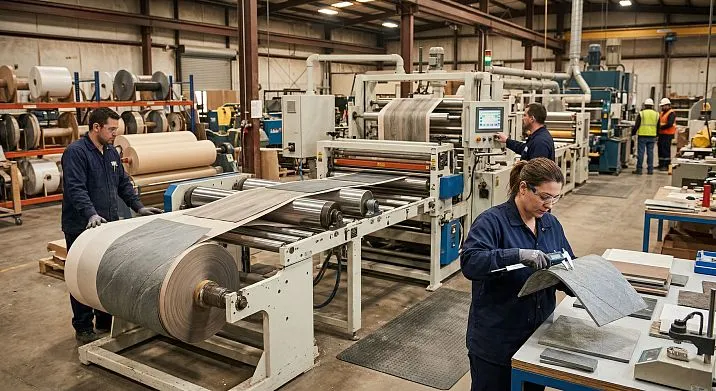
If you've ever held a poor-quality slatted panel in your hands — you understood it immediately. Slats with uneven spacing. Fabric backing with bubbles. Ends that don't align when joined. All of this is not a coincidence or a defect of a specific item. It's a direct consequence of production culture, which either doesn't exist or exists only on paper.
Producing flexible panels is a fundamentally different story than manufacturing rigid slatted modules. Fabric backing, precision of slat spacing, end geometry, preparation for finishing — each of these parameters directly determines how the panel will behave on a curved surface, column, or bent furniture front. And that is precisely why choosing a manufacturer of flexible panels is not a choice of 'cheaper' or 'faster'. It's a choice of result reliability.

What are flexible panels and how do they differ from regular ones
Before talking about production, it's important to understand the construction. Because understanding the design is the key to understanding why quality is so critical.




Flexible panel construction: how it works
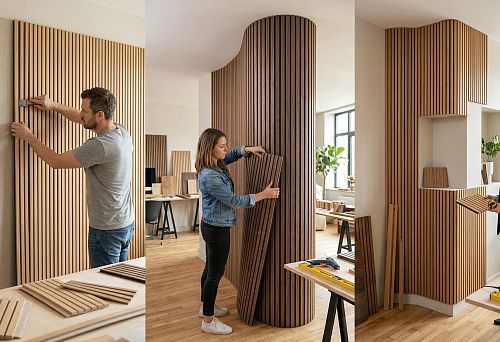
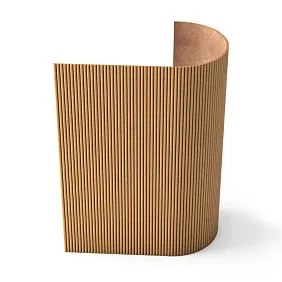
A flexible slatted panel consists of two elements: wooden or MDF slats and an elastic fabric backing onto which they are glued at a set spacing. Each slat is an independent unit, not rigidly connected to its neighbors via a solid board. That is precisely why the entire canvas bends freely: the fabric acts as a living matrix, and the slats within it remain parallel and geometrically unchanged.
According to the STAVROS website description,flexible slatted panel on a fabric baseworks like chainmail: individual rigid elements (slats) are connected by a flexible matrix (fabric), and the combination provides flexibility while maintaining structure. Minimum bending radius — from 100–150 mm depending on the width and thickness of the slat.
Our factory also produces:




Fabric base: what it is and why it's important
The backing is made from textile mesh or non-woven material based on fiberglass or polyester. The requirements for it are strict: high elasticity during bending, zero residual deformation before installation, sufficient strength to hold the slats during transportation. Base thickness — 0.5–1.2 mm: it does not affect the final thickness of the structure, but completely determines its bending behavior.
If the base is made of low-quality material — it stretches unevenly, loses shape under load, delaminates when bent on a small radius. No beautiful wood grain pattern on the slats will fix this.
Get Consultation
The role of slat spacing and its precision
Slat spacing is both a design and technical parameter simultaneously. Visually, it creates a rhythm that is readable from a distance and determines the 'weight' of the surface. Technically — it is precisely the consistency of the spacing that ensures seamless module joining. If the spacing varies even by a millimeter, when joining two panels the slats will not align. The result — a visible break in the rhythm.
Rigid panel vs. flexible: where each excels
| Parameter | Rigid panel | Flexible panel |
|---|---|---|
| Application on flat walls | Ideally | Excellent |
| Working on a radius | Impossible | Main task |
| Flatness accuracy | Maximum | Depends on the base |
| Installation on battens | Yes | Optional |
| Installation with adhesive | Yes | Preferred |
| For curved furniture fronts | No | Yes |
How flexible panel production works
The question 'how are flexible panels produced' is key to understanding the difference between reliable and compromise solutions. Let's examine the entire technological cycle.
Stage 1. Selection and preparation of raw materials
Everything starts with the material. For solid wood panels, it's controlled moisture content of the blanks: 8–12% after kiln drying. Over-dried or under-dried solid wood warps, changes the geometry of the slats, and disrupts the stability of the spacing. For MDF battens, it's the density of the board and the uniformity of its composition, because low-quality MDF crumbles during milling and accepts primer unevenly.
A manufacturer that works with verified raw materials is a manufacturer that controls the outcome, not one that hopes for chance.
Stage 2. Milling the slats
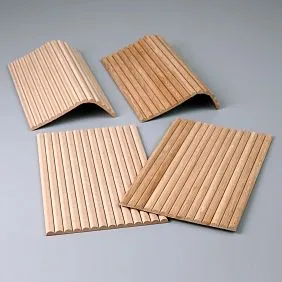
Each batten undergoes milling, which forms the cross-sectional profile — semicircular, rectangular, chamfered, or custom. The precision of the milling determines:
-
the consistency of the slat width along its entire length;
-
the cleanliness of the side faces (this affects the appearance of the gap between the slats);
-
the correctness of the profile — if the rounding is uneven, the play of light and shadow on the surface will be chaotic, not structural.
In professional production, the tolerance for slat width is ±0.2 mm. In artisanal production, it's ±1 mm and above, which is already visually noticeable.
Stage 3. Sanding
After milling, the slats are sanded — sequentially, through several grits of abrasive. For MDF, sanding is needed for quality priming: pores are closed, and the surface is leveled. For solid wood, sanding reveals the fiber structure, preparing it for the application of oil, wax, or varnish.
An unsanded MDF slat will absorb primer unevenly — in patches. An unsanded solid wood piece will show different staining depths on the same module.
Step 4. Gluing battens onto the fabric base
This is the most technologically complex stage. Battens are laid on the fabric base with a specified pitch and glued. The goal is to ensure:
-
precise and consistent pitch along the entire panel length;
-
secure fixation of each slat without shifting during bending;
-
even distribution of the adhesive layer (excess adhesive squeezes into the gap and spoils the appearance; insufficient adhesive causes slats to peel off).
In industrial production, this process is performed on specialized equipment with fixed stops. In artisanal production, it is done manually, with inevitable pitch inaccuracies.
Step 5. Priming (for MDF)
Priming is not a decorative operation but a technological necessity. Unprimed MDF actively absorbs paint, soaks it unevenly, and yields different shades with the same color.Primed MDF panel PAN-002It is produced with two layers of polyurethane primer-insulator, ensuring readiness for final painting without additional preparation. This provides significant savings in time and costs on site.
Stage 6. Geometry and batch quality control
Professional production of flexible panels involves output control: checking the spacing of slats, horizontality of ends, uniformity of sanding and primer, and compliance of the shade with the batch reference sample. Consistency of batch tone is a particularly important parameter for large projects where multiple deliveries must yield identical results.
Stage 7. Packaging
Flexible panels are packed in bundles with interleaving material that protects against scratches during transportation. Important: panels must be stored in a horizontal position, without sagging at the ends. Improper storage deforms the fabric base and creates a 'memorized' bend that later interferes with installation.
What materials are used in the production of flexible panels
The choice of material is a choice not only of visual result but also of the technological path.
MDF for painting
MDF is a medium-density fiberboard made from wood fibers pressed under pressure with a binder. The homogeneous structure without pores, knots, or natural defects makes MDF an ideal material for finish painting. The production of flexible panels from MDF is oriented towards tasks requiring precise color—any from the RAL or NCS palette or according to the customer's sample.
The key advantage of MDF: stability. The color will be the same on all slats, throughout the entire batch, and with any reorder. This is critically important for commercial facilities and projects with large cladding areas.
Solid oak
Oak is a key material for panels where natural texture is important. Open pores, the living pattern of the grain, the warm shade that changes depending on the lighting angle—all this cannot be imitated without real wood.
The production of flexible wood-look panels from solid oak involves strict control of blank humidity, selection of slats by color and texture within a batch, as well as the correct choice of finish coating.Slatted panel PAN-001 made from solid oakis produced with finishing options: oil, wax, varnish, or without coating for self-treatment.
Beech
Beech is more uniform in structure, lighter and more neutral in shade. It takes tinting well and is consistent in color within a batch. Suitable for Scandinavian, Nordic, minimalist interiors where a restrained texture without a pronounced wood grain pattern is required.
Flexible base: polyester or fiberglass
The choice of base material determines the elasticity, strength, and durability of the panel. Polyester is softer and performs better on small radii. Fiberglass is stiffer but more stable under temperature changes and in high humidity conditions. Both options are suitable for residential interiors; for commercial projects with special conditions, consult the manufacturer.
Adhesive system
The adhesive used to bond the slats to the base determines the longevity of the construction. Poor-quality adhesive loses adhesion over time—slats begin to detach, especially when bent on a small radius. A manufacturer that uses professional adhesive systems and controls temperature and pressure during bonding is a manufacturer that thinks about service life, not just first impressions.
Why production quality is visible even in the construction
This is a practical section for those who want to be able to evaluate the product even before installation.
Stability of slat spacing
Take a ruler and measure the spacing between the slats at three different points along the length of the panel. The permissible deviation is no more than 0.5 mm. If the spacing varies by 1–2 mm, the joint between two panels on-site will be visible. On a column where the panel wraps around the circumference, a mismatch in spacing will turn into a noticeable defect.
Evenness of ends
The ends of the panel are the area where it joins with the adjacent module. They must be strictly perpendicular to the long side, even, and free of burrs. A careless end creates a visible gap during joining, which cannot be concealed by any design techniques.
Sanding quality
Run your palm along the slat. The surface should be smooth, uniform, without transitions in graininess. On MDF slats—without raised fibers. On solid wood—without coarse scratches. Inconsistent sanding within one batch means the finish coating will be applied unevenly.
Batch Uniformity
Quality production of flexible panels ensures color consistency within a batch: all slats from the same MDF batch should have an identical white primer without stains. For solid wood—matching by color and texture. A batch where half the slats are lighter than the other is a batch where there was no quality control.
Panel behavior on a radius
A good way to check quality is to try bending the panel by hand to a radius of ~30–40 cm. It should bend evenly, without cracking, without distortion of the pattern. If the slats fan out unevenly during bending—this is a production defect of the backing or uneven gluing of the battens.
Quality of module joining
A competent manufacturer thinks about how their panels will be joined on-site. Professional joining technology assumes that the end battens of adjacent modules are at the same distance from the edge of the fabric base—equal to half the standard gap. Only this way does the pattern spacing not break at the joint.
What flexible panels can be ordered from the manufacturer
A good manufacturer is not a warehouse with a single item. It is a production system that can solve a task for a specific project.
Flexible panels with solid wood appearance
These areFlexible slat panel PAN-001on fabric backing — semi-circular battens made of solid oak or beech, with gap spacing of 5, 8, or 10 mm, in various finish coatings. Module size: width × length from 300×1200 to custom project-specific dimensions.
Flexible MDF panels for painting
panel PAN-002— flexible slatted panel made of deeply milled MDF on fabric backing, with two layers of polyurethane primer-insulator. Ready for finishing painting in any color from RAL or NCS. This is a solution for interiors requiring an exact color matching the design project, not a natural texture.
Flexible panels for columns and arches
Production of flexible panels for columns involves separate development: calculation of the column perimeter, selection of module width to minimize the number of joints, verification of the minimum radius.Learn more about application for curved surfaces— the full range of tasks: round and elliptical columns, arched openings, niches, wave-shaped partitions.
Flexible panels for radius walls
A radius wall requires precise matching of the panel radius and the surface. A manufacturer working with design tasks will select the module width and specify the minimum radius for a specific execution.Everything about flexible panels for complex surfaces— a detailed breakdown of design options and application scenarios.
Flexible panels for furniture facades
Curved facades of kitchen islands, bar counters, cabinets, sliding wardrobes with radius ends — all of this is implemented using fabric-based flexible panels. Important parameters: slat thickness (determines how small the finishing base can be) and coating type (enamel for high loads on the facade).
For commercial projects on order
For hotels, restaurants, offices, shopping centers, and reception areas — it is possible to produce flexible panels for commercial projects on order: according to individual dimensions, with a specific color from RAL, with a non-standard slat profile. Submitting technical specifications speeds up production and eliminates on-site adjustments.
When to order flexible panels from a manufacturer instead of choosing a serial analog
This question is more important than it seems. Serial panels are a compromise in size, profile, color, and spacing. Sometimes that's enough. But more often — it's not.
Non-standard radius
If the radius of your column or arch does not match the 'standard' one, a serial panel will either not bend or create stress in the base that will lead to delamination. A custom order in production allows you to specify the parameter in advance and get a module made for your radius.
Project for a specific color
A designer project with a clearly specified color according to RAL or NCS does not tolerate approximations. 'Almost white' is not white. An order from the manufacturer with an exact code is the only way to get an accurate result.
Complex geometry with multiple transitions
When one space has straight walls, columns, arches, and furniture fronts — and a unified slat rhythm is needed on all surfaces — only a manufacturer who understands the task as a whole will ensure unity of pitch and color. Serial panels from different shipments will give different shades and different pitches — and the 'unity effect' will fall apart.
Requirements for batch repeatability
A commercial object with phased deliveries requires a guarantee of consistency: color, pitch, profile must be reproduced from batch to batch without deviations. A manufacturer with quality control guarantees this; random resellers do not.
Designer and architectural projects
Flexible panels for designers and architects are a special segment of work. Critical here are: speed of coordination, possibility of sample production, technical support for installation, and readiness for non-standard solutions.
How to choose a flexible panel manufacturer: a practical checklist
The question 'how to choose a flexible panel manufacturer' sounds simple. But the answer to it is the difference between a successful project and a redo.
Check the construction
Clarify with the manufacturer: what base is used (fabric, rubber, non-woven), its density and thickness, and the minimum bending radius. If the manufacturer doesn't know the parameters of their own base — that's a red flag.
Clarify the available slat materials
A quality manufacturer offers at least two versions: MDF for painting and solid wood. If the assortment includes only one option — this is limited-assortment production, not designed for project tasks.
Ask about readiness for finishing
Primed surface for painting is an indicator of production technological maturity. Not 'can be painted,' but 'supplied with two layers of insulating primer, ready for finishing painting without preparation' — this is a fundamental difference.
Request a sample
A sample allows you to evaluate sanding, pitch consistency, end evenness, and primer quality. A manufacturer confident in their product sends a sample without hesitation. One who avoids sending a sample knows there's nothing to show.
Clarify the possibility of manufacturing for a non-standard project
Can the manufacturer produce panels in non-standard sizes? In a custom RAL color? With a non-standard slat profile? With a non-standard gap spacing? The answer to these questions will show whether the production is truly flexible or just sells standard items.
Check experience with curved surfaces
This is a specific skill. The manufacturer must be able to calculate the number of modules for a specific column perimeter, explain how to join panels on an arch, and provide recommendations for the minimum radius for a specific design.
Read about installation on the website
A manufacturer that publishes detailed installation instructions is a manufacturer that thinks about the end result, not just about selling. If the installation section is empty or consists of a single phrase 'glue it with adhesive'—this is not the place to order panels for a complex project.
What affects the production price of flexible panels
The price of flexible panels from the manufacturer is not an arbitrary figure. Every element of it is explainable and justified.
Material of the slats
MDF—base price. Solid oak—30–60% higher depending on species and grade. Solid beech—an intermediate option. Non-standard species (ash, walnut, American maple)—individual calculation.
Presence and type of priming
Unprimed MDF panel—cheaper. Panel with two layers of polyurethane primer-isolator—more expensive, but reduces on-site costs due to no preparation needed. For large projects, the difference in the final budget is usually in favor of the primed option.
Profile and slat width
Standard semicircular profile — optimal price. Custom profile for the project (chamfer, step, complex cross-section shape) — milling according to an individual template, corresponding markup.
Module dimensions
Standard sizes (300×2400, 600×2400, 300×2700) — minimum price. Custom sizes for the project — always with individual calculation. At the same time, custom sizing often justifies itself by reducing waste and better layout on site.
Order volume
Production of flexible panels for commercial facilities is always cheaper per square meter than a retail order. Minimum production run — check with the manufacturer.
Final finishing
MDF for painting — price for prepared surface. Tinted oak (oil, wax) — additional operation, additional cost. Custom color to RAL — tinting and sample approval.
Stavros organizes delivery within Moscow using its own transport or partners with logistics providers for delivery to regions. Packaging ensures the preservation of even delicate carved elements.
Panels 2700 mm long are transported in long packaging. This affects the cost of delivery to regions. For large projects, it is more correct to calculate the final cost taking logistics into account, not just the product cost.
Mistakes when choosing a flexible panel manufacturer
People make mistakes in the same places. Here are the most common ones.
Looking only at the price
'Cheaper' in flexible panels almost always means a thinner base, poor-quality adhesive, or superficial sanding. All of this will manifest either during installation or after a year of use — when redoing will cost significantly more than the initial price difference.
Do not specify the base type
"Flexible panel" is a broad concept. The base can be fabric, rubber, non-woven, or kraft paper. Different bases have different minimum radii, different bending behaviors, and different lifespans. If the manufacturer does not specify the base type—do not order.
Do not check the preparation for painting
An MDF panel "for painting" and an MDF panel "primed with two layers of insulator" are different things. The first will require you to prime on-site. The second will not. Not clarifying this parameter = losing time and money during installation.
Do not consider batch consistency
For a large project with multiple deliveries, it is critical that the manufacturer can reproduce the same shade of MDF primer, the same oak tint color, and the same slat profile. If the manufacturer cannot guarantee this—it is a serious risk for the design project.
Do not ask about radius and joining
A manufacturer who has never dealt with real tasks on columns and arches does not know the nuances—and will not be able to consult you. Ask a direct question: "What is the minimum radius for your panel?" and "How to properly join modules so the pattern is not interrupted?" The answers will immediately show the level of competence.
Confusing flexible panels with rigid ones
It sounds strange, but this is a real mistake that happens when ordering. Make sure you have a flexible module on a fabric base in your hands, not a rigid slat panel. Visually they may look similar, but on a column the difference will appear immediately.
Flexible panel production: B2B logic and project work
A separate story is the manufacturer's work with architects, designers, contractors, and suppliers. Different rules apply for professional B2B.
What is important for a designer
-
Ability to order samples quickly;
-
Guarantee of color and profile reproducibility in the next batch;
-
Technical consultations on volume calculation and joining;
-
Possibility of custom specifications for the project;
-
Clear production and delivery timelines.
For design projects, it is especially important that the manufacturer discusses permissible deviations and how they ensure batch consistency.Details on working with slatted panels for design projects— about installation, calculation and choosing the right solution.
What matters to the contractor
-
Guaranteed deadlines;
-
Proper packaging for damage-free transportation;
-
Clear documentation with product parameters;
-
Possibility of phased deliveries with batch identity preservation.
What matters to the commercial customer
-
Ability to order according to non-standard project requirements;
-
Production of flexible panels for hotels, restaurants and offices with different deadlines;
-
Material certification and technical documentation;
-
Experience working on similar projects.
FAQ — answers to common questions about flexible panel production
Who produces flexible panels in Russia?
Production of flexible slatted panels from MDF and solid wood on a fabric base is a specialized segment. STAVROS is one of the Russian manufacturers producing flexible slatted panels from solid oak (PAN-001) and MDF (PAN-002) for painting, with a fabric base, for walls, columns, arches, and furniture fronts.
How are flexible panels produced?
Technological cycle: material selection and drying → milling of slats → sanding → gluing onto a fabric base with a specified spacing → priming (for MDF) → geometry and batch control → packaging.
What are flexible panels made of?
Slats — made from solid wood (oak, beech) or high-density MDF. Base — made from textile mesh based on polyester or fiberglass. Adhesive system — professional, with resistance to deformation during bending.
Can flexible panels be ordered in non-standard sizes?
Yes. Production of flexible panels to individual customer sizes is possible. This is especially relevant for large commercial projects where visible seams need to be minimized.
How to choose a flexible panel manufacturer?
Check: base type and its parameters, availability of samples, preparation for finishing, experience with curved surfaces, batch stability, custom manufacturing capability.
Are there flexible MDF panels on a fabric base?
Yes. This is exactly what PAN-002 represents: deeply milled MDF on a fabric base with two layers of polyurethane primer-isolator.
What affects the production price of flexible panels?
Material of slats, presence of priming, slat profile, module size, order volume, finishing, and logistics.
What is the minimum radius for flexible slatted panels?
From 100–150 mm — depending on the width and thickness of the slat. For specific execution — check with the manufacturer.
Can flexible MDF panels be painted independently on site?
Yes. The PAN-002 panel is supplied ready for finishing painting — a double primer-isolator is applied during production. It is sufficient to apply a finishing layer of enamel in the chosen RAL code.
How to join flexible panels so the pattern doesn't break?
The end battens of adjacent modules should be at a distance equal to half the standard gap from the edge of the fabric base. Joints between modules are always made in the gap between battens. The first module — strictly level.
Are flexible panels suitable for exterior facade finishing?
No. Slatted flexible panels on an MDF and solid wood fabric base are intended for interior finishing. For facades, fundamentally different materials are used.
How to store flexible panels before installation?
Horizontally, without sagging. Do not stand on end. Protect from moisture and direct sunlight.
Are there flexible wood-look panels from the manufacturer with oil finish?
Yes. Solid oak on a fabric base (PAN-001) is available with various finish options, including oil. Specify the desired finish in your order.
How much do flexible panels from the manufacturer cost?
Price depends on material, size, presence of priming, order volume, and logistics. For an accurate calculation — contact the manufacturer with specific project parameters.
When is it better to order flexible panels from production rather than buying ready-made ones?
Always when: non-standard radius, exact color to match the project, multiple deliveries requiring consistency, a commercial facility with a large area, or a design project with high quality requirements.
Conclusion: why production is more important than appearance
A flexible wood-look panel in a picture looks the same, whether made in a professional production or in a workshop without quality control. The difference becomes apparent when the panel needs to be bent to the radius of a column, joined without a visible seam on a long wall, or repainted to a specific shade—and for it to match on all surfaces.
Production of flexible panels is about discipline. Consistency of slat spacing, proper backing, precise edges, MDF primer, batch uniformity—each of these parameters is either part of the production process or it isn't. And these are exactly what you should use to choose a manufacturer.
If surfaces are straight—a rigid slatted panel provides maximum flatness and structural rigidity.
If there are columns, arches, radius walls, rounded corners, or curved furniture fronts—a flexible panel on a fabric backing is irreplaceable.
MDF for painting—when you need an exact color, a monochrome interior, commercial color accuracy.
Solid oak—when natural texture, live wood grain pattern, oil or wax finish are important.
Full range of solutions—in STAVROS slatted panels catalog, featuring both flexible and rigid modules in MDF and solid oak for any task.
About the company STAVROS
STAVROS is a Russian manufacturer of decorative products made from solid wood and MDF. The company specializes in slatted panels for interior finishing of residential and commercial spaces: both rigid modules for flat surfaces and flexible fabric-backed solutions for columns, arches, radius walls, niches, and curved furniture fronts.
STAVROS manufactures products from solid oak, beech, and paintable MDF, working with architects, designers, furniture manufacturers, and commercial clients across Russia. Each order is custom-produced for a specific project: selection of material, slat profile, gap spacing, module dimensions, and finish preparation. For professional projects, custom sizing and parameters are available.