Article Contents:
- Is neoclassical style suitable for a hallway?
- Why a hallway benefits from architectural organization
- Main mistakes with moldings in a hallway: what ruins the space
- Too many frames on a short wall
- Heavy relief in a narrow corridor
- Moldings without connection to mirror, console, and door
- Contrast in a dark hallway
- Decor on all surfaces simultaneously
- Lack of logical connection between elements
- Which moldings to choose for the hallway and corridor
- Molding profile: range for the hallway
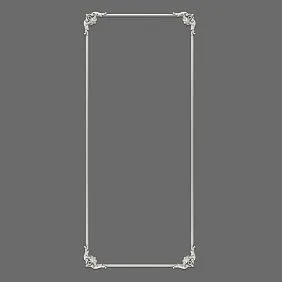
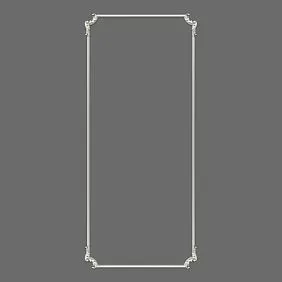
- Corner Decorative Elements
- Practicality first
- Five strong hallway design schemes
- One accent wall with a decorative frame
- Mirror above the console in a decorative frame
- Framing the doorway with a portal
- Low panels and high baseboard
- Vertical panels in a long corridor
- Mirror and Console as the Center of Architectural Composition
- Random Mirror and Systematic Mirror
- Mirror Size: Proportions for the Hallway
- Hanging Height
- Console: The Horizontal Anchor of the Composition
- How to Decorate a Doorway in the Hallway: From Casing to Portal
- When Casing is Enough
- When a Portal is Needed
- What to Do with the Upper Part of the Portal
- Color and Light in a Neoclassical Hallway
- Why light shades are the primary choice
- Moldings in tone or with nuanced contrast
- How sconces 'reveal' relief
- Neoclassicism in a small hallway and long corridor
- Small hallway 3–4 m²
- Medium hallway 6–7 m²
- Long corridor
- Hallway without natural lighting
- Hallway with multiple doors
- Ready-made set or independent layout: what is better for a hallway
- DIY assembly: when is it justified
- Ready-made set: advantages for the entryway
- How to choose a solution for a specific hallway: practical table
- What else supports neoclassicism in the hallway
- About the Company STAVROS
- Frequently Asked Questions
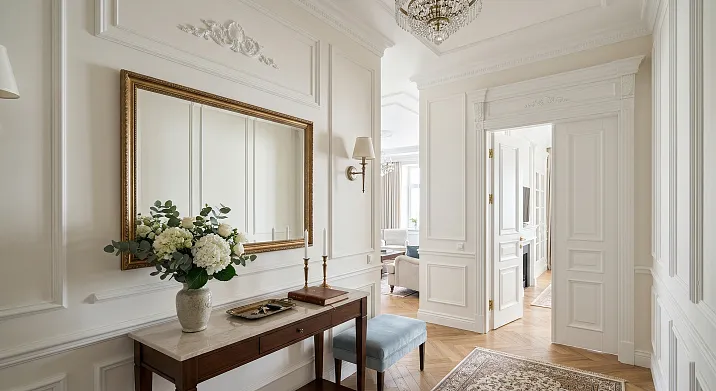
There are spaces we hardly pay attention to. We simply pass through them—toss keys, take off coats, hurry on. The hallway is exactly such a place. And that's precisely why it says so much about the interior as a whole: not with words, but with its very appearance. A neat, architecturally composed entry zone with a symmetrically placed mirror, delicate moldings, and a clearly defined doorway—this is the first sentence in the story of a home. And it determines whether a person will want to read further.
Hallway in neoclassical style—is not a ceremonial hall with gilding and marble floors. It is a strict, intelligent organization of space, where every element—a molding frame, a portal above the door, a mirror on a console—works as part of a thoughtful system. Not a single extra accent. Not a single random detail. Only architectural logic, a light palette, and moderate decor that makes even a small hallway a status zone.
The difficulty lies elsewhere. The hallway is the most 'difficult' room to decorate: narrow, a passageway, without natural light, with several doorways and a perpetual shortage of free walls. How to fit neoclassicism here without creating a feeling of a cluttered vestibule? How to choose moldings that won't get in the way but, on the contrary, will structure the space? Where to place a mirror so it works for the architecture, not just hangs on its own?
This material precisely answers these questions.
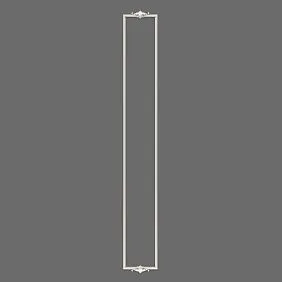
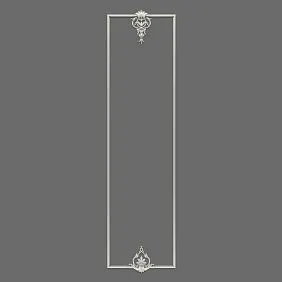
Is neoclassicism suitable for a hallway
Briefly — yes. In detail — with important caveats.
Neoclassicism as a style rests on several principles: symmetry, order, moderation, and the architectural structure of space. All these qualities are especially valuable in the hallway — a room that is inherently chaotic: a mix of street and home, a jumble of functions, constant movement.
Symmetry in the hallway is not a luxury, but a salvation. A mirror centered on the wall, identical sconces on the sides, a console strictly under the mirror — and the space instantly 'comes together,' becomes legible and calm. Add a delicate molding frame around the mirror or on the end wall of the corridor, a neat cornice under the ceiling, and a classic baseboard — and the hallway transforms from a vestibule into an architecturally defined entrance zone.
It is fundamentally important to understand: neoclassicism in the hallway should be lighter than in the living room. If wide molding profiles, rich corner elements, and developed decorative panels are appropriate in a formal room, then in the entrance zone — everything is more delicate. A thin profile, moderate relief, one accent wall instead of four — these are the principles by which neoclassicism works in the hallway without a sense of overload.




Why the hallway benefits from architectural organization
Ask yourself a simple question: what do you feel when you enter a hallway with bare walls, a mirror hanging 'wherever it fit,' and random hooks for clothes? Most likely — nothing special. The space doesn't welcome, doesn't set the mood. It just exists.
Now imagine the same area, but with a wall where the mirror is set into a decorative frame, symmetrical sconces on the sides, a console exactly aligned with the mirror's axis below, and the doorway to the living room framed by a neatpolyurethane portal. This is a different feeling — the space begins to 'speak,' it has character, logic, intention.
This is exactly what neoclassicism gives in the hallway — not opulence, but architectural speech in a properly organized space.
Our factory also produces:


Main mistakes with moldings in the hallway: what destroys the space
Before moving on to schemes and solutions, it's important to understand what's going wrong. These mistakes are common, and in the narrow space of a hallway, they are especially painful.
Get Consultation
Too many frames on a short wall
Three frames on a wall 180 cm long is a complete fragmentation of space. The hallway turns into an ornamental box. The rule for the entrance area is strict: one frame or one decorative panel per visible plane. Period.
Heavy relief in a narrow corridor
Corner decorative elements with a projection of 40–50 mm in a corridor 120 cm wide create a physical feeling of compression. Relief objects on walls in a very narrow space literally 'narrow' the corridor visually. For hallways, the projection of corner elements should be no more than 15–20 mm, and the molding profile should be 20–25 mm.
Moldings without connection to the mirror, console, and door
A frame on the wall that has no relation to the mirror next to it, the console below, and the doorway nearby is decoration for decoration's sake. It doesn't structure the space; it simply exists. In neoclassicism, every element should be part of a system. The frame creates a field—the mirror, sconce, or painting enters this field.
Contrast in a dark hallway
Dark walls with white moldings in a hallway without a window is an aggressive solution. Contrasting lines fragment an already small space, making it restless. For a hallway with poor lighting—only light walls and monochrome decor.
Decor on all surfaces simultaneously
Frames on the end wall, moldings on the side walls, a portal at the entrance door, and a decorative baseboard with a rich profile—all together in a small hallway create visual noise. Principle: one main accent zone, the rest only support the style through cornice and baseboard.
Lack of logical connection between elements
A molding frame on one wall, a random mirrored portal on another, door trims from a completely different era—and the hallway looks like a warehouse of unrelated design solutions. In neoclassicism, all decorative elements work in one system: one style, one scale, one palette.
Which moldings to choose for the hallway and corridor
Practical breakdown—with numbers and guidelines.
Molding profile: range for the hallway
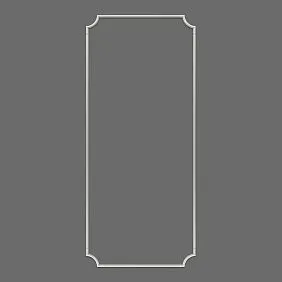
For the entrance area—a profile 18–25 mm wide with a section height of 9–12 mm. This is the working range for the hallway: the profile is noticeable enough to create a readable line, and delicate enough not to overwhelm in a small space.
A profile wider than 30 mm in the hallway is already borderline. It is used only with good corridor width (from 150 cm) and high ceilings (from 2.8 m).
MDF moldings for paintingfrom STAVROS—factory-primed profiles with precise geometry: a straight line without deformations over a length of 2.5 m, ready for finishing painting with acrylic enamel without additional processing. For the hallway, this is critically important—a straight, clean line without the slightest bend.
Corner decorative elements
For the hallway — corner elements with a projection of 12–18 mm. The ornament pattern is geometric or moderately floral: a light leaf, a small rosette, a restrained classic motif. Not a Baroque relief with full-size curls — that scale is for the living room or formal hall, not the entry zone.
Polyurethane decorative appliquesare good because they accurately reproduce the relief, are not afraid of mechanical impacts (which is crucial in the hallway, where coats, bags, and umbrellas are constantly carried through), and accept acrylic paint directly — without special primer.
Practicality above all
In the hallway, moldings are at significantly greater risk of mechanical damage than in the bedroom or living room. Passing through with bags, umbrellas, children's backpacks — all this creates a risk of snagging the decor. A protruding relief on a narrow corridor wall is a vulnerable area.
That is why in the hallway it is recommended: either place frames above shoulder level (from 160 cm and higher), or use a high-density polyurethane profile — it better withstands accidental impacts. The lower wall zone (up to 100 cm) in the hallway is a high-traffic area. Here, a tall wooden baseboard or wall panel works better, not delicate molding decor.
Five strong hallway design schemes
One accent wall with a decorative frame
The most universal scenario. The end wall of the hallway — the one visible immediately upon entry — receives one decorative frame in the center. The other three walls — only cornice and baseboard.
Proportions of the frame for the end wall:
-
width — 40–60% of the wall width
-
height — from the top edge of the baseboard to 20–25 mm below the cornice
-
gap from the corners to the edge of the frame — at least 20 cm on each side
A frame on the end wall creates a visual 'focal point': upon entering the hallway, the gaze travels along the corridor and rests on a structured surface — this creates a sense of depth and intentional space.
Mirror above the console in a decorative frame
One of the most effective and elegant scenarios for a hallway in the neoclassical style. The system is constructed as follows:
Console — the horizontal lower point of the composition. Its axis of symmetry establishes the vertical axis of the entire system.
Mirror — the central object. It is positioned along the axis of the console, at a height of 150–180 mm from its tabletop to the lower edge of the mirror.
Decorative frame — a molding frame around the mirror or surrounding it. The frame may only encompass the mirror or significantly exceed it in size — creating a field within which the mirror 'lives'.
Sconces — symmetrically on either side of the mirror, at the same height. Aligned horizontally relative to the center of the mirror or its upper third.
This system — mirror + console + sconces + decorative frame — is the classic 'stage' of a neoclassical hallway. It is precisely what transforms a collection of objects into an architectural composition.
Mirror in a stucco portal— this is not a complication, but a simplification: instead of many details — one systemic scheme that holds the space.
Framing a doorway with a portal
In the hallway, there are usually several doorways: the entrance door, the door to the living room or corridor, the door to the bathroom or toilet. Not all of them require decorative framing. But one — the main one, leading from the hallway to the main rooms — can be decorated with a portal.
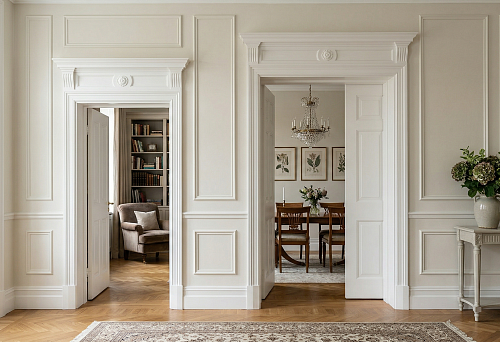
A portal transforms an ordinary doorway into an architectural object: vertical pilasters or architraves on the sides and a horizontal pediment or cornice on top create a frame that visually 'completes' the opening and connects the hallway with the adjacent room into a unified space.
For a neoclassical hallway, suitableprofiled architraves made of polyurethane— from a simple rectangular profile to a classic one with projections. The width of the architrave for the hallway is 60–80 mm: noticeable, but not heavy. The top horizontal element is straight or with a small central projection (keystone).
It is fundamentally important: if there are several doors in the hallway — decorate only one, the main one, with a portal. Multiple portals in a small space create chaos of frames.
Low panels and high baseboard
For small entryways where full-height frames might break up the wall, a different approach works: the lower zone of the wall is finished with low horizontal panels or a belt, divided by molding, and above it—a smooth wall.
Scheme:
-
a high baseboard 80–100 mm with a protruding profile
-
a horizontal dividing molding at a height of 90–100 cm from the floor (the conventional 'chair rail line')
-
below the line—panels or a wall with a different finish/color
-
above the line—a smooth wall, possibly with one decorative frame on the end plane
This technique is especially good for entryways where the lower part of the wall is actively 'working' (coat racks, shelves, shoe cabinets)—the dividing molding clearly marks the boundary between the 'functional' and 'decorative' zones of the wall.
Vertical panels in a long hallway
If the entryway transitions into a long hallway—the task changes. It's not just about decorating the wall, but also structuring the long surface without turning it into an endless gallery of frames.
Solution: rhythmic vertical panels with equal spacing. Not picture frames, but narrow architectural panels—50–70 mm wide, height from the baseboard almost to the cornice. They create rhythm, making the hallway not endless, but 'counted,' broken into equal segments.
The distance between panels—equal to or a multiple of their width. Strict rhythm—that is neoclassicism.
Mirror and console as the center of architectural composition
Let's talk about the mirror separately — because it is the main object in a neoclassical hallway and it is the one most often subject to mistakes.
The 'random' mirror and the 'systemic' mirror
A random mirror — hung where space was found. It serves a function (to look at oneself before leaving), but creates nothing in the space.
A systemic mirror — integrated into the architectural scheme. It is positioned along the axis of symmetry, framed by a border or portal, connected to a console below and light fixtures on the sides. It works on several levels at once: functional (to look into it), architectural (organizes the space), and lighting (reflects light, visually expands the hallway).
It is precisely such a mirror — a systemic one — that neoclassicism speaks of in the hallway.
Mirror size: proportions for the hallway
The mirror should be large enough for a person to see themselves at least down to the waist. Minimum height — 80–90 cm. Optimal for a hallway — 90–120 cm in height, 50–80 cm in width.
If the mirror is part of a decorative frame — it should occupy no more than 60–70% of the frame's inner field. A mirror nearly equal in size to the frame visually competes with it — both framings clash.
Hanging height
The center of the mirror should be at eye level for an average person, i.e., approximately 160–165 cm from the floor. When installing above a console: the bottom edge of the mirror should be 150–200 mm above the console surface.
A mistake to avoid: hanging the mirror too high. In the hallway, this is a common story—the mirror is hung 'so it doesn't get in the way,' and it ends up at forehead level instead of eye level.
Console: the horizontal anchor of the composition
The console sets the lower horizontal line of the system. Its width is equal to the width of the mirror or slightly wider (up to 10–15% on each side). Height is standard 80–85 cm.
On the console surface—minimal items. Two symmetrical candles or candlesticks, one vase, a small decorative plate. An overloaded console ruins the entire architectural scheme.
How to design a doorway in the hallway: from casing to portal
The doorway is a boundary. A boundary between the hallway and the living space of the house. How this boundary is designed determines whether the transition between rooms feels cohesive or like a break.
When casing is sufficient
Simple profiledwooden or polyurethane casingA width of 60–70 mm is the minimum but sufficient solution for a hallway in a neoclassical style. It clearly defines the opening boundary, creates a classic 'frame,' and harmonizes with the wall molding decor.
A door casing is suitable when:
-
the hallway is small and there is no desire to add bulky elements;
-
there are several doors and a uniform solution is needed for all;
-
the overall decor tone is light, restrained neoclassicism.
When a portal is needed
A portal is the next level. Vertical pilasters or flanking elements on the sides of the opening plus a horizontal element on top. A portal creates not just a frame, but an architectural volume around the door opening—a full-fledged architectural element.
Decorative portalsare appropriate in a hallway when:
-
the main door opening is the focal point of the space (for example, an opening into the living room that is visible immediately upon entry);
-
The hallway is spacious enough so that the portal does not create a feeling of tightness;
-
The interior style is pronounced neoclassicism or classicism, not a light hint of style.
What to do with the upper part of the portal
The horizontal element above the door—the pediment—is the area where scale mistakes are most often made. A heavy profiled pediment with large stucco decoration above a door in a hallway with a 2.5 m ceiling creates a feeling of an oppressive top.
For the hallway—a horizontal element that is straight or with a minimal projection (10–15 mm). No pediment arches or 'palatial' cornices above the door in the entrance area. A modest, clear horizontal line—and that's enough.
Color and light in a neoclassical hallway
The hallway most often lacks natural light or receives it minimally. This makes the choice of color and the principle of lighting especially important.
Why light shades are the primary choice
A light wall reflects artificial light, making the space visually more spacious and airy. In a windowless hallway, a dark wall literally 'absorbs' light—the space becomes gloomy and cramped regardless of the decor.
For a neoclassical hallway—warm light tones: cream, pearl, pale gray-beige, soft linen. This is a classic palette that simultaneously creates a feeling of warmth and provides a sufficiently neutral background for decor.
Moldings in matching tone or with nuanced contrast
For the hallway — strictly monochrome or nuanced contrast (moldings half a tone lighter than the wall). Contrasting white moldings on a colored wall are only permissible with good hallway width and sufficient artificial lighting.
In a narrow, dark corridor, a monochrome solution is the only correct one. Contrasting lines fragment the space, which is already limited.
How sconces 'reveal' the relief
Sconces in the hallway are not just a light source. Side warm lighting creates chiaroscuro on the relief of the moldings — a frame that almost blends with the wall in daylight comes alive with shadows and volume when the sconces are on. This is one of the most sophisticated techniques in decor work: the same frame looks fundamentally different at different times of day.
Therefore, sconces in the hallway are not a luxury, but a necessity for those who want a full-fledged neoclassical interior.
Neoclassicism in a small hallway and long corridor
Let's examine specific scenarios — because 'hallway' can be very different.
Small hallway 3–4 m²
The most challenging situation. Few walls, insufficient space, maximum functional load.
What works:
-
one vertical frame on the end wall is the only decorative accent;
-
mirror as a mandatory element (visual expansion + function);
-
only monochrome painting of moldings;
-
delicate profile 18–20 mm;
-
cornice no more than 40 mm;
-
baseboard 60–70 mm.
What not to do:
-
no frames on side walls;
-
no portals (or the most delicate casing 60 mm);
-
No dark-colored walls.
Average hallway 6–7 m²
There is already space for a more complex solution here.
Possible schemes:
-
accent wall with a decorative frame + mirror/console/sconce system;
-
one portal on the main doorway + a delicate frame on the end wall;
-
panels on the lower part of the wall (up to 100 cm) + moldings on the upper part of the accent wall.
Color: a nuanced contrast is acceptable — a cream-colored wall with white-toned moldings.
Long corridor
A long corridor is a completely different task. The main problem here is not tightness, but monotony. A flat, long surface without accents tires the eye.
Solutions:
-
rhythmic vertical panels with equal spacing on one wall (the long wall);
-
alternating mirror frames and solid frames along the length of the corridor;
-
at the end of the corridor — one accent decorative frame that 'closes' the perspective.
When working with a long corridor, it is important to maintain rhythm: the distance between frames or panels should be equal. Uneven spacing creates chaos.
Entryway without natural lighting
Three principles:
-
light walls — mandatory;
-
mirror — mandatory (reflects artificial light);
-
monochrome moldings — decor without contrast, so as not to fragment the space.
Add recessed ceiling lights in addition to sconces — and the windowless entryway will become bright and cozy.
Entryway with multiple doors
In an entryway with three or four doors — do not try to decorate each one. One portal or casing with a pronounced profile — on the main opening. The others — with minimal casings 50–60 mm, of the same style.
Ready-made set or custom layout: which is better for the hallway
This question is particularly acute in the context of the hallway—because it involves many nuances.
Assembling yourself: when is it justified
-
non-standard wall geometry with niches or protrusions;
-
design project with custom proportions;
-
a very specific profile is needed that is not available in ready-made sets;
-
extensive experience working with molding decor.
The main risk of independent selection for the hallway: mismatch in the scale of the molding and decorative corner elements. In the hallway with its limited space, inconsistency in sections is immediately noticeable. Thin molding and a large corner element—this is a visual mismatch that does not 'read' as a unified system.
Ready-made set: advantages for the entry zone
Ready-made set of stucco decor— is a system with pre-coordinated elements. The molding and decorative corners are matched in style, proportion, and relief. The composition is designed for a specific frame format.
For an entryway, this is especially valuable for two reasons.
First: In a small space, a scale error is critical. A ready-made set for light neoclassicism is already designed for a delicate range — you inherently get a solution that won't overload a compact space.
Second: Simplifies selection. The entryway is a room with fewer design 'freedoms' than a living room. Here, precision is more important than variety. The ready-made set provides this precision: one item number — a complete architectural system.
How to choose a solution for a specific entryway: a practical table
| Entryway Type | Recommended Scenario | Molding | Features |
|---|---|---|---|
| Small 3–4 m² | One frame on the end wall | 18–20 mm, monochrome | Only one wall with decor |
| Medium 6–7 m² | Frame + portal or mirror system | 20–22 mm | One portal, accent wall |
| Long corridor | Rhythmic vertical panels | 18–22 mm | Equal spacing, one wall |
| No natural light | Monochrome frame + mirror | 18–20 mm, light tones | Mirror required |
| With multiple doors | Single portal + delicate trims | Portal 60–80 mm | One distinct opening |
| Transition to living room | Portal on main opening | 70–80 mm | Portal as architectural centerpiece |
| Narrow corridor (up to 1.2 m) | Only end frame | 18–20 mm | Frame on the end, nothing on the sides |
What else will support neoclassicism in the hallway
Moldings are the main tool, but not the only one. Several additional elements that work towards the integrity of the image.
High baseboard. In the hallway, an 80–100 mm baseboard with a classic profile creates a pronounced lower horizontal belt. It visually 'grounds' the space and adds architectural character without additional wall decor.
Thin ceiling cornice. NarrowCornice40–50 mm around the perimeter of the hallway creates a transition from wall to ceiling—a detail that instantly elevates the interior to another level. A cornice wider than 60 mm in a hallway with a 2.5 m ceiling visually 'lowers' the ceiling.
Symmetry of furniture. Console in the center of the wall. Two hooks or two light fixture mounts at the same height and distance. Symmetrically arranged items on the console. In neoclassicism, symmetry is not an aesthetic, but a principle.
Calm textile palette. If there is a rug in the hallway—neutral, without intense patterns. A colorful rug under decorative moldings is competition that the interior cannot handle.
Lighting fixtures. Sconces in the neoclassical spirit—brass, matte gold, 'aged' silver. No chrome and glass in the loft style. Two symmetrical sconces on either side of the mirror—this is lighting, decor, and part of the architectural scheme all at once.
About the company STAVROS
A hallway in the neoclassical style is a space where the quality of materials and the precision of geometry are tested first. A straight molding line, impeccable relief of corner elements, precise profile of the trim, clearly defined portal—all of this is visible immediately, at the first glance at the entrance area.
STAVROS is a Russian manufacturer of architectural decor: paintable MDF moldings, polyurethane decorative elements, architraves, cornices, baseboards, door portals, ready-made sets of wall stucco decor. Production is in Russia, quality control is at every stage, from raw material selection to final packaging.
STAVROS works with private clients, designers, and suppliers, selecting solutions for specific tasks. A 3 m² hallway, a 40 m² studio, or a 100 m² grand hall — the approach is the same: an exact solution for the specific space, not an averaged option 'for everything at once'.
Full catalog — includingmoldings of all profiles, architraves and portals, polyurethane decorative overlays, Ready-made molded decor kitsandsolutions for portals— on the STAVROS website. Consultation on selection for a specific hallway — no obligations.
If you need a bedroom — see the article on moldings in the bedroom and decorating the wall behind the bed. If you need a small apartment entirely — proceed to the guide onneoclassics in a small apartment without overloadIf you need a general primer on decorative molding — it's all covered in thecomplete guide to polyurethane moldingseverything is broken down: types of profiles, installation, calculation, painting.
Frequently asked questions
Is neoclassicism suitable for a small entryway?
Yes — especially well. Neoclassicism in its lightweight version organizes and structures the space, making it cohesive. One frame on the end wall, a mirror, a delicate baseboard and cornice — and even an entryway of 3–4 m² gains architectural character.
Which moldings to choose for a hallway?
Profile 18–22 mm, section height 9–12 mm. Corner elements with an overhang of no more than 15–18 mm. For a narrow hallway — strictly monochrome painting. For a more spacious one — nuanced contrast is acceptable.
Is a portal needed in an entryway?
Not necessarily. A simple profiled casing 60–70 mm solves the task of framing the opening in restrained neoclassicism. A portal is needed when the main doorway is the conceptual center of the entryway and it is wide enough to accommodate a voluminous architectural element.
Can a mirror be done in a molded frame?
Not only possible — necessary. A mirror in a decorative frame is a classic 'scene' for a neoclassical entryway. The mirror occupies 50–70% of the frame's inner field, the mirror's axis aligns with the console's axis, and sconces are placed symmetrically on the sides.
What's better for the entry zone: frames or panels?
Depends on ceiling height and entryway size. For an entryway with ceilings up to 2.6 m — vertical frames or lower panels with a dividing molding. For an entryway with ceilings from 2.8 m and above — full-height vertical panels are appropriate.
How to avoid overloading a long hallway?
Rhythm is the main tool. Equal spacing of vertical panels on one wall, the second wall — clean or with a delicate cornice. At the end of the hallway — one accent frame or mirror. No more than one decorative accent per every 1.5–2 m of hallway length.
Is it worth buying a ready-made set for the entryway?
For most situations — yes. A ready-made set for light neoclassicism is initially designed for a delicate scale that works in compact spaces. This reduces the risk of proportion errors and simplifies the entire process — from selection to installation.