Article Contents:
- Specifics of office and public spaces
- Intensity of use
- Requirements for fire safety
- Sanitary and Hygiene Standards
- Advantages of MDF and polyurethane in operation
- Geometric Stability
- Resistance to mechanical impacts
- Economic efficiency
- Wood as an element of status and coziness
- Psychological Impact of Natural Materials
- Status and reputation
- Status zoning
- Acoustic properties and comfort
- Acoustics problem in open spaces
- Rail structures as acoustic elements
- Placement of acoustic panels
- Mounting options and hidden fasteners
- Adhesive mounting of skirting boards
- Clip systems for hidden mounting
- Mounting of rail structures
- Aesthetic role of lines in business space
- Horizontal lines of stability
- Vertical lines of dynamics
- Corporate identity through materials
- Frequently Asked Questions
- Conclusion
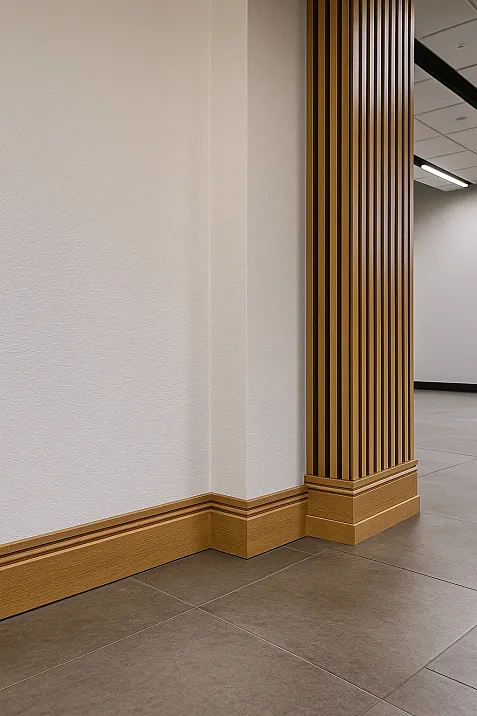
Commercial spaces require a special approach to selecting finishing materials, where practicality of use combines with aesthetic expressiveness.MDF Skirting Boardensures durability and resistance to heavy loads at an affordable cost.Decorative wooden stripcreates accent zones, highlighting the status of the office space.— is a horizontal element that frames the room at the bottom of the walls where the wall meets the floor. Skirting boards perform several functions: they hide the technological gap between the wall and floor covering (necessary for thermal expansion), protect the lower part of the wall from mechanical damage, create visual completion, and may conceal wiring.opens up limitless possibilities for creating a corporate style through color.Panels under wooden railsform functional and aesthetic surfaces with acoustic properties.Planed wooden stripdemonstrates precision of processing and material quality, creating flawless architectural lines.


Specifics of office and public spaces




Intensity of use
Commercial spaces are characterized by significantly higher traffic compared to residential areas. Offices with 50-100 employees create a load on finishing materials comparable to intensive use over 10-15 years in an apartment.MDF Skirting Boardwith a density of 760-780 kilograms per cubic meter withstands regular mechanical impacts from vacuum cleaners, mops, and cleaning carts.
High-traffic zones include entrances, corridors, and waiting areas where pedestrian movement is concentrated. Baseboards in these zones are subjected to impacts from footwear, suitcase wheels and bags, and furniture elements during rearrangement.— is a horizontal element that frames the room at the bottom of the walls where the wall meets the floor. Skirting boards perform several functions: they hide the technological gap between the wall and floor covering (necessary for thermal expansion), protect the lower part of the wall from mechanical damage, create visual completion, and may conceal wiring.with a quality enamel coating creates a durable protective film resistant to abrasion and chipping.
Cleaning of commercial spaces is performed daily using professional equipment and chemical agents. Vacuum cleaners, rotary machines, and concentrated cleaning solutions create an aggressive environment for finishing materials.MDF Skirting Boardwith a laminate finish is resistant to household cleaning agents and retains its original appearance with regular wet cleaning.
Our factory also produces:


Fire Safety Requirements
Commercial spaces are regulated by strict fire safety standards. Finishing materials are classified by flammability groups from G1 (low-flammability) to G4 (high-flammability).MDF Skirting Boardbelongs to groups G3-G4, which limits its use in certain types of buildings. Impregnation with fire retardants increases fire resistance to group G2, expanding its application scope.
Evacuation routes require the use of non-combustible materials of class NГ or low-flammability G1. In corridors and stairwells, MDF baseboards may be used only under specific conditions — surface area, distance to evacuation exits, presence of a fire suppression system.Planed wooden stripafter antipyrene treatment, obtains a certificate of compliance with fire safety requirements.
Automatic fire suppression and alarm systems are mandatory for most commercial facilities. Installation of slat structures must not interfere with the operation of sprinklers and smoke detectors.Panels under wooden railsare designed with regard to the location of engineering systems, ensuring access for maintenance and repair.
Get Consultation
Sanitary-Hygienic Standards
Office spaces must comply with sanitary standards for air quality. Finishing materials undergo tests for emissions of volatile organic compounds. MDF of emission class E1 has formaldehyde content less than 0.124 milligrams per cubic meter of air, meeting hygienic norms.— is a horizontal element that frames the room at the bottom of the walls where the wall meets the floor. Skirting boards perform several functions: they hide the technological gap between the wall and floor covering (necessary for thermal expansion), protect the lower part of the wall from mechanical damage, create visual completion, and may conceal wiring.from certified manufacturers is safe for prolonged human occupancy.
Medical facilities, children’s centers, and public catering establishments impose higher requirements for surface hygiene. Smooth, non-porous laminated MDF surfaces do not accumulate dust and microorganisms and are easily cleaned with disinfecting solutions.Decorative wooden stripwith a lacquer finish creates a sealed surface that prevents contaminants from penetrating the wood.
Acoustic comfort is regulated by noise level standards in office spaces. Slat structures with gaps between elements perform sound absorption, reducing reverberation and improving speech intelligibility.Panels under wooden railswith acoustic filler behind the slats provide a sound absorption coefficient of 0.6-0.8 in the speech frequency range of 500-2000 Hz.
Advantages of MDF and Polyurethane in Operation
Geometric Stability
MDF Skirting Boarddemonstrates high dimensional stability under temperature and humidity fluctuations. The linear expansion coefficient of 0.02 percent per 10 degrees Celsius is minimal compared to solid wood. In commercial spaces with operating HVAC systems, where humidity and temperature constantly change, this stability is critical. Baseboards maintain a perfectly straight line without deformation for years.
The homogeneous structure of MDF eliminates internal stresses characteristic of natural wood. Absence of knots, resin pockets, and differences in early and late wood density ensures predictable material behavior.— is a horizontal element that frames the room at the bottom of the walls where the wall meets the floor. Skirting boards perform several functions: they hide the technological gap between the wall and floor covering (necessary for thermal expansion), protect the lower part of the wall from mechanical damage, create visual completion, and may conceal wiring.does not crack, warp, or peel when properly installed and maintained.
Polyurethane elements exhibit even greater stability due to the polymeric nature of the material. Absolute moisture resistance makes polyurethane ideal for humid zones in commercial facilities — restrooms, showers, pools, kitchens. The operating temperature range from minus 50 to plus 70 degrees covers all possible conditions.
Resistance to Mechanical Impact
The hardness of the laminated MDF surface reaches 4-5 units on the Brinell scale, comparable to the hardness of many wood species. A protective film of 0.3-0.5 millimeters thickness creates a barrier against mechanical impacts.MDF Skirting Boardwith quality laminate is resistant to scratches from footwear, impacts from carts, and friction during cleaning.
Repairability of MDF products simplifies maintenance of commercial facilities. Local damage is repaired with putty and touch-up paint. Significant damage is resolved by replacing individual baseboard segments without dismantling the entire structure.— is a horizontal element that frames the room at the bottom of the walls where the wall meets the floor. Skirting boards perform several functions: they hide the technological gap between the wall and floor covering (necessary for thermal expansion), protect the lower part of the wall from mechanical damage, create visual completion, and may conceal wiring.can be completely repainted when changing corporate style or updating interior design.
Polyurethane elements have elasticity that allows the material to restore its shape after minor deformations. Impact creates dents that partially level out over time due to the polymer's elasticity. Polyurethane does not fear impacts from heavy objects — instead of scratches and cracks typical of wood and MDF, dents form without structural damage.
Economic Efficiency
PriceMDF Skirting BoardsThe cost of MDF skirting boards is 2-3 times lower than wooden analogs with comparable aesthetic qualities. For commercial spaces with large areas, this difference becomes significant. An office of 300 square meters requires approximately 120-150 linear meters of skirting. Choosing MDF instead of solid oak saves 30,000-50,000 rubles.
The service life of MDF skirting boards in commercial spaces is 10-15 years under intensive use. The amortization of cost over a long period makes the investment economically justified. The absence of the need for regular coating renewal, typical of oil-based finishes on wood, reduces operational expenses.
Installation of MDF elements is simpler and faster compared to wooden elements. Adhesive bonding or clip installation does not require pre-drilling.— is a horizontal element that frames the room at the bottom of the walls where the wall meets the floor. Skirting boards perform several functions: they hide the technological gap between the wall and floor covering (necessary for thermal expansion), protect the lower part of the wall from mechanical damage, create visual completion, and may conceal wiring.Installed by one specialist at a rate of 30-40 linear meters per shift, which is 1.5-2 times faster than installing wooden skirting boards with screws.
Wood as an element of status and coziness
Psychological impact of natural materials
Natural wood creates psychological comfort in commercial spaces, softening the artificial environment. Studies show that the presence of natural materials in offices reduces employee stress by 15-20 percent and increases productivity by 8-12 percent.Decorative wooden stripOn accent walls, it creates a connection with nature, compensating for the artificiality of the surrounding environment.
Tactile contact with wood evokes positive emotions due to the warmth and pleasant texture of the material. In waiting areas, conference rooms, and executive offices, wooden elements create an atmosphere of trust and stability.Planed wooden stripMade from solid oak or ash, it demonstrates natural beauty and premium quality.
The visual complexity of wood grain, with characteristic growth rings and color transitions, attracts attention without causing fatigue. Smooth, monochromatic surfaces of modern offices create visual monotony.Panels under wooden railsThey add visual variety and organize space through rhythmic structures.
Status and reputation
Using natural wood in office decoration signals financial stability and business success. Clients and partners perceive wooden elements as indicators of seriousness and reliability of the business.Decorative wooden stripMade from solid oak in the reception area creates a first impression of premium quality.
The use of natural, renewable materials demonstrates the company's ecological responsibility. FSC or PEFC certificates confirm that the wood is sourced from sustainably managed forests.Planed wooden stripProducts with ecological certifications become part of the company's sustainable development strategy.
The durability of wooden elements exceeds the service life of MDF by 2-3 times. Solid oak in office spaces lasts 25-30 years, acquiring a noble patina. Investment in high-quality wooden elements pays off over a long service life without the need for replacement.Panels under wooden railsMade from solid wood, they become part of the interior for decades.
Zoning by status
Selective use of wood in the most important zones optimizes the budget while maintaining a premium effect. The reception area receives the highest concentration of wooden elements — a panel wall behind the counter, wooden skirting boards and cornices.Decorative wooden stripIt creates the first impression that determines the perception of the entire company.
Conference rooms and the director's office are decorated with wooden panels, creating an atmosphere of respectability. Work zones are decoratedMDF baseboardthat provide practicality at lower costs. Technical rooms receive minimal functional finishes.
Such a strategy creates a visual hierarchy of spaces, where each zone is read by the level of finish. Clients and partners perceive the gradation of status, which aligns with business etiquette.Planed wooden stripIt marks priority zones, creating correct navigation through materials.
Acoustic properties and comfort
Problem of acoustics in open spaces
Modern open-plan offices with a large number of workstations per area face the problem of excessive reverberation. Sound waves reflect multiple times off hard surfaces — concrete ceilings, gypsum walls, glass partitions — creating noise and reducing speech intelligibility. The reverberation time in unprocessed open spaces reaches 2-3 seconds, while the norm for office spaces is 0.6-0.8 seconds.
Excessive noise reduces labor productivity by 20-30 percent, causing employee fatigue and irritation. Studies show that office workers lose 21.5 minutes per day recovering concentration after acoustic disturbances. The annual economic loss from poor office acoustics in an office with 50 employees is estimated at 2-3 million rubles in lost productivity.
Acoustic treatment of space has become a necessity, not a luxury. Suspended acoustic ceilings, carpet coverings, and soft furniture partially address the issue.Panels under wooden railsoffer an aesthetic solution combining acoustic function with decorativeness.
Louvered structures as acoustic elements
Decorative wooden stripwith gaps between elements creates a structure that effectively absorbs sound. A sound wave entering the gap between the louvers partially penetrates the space behind the louvered surface, where it loses energy. The sound absorption coefficient of a louvered structure without additional materials is 0.2–0.3 in the speech frequency range.
Placing acoustic material behind the louvers increases sound absorption to 0.6–0.8. Mineral wool with density 50–80 kg/m³ or acoustic foam 50 mm thick is placed in the gap between the base wall and the louvered structure.Panels under wooden railsbecome highly effective sound absorbers, reducing reverberation time to normative values.
The width of gaps between louvers determines acoustic efficiency. Narrow gaps of 10–20 mm are effective at high frequencies 2000–4000 Hz. Medium gaps of 30–50 mm absorb speech frequencies 500–2000 Hz. Wide gaps of 60–100 mm work at low frequencies 125–500 Hz.Planed wooden stripof different cross-sections with variable spacing create broadband sound absorption across the entire frequency range.
Placement of acoustic panels
Acoustic treatment is most effective when sound-absorbing surfaces are placed in the first reflection zones. In an office, this is walls at a height of 1.5–2.5 meters from the floor — the level of seated or standing people’s heads.Decorative wooden stripis placed precisely at this height, maximizing the acoustic effect.
Ceiling louvered structures complement wall panels, creating a three-dimensional acoustic environment. A suspended louvered ceiling with acoustic filling absorbs sound reflected from the base ceiling.Panels under wooden railson the ceiling and walls form an acoustically comfortable space with a reverberation time of 0.6–0.7 seconds.
The required area of sound-absorbing surfaces is calculated by acousticians based on room volume and finish type. General rule — sound-absorbing surfaces should cover 25–40 percent of wall and ceiling area. For an office of 100 square meters with a height of 3 meters, 60–90 square meters of acoustic treatment is required.Planed wooden stripcovers this area, creating a comfortable acoustic environment.
Mounting options and concealed fasteners
Adhesive installation of baseboards
MDF Skirting BoardIn commercial spaces, baseboards are most often mounted using adhesive, providing a clean surface without visible fasteners. Polyurethane adhesives such as liquid nails create a strong bond capable of withstanding loads from cleaning equipment. Adhesive is applied in a zigzag pattern with 10–15 cm intervals on the back of the baseboard.
Preparation of the base is critical for the quality of the adhesive bond. Walls must be flat with deviations not exceeding 3 mm per linear meter. The surface is cleaned of dust and primed with deep-penetration primers.— is a horizontal element that frames the room at the bottom of the walls where the wall meets the floor. Skirting boards perform several functions: they hide the technological gap between the wall and floor covering (necessary for thermal expansion), protect the lower part of the wall from mechanical damage, create visual completion, and may conceal wiring.is pressed against the wall and held until the adhesive sets — 10–15 minutes.
The disadvantage of the adhesive method is the difficulty of dismantling when replacement of damaged elements is required. The baseboard must be peeled off the wall, damaging the decorative finish. In commercial spaces where renovations and reconstructions are possible, this becomes a problem. An alternative solution — clip systems, providing disassemblability.
Clip systems for concealed mounting
A clip system consists of metal or plastic brackets mounted to the wall, and the baseboard clicks into special grooves on them.MDF Skirting BoardWith clip mounting, the baseboard can be easily removed and reinstalled without damage — critical for office spaces where regular maintenance and repair of engineering systems are conducted.
Clips are installed on the wall with a spacing of 40–50 cm. Marking is done with a laser level to ensure perfect horizontal alignment of the mounting line. Holes of 6 mm diameter are drilled into the wall, anchors are installed, and clips are secured with self-tapping screws.— is a horizontal element that frames the room at the bottom of the walls where the wall meets the floor. Skirting boards perform several functions: they hide the technological gap between the wall and floor covering (necessary for thermal expansion), protect the lower part of the wall from mechanical damage, create visual completion, and may conceal wiring.is inserted into the clip grooves and clicked into place with a light press.
The advantage of the clip system is the ability to run communications behind the baseboard. Power and low-voltage cables are placed in the space between the wall and baseboard. Removing the baseboard to access cables takes minutes without damaging the finish. For offices with advanced IT infrastructure, this is a significant advantage.
Mounting louvered structures
Decorative wooden stripis mounted on a frame of horizontal or vertical beams depending on the orientation of the louvers. The frame is made of 40x40 mm wooden beams or aluminum profiles. The frame spacing is 60–80 cm, ensuring structural rigidity. The frame is leveled, and wall irregularities are compensated with shims.
Louver blades are secured to the frame with concealed-head screws 30–40 mm long. Pre-drilling holes 1 mm smaller in diameter than the screw prevents splitting the wood. Screw heads are countersunk 2–3 mm and masked with wooden plugs or left visible, emphasizing structural honesty.Planed wooden stripVisible mounting corresponds to the industrial aesthetic of modern offices.
Hidden rail mounting is achieved using special cleats — metal brackets that attach to the frame and hold the rail from the side. Cleats allow for disassembly of individual elements without dismantling the entire structure.Panels under wooden railsCleats create a clean surface without visible fasteners while maintaining disassemblability.
Aesthetic role of lines in a business space
Horizontal lines of stability
MDF Skirting BoardCreates the basic horizontal line of the office space, perceived as a foundation, base, and stability. Psychological perception associates horizontals with calmness, reliability, and confidence — qualities important for a business image. A clear straight skirting board organizes chaotic space, creating order and logic.
The height of the skirting board determines the visual weight of the lower part of the room. Low skirting boards (60-70 mm) create lightness and airiness, suitable for small offices. Medium skirting boards (80-90 mm) are universal for most commercial spaces. High skirting boards (100-120 mm) emphasize the scale and status of spacious rooms with high ceilings.— is a horizontal element that frames the room at the bottom of the walls where the wall meets the floor. Skirting boards perform several functions: they hide the technological gap between the wall and floor covering (necessary for thermal expansion), protect the lower part of the wall from mechanical damage, create visual completion, and may conceal wiring.At any height, it creates a clear architectural line.
The color of the skirting board determines its visual role. Skirting board in the same tone as the walls blends with vertical surfaces, creating a sense of continuity. Skirting board in the same tone as the floor forms a visual base from which walls rise. A contrasting skirting board — white on dark walls or dark on light walls — emphasizes the horizontal line, making it an architectural accent.MDF Skirting BoardIntegrated into the company’s branding strategy.
Vertical lines of dynamics
Decorative wooden stripVertical orientation creates an upward dynamic, activity, and aspiration for growth. Verticals are perceived as growth, ambition, and upward movement — qualities corresponding to the spirit of modern business. Frequent repetition of vertical rails forms a rhythmic structure that organizes space and creates visual interest.
The intervals between vertical rails determine the degree of surface activity. A dense rhythm with an interval of 20-30 mm creates an active texture that attracts attention. Such a surface is suitable for accent zones — walls behind reception, in meeting rooms, in waiting areas. A sparse rhythm with an interval of 80-100 mm forms a calm structure, suitable for work zones.Planed wooden stripAt different spacing, it creates the required degree of visual activity.
At different heights, they create a hierarchy of accents in the office space.Panels under wooden railsOf different heights, they create a hierarchy of accents in the office space.
Corporate identity through materials
The color solution of finishing elements is integrated into the corporate identity system.— is a horizontal element that frames the room at the bottom of the walls where the wall meets the floor. Skirting boards perform several functions: they hide the technological gap between the wall and floor covering (necessary for thermal expansion), protect the lower part of the wall from mechanical damage, create visual completion, and may conceal wiring.It is painted in the company’s corporate colors, creating a visual link between space and brand. IT companies choose blue and gray tones, corresponding to technological sophistication. Creative agencies use bright accent colors, highlighting their non-standard nature.
Materials convey the company’s values. Natural wood demonstrates ecological responsibility, stability, and traditional values.Decorative wooden stripSolid oak is suitable for financial companies, law firms, and consulting agencies. MDF, suitable for painting in bright colors, corresponds to dynamic startups and creative industries.
Logos and corporate fonts are integrated into rail structures.Planed wooden stripIt forms the company logo with raised letters on the wall behind reception. Variable rail density creates images and patterns readable from a distance.Panels under wooden railsThey become carriers of corporate identity in three-dimensional space.
Frequently asked questions
Which skirting board is better to choose for an office — MDF or wooden?
For most office spaces, the optimal choice isMDF Skirting BoardThanks to the balance of price, quality, and practicality. Geometric stability, resistance to mechanical impacts, and affordable cost make MDF ideal for commercial spaces. Wooden skirting boards are recommended for reception areas — director’s office, meeting rooms, reception zone — where status and premium impression are important.
How often should skirting boards in an office be renewed?
With proper material selection and quality installation,MDF Skirting BoardIn an office, it lasts 10-15 years without replacement. Solid oak wooden skirting boards last 20-30 years. Renewal is required only in case of significant mechanical damage or when changing the interior concept. Regular cleaning and timely repair of minor damages extend service life.
Can MDF skirting be painted in the company's corporate color?
— is a horizontal element that frames the room at the bottom of the walls where the wall meets the floor. Skirting boards perform several functions: they hide the technological gap between the wall and floor covering (necessary for thermal expansion), protect the lower part of the wall from mechanical damage, create visual completion, and may conceal wiring.It is specially designed for painting in any color chosen by the customer. The surface is primed, and 2-3 layers of enamel of the desired shade are applied with intermediate sanding. Color matching is performed according to RAL or NCS catalogs, ensuring precise correspondence to corporate colors. Matte, semi-gloss, or glossy finish is selected depending on the interior concept.
What is the cost of installing slat panels in an office?
Installation costof wooden slat panelsamounts to 800-1500 rubles per square meter depending on the complexity of the structure. Simple vertical slats with a constant spacing cost 800-1000 rubles per square meter. Structures with variable spacing, diagonal elements, and built-in lighting cost 1200-1500 rubles. Material costoak planed planksamounts to 300-800 rubles per linear meter.
How to improve office acoustics using slats?
Decorative wooden stripCreates an effective acoustic system when sound-absorbing material is placed behind the slats. Mineral wool with density 50-80 kg/m³ or acoustic foam 50 mm thick is placed in the gap between the wall and the slat structure. The sound absorption coefficient reaches 0.6-0.8, reducing reverberation time to comfortable levels. The area of slat panels should be 25-40 percent of the total wall and ceiling area.
Is special permission required for installing wooden elements in an office?
InstallationMDF skirting boardsanddecorative wooden planksDoes not require special permits if the work does not involve load-bearing structures. Fire safety norms must be observed — materials treated with flame retardants should be used in evacuation routes. The finishing design is coordinated with the building management company. Material compliance certificates and work completion acts remain in the office documentation.
How to choose the spacing between slats?
Spacing betweenwooden planed slatsis determined by function and aesthetics. For acoustic panels, optimal spacing is 30-50 mm, ensuring effective sound absorption. For decorative purposes — 60-100 mm, creating a rhythmic structure without excessive density. Narrow spacing of 10-20 mm forms almost a continuous surface with narrow gaps. Calculation is performed taking into account wall width — the number of slats should be an integer for symmetrical composition.
Can MDF skirting be used in humid office zones?
MDF Skirting BoardWith quality lamination or painting, it withstands normal humidity up to 70%, which corresponds to conditions in office restrooms with forced ventilation. For humid zones with direct water contact — showers, pools, saunas — polyurethane skirting with absolute water resistance is recommended.— is a horizontal element that frames the room at the bottom of the walls where the wall meets the floor. Skirting boards perform several functions: they hide the technological gap between the wall and floor covering (necessary for thermal expansion), protect the lower part of the wall from mechanical damage, create visual completion, and may conceal wiring.With water-resistant enamel in 3-4 layers, it is suitable for office restrooms.
What is the installation timeframe in an operational office?
InstallationMDF skirting boardsIn an office of 100 square meters, installation takes 1-2 working days. Installationof wooden slat panelsof 20-30 square meters requires 3-5 working days. Work is performed outside working hours — in the evening, at night, on weekends — to avoid disrupting office operations. Material preparation and cutting are done outside the office; installation is performed directly on-site.
How to care for wooden slats in an office?
Decorative wooden stripWith lacquer finish, minimal care is required. Regular vacuuming with a soft brush attachment removes dust from gaps between slats. Wet cleaning is performed once a month using a well-wrung cloth with neutral detergent.Planed wooden stripWith oil finish, the protective layer requires renewal every 2-3 years. Professional cleaning companies perform maintenance as part of a regular contract.
Conclusion
Commercial interiors require a special balance between practicality of use, economic efficiency, and aesthetic expressiveness.MDF Skirting BoardEnsures durability, geometric stability, and resistance to heavy loads at an accessible cost.Decorative wooden stripCreates status accent zones, demonstrating the company's success and stability.
— is a horizontal element that frames the room at the bottom of the walls where the wall meets the floor. Skirting boards perform several functions: they hide the technological gap between the wall and floor covering (necessary for thermal expansion), protect the lower part of the wall from mechanical damage, create visual completion, and may conceal wiring.Integrates into the corporate identity system through color.Panels under wooden railsSolves acoustic problems in open office spaces, creating a comfortable acoustic environment.Planed wooden stripForms architectural lines that organize the business space.
Since 2002, the company STAVROS has been supplying finishing materials for commercial projects throughout Russia. A wide range of profiles, the ability to paint in corporate colors, and technical support at every stage of the project ensure the successful implementation of office interiors of any complexity. European quality standards, stable deliveries, and warranty obligations make STAVROS a reliable partner for creating practical and stylish commercial spaces where every detail contributes to business success.