Article Contents:
- Introduction: Importance of Choosing the Right Skirting Board
- 1. Ecological Purity and Safety
- 2. Durability and Restorability
- 3. Thermal and Sound Insulation
- 4. Aesthetics and Design
- 5. Durability
- Solid wood
- MDF veneered
- Combined profiles
- Flexible baseboards
- Baseboards with cable channels
- Wood Species
- Surface Treatment
- Profile and Width
- Texture and Profile Complexity
- Brand and Manufacturer
- Logistics and Regional Features
- Installation conditions
- Budget Segment (400–700 ₽/linear m)
- Mid-Range Segment (700–1200 ₽/linear m)
- Premium Segment (1200–2000 ₽/linear m+)
- Specialized Showrooms and Showrooms in Nizhny Novgorod
- Online Stores with Delivery and Pickup
- Hardware store hypermarkets
- Algorithm for Cost-Effective Purchase
- Step 1. Define Your Budget
- Step 2. Set Design Priorities
- Step 3. Measure and Calculate
- Step 4. Check Samples
- Step 5. Evaluate Service
- Step 6. Match Price and Services
- Installation Options
- Preparatory work
- Installation Pricing
- How to Save on Installation
- Daily care
- Periodic Maintenance
- Climate Condition Control
- Repair and restoration
- Sustainable forestry
- Healthy Microclimate
- Absence of Toxins
- Contrast and Frame
- Monochrome and minimalism
- Lighting Integration
- Zoning of open spaces
- Combining with decorative elements
- Frequently Asked Questions (FAQ)
- Conclusion

baseboard — an element that at first glance seems insignificant. However, a thoughtful choice and proper installation of wooden baseboard create a sense of a finished and thoughtfully designed interior, provide protection for walls and flooring, and add an additional level of sound and thermal insulation. At the same time, the price of wooden baseboards may vary significantly depending on many factors: wood species, processing method, profile, brand-manufacturer, region of purchase, and installation conditions. In this comprehensive and in-depth analysis, we will examine all aspects related to where and howbuy wooden baseboards price will be optimal, and provide practical recommendations for different types of tasks and budgets.


Introduction: Importance of Choosing the Right Baseboard
When planning a renovation, attention is often focused on large interior elements — wall finishes, flooring selection, furniture. The baseboard, however, remains 'off-camera,' although it is precisely this element that covers the technological gap between the wall and floor, protects the edges of the flooring from impacts and moisture, and creates a neat visual boundary. The baseboard gains special value when made of natural wood: it not only performs a protective function but also fills the space with warmth and textural richness characteristic of natural species. At the same time, the cost of wooden baseboards is noticeably higher than standard MDF or PVC — from 400 rubles per linear meter for budget options to 2000 rubles and more for products made from premium species. Therefore, before purchasing, it is important to carefully examine the details to find a balance between aesthetics, quality, and budget.
The main goal of this guide is to provide the reader with comprehensive information on where and howbuy wooden baseboards price will be optimal, which parameters affect the cost, and how to avoid typical mistakes when choosing and installing. We will examine all stages of the process: from analyzing materials and prices to practical tips on installation and maintenance.
Advantages of wooden baseboard




1. Ecological Purity and Safety
Natural wood does not emit toxins or volatile organic compounds, which is confirmed by E0/E1 formaldehyde certificates. This is especially important for children's rooms, bedrooms, and medical facilities, where air quality requirements are particularly high. Moreover, solid wood does not contain any adhesive or synthetic binders, making it hypoallergenic and safe for people with allergies and asthma.
Our factory also produces:


2. Strength and Restorability
The thickness of wooden baseboard is usually more than 18 mm, allowing the plank to withstand impacts from furniture and household appliances. When scratches or scuffs appear, a light sanding and application of a new protective coating (varnish or oil) are sufficient, whereas for MDF and PVC, complete replacement of the element is often required.
Get Consultation
3. Thermal and Sound Insulation
The structure of natural wood has a porous texture that absorbs sound. A wide wooden baseboard installed around the entire perimeter creates an additional acoustic barrier and reduces resonance in rooms with 'bare' walls and floors. In addition, wood has low thermal conductivity, which reduces heat loss at the junction of the floor and wall.
4. Aesthetics and Design
The natural pattern of growth rings and unique color of wood make each piece of baseboard unique. Oak with golden veins, dark walnut, light birch or pine — the choice is vast. Wood can be stained or covered with transparent varnish, preserving its natural beauty, or you can use painted baseboards to match an interior in loft or Scandinavian style.
5. Durability
Solid wood, with proper care, serves for decades. Even veneered models, with careful use and timely restoration, can maintain an attractive appearance for 10–15 years.
Classification and Types of Material
When analyzing the market for wooden baseboards, several groups are identified based on material and manufacturing method:
Solid wood
● Description: made from solid boards of hardwood species (oak, beech, ash, walnut).
● Thickness: 18–30 mm; width: 60–150 mm.
● Advantages: high strength, possibility of multiple sanding, eco-friendliness.
● Disadvantages: high price (usually from 1200 ₽/m linear), sensitivity to humidity, need for compensatory gaps.
Laminated MDF
● Description: core made of moisture-resistant MDF, front part covered with natural veneer (1–3 mm).
● Thickness: 16–20 mm; width: 60–120 mm.
● Advantages: stable geometry, more affordable price (from 400 ₽/m linear), wide range of shades.
● Disadvantages: veneer is vulnerable to mechanical damage, local restoration is not possible.
Combined Profiles
● Description: lower part — MDF, front panel — solid wood or veneer.
● Thickness: 18–22 mm; width: 80–150 mm.
● Advantages: natural appearance, resistance to humidity fluctuations.
● Disadvantages: complex installation, full replacement if the front panel is damaged.
Flexible skirting boards
● Description: made from composites with the addition of wood fibers.
● Advantages: can hide wall irregularities up to 10 mm, suitable for arched openings.
● Disadvantages: limited choice of textures, possible change in elasticity over time.
Skirting boards with cable channel
● Description: internal hollow profile for cable routing.
● Advantages: concealed wiring, easy access to cables for repair if needed.
● Disadvantages: limited cable channel space, higher price.
What determines the price: main factors
The cost of wooden skirting board consists of several key components:
Wood species
● Oak: most expensive, price starts from 1200 ₽ per linear meter.
● Ash: slightly cheaper than oak, but still in a high price segment.
● Beech: mid-price range, more affordable, but less hard.
● Walnut: exclusive segment, depending on the variety, price may exceed 2000 ₽.
● Birch/spruce veneer: budget options, price from 400 to 700 ₽.
Surface treatment
● Open pores: multi-layer matte lacquer, highlighting the texture.
● Oil finish: natural feel, requires regular maintenance.
● PU lacquer finish: increased wear resistance, but a more 'cold' surface.
● Painting: skirting boards for painting (MDF) are cheaper, but require additional costs for painting.
Profile and width
● Width 60–80 mm: basic models, lower price.
● Width 100–150 mm and more: increased material volume, more complex profile, significantly higher cost.
Texture and profile complexity
● Simple straight: cheaper.
● Scandinavian bevel: mid-price range.
● Modern grooves and decorative elements: high prices due to complexity of milling.
Brand and manufacturer
● Local small workshops: low prices, but less warranty and quality control.
● Large federal brands: stable quality, service, and warranty, price 15–30% higher.
● European import brands: premium price segment, from 1500 ₽ per linear meter and above.
● Transportation costs: delivery from central regions may add 100–200 ₽/sq. m.
● Regional dealers: presence of warehouses and showrooms in Nizhny Novgorod reduces price due to lower logistics costs.
● Regional dealers: presence of warehouses and showrooms in Nizhny Novgorod reduces price due to lower logistics costs.
Installation Conditions
● Self-installation: saving on installers' services 200–300 ₽/sq. m.
● Professional installation: 300–500 ₽/sq. m., but with quality and speed guarantees.
Analysis of Price Segments in the Market
Budget Segment (400–700 ₽/sq. m)
● Material: veneered MDF, simple straight profiles 60–80 mm wide.
● Advantages: low cost, wide assortment, suitable for secondary rooms (guest, storage).
● Disadvantages: limited durability, vulnerability to mechanical damage and moisture, inability to restore veneer.
Mid-range Segment (700–1200 ₽/sq. m)
● Material: solid wood from less valuable species (pine, aspen, beech), veneered MDF with wide profiles (80–120 mm).
● Advantages: balanced price and quality, possibility of restoration for solid wood, more stylish design.
● Disadvantages: higher installation cost, requires maintaining microclimate.
Premium Segment (1200–2000 ₽/sq. m+)
● Material: oak, beech, walnut, combined profiles with decorative elements and recessed lighting.
● Advantages: maximum durability, exclusive design, possibility of creating unique projects.
● Disadvantages: high price, requirements for humidity and temperature control, installation requires professionals.
Where to Buy: Stores, Chains, Online Platforms
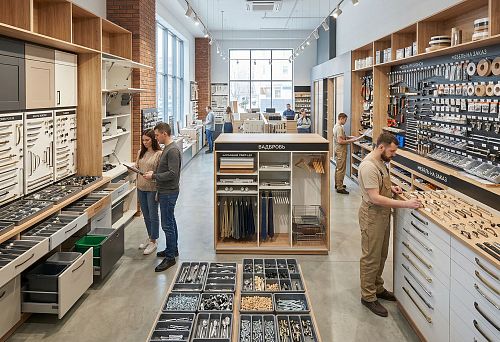
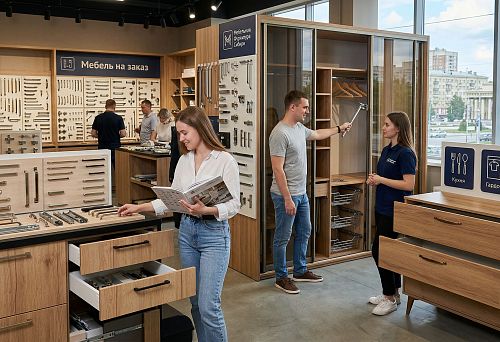
Specialized Showrooms and Showrooms in Nizhny Novgorod
● Advantages: immediate access to samples, consultations, precise measurements.
● Disadvantages: higher markup, need to visit the office.
● Recommendations: visit several showrooms, compare shades under different lighting, do not take the first samples you encounter.
Online Stores with Delivery and Pickup
● Advantages: wide assortment, filters by parameters, promotions, discounts, ability to compare many offers.
● Disadvantages: difficult to assess shade without samples, delivery times 2–14 days.
● Tip: order free or inexpensive demo veneer samples, analyze reviews from real buyers.
Construction Material Hypermarkets
● Advantages: affordable prices, wholesale discounts, availability of all accompanying products.
● Disadvantages: limited wood species and profiles, absence of designer consultations and installation guarantees.
Smart Buying Algorithm
- List requirements: profile, width, species, finish.
- Compare prices in three sources: showroom, online store, hypermarket.
- Order free samples of veneer or demo panels.
- Calculate logistics and installation.
- Make your final decision based on the price/quality/service ratio.
For a quick start, we recommendbuy wooden baseboards price a proven online project with a showroom in your city.
How to choose the optimal option: step-by-step methodology
Step 1. Define your budget
● Budget up to 700 ₽/linear m → consider veneered MDF.
● 700–1200 ₽/linear m → ideal choice — solid oak or composite profile.
● From 1200 ₽/linear m → solid oak, ash, and exclusive collections.
Step 2. Set design priorities
● If natural texture is important — solid wood.
● For painting and monochrome interiors — MDF primed for painting.
● For hidden backlighting — profile with a niche.
Step 3. Measure and calculate
● Measure the perimeter precisely and account for technological clearance.
● Add 10% allowance for cuts and defects.
● Divide by package length.
Step 4. Check samples
● Evaluate the shade under daylight and artificial lighting.
● Check coating quality and absence of defects.
Step 5. Evaluate service
● Presence of measurers and installers.
● Guarantees for geometry and absence of scratches.
● Return and exchange conditions.
Step 6. Align price and services
● If prices from two suppliers are close, choose the one offering installation and service for free or at a reduced rate.
Installation and its impact on final cost
Installation options
- Hidden clips and guides
○ Cost: 200–300 ₽/linear m.
○ Advantages: ventilation, disassembly without damage.
○ Disadvantages: requires a flat surface.
- “Liquid nails” (adhesive base)
○ Cost: 150–250 ₽/linear m.
○ Advantages: simplicity, no visible fasteners.
○ Disadvantages: wall surface is damaged during disassembly.
- Self-tapping screws with decorative caps
○ Cost: 100–200 ₽/linear m.
○ Advantages: maximum strength, fast installation.
○ Disadvantages: visible mounting points, need to match plugs to color.
Preparation work
● Removal of old baseboards.
● Leveling walls and floors if deviation exceeds 5 mm over 2 m.
● Priming surface for better adhesive bonding.
Installation rates
● Professional crew: 200–500 ₽/linear m. depending on profile complexity and site conditions.
● DIY installation: saves up to 100% on installation services, but requires time and carries risk of errors.
How to save on installation
● Proper surface preparation — fewer adjustments during installation.
● Choose hidden clips for quick installation without “liquid nails”.
● Combine purchase and installation with one supplier — discounts on bundled services.
Operation and maintenance: extending service life
Daily Care
● Wipe with soft dry or slightly damp cloth without aggressive cleaning agents.
● Wipe water immediately upon contact to prevent absorption into wood.
Periodic maintenance
● Apply protective coating (varnish, oil) every 6–12 months.
● Remove minor scratches with fine-grit sandpaper and reapply finish.
Climate condition control
● Maintain humidity at 40–60% and temperature at +18…+24 °C.
● Use humidifiers during the heating season and dehumidifiers in summer when humidity is excessive.
Repair and restoration
● Local restoration of solid wood: sanding and reapplication of varnish.
● Replacement of individual veneer segments in case of severe damage.
Ecological and healthy aspect of wooden skirting boards
Sustainable forestry
● FSC/PEFC certificates confirm the legality of wood origin and careful management of forest resources.
● When purchasing, pay attention to labeling and supplier details.
Healthy microclimate
● Wood regulates humidity in the room: absorbs excess moisture when humidity is high, and releases stored moisture when air is dry.
● Non-static material reduces accumulation of dust and microorganisms.
No toxins
● Solid wood and natural veneer do not contain formaldehyde and volatile organic compounds in hazardous concentrations.
● Use of safe lacquer and oil-based finishes enhances the ecological effect.
Design techniques using wooden skirting boards
Contrast and framing
Highlight the boundary between floor and wall by using skirting boards 2–3 tones darker or lighter than the flooring. This creates a visual 'frame' effect and emphasizes the pattern of parquet or laminate.
Monochromatic and minimalist
Choose skirting boards to match door frames, window casings, and flooring to create a seamless, spacious interior. Ideal for modern minimalist styles.
Integration of lighting
Installing LED strips in the recess of a wide skirting board creates soft indirect lighting along the floor, giving the room a 'floating' interior status and additional comfort at night.
Zoning of open spaces
In studios with combined kitchen and living areas, use different profiles or wood species to visually distinguish zones without walls or heavy structures.
Combination with decorative elements
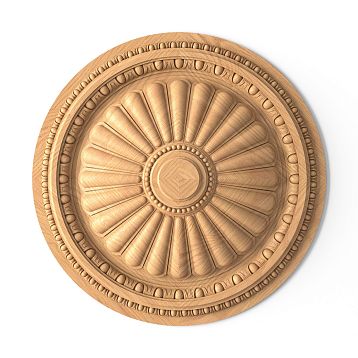
In classic interiors, wooden skirting boards can be complemented with decorative rosettes, cornices, and friezes made of the same material or paintable finishes.
Frequently Asked Questions (FAQ)
Q1. Can wooden skirting boards be painted?
Yes. For veneered MDF skirting boards, acrylic, alkyd, and water-emulsion paints are suitable. Solid wood is better treated with stain and varnish to preserve the texture.
Q2. Which skirting board is best for 'warm floors'?
Choose skirting boards at least 18 mm thick, certified for surfaces up to +27°C, and ensure a compensatory gap of at least 10 mm.
Q3. Are special tools needed for installation?
For quality installation, you will need a level, painter's line, a circular saw or a miter gauge, clips or 'liquid nails', self-tapping screws, and protective caps.
B4. How to store skirting board until installation?
Horizontally, in a dry room at a temperature of +10…+25 °C and relative humidity of 40–60 %, away from direct sunlight and heating appliances.
B5. Can I install a wide solid wood skirting board myself?
Yes, if you have the necessary tools and skills. However, for large-profile boards, we recommend professional installation to avoid errors that are difficult to fix without specialists.
Conclusion
Selecting and installing wooden skirting boards is a complex task requiring consideration of many factors: wood species, profile, width, finish, usage conditions, and installation method. buy wooden baseboards price Optimally in trusted stores offering full-service: from measurements and samples to delivery, installation, and subsequent maintenance. Balancing budget and quality, you will create an interior that lasts long, preserves the beauty of natural wood, and ensures comfort in your home.