












































































Article Contents:
- Comparative table of chemical and physical properties
- Polystyrene: lightness and accessibility
- Duroplastic: strength of the new generation
- MDF: wooden alternative
- Polyurethane: elastic strength
- Comparative table of chemical and physical properties
- Advantages and disadvantages of each material
- Polystyrene: people's favorite
- Duroplastic: premium class
- MDF: imitation of wood
- Polyurethane: flexible luxury
- Comparison of cost, durability, and resistance
- Cost: calculation on a real example
- Durability: service life under real conditions
- Resistance to various factors
- Ownership cost: TCO (Total Cost of Ownership)
- Where to use each type of skirting board
- Polystyrene: universal budget option
- Duroplastic: premium for demanding users
- MDF: elegance with limitations
- Polyurethane: when flexibility or maximum quality is needed
- High-density polystyrene: what is its advantage
- What is high-density polystyrene
- Advantages of high density
- Disadvantages of high density
- How to distinguish high-density polystyrene
- Real reviews and operational experience
- Polystyrene: what users say
- Duroplastic: premium justifies itself
- MDF: beautiful, but with reservations
- Polyurethane: expensive, but perfect
- General conclusions from reviews
- Final choice: which material suits you best
- Choice by budget
- Select by room type
- Choosing by interior style
- Choice by priorities
- STAVROS Recommendations
- Combined approach: saving without sacrificing quality
- Common mistakes when choosing
- Conclusion
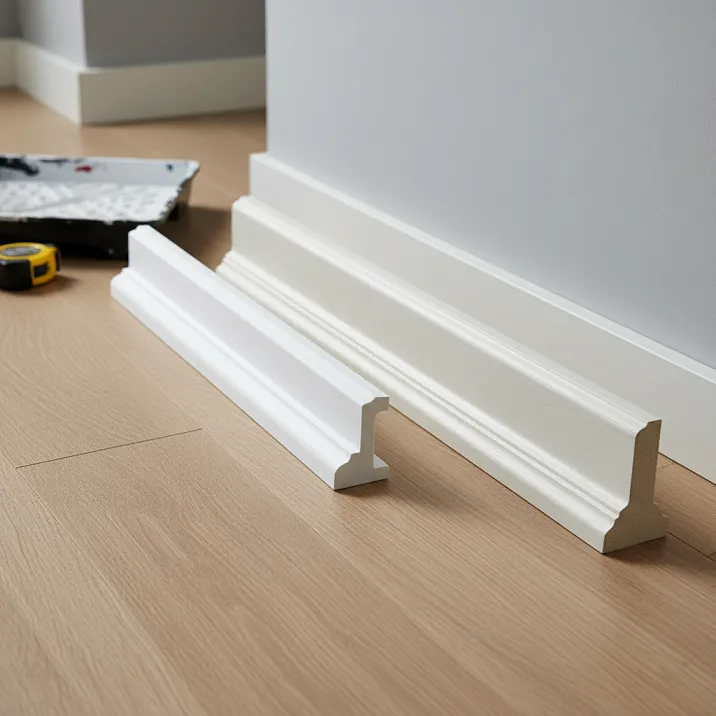
Choosing baseboard is not just buying a certain amount of finishing material. It is a decision that will affect your interior for the next 10-20 years. You will see the baseboard every day, it will be subjected to daily wear and tear, and it will need to be cleaned and wiped. The correct choice of material depends not only on the appearance of the room, but also on practicality, durability, and ease of maintenance.
The modern market offers dozens of options. Polystyrene, duro-polymer, MDF, polyurethane, PVC, wood, gypsum — how not to get lost in this variety? Each seller praises their product, each material has its advantages and disadvantages. Where is the truth, and where is marketing? Let's examine this in detail, based on facts, chemical composition, real properties of materials, and experience of use.


Polystyrene, duro-polymer, MDF and polyurethane: chemical composition and properties




Polystyrene: lightness and accessibility
Chemical composition and production:
Polystyrene is a synthetic polymer obtained by polymerization of styrene (C8H8). In construction, expanded polystyrene (EPS or PSB) is used. It is produced by extrusion: polystyrene granules are heated, foamed with a special agent (usually pentane), and formed into the required profile.
Material structure — closed-cell, 98% of volume is air enclosed in microscopic sealed cells of 0.1–0.3 mm. This structure determines the main properties of the material.
Physical characteristics:
-
Density: 15–35 kg/m³ (for baseboards usually 25–35 kg/m³)
-
Thermal conductivity: 0.028–0.034 W/(m·K) — excellent insulator
-
Water absorption: less than 2% of volume within 24 hours
-
Compressive strength: 0.1–0.4 MPa
-
Melting point: 80–100°C
-
Melting temperature: 160–170°C
-
Flammability: Group G3–G4 (normally flammable, with flame retardants — G2)
Molecular structure:
Polystyrene consists of long chains of styrene molecules connected by carbon-carbon bonds. The material is chemically inert and does not react with most substances. It is degraded by organic solvents (acetone, toluene), which break intermolecular bonds.
Material aging:
Polystyrene is susceptible to photoaging under ultraviolet radiation. UV radiation breaks molecular bonds, causing yellowing and deterioration of mechanical properties. High-quality polystyrene contains UV stabilizers that slow down this process. Products from reputable manufacturers such as Hi Wood include modern additives ensuring resistance to yellowing.
Our factory also produces:


Duropolymer: strength of the new generation
Chemical composition and production:
Duropolymer (duropolymer) is a trade name for high-density expanded polystyrene with a modified structure. Essentially, it is the same polystyrene, but produced using an improved technology with reinforcing components and stabilizers added.
Unlike ordinary polystyrene, duropolymer has smaller cell sizes (0.05-0.1 mm), thicker cell walls, and additives for increased strength. It is produced by high-temperature extrusion with precise parameter control.
Physical characteristics:
-
Density: 50-70 kg/m³ (twice higher than polystyrene)
-
Thermal conductivity: 0.032-0.036 W/(m·K)
-
Water absorption: less than 1%
-
Compressive strength: 0.5-0.8 MPa (2-3 times higher)
-
Melting temperature: 90-110°C
-
Impact resistance: 3-4 times higher than ordinary polystyrene
-
Flammability: Group G1-G2 (low flammability)
Differences from polystyrene:
Visually, duroplastic may be indistinguishable from polystyrene, but its physical properties are significantly better. A denser structure provides high mechanical strength, resistance to scratches and impacts. The material is heavier (though still lighter than alternatives), but noticeably stronger.
Duroplastic has higher surface detail - it allows creating thinner and deeper decorative elements. The surface is smoother, paint adheres better. Service life is 30-50% longer than ordinary polystyrene.
Get Consultation
MDF: wood alternative
Chemical composition and production:
MDF (Medium Density Fiberboard, medium-density fiberboard) - a composite material made of wood fibers bonded with synthetic resins. Produced from ground wood (usually wood processing waste), which is steamed, broken down into fibers, mixed with a binder (urea-formaldehyde or melamine-formaldehyde resins), formed under pressure and high temperature.
For baseboards, MDF is covered with a finish layer: film (laminate), veneer, paint, or varnish. This protects the material from moisture and gives it a decorative appearance.
Physical characteristics:
-
Density: 600-800 kg/m³ (20-30 times denser than polystyrene!)
-
Thermal conductivity: 0.10-0.15 W/(m·K)
-
Water absorption: 15-25% in 24 hours (critical parameter)
-
Bending strength: 20-30 MPa
-
Compressive strength: 10-15 MPa
-
Operating temperature: up to 80°C
-
Flammability: Group G4 (highly flammable)
Material structure:
Under a microscope, MDF appears as densely compressed wood fibers bonded with resin. The structure is homogeneous, without layers (unlike plywood or particleboard). This ensures uniform properties in all directions and allows milling of complex profiles.
Ecological:
The main ecological problem with MDF is formaldehyde, which may be released from the binding resins. Modern technologies allow reducing emissions to safe levels (E1 or E0 class). Quality MDF from European manufacturers is safe, but cheap Chinese variants may exceed norms.
Polyurethane: elastic strength
Chemical composition and production:
Polyurethane - a broad group of polymers containing urethane groups -NH-CO-O-. Obtained by reaction of polyols with isocyanates. For baseboards, it is used as foamed polyurethane with density 200-300 kg/m³ or solid polyurethane with density 500-700 kg/m³.
Production: liquid components (polyol and isocyanate) are mixed, undergoing a chemical reaction with CO2 release, which foams the mass. The mixture is poured into molds, where polymerization occurs. Result - a resilient, strong material with a closed-cell structure.
Physical characteristics:
-
Density: 200-700 kg/m³ (depending on type)
-
Thermal conductivity: 0.035-0.040 W/(m·K)
-
Water absorption: less than 1%
-
Bending strength: 5-15 MPa
-
Elasticity: can be bent to any radius without breaking
-
Operating temperature: -40 to +90°C
-
UV resistance: high (with additives)
-
Flammability: Group G2-G3
Unique properties:
The main feature of polyurethane is elasticity. The material can be bent and will return to its original shape without cracks or deformation. This allows its use on curved surfaces, for decorating columns, arches, and bay windows.
Polyurethane is not afraid of impacts — due to its elasticity, impact energy is absorbed without destruction. It is resistant to abrasion and scratches. Relief detailing can be very high — thin elements as thin as 1-2 mm are possible.
Aging:
Polyurethane ages slowly. High-quality material with UV stabilizers retains its properties for 30-50 years. It may slightly yellow, but mechanical properties remain practically unchanged. It is not afraid of temperature or humidity fluctuations.
Comparative table of chemical and physical properties
| Property | Polystyrene | Duropolymer | MDF | Polyurethane |
|---|---|---|---|---|
| Base | Expanded polystyrene | Modified polystyrene | Wood fibers + resin | Polyurethane polymers |
| Density (kg/m³) | 25-35 | 50-70 | 600-800 | 200-700 |
| Weight of 1 m of skirting board 80mm (g) | 80-120 | 150-200 | 400-600 | 300-500 |
| Water absorption | < 2% | < 1% | 15-25% | < 1% |
| Compressive strength (MPa) | 0,1-0,4 | 0,5-0,8 | 10-15 | 5-15 |
| Elasticity | No | No | No | High |
| Operating temperature | -40...+80°C | -40...+100°C | -20...+80°C | -40...+90°C |
| UV resistance | Medium | High | Depends on coating | High |
| Ecological | High | High | Average (formaldehyde) | High |
Advantages and disadvantages of each material
Polystyrene: the people's favorite
Advantages:
Minimum weight — the main advantage. A linear meter of skirting board weighs 80-150 grams. This is 3-5 times lighter than polyurethane and 5-7 times lighter than MDF. Lightness ensures easy installation, secure adhesion on glue without additional fasteners, and no load on walls.
Affordable price — polystyreneMDF or polystyrene skirting boardcosts 2-4 times less than polyurethane, 1.5-2 times less than MDF, and 4-6 times less than duro-polymer. With a limited budget, this is the optimal choice without significant loss of quality.
Absolute water resistance — water absorption less than 2% means practical immunity to water. Can be used in bathrooms, showers, and kitchens. Does not rot, swell, or deform. Mold and fungi do not form on polystyrene — there is no nutrient medium.
Ease of processing — cuts with ordinary tools without special skills. Metal hacksaw, construction knife, even a kitchen knife will do. Does not produce hazardous dust (unlike MDF). No need for powerful tools.
Easy to paint — polystyrene takes water-based paints excellently. Any color can be created, and it can be repainted unlimited times. Paint adheres well and does not peel off with proper preparation.
Safety - chemically inert, does not emit harmful substances under normal operation. Approved for residential spaces, children's rooms, medical facilities. Does not contain formaldehyde or other volatile compounds.
Thermal insulation - due to low thermal conductivity, it creates an additional thermal barrier at the junction of wall and floor/ceiling. Does not freeze, does not form cold bridges.
Disadvantages:
Average mechanical strength - under strong impact, dents or chips may form. The material is soft and easily compresses under point load. Not suitable for areas with high mechanical load.
Sensitivity to solvents - acetone, solvents, and some adhesives damage polystyrene. Careful selection of mounting and painting compounds is required.
Limited heat resistance - begins to soften at temperatures above 80°C. Cannot be installed close to powerful heat sources. In case of fire, it melts quickly, releasing toxic gases.
Flammability - polystyrene burns and sustains combustion. Even with flame retardants, it belongs to Group G2-G3 (moderately/normal flammability). This limits its use in spaces with heightened fire safety requirements.
Limited relief detail - reproducing complex fine decorative elements is difficult. Minimum element thickness is 3-4 mm; otherwise, it becomes brittle.
Risk of yellowing - inexpensive polystyrene without UV stabilizers yellows over time when exposed to sunlight. Quality products, such as those from HiWood, lack this drawback due to modern additives.
Electrostaticity - polystyrene accumulates static electricity, attracting dust. Requires more frequent cleaning compared to other materials.
Duropolymer: premium class
Advantages:
Maximum strength among polymers - impact resistance 3-4 times higher than polystyrene. Resistant to accidental impacts from furniture, toys, or vacuum cleaners. Scratches form with difficulty. Suitable for rooms with children and pets.
Excellent detail - allows for extremely fine relief elements (1-2 mm), deep grooves, complex patterns. In terms of decoration quality, it matches plaster molding, surpassing it in all other characteristics.
Durability - service life of 30-50 years without loss of properties. Does not yellow, does not deform, does not crack. Install once, forget for decades.
Water resistance - better than polystyrene (water absorption < 1%). Can be washed under pressure, suitable for pools and saunas.
Dimensional stability - does not expand or contract with temperature fluctuations. Does not deform over time. Joints remain tight for years.
Chemical resistance - withstands contact with household chemicals and cleaning agents, without changing properties or color.
Enhanced heat resistance - softening temperature of 90-110°C, 10-30°C higher than standard polystyrene. Can be installed closer to heat sources.
Better fire safety - due to flame retardant additives, it belongs to Group G1-G2 (slightly/moderately flammable). Self-extinguishing - stops burning when the fire source is removed.
Disadvantages:
Higher price - main drawback. Cost is 4-6 times higher than polystyrene, 1.5-2 times higher than quality polyurethane. Not suitable for budget repairs.
Greater weight - although still lighter than MDF and polyurethane, it is twice as heavy as polystyrene. Requires more careful installation and quality adhesive.
Processing difficulty - dense material is harder to cut. Requires sharper tools and more effort. A jigsaw or circular saw is preferable for large-scale work.
Limited availability - not sold in all hardware stores. May require ordering and waiting for delivery.
Repair difficulty - more difficult to restore after damage. Spackle adheres less well to dense surfaces.
MDF: wood imitation
Advantages:
Appearance - main advantage of MDF. Laminate film or veneer beautifully imitates natural wood. Wide range of decorative options - oak, walnut, cherry, wenge, and other species. Looks respectable and expensive.
High mechanical strength - hard material resistant to impacts, scratches, and dents. Furniture can be placed directly without fear of damage.
Sharp edges - dense material allows creating profiles with sharp, well-defined edges that do not round off over time.
Shape stability - does not bend, does not deform, maintains perfectly straight lines even over long spans.
Easy installation - many models feature a clip system. Snap onto brackets - and done. Easily removable if needed.
Sanding capability - scratches and minor damage can be sanded and re-coated with varnish or paint.
Ecological - quality MDF class E1 or E0 is safe for health. Made from natural wood.
Disadvantages:
Low moisture resistance - a critical flaw of MDF. Water absorption of 15-25% means the material swells, deforms, and delaminates when in contact with water. Absolutely unsuitable for humid areas.
Even moisture-resistant MDF can only withstand increased air humidity, not direct contact with water. In case of flooding, MDF skirting boards must be replaced entirely.
Heavy weight - one meter weighs 400-600 grams. This creates stress on fasteners and requires secure fixation. When glued, it may detach under its own weight.
Difficulty in painting - laminated MDF is practically impossible to repaint. Paint does not adhere to the film. If you’re tired of the color, only replacement is an option.
Dust formation during cutting - fine wood dust is harmful to respiratory pathways. Must use respirator and goggles. Dust spreads throughout the room.
Toxicity when burning - during fire, MDF releases toxic gases from burning resin binders. Flammability class G4 - highly flammable.
Limited application - suitable only for dry rooms. Not suitable for entryways (wet shoes), kitchens (water splashes), or bathrooms.
Deformation due to humidity fluctuations - even in dry rooms, MDF slightly expands or contracts with seasonal humidity changes. After several years, gaps may appear at joints.
Repair difficulty - damaged laminated film cannot be restored. Dents or chips remain permanently. The only option is replacing the entire strip.
Polyurethane: flexible luxury
Advantages:
Unique flexibility - can be bent along a radius, form columns, arches, bay windows, curved walls. No other material allows this. For non-standard architectural solutions, polyurethane is indispensable.
High detail - possible extremely fine decorative elements (1 mm), deep relief (up to 30 mm), complex patterns. In beauty, it rivals plaster molding, surpassing it in practicality.
Maximum impact resistance - elastic material absorbs impacts without breaking. You can hit it with a hammer - only a small dent forms, which partially recovers itself.
Durability - service life of 40-50 years. Won’t yellow, crack, or lose properties. The most durable material among all.
Moisture resistance - absolute. Not afraid of direct water contact, can be washed under pressure. Suitable for pools and saunas.
Temperature resistance - withstands from -40 to +90°C without property changes. Does not deform from heat or cold.
Versatility - suitable for any rooms and conditions. Living rooms, kitchens, bathrooms, saunas, unheated spaces, facades - polyurethane will serve for decades everywhere.
Easy maintenance - smooth, dense surface does not accumulate dirt, easily cleaned with any cleaning agents. Resistant to household chemicals.
Restoration possibility - minor damage can be sanded, sanded, and painted. Even heavily damaged skirting boards can be restored.
Disadvantages:
High cost - polyurethane is 3-4 times more expensive than polystyrene, 1.5-2 times more expensive than MDF. Not suitable for budget renovations.
Heavy weight - 3-5 times heavier than polystyrene. Requires quality adhesive, sometimes additional mechanical fastening.
Processing difficulty - dense, elastic material is harder to cut. Requires sharp tools and effort. For large volumes, a panel saw is recommended.
Installation time - heavy material requires longer pressing during gluing. Requires secure temporary fixation.
Cost of errors - if you make a mistake cutting expensive polyurethane skirting boards, the loss is significant. With polystyrene, the error is less critical.
Limited selection in stores - not available everywhere, may require ordering.
Comparison of cost, durability, and resistance
Cost: calculation on a real example
Calculate the cost of skirting boards for a standard 4x5 meter room:
Perimeter: (4+5) x 2 = 18 m
Minus door: 18 - 0.9 = 17.1 m
With reserve: 20 m
Polystyrene:
-
Price: 40-80 rub/m (average 60 rub)
-
Total: 20m x 60 = 1200 rub
-
Adhesive: 200 rub
-
Paint (optional): 300 rub
-
Total: 1400-1700 rub
Duropolymer:
-
Price: 250-400 rub/m (average 300 rub)
-
Total: 20m x 300 = 6000 rub
-
Adhesive: 300 rub
-
Paint: 300 rub
-
Total: 6300-6600 rub
MDF:
-
Price: 80-150 rub/m (average 110 rub)
-
Total: 20m x 110 = 2200 rub
-
Fasteners/clips: 400 rub
-
Total: 2600 rub
Polyurethane:
-
Price: 200-350 rub/m (average 250 rub)
-
Total: 20m x 250 = 5000 rub
-
Adhesive: 300 rub
-
Paint: 300 rub
-
Total: 5300-5600 rub
Relative cost (polystyrene = 1):
-
Polystyrene: 1x
-
MDF: 1.5x
-
Polyurethane: 3-3.5x
-
Duropolymer: 4-4.5x
Durability: service life under real conditions
Polystyrene: 15–25 years
Actual service life depends on conditions:
-
In living rooms without direct sunlight: 20-25 years
-
On sunny side without painting: 10-15 years (yellowing)
-
With painting: 20-25 years
-
In humid areas: 15-20 years
-
Under high mechanical loads: 10-15 years
Limiting factor - mechanical damage. The material itself does not age, but accumulates dents, chips, scratches. By the 20th year, the appearance deteriorates and replacement is required.
Duro-polymer: 30–50 years
The most durable among polymers:
-
Under any conditions: at least 35-45 years
-
Mechanical damage is minimal due to strength
-
Does not yellow, does not deform
-
Limitation - only radical interior changes
MDF: 10-20 years
Depends on humidity:
-
In dry rooms: 15-20 years
-
In rooms with humidity fluctuations: 10-15 years
-
In humid areas: not recommended (destruction within 3-5 years)
Limiting factors:
-
Damage to laminated coating
-
Deformation due to humidity
-
Chips on edges
-
Material delamination
Polyurethane: 30–50 years
Maximum durability:
-
Practically eternal material
-
Does not age, does not deform
-
Withstands any conditions
-
Real limitation - only design solutions
Resistance to various factors
Water Resistance:
| Material | Assessment | Comment |
|---|---|---|
| Polystyrene | 5/5 | Excellent. Completely resistant to water |
| Durapolymers | 5/5 | Excellent. Water absorption < 1% |
| MDF | 1/5 | Poor. Degrades from moisture |
| Polyurethane | 5/5 | Excellent. Absolute moisture resistance |
Mechanical strength:
| Material | Assessment | Comment |
|---|---|---|
| Polystyrene | 2/5 | Average. Easily compressed, scratches easily |
| Durapolymers | 4/5 | Good. High impact resistance |
| MDF | 4/5 | Good. Hard, but can crack |
| Polyurethane | 5/5 | Excellent. Elastic, absorbs impacts |
Temperature resistance:
| Material | Assessment | Range | Comment |
|---|---|---|---|
| Polystyrene | 3/5 | -40...+80°C | Softens at 80°C |
| Durapolymers | 4/5 | -40...+100°C | Better than polystyrene |
| MDF | 3/5 | -20...+80°C | Deforms at high temperatures |
| Polyurethane | 5/5 | -40...+90°C | Stable over a wide range |
UV resistance:
| Material | Assessment | Comment |
|---|---|---|
| Polystyrene | 3/5 | May yellow without stabilizers |
| Durapolymers | 5/5 | Will not yellow due to additives |
| MDF | 4/5 | Depends on finish. Veneer may fade |
| Polyurethane | 5/5 | Excellent UV resistance |
Chemical resistance:
| Material | Assessment | Comment |
|---|---|---|
| Polystyrene | 3/5 | Dissolves in organic solvents |
| Durapolymers | 4/5 | Better than polystyrene, but sensitive to solvents |
| MDF | 3/5 | Finish may be damaged by aggressive chemicals |
| Polyurethane | 5/5 | Resistant to most household chemicals |
Ownership cost: TCO (Total Cost of Ownership)
Let's consider the total cost over 30 years of operation:
Polystyrene:
-
Initial installation: 1500 rub
-
Replacement after 20 years: 1800 rub (inflation-adjusted)
-
Repainting (3 times over 30 years): 900 rub
-
Total over 30 years: 4200 rub
Duropolymer:
-
Initial installation: 6500 rub
-
Replacement: not required
-
Painting: 300 rub (1 time)
-
Total over 30 years: 6800 rub
MDF:
-
Initial installation: 2600 rub
-
Replacement after 15 years: 3500 rub
-
Total over 30 years: 6100 rub
Polyurethane:
-
Initial installation: 5500 rub
-
Replacement: not required
-
Painting: 300 rub (1 time)
-
Total over 30 years: 5800 rub
Conclusion: Over the long term, the price difference is offset. Durapolymer and polyurethane pay for themselves due to longevity. Polystyrene remains the most economical option even when replacements are considered.
Where to use each type of skirting board
Polystyrene: universal budget option
Optimal rooms:
Living rooms (bedrooms, living rooms, children's rooms):
Polystyrene is ideal for rooms with low mechanical load. In a bedroom, no one hits the skirting board, the load is minimal. Ease of installation, ability to paint in any color, and affordable price make polystyrene the perfect choice.
Offices, libraries:
Rooms with low foot traffic, no moisture, and careful use — ideal conditions for polystyrene. Here, it will last 25–30 years without problems.
Ceiling skirting boards (any rooms):
For ceilings, polystyrene is the best choice. There is no mechanical load, and lightness is critical (it holds only with adhesive). Affordable price allows installing decorative cornices even with a modest budget.
Temporary housing:
Rented apartments, dormitories, cottages — everywhere where long-term use is not planned, polystyrene is optimal. Low price means minimal losses when moving.
Commercial spaces with low foot traffic:
Offices, offices, meeting rooms, where there is no heavy traffic or mechanical impact.
NOT recommended:
Hallways and corridors:
High foot traffic, impacts from bags, suitcases, shoes will quickly cause damage. Polystyrene here will last 5–10 years, losing its appearance.
Rooms with children and pets:
Toys, claws, impacts — polystyrene will quickly develop dents and scratches. It’s better to choose a more durable material.
Areas near heat sources:
Cannot be installed near fireplaces, stoves, powerful heaters. It will soften and deform.
Commercial spaces with high foot traffic:
Stores, restaurants, public buildings - polystyrene cannot withstand the load.
Duroplastic: premium for demanding applications
Optimal rooms:
Representative spaces:
Halls, living rooms, entrance halls, where a flawless appearance is required for decades. Duroplastic creates a sense of luxury without losing it over time.
Hallways and corridors:
High traffic requires durability. Duroplastic withstands impacts and scratches, preserving its appearance. Ideal choice for entrance areas.
Children's rooms:
Duroplastic's strength protects against children's play. Parents will be reassured - baseboards won't be damaged by toys, balls, or bicycles.
Rooms with animals:
Dog and cat claws will not leave marks on strong duroplastic.
Commercial real estate:
Offices, clinics, beauty salons, stores - everywhere where durability and a professional appearance matter.
Wet areas:
Bathrooms, kitchens, pools, saunas - duroplastic's water resistance allows its use everywhere.
Restoration of historical interiors:
High relief detail allows recreation of vintage moldings with millimeter precision.
NOT recommended:
Budget repair:
Duroplastic is an unaffordable luxury when budget is limited. Polystyrene delivers 80% of the result for 25% of the price.
Temporary housing:
There's no point investing in expensive materials if you'll be moving in a year or two.
Hidden areas:
Behind furniture, in storage rooms and utility spaces, paying extra for duroplastic is unjustified.
MDF: elegance with limitations
Optimal rooms:
Offices, libraries:
Strict interior, wood imitation, noble appearance - MDF creates an atmosphere of solidity. In dry rooms with low load, it will last 15-20 years.
Bedrooms:
Dry room, low load, appearance matters - MDF is good. Wood-grain decor creates a cozy atmosphere.
Living rooms:
If there's no risk of water contact, MDF will decorate the interior. Wide range of decor options allows precise matching with furniture.
Offices:
Professional appearance, durability, affordable price - MDF is popular in office spaces.
ABSOLUTELY NOT recommended:
Bathrooms:
Even water-resistant MDF will be destroyed by water splashes. Contact with water is inevitable - MDF will swell, deform, and delaminate. Service life - maximum 2-3 years.
Kitchens:
Splashes from washing dishes or floors, possible leaks — all of this is a death sentence for MDF.
Entryways:
Wet shoes, umbrellas, snow — sources of moisture. MDF will swell from the bottom and lose its appearance within 3-5 years.
Basements, ground floors:
High humidity, risk of flooding — MDF is not suitable here.
Unheated spaces:
Condensation from temperature fluctuations will destroy MDF within one season.
Polyurethane: when flexibility or maximum quality is needed
Optimal rooms:
Rooms with complex geometry:
Columns, arches, bay windows, curved walls — only polyurethane can be bent. Essential for non-standard architecture.
Classic interiors with rich moldings:
High detail, complex patterns, multi-tiered cornices — polyurethane creates the effect of plaster moldings with greater practicality.
Premium wet areas:
Bathrooms, SPA, pools in luxury residences — polyurethane will provide luxurious appearance and absolute durability.
Rooms with high mechanical load:
Corridors, halls, public spaces — polyurethane’s impact resistance is indispensable.
Facade decoration:
Special facade polyurethane withstands any weather conditions. Used for entrance areas and building facades.
Restoration:
Recreating historical moldings with the finest details.
NOT recommended:
Budget repair:
If the budget is limited, polyurethane is an unjustified luxury.
Simple straight sections in ordinary rooms:
Overpayment is not justified.Polystyrene and polyurethane: differencesPrice differences are significant, and for simple tasks, polyurethane’s advantages are not realized.
Temporary housing:
Polyurethane’s durability is unnecessary if you plan to move within a year.
High-density polystyrene: what is its advantage
What is high-density polystyrene
The density of standard polystyrene for baseboards is 15-25 kg/m³. This is a very light material with low strength. High-density polystyrene is a material with density of 30-40 kg/m³, which is 50-100% higher than the standard.
Increased density is achieved in several ways:
-
Smaller cell size (0.05-0.1 mm instead of 0.2-0.3 mm)
-
Thicker cell walls
-
Less foaming agent
-
Special additives strengthening the structure
Hi Wood products are made precisely from high-density polystyrene (32-35 kg/m³), which provides improved properties while retaining all the advantages of polystyrene.
Advantages of high density
Increased mechanical strength:
Compressive strength increases by 1.5-2 times. If standard polystyrene easily compresses under a finger, high-density material requires significant force. This means fewer dents from accidental impacts and a longer service life.
Bending strength is also higher. The baseboard bends less and maintains its shape on uneven walls. During transportation and installation, the risk of breakage is lower.
Better machinability:
Dense material cuts cleaner, without ragged edges. End cuts are smooth, without crumbling. This is especially important for corners — they fit together more tightly, with minimal gaps.
When cutting with a sharp tool, you can achieve a perfectly smooth cut that does not require additional sanding. This saves installation time.
Smoother surface:
Smaller cell size provides a smoother factory surface. Minimal surface preparation is required for painting. Paint lays evenly, with less consumption.
When painting, only 2 coats instead of 3 are needed to achieve a dense finish. Paint savings amount to 20-30%.
Better relief detail:
Dense material allows creating thinner and sharper decorative elements. Edges remain sharp, not rounded. Relief is deeper and more pronounced.
Increased durability:
The service life of high-density polystyrene is 30-50% longer than standard. If standard polystyrene lasts 15-20 years, high-density lasts 20-30 years.
The material accumulates mechanical damage more slowly. Scratches and dents occur less frequently. Appearance is preserved longer.
Less brittleness in cold:
At negative temperatures, standard polystyrene becomes brittle. High-density material retains its properties even at -30°C. This is important for unheated rooms and winter installation.
Disadvantages of high density
Greater weight:
The baseboard weighs 30-50% more than standard polystyrene. This is still a very light material, but the difference is noticeable in large volumes. Nevertheless, this is more of an advantage — the baseboard adheres better to the wall under its own weight.
Slightly higher price:
High-density polystyrene costs 20-40% more than standard. But it is still much cheaper than duro-polymer or polyurethane. The price difference is quickly offset by durability and quality.
Slightly more difficult to cut:
Dense material requires slightly more effort to cut. But with a sharp tool, the difference is negligible.
How to distinguish high-density polystyrene
Visually:
-
Smother surface
-
Fine, uniform structure (small pores)
-
Snow-white color without grayish tint
To the touch:
-
Harder, does not compress under finger pressure
-
Feeling of density when compressed
-
Sound is more resonant when tapped
When cutting:
-
Clean cut without crumbling
-
Smooth edge
-
Does not deform during cutting
By marking:
Responsible manufacturers, such as HiWood, indicate density in technical specifications. Look for values of 30-35 kg/m³ and above.
Real reviews and user experience
Polystyrene: what users say
Positive reviews:
"Installed polystyrene skirting boards 8 years ago throughout the apartment. Cost practically nothing. Over this time, nothing has happened to them — they look brand new. Once repainted to another color during wallpaper change. Very satisfied, why pay more?" — Andrey, Moscow
"Did the renovation myself, without professionals. Installing polystyrene skirting boards turned out to be elementary. Cut with a regular hacksaw in a sawhorse, glued with liquid nails. All corners came out perfect the first time. Lightweight — held with one hand, glued with the other. Ideal option for those doing DIY renovations." — Elena, Saint Petersburg
"Used polystyrene in the bathroom. Five years have passed — no problems. Water regularly gets in, but the skirting board hasn't swollen or peeled off. The key — use a good moisture-resistant glue." — Dmitry, Yekaterinburg
Critical reviews:
"Installed polystyrene in the hallway. After a year, it's all dented from shoes and suitcases. Looks terrible. Definitely not suitable for hallways — needs something stronger." — Sergey, Novosibirsk
"Bought the cheapest polystyrene. After three years, it turned yellow on the sunny side. Had to repaint. Should have bought quality material or painted during installation." — Oleg, Krasnodar
"Accidentally used the wrong glue — with solvent — during installation. The skirting board was completely eaten away, had to redo it. Important to pay attention to what glue you're using!" — Alexander, Kazan'
Duroplastic: premium justifies itself
Positive reviews:
"Installed duroplastic in the hallway 10 years ago. Looks brand new — not a single scratch. Children are here, dogs run around — the skirting board is like iron, nothing can harm it. Expensive, but worth it." — Mikhail, Moscow
"Did a designer renovation, used duroplastic with a very complex relief. The detailing is amazing — looks like real plaster molding. Seven years have passed — perfect condition. No yellowing, no cracking. High price, but quality matches." — Irina, Sochi
Critical reviews:
"Duroplastic is good, but very expensive. For a regular apartment, the extra cost is unjustified. In bedrooms, I installed regular polystyrene — and it works perfectly." — Vladimir, Nizhny Novgorod
"Heavier, more difficult to install than polystyrene. Must hold it for a long time until the glue sets. Good result, but labor-intensive." — Igor, Chelyabinsk
MDF: beautiful, but with reservations
Positive reviews:
"MDF in a walnut finish looks amazing in the office. All guests like it and think it's real wood. Six years have passed, and everything is fine. The main thing is to protect it from water." - Alexey, Rostov-on-Don
"I installed MDF with a cable channel. It's convenient - all wires are hidden. Installation is simple - on clips. Snap it and done. It's been serving in the living room for 8 years without any problems." - Pavel, Samara
Critical reviews:
"I installed MDF in the kitchen - a huge mistake. After 2 years, the bottom swelled from moisture and cracks appeared. Had to replace it with polystyrene. MDF is absolutely unsuitable for kitchens!" - Anton, Voronezh
"Our upstairs neighbors flooded us. The MDF skirting board swelled up everywhere, like a sponge soaking up water. Had to throw it away and install new ones. Polystyrene would have handled this calmly." - Marina, Ufa
"MDF cannot be repainted. I got tired of the color after 5 years, and there was nothing I could do. Had to buy new ones. This is a downside." - Igor, Perm'
Polyurethane: expensive, but perfect
Positive reviews:
"We have columns in the living room. Only polyurethane could be bent to a radius. The result is amazing - the skirting board smoothly wraps around the column. Expensive, but there's no alternative." - Elena, Moscow
"I used polyurethane in the bedroom with lighting. It's something! Looks luxurious, like in a luxury hotel. It cost a lot, but I wouldn't regret a single kopeck." - Natalia, Saint Petersburg
"I used polyurethane in the bathroom. Twelve years have passed - absolutely no changes. You can wash it with anything, even hose it down. A permanent material." - Vyacheslav, Krasnodar
Critical reviews:
"Polyurethane is heavy. The one who glued it - suffered. You need to hold it for a long time until it sets. It's better to work with a helper." - Andrey, Krasnoyarsk
"The price bites. In a three-room apartment, the skirting boards cost more than 30,000 rubles. But the quality is top-notch, no complaints." - Sergey, Novosibirsk
General conclusions from reviews
Polystyrene - the people's favorite for ordinary living spaces. Main advantages: price, ease of installation, sufficient quality. Disadvantages become apparent in hallways and when using cheap, low-quality variants.
Duroplastic - the choice for those willing to pay for maximum quality and durability. There are practically no complaints about the material, only about the price.
MDF - good for dry rooms where the wood-like appearance is important. Absolutely unsuitable for humid rooms - all negative reviews confirm this.
Polyurethane - ideal for complex tasks and premium interiors. Everyone is satisfied with the quality, complaints are only about the price and weight.
Final choice: which material suits you best
Budget selection
Minimal budget (up to 2000 rubles per room):
Definitely polystyrene. No other materials fit this budget. Choose high-quality, high-density polystyrene from reliable manufacturers like High Wood - it will last 20-25 years.
Average budget (2000-4000 rubles):
MDF can be considered for dry rooms. It gives a beautiful wood-like appearance. Butpolystyrene or duroplastic skirting boardFrom quality polystyrene, it's still more practical and versatile.
Comfortable budget (4000-7000 rubles):
You can choose polyurethane or duroplastic. Both options will give excellent results for decades. Polyurethane - if you need flexibility or maximum detail. Duroplastic - if strength and durability are important.
Premium (more than 7000 rubles):
Duroplastic with rich relief or polyurethane for complex architectural solutions. You can combine: polyurethane for curved sections, duroplastic for straight sections.
Choice by room type
Dry living rooms (bedrooms, living rooms, offices):
-
Budget option: polystyrene
-
Optimal: high-density polystyrene (Hi Wood)
-
Premium: duro polymer
-
If you need wood appearance: MDF
Wet areas (bathrooms, kitchens, toilets):
-
Budget: polystyrene
-
Optimal: high-density polystyrene
-
Premium: polyurethane or duro polymer
-
MDF: absolutely not!
Hallways, corridors:
-
Minimum: high-density polystyrene
-
Optimal: duro polymer
-
Premium: polyurethane
-
Regular polystyrene: not recommended
-
MDF: possible, but with moisture risk
Children's rooms:
-
Budget: high-density polystyrene
-
Optimal: duro polymer (can withstand games)
-
Regular polystyrene: possible, but damage will appear quickly
Rooms with animals:
-
Minimum: high-density polystyrene
-
Optimal: duro polymer
-
Premium: polyurethane
Ceiling skirting boards:
-
Optimal: polystyrene (lightweight is critical)
-
Premium for complex moldings: polyurethane
-
Duro polymer: only for very wide moldings
Selection by interior style
Modern minimalism:
Simple smooth profiles without decoration. Polystyrene is ideal - lightweight, inexpensive, can be painted any color.
Scandinavian style:
Simple white baseboards. Polystyrene is the best choice. Whiteness without yellowing is important - choose quality material.
Classic style:
Profiles with relief, possibly gilded. Duro polymer or polyurethane will provide the necessary detail. Polystyrene is possible, but the relief will be less pronounced.
Baroque, Rococo:
Rich moldings, complex patterns. Only polyurethane or duro polymer. Polystyrene will not provide the required depth and relief detail.
Loft:
Minimal decoration, often baseboards are absent. If installing, use simple polystyrene painted gray or graphite.
Provence, country:
Medium-width baseboards with romantic decoration. MDF under wood or pastel-colored painted polystyrene are suitable.
Eco-style:
Wood imitation. MDF under wood or polystyrene with wood grain texture imitation.
Priority Selection
Main - Price:
Polystyrene. No alternative.
Main - Durability:
Duropolymer or polyurethane. Will last 40-50 years without problems.
Main - Appearance:
For wood imitation - MDF. For classic moldings - duropolymer or polyurethane.
Main - Ease of Installation:
Polystyrene. Lightest, easy to cut, easy to glue.
Main - Moisture Resistance:
Any polymer (polystyrene, duropolymer, polyurethane). All are completely moisture-resistant. MDF - not.
Main - Strength:
Duropolymer. Maximum impact resistance among polymers.
Main - Versatility:
High-density polystyrene. Suitable for any rooms, easy to work with, sufficiently strong, moisture-resistant, inexpensive.
STAVROS Recommendations
STAVROS Company, working in partnership with HiWood (HiWood) manufacturer, recommends the following approach to selection:
For a standard apartment:
-
Living rooms, ceilings: high-density polystyrene HiWood
-
Bathroom, kitchen: high-density polystyrene HiWood
-
Hallway: duropolymer or high-density polystyrene HiWood
For luxury housing:
-
Entrance areas (hall, living room): duropolymer with rich decoration
-
Bedrooms, offices: duropolymer or polyurethane
-
Bathrooms, SPA: premium-grade polyurethane
-
Curved sections: polyurethane
For offices and commercial spaces:
-
Reception areas: duropolymer
-
Work areas: high-density polystyrene HiWood
-
Moist areas: polystyrene or polyurethane
Universal advice:
High-density polystyrene from HiWood is the optimal balance of price, quality, and practicality for 90% of tasks. HiWood products have a density of 32-35 kg/m³, ensuring strength, durability, and ease of processing.
Combined approach: saving without sacrificing quality
It is not necessary to use one material everywhere. Combining materials allows you to optimize your budget:
Economical option:
-
Living rooms: polystyrene
-
Hallway: duroplastic
-
Ceilings everywhere: polystyrene
-
Savings: 40-50% compared to duroplastic everywhere
Optimal option:
-
Entrance areas: duroplastic
-
Other rooms: high-density HiWood polystyrene
-
Ceilings: polystyrene
-
Savings: 30-40% while maintaining an impressive appearance in key zones
Premium with savings:
-
Complex areas (columns, arches): polyurethane
-
Straight sections: duroplastic
-
Ceilings: polyurethane with rich decoration in the living room, polystyrene in other rooms
-
Savings: 20-30%
Common mistakes when choosing
Error 1: Choosing only by price
“I’ll buy the cheapest one” — and a year later, the skirting board turned yellow, became dented, and peeled off. Saving 500 rubles turned into redoing it for 2000 rubles plus lost time.
Correct: Assess the material quality. It’s better to buy less material but of higher quality than a lot of cheap stuff.
Error 2: Ignoring operating conditions
MDF in the bathroom, regular polystyrene in the hallway — classic mistakes. The material is unsuitable for the conditions and quickly fails.
Correct: Consider humidity, mechanical loads, and temperature. Each room has its own optimum.
Error 3: Paying extra unnecessarily
Duroplastic for 6000 rubles in a storage room or behind a cabinet. Why? Polystyrene for 1000 rubles will handle it just fine.
Correct: Expensive materials — in visible and heavily loaded areas. In hidden zones — economical alternatives.
Error 4: Choosing based on the picture without considering the material
“I want a skirting board like in the picture.” On the picture — duroplastic for 300 rubles per meter, but you buy polystyrene for 50 rubles per meter and wonder why it looks different.
Correct: Check the material of the liked skirting board. The detail of the relief and the sharpness of the edges depend on the material.
Error 5: Purchase without reserve
We calculated exactly 18 meters, bought 18 meters. Not enough after cutting corners. Bought more — different batch, shade differs.
Correct: Always take a 10-15% reserve. Leftovers will be useful for repairs or other rooms.
Conclusion
Choosing skirting board is a decision for decades. There is no universal "best" material. Each is good for its own purposes. Polystyrene — popular favorite, optimal price-to-quality ratio for most rooms. Durapolymers — premium class for demanding users ready to pay for maximum durability and strength. MDF — choice for those who value wood imitation in dry rooms. Polyurethane — solution for complex architectural tasks and luxurious interiors.
The key to the right choice — honest assessment of your needs, usage conditions, and budget. Don't chase the cheapest option and don't overpay for unnecessary luxury. Evaluate the real conditions of each room. Hallway with high traffic requires durability. Bathroom — moisture resistance. Entry living room — elegant appearance. Bedroom may do with budget-friendly but quality option.
High-density polystyrene, such as Hi Wood products, represents the golden middle ground. Density of 32-35 kg/m³ provides strength approaching durapolymer, at a price close to regular polystyrene. This is the optimal choice for those who want maximum quality without overpaying.
STAVROS company, in partnership with manufacturer HiWood, offers a full range of solutions for any tasks and budgets. The assortment includes skirting boards made of polystyrene of various densities, durapolymer, as well as all necessary installation materials — adhesives, putties, paints, tools. Professional consultants will help select the optimal solution, taking into account the specifics of your rooms, interior style, and project budget.
Don't save on material quality, but also don't overpay for unnecessary properties. The correctly chosen skirting board will serve for decades, completing the interior and creating a sense of thoughtful detail. HiWood skirting board from STAVROS — quality guaranteed, proven by thousands of completed projects and satisfied clients across Russia.
Make an informed choice based on facts and real material properties, not marketing promises. Consider chemical composition, physical characteristics, and real user experience. And then your skirting board will delight you with flawless appearance and reliability for many years, becoming that very subtle but critically important detail that turns a room into a harmonious interior.


