Article Contents:
- What is door trim for interior doors and what does it include
- What is included in the minimum set
- Which elements you specifically need: a simple selection scenario
- If the wall is of standard thickness
- If an extension is needed
- If neat jointing is important
- If decorative emphasis is important
- Architraves for interior doors: when to choose straight, shaped, or carved
- Straight flat casing
- Shaped casing
- Carved and decorative casing
- Telescopic casing
- Door frame profile and frame: what to look for when choosing
- What to look for when choosing a frame
- Extensions for interior doors: when they are indispensable
- Wall thicker than the frame
- Neat uniform opening required
- Integrated visual solution required
- Telescopic or standard molding
- What to choose: solid wood or MDF
- Solid wood molding
- MDF molding
- How to match molding to door style and interior
- Classic Interior
- Modern Interior
- Accent framing of the opening
- Combination with wooden interior elements
- How to avoid mistakes with dimensions
- Casing width
- Wall thickness and extension piece
- Frame and fit
- When Individual Selection is Needed
- What determines the price of trim for interior doors
- How to order trim for interior doors
- What to Prepare Before Ordering
- What dimensions to provide
- How to assemble the kit
- Where to go in the catalog
- Finishing a door opening with wood: details that change everything
- About the Company STAVROS
- FAQ: Answers to Popular Questions
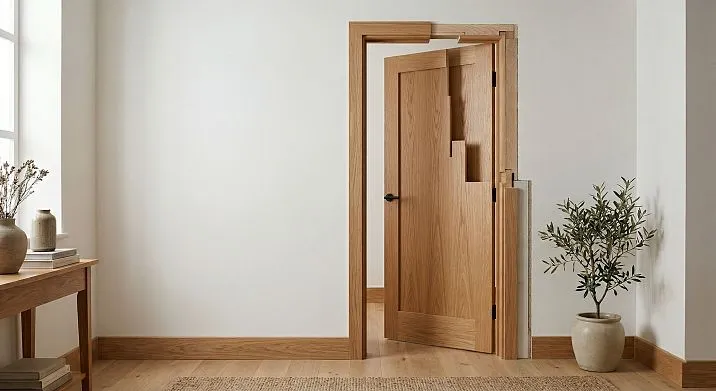
When replacing doors in an apartment or house, most people only think about the door leaf: color, finish, style. But behind a beautiful door lies much more than just one panel. Trim for interior doors is a complete set of elements without which no door will look finished: neither functionally nor visually. An opening without a frame, casing, and extension is just a hole in the wall. With properly selected trim, the same door becomes an architectural accent in the interior.
In this article, we'll break down everything that matters: what's included in the kit, how to choose each element, which material to prefer, when a telescopic option is needed, and how not to make mistakes with dimensions. Specifically, practically — no fluff.



What is trim for interior doors and what does it include
The word 'trim' itself comes from 'linear meter' — meaning products that are measured and sold by length. In the door industrytrim for interior doors— is a set of specialized elements that frame the doorway: they conceal technological gaps, secure the door structure, give the opening a finished look, and integrate it into the overall style of the space.
A standard door kit includes:
-
Door casings (architraves) — decorative strips that are attached around the perimeter of the opening on both sides, covering the gap between the frame and the wall. The main visual element.
-
Door frame profile — the load-bearing frame into which the door leaf is hung. Without it, there's simply nowhere to hang the door.
-
Door jamb extensions (door liners) — expansion strips that are installed when the wall thickness exceeds the width of the frame.
-
Meeting stiles (astragals) — used with double-leaf swing doors, they close the gap between the leaves.
-
Connector strips — provide a neat junction between the jamb extension and the frame.
-
Decorative extension elements — additional architectural details for expressive framing of the opening in a classic or accent style.
Each of these elements performs its own task. Remove any one — and either the opening will look unfinished, or operational problems will begin.




What is included in the minimum kit
For a standard interior door, the minimum set includes:
-
Door frame profile (two vertical and one horizontal element)
-
Door casings (on both sides of the opening — 6 pieces total: 2×3)
-
Door extensions — if needed (if the wall is thicker than the frame)
This basic set alone fully covers the functional and aesthetic requirements. Everything else is an addition that works on detailing and style.
Our factory also produces:


Which elements you specifically need: a simple selection scenario
Before going to the catalog and looking at casings, it's worth answering a few specific questions about your opening. This will save both time and money.
Get Consultation
If the wall is of standard thickness
Interior partitions in typical apartments usually have a thickness of 80–100 mm. A standard door frame is designed precisely for such an opening. In this case, extensions are not needed: the frame fits the width of the wall, and the casings cover the joints on both sides. This is the simplest and most common option.
If an extension is needed
In houses with brick walls, in suburban projects, or during redevelopment, wall thickness often reaches 120, 150, or even 200 mm. A standard door frame does not fit into such an opening in width—a section of the wall remains exposed. This is where an extension is needed: a flat strip that is joined to the frame, covering the remaining part of the opening. The total width of the frame plus the extension must equal the wall thickness.
If neatness of the joint is important
Sometimes the wall is uneven or has slight variations. A telescopic architrave or telescopic extension saves the day in such cases: thanks to its movable groove, it compensates for geometric imperfections without visible gaps. This nuance is especially relevant during renovations in Soviet-era buildings.
If a decorative accent is important
When the interior requires expressive framing—classical style, rich finishes, high ceilings—a simple architrave alone won't suffice. Shaped profiles, wide carved architraves, and composite framings with decorative corners come into play. This is where the real work of a designer begins.
Architraves for interior doors: when to choose straight, shaped, or carved
The architrave is the most noticeable element of door trim. It shapes the visual impression of the opening. And this is where mistakes are most often made: people choose the first option they come across or focus only on price, forgetting about style and proportions.
Let's break down the selection logic by profile type.
Straight flat architrave
A minimalist rectangular strip without decoration. Works in modern interiors: Scandinavian style, minimalism, loft, high-tech. Pairs well with doors without milling, solid-color finishes, and smooth walls. With a width of 60 to 80 mm, it looks strict and concise—exactly what's needed if the interior is built on clean lines.
Molded casing
Profile with molding: bevels, steps, radius transitions. Adds volume and visual interest without overloading with decor. A universal solution that works in neoclassical, transitional styles, modern classic. Suitable for doors with simple milling, reads well in living rooms with moderate ceiling heights.
Carved and decorative casing
Hand or machine carving, complex relief, ornaments, plant motifs — this is already an architectural statement. A carved casing made of solid oak or beech turns a door opening into a full-fledged decorative element. It is appropriate in classic interiors, studies, formal areas, country houses with wooden finishes.
Telescopic casing
A special type where one part of the profile fits into another, like a telescope. This is a structural solution, not a stylistic one: such a casing is attached without nails, into a special groove on the frame. Installation is easier, fit is tighter, wall irregularities are hidden more reliably. For walls with unstable geometry — practically an ideal choice.
All listed options in different executions — made of solid oak, beech and MDF — are presented in the section STAVROS trim productswhere you can choose a profile for any style and budget.
Door frame profile and frame: what to look for when choosing
A door frame is not just a frame. It is a load-bearing element of the entire door structure. The quality of the frame determines how accurately the hinge assembly will work, how tightly the leaf will close, and whether the door will warp after a year of use.
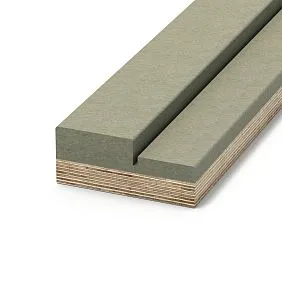
Door Frame Profile DK-001from STAVROS — a characteristic example of proper engineering approach. The design includes an 18 mm thick birch plywood base (high rigidity, resistance to deformation) and a front part made of two layers of 12 mm deep-milled MDF each. The multilayer structure prevents warping. The profile features a 3.4 mm wide groove for a seal — this improves thermal and sound insulation of the door unit.
What to look for when choosing a door frame
-
Material — solid wood, MDF, combination. Each option has its own strength and stability characteristics.
-
Cross-section — standard profiles: 32×74 mm, 40×74 mm, 40×100 mm. A different configuration may be required for non-standard door leaf.
-
Presence of a seal — a groove for a seal in the profile ensures tight fit of the door leaf and reduces noise transmission between rooms.
-
Rebate — a recess in the profile where the door leaf sits. Its depth and width must precisely match the thickness of the door leaf.
-
Geometric stability — critically important. The slightest warping of the frame during operation leads to the door starting to stick or not closing completely.
Wooden door profile — a separate topic in terms of proportion selection and finishing. More about profiling options and their application can be found in the corresponding section of the STAVROS catalog.
Door extensions for interior doors: when they are indispensable
Extension — one of the most frequently underestimated elements of a door kit. It is not part of the door's visual 'image', it doesn't catch the eye in magazine photos. But precisely the absence of an extension with a non-standard wall thickness immediately reveals unfinished installation.
An extension is needed in three typical situations:
The wall is thicker than the frame
If the width of the door frame (e.g., 74 mm) is less than the wall thickness (e.g., 120 mm), an open section remains on the side of the opening. The extension covers this section, joining with the end of the frame and creating a single plane from one trim to the other.
A neat, uniform opening is needed
Even if the frame technically fits into the opening, an extension can be used to align and give the opening visual depth. Especially relevant in interiors where the opening is visible through from several viewpoints.
A cohesive visual solution is required
In design projects—especially in classical and neoclassical styles—the extension becomes part of a unified framing system. It is selected from the same material and with the same finish as the frame and trims, creating a continuous decorative contour.
Extension dimensions are selected individually: width equals the difference between wall thickness and frame width, length equals opening height plus a small margin. Standard extension widths: from 60 to 300 mm, for wide openings—up to 600 mm.
A telescopic extension is mounted into the groove of the frame, fixed without glue and fasteners—convenient for quick installation and subsequent adjustment.
Telescopic or regular molding
This issue is actively discussed both on construction forums and in professional circles. Let's break it down without unnecessary words.
Standard (nail-on) trim is attached in the traditional way: with finishing nails or liquid nails. Reliable, proven over decades, doesn't require a special frame. The downside is that it requires careful installation, otherwise the joints will be noticeable.
Telescopic trim is a modern solution with a fundamentally different fastening principle. The frame is equipped with special grooves into which the casings and extensions fit without fasteners—they simply snap into place. Advantages:
-
installation is faster and cleaner;
-
no nail marks on the front surface;
-
wall irregularities are compensated by the element's mobility;
-
easier disassembly for replacement or repair.
When to choose the telescopic option:
-
walls with variations and irregularities;
-
DIY installation without carpentry experience;
-
interiors where perfect surface cleanliness without a single hole is important;
-
fast repair timelines.
When ordinary is sufficient:
-
walls are even, installation is performed by an experienced installer;
-
classical or historical interiors where nail fastening is organic;
-
working with massive decorative profiles that are not designed for a telescopic system.
What to choose: solid wood or MDF
One of the main questions when purchasing door trim. There is no universal answer here — there is a logic of choice for specific conditions and tasks.
Solid wood trim
Solid wood is oak, beech, pine, or other species in pure form, without pressed binders. Oak or beech Solid wood door trimDistinguished by:
-
Durability — with proper care, it lasts 30–50 years;
-
Natural texture — oak with pronounced annual rings, beech with a uniform fine-pored structure;
-
Repairability — can be sanded and refinished multiple times;
-
Eco-friendliness — natural material without synthetic binders;
-
Prestige — solid wood feels like a material of a different class.
Disadvantages: higher price and sensitivity to indoor climate (optimal conditions — humidity 45–65%, temperature 18–24°C).
MDF trim
MDF is pressed wood fibers with added binders. High-density MDF (750–850 kg/m³) provides:
-
Stable geometry — does not warp with moderate humidity fluctuations;
-
Perfect base for painting — uniform structure without pores, paint applies evenly;
-
Variety of profiles — MDF is easier to mill than solid wood, so complex decorative profiles in MDF are cheaper;
-
Affordable price — MDF molding is on average 2–3 times cheaper than solid wood of the same profile.
Disadvantages: shorter service life, restoration is impossible, swells when wet.
| Criterion | Solid oak/beech | MDF |
|---|---|---|
| Durability | 30–50 years | 7–15 years |
| Appearance | Living texture | For painting/film |
| Repairability | Yes, multiple times | No |
| Price | Higher | Below |
| Shape Stability | With proper care | High |
| Ecology | Natural | Class E1 |
The conclusion is simple: solid wood is for those who choose once and for a long time, who value natural material. MDF is for a budget or temporary solution, or when painting in a specific color is needed.
How to choose door trim to match the style of the door and interior
The door and trim are a unified system. A mismatch between the style of the casing and the style of the door slab is noticeable even to an untrained eye.
Classic interior
For classic styles, shaped and carved solid wood casings with rich relief are suitable. Width: from 80 to 120 mm, profile with two-sided molding. The frame has a rabbet, the extension is made of the same material. Finish: toning to walnut, oak, wenge, or classic white enamel. Architectural details are appropriate: decorative corners, rosettes at casing joints.
Modern interior
Minimalist straight casings 60–70 mm, without relief or with a minimal bevel. The frame has a laconic cross-section, the extension matches the wall color or the door tone. Material: MDF for painting or solid beech for light enamel. Matching the finish of the walls and casings in the same color scheme creates the effect of an 'invisible' door—a popular designer technique.
Accent framing of the opening
When the door opening is intended as a visual accent—arched framing, wide columns made of moldings, pilasters on the sides—the trim becomes an architectural element. This is the highest level of spatial design, requiring precise planning and high-quality solid wood.
Combination with wooden interior elements
If the interior already has wooden baseboards, moldings, cornices—the casing and frame should be made of the same material or at least the same wood species and finish. STAVROS offers a wide range of trim products, where profiles for the door opening, baseboards, and moldings are made from a single raw material with identical surface treatment. This allows for creating a visually unified interior.
How to avoid mistakes with dimensions
Incorrect dimensions are the main cause of defects during trim installation. We break it down for each element.
Casing width
Standard recommendation: 70–80 mm for typical apartments with ceiling heights of 2.5–2.7 m. For ceilings 3 m and higher — from 90 to 120 mm. A 50 mm wide casing will look thin and random; wider than 120 mm — massive, 'weighs down' the opening.
Principle: the higher the ceilings and the wider the door leaf, the wider the casing can be.
Wall thickness and extension piece
Measure the wall at several points — it may be uneven. Calculate the extension piece width from the minimum value. It's better to order with a small width allowance and trim on site than to get an extension piece that doesn't cover the opening.
Door frame and installation
The width of the door frame should correspond to the wall thickness (when used without an extension piece) or be less than it by the amount of the extension piece. The depth of the rabbet should equal the thickness of the door leaf.
When individual selection is needed
For non-standard openings — arched, slanted, with a large variation in thickness — custom manufacturing to individual dimensions is required. STAVROS works with bulk orders for custom profiles. Minimum order quantity and lead times are confirmed with the manager.
What determines the price of trim for interior doors
The question of the price of door trim is almost always the first one. To avoid being surprised by the price range, you need to understand what exactly affects the cost.
Key pricing factors:
-
Material — solid oak is more expensive than beech, beech is more expensive than MDF. The price difference can be double or triple.
-
Profile — the more complex the milling and relief, the higher the labor intensity and price. A simple straight casing is several times cheaper than a carved one.
-
Decorativeness — hand-carved details, complex ornaments, and inlay significantly increase the cost.
-
Dimensions — a wide casing (from 100 mm) costs more than a narrow one of the same length due to greater material consumption.
-
Completeness — a single item (only casings) will be cheaper than a full set, but assembling everything in one place from the same material is always more cost-effective than buying parts separately.
-
Finish — an item 'under enamel' is cheaper than an item 'under tinting' with lamellas selected for texture. Final painting or varnishing adds to the price separately.
-
Custom manufacturing — non-standard sizes and profiles are always more expensive than stock items. But this solves the issue of openings with atypical geometry once and for all.
When choosing, focus not on the minimum price, but on the total cost of ownership: a solid oak casing with proper care lasts 40–50 years without replacement, while MDF will require replacement in 7–10 years.
How to order trim for interior doors
Ordering door trim is not just 'choose and add to cart'. Proper preparation is needed for everything to fit correctly.
What to prepare before ordering
-
Doorway measurements: height, width, wall thickness at multiple points.
-
Number of doors — each side requires a separate set of architraves.
-
Decide on the material: solid wood or MDF, for painting or tinting.
-
Photo or description of the interior — this will help match the profile to the style.
What dimensions to provide
-
Wall thickness (for selecting extensions)
-
Doorway width
-
Doorway height
-
Door leaf thickness (for selecting the jamb rabbet)
-
Preferred architrave width
How to assemble a kit
Standard kit for one door includes:
-
3 frame elements (2 vertical + 1 lintel)
-
6 architraves (3 on each side: 2 vertical + 1 horizontal)
-
2–3 extensions (if necessary)
-
Seal for frame groove
Where to go in the catalog
All door trim elements —STAVROS trim products, including door frame profile, baseboard-architraves, and moldings — are collected in one section. Here you can select the profile, material (oak, beech, MDF) and finish, order in stock or for production.
To select a kit for a specific opening — consult a manager: STAVROS specialists will help calculate the composition and quantity taking into account all parameters.
Wooden Doorway Design: Details That Change Everything
Wooden millwork is not just a practical necessity. It is a tool that transforms an opening from a technical hole in the wall into an architectural detail of the space.
When an oak casing, a beech frame, and a baseboard in a unified material align into a continuous wooden line, the interior gains tectonics and a sense of integrity. This is something difficult to explain in words but is immediately felt upon entering the room.
Doorway framing in the Provence style is characterized by simple forms, use of light, pastel tones, and an aged effect. Casings may have a simple profile but with a light patina, wear marks, cracks that create a sense of time and history. Often, botanical motifs – lavender, olives, grapes, characteristic of Southern France – are used.— is the skill of thinking about details. The width of the casing, the profile of the frame, the type of extension jamb, the wood species, and the finish shade—all work within a system. Neglect one, and the system falls apart.
This is precisely why professional designers and architects working on high-class projects choose STAVROS: here, all door and interior millwork is produced within a single technological chain, with control at every stage—from wood selection to final sanding.
About the company STAVROS
STAVROS is a Russian manufacturer of millwork products and decorative elements from solid wood and MDF, with a history dating back to 2002. The company was founded by two artists and started with carved products for the restoration of palace interiors, including work on sites such as the Hermitage, Alexander Palace, and Konstantinovsky Palace in Strelna.
Today, STAVROS is a full-fledged woodworking production facility in St. Petersburg, operating according to European quality standards. Drying wood to an optimal moisture content of 8–12%, four-sided planing machines of German production, a geometric tolerance of ±0.1 mm per linear meter—this is not marketing, but production reality.
The STAVROS catalog features door profiles, casings, moldings, baseboards, cornices, battens, corner pieces, and structural blocks made of oak, beech, and high-density MDF. Showrooms in St. Petersburg and Moscow, delivery throughout Russia and CIS countries.
FAQ: Answers to popular questions
What is included in millwork for interior doors?
A complete set includes the door frame profile (3 elements: 2 vertical + 1 top), casings (6 pieces—3 on each side of the opening), extension jambs (if necessary), a seal for the frame groove, and meeting and connecting strips (for double or special doors).
What is the difference between a door casing and a door jamb extension?
A door casing is a decorative strip that covers the joint between the door frame and the wall on the front side of the opening. A door jamb extension is an expansion strip that covers the remaining part of the opening when the wall thickness is greater than the width of the door frame. The casing conceals the gap from the outside, while the extension fills the space inside the opening.
When is a door jamb extension needed?
When the wall thickness exceeds the width of the door frame. This is typically the case with brick walls from 120 mm, floor slabs, and openings in load-bearing walls of country houses. If the door frame and the wall are the same width, an extension is not needed.
What is better for a door: solid wood or MDF?
Solid wood is more durable (30–50 years), repairable, has a natural texture, and is more expensive. MDF is more geometrically stable, better suited for painting in a specific color, more affordable in price, and has a service life of 7–15 years. For permanent housing with a long-term horizon — solid wood. For rental or temporary solutions — MDF.
What is telescopic door trim?
A type of trim where the element is attached not with nails, but is inserted into a special groove in the door frame. This ensures quick installation without visible fasteners, tight fit to uneven walls, and the possibility of dismantling without damaging the surface.
How to choose the width of a door casing?
Standard is 70–80 mm for ceilings 2.5–2.7 m. For high ceilings (from 3 m) — 90–120 mm. A narrow casing looks accidental, while one that is too wide overloads the opening. Use the proportion as a guide: the width of the casing to the height of the opening is approximately 1:25–1:30.
Can door trim be purchased separately from the door leaf?
Yes. Door trim is sold separately. This is standard practice: the door leaf and components are often sourced from different manufacturers. The main thing is to correctly take measurements from the opening and the leaf before ordering.
How to choose door trim for a classic door?
For classic styles, shaped or carved solid wood architraves with rich relief, 90 mm or wider, are suitable. The door frame should have a pronounced rabbet, with decorative carving at the corners of the architraves. Material: oak or beech for tinting. Finish: walnut, wenge, golden oak, or classic white enamel with gilding.
Can door trim be ordered to size?
Yes, STAVROS manufactures products according to individual drawings and sizes — for batch orders. For non-standard openings, arched structures, or custom design projects, this is the optimal solution. Terms and conditions are clarified with the manager.
How to care for wooden trim?
Regular dry cleaning with a soft brush, wiping with a well-wrung cloth. Avoid large amounts of water and abrasive agents. Renewing the protective coating (oil-wax or varnish) — every 5–10 years depending on wear. With proper care, a solid oak architrave retains its appearance for decades.