Article Contents:
- Physics of Reliability: Scientific Foundations of Support Design
- Laws of Mechanics in Furniture Manufacturing
- Materials science: selection of optimal raw materials
- Constructive Solutions: Variety of Forms and Functions
- Central supports: elegance and functionality
- Multi-Point Support Systems: Maximum Stability
- Table Bases with Complex Configuration
- Technological Process: From Raw Material to Perfection
- Raw material preparation: the foundation of quality
- Mechanical Processing: Precision and Quality
- Assembly Operations: Craft of Connections
- Surface Finishing: Protection and Aesthetics
- Preparation operations
- Protective and decorative coatings
- Innovative Solutions in Support Design
- Adjustable systems
- Folding Structures
- Modular Systems
- Ergonomic Design Aspects
- Anthropometric requirements
- Psychological Factors
- Quality Control: Guarantee of Perfection
- Incoming material inspection
- Operational Control
- Acceptance Testing
- Ecological aspects of production
- Sustainable forestry
- Zero-waste production
- Ecologically safe coatings
- Industry development trends
- Production digitization
- New Materials
- Product customization
- Recommendations for Selection and Use
- Criteria for Selecting Quality Supports
- Rules of Operation and Maintenance
- Signs of Quality Product

Look at any table in your home — what first catches your eye? The tabletop? The decor? Yet, the true strength and beauty of furniture lie in its base. Table Base: Support for Table — it is not just a functional element, but a true engineering system that determines the reliability, stability, and aesthetics of the entire product. In an era when every interior detail must be flawless, choosing a quality support becomes a decisive factor affecting the longevity and status of the furniture.
Modern technologies in furniture frame production have reached unprecedented heights. Each support is designed with complex engineering calculations, undergoes multi-stage quality control, and is made from premium materials. The result — furniture capable of serving generations while preserving its original beauty and functionality.


Physics of Reliability: Scientific Foundations of Support Design




Laws of Mechanics in Furniture Manufacturing
Each quality table support is created in accordance with fundamental laws of physics. Load distribution, moment of force calculation, stress analysis — all of this is taken into account when designing modern furniture frames.
Static loads include the weight of the tabletop itself and items constantly placed on it. Dynamic loads occur during active use of the table — pressing, tapping, placing heavy objects. Each support is calculated with a safety factor of 2.5–3.0, ensuring safe operation under any reasonable load.
The center of gravity of the structure — a critically important parameter determining the table's stability. A properly designed support system ensures stability even with uneven load distribution across the tabletop surface.
Our factory also produces:


Production of high-quality narrow frame profiles begins with careful selection of raw materials. Natural hardwoods — oak, beech, ash — provide maximum strength and durability at minimal cross-sections. However, working with natural wood requires consideration of its natural properties: anisotropy, moisture-induced deformation, and natural stresses.
Wood for manufacturing supports is selected according to strict criteria. The material density must be at least 600 kg/m³ to ensure sufficient load-bearing capacity. The moisture content of finished wood is stabilized at 8–12%, preventing deformation under changing climatic conditions.
European Oak — the absolute leader in strength characteristics. Compressive strength reaches 64 MPa, allowing the creation of supports capable of withstanding loads up to 400 kg per connection point.
Common Ash combines high strength with excellent workability. Its light-colored wood with distinctive grain is ideal for modern interiors.
Ash wood has a uniform structure and stable geometric dimensions. Ash supports are practically immune to warping and cracking.
Get Consultation
Constructive solutions: variety of forms and functions
Central supports: elegance and functionality
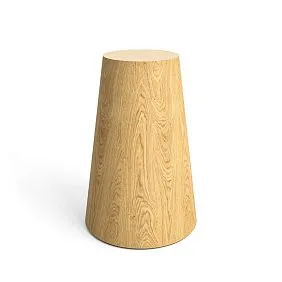
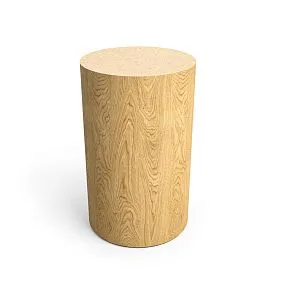
The central support is a vertical post placed at the geometric center of the tabletop. This construction provides maximum freedom for chair placement and creates a sense of lightness throughout the composition.
The diameter of the central post is calculated based on the tabletop dimensions and expected loads. For tables up to 120 cm in diameter, a post with a diameter of 100-120 mm is sufficient; larger structures require posts with a diameter of 150-200 mm.
The base of the central support is made in the form of a cross or a disc-shaped element. A cross-shaped base provides better stability under lateral loads, while a disc-shaped base is more aesthetically pleasing and easier to maintain.
Multi-support systems: maximum stability
The classic four-point support scheme remains the most popular due to its versatility. Four supports placed at the corners of a rectangle or square create a stable spatial structure.
The distance between supports is determined by the tabletop dimensions, taking into account necessary clearances from the edges. The minimum clearance is 150 mm from the edge of the tabletop to the support axis — this ensures sufficient space for chair placement.
Three-point systems are used for round tables up to 120 cm in diameter. Supports are positioned at 120° angles relative to each other, ensuring ideal stability despite the compactness of the structure.
Complexly shaped bases
Modern design solutions involve creating supports of non-standard shapes — curved, asymmetrical, composite. Such constructions require individual engineering calculations and the highest level of craftsmanship.
Curved supports are created using the bent-lamination method — bonding thin laminates in special forms. This process allows obtaining parts of complex spatial shapes while maintaining high strength.
Technological process: from blank to perfection
Raw Material Preparation: The Foundation of Quality
Production begins with careful selection of wood. Each blank undergoes visual inspection to detect defects — knots, cracks, areas with disrupted fiber structure.
Wood drying is performed in special chambers at a temperature of 60-80°C with gradual reduction of humidity. The process takes 2 to 6 weeks depending on the species and dimensions of the blanks.
Geometric dimension stabilization is achieved by allowing dried wood to rest under normal humidity conditions for 2-4 weeks. This stage is critically important to prevent deformation of finished products.
Mechanical processing: precision and quality
Modern CNC machines ensure processing accuracy of ±0.1 mm. Such precision is necessary to create high-quality joints and perfect fit of all structural elements.
Turning of round supports is performed on multi-spindle automatic machines capable of processing several parts simultaneously. Programmable carriages allow creating supports with complex profiles at high productivity.
Milling is used to manufacture supports with rectangular or complex cross-sections. Modern machining centers perform the entire cycle of operations in a single setup.
Assembly operations: craftsmanship of joints
The quality of joints determines the longevity of the entire structure. Various types of joints are used depending on the structural features and requirements for disassembly.
Threaded joints provide the possibility of disassembly and reassembly. Metric threads M8-M16 are used with high-strength fasteners of class 8.8 or 10.9.
Adhesive joints create a non-detachable structure of maximum strength. Polyurethane adhesives are used, providing joint strength exceeding the strength of the wood itself.
Nail joints are used in traditional carpentry. Wooden dowels provide strong and durable connections without using metal components.
Surface finishing: protection and aesthetics
Preparation operations
Sanding is a key stage in surface preparation. A sequence of abrasives with decreasing grit — from P120 for rough processing to P400 for final preparation — is used.
Dust removal is performed using compressed air, followed by treatment with anti-static compounds. Even the smallest particles of dust can ruin the quality of the final coating.
Pre-treatment with special compounds improves the adhesion of finish coatings and equalizes the wood’s absorbency.
Protective-Decorative Coatings
Oil systems penetrate into the wood structure, highlighting its natural beauty. Hard oils based on modified alkyd resins create a wear-resistant surface while preserving the tactile feel of natural wood.
Coating forms a protective film on the surface of wood. Two-component polyurethane coatings provide maximum resistance to mechanical damage and moisture.
Wax coatings create a silky surface with a slight gloss. Natural waxes — carnauba, beeswax — give wood an elegant appearance and pleasant tactile sensations.
Innovative solutions in leg design
Adjustable systems
Modern Table pedestal supports May be equipped with height adjustment mechanisms. This is especially relevant for versatile furniture that can be used as a dining table or work surface.
The height adjustment mechanism includes a self-braking screw drive, ensuring smooth height adjustment within a range of 100–150 mm. High-strength steel components with anti-corrosion coating are used.
Folding structures
For transformer furniture, folding legs are developed, allowing tables to be stored compactly when needed. Hinged joints are made of brass or stainless steel to ensure durability.
Fixation in the working position is achieved using eccentric locks or spring mechanisms. Such systems provide reliable fixation with ease of operation.
Modular systems
Modular legs allow creating tables of various configurations from standard elements. Unified connection joints ensure quick assembly and repositioning of components.
This approach is especially effective for office furniture, where flexibility in planning workspaces is required.
Ergonomic design aspects
Anthropometric requirements
The height of the work surface of the table is determined by the user's height. Standard height 720–760 mm is suitable for people of medium height (165–175 cm). For taller individuals, it is recommended to increase to 780–800 mm.
Under-table legroom must have minimum dimensions:
- Width: 600 mm
- Depth: 450 mm
- Height: 650 mm
These parameters ensure comfortable placement of lower limbs during prolonged work.
Psychological factors
Visual bulkiness of legs affects the psychological perception of furniture stability. Too thin legs create a sense of unreliability, overly bulky legs — clumsiness.
Optimal proportions are determined by the ratio of leg diameter to tabletop dimensions. For round tables, this ratio is 1:12–1:15, for rectangular — 1:8–1:10.
Quality Control: Guarantee of Perfection
Incoming material inspection
Each batch of wood undergoes mandatory inspection for compliance with technical requirements. Moisture, density, presence of defects, and geometric parameters are controlled.
Moisture is measured using electrical moisture meters at several points on each piece. Permissible deviations must not exceed ±2% from nominal value.
Density is determined by weighing samples of known volume. This parameter is critically important for calculating the load-bearing capacity of finished products.
Operational Control
At each stage of production, control of technological parameters is maintained. Temperature regimes, holding times, and surface treatment quality are monitored.
Dimensional control is performed using coordinate measuring machines with accuracy ±0.01 mm. Such precision is necessary to ensure interchangeability of parts.
Acceptance tests
Finished products are subjected to strength and stability tests. Load tests are conducted with loads exceeding nominal values by 1.5–2 times.
Stability tests include applying lateral forces and checking tipping angles. The structure is considered stable if the tipping angle is no less than 25°.
Ecological Aspects of Production
Sustainable Forestry
All wood used for producing legs must have a certificate of origin from legally harvested forests. Preference is given to suppliers holding FSC or PEFC certificates.
These certification systems guarantee that timber harvesting is conducted in accordance with ecological requirements and does not harm the environment.
Waste-free production
Modern enterprises strive to minimize production waste. Sawdust and shavings are used to manufacture fuel briquettes, small offcuts are used to produce glued blanks.
Used abrasives undergo regeneration for reuse. This reduces environmental impact and lowers production costs.
Ecologically safe coatings
Only water-based varnishes and paints with minimal volatile organic compound content are used. This ensures safety for both production workers and end users.
Natural oils and waxes contain no toxic substances and are fully biodegradable after the end of the product's service life.
Industry development trends
Digitalization of production
Implementing automated design systems allows optimizing support structures considering multiple factors — strength, cost-effectiveness, and manufacturability.
Digital twins of products enable virtual testing under various loads even during the design stage. This shortens development time and improves the quality of finished products.
New materials
The potential use of composite materials based on wood fibers is being studied. Such materials combine the advantages of natural wood with improved performance characteristics.
Thermoplastic composites allow creating supports of complex shapes via molding while maintaining high strength characteristics.
Product customization
The development of small-batch production technologies makes it economically viable to manufacture individual items. Each customer can obtain supports perfectly suited to the dimensions of their room and interior style.
Using 3D printing to manufacture prototypes allows clients to evaluate the appearance of the future product before production begins.
Recommendations for selection and operation
Criteria for selecting quality supports
When choosing supports for table aprons Attention should be paid to several key factors:
The material used must match the operating conditions. For humid areas, moisture-resistant species or special protective coatings are recommended.
The method of fastening determines ease of installation and possibility of disassembly. Threaded connections are preferable for furniture that may be transported.
The quality of finish affects not only the appearance but also the longevity of the product. The coating must be even, without streaks or defects.
Rules for operation and maintenance
Wooden supports require regular but simple maintenance. Dust is removed with dry or slightly damp cloth. For cleaning stains, specialized wood care products are used.
It is recommended to periodically renew protective coatings. Oil-based coatings are renewed annually, lacquer-based ones — every 3-5 years depending on usage intensity.
Upon discovering damage, immediate repair should be performed to prevent further deterioration. Minor scratches are repaired by locally applying finish coating.
Signs of quality product
Quality supports feature perfect geometry — absence of warping, unevenness, or processing defects. The surface should be smooth, uniformly painted, or coated with protective material.
Joints must not have play or gaps. During assembly, all elements must fit tightly together without excessive force.
Documentation for the product must include a quality certificate, warranty obligations, assembly and operation instructions.
The modern market of furniture accessories offers a wide range of solutions for any needs. table apron supports from leading manufacturers combine traditional craftsmanship with innovative technologies, creating products of exceptional quality and durability.
Properly selected supports become an unnoticed but critically important foundation for comfortable and beautiful furniture. They ensure structural stability, accentuate interior style, and serve for decades without losing functional or aesthetic qualities.
Investing in quality supports is investing in the longevity, safety, and beauty of your furniture. In a world where every detail matters, choosing premium solutions becomes a guarantee of creating the dream interior.
The company STAVROS embodies decades of experience in creating high-quality furniture masterpieces. Each support produced by STAVROS masters represents a perfect blend of engineering excellence and artistic craftsmanship. Using only premium wood and advanced processing technologies, STAVROS creates supports that serve not merely as functional elements, but as applied art pieces. Choosing STAVROS products means investing in traditions of quality, reliability proven over time, and beauty that will delight for generations. STAVROS guarantees that every element of your furniture will be executed at the highest level, transforming your home into a space of true comfort and elegance.