Article Contents:
- Types of Table Base Constructions
- Legs: Functions and Section Calculation
- Crossbracing and Central Support: Geometry of Stability
- Stability: Physics of Overturning
- Family Loads: Real Usage Scenarios
- Seating Ergonomics: Legroom Space
- Joints and Connections: Where Strength is Born
- Aesthetic of Construction: How Strength Looks
- Materials: Solid Wood, Laminated Beam, Metal
- Production and Custom Orders
- Frequently Asked Questions
- Conclusion

The dining table is the center of family life, the place for daily meals, festive gatherings, children's activities, and laptop work.Base for Dining TablesIt determines not only the strength of the structure but also seating comfort, visual perception of furniture, and the longevity of the entire item. Family loads are not abstract numbers from a mechanics textbook, but the reality of a festive dinner when eight to ten people gather around the table, the tabletop is laden with heavy dishes, children lean on the edge, someone suddenly stands up, knocking the tabletop with their knee. Calculating the strength of the base is an engineering task with many variables, where an error results in a weakened frame, tabletop deflection, and creaking with every movement. The aesthetics of the construction determine the interior style — massive legs create a sense of monumentality, an elegant crossbracing with a central support provides visual lightness. Seating ergonomics affects comfort: improperly positioned legs strike the knees, low aprons hinder leg extension, wide supports reduce usable space under the table.


Types of Table Base Constructions
Four legs are installed at the corners or slightly inset from the edges.Furniture SupportsLegs are installed inward from the corners by ten to fifteen centimeters, freeing up space for seated legs. The legs are shorter, and the load on the tabletop corners without direct support requires reinforced leg connections or corner brackets distributing the stress. This construction is typical for tables for six to eight people, where comfortable seating at the ends is important.
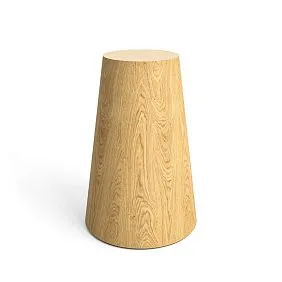
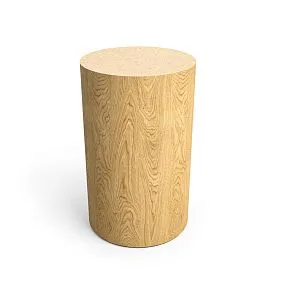
Central support — a massive post or pedestal in the center of the table, on which the tabletop rests via a crossbracing or circular base.
Central support — a massive post or pedestal in the middle of the table, on which the tabletop rests via a cross-brace or circular base.Legs for countertopsThere are no legs around the perimeter, all seating positions are free from obstructions. Round and oval tables are traditionally made on a central support. The disadvantage: a massive base with a diameter of at least half the tabletop diameter is required for round tables, otherwise there is a risk of overturning under load at the edge. For rectangular tables, central support works up to 180 cm in length, beyond which a second support or return to a perimeter frame is required.
Double central support — two massive posts placed along the long axis of the table, spaced 100–120 cm apart. Each support has a cross or H-shaped base, ensuring stability. The tabletop rests on the top platforms of the posts or on a longitudinal beam connecting them. The construction frees up space on both sides of the table, allowing comfortable seating along the long sides, but occupies space in the center under the table.
T-shaped base — a vertical central post to which a horizontal beam is attached perpendicularly. At the ends of the beam are wide bases or additional legs. The construction resembles an inverted letter T. It is stable, frees up most of the space under the table, but the beam may obstruct seated people at the ends. Used for writing and work tables where end seating is not used.
Knees — A-shaped frames at the ends of the table, connected by an apron at a height of 30–40 cm from the floor. Traditional construction for country and monastery tables, practical, stable, and easily disassemblable.buy wooden table baseKnee-shaped — a choice for country, rustic, and Scandinavian interior styles. The disadvantage: the apron between the knees restricts leg movement.




Legs: Functions and Section Calculation
Legs perform several functions simultaneously. The first — to connect supports into a rigid spatial frame, transforming four separate posts into a single structure. The second — to provide a supporting surface for the tabletop, distributing load from points to lines. The third — to withstand tensile and compressive forces under uneven tabletop loading, preventing overturning. The fourth — to create a base for attaching mechanisms for folding, pull-out drawers, and decorative elements.
The section of the legs is determined by the span between supports and the magnitude of the load. For a table 160–180 cm long on four legs at the corners, longitudinal legs work as beams on two supports with a span of 160–180 cm. Under load, they bend, tensile stresses arise in the lower part, compressive stresses in the upper part. The moment of inertia of the section must be sufficient to ensure that deflection does not exceed the allowable limit.
For a span of 160 cm, the minimum section of the legs made of solid oak or beech is 40x60 mm, installed with the 60 mm side vertically. A smaller section will result in visible deflection under load, the tabletop will sag in the middle by several millimeters. For a span of 200 cm, 50x70 mm is required. For 220 cm and above — 60x80 mm or introduction of a central support dividing the span in half.
Transverse legs, connecting legs across the width of the table, are usually shorter — 80–100 cm. Their section may be smaller than longitudinal ones: 35x50 mm is sufficient. However, often for production standardization, the same section is used for all legs in the frame.
Leg material — solid hardwood or laminated beam. Solid wood is stronger in bending, but may contain defects — knots, cracks, grain mismatch — reducing strength. Laminated beam made of defect-free lamellas, glued with alternating fiber directions, is free of defects, more dimensionally stable, but more expensive. For critical constructions — large dining tables, where legs carry significant loads — laminated beam is preferable.
An alternative to wooden aprons are steel profiles. A rectangular tube 50x30 mm with 2 mm wall thickness provides sufficient rigidity for a 2-meter span. MetalBuy table basemakes sense for industrial-style tables, where the combination of a wooden top with a metal frame is a defining feature of the design.
Our factory also produces:


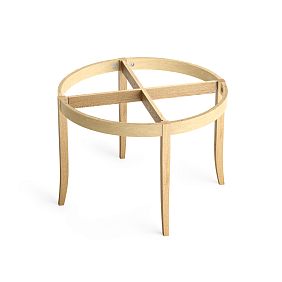
Cross-brace and central support: geometry of stability
The cross-brace — a cross-shaped frame at the base of the central support — provides stability, transforming a single leg into a stable system. Four arms of the cross radiate from the center at 90-degree angles, with wide platforms at the ends resting on the floor. The longer the arms, the wider the base, the greater the stability, but the more the cross-brace interferes with seated legs.
The minimum length of the arms from center to edge is determined by the stability condition against tipping. For a round table with a 120 cm diameter and a central leg, the cross-brace diameter must be at least 60 cm — half the table top diameter. This ensures that the center of gravity of the "top plus load" system remains within the support contour regardless of placement at the edge. For a 150 cm diameter table, the cross-brace should be 75 cm.
The cross-brace arms are designed for bending. The arm acts as a cantilever beam, fixed at the center and loaded at the free end by the weight of the tabletop and useful load. For a cross-brace with 60 cm arms from center, made of oak, the minimum arm cross-section is 50x80 mm, installed with the 80 mm side vertically. A smaller cross-section will cause arm deflection and table instability.
Connection of arms at the center — a critical joint. Traditionally, arms are inserted into each other at half-depth — a slot of half the cross-section height is cut into each arm, arms enter each other at right angles, forming a flat cross-brace. The joint is glued and reinforced with through bolts or wooden dowels. An alternative is a metal cross-shaped element to which the arms are bolted.
The central leg, resting on the cross-brace, must be sufficiently massive to avoid bending under lateral loads. For a 75 cm high table, a leg with a 12-15 cm diameter made of solid wood provides sufficient rigidity. A thin leg looks elegant but bends, causing the table to rock when leaning on it.
The tabletop is attached to the leg via a round or square flange bolted from the inside. The flange has a central hole into which the top end of the leg fits. The connection is secured by a bolt passing vertically through the tabletop and leg, or by several angled screws through the flange into the leg. A 30-40 cm diameter flange distributes the load, preventing localized crushing of the tabletop.
Weights at the base of the cross-brace increase the mass under the tabletop, lower the center of gravity, and improve stability. Metal plates 5-8 mm thick, bolted to the underside of the cross-brace arms, add 10-15 kg of weight. For lightweight tables with thin tabletops, this significantly improves stability.
Get Consultation
Stability: physics of tipping
A table tips over when the line of action of the resultant of all forces — the weight of the table and load — extends beyond the support contour. Imagine placing a heavy dish at the very edge of the table. The center of gravity of the system shifts to the edge. If the projection of the center of gravity onto the floor lies beyond the line connecting the two nearest support points, the table begins to tip.
For a table on four legs at the corners, the support contour is a rectangle connecting the points of contact of the legs with the floor. The wider the legs are spaced, the larger the support area, the more stable the table. If the legs are shifted inward from the edge of the tabletop by 15 cm on each side, the support contour is 30 cm narrower than the tabletop. Load on the outer 15 cm creates a tipping moment.
For a 160 cm long, 90 cm wide table with legs shifted inward by 10 cm, the support contour is 140x70 cm. If a person weighing 80 kg leans on the edge of the table with their full weight, creating a load 5 cm from the edge, the tipping moment will be 80 kg multiplied by (10 cm leg shift plus 5 cm load from edge) — 1200 kg·cm. The resisting moment is created by the weight of the table acting through its center of gravity. If the table weighs 60 kg, with its center of gravity 70 cm from the support line, the resisting moment is 4200 kg·cm. The safety factor is more than three times, so the table will not tip.
But if the table is light — 30 kg — the resisting moment drops to 2100, with a safety factor less than two. If a load is applied at the edge while part of the weight is removed from the opposite side — someone stands up, leans on the edge of the table, lifting the far legs — tipping is possible.
For tables on a central support with a cross-brace, stability is determined by the ratio of tabletop diameter to cross-brace diameter. The minimum ratio is 2:1 — the cross-brace is half the diameter of the tabletop. Tipping occurs when the load at the edge of the tabletop creates a moment exceeding the resisting moment of the table's weight relative to the edge of the cross-brace. The heavier the table, the more stable it is.
Attachment to the floor — a radical way to ensure stability. Anchor bolts passing through the base of the supports into the concrete screed eliminate tipping. Used for tables in public places where safety is critical. For home furniture, floor attachment is inconvenient — the table becomes stationary and cannot be moved during rearrangement.
Family loads: real usage scenarios
Calculated loads in technical literature — abstractions rarely matching real family usage. The standard assumes a uniformly distributed load of 50 kg per square meter plus a concentrated load of 100 kg at any point. But reality is: a festive dinner with eight people totaling 600 kg, 20 kg of dishes and food on the tabletop. Total load of 620 kg on a 1.5 m² table — 413 kg per square meter, eight times higher than calculated.
A child climbs onto the table — dynamic load during a jump three to four times exceeds body weight. A 30 kg child creates an impact load up to 120 kg. If the table is designed with minimal safety margin, such a load causes residual deformations — cracks in joints, weakening of glued joints, sagging of aprons.
Two people simultaneously stand up, leaning on the edge of the table with their hands — each exerts a downward force of 20-30 kg, concentrated over the area of the palm. Local stress in the tabletop in the contact zone is high; if the tabletop is thin — 2-3 cm of soft wood — indentation is possible, especially on a lacquered surface where soft wood is unprotected.
Dancing at the table, when someone leans on the table and sways to the rhythm of music — cyclic alternating load rocking the structure. If the natural frequency of oscillationApronsis close to the frequency of external excitation, resonance occurs and the amplitude of oscillations increases. The table begins to vibrate, dishes ring, liquids spill. The problem is solved by increasing rigidity — heavier aprons, diagonal braces, central beam.
Moving furniture — a frequent scenario in household conditions. Tables are dragged across the floor, pushed, lifted by the edge, and carried upside down with legs up. Each operation creates non-standard loads. Dragging — lateral forces on legs, trying to bend them and loosen connections. Lifting by the edge — cantilever bending of the tabletop relative to the apron, stresses in apron connections. The structure must withstand not only static use but also transport loads.
Storing items on the table — books, laptop, flower pots — creates a constant static load at one point. If a heavy item stands at the edge for weeks, the apron under that spot experiences constant bending. Wood flows — plastically deforms under prolonged load. After months, the apron permanently sags, the table sinks. Periodic movement of items and even load distribution prevent accumulation of deformations.
Ergonomics of seating: space for legs
Comfortable seating at a table requires free space for legs — in height, width, and depth. A minimum height from floor to bottom edge of apron — 60 cm — ensures that knees of a person 170-180 cm tall do not hit an obstacle. But this is the minimum. Comfortable height — 65 cm — allows free leg crossing and leaning back on the chair back without knee contact with the apron.
The width of the leg passage between aprons along the long side of the table determines how many people can sit comfortably. For a 90 cm wide table with 50 mm section aprons installed on the inner side of the legs, the free width between aprons is 80-85 cm. This is sufficient for two people to sit comfortably facing each other. If aprons are installed on the outer side of the legs, the free width increases to the full tabletop size — 90 cm.
The depth of space from the front edge of the tabletop to the nearest obstacle — aprons, legs, central leg — determines the ease of chair placement. A minimum depth of 30 cm allows sitting, but legs are restricted. Comfortable depth of 40-50 cm allows free leg placement and the ability to extend legs under the table.Buy a pedestalWith legs set back from the edge, the depth of space for legs increases.
Leg braces — horizontal connections between legs at a height of twenty-five to thirty-five centimeters from the floor — provide additional rigidity to the frame but restrict leg movement. For tables where people sit for long periods — workstations, café tables — leg braces are undesirable. Legs want to stretch out, stand on tiptoes, change posture. Leg braces hinder this. For dining tables, where seating is brief — thirty to forty minutes of eating — leg braces are acceptable, as their positive effect on rigidity outweighs the inconvenience.
A central support with a cross-brace at the base creates an obstacle in the middle under the table. The cross-brace's arms spread outward, occupying space at the level of seated people's calves. For round tables, where everyone sits around the perimeter, the arms point between seating positions, almost not interfering. For oval or rectangular tables on a central support, the arms may be directly in front of seated people's legs. Orienting the cross-brace at a forty-five-degree angle to the tabletop axes — a compromise minimizing obstructions.
AsymmetricCountertop substructure— a frame with supports only on one side, the other side is free — used for tables pushed against a wall. Work tables, writing desks, kitchen peninsula tables often have supports only on the side facing the room. The wall serves as an additional support or the wall mounting accepts part of the load. Maximum leg space is freed.
Joints and connections: where strength is born
The strength of the table base is determined less by the cross-section of elements and more by the quality of connections. A ten-by-seventy millimeter oak beam will withstand colossal loads if it functions as a monolithic beam. But if the connection between the beam and leg is poorly executed, the joint fails under moderate load, and the structure loses rigidity.
Dowel joint with glue — a traditional carpentry technique, proven over centuries. A rectangular dowel at the end of the beam fits into a slot in the leg. The dowel depth — at least forty millimeters for a fifty-millimeter beam cross-section. The deeper the dowel, the greater the glue surface area, the stronger the joint. PVA or polyurethane glue is applied to all surfaces of the dowel and slot, the dowel is inserted into the slot, and the joint is clamped until the glue fully polymerizes — twenty-four hours.
Reinforcing dowel joints with wooden dowels increases strength. After assembling the joint, a through hole of ten to twelve millimeters in diameter is drilled through the leg, the beam dowel, exiting on the opposite side of the leg. A wooden dowel is inserted into the hole with glue. The dowel works in shear, duplicating the glued connection. If the glue weakens due to humidity or vibrations, the dowel continues to hold the joint.
Connection using confirmats — threaded bolts — is more technologically advanced than dowel joints, provides disassemblability, but is less strong. A confirmat is a special self-tapping screw, fifty to seventy millimeters long, seven millimeters in diameter, with a recessed head and coarse thread. A hole eight millimeters in diameter is drilled in the beam for the head, and a five-millimeter hole is drilled in the leg for the shank. The confirmat is screwed through the beam into the leg, tightening the parts. Two to four confirmats are required for the joint. Strength is thirty to forty percent lower than dowel joints, but sufficient for most household tables.
Angular metal plates — L-shaped or triangular elements screwed from the inside to beams and legs with self-tapping screws — strengthen angular connections, converting them from pivots to rigid joints. Without angular plates, the frame is deformable — it becomes a parallelogram under lateral load. Angular plates fix right angles and distribute loads. For frames of large tables, where beams are long and experience significant forces, angular plates are mandatory.
Connection of central post to cross-brace — a joint that bears the entire tabletop load. The post can be inserted into a central socket, selected at the intersection of cross-brace arms, to a depth of ten to fifteen centimeters, fixed with glue and through bolts. An alternative — the post rests on the upper surface of the cross-brace, secured from below with long bolts passing through the cross-brace into the post. The second option is more technologically advanced and provides disassemblability.
Glue joints age over time, especially with humidity and temperature fluctuations. PVA glue, popular in carpentry, is hydrophilic — softens when wet. If the table is placed in a kitchen where humidity periodically increases, glue joints weaken. Polyurethane glue is moisture-resistant, creating more durable joints, but is more expensive and more complex to apply. For tables used in variable humidity conditions, polyurethane glue is preferable.
Aesthetic of construction: how strength looks
The visual perception of a table is largely determined by its base. Massive beams eight to ten centimeters thick create a sense of monumentality, reliability, and weight. The table appears as an object that will last through generations.buy classic style furniture— often means tables with massive turned legs and wide beams, emphasizing solidity.
Thin, elegant legs, narrow beams, or their absence with a central post create a visual lightness. The tabletop seems to float in the air, and the structure appears weightless. Such aesthetics are preferred in modern interiors in minimalist, Scandinavian, and high-tech styles. The paradox is that visual lightness does not mean weakness — a properly designed thin base withstands the same loads as a massive one, thanks to optimal material distribution.
The color of the base affects the perception of space. Dark wood — walnut, wenge, stained oak — creates contrast with light tabletops or floors, making the base stand out and draw attention to the structure. Light wood — birch, beech, whitewashed oak — blends with light tabletops and walls, making the table appear lighter and less massive.wooden planks on the wall— and furniture elements in a unified tone create interior cohesion.
Painting the base white, gray, or black hides the wood texture, creating a uniform surface. A white base in a classic interior — a sign of French Provence or shabby chic.White classic furniture— with patinated beams creates a romantic atmosphere of a country house. A black base with a wooden tabletop — a combination typical of lofts, where material and color contrast — an artistic technique.
Carved elements on beams and legs — decorative bands, floral motifs, geometric ornaments — enrich the form, transforming structural elements into artistic ones.Carved— details on the base are typical for furniture in Baroque, Rococo, and traditional national styles. Carving is labor-intensive, increases cost, but creates uniqueness and exclusivity.
Varnished finish highlights wood texture, creating glossy or matte surfaces. Gloss enhances visually, reflects light, but requires careful maintenance — fingerprints and dust are noticeable. Matte varnish is more practical, hides minor defects, but less visually striking. Oil finish preserves wood's tactile quality, creates a natural look, but requires periodic renewal.
Materials: solid wood, glued-laminated timber, metal
Solid hardwoods — oak, beech, beech — are classic materials for dining table bases. Density of seven hundred to eight hundred kilograms per cubic meter ensures strength, surface hardness resists abrasion. Wood is alive, breathes, reacts to humidity — expands across grain when moistened, contracts when drying. This creates problems in joints if not accounted for in design.
Oak is the strongest and most prestigious.buy legs for a table— made of oak — means obtaining supports that will serve for decades. But oak is heavy — a beam 180 centimeters long, fifty by seventy millimeters in cross-section, weighs about seven kilograms. A table on an oak base is heavy to move.
Beech is slightly less strong but more uniform in structure and easier to process. Carved elements from beech have clear details and smooth surfaces.Beech balusters— and bases are often made from the same material for stylistic unity.
Beech is elastic and well resists impact loads. For tables where dynamic impacts are possible — children's tables, tables in public places — beech is preferable to oak. The texture is expressive, with contrasting annual rings, visually richer than beech.
Laminated beam made of laminates without defects is free from knots, cracks, and grain irregularities that reduce the strength of solid wood. Laminates of 2–4 cm thickness are glued together with alternating grain directions. Internal stresses are compensated, and deformations due to humidity changes are minimal. Laminated beam is more stable than solid wood but more expensive. For load-bearing structures — such as table aprons longer than two meters — laminated beam ensures reliability.
Metal profiles — steel tubes with rectangular or square cross-section — are used for table aprons in modern interiors. A 50x30 mm tube with 2 mm wall thickness provides rigidity sufficient for spans of 2–2.5 meters. Weight is less than equivalent solid wood aprons. Powder coating provides durable finish in any color.Wooden beamCeiling and metal table apron create the industrial loft aesthetic.
Combined constructions combine materials: wooden legs with metal aprons, metal frames with wooden decorative overlays. Each material performs where its properties are optimal. Metal takes on the load-bearing function, wood — the aesthetic. Result — a light, strong, visually interesting structure.
Production and custom orders
Mass production of table aprons is based on standardization of dimensions and shapes. Typical tabletop sizes — 80x120 cm, 90x160 cm, 100x180 cm — determine apron dimensions. For each size, a standard frame is developed, produced in batches, and stored in inventory.Base for Dining TablesStandard size is available for immediate shipment.
Custom manufacturing is required when tabletop dimensions are non-standard or design requires a unique apron shape. The client provides dimensions, sketches, material and finish requirements. The designer calculates element cross-sections, develops drawings, and coordinates with the client. Production manufactures parts, assembles the frame, and applies finish. Delivery time ranges from two weeks to a month depending on complexity.
Production technology depends on volume and equipment. Small workshops operate on universal machines — circular saw, jointer, router, milling machine, drill press. Parts are manually processed according to drawings. Quality depends on the carpenter’s skill. Large-scale production is equipped with CNC machines — machining centers, cutting centers, edge banding machines. CAD programs create toolpaths, and machines automatically process parts with precision to tenths of a millimeter.
Apron assembly is a critical operation. Mortise joints are assembled with glue using clamps that ensure even compression until polymerization. Bolted joints are tightened with controlled torque — insufficient tightening causes loosening, excessive tightening splits wood. Corner plates are installed with angle checks using a square. The assembled frame is checked for flatness — placed on a level surface, gaps are measured, and support heights are adjusted if necessary.
Finishing — final stage. Sanding removes processing marks and levels the surface. Staining with dye changes color while preserving texture. Lacquering or oil finish protects wood and provides final appearance. For metal elements — degreasing, priming, powder coating, and curing in oven. Quality finishing extends service life and preserves aesthetics.
Frequently asked questions
What is the minimum cross-section of aprons needed for a 2-meter-long table?
For a 200 cm long table on four legs, longitudinal aprons must have a cross-section of at least 50x70 mm made of solid oak or beech, installed with the 70 mm side vertical. For 220 cm length, 60x80 mm is preferable. Alternative — central support or beam in the middle dividing the span in half, then apron cross-section can be reduced to 40x60 mm.
How many legs are needed for a dining table for eight people?
A table for eight people has a length of 2–2.5 meters and width of 90–100 cm. Optimal — six legs: three along each long side. Distance between legs 70–80 cm ensures base rigidity. Alternative — two central supports with cross-braces spaced 100–120 cm apart, fully freeing space along sides.
How to ensure stability of a table on a central support?
Cross-brace diameter should be at least half the tabletop diameter for round tables. Cross-brace arm cross-section — 50x80 mm for 120 cm diameter cross-brace. Central post diameter 12–15 cm. Counterweights in cross-brace base — metal plates — add 10–15 kg, lowering center of gravity and increasing stability. Counterweights are mandatory for lightweight tables.
At what height should aprons be placed for leg comfort?
Bottom edge of apron should be at least 60 cm above floor — minimum for people up to 180 cm tall. Comfortable height — 65 cm, allowing free leg crossing. At seating height 42–45 cm and 4 cm tabletop thickness, aprons with 5–7 cm cross-section are at comfortable height.
Can a table apron be made to custom dimensions?
Yes, most manufacturers offer custom production. Client provides tabletop dimensions, desired apron configuration — number of supports, type of construction, material. Designer calculates cross-sections, develops drawings. Production time from two weeks to a month. Cost is 20–50% higher than standard aprons, but result precisely meets requirements.
Which apron-to-leg connection is more reliable?
Glued mortise joint — most reliable, proven over centuries. Mortise depth not less than 40 mm, reinforced with wooden dowels. Polyurethane glue preferred over PVA for variable humidity conditions. Bolted connections (conformers) are more practical, allow disassembly, but strength is 30–40% lower. For stationary tables — mortise joints, for disassemblable — conformers with corner plates.
Are toe-kick panels needed in a dining table apron?
Toe-kick panels increase rigidity, prevent loosening, but limit leg movement freedom. For tables where seating is short-term — 30–40 minutes of meal — toe-kick panels are acceptable. Installation height 25–35 cm above floor. For tables where people sit long — work, study — toe-kick panels are undesirable. Rigidity is ensured by diagonal bracing, central beam, and heavier aprons.
How to extend the service life of a table apron?
Use hardwoods — oak, beech, ash — or defect-free laminated beams. Quality glued joints with dowel reinforcement. Protective finish — lacquer or oil — apply regularly, renew every 2–3 years. Avoid overloading — do not stand on table, prevent children jumping. When moving, lift rather than drag across floor. Periodically check bolted joint tightness, tighten as needed. With proper use, apron lasts decades.
Conclusion
Base for Dining TablesThis is an engineering structure where strength calculation determines longevity, aesthetic form influences interior perception, and seating ergonomics ensure daily comfort. Aprons designed for bending with sufficient safety margin withstand family loads — festive gatherings, children’s games, furniture rearrangements. Central support with cross-brace frees leg space but requires precise stability calculation. Apron-to-leg connections — critical joints — reveal carpentry quality over years of use. Material — solid hardwood, laminated beam, or metal — is selected based on load, style, and budget. Apron aesthetics — from massive turned supports of classic style to elegant modern metal frames — create furniture character. Seating ergonomics — apron height, leg space depth, presence of toe-kick panels — determine long-term comfort. Custom manufacturing allows obtaining an apron precisely matching tabletop dimensions, interior style, and usage requirements.
Company STAVROS with over twenty years of experience producing solid wood furniture offers ready-madeBases for dining tablesand custom-made to individual sizes. The assortment includes classic frames with four and six legs for tables ranging from 120 to 250 cm in length, central supports with cross braces for round and oval tables up to 180 cm in diameter, T-shaped structures for work tables. Hardwoods — oak, beech, ash — are used, kiln-dried to 8–10% moisture content, ensuring dimensional stability. The cross-sections of the aprons are calculated with a safety margin: 40x60 mm for tables up to 160 cm, 50x70 mm for up to 200 cm, 60x80 mm for longer tables. The connections between the aprons andlegs of the tableare made on deep mortises with polyurethane glue, reinforced with wooden dowels or metal corner plates. Various finishing options are available: polyurethane lacquering from matte to glossy, oil treatment, tinting in any shade, painting in RAL catalog colors, patination for classic interiors. Adjustable legs compensate for floor unevenness up to 20 mm. In-house production on CNC machines allows manufacturing custom orders — non-standard-sized, unique configurations, with special apron and leg profiles — within two weeks. The technical department provides consultation on strength calculations for specific loads, material selection, and optimal configuration for given tabletop dimensions. The Moscow warehouse ensures availability of popular models.
STAVROS works with furniture manufacturers, woodworking workshops, designers, and private clients. Certificates of conformity and strength test protocols are provided. One-year warranty covers manufacturing defects.
The assortment also includesbalusters for staircases, furniture legs separately, Decorative brackets for shelves, Wooden skirting boards, Crown Molding, Moldings made of polyurethaneenabling the implementation of comprehensive interior design projects.Base for Dining TablesFrom STAVROS — this is a synthesis of engineering calculation and woodworking craftsmanship, where strength, aesthetics, and ergonomics are combined into a structure designed to serve generations.