Article Contents:
- Floor and ceiling baseboards as interior framing
- Types of wooden baseboards: from simple to decorative
- Selection parameters: height, width, profile
- Regional factor: Moscow and St. Petersburg
- Price and rates: how to calculate budget for baseboards
- How to buy wooden baseboards without making a mistake
- Installation and joining with doors, door casings, and cornices
- Conclusion: STAVROS — baseboards for a finished interior
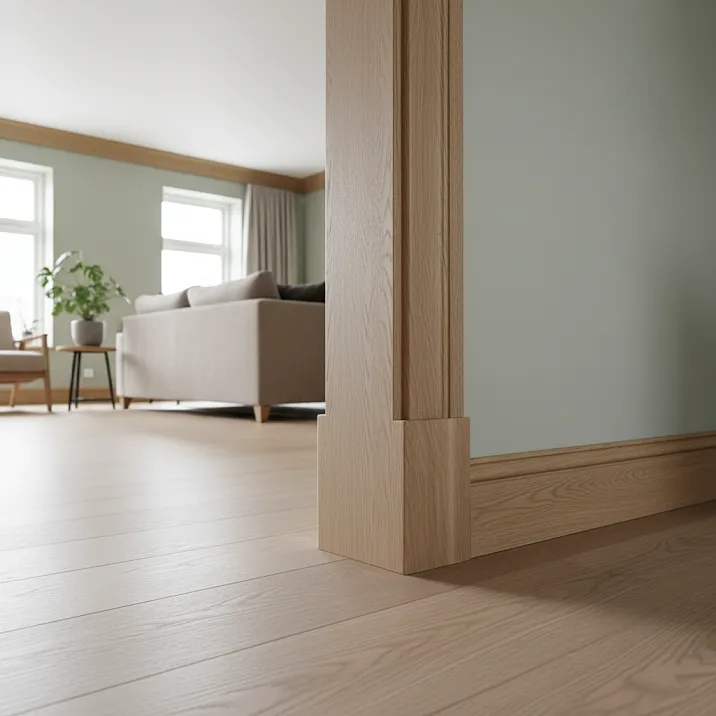
Room withoutof wooden skirting boards— it’s like a picture without a frame. Technically, everything functions: walls stand, the floor lies, the ceiling holds. But visually, the space is not completed, not finished, looks like a construction site, not a living room.wooden floor baseboardandCeiling skirting board made of wood, height 100-150 mm, enhances the perception of ceiling height.— these are horizontal lines that frame the wall from below and above, creating a frame within which the entire interior composition unfolds. Without the lower line (floor baseboard), the wall 'cuts off' into the floor, there is no transition, no completion. Without the upper line (ceiling baseboard or cornice), the wall 'embeds' rigidly into the ceiling, without softening.Wooden baseboard— this is not luxury or decorative excess. It is a basic element that transforms a set of planes into an architectural space with a beginning, middle, and end.




Floor and ceiling baseboards as interior framing
— this gap is unavoidable by the laws of physics. Any floor covering (parquet, planks, laminate) is laid with a 10-15 mm gap from the wall — a thermal gap that compensates for material expansion due to changes in humidity and temperature. Without this gap, the floor will jam against the wall, swell, and form waves. The gap is necessary, but looks sloppy — a 1 cm gap around the entire perimeter of the room.Floor baseboard wood— covers this gap, hides the technical necessity, turning it into a decorative solution.
— this is the most vulnerable zone. Here, vacuum cleaners hit, feet bump, furniture bumps during rearrangement, water spills during floor cleaning. Without baseboards, the wall (especially if painted or wallpapered) quickly gets worn, stained, and peels.with a classic profile creates a sense of solidity, reliability.— absorbs impacts, protects the wall. Wood is hard (especially oak or beech), withstands mechanical impact, does not crumble or deform. Even if the baseboard is scratched or dented, it is easier to repair (sand and repaint) than to repair the entire wall.
— this is a box inside which cables are laid: electrical, TV, internet cables. Instead of cutting grooves in walls (dust, drilling, damaging finish), cables are laid behind the baseboard or inside a special cable channel within the baseboard. This is cheaper, faster, and less destructive to walls.wooden baseboard— a practical solution for modern interiors with lots of electronics and wires.
— this is aesthetic. The baseboard completes the wall, creating a visual boundary between vertical (wall) and horizontal (floor). Without this boundary, the eye gets lost: where does the floor end and the wall begin? With a baseboard, everything is clear: here is the floor, here is the baseboard line, here is the wall. This clarity structures perception, making the space understandable and orderly. The height of the baseboard, its profile, and color affect the perception of room proportions. A tall baseboard (100-150 mm) visually 'raises' the wall, making it appear higher and adding grandeur. A low baseboard (40-60 mm) is neutral, does not affect proportions, works as a thin line.
Ceiling baseboard wooden— performs similar functions, but from above. Technically, it covers the joint between the wall and ceiling, where gaps may also exist (especially if the ceiling is a suspended or tensioned one, where the perimeter junction is not ideal). Aesthetically, the ceiling baseboard completes the wall from above, creating a transition from vertical to horizontal, softening the sharp angle. Without a ceiling baseboard, the room appears lower, and the ceiling 'presses down'. With a ceiling baseboard, the room appears higher and more airy — the baseboard visually 'detaches' the ceiling from the wall, creating a gap of light (especially if the baseboard is white and the walls are colored).
Differences between floor and ceiling baseboards made of wood — in profile and construction. Floor baseboards have a flat base (which contacts the floor) and a vertical plane (which contacts the wall). The front part is profiled: rounded edges, beveled edges, grooves. Height 40-150 mm, thickness 16-25 mm. Ceiling baseboards have two planes at a 45-degree angle (to the wall and ceiling), and the front part is the hypotenuse of a triangle, visible from below. The profile is more complex than floor baseboards: multiple tiers, protrusions, recesses. Width (from wall to edge) 40-120 mm, thickness 15-30 mm. Ceiling baseboards are lighter than floor baseboards (less load, no need for strength), but require more precise installation (45-degree joints visible from below must be perfect).




Saint Petersburg is traditionally the center of wood processing, where dozens of manufacturers operate, competition is high, prices are 10-20% lower than in Moscow.
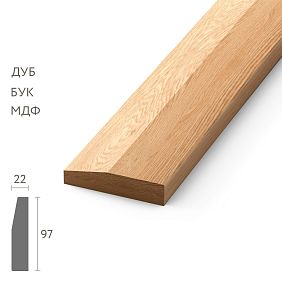
Wooden skirting boards— divided by height into three categories: low, medium, high. Low baseboard — height 40-60 mm. This is a minimalist option that almost does not stand out, works as a thin line at the boundary between floor and wall. Suitable for modern interiors where restraint and lack of decoration are important. Profile is simple: rectangle with one rounded top or bevel. Price from 150 to 300 rubles per linear meter (depends on species). Installed with glue or self-tapping screws, joints at 45 degrees in corners.
— height 70-90 mm. This is the standard for most residential interiors, a balance between functionality and decoration. Such a baseboard is noticeable, creates a distinct boundary, but does not dominate or overload. Profile of medium complexity: two to three tiers, rounded edges, shallow grooves. Suitable for neoclassical, Scandinavian, and contemporary styles. Price from 250 to 500 rubles per linear meter.and paint it to the desired shade — standard practice in modern design. It is important to use special wood finishes that allow the material to breathe.— the most popular choice.
— this is a baseboard with character that affects the perception of the entire room.Wide Wooden Skirting Board— visually raises the wall, makes ceilings appear higher, adds grandeur. Suitable for classical interiors, high ceilings (from 3 meters), large rooms (from 30 square meters). In a small room with low ceilings, a high baseboard will look excessive and consume space. Profile is complex: four or more tiers, deep grooves, protruding cornices. Price from 400 to 800 rubles per linear meter.Wide wooden floor skirting boardRequires professional installation — joints must be flawless, otherwise the complex profile will highlight errors.
Ceiling skirting board made of wood, height 100-150 mm, enhances the perception of ceiling height.The ceiling trim can be narrow (width 30-50 mm) or wide (width 60-120 mm). A narrow trim is a light line under the ceiling marking the boundary but not dominating. Suitable for modern interiors and low ceilings (2.5-2.7 meters). Profile is simple or medium complexity. Price from 200 to 400 rubles per linear meter. A wide trim is a striking element that creates a "roof" over the wall, visually separating the ceiling and making it appear higher. Suitable for classic interiors and high ceilings (from 3 meters). Profile is complex, multi-tiered. Price from 500 to 1000 rubles per linear meter.Wooden ceiling baseboardWide trim is used less frequently than narrow trim, but in grand interiors (living rooms, halls) it is necessary.
The effect of skirting board height on wall perception — a proven design technique. Rule: the higher the skirting board, the higher the wall appears. Why? Because a high skirting board creates a visual plinth on which the wall "stands." The eye interprets the skirting board as the base, and everything above it as the wall itself. If the skirting board is 100 mm high, the wall begins 10 cm above the floor, and these 10 cm are no longer considered part of the "lower" room. The wall appears higher. The reverse effect: a low skirting board (40 mm) is almost invisible, the wall begins almost at floor level, there is no visual plinth, the wall appears lower. This effect is intensified if the skirting board contrasts in color with the wall (white skirting on a dark wall or dark on light). If the skirting board matches the wall color, the effect is weaker.
Our factory also produces:


Selection parameters: height, width, profile
Selection of skirting board height depends on three factors: ceiling height, room area, interior style. High ceilings (3 meters and above) allow using a high skirting board (100-150 mm) — it will be proportional and not overpowering. Medium ceilings (2.7-2.9 meters) — medium skirting board (70-90 mm), a universal option. Low ceilings (2.5-2.6 meters) — low skirting board (40-60 mm), to avoid consuming height. Large room (from 30 square meters) allows a high skirting board — it sets the scale, matches the volume. Small room (up to 20 square meters) — medium or low skirting board, to avoid overloading. Classic interior requires a high skirting board (it is part of the style). Modern interior — low or medium.
Skirting board width (thickness) is usually standard: 16-20 mm for floor, 15-25 mm for ceiling. Width affects strength and stability: the thicker the skirting board, the stiffer it is, does not bend or sag during installation. Thin skirting board (12-14 mm) may bend, making installation on uneven walls more difficult. Thick skirting board (22-25 mm) is more stable but more expensive (more material), heavier, requires more secure mounting. Standard 18-20 mm — optimal balance.
Skirting board profile is selected based on interior style. Modern style (minimalism, Scandinavian, loft, high-tech) requires a simple profile: rectangle with one bevel or one rounded edge. No grooves, multi-tiered transitions, complex shapes. The line should be clean and minimalist. Neo-classicism, contemporary — medium profile: two to three tiers, rounded edges, shallow grooves. The shape is readable but does not dominate. Classic, baroque, empire — complex profile: four or more tiers, deep grooves, protruding cornices, curved transitions. Profile is a decorative accent that emphasizes style.wooden skirting board purchaseMust match the style of the entire interior, otherwise there will be a mismatch.
Wood species for skirting boards are selected by the same criteria as for any trim. Pine — budget option (150-300 rubles per linear meter), softwood with knots, suitable for opaque finish. Beech — mid-range (250-500 rubles), hard, uniform wood, suitable for transparent finish (varnish, oil) or paint. Oak — premium (400-800 rubles), hard wood with pronounced texture, suitable for transparent finish to showcase texture. Ash — alternative to oak (350-700 rubles), similar texture, slightly lighter. All skirting boards in one room must be of the same species to match texture and tone (especially important with transparent finish).
Get Consultation
Regional factor: Moscow and Saint Petersburg
Wooden skirting Moscow— Large, competitive market, prices vary widely. In Moscow, there are many resellers who purchase skirting boards from regions (including Saint Petersburg) and sell them with a markup of 20-50%. There are large manufacturers with their own warehouses in Moscow, offering lower prices but limited selection of popular profiles. Non-standard profiles, custom orders — these are orders from regional manufacturers with delivery.Buy wooden skirting board in Moscow— Saint Petersburg is traditionally the center of wood processing, with dozens of manufacturers, high competition, prices 10-20% lower than in Moscow.
wooden skirting board St. PetersburgSaint Petersburg is traditionally the center of woodworking, where dozens of manufacturers are located, competition is high, prices are 10-20% lower than in Moscow.wooden skirting buy in SPb— Can be purchased directly from the manufacturer, avoiding intermediaries. Many manufacturers have showrooms where you can see samples, touch, compare profiles, and choose the species.Wooden baseboard St. Petersburg— Mostly produced from northern wood (pine, spruce), oak and beech are imported, hence more expensive. However, processing quality in St. Petersburg is high — traditions, skilled craftsmen, modern equipment.
— Must be purchased from those who understand the importance of drying and storage.Buy wooden skirting boardsNeeded by those who understand the importance of drying and storage.
Delivery of skirting boards in Moscow and St. Petersburg — a separate issue. Skirting boards are long (planks 2-2.5 meters), fragile (easy to chip corners), require careful packaging. Large manufacturers wrap them in stretch film, stack on pallets, and deliver by truck. Delivery cost in Moscow: 2000-5000 rubles (depends on volume and distance), in St. Petersburg: 1500-4000 rubles. For small volumes (up to 50 linear meters), you can pick up yourself if you have a car with a trunk or trailer. However, the risk of damaging the skirting board during self-transport is high — better to order delivery from the manufacturer.
Price and rates: how to calculate the budget for skirting boards
Wooden baseboard price— Composed of several factors. First — wood species. Pine: simple profile 150-200 rubles per linear meter, medium profile 200-280 rubles, complex 280-400 rubles. Beech: simple profile 250-350 rubles, medium 350-500 rubles, complex 500-700 rubles. Oak: simple profile 400-550 rubles, medium 550-750 rubles, complex 750-1200 rubles. These are base prices for grade B skirting boards (allowing small knots, minor tone differences), machine-sanded, without finish (for painting or varnishing on-site).
— Depends on grade: if you need skirting board for transparent finish (varnish, oil), choose grade A or "Extra." For opaque paint, grade B or C is suitable.wooden skirting board pricingDepends on grade: if you need molding for transparent finish (varnish, oil), choose grade A or 'Extra'. For opaque paint, grades B or C are suitable.
— For standard projects — machine-sanded, grade B, for painting.Price of wooden floor skirtingFourth factor — finish. Skirting board without finish (for painting on-site) — base price. Skirting board primed (coated with primer, ready for final paint) costs 50-80 rubles more per linear meter. Skirting board painted (two to three paint layers, ready for installation) costs 100-150 rubles more per linear meter. Skirting board varnished (two to three varnish layers, glossy or matte) costs 120-180 rubles more per linear meter. Skirting board with oil finish (two oil layers, natural texture visible) costs 80-120 rubles more per linear meter. If you plan to paint on-site, choose without finish. If you need a ready result, choose with finish — saves time, guarantees paint quality.
Fourth factor — finish. Molding without finish (for on-site painting) — base price. Primed molding (coated with primer, ready for final paint) costs 50-80 rubles per linear meter more. Painted molding (two-three layers of paint, ready for installation) costs 100-150 rubles per linear meter more. Varnished molding (two-three layers of varnish, glossy or matte) costs 120-180 rubles per linear meter more. Molding with oil finish (two layers of oil, natural texture visible) costs 80-120 rubles per linear meter more. If you plan to paint on-site, choose without finish. If you need ready-to-install result, choose with finish — saves time and guarantees paint quality.
Price of wooden skirting per meterExample budget calculation for skirting boards in a 60-square-meter apartment (three rooms + hallway). Total perimeter of all rooms is about 80 linear meters (including doorways where skirting is not installed, actual perimeter is approximately 70 meters). Skirting board made of beech, grade B, medium profile, height 80 mm, machine-sanded, without finish. Price 400 rubles per linear meter. Material consumption including waste: 70 × 1.15 = 80.5 meters, rounded to 81 meters. Material cost: 81 × 400 = 32,400 rubles. Delivery to Moscow: 3,000 rubles. Installation (if hired): 81 × 200 = 16,200 rubles. Painting (if hired): 81 × 150 = 12,150 rubles. Total: 32,400 + 3,000 + 16,200 + 12,150 = 63,750 rubles. This is the full budget for skirting boards in a 60-square-meter apartment.
Budget calculation example for a 60 sq. meter apartment (three rooms + hallway). Total perimeter of all rooms is about 80 linear meters (accounting for doorways where molding is not installed, actual perimeter is approximately 70 meters). Birch molding, grade B, medium profile, height 80 mm, machine-sanded, no finish. Price 400 rubles per linear meter. Material consumption including waste: 70 × 1.15 = 80.5 meters, rounded to 81 meters. Material cost: 81 × 400 = 32,400 rubles. Delivery to Moscow: 3,000 rubles. Installation (if hired): 81 × 200 = 16,200 rubles. Painting (if hired): 81 × 150 = 12,150 rubles. Total: 32,400 + 3,000 + 16,200 + 12,150 = 63,750 rubles. This is the full budget for molding in a 60 sq. meter apartment.
How to buy wooden skirting boards without making mistakes
wooden skirting board purchase— A task requiring attention to detail. First — check geometry. Take a plank, look along it as along the barrel of a rifle. The plank should be straight, without bends, without twist (rotation along the axis). If curvature is visible, an arc — such skirting board should not be purchased, as it will not lie flat during installation, resulting in gaps or waves. Place the plank on a flat surface and check if it fits tightly. If there are gaps in the middle or at the edges — geometry is compromised. Check the profile: place two planks face to face, profiles should match perfectly. If they don't match — the batch is inconsistent, processing is poor.
Second — check grade. Inspect each plank for knots, cracks, resin pockets (for pine), chips, wood splinters. Grade B allows small knots up to 10 mm in diameter and minor color variations. If knots are larger, if there are missing knots (holes in wood), if cracks exceed 50 mm — this is grade C or defective. If you plan to paint with opaque paint, grade is not critical (paint will cover defects). If you plan to use varnish or oil, choose grade A or 'Extra' — under transparent finish, all defects will be visible.wooden skirting boards for floor purchaseNeeded in one package — guarantee that tone and texture will be uniform.
Third — check moisture content. Ask the seller to measure moisture with a moisture meter. Norm is 8-12%. If moisture exceeds 15%, molding is too wet — after installation it will dry out, gaps will appear between planks, joints will separate. If moisture is below 6%, molding is over-dried — may crack, absorb moisture from air and swell. Ideal moisture is 9-11%. If the seller refuses to measure or lacks a moisture meter — this is a red flag, better to find another seller. Molding must be stored in a heated warehouse, wrapped in stretch film. If molding is stored outdoors under a canopy — it has already absorbed moisture and is unusable.
Fourth — calculate quantity with reserve. Measure perimeter of all rooms, subtract door opening widths (where molding is not installed), add 10-15% for waste. Order this quantity rounded up to whole planks. It’s better to buy one or two extra planks rather than purchase more later — a new batch may differ in tone (even within the same species, tone varies), you’ll need to mix planks from different batches, which is noticeable under transparent finish.Buy wooden skirting boardsWith reserve — this is insurance against problems.
Fifth — coordinate with other elements. Molding should match doors, door casings, furniture. If doors are oak, molding should also be oak (or painted to match door color with opaque paint). If door casings have a specific profile, molding should have a related profile (from the same family of forms). If furniture has wooden elements (legs, facades), their species should match molding species. Mixing species is only possible under opaque paint, where texture is not visible.buy wooden skirting boardNeeded as part of a system, not as a separate element.
Molding installation and jointing with doors, door casings, and cornices
Molding installation is done in two ways: with adhesive (liquid nails, polyurethane adhesive) or with self-tapping screws (in wall anchors). Adhesive is faster, no screw heads, surface is clean. But holds less securely, especially on uneven walls (where molding doesn’t fit tightly). Suitable for smooth walls (plastering to guides, drywall) and light molding (up to 80 mm height). Self-tapping screws are more reliable, molding presses against the wall, compensating for unevenness. But screw heads are visible (they are spackled and painted, but still noticeable under oblique light). Suitable for uneven walls and heavy molding (height over 80 mm, complex profile). Screws are driven in at 50-70 cm intervals, into 6 mm anchors, recessed 1-2 mm, screw heads are spackled with wood putty.
Corner jointing is done at 45 degrees. Both planks converging at the corner are cut at 45 degrees with a circular saw, joined to form a right angle. If the wall corner is not exactly 90 degrees (which it almost never is), measure the actual angle with a protractor, divide it in half, cut at the resulting value. For example, an 88-degree angle: 88 / 2 = 44 degrees. One plank is cut at 44 degrees to the left, the other at 44 degrees to the right. The joint becomes tight, without gaps. The joint is coated with carpenter’s glue, planks are pressed together, excess glue is wiped off. After glue dries, the joint becomes monolithic.
The thickness of molding and door casing should match or be close. If molding is 18 mm thick and door casing is 12 mm thick, there will be a step at the joint, which looks unattractive. Better if thicknesses match (both 18 mm) or differ by no more than 2 mm. The molding profile and door casing profile should be related — from the same family of forms. If molding has rounded top, door casing should also have rounded top. If molding has a groove, door casing should also have a groove. This creates visual unity, connecting floor and door.
The thickness of the skirting board and the thickness of the door casing should match or be close. If the skirting board is 18 mm thick and the door casing is 12 mm thick, there will be a step at the joint, which looks unattractive. It is better if the thicknesses match (both 18 mm) or differ by no more than 2 mm. The profile of the skirting board and the profile of the door casing should be related — from the same family of shapes. If the skirting board has a rounded top, the door casing should also have a rounded top. If the skirting board has a groove, the door casing should also have a groove. This creates visual unity and connects the floor and the door.wooden baseboardIt is better to buy molding and door casings from the same manufacturer, from the same collection — guarantee of compatibility.
Ceiling skirting board made of wood, height 100-150 mm, enhances the perception of ceiling height.The ceiling cornice (ceiling molding) is installed with adhesive, as it is lightweight and does not bear mechanical load. Adhesive is applied to both surfaces (to wall and ceiling), cornice is pressed and temporarily fixed with supports (sticks from floor to cornice) until adhesive dries (usually 12-24 hours). Corner joints — at 45 degrees, like floor molding. But ceiling cornice joints are more complex, as the cut surface runs at an angle to both adjacent surfaces. Requires a circular saw with adjustable blade angle. Or a special ceiling molding stop. Incorrectly cut cornice will not join, and gaps are inevitable.
Connection:Ceiling skirting board made of wood, height 100-150 mm, enhances the perception of ceiling height. + Furniture corniceFor furniture and ceiling molding, it is better to order from the same manufacturer, from the same collection — this guarantees compatibility of profiles, species, and colors.Wooden corniceFor furniture and ceiling skirting, it is better to order from the same manufacturer, from the same collection — this guarantees compatibility of profiles, wood species, and colors.
Conclusion: STAVROS — molding for a finished interior
Wooden baseboardThis is not a minor detail chosen at the last moment when renovation is already complete. It is a basic element that must be planned in advance, coordinated with doors, door casings, furniture, and interior style. Poorly chosen molding (incorrect height, profile, species, or color) can ruin the entire interior, making it disharmonious and random. Properly chosen molding completes the interior, creating a frame within which everything appears orderly, professional, and thoughtfully designed.Line of junctionFloor to wall and ceiling to wall — these are critical zones where molding delivers results.
Available in various cross-sections: from thin 20×10 mm to thick 100×40 mm, from different species (pine, beech, ash, oak), different processing (planed, machine-sanded, hand-sanded), different lengths (standard 2.5 meters, custom up to 3 meters).Wooden skirting boardsMore than 50 profiles: from simple to complex, from low (40 mm) to high (150 mm), from different species (pine, beech, ash, oak), various grades (from 'Extra' to C).wooden floor baseboardAll profiles are available in three variants: without finish (for on-site painting), primed (ready for final paint), painted or varnished (ready for installation).Ceiling baseboard woodenCeiling cornice (ceiling molding) is available in profiles of different widths (from 30 to 120 mm), different complexities (from simple rounding to multi-step relief), coordinated with floor molding in style.
Wall protectionfrom mechanical damage, closing thermal gaps, concealing utilities, creating a finished visual frame — all these are functions of skirting boards that, if made of quality material, have been performing for decades.
Forclassic interiorSTAVROS offers skirting boards with complex profiles made of oak or ash, 100-150 mm high, suitable for transparent finishes (varnish, oil), which highlight the texture. For modern interiors — skirting boards with simple profiles made of beech or pine, 60-80 mm high, suitable for opaque finishes (white, gray, black paint), creating a clean line. For neoclassicism — skirting boards with medium profiles, 80-100 mm high, made of beech or oak, suitable for painting or transparent finishes. All profiles are coordinated with the profiles of window casings, moldings, and cornices from the STAVROS collection — this ensures visual unity of all elements.
wooden skirting board purchasecan be ordered from warehouses in Saint Petersburg and Moscow (popular profiles in stock, shipment within the same day) or custom-ordered from the factory (non-standard profiles, individual painting, non-standard lengths up to 3 meters).wooden skirting boards for floor purchasewith delivery across Russia and CIS countries: packaging on pallets, transportation by freight vehicles, guarantee of cargo safety.Buy wooden ceiling moldingCan be combined with floor-level profiles — creating a unified profile system for the entire room.
STAVROS Showrooms in Saint Petersburg and Moscow: here you can see samples of all skirting board profiles, compare heights, assess relief complexity, touch different wood species, choose paint colors. Consultants will help calculate the required amount of skirting (perimeter + 10-15% for cuts), select a profile matching your interior style, coordinate the skirting with doors and door casings, calculate the cost including delivery and installation. For complex projects, a technician can visit the site for measurements, specification preparation, and 3D visualization of how the skirting will look in the interior.
Contacts: phone 8 (800) 555-46-75, websitestavros.ruAddresses of showrooms and warehouses on the website. Call, visit, choose — STAVROS creates skirting boards that complete the interior, making it harmonious, finished, and professional. STAVROS skirting is a frame within which your interior becomes a masterpiece.