Article Contents:
- Why You Need a Floor Skirting Board: Non-Obvious Functions of an Obvious Element
- Which Floor Skirting Boards Are Most Often Chosen
- Solid Wood Floor Skirting Board
- MDF Floor Skirting Board
- High Floor Skirting Board
- White Floor Skirting Board
- Wide Floor Skirting Board
- Wooden Floor Skirting Board: When Natural Wood Is the Only Right Choice
- Natural wood floor
- Classical and Neoclassical Interior
- Renovation with a 20–30 year horizon
- House with wooden interiors
- When the feel of the material matters
- MDF floor skirting: an honest analysis of pros and limitations
- How to choose floor skirting by height, width, and profile
- Height: the main rule of proportions
- Width: accent or neutrality
- Profile: smooth or decorative
- Floor skirting for specific floor coverings
- Floor skirting for laminate
- Floor skirting for parquet and engineered board
- Floor skirting for quartz vinyl
- Floor skirting for tile and porcelain stoneware
- Floor skirting in interior design: how it works in different styles and rooms
- Wooden skirting in classic interior
- White skirting in modern interior
- Tall skirting in interiors with high ceilings
- Wooden skirting in neoclassical style
- Skirting for hallway: special requirements
- Baseboard for the living room: style as the main criterion
- Baseboard for the bedroom
- Unified wooden system: how baseboard works together with other elements
- Mistakes when choosing floor baseboard: a list from a practitioner
- Mistake 1: choosing baseboard after laying the floor without comparing samples
- Mistake 2: incorrect height
- Mistake 3: conflict with door trims
- Mistake 4: choosing only by price
- Mistake 5: rich relief profile in a room with active cleaning
- Mistake 6: different baseboards in adjacent rooms
- Error 7: baseboard attached to floor, not to wall
- Where to buy floor baseboard: from selection to order
- About the Company STAVROS
- FAQ: Answers to Popular Questions
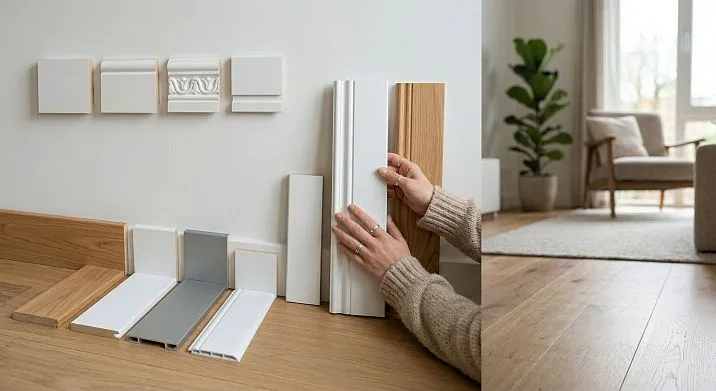
There are things in interior design that go unnoticed when done correctly. And are immediately noticed when something goes wrong. Floor baseboard is exactly such an element. A neat line at the floor that separates the vertical of the wall and the horizontal of the flooring—this is not a technical detail nor a remnant of Soviet building regulations. It is an architectural boundary that gives space completeness, clarity, and scale.
But the choicebaseboardremains one of the most underestimated tasks during renovation. It's postponed until the last moment, people take the first thing they find in a hardware store, without thinking about compatibility with the floor, doors, room style, and long-term perspective. And then they live with this decision for years, getting annoyed with every glance downward.
This article is for those who want to do it right the first time. Here is a complete practical breakdown: materials, height, profile, color, floor covering, interior style, and an honest answer to the question of where to buy floor baseboard and not regret it.




Why floor baseboard is needed: non-obvious functions of an obvious element
Most people know only one function of baseboard—to cover the gap between the wall and floor. This is true, but it's only part of the answer.
Technical function. The joint between wall and floor is a problematic structural node. Here, two different materials with different expansion coefficients meet. Floating floors—parquet, laminate, quartz vinyl—require an expansion gap at the wall. This gap cannot be filled: it's needed so the flooring can move freely with changes in temperature and humidity.baseboardcovers this gap decoratively without blocking the movement of the flooring.
Architectural function. The lower horizontal line of a room is the visual foundation of the space. The human eye automatically seeks horizontals in an interior: the floor line, the ceiling line, the windowsill line. A baseboard creates a clear lower boundary, organizes the space, and makes it legible.
Stylistic function. A baseboard is part of a unified wooden interior system that includes architraves, cornices, and moldings. When all these elements are coordinated in material, finish, and profile character, the interior looks well-considered. When they are mismatched, even an expensive renovation appears random.
Protective function. A baseboard protects the lower part of the wall from wet cleaning, accidental impacts, and dirt. Without it, the plaster near the floor gets wet with every floor washing, causing the wall to darken and deteriorate.




Which floor baseboards are most often chosen
The market offers several fundamentally different categories. Each has its own logic of application, its own strengths, and its own limitations.
Our factory also produces:


Solid wood floor baseboard
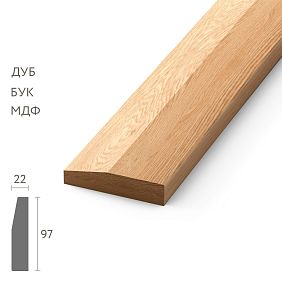
Wooden baseboardmade of oak or beech is the pinnacle of the hierarchy. A natural material with a density of 620–750 kg/m³, precise milling, perfect geometry, and a surface that can be treated with any finish—varnish, oil, wax, paint. Service life under normal operating conditions is 30–50 years with the possibility of restoration.
Oak is the most popular species for floor baseboards. High hardness on the Janka scale (3.5–4.0 kN), good resistance to mechanical impacts, beautiful texture with a pronounced grain pattern. Beech is slightly softer, with a more neutral fine-pored structure, ideal for painting in any color.
Get Consultation
MDF floor baseboard
MDF Skirting Boardis a high-density engineered board (750–850 kg/m³) with even geometry, a good surface for painting, and a low price. For a modern minimalist interior, it is one of the most practical options. Its weak points are the ends when wet and insufficient surface hardness compared to oak.
Tall floor skirting board
A separate category — not by material, but by dimensions. Skirting boards 100 mm and taller create a strong lower line in a room, visually organizing the space, especially in rooms with high ceilings. In classical and neoclassical interiors with ceilings from 3 meters, a tall skirting board is an architectural necessity.
White floor skirting board
One of the most common queries. White skirting board is a universal solution that works with any color of floor and walls. Made from beech for white enamel or from MDF with factory coating — it's a neutral, clean, modern choice for light interiors.
Wide floor skirting board
A skirting board 80–120 mm wide creates a powerful decorative accent. In classical interiors with high ceilings, it is part of the architectural vocabulary: a wide wooden skirting board with a shaped profile is a small cornice at the base of the wall.
Wooden floor skirting board: when natural wood is the only right choice
There are situations where the choice is predetermined. And they occur more often than it seems.
Natural wooden floor
Oak parquet, solid wood board, engineered board with an oak layer — and the question of the skirting board is already decided.with a classic profile creates a sense of solidity, reliability.From the same wood species in the same or a similar stain — the only solution that creates a sense of a cohesive, natural interior. Any other material here will be a compromise that is immediately visible.
The stain is crucial here. If the parquet is stained dark walnut — the baseboard should be in a similar range, not necessarily identical, but close. A sharp contrast between a light baseboard and dark parquet is a design decision that requires intentional application, not an accidental result.
Classic and neoclassical interior
In classic style, only natural materials are used — wood, stone, metal, fabric.to buy wooden baseboardOak with a shaped profile for a classic living room — this is not a matter of preference, it's a matter of stylistic consistency. MDF in a classic interior with oak doors and parquet looks like a mistake.
The profile for classic style — with a pronounced bead, roundings, chamfer. Not overloaded, but with a tangible play of shadow under side lighting. It is precisely the depth of shadow on the profile that distinguishes real classic from imitation.
Renovation with a 20–30 year horizon
When renovation is done 'forever' — only wood.Floor wooden skirtingOak can be sanded, repainted, stained a new color during interior restyling after 15 years. MDF does not offer this option — only replacement.
House with wooden interiors
In a wooden country house — a log house, timber house, or house made of glued laminated timber — wooden floor baseboards are a structural logic of the interior. Natural wood on all planes — floors, walls, ceiling, baseboards. A unified, living texture that no engineered material can replace.
When the feel of the material matters
There are interiors where the tactile and visual sensation of natural material is fundamental. Wood is warm, alive, with an individual grain pattern—each solid wood detail is unique. MDF is predictable, neutral, uniform. Choosing between them is a choice between character and neutrality.
MDF floor skirting: an honest analysis of pros and limitations
MDF Skirting BoardSome are undeservedly underestimated, others overestimated. The truth, as always, lies in a precise understanding of the application context.
Strengths of MDF floor skirting:
Perfect geometry. The engineered material does not warp or twist under normal microclimate conditions. A straight MDF skirting provides a smooth line without local gaps.
Excellent surface for painting. The fine-porous structure of MDF accepts enamel without preparation—only light priming is needed. White MDF skirting is the most popular choice for modern light-colored apartments.
Low price. MDF is 2–3 times cheaper than solid wood with similar geometry. For large volumes or budget projects—a reasonable choice.
Simple installation. MDF skirting is cut with a regular fine-toothed saw, corners are trimmed with a miter saw. Glue or clips—both options work.
Limitations of MDF:
Ends when wet. The end cuts of MDF swell and delaminate upon contact with moisture. In the kitchen, bathroom, or entry area—ends must be sealed.
Surface fragility. MDF crumbles at the corners under strong mechanical impact. Where the skirting board regularly contacts furniture or chair legs, solid wood is more reliable.
Impossibility of restoration. A scratched or damaged MDF skirting board cannot be sanded and repainted locally—only complete replacement of the fragment.
How to choose a floor skirting board by height, width, and profile
This is the section that is read last and in vain. Because it is precisely the correct height that determines whether the skirting board will work architecturally or simply 'stand against the wall'.
Height: the main rule of proportions
Skirting board height and ceiling height are related quantities. Violation of proportions here is immediately noticeable.
| Ceiling Height | Recommended skirting board height |
|---|---|
| Up to 2.5 m | 60–70 mm |
| 2.5–2.8 m | 70–80 mm |
| 2.8–3.0 m | 80–100 mm |
| 3.0–3.5 m | 100–120 mm |
| More than 3.5 m | from 120 mm, cornice system |
A skirting board that is too low in a high room gets lost—it is not visible from eye level, the lower line of the space remains unorganized. One that is too high in a low room feels oppressive and visually 'lowers' the ceiling.
Width: accent or neutrality
The width and height of a skirting board are often the same, but with different emphasis. A wide floor skirting board is a decorative element that requires visual space to work. In a small room of 12–15 sq. m with a 2.5-meter ceiling, a wide 120 mm skirting board will look heavy. In a spacious living room of 30 sq. m with a 3-meter ceiling, it will look organic and appropriate.
Profile: smooth or decorative
Smooth straight profile — this is modern minimalism. Clear geometry, no decor, maximum neutrality. Perfect for Scandinavian style, minimalism, high-tech, loft.
A beveled or rounded profile is a subtle relief that adds visual interest without active decoration. A versatile solution for modern and transitional interiors.
Figurative classic profile — coves, torus, ovolos. For classic, neoclassical, empire styles. Here, the depth of shadow on the profile under side lighting creates the lively plasticity of an architectural element.
Rule: the baseboard profile should match the overall complexity of the interior. If the room has many details, textured surfaces, decor — a baseboard with a rich profile. If clean surfaces, geometry, minimal details — smooth or with a bevel.
Floor baseboard for specific floor covering
One of the most practical questions: which baseboard should I choose specifically for my floor? Let's break it down by each main covering.
Floor baseboard for laminate
Laminate is the most common covering. A wooden baseboard in a similar tone or MDF in the color of the floor or walls suits it.
Technical detail: when installing laminate, the baseboard is attached exclusively to the wall, not to the covering. A gap of 5–8 mm must be maintained between the baseboard and the laminate — this is space for the expansion of the floating covering. If the baseboard is pressed against the laminate — the covering will buckle within a year.
Color solution: if the laminate imitates light oak — a beech skirting board in natural tint or under white enamel. If dark walnut — a skirting board in a similar dark range. White skirting board with dark laminate — an intentional contrast that works in modern interiors when applied correctly.
Floor skirting board for parquet and engineered board
Here the answer is unequivocal: onlyWooden baseboardfrom the same wood species. Oak parquet — oak skirting board. Ash engineered board — skirting board from ash or beech in a similar tint. Any other material in this combination will look like a selection error.
Feature of engineered board: it is less sensitive to humidity changes than solid parquet, but an expansion gap at the wall is still needed. Skirting board — decorative closure of this gap, attached only to the wall.
Floor skirting board for quartz vinyl
Quartz vinyl — one of the most popular options for modern housing. Waterproof, warm, visually often imitates wood or stone. To quartz vinyl with wood imitation — wooden skirting board in a similar tint. To neutral gray or concrete quartz vinyl — white MDF or wooden skirting board from beech under neutral enamel.
Technically: quartz vinyl is laid as a floating floor or with adhesive. With floating method — an expansion gap at the walls is mandatory, which the skirting board covers. With adhesive — the gap is smaller, but skirting board is still needed for neat joint finishing.
Floor skirting board for tile and porcelain stoneware
Tile — a rigid adhesive coating that does not require an expansion gap. Here the function of the skirting board is decorative: finishing the joint and protecting the lower part of the wall.
Any skirting board material works with tiles: wood, MDF, PVC. The choice is determined by the room's style. In kitchens and hallways with tiles — white MDF or wooden skirting, depending on the overall interior context.
Important: when laying floor tiles, the skirting board is installed on top of the tile, not under it. The lower edge of the skirting rests on the tile, the upper edge presses against the wall. Sealing the bottom seam with clear silicone is mandatory in kitchens and hallways.
Floor skirting in interior design: how it works in different styles and rooms
Wooden skirting board in a classic interior
Classic style means natural materials, symmetry, rich profile decoration.Wooden skirting boardsOak skirting with an expressive shaped profile is an essential element of a classic interior. They work in tandem withmoldingswall moldings, ceiling cornices, and decorative panels.
In a classic living room with a 3-meter ceiling, a wide 100–120 mm skirting creates a lower architectural horizontal line that 'holds' the tall space. Without it, the room feels unfinished, no matter how much expensive furniture it contains.
White skirting board in a modern interior
White smooth skirting is the hallmark of a modern minimalist interior. White walls, light floors, clean horizontals — and a white skirting that blends into the lower part of the wall without creating unnecessary emphasis.
In a small apartment with 2.5-meter ceilings, a white baseboard matching the walls visually expands the space: the lower boundary of the floor 'disappears,' making the wall appear taller. This is a simple and effective design technique.
Tall baseboard in an interior with high ceilings
In rooms with ceilings of 3 meters or higher, a tall oak baseboard is an architectural solution, not just a floor detail. It creates a transition zone between the floor and wall, scales the space, and makes a tall room feel cozy rather than empty.
In combination withwith wooden cornicesAt the top—a tall floor baseboard forms a unified vertical interior system: two horizontal accents at the top and bottom that frame the space.
Wooden baseboard in neoclassicism
Neoclassicism is a transitional style between strict classicism and modernity. It features light surfaces, marble inserts, brass hardware, and wooden details with refined profiles. A beech wooden baseboard under white or cream enamel is a perfect match. It adds the warmth of natural material to the neutral backdrop of a neoclassical interior.
Baseboard for the hallway: special requirements
The hallway is the room with the highest intensity of use. Here, the baseboard gets hit by shoes, comes into contact with wet footwear after rain, and undergoes aggressive cleaning. Requirements include high surface durability, moisture-resistant coating, and a smooth profile for easy cleaning.
An oak wooden baseboard with double lacquer is the optimal choice for the hallway. The hardness of oak withstands impacts, the lacquer protects against moisture, and the smooth surface is easy to clean.
Baseboard for the living room: style as the main criterion
In the living room, the baseboard works in tandem with all wooden interior elements. If the living room has wooden doors, parquet flooring, wooden frames — the baseboard should be part of this system.moldings, cornices, and baseboardsin a unified style and finish — this is what makes the living room a complete interior, not just a collection of expensive items.
Baseboard for the bedroom
In the bedroom, the baseboard works quietly. Here, a bright decorative accent is not needed — harmony is required. A wooden baseboard matching the parquet or door trims, a neat profile without excessive decoration. In the bedroom, the horizontal quietness of the lower line is especially important — it creates a sense of calm.
Unified wooden system: how the baseboard works together with other elements
One of the principles of good interior design is the systematic nature of wooden details. The baseboard does not exist in a vacuum. It works in an ensemble with door trims, window slopes, cornices, and wall moldings.
When all these elements are made from the same wood species, with the same finish and the same stylistic profiles — the interior gives the impression of being very expensive, even if the finishing itself is moderately priced. When each element was chosen separately, randomly — expensive materials can look cheap.
solid wood millwork— is a complete system of profile elements: baseboards, trims, moldings, cornices, slats. By ordering all elements from one manufacturer, you get guaranteed unity of finish and profile, which is impossible to ensure when purchasing from different suppliers.
An interesting detail that is often overlooked:Wooden molding— is a narrow decorative profile used for finishing panels, door leaves, stained glass, decorative inserts in furniture. In an interior with a wooden baseboard and trims, the glazing bar adds another level of wooden decor — subtle, unobtrusive, but noticeable in the details.
Floor skirting board selection mistakes: a practitioner's list
These mistakes are easy to avoid if you know about them in advance.
Mistake 1: choosing skirting board after laying the floor without comparing samples
The most common mistake. The skirting board is chosen 'by eye' based on memory of the floor color. The result is a mismatch in tones that is immediately visible. Rule: always compare a skirting board sample with a floor covering sample under a single light source.
Mistake 2: incorrect height
A 60 mm skirting board in a room with a 3-meter ceiling is a visual loss: the bottom line of the space doesn't work. A 120 mm skirting board in a room with a 2.5-meter ceiling creates pressure from both top and bottom simultaneously. Proportions are the primary criterion, not aesthetic preferences.
Mistake 3: conflict with door architraves
Door architraves and skirting boards should be made of the same material, have the same toning, and belong to the same stylistic group of profiles. A dark, massive skirting board with a classic profile and white, smooth architraves is a stylistic conflict that destroys the feeling of a well-thought-out interior.
Mistake 4: choosing based solely on price
A cheap skirting board made of soft MDF with a thin coating on the ground floor of a house or near the entrance door is money spent twice. First on purchase and installation, then on replacement after two years. An oak wooden skirting board costs more but lasts many times longer and allows for restoration.
Mistake 5: rich relief profile in a room with active cleaning
Deep grooves of a classic profile accumulate dust and dirt. In the hallway, kitchen, corridor — smooth or with minimal relief. Decorative profile — for the living room and bedroom, where cleaning is less intensive.
Mistake 6: different skirting boards in adjacent rooms
Open plan: living room transitions to kitchen, kitchen — to hallway. Different skirting boards in adjacent zones create a visual break that disrupts the feeling of a unified space. One skirting board should run along the entire perimeter of the open zone.
Mistake 7: skirting board attached to the floor, not to the wall
Technically this is a mounting error, but the buyer should know: the skirting board is always attached to the wall. The lower edge of the skirting board rests on the floor covering but is not attached to it. This ensures free movement of the floating floor.
Where to buy floor skirting: from selection to order
The question seems simple. But in practice, there are many nuances here.
In a construction hypermarketbuy floor skirtingfast — but the assortment there is limited to standard items: several MDF widths, several colors, basic profiles. No choice of wood species, no consultation on compatibility with specific flooring and interior.
If you need awith a classic profile creates a sense of solidity, reliability.from a specific wood species, with a specific profile for your parquet or trim — the right path is a specialized manufacturer with their own production. Here:
-
full range of profiles and wood species;
-
ability to match the tint to existing interior elements;
-
specialist consultation;
-
guarantee of material quality and processing;
-
manufacturing of non-standard profiles according to individual drawings.
Buy floor skirting boardwith delivery across all of Russia — this is standard practice for specialized manufacturers. Molded products transport well with proper packaging.
Floor skirting boards catalogfrom a professional manufacturer includes dozens of profiles in different wood species and tints — from minimalist smooth to rich classic. You can compare profiles by photos and samples, order — by precise linear dimensions accounting for cutting allowance.
About the company STAVROS
STAVROS is a Russian manufacturer of wooden architectural moldings and decorative elements made from solid oak and beech. The company was founded in 2002 in St. Petersburg. From its early years, STAVROS has specialized in producing profile products from natural wood for residential and commercial interiors.
Among the completed projects are the restoration of the Konstantinovsky Palace in Strelna, work in the interiors of the Hermitage and Alexander Palace, and dozens of private residences and commercial projects. Experience working on cultural heritage sites is a confirmed quality standard, not just a declaration.
STAVROS production is equipped with European woodworking machinery. Raw materials undergo chamber drying to 8–12% moisture content. Milling accuracy of ±0.1 mm is a production standard, not a marketing figure. Each batch undergoes incoming inspection and final checks for geometry and surface quality.
STAVROS showrooms operate in St. Petersburg and Moscow. Partner programs are available for designers, architects, and construction companies. Custom profiles based on individual drawings are available for orders from 50 linear meters. Delivery is available throughout Russia.
FAQ: Answers to popular questions
Which floor skirting board is best to choose?
It depends on the context. For a classic interior with parquet – a wooden oak skirting board with a figured profile. For a modern apartment with light laminate – white MDF or a beech wooden skirting board under white enamel. The main criterion is compatibility with the floor covering, door trims, and interior style.
What is better: wooden skirting board or MDF?
Oak wooden skirting board is mechanically stronger, more durable, allows for restoration, and has a living natural texture. MDF is cheaper, easier to paint, and works well in modern interiors. For a renovation lasting 20–30 years and natural floor coverings – wood. For a budget project or modern minimalism – MDF.
Which skirting board to choose for laminate?
Wooden skirting board in a similar tone or MDF in the color of the floor or walls. The skirting board is attached to the wall, and a gap of 5–8 mm must be maintained between it and the laminate for the expansion of the floating floor.
Which skirting board to choose for parquet?
Only a wooden skirting board made from the same wood species with a similar tint. Parquet and wooden skirting board are a unified natural system. Any other material here will look like a compromise.
Where to buy floor skirting board?
From a specialized manufacturer with their own production of wooden moldings. This ensures the correct choice of wood species, profile, tint, and material quality. STAVROS — production in Saint Petersburg, delivery across all of Russia.
What height should the baseboard be?
Depends on ceiling height. For 2.5 m ceilings — 60–70 mm. For 2.8–3 m — 80–100 mm. For 3 m and above — from 100 mm. Incorrect height disrupts the room's proportions.
What color skirting board is best to choose?
Three working logics: matching the floor — expands the space; matching the walls — minimalism; matching the door/window casings — a unified wooden system. For a small room — skirting board matching the wall or floor. For a classic interior — matching the other wooden elements.
Is an expansion gap needed between the skirting board and laminate?
Absolutely. Floating floors — laminate, quartz vinyl, engineered board — expand with changes in temperature and humidity. A 5–8 mm gap at the wall, covered by the skirting board, allows for this movement. Without a gap, the flooring will buckle.
Can wooden skirting boards be painted?
Yes, and this is one of wood's main advantages. Beech skirting board accepts any acrylic or oil-based enamel. Oak — paints well after priming with a primer designed for dense wood species. In 10–15 years during an interior restyling, a wooden skirting board can be repainted a new color without replacement.