Article Contents:
- Why a wooden baseboard is important in any interior
- Advantages of a wooden baseboard
- Types of wooden baseboard and their features
- Choosing Wood Species
- Profile parameters: width, thickness, shape
- Calculating the required quantity
- Storage conditions and preparation for installation
- Installation Technology
- Caring for wooden skirting boards
- Design tips and advice
- Frequently Asked Questions
- Where to buy baseboard affordably in Voronezh
- Conclusion

Buying a baseboard is not just purchasing a decorative element. In modern conditions, a thoughtful approach to finishing the wall and floor base determines not only aesthetics but also the longevity of the renovation, ease of cleaning, and indoor microclimate. This issue is especially acute in cities like Voronezh, where climatic conditions impose higher requirements on materials. In this article, we will thoroughly examine the entire process: from analyzing the advantages of a wooden profile to practical recommendations on purchasing and installation. If you are ready to update your interior, we recommend immediately moving to the selection and order page —Buy wooden baseboard in Voronezh.


Why a wooden baseboard is important in any interior
Often, during renovation, primary attention is paid to wall finishes, color and texture selection of flooring materials, while the baseboard issue is left for the final stage. However, a baseboard performs a whole set of functions without which the finished space will not look harmonious. It covers the gap between the floor and the wall, protects the lower part of the walls from mechanical damage and moisture, and creates a neat frame for the finish. In wooden form, the baseboard also regulates the humidity level in the room, the "breathable" structure of wood creates a more comfortable microclimate, and the natural texture adds warmth and depth to the interior.
Saving money on the baseboard often leads to the fact that after one or two years of use, the appearance of a brand-new floor finish is lost: low-quality PVC or cheap MDF breaks, cracks, deforms, makes cleaning more difficult, and forces you to face the need for repeated renovation. A wooden baseboard is an investment in quality: it will serve for decades, and if necessary, it can be restored by sanding and applying a new protective coating. For residents of Voronezh, this choice is especially relevant, since the combination of humid summers and dry winters requires materials resistant to microclimate fluctuations.




Advantages of a wooden baseboard
Wood in interior design is always perceived as a sign of high standards and natural warmth. Natural solid wood or veneer has the following advantages:
Ecological safety and safety. When properly manufactured and complying with European E0/E1 formaldehyde standards, wood does not emit harmful substances, is hypoallergenic, and is suitable for rooms with children and allergy sufferers.
Strength and repairability. Solid wood planks withstand furniture impacts, intensive cleaning, and repeated contact with household appliances. In case of scratches or damage, local sanding and reapplication of varnish are sufficient, unlike disposable cheap MDF.
Thermal and sound insulation. The structure of wood absorbs sound waves, reducing noise from footsteps and impacts on the floor. Low thermal conductivity of wood creates an additional warm zone at the base of walls, reducing heat loss.
Microclimate regulation. Wood "breathes", absorbing excess moisture and releasing it back into the air when dry, which reduces the risk of laminate or parquet deformation and positively affects air quality.
Aesthetics and status. The unique pattern of annual rings, the ability to choose wood species and veneer shade make the baseboard a self-contained decorative element that emphasizes the interior style — from classic luxury to Scandinavian minimalism.
Our factory also produces:
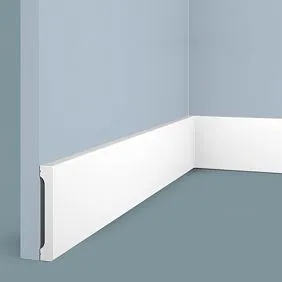
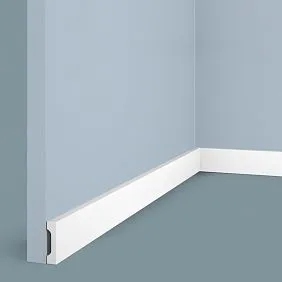
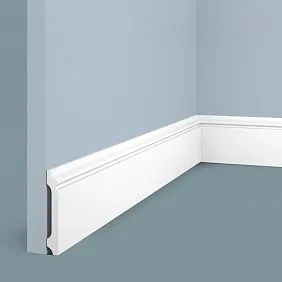

Types of wooden baseboard and their features
There are several manufacturing technologies for wooden baseboards, each adapted to different tasks and budgets.
Solid hardwood. Made from dense hardwoods — oak, ash, beech, walnut. This offers maximum durability, eco-friendliness, and the possibility of multiple restorations, although the price is 30–50% higher than veneered alternatives.
MDF baseboard with veneer finish. The body is made of moisture-resistant MDF, the front part is veneered with 1–3 mm thick veneer. The price is lower than solid wood, stable geometry under humidity fluctuations, rich color palette. The disadvantage is the vulnerability of the veneer to scratches and the inability to perform local restoration — in case of serious damage, the entire plank must be replaced.
Composite profiles. Combine solid wood on the front part and MDF in the base. This is a balance of strength, natural appearance, and price. Requires precise installation, and if the front panel is damaged, the entire element must be replaced.
Flexible baseboards. Composites with wood fibers for curved walls and radius structures. Conceal unevenness up to 10 mm, but the texture is less varied, and over time, elasticity may decrease.
Baseboards with cable channels. A hidden channel inside the profile allows for neat and safe wiring without additional wall grooves.
Get Consultation
Wood species selection
Oak — the standard for durability, hard, noble tone; suitable for high-traffic areas and luxury interiors. Price — 1500–2000 ₽/linear meter. Ash — elastic, light, modern; looks great in Scandinavian and minimalist projects, price — 1200–1800 ₽/linear meter. Beech — moderate hardness, pinkish tone, economical option for living rooms, price — 1000–1400 ₽/linear meter. Walnut — luxurious dark tone, exclusive; price — from 1800 ₽/linear meter. Birch and pine (veneer) — budget-friendly, easy to paint, suitable for any color finish, price — 400–700 ₽/linear meter.
Profile parameters: width, thickness, shape
The width of the skirting board affects the perception of space: for ceilings up to 2.7 m, optimal widths are 60–80 mm, up to 3 m — 80–100 mm, above 3 m — 100–150 mm. Profile thickness of 18–30 mm determines strength and resistance to impacts, protrusion depth of 15–24 mm — protective and decorative properties. Profile shapes include straight, beveled, grooved, and recessed for lighting. Each shape creates its own style and functional advantages.
Calculation of required quantity
Accurate calculation saves time and money. Measure the room’s perimeter along the inner corner with a tape measure, subtract the width of doors and windows deeper than 2 cm, add 10% for cutting and waste. Confirm with the supplier the package length (2.4–2.7 m), divide the total linear meters by the length of one strip, and round up to the nearest whole package.
Storage conditions and preparation for installation
Store the skirting board horizontally in a dry room at a temperature of +10 to +25 °C and humidity of 40–60%. Before installation, allow the material to acclimate in the room conditions for at least one day. Prepare tools: level, painter’s string, tape measure, marker, miter saw or combination square, clips and guides, construction adhesive ("liquid nails"), decorative-headed screws, lacquer or oil for finishing ends, protective gloves and safety glasses.
Installation technology
Hidden installation using clips ensures ventilation of the skirting board and allows for removal without damage. Adhesive mounting with "liquid nails" is suitable for flat walls and allows for flush installation without visible fasteners. Traditional screw mounting with decorative caps remains the simplest and cheapest method, but requires careful concealment of fastener points. Always use a compensatory gap of 2–3 mm during installation to accommodate seasonal wood expansion.
Care for wooden skirting boards
Wipe with a dry or slightly damp cloth without abrasives, immediately remove spilled liquids, avoid contact with aggressive chemicals. Renew lacquer or oil every six months, remove minor scratches with fine sandpaper and reapply finish. Monitor room humidity using humidifiers and dehumidifiers, maintaining a level of 40–60%. In case of severe wear, consult professionals for full restoration.
Design techniques and tips
A contrasting dark skirting board on a light floor emphasizes room geometry and adds graphic appeal. Monochromatic solutions "dissolve" boundaries, visually expanding the space. Wide profiles with recessed LED lighting create a "floating" floor effect and a cozy atmosphere. Combining different wood species allows zoning of open spaces without additional partitions.
Frequently asked questions
Can skirting boards be installed on a "warm floor"? Yes, provided the profile is certified for surface temperatures up to +27 °C and a compensatory gap is maintained.
What width of skirting board is suitable for 3 m ceilings? Optimal width is 100–120 mm to maintain proportions.
Is veneered MDF suitable for painting? Yes, such models are easily tinted with acrylic and alkyd paints.
How long does skirting board installation take? A professional team installs skirting board in a room up to 25 m² in 3–5 hours, including preparation and finishing work.
How to store skirting board until installation? Horizontally in a dry room, in factory packaging, at a temperature of 10…25 °C and humidity of 40–60 %.
Where to buy skirting board in Voronezh
For those who are looking Buy wooden baseboard in VoronezhAt the online store Stavros, you can find a wide range of profiles and wood species, high-quality finishing, and professional consultations. Delivery to Voronezh within 1–2 days, the option to order free veneer and demonstration samples will help you precisely select the desired shade and texture. Comprehensive service includes a measurer’s visit, assistance with calculation and ordering, installation team with warranty on work.
Conclusion
Wooden skirting board is not just a finishing material, but a key element that combines practical and aesthetic aspects of renovation. It protects walls, simplifies cleaning, improves microclimate, and becomes a distinctive interior accent. Choosing high-quality solid wood or veneered options, considering Voronezh’s climatic conditions, correctly calculating the quantity, and organizing professional installation, you will get a reliable and long-lasting solution. To avoid mistakes in selection and to place your order as quickly as possible, click the link Buy wooden baseboard in Voronezh and start transforming your home today.