Article Contents:
- Why the Hallway Often Ends Up Either Empty or Overloaded
- Why MDF Skirting is a Good Base Specifically for the Hallway
- Basic Wall Protection in the Load Zone
- Neat Appearance for Painting
- Performance in High-Traffic Areas Without Degradation
- Compatibility with Different Styles and Materials
- Where Decorative Elements Are Needed in the Hallway and Where It's Better to Leave the Wall Calm
- Accent Wall
- Mirror area
- Console or Coat Rack Area
- Long Passage
- Where Decor Isn't Needed
- How to Use Molding in a Hallway Without Overloading
- Thin Profile as a Basic Choice
- Subtle Relief — Key to Lightness
- Limited Number of Frames
- Combination with a Smooth Wall: The 'Field' Rule
- Where Molding Should End
- How to Connect MDF Baseboard and Wall Relief into a Unified System
- Wall Base — The Lower Line of the Interior
- Transition from floor to relief
- Baseboard height and its impact on decor above
- Scale of decor and proportions
- Unified profile or coordinated profiles
- Ready-made solutions that work especially well in hallways
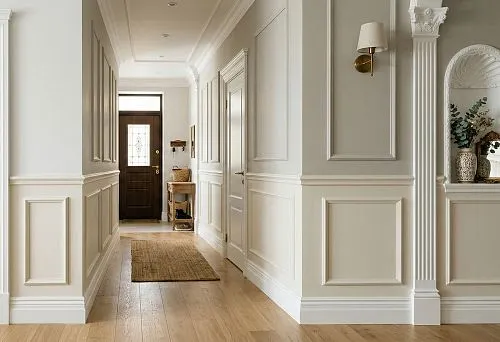
- Solution 1: Light hallway with high MDF baseboard
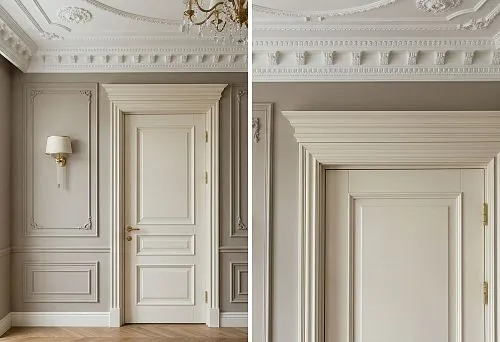
- Solution 2: Calm neoclassicism with light molding
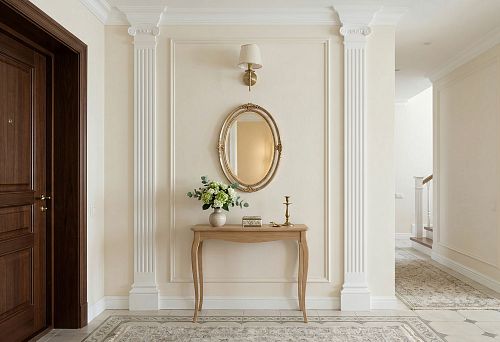
- Solution 3: Mirror area with decorative frame
- Solution 4: Long hallway with moderate rhythm
- Solution 5: Passage area with accent on only one wall
- How to make relief practical, not easily soiled and heavy
- Fewer protrusions in the contact area
- Calm profile: without sharp protrusions and fine ornamentation
- Correct height of decor and ease of cleaning
- Polyurethane resistance to household contact
- Mistakes that make the corridor seem even more cramped
- Too active relief on all walls at once
- Heavy decor in a narrow passage
- Weak baseboard under a large wall composition
- Too many small elements
- No connection between the wall base and decor
- Dark bottom and too fragmented top
- What to look for in the catalog for such a composition
- FAQ: Answers to Key Questions
- Is MDF skirting suitable for a hallway?
- How to use molding in a hallway without overloading?
- Which decorative elements are suitable for a passage zone?
- How to connect MDF skirting and wall relief?
- What is better for a hallway: plain skirting or skirting with molding?
- How to make a hallway practical but not empty?
- Is polyurethane molding suitable for a hallway?
- How much relief is needed in a small hallway?
- About the company
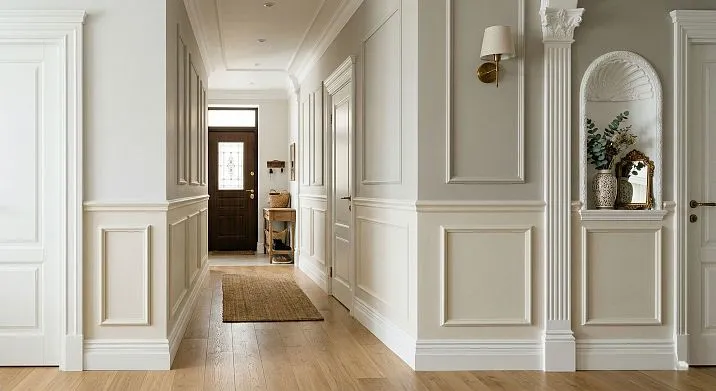
There are spaces perceived as utilitarian—and that's a big mistake. A hallway isn't just a passage from one room to another. It's the first and last point of impression about a home. It's the space that sets the rhythm, mood, and logic of the entire interior. And it's precisely here where one of two extremes most often occurs: either the walls remain bare because 'there's nowhere to hang anything' and 'no space,' or they're cluttered with everything in an attempt to 'make it look nice.'
Between emptiness and overload, there is a precise path. It's built on three elements:MDF Skirting Boardas a reliable wall base,decorative elementsas architectural relief, andMoldingsas a unifying decorative language. Together, these three components give the hallway what it most often lacks: integrity, expressiveness, and practicality in one package.
Let's break this down in detail and honestly—with specific solutions, proportions, typical mistakes, and ready-made schemes.



Why hallways most often end up either empty or overloaded
Ask yourself: how many times have you seen a hallway that makes an impression? Not just 'okay'—but 'wow, this is done.' There aren't many such interiors. And it's not about budget, square footage, or ceiling height.
It's about the approach.
A corridor is a passage area with special conditions: narrow space, high traffic, constant everyday contact with walls, limited areas for decor. You can't work here by the same rules as in a living room. Different scale, different function, different movement rhythm.
That's why one of two fundamental mistakes is often made here:
The first mistake — meaningless minimalism. Smooth painted walls, simple baseboard, mirror, and coat rack. Functionally — yes. Architecturally — no. Such a corridor looks like a draft, not a finished space.
The second mistake — decor for decor's sake. Frames of different sizes, overlays in different styles, a heavy cornice under a low ceiling, active relief on all walls at once. A person enters — and literally feels pressure. The narrow passage is perceived as even more cramped because the walls 'scream'.
The solution lies in a system.MDF Skirting Boardsets the base. Decorative elements create relief. Molding adds architectural language. And all three levels work towards one goal: to make the space readable, practical, and visually light.




Why MDF baseboard is a good base specifically for a corridor
It's common to think of baseboard as a trifle — 'something down there by the floor.' But it's precisely the baseboard that determines how the lower third of the wall is perceived. And in a corridor, the lower third is the zone of maximum everyday contact: shoes, bags, accidental bumps, children, pets. What's needed here isn't just aesthetics — it's durability.
MDF Skirting Boardmeets these requirements. Let's examine why.
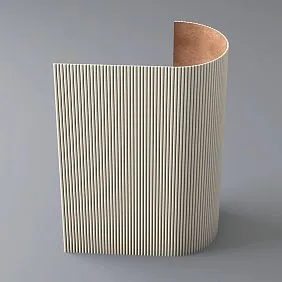
Our factory also produces:


Basic wall protection in the load zone
MDF is a medium-density fiberboard with a homogeneous structure. Unlike polystyrene and plastic skirting boards, it withstands impact loads without deformation. Unlike solid wood, it does not crack with seasonal changes in temperature and humidity. For a hallway, where the load on the lower wall zone is daily, this is not a bonus but a necessity.
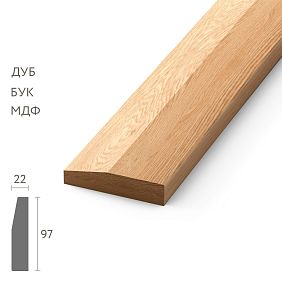
The height of MDF skirting for a hallway is from 80 to 120 mm. This is a sufficient barrier that protects the impact zone from shoes and bags, while also forming a noticeable lower line of the wall.
Get Consultation
Neat appearance suitable for painting
One of the main advantages of MDF is its perfectly smooth surface for painting. In hallways, where walls are often painted rather than wallpapered, MDF skirting for painting is a logical choice: it fits into a unified color scheme, doesn't stand out, doesn't yellow, and doesn't lose its shape.
White MDF skirting in a light hallway is a timeless classic. It creates a clear horizontal line at the floor, visually 'grounding' the space and giving it structure.
Performance in high-traffic areas without degradation
A hallway is not a living room. People walk here in outdoor shoes, furniture corners hit the walls when moving, children run and brake against the walls. MDF skirting in these conditions retains its shape and paint significantly longer than lightweight polystyrene alternatives. And if necessary, it can be easily repainted without replacement.
Compatibility with different styles and materials
MDF Skirting Board— a neutral base element. It works equally well in modern neoclassicism with subtle molded relief, in minimalism with clean walls, in eclecticism with wooden overlays. A unified skirting profile, coordinated with the molding or frame profile — and the wall's vertical gets a logical base.
It's worth mentioning high MDF skirting separately — from 100 mm and above. In hallways with ceilings of 2.7–3 m, high skirting creates a more pronounced 'edge' at the floor, visually increases the perceived height of the room, and provides greater protective coverage on the wall.
Where in the hallway decorative elements are needed, and where it's better to leave the wall calm
Not every wall in the hallway requires decoration. This is a fundamental idea. In a narrow passage space, decorative elements should work in a targeted manner, as accents, not as continuous coverage.
How to understand where decor is needed and where it will be excessive?
Accent Wall
In most hallways, there is one end or side wall that a person sees first. This is a candidate for an accent solution. It is here that decorative elements, frames made of molding profiles, moldings are justified. The remaining walls are calm, without relief or with a minimal element.
Mirror zone
A mirror in the hallway is a functional center. The wall around the mirror is a natural place for decorative design. A thin profile frame around the mirror, two small elements on the sides — and the area becomes complete. Here, the decor does not weigh it down because it is concentrated around a specific item.
Console or hanger area
If there is a console or a wall hanger in the hallway — the wall behind it also requires visual design. A rectangular frame made of molding on the wall, which encompasses the console along the perimeter, creates an architectural context for the furniture piece.
Long passage
In long corridors, monotonous walls create a feeling of a 'tube'—monotonous and uncomfortable. Here, the rhythmic repetition of a decorative element (for example, three identical vertical frames on one wall with equal intervals) creates movement, turning the 'tube' into an organized space.
Where decor is not needed
The wall behind a wardrobe—decor is pointless, as it's covered anyway. A very narrow corridor (up to 80 cm wide)—any protruding relief further 'narrows' the passage. The area near a door—decor here interferes with opening and closing doors.
How to use molding in a corridor without overloading it
MoldingsMolding in a corridor is not about opulent luxury. It is an architectural tool that, when applied correctly, makes a passageway expressive and cohesive. When applied incorrectly—it becomes oppressive and cramped.
The main principle: molding in a corridor should be calm, even, and light. This does not mean—inconspicuous. It means—proportionate to the space.
A thin profile as a basic choice
For a corridor, the optimal profilemolding on walls—width 16–22 mm, relief depth from the wall 10–14 mm. This is enough to create a shadow and a readable line. Not enough to 'protrude' from the wall toward a person, reducing the passage.
A profile with ornament in a corridor—used with caution. An ornamental profile is appropriate only where there is space to perceive details. In a narrow corridor, the ornament 'gets lost' and creates a sense of noise.
A calm relief is the key to lightness
The depth of the relief is the main tool for controlling the 'weight' of the decor.Relief DecorationA relief up to 12 mm in a hallway is perceived as light. From 20 mm and above — it already feels voluminous, loading the space.
For a standard-width hallway (90–120 cm) — a maximum of 15 mm relief depth. For wider hallways (from 140 cm) — you can be a bit bolder, up to 18–20 mm.
Limited number of frames
On one hallway wall — no more than two frames. Better one, but precise and well-considered. Three frames on a narrow wall is already a rhythmic overload that makes the wall 'busy' up to the ceiling.
Combination with a smooth wall: the 'field' rule
Any frame element frommoldings for wallsmust have a 'field' — free space around itself. In a hallway, the minimum field is 80 mm from the edge of the frame to the adjacent element or wall edge. Less — and the frame starts to 'suffocate,' losing readability.
Where the molding should end
In the corridorWall moldingsshould not drop below the level of the baseboard. That's obvious. But no less important: the molding should not rise right up to the ceiling cornice if a cornice is already present. Between the top edge of the wall decor and the bottom edge of the cornice—a pause of at least 100–120 mm. Otherwise, the upper part of the wall is perceived as a solid decorative strip.
How to link MDF baseboard and wall relief into a single system
This is where it gets really interesting. You can choose an excellentMDF Skirting Boardand beautifuldecorative elements—and yet they won't work together. Because the connection between the wall base and the wall relief is a separate design task.
Wall base—the lower line of the interior
A baseboard is not just a 'little strip by the floor.' It is the lower line of the entire wall composition. It sets the scale for everything above it.
If the baseboard is tall (100–120 mm) and has a pronounced profile—the decor above it should be proportionate: frames of sufficient width, a profile no thinner than that of the baseboard. Otherwise, a mismatch arises: a powerful base and delicate, thin details above—it's like a heavy pedestal under a graceful figurine.
If the baseboard is modest (60–80 mm)—the frames above can be slightly more delicate, but should not be excessively large.
Transition from floor to relief
In classical and neoclassical interiors, the transition from floor to wall relief is structured according to the scheme: baseboard → pause of smooth wall → lower horizontal molding (or lower side of frame). This pause between the top edge of the baseboard and the lower edge of the frame is the 'breathing' space. In a corridor, it should be 200–350 mm.
Moldings— wooden or polyurethane horizontal profiles — can serve as an additional transitional element: they mark the lower boundary of the wall panel, creating a 'plinth' level above the baseboard.
Baseboard height and its influence on decor above
The height of the MDF baseboard directly affects how much 'working' area remains on the wall for decor:
| Ceiling Height | Recommended MDF baseboard height | Zone for wall decor |
|---|---|---|
| 2.4–2.5 m | 70–80 mm | Moderate, decor in 1 level |
| 2.6–2.8 m | 80–100 mm | Good, frame or two elements |
| 2.9–3.2 m | 100–120 mm | Full, high relief possible |
| from 3.2 m | 120–150 mm | Large, multi-tiered composition |
Scale of decor and proportions
The width of the molding profile frame should be coordinated with the height of the baseboard. An approximate rule: the width of the frame profile is from 1/4 to 1/3 of the baseboard height. For a 100 mm baseboard, the frame profile is 25–35 mm. For an 80 mm baseboard — 20–28 mm. This preserves the scale unity between the base and the relief.
Unified profile or coordinated profiles
Идеальный вариант: плинтус МДФ, молдинги, рамки из лепнины и карниз принадлежат одному профильному семейству. Это значит, что в сечении все элементы «говорят» на одном языке: одинаковый изгиб, одна глубина, один угол скоса. Если такого набора нет — можно подбирать близкие профили, не контрастирующие друг с другом по рисунку.
Ready-made solutions that work especially well in the hallway
Solution 1: Light hallway with a high MDF baseboard
Scenario: standard hallway 100–120 cm wide, ceilings 2.7 m, light walls.
Contents:
-
MDF Skirting Boardheight 100–110 mm, profile with a simple convex top edge, painted to match the wall or slightly more contrasting
-
One rectangular frame made ofmoldings on the wallon the end wall, profile 20×14 mm
-
Mirror in the center of the frame
Result: an architectural end wall without overload. The baseboard provides the base, the frame provides structure, the mirror provides depth.
Solution 2: Calm neoclassicism with light stucco
Scenario: a corridor in an apartment with a neoclassical interior, ceilings 2.8–3 m.
Contents:
-
WhiteMDF Skirting Board120 mm high with a slightly pronounced profile
-
Horizontal moldingat a height of 900–950 mm from the floor — marks the upper boundary of the 'plinth' zone
-
Above the molding — a rectangular frame made ofmoldings from polyurethaneon the accent wall
-
CeilingCornice— neat, without excessive expressiveness
Result: a three-level wall system: baseboard — molding — frame — cornice. Cohesive, neoclassically correct.
Solution 3: Mirror area with a decorative frame
Scenario: one corridor wall with a mirror, no space for large-scale solutions.
Contents:
-
StandardMDF Skirting Board80 mm
-
Thin profiledecorative molding— around the mirror: perimeter framing 18–20 mm wide
-
On the sides of the mirror — small verticalDecorative Inserts
Result: mirror area with architectural framing. Everything in one place, without distributing decor across all walls.
Solution 4: Long corridor with moderate rhythm
Scenario: a corridor at least 4 m long, with one long side wall without windows.
Contents:
-
HighMDF Skirting Board100–120 mm along the entire length
-
Three identical vertical frames made ofmoldings on wallswith equal spacing between them
-
The frames are identical in size and profile
-
Between the frames — a smooth wall, no additional decor
Result: a rhythmic wall with clear horizontal and vertical logic. The corridor no longer feels like a 'tube' — movement and structure appear.
Solution 5: A passage zone with an accent on only one wall
Scenario: a wide corridor-hall with several walls — and one needs to be chosen for decoration.
Contents:
-
On the accent wall — a full wall panel:MDF Skirting Board+ molding + frame +Relief Decorationin the form of corner overlays
-
On the remaining walls — only baseboard, walls are smooth
-
Cornice — along the entire perimeter, unifies the space
Result: one bright accent and a calm environment. The hallway is not overloaded but has an obvious visual center.
How to make relief practical, not easily soiled and heavy
Practicality in the hallway is not the opposite of beauty. It is its condition. Decor that is hard to clean, that catches on clothing, that crumbles from an accidental hit — that's not decor, it's a problem.
Let's break down how to organizedecorative elementsand molding in the hallway so that they last for years.
Fewer protrusions in the contact zone
The touch zone in the corridor is the first 120–150 cm from the floor. This is where clothing passes, where bags and backpacks brush against. In this zone, the wall relief should be minimal: a baseboard—and nothing else bulky up to a height of 100–120 cm. Decoration with protrusions begins higher.
If in your solution the frame made of stucco decoration descends to a level of 800 mm from the floor—ensure that the lower profile of the frame has a minimal protrusion (8–10 mm) and no sharp edges.
Calm profile: without sharp protrusions and fine ornamentation
Sharp edges and fine ornamentation in the corridor are not the best idea. Sharp edges get damaged and damage clothing themselves. Fine ornamentation accumulates dust in hard-to-reach places that are difficult to clean.
For the corridor—a smooth or large, soft-curved profile. Polyurethane Decor in a smooth finish without fine ornamentation—is the optimal choice: resistant to moisture, easy to clean, does not accumulate dirt in hard-to-reach areas.
Correct height of decoration and ease of cleaning
Allpolyurethane decor, located above the touch zone (from 140 cm from the floor), practically does not suffer from everyday contact. In this zone, you can allow for a slightly more pronounced profile.
Important point: the horizontal top edges of frames and moldings are places where dust settles. Frames with horizontal flat top shelves accumulate dirt faster than frames with slanted or rounded edges. In the corridor, this should be considered when choosing a profile.
Polyurethane resistance to household contact
Polyurethane moldings— one of the most durable materials for decor in high-traffic areas. Polyurethane is not afraid of wet cleaning, does not swell from water, does not crumble upon impact like plaster, and does not crack with temperature changes.
For a hallway, this is especially important: cleaning here is more frequent than in living rooms, and accidental impacts and contact with moisture (wet shoes, umbrella, outerwear after rain) are a daily reality.
Mistakes that make the hallway seem even more cramped
Knowing mistakes means knowing anti-rules. Sometimes understanding what to do right is easiest through what not to do.
Too active relief on all walls at once
WhenWall moldings— present on all surfaces of the hallway — on the side walls, on the end wall, above the doors — the space visually shrinks. Decor from all sides creates a 'cocoon' feeling. In a small hallway, this is a direct path to claustrophobia.
Rule: in a hallway, relief — on one or two surfaces maximum. The rest are smooth or minimally decorated.
Heavy decor in a narrow passage
Applieddecorative elements— with deep relief — medallions, large rosettes, voluminous cartouches — in a narrow hallway literally create a physical sensation of tightness. Visually they 'protrude' from the wall towards you, narrowing the already limited passage space.
For narrow corridors (up to 100 cm wide) — only thin profiles, no protruding overlays deeper than 12 mm.
A weak baseboard under a large wall composition
This is a scale error. If an expressive framed composition with moldings is created on the wallwith molded decoration, and a miniature 40–50 mm baseboard is placed at the bottom — the entire upper structure loses its 'support'. It looks like a building without a foundation.
MDF Skirting Board for a wall composition — from 80 mm, preferably 100 mm. It should be proportionate to what is above it.
Too many small elements
Five small overlays, three thin frames, two strips of molding, and a cornice under the ceiling — each of these may seem delicate on its own. Together — they create chaotic visual noise. In a corridor, the principle 'less but more precise' works.
No connection between the wall base and the decor
MDF Skirting Board from one profile family, anddecorative elementsandMoldings — from a completely different one, with a different line character. This is a system break. The eye catches the mismatch, even if a person cannot articulate it in words. The interior is perceived as 'something off'.
Dark bottom and too fragmented top
A dark baseboard on a light wall plus an active relief of molding above creates a visual conflict between the lower and upper zones. The dark bottom 'lowers' the space, the fragmented top 'presses' from above. As a result, the space between them—the very place where a person is located—feels compressed.
What to look for in the catalog for such a composition
When assembling a hallway solution from MDF baseboard, wall relief, and molding, it is important to work with a single catalog where profiles, scale, and style are coordinated. Below is a selection of sections.
MDF Skirting Board— the main foundation of the hallway solution. Different heights and profiles, for painting. Selected first as the element that sets the scale.
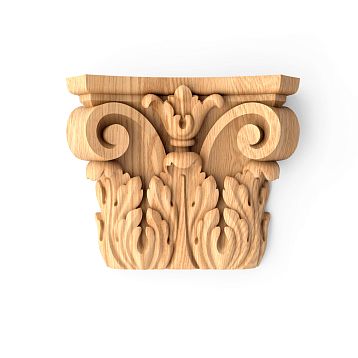
Decorative elements — solid wood overlays— wooden wall overlays for accent relief, corner zones, decorative inserts.
Moldings from solid wood— horizontal and vertical profile elements for creating wall belts and transition lines.
Crown Molding— solid wood ceiling cornices for the top line of the hallway. A neat cornice completes the wall system from above.
Baseboards — full section— expanded catalog of floor skirting boards made from various materials.
Polyurethane moldings— full range of polyurethane wall and ceiling decor.
Molded decor — overlays— wall-mounted molded elements for frames, accent zones, horizontal borders.
Polyurethane molding — trim— trim profile for creating wall frames and moldings from polyurethane.
Polyurethane decor — rosettes— point decorative elements: rosettes, corner inserts, central accents.
FAQ: Answers to Key Questions
Is MDF skirting board suitable for a hallway?
Yes, and excellently.MDF Skirting Board— one of the best options specifically for a hallway: durable, resistant to everyday contact, looks perfect under paint, holds its shape well under high traffic. For a hallway, a height of 80 mm or more is recommended.
How to use molding in a hallway without overloading it?
Thin profile, shallow relief depth (up to 14 mm), one or two frames maximum, only on an accent wall.Wall moldingsIn a hallway, it should create architecture, not cover all surfaces. The other walls are smooth.
What decorative elements are suitable for a passage zone?
Applieddecorative elementsWith slight relief, profile frames from trim, horizontal moldings. Important: the relief should not protrude more than 12 mm in the active contact zone (up to 140 cm from the floor).
How to connect MDF baseboard and wall relief?
A unified profile language: the baseboard and moldings should belong to the same stylistic group. Between the top edge of the baseboard and the bottom edge of the frame — a gap of 200–350 mm. The width of the frame profile is 1/4 to 1/3 of the baseboard height.
What is better for a hallway: just a baseboard or a baseboard with molding?
Depends on the task. If the hallway is a transit zone in a minimalist interior — a good baseboard is enough.MDF Skirting BoardsIf architectural expressiveness is needed — baseboard plus a frame onstucco decorationan accent wall. A combination is always richer than a single element.
How to make a hallway practical but not empty?
Three levels: MDF baseboard (base), horizontal molding (belt), frame or decorative element (accent). One level can be omitted — but a system of three components delivers maximum results.
Is polyurethane molding suitable for a hallway?
Yes.Polyurethane moldings— the optimal material for a hallway: not afraid of moisture, easy to clean, resistant to mechanical contact, doesn't crumble like plaster. At the same time, it provides the full visual effect of classic stucco decor.
How much relief is needed in a small hallway?
One decorative layer on one wall. More — risk of overload. Specifically: a frame made of linear profile with a height of 14 mm, placed on the end wall, occupying 70–75% of the wall area — the ideal volume of decor for a hallway 100 cm wide.
About the Company
To assemble a hallway with a proper base, precise relief, and cohesive architectural logic means having access to products made within a unified system and coordinated in profile, scale, and style.
STAVROS — manufacturer of decorative architectural products from solid wood and polyurethane: MDF baseboards, moldings, cornices, decorative elements, wall overlays, polyurethane stucco decor. Every item in the STAVROS catalog is developed with consideration for the interior's architectural logic — so that baseboard, molding, frame, and cornice don't just exist side by side but form a unified wall system. This is especially important for spaces like hallways — where every detail is on display and every mismatch is noticeable at first glance.