Article Contents:
- The significance of lines and proportions in interior design
- Golden ratio in proportions
- Visual axes of space
- Scale and proportionality of elements
- How to properly combine baseboards and vertical rails
- Principles of visual harmony
- Geometry of element junctions
- Rhythmic structures
- Corner solutions
- Color, material, texture: foundations of harmony
- Color coordination strategies
- Material Combinations
- Textural Solutions
- Installation: seamless joint
- Surface Preparation
- Joining technologies
- Corner joints
- Final finishing
- Examples of successful interior solutions
- Scandinavian minimalism
- Modern loft
- Classic elegance
- Eco-style with natural materials
- Japanese Minimalism
- Modern classicism
- Futuristic high-tech
- Conclusion
- Frequently Asked Questions
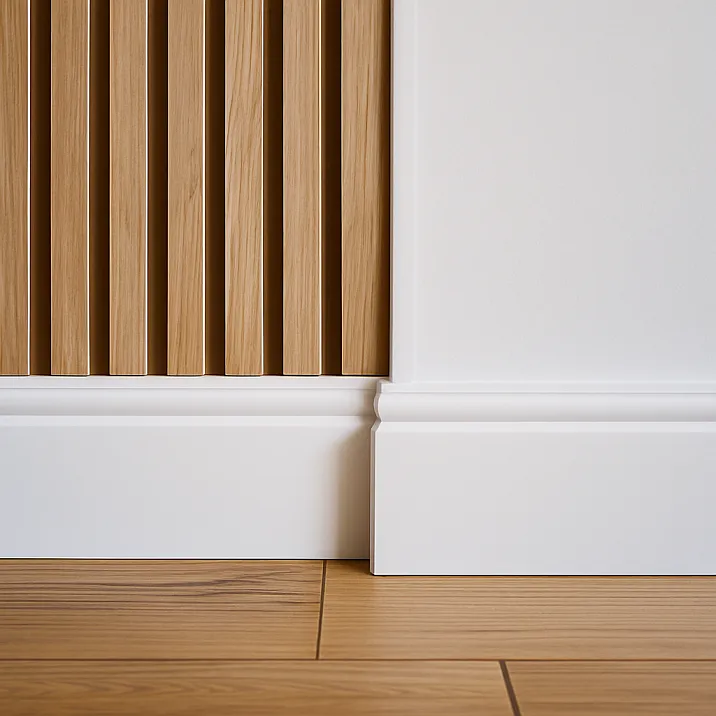
Architectural expressiveness of the interior arises from the precision of lines and thoughtful design of each element.Wooden baseboardandWooden rail 20x40— not merely functional finishing details, but geometric tools for forming the visual logic of space. Proper combination of horizontal and vertical lines creates a rhythm that structures the perception of the room and gives it completeness.


The significance of lines and proportions in interior design
The geometry of the interior is built on the interaction of horizontals and verticals.wooden baseboardforms a clear horizontal line separating the floor plane from the wall's vertical. This boundary is critically important for spatial perception — it visually grounds the interior, creating a sense of stability and completeness.Wooden planks for decorationform a vertical rhythm that controls the visual height of the room.




Golden ratio in proportions
Classical architecture uses mathematical proportions to create harmonious spaces.MDF skirting board 80— at a height of {count} millimeters, relates to ceiling height according to the golden ratio. At a standard ceiling height of 2.7 meters, a baseboard of such height creates a visually balanced proportion between the plinth and the main wall plane.Wide Wooden Skirting Board— enhances the significance of the lower zone, which is especially important in rooms with high ceilings.
Vertical rails create a modular grid on the wall.Wooden plank— with a width of 40 millimeters and gaps of 40–60 millimeters, forms a rhythm comfortable for perception. Too frequent a rhythm creates visual noise, too sparse a rhythm disrupts the composition’s integrity.wooden planks on the wall— are installed according to a module that is a multiple of the rail’s own width.
Our factory also produces:


The smooth surface reflects light, creating highlights on vertical surfaces. A brushed plank with a distinct ring texture absorbs light, forming a matte textured surface.
Each room has main and secondary visual axes.wooden skirting board purchaseIt should be a single color along the room's perimeter, creating a continuous horizontal line that unifies the space.Wooden boards in interiorThey accent the main wall, forming a vertical axis that draws the eye.
The intersections of vertical rails with the horizontal skirting create compositional focal points.with a classic profile creates a sense of solidity, reliability.It serves as a visual base for the vertical rails, creating a sense of constructive logic. The rails seem to grow out of the skirting, forming an organic connection between elements.
Get Consultation
Scale and Proportion of Elements
The size of details should correspond to the scale of the room.Baseboard MDFA height of 60-70 millimeters is suitable for small rooms with low ceilings.Wide wooden floor skirting boardA height of 100-120 millimeters is used in spacious rooms with ceilings higher than 3 meters, where small details would be lost in the overall volume.
Wooden rail 10x20It creates a delicate graphic structure, suitable for minimalist interiors.Wooden rail 20x40 buyIt is the optimal size for most living spaces, providing sufficient visual mass without overloading the composition.Wooden slats on the wallLarger sections are used in public spaces with increased volumes.
How to Properly Combine Skirting and Vertical Rails
Compositional unity between horizontal and vertical elements is achieved through consistency in materials, sizes, and finishing methods.Ceiling baseboard woodenThe ceiling and floor skirting should visually correspond with the rail constructions on the walls. Unity is achieved through repetition of profiles, textures, or color solutions.
Principles of Visual Harmony
The thickness of the rail should correspond to the thickness of the skirting.MDF Skirting BoardA thickness of 15-18 millimeters harmonizes withwooden plankA thickness of 15-25 millimeters. Too massive rails with a thin skirting create imbalance, making the skirting visually weak.Thickness of MDF skirting boardThe thickness of horizontal and vertical elements should be comparable.
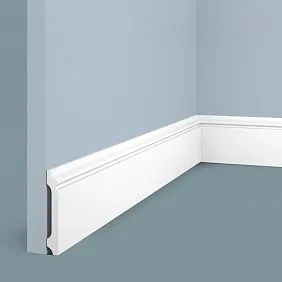
The skirting profile sets the stylistic tone for all trim elements.White Wooden BaseboardWith a classic profiled cross-section, it requires rails with beveled edges or rounded corners. A simple rectangularwooden baseboardcombines with minimalist rails without decorative treatment.
Geometry of Element Connections
The contact points between vertical rails and skirting require thoughtful solutions.Wooden planks for wall decorationThey may descend to floor level, overlapping the skirting, or terminate at the top edge of the skirting. The first option creates continuity of vertical lines, the second emphasizes constructive logic, where the skirting serves as a base for the rails.
Wooden planks on walls and in interiorsWith gaps, a decision must be made on how the skirting passes behind them. A solid skirting behind rail construction creates a background horizontal line. A broken skirting, repeating the rhythm of the rails, enhances the modularity of the composition.MDF Skirting Board BuyA single color matching the wall makes it invisible behind the rails.
Rhythmic structures
Alternating vertical rails create a rhythm that must align with the room's module.Price of wooden slatsIt depends on the cross-section, but when planning, the geometry of the composition is more important. Uniform rhythm creates a calm, regular structure. Variable rhythm with alternating narrow and wide gaps adds dynamism.
Finishing with wooden stripsIt can use a gradient rhythm - the gaps between rails gradually increase or decrease from one side of the wall to the other. This creates visual movement and controls the perception of space.wooden corniceAt the top of the wall, it can repeat the rhythm of the rails, forming a compositional frame.
Corner Solutions
Room corners - critical points where perpendicular planes meet.to buy MDF skirting boardPrecise corner alignment creates a continuous line along the perimeter.Wooden planks in interior designOn adjacent walls, they may continue through the corner, forming a single structure, or terminate at the wall edge, emphasizing the autonomy of each plane.
Wooden corner bracketIt can be used as a decorative element at the junction of rail compositions.Decorative wooden moldingsIn corners, they create a smooth transition between planes. Contrasting colors of corner elements highlight the geometry of the space.
Color, Material, Texture: Foundations of Harmony
Visual unity of the interior is built on the consistency of material characteristics of all elements.Wooden baseboardRails and planks from the same wood species create absolute texture harmony. Combining different materials requires careful work with color and texture to achieve balance.
Color Combination Strategies
Monochromatic solution uses a single color for all wooden elements.White MDF Skirting BoardIn combination with white rails, it blends into light walls, creating a delicate texture without color contrast.White wooden slatAnd the skirting board form a three-dimensional structure visible only due to the play of light and shadow.
Contrasting solution is built on the contrast between light and dark.Black MDF baseboardAgainst a light wall with dark vertical rails, it creates a graphic structure.MDF floor skirting board, whiteWith light rails on a dark wall - an inversion of the same approach.
Nuanced solution uses close shades of one color.MDF skirting board oakNatural tone combines withwooden railslighter oak. The difference in shade is visible but does not create a sharp contrast, forming a rich textural composition.
Material combinations
Combining solid wood and MDF ensures a balance of budget and aesthetics.Baseboard MDFIn the floor zone, where practicality and moisture resistance are important, it combines withas solid wood plankson walls where natural texture is valued.— is a horizontal element that frames the room at the bottom of the walls where the wall meets the floor. Skirting boards perform several functions: they hide the technological gap between the wall and floor covering (necessary for thermal expansion), protect the lower part of the wall from mechanical damage, create visual completion, and may conceal wiring.It allows for precise color matching with solid wood.
Wooden pine rail- an affordable option for vertical structures.Buy wooden skirting board in MoscowFrom harder species - oak, beech - ensures durability in areas of maximum mechanical stress. The combination of soft pine on walls and hard oak in skirting boards is rational from an operational standpoint.
Textural Solutions
Surface texture affects the visual perception of elements.Planed wooden stripA plank with similar treatment creates a unified texture.Floor wooden skirtingA plank with similar treatment creates a unified texture.
MDF skirting board 80 mmWith a laminated surface, it has a smooth uniform texture. Combined withwooden planks for decorationMade from solid wood, it creates a texture contrast - smooth artificial and living natural material. This contrast can be an artistic technique in modern eclectic interiors.
The gloss level of the finish also affects perception. A matte oil finish on planks creates a warm natural surface. A glossy lacquer adds a formal touch and suits classical interiors.Buy white MDF skirting boardIt can be painted with matte or glossy enamel depending on the desired effect.
Installation: joint without shadow
The quality of installation determines the final perception of the composition. Perfect joints, absence of gaps and gaps, precise geometry - signs of professional installation.Installation of MDF Skirting BoardThe installation of planks requires different technologies, but the general principle is flawless precision.
Surface preparation
The base surface must be perfectly flat.How to install MDF skirting boardTo a non-flat wall - compensate for irregularities with elastic adhesive or use mounting strips.Installing MDF skirting boardOn curved walls, gaps appear that are difficult to eliminate.
Buy oak wooden planks for wallsWood should be acclimated to room conditions. Wood should remain in the room for 2-3 days to adapt to temperature and humidity. This prevents deformation after installation.Mounting wooden slatsInstalling on wet wood causes warping.
Marking is done with maximum precision. A laser level ensures the parallelism of horizontal skirting lines.Wooden planks in interior designEach plank is marked with vertical control. Even a 1-2 millimeter deviation per meter height becomes noticeable.
Mounting technologies
MDF skirting board adhesiveIt should have high initial adhesion. Construction foam is unsuitable for this task - it expands and may deform the skirting board. Polymer adhesives such as liquid nails or special wood adhesives provide reliable fixation.How to glue MDF skirting boardApply adhesive in dots or zigzag pattern with a 30-40 cm spacing.
How to mount wooden rails to the wallThrough a hidden fastening system. Clamps are installed on mounting strips, planks snap into clamps without visible fasteners. This method ensures a clean facade without screws.MDF skirting board mountingOn clips, similarly - mounting strips on the wall, skirting board snaps into the strips.
Mechanical fastening with screws is used for massive elements.and paint it to the desired shade — standard practice in modern design. It is important to use special wood finishes that allow the material to breathe.Oak requires pre-drilling to avoid splitting. Screws are driven in, screw holes are filled and painted to match the wood tone.Wooden plank made by handInstalled with visible fasteners in loft interiors as a design technique.
Corner Joints
Accuracy of corner cuts is critical for appearance.Cutting MDF skirting boardIt is cut at 45 degrees using a panel saw.How to cut MDF skirting boardFor internal corners - both elements are cut at 45 degrees with the cut direction inward. For external corners - with the cut direction outward.
Polyurethane corner moldingsUsed as ready-made decorative elements for complex joints. They hide cutting inaccuracies and add decorative detail to corners.Join MDF skirting boardLonger planks are better joined with a beveled joint at an acute angle - such a connection is less noticeable than a straight joint.
Vertical planks in corners can be installed flush or with a small gap.decorative wooden rails on the wallAt the corner, either a tight joint or a symmetrical gap of 10–20 millimeters is formed, which becomes part of the rhythmic structure.Decorative wooden corner pieceCovers the internal angle between boards on adjacent walls.
Final finishing
Final finishing is performed after installation.How to cut MDF skirting boardFor trimming, a fine-toothed saw or jigsaw provides a clean cut. Joint areas are spackled with acrylic compounds and sanded after drying.MDF skirting board for painting, buyPrimed, simplifies final finishing.
Painting wooden railsApplied before or after installation, depending on the technology. Pre-painting ensures even coverage but requires careful handling during installation. Painting after installation allows hiding mounting points but is more complex to execute.Paintable MDF Floor Skirting BoardPainted with acrylic enamels in 2–3 layers.
Joint sealing between skirting board and wall is done with acrylic sealant. It fills micro-gaps and is painted together with the skirting board. Silicone sealants do not paint and are used only where painting is not required.White MDF Skirting BoardWith white acrylic sealant, creates a flawless joint.
Examples of successful interior design solutions
Practical implementations demonstrate diverse approaches to combining skirting boards and boards. Each solution is unique, but follows general principles of geometry and proportions.
Scandinavian minimalism
Light color palette with emphasis on natural materials.White MDF Skirting BoardAt 80 millimeters high around the room perimeter, creates a subtle boundary between white walls and light wooden floor.White Wooden PlankOn the accent wall behind the sofa, forms a textured surface barely noticeable due to monochromaticity.
Wooden boards 20x40Made from light birch with 50-millimeter gaps, creating a regular structure. Boards are painted with white matte enamel and almost blend into the wall, appearing only through play of light.MDF floor skirting board, whiteOf the same shade, completes the composition, creating a sense of lightness and airiness.
Modern loft
Contrasting graphic composition with industrial accents.Black MDF baseboardAt 100 millimeters high against gray concrete walls, creates a clear horizontal line.Wooden rails loftMade from untreated pine, preserving natural texture, mounted vertically with open fastening on black self-tapping screws.
Wooden plankTreated with dark oil, highlighting texture and protecting wood. Gaps between boards 80–100 millimeters create a sparse structure through which the texture of the concrete wall is visible.Wooden planks on walls and in interiorsDo not cover the entire surface, but only the central fragment, forming the compositional center.
Classic elegance
Rich composition using various architectural elements.Wide wooden floor skirting boardMade of oak, 120 millimeters high with a classic profile, serves as the visual foundation of the composition.Polyurethane moldings in interior designAt a height of 90 centimeters, form a panel structure on the wall.
Wooden planks for decorationUsed within panels, creating vertical rhythm within limited wall fragments.wooden corniceAt the top of the wall, completes the three-part composition — baseboard (skirting), main plane (panels with boards), frieze (cornice).Moldings decorationIn the form of rosettes and ornaments, complements the composition.
Eco-style with natural materials
Emphasis on naturalness and wood texture.Wooden baseboardmade of natural oak with a matte oil finish.wooden planks on the wallof the same species, but with a more pronounced texture due to brushing.
Finishing with wooden stripscovers the wall from floor to ceiling, creating a seamless wooden surface. Boards of varying widths — from 30 to 60 millimeters — alternate randomly, mimicking natural irregularity.Ceiling baseboard woodenof the same shade frames the composition from top to bottom, creating a wooden border from floor to ceiling.
Japanese minimalism
Strict geometry with emphasis on void and space.Hidden MDF skirting boardcreates a shadow gap between wall and floor without visible profile. The wall visually hovers above the floor.Wooden slats on the wallmade of dark wenge, installed with wide gaps of 150–200 millimeters.
Wooden rail 20x40creates thin vertical lines on a light wall. Gaps between boards are several times wider than the boards themselves, creating a sense of air and void.Wooden boards in interiordo not cover the entire wall, but form compositional fragments, leaving most of the wall empty.
Modern classic
Synthesis of classical proportions and modern materials.MDF skirting board 80is painted in a noble beige-gray shade.Moldings made of polyurethaneof the same color form framed compositions on the walls.
Wooden planks for wall decorationused within molding frames, creating contrast between smooth polyurethane frames and textured wooden fillers.Polyurethane decor for interiorsincludes sockets for chandeliers and decorative overlays that echo the vertical rhythm of the boards.Polyurethane moldingscreates rich ceiling molding.
Futuristic high-tech
Technological and non-standard solutions.Baseboard MDFwith built-in LED lighting creates a floating floor effect. Light from under the skirting board illuminates the lower wall zone.Wooden slats with backlightingmounted with clearance from the wall, behind which LED strips are hidden.
Wooden plankpainted in metallic silver, imitating aluminum profiles. The composition’s geometry is deliberately technological — boards of varying widths alternate in a precisely calculated order.Wall decoration with wooden slatscreates a three-dimensional panel whose visual texture changes depending on the angle of illumination.
Conclusion
Precision geometry in finishing is achieved through attention to detail at every stage — from design to final finishing.Wooden baseboardandWooden planks for decoration— not merely functional elements, but architectural tools for creating harmonious space.MDF skirting board 80ensures practicality and accessibility,Wooden rail 20x40creates an expressive vertical structure.
The correct combination of color, material, and texture forms visual unity. Precise installation ensures a flawless result without visible defects. The variety of stylistic solutions allows implementing any design concept — from Scandinavian minimalism to classic luxury.
STAVROS company offers a full range of skirting boards made of solid wood and MDF, decorative boards of various cross-sections, as well as a wide selection of polyurethane moldings for creating comprehensive interior solutions. High product quality, precise dimensions, and diverse finishing options enable implementing projects of any complexity and style. Professional consultation from specialists helps select the optimal combination of elements for a specific interior.
Frequently asked questions
How to calculate the optimal skirting board height for a specific room?
Skirting board height is determined by ceiling height — standard ratio 1:30 or 1:35. For a 2.7-meter ceiling, the optimal height isMDF baseboard 80millimeters. For high ceilings of 3-3.5 meters, useWide wooden floor skirting boardheight of 100-120 millimeters.
What distance between vertical rails is considered optimal?
The optimal distance equals the width of the rail or 1.5-2 times wider.Wooden rail 20x40A width of 40 millimeters combines with gaps of 40-80 millimeters. Wider gaps create a sparse structure, narrow gaps — a dense textured surface.
Can MDF skirting be combined with solid wood rails?
Combination is possible and is often used for budget optimization.Baseboard MDFpractical and affordable,Wooden planks for decorationsolid wood creates a natural texture on walls. Color coordination is achieved by staining MDF to match the solid wood.
Is there a need for a gap between vertical rails and skirting?
The gap is not mandatory, but can be used as a design element. Rails can extend to the floor, overlapping theWooden baseboardor end on the top surface of the skirting with a 2-3 millimeter gap. The second option emphasizes the constructive logic of the composition.
What is the most reliable and aesthetic method of attaching rails?
Hidden mounting through clips ensures a clean facade without visible fasteners.How to mount wooden rails to the wall— on mounting strips using special clips into which the rails snap. This allows for disassembly without damaging the elements.
Is additional treatment of wooden elements required after installation?
After installation, final finishing of joints and mounting points is required.Painting wooden railsIt can be done before or after installation. Mounting points are spackled and painted to match. Protective coating with varnish or oil is mandatory for longevity.
How to avoid gaps between skirting and uneven walls?
Gaps are compensated with elastic glue or acrylic sealant.How to glue MDF skirting boardTo uneven walls — apply thick glue that fills irregularities. After installation, the joint is treated with acrylic sealant for painting.
Can rails and skirting be used in rooms with high humidity?
Usage is possible with special treatment.Wooden planks in interior designbathrooms require moisture-resistant impregnation and water-resistant varnish.Baseboard MDFmust be moisture-resistant grade. Effective room ventilation is mandatory.