Article Contents:
- What is Wall Skirting and Why This Query is Broader Than It Seems
- Wall Decor: What People Choose Instead of 'Ordinary Skirting'
- Molding for Walls
- Wall moldings
- Slatted panels on the wall
- Decorative Profile for Zoning
- When Decorative Skirting is Exactly What Suits the Walls
- Frame Decor on the Wall
- Horizontal Wall Division
- Accent Wall
- Classical and Neoclassical Interior
- Designing Transitions Between Materials
- Wall Skirting or Molding: What to Choose and When
- When a strict linear profile works best
- When wall molding is the best choice
- When both tools are used together
- Wall skirting or slatted panels: an honest comparison
- Decorative wall profile
- Wall Slat Panels
- When slatted panels and moldings are combined
- Slatted panels with lighting: when wall decor reaches a new level
- How to choose a wall profile according to interior style
- Classic and neoclassic
- Modern Interior
- Bedroom
- Living Room
- Entry Hall
- Textures, combinations, and multi-layered decor: how not to get confused
- How not to make a mistake when choosing a decorative wall profile
- Error 1: confusing floor and wall scenarios
- Error 2: too bulky a profile for a small room
- Mistake 3: Mixing incompatible styles
- Error 4: ignoring slat panels where they are more appropriate
- Error 5: lack of systematic approach
- Error 6: incorrect mounting adhesive
- Where to buy decorative wall profile: from selection to result
- About the Company STAVROS
- FAQ: Answers to Popular Questions

When a person searches for 'wall skirting', they rarely mean the same thing as when searching for floor skirting. This query most often carries a completely different intent—a desire to decorate a wall, divide it vertically or horizontally, create frames, an accent zone, or decorative panels. These are tasks of wall decor, not installation technology.
Decorative wall profile—this is a separate area of interior design with its own logic, materials, and application scenarios. Molding, cornices, polyurethane overlays, slat panels—all are different tools for solving one task: making a wall expressive, organized, and stylistically complete.
In this article—an honest and professional breakdown: what iswall skirtingin the modern understanding, how it differs from stucco and moldings, when it is more appropriate to choose slatted panels and how to avoid typical mistakes when decorating walls with decorative profiles.




What is a wall skirting board and why this query is broader than it seems
Formally, a skirting board is a linear profile that decorates the joint of two planes. On the floor — the joint of the floor and the wall. On the ceiling — the joint of the wall and the ceiling. On the wall — it can be the joint of two zones, the boundary between a decorative panel and plain plaster, a horizontal break at half the wall height, a frame molding around a decorative field.
Exactly thereforewall skirting boardin the interior context — is a broad concept. It is understood as:
-
a horizontal profile that divides the wall into zones (plinth part, main field, frieze);
-
a frame molding that creates rectangular decorative fields on the wall;
-
a decorative transition between different finishing materials;
-
a finishing element of a decorative panel or slatted system.
None of these scenarios are about floor skirting boards. All of them are about wall decor, and they work completely differently.
When you understand this, the selection task becomes specific: which wall profile is needed, for what scenario, made of what material, in what style. Let's break it down in order.




Wall decor: what people choose instead of 'ordinary baseboard'
The wall is the largest surface in any room. And it is precisely this that defines the character of the interior. A properly finished wall with decorative profiles, moldings, or slatted panels is the foundation of any stylish space.
Our factory also produces:


Wall molding
wall molding— a classic tool of wall decor, dating back to ancient architecture. In modern interiors, it is primarily implemented through polyurethane products: overlays, moldings, decorative elements with floral and geometric motifs. Polyurethane accurately reproduces complex molded forms, is easily installed on any substrate, and takes paint well.
Wall molding— is always a decorative statement. It adds depth and relief, creates a play of shadow under directed lighting, and transforms a neutral plastered plane into an architecturally expressive surface.
Get Consultation
Wall moldings
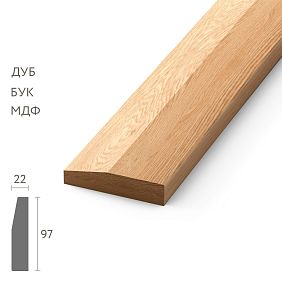
Molding is a linear profile with decorative relief, used for dividing a wall, creating frames, horizontal bands, or finishing decorative panels. Essentially, it is the 'baseboard for walls' in the strict architectural sense—only it's not located at the floor, but on a vertical plane.
Polyurethane wall decor— includes both linear moldings (sold by the linear meter and cut to the required length) and ready-made overlay elements—corner rosettes, decorative inserts, relief tiles. Together, they allow for creating complex decorative compositions on a wall without special construction skills.
Slatted wall panels
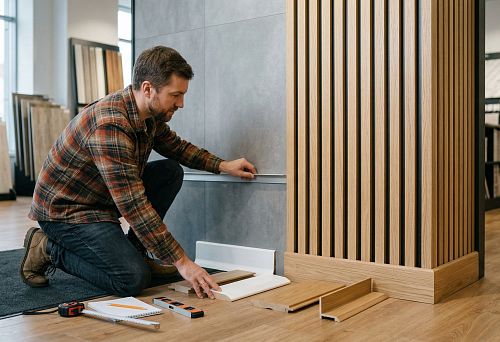
Slatted panel is a modern alternative to traditional wall profiles. Instead of the horizontal lines of moldings, it introduces a vertical rhythm into the interior: rows of parallel slats with equal spacing create a structured surface, which is perceived completely differently than smooth plaster.
buy slatted panels— today can be made from natural wood—oak, beech, ash—or from paintable MDF. These are different products with different aesthetics but the same function: to create an expressive, rhythmic surface on the wall.
Decorative profile for zoning
A horizontal profile at half the wall height is a popular classic technique. The wall is divided into two zones: the lower (baseboard panel, wood or stone finish) and the upper (plaster, paint, wallpaper). The border between them is decorated with molding or a horizontal belt profile. This is most often what is meant by 'wall baseboard.'
When a decorative baseboard is suitable for walls
There are specific scenarios where decorativewall skirting boardis the perfect solution. Let's examine each in detail.
Frame decoration on the wall
One of the most effective and yet inexpensive wall decor techniques is creating rectangular frames from moldings. On a neutral wall, a grid of rectangles is drawn, and linear profile is glued along their perimeter—and the wall transforms. This is exactly how walls were decorated in classic palace interiors of the 17th–19th centuries, and exactly how they are decorated today in neoclassical and classic residential interiors.
For frame decoration, a narrow smooth profile (20–30 mm) or classic molding with a simple relief is used. The height of the frames ranges from 400 to 800 mm depending on the room height. The distance between frames is usually 40–80 mm.
Horizontal division of the wall
A horizontal profile at a height of 90–100 cm from the floor is the classic 'wall baseboard' in its traditional application. It divides the wall into two zones and creates a horizontal line that visually organizes the space. The lower zone can be finished differently—with wooden panels, paint of a different tone, decorative plaster.
This solution is especially relevant for:
-
hallways and corridors where the lower part of the wall experiences constant mechanical stress;
-
dining rooms and living rooms in a classic style;
-
bedrooms with decorative headboards;
-
studies with wooden paneling.
Accent Wall
An accent wall is one wall in a room decorated differently from the others. This could be the wall behind the sofa in the living room, the wall behind the bed headboard in the bedroom, or the wall by the entrance door in the hallway.
Decorative wall skirtingin the form of moldings or overlay elements on an accent wall creates a focused visual effect: one wall is expressive, with relief and shadow play, while the others remain neutral. This technique delivers maximum decorative impact with minimal effort.
Classic and neoclassical interior
In classic style, wall decorative profile is not an option but part of the architectural language. Cornices, moldings, frames, friezes—all these are integral elements of a classic wall. Without them, a classic interior looks incomplete, no matter how expensive the furniture and finishes are.
Specifically for classic and neoclassical projectsMoldings decorationmade of polyurethane is the primary tool: a wide selection of profiles, accurate reproduction of classic forms, easy adhesive installation, and the ability to paint in any color.
Finishing transitions between materials
Where two different materials meet on a wall — tile and plaster, wood and drywall, wallpaper and paint — a decorative profile conceals the joint and makes it neat and intentional, not accidental. This is precisely the situation where wall molding serves both a technical and aesthetic function simultaneously.
Wall molding or decorative plasterwork: what to choose and when
This is a question that arises for most people who seriously engage in wall decoration. And the answer is not universal — it depends on the specific scenario.
When a strict linear profile works better
A strict straight or minimally profiled molding is a tool of geometry and order. It creates clear lines, horizontals, frames. Its strength lies in precision and neatness. It works well in:
-
contemporary and transitional interiors where decorative plasterwork would be excessive;
-
minimalist spaces where structure is needed without opulence;
-
functional zones — hallway, study, children's room.
When decorative plasterwork on the wall is the best choice
-
classical and neoclassical interiors, where relief decor is part of the architectural language;
-
formal spaces — living rooms, halls, dining rooms;
-
rooms with high ceilings, where neutral surfaces create a sense of emptiness;
-
projects with rich decorative context — expensive furniture, damask wallpaper, plaster ceiling cornice.
Molding adds depth and liveliness to the wall — that very feeling of a 'real interior' which cannot be created by any other method at comparable costs.Polyurethane wall decorfrom modern brands — this is an accurate reproduction of classical forms with the convenience of installation and painting.
When both tools are used together
In complex classical interiors, trim molding and plaster decor work in a system. Molding creates horizontal structure — frames, belts, division. Plaster elements — rosettes, cartouches, corner decorative details — place accents within this structure. This is precisely the logic that underlies professional classical interior design.
Wall skirting or paneling: an honest comparison
This comparison is especially important today, when slatted panels are experiencing a real surge in popularity. What's better — decorative molding or a slatted system? The answer: they solve different tasks, and the choice depends on the interior context.
Decorative wall molding
What it does: creates horizontal lines, frames, geometric surface structure. Works subtly, doesn't take up volume, conforms to the wall.
Best context: classic, neoclassical, historical styles, formal interiors, rooms with rich decorative context.
Scale of application: molding weighs grams, mounts on any flat surface, suitable for any room.
Wall Slatted Panels
What they do: create vertical rhythm, add volume and texture, form a three-dimensional structured surface. This is already full-fledged cladding, not decorative molding.
Best context: contemporary style, Scandinavian aesthetic, minimalism, loft, biophilic design with natural materials.
Scale of application: separate accent wall, area behind the sofa, wall behind the bed, hallway, workspace area.
Buy slatted wall panelsToday they can be made from different materials: oak slats on fabric backing, MDF slats on plywood, primed MDF slats for painting. Each option has its own aesthetic and its own area of application.
When slatted panels and moldings are combined
In mixed interiors that combine classical and contemporary elements, slatted panels and decorative moldings can work together. For example: a slatted panel on an accent wall, framed top and bottom with horizontal molding. Or a slatted system in a niche, framed with molding-based decorative trim.
Buy wall slatted panelsand complement them with a decorative profile around the perimeter—this is a solution that provides both a contemporary rhythm and classical neatness of boundaries. This is exactly what good designers do when working with spaces that don't fit into a single stylistic code.
An important practical detail:MDF wall slatted panels for painting—this is an especially flexible option. The primed surface accepts any acrylic enamel, allowing you to precisely match the color of the slatted system with the color of moldings, doors, and other wooden interior elements.
Slatted panels with lighting: when wall decor reaches a new level
Special attention deserveswall slatted panel with lighting. This is no longer just decor, but full-fledged light architecture: an LED strip integrated into the space between or behind the slats creates soft contour lighting that emphasizes the rhythm of the slatted system and adds depth to the surface.
This solution is especially relevant for:
-
accent wall behind the TV in the living room;
-
walls behind the headboard in the bedroom;
-
work area in a study or studio;
-
reception area in an office or commercial space.
The combination of a slatted panel with lighting and perimeter molding framing is a modern interpretation of the classic idea of a decorative wall panel, equally valued in residential and commercial projects.
How to choose a wall profile according to interior style
Choosing a decorative profile for walls is always a decision made within the context of a specific style. Let's examine the key stylistic scenarios.
Classicism and neoclassicism
A classic interior requires rich decoration with stucco profiles, frame moldings, and horizontal cornices.You can buy ready-made stucco matching the Baroque style. Calculate the quantity: linear meters of cornices and moldings, number of rosettes, pilasters, consoles, corner elements. Add a ten to fifteen percent allowance for trimming.for classic walls means achieving an accurate imitation of historical stucco with modern installation convenience.
Profiles for classic style: moldings with coves and fillets, frame profiles with pronounced relief, corner rosettes, cornices with meander or floral elements. White or ivory color on a neutral wall background is a classic solution.
Neoclassicism works more softly: the same frames and cornices, but the profiles are more concise, the decor is less saturated. White molding on a light gray or cream wall is neoclassicism in its modern interpretation.
Modern interior
In a modern interior, wall molding should be almost invisible—it creates structure without drawing attention. A smooth, straight profile 20–25 mm wide, white or matching the wall color—neat frames or horizontal divisions.
For a modern interior emphasizing natural materials and textures—buy MDF slatted wall panels—paintable or made of natural oak. A slatted system creates what no molding can—a lively vertical rhythm, a three-dimensional surface texture.
Bedroom
In the bedroom, wall decor should promote a sense of calm and coziness. Frame molding on the wall behind the bed is a classic solution that creates a 'headboard across the entire wall.' A slatted panel behind the bed is a modern interpretation of the same principle.
White wall molding for the bedroom—frame molding in white on a cream or gray-beige wall. The profile is delicate, 15–25 mm, with a slight relief. This is the most refined solution for a modern bedroom in a neoclassical spirit.
Living Room
In the living room, wall decor works more intensely—there is more space and more possibilities. The wall behind the sofa can be decorated with full-height frame moldings, a slatted panel with lighting, or a combination of a lower wooden panel with upper plasterwork.
Wall molding for the living room—in the classical sense—is a horizontal band at a height of 90–100 cm that divides the wall and creates a lower protective zone. Paired with frame decor above and a plaster ceiling cornice at the top—this is a complete classical wall system.
Entryway
In the hallway, wall molding serves a functional role—protecting the lower part of the wall from mechanical damage and dirt. A horizontal profile at a height of 90–100 cm divides the wall: below—more durable finishes (tile, wooden panel, painted MDF), above—regular plaster or wallpaper.
Wall molding for the hallwayas a finishing profile along the top edge of the lower panel — this is both a functional and aesthetically correct element. In modern hallways, it is often made from metal profile or wooden molding to match the door.
Textures, combinations, and multi-layered decor: how not to get confused
One of the most complex aspects of wall decor is combining different elements without visual chaos. How to combine slatted panels, moldings, stucco, and background finishes?
Slatted panel — texture, polyurethane molding, and texture combinations— this topic is covered in a separate article on the STAVROS website. But here are the key principles.
Principle of hierarchy. In a decorative system, there should be primary and secondary elements. Either focus on the slatted panel, with molding as its frame. Or focus on stucco overlays, with the slatted system as a background texture. Don't make everything equally loud.
Principle of color unity. If the moldings are white — the slats should also be white, or natural wood against a white background. Three different colors in the wall decor of a single room is already a visual conflict.
Principle of scale. Small slats (10–15 mm wide) pair well with thin molding. Wide slats (40–60 mm) require a larger, more expressive framing profile.
Principle of completeness. Every decorative element should have a beginning and an end. A slatted panel without top and bottom finishing looks incomplete. Molding frames without corner elements look sloppy. Completeness is a sign of professional work.
How to avoid mistakes when choosing decorative wall profiles
Mistakes when installing decorative wall profiles are not a disaster, but fixing them is often as labor-intensive as starting from scratch. Therefore, it's worth studying the list of typical miscalculations in advance.
Mistake 1: Confusing floor and wall scenarios
A floor skirting board is a completely different product, with a different profile and height. Attempting to use a floor skirting as a wall molding often results in a disproportionate, heavy look. Wall moldings are typically thinner and more delicate.
Mistake 2: Too massive a profile for a small room
In a 12 sq. m room with a 2.5-meter ceiling, a wide plaster molding of 80–100 mm around the perimeter of the walls creates a feeling of confinement and pressure. The scale of the profile should match the scale of the room. In small rooms, use delicate profiles of 20–35 mm.
Error 3: Mixing incompatible styles
Rich classical-style plasterwork on a wall with slatted panels in Scandinavian minimalist style is a stylistic contradiction that isn't 'read' as an authorial move but is perceived as a mistake. Decorative elements should speak the same language.
Mistake 4: Ignoring slatted panels where they are more appropriate
If a user is searching for 'wall skirting for a modern interior', the correct answer is often precisely a slatted panel, not a molding.catalog of slat panelsoffers dozens of options for different interior scenarios, and ignoring this tool when decorating modern walls means rejecting the best solution in favor of the familiar one.
Mistake 5: Lack of systematic approach
Molding on one wall, slat panel on another, clean plaster on a third, wallpaper on a fourth — this is not eclecticism, it's chaos. Wall decor must follow a single logic, even if different walls are designed differently.
Error 6: incorrect mounting adhesive
Polyurethane moldings and decorative elements are glued with special polyurethane or acrylic mounting adhesive. Silicone is not suitable — it does not provide a rigid connection. Regular PVA is not suitable — it does not hold on plaster and paint. The right adhesive is half the success of installation.
Where to buy decorative wall profile: from selection to result
Choosing a supplier for wall decor is a choice not only of product but also of expertise. Decorative wall profile requires an understanding of scale, style, and combination with other interior elements.
Buy wall skirting board— decorative moldings and decorative profiles made of polyurethane — are best purchased from a specialized manufacturer with a full catalog of wall profiles, the ability to select for a specific interior, and specialist consultation.
buy MDF slatted wall panelsor panels made of natural wood — from a manufacturer with its own production of trim and slat systems, which ensures product compatibility within a unified wooden interior system.
Important: when moldings and slat panels are purchased from the same manufacturer, you are guaranteed to get uniform toning, profile compatibility, and coordinated aesthetics. When purchasing from different suppliers, this is practically impossible to ensure.
Slat panels for walls — buywith delivery throughout Russia. Polyurethane wall moldings and stucco — also with delivery and professional packaging.
About the company STAVROS
STAVROS is a Russian manufacturer of wooden architectural millwork, slatted panels, and polyurethane decorative stucco for residential and commercial interiors. Founded in St. Petersburg in 2002.
Over more than twenty years of operation, STAVROS has completed projects at cultural heritage sites — the Konstantinovsky Palace in Strelna, the Hermitage, the Alexander Palace — and in hundreds of private residences across Russia. This is not a marketing story: it is the production biography of the company, where each project is a confirmed standard of quality.
STAVROS's production includes the full cycle of woodworking and polyurethane product manufacturing: chamber drying of raw materials to 8–12% moisture content, precise milling ±0.1 mm, final inspection of each batch. Showrooms in St. Petersburg and Moscow, partner programs for designers and architects, manufacturing of custom profiles according to individual drawings.
FAQ: Answers to popular questions
What is a wall skirting board?
It is a decorative millwork profile that is mounted on the vertical surface of a wall. Used for horizontal division of the wall, creating frame decoration, finishing transitions between different finishing materials, and completing decorative panels. Essentially — a molding in a wall application.
How does a wall skirting board differ from a molding?
Essentially, they are the same thing — a millwork profile on a wall. The difference is in terminology: 'wall skirting board' is a common household term, 'molding' is an architectural term for a decorative profile. In practice, a wall skirting board is often understood as a horizontal band at a certain height on the wall, while molding is any millwork profile with decorative relief.
What is better for a wall: stucco or a decorative profile?
It depends on the interior style. For classic, neoclassical, and formal spaces — polyurethane stucco with rich relief. For modern and transitional interiors — a smooth or minimally relieved decorative profile. In complex classical projects, both tools are used in a system.
What to choose: wall skirting or slatted panels?
They solve different tasks. Decorative molding creates a horizontal structure, frames, geometric order—it's a tool for classic and transitional styles. Slatted panels create a vertical rhythm and volumetric texture—it's a tool for modern design. In mixed interiors, they can be combined.
Where to buy decorative wall molding?
From a specialized manufacturer with a full range of wall moldings, stucco elements, and slatted panels. STAVROS offers both directions—polyurethane wall decor and wooden slatted panels—with delivery across all of Russia.
Where to buy slatted panels for walls?
The STAVROS catalog features slatted panels made from natural wood and paintable MDF for various interior scenarios. Delivery across all of Russia, specialist consultation on selection.
Is white wall skirting suitable for a modern interior?
Yes, white smooth molding is one of the most versatile options for modern and transitional interiors. It creates a neat framed structure on the wall without excessive decor. For maximum neutrality—match the wall color.
How to combine slatted panels and moldings on one wall?
The slatted panel occupies the main area of the wall, the molding frames its top and bottom edge—as a horizontal frame. It's important to maintain color unity: if the slats are white, the molding should also be white or matching in tone. The scale of the molding should correspond to the scale of the slatted system.