Article Contents:
- What is a Baseboard for Panels: Not to be Confused with Floor Baseboard
- Which Panels Need a Profile: Breakdown by Type
- MDF Wall Panels
- Decorative Wall Panels for Painting
- Slatted panels
- PVC Panels and Wet Rooms
- Combined Wall Solutions
- When to Use Baseboard for Panels and When Another Profile is Better
- Baseboard for Panels and Slat Panels: What to Choose and How to Combine
- When to Use a Profile and When to Use a Slatted Panel
- Slatted Panels as a Standalone Solution
- Slatted Panel for Walls: MDF as the Base
- Decorative Slatted Panels Made from Solid Wood
- How to Properly Combine Slatted Panels and Profiles in One Interior
- Painting-Ready Slatted Panels: Complete Color Freedom
- How to Choose a Profile to Match the Interior Style
- Classic and neoclassic
- Neoclassicism
- Modern minimalist interior
- Scandinavian Style
- Accent wall in the living room
- Bedroom: Panels at the Headboard
- Hallway: Functionality as a Priority
- Mistakes When Choosing a Profile for Panels
- First mistake: confusing floor skirting and wall profile
- Second mistake: too massive a profile for a thin slatted panel
- Third mistake: not considering panel thickness when choosing a profile
- Fourth mistake: ignoring slatted panels as an alternative
- Fifth mistake: different profiles on one panel wall
- Where to buy skirting for panels and slatted panels
- About the Company STAVROS
- FAQ: Answers to Popular Questions
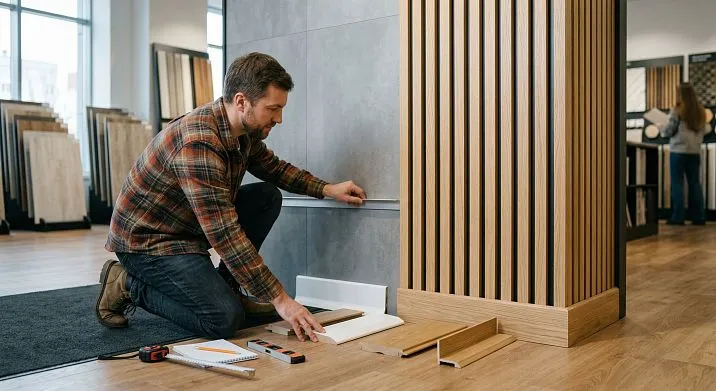
When walls are clad in panels, every designer, craftsman, or apartment owner faces the same question: how to finish this story at the bottom? What to do with the lower boundary of the panel wall? How to design the joint where the panel meets the floor, transitions into a corner, or ends an accent zone?
This is where the query 'skirting for panels' appears—and this is where most make the first mistake: confusing the classic floor skirting with the profile needed for working with wall panels. They are not the same. These are different tasks, different elements, different application logic—and different results.
Skirting for wall panels—is an applied decorative profile that solves four tasks simultaneously: covers the lower end of the panel, designs the joint with the wall and floor, creates a horizontal architectural accent, and maintains the visual boundary of the panel zone. When this profile is chosen correctly, the panel wall looks finished, substantial, and professionally executed. When chosen incorrectly, everything else loses meaning.
This article provides a complete breakdown of the topic: which profile is needed for different types of panels, when a plinth is appropriate, when a molding is, and when it's worth rethinking the task entirely and turning toslatted wall panelsas a more holistic solution. And — how to correctly combine all of this in one interior.


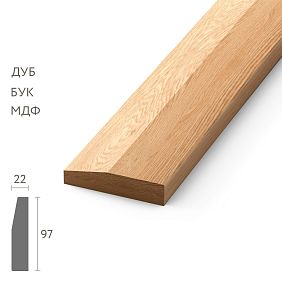


What is a panel plinth: not to be confused with floor plinth
Before moving further, it's necessary to distinguish the concepts. Because in the search query 'plinth for panels,' people are looking for completely different things — and only by understanding this can one give an accurate answer.
A floor plinth is a horizontal profile that covers the expansion gap between the floor and the wall. It is attached to the lower part of the wall and touches the floor. Its task is to technically close the gap and decoratively finish the floor.
A plinth for panels is a completely different story. It is a profile that works at the junction of a panel finishing element and the wall, floor, or ceiling. It can be:
-
a lower finishing profile for panel cladding at the floor;
-
an upper profile, covering the panel end at the ceiling;
-
a side joining element between the panel and the wall;
-
decorative frame around the panel area.
That is, a 'panel skirting board' in interior design terms is more of a system of finishing and joining profiles than a single specific element. And the first step in making the right choice is to understand exactly what task this profile should solve.
Another important shift: in modern interiors with decorative wall panels, a separate technical profile is increasingly being replaced by an organically integrated solid woodWooden baseboardas an independent lower decorative element that works together with the panel, rather than just covering its lower end. This is a fundamentally different approach — more design-oriented, more expensive in terms of the result.




Which panels need a profile: breakdown by type
Wall panels is a broad concept. It encompasses completely different materials with different structural features, and therefore — different requirements for the finishing profile.
Our factory also produces:


MDF wall panels
MDF panels are the most widespread segment of wall finishing in modern interiors. High-density board, smooth surface, good paintability. They are mounted either directly on the wall or on a frame.
For an MDF panel, the profile at the lower edge serves a dual function: it conceals the lower end (which is not always perfectly even) and creates a horizontal decorative boundary. Here, both a classic wooden or MDF floor skirting board and a special joining profile are appropriate, depending on the design solution.
The thickness of an MDF panel is usually 12–18 mm. This means the panel protrudes 12–18 mm from the wall plane. The profile must account for this: either overlap the panel's end or create a smooth transition from the panel to the floor.
For panelsMDF Skirting Boardat the lower edge — a logical paired solution: uniform material, uniform tint, uniform geometric precision.
Get Consultation
Decorative wall panels for painting
Panels for painting are primed MDF elements with various relief surfaces: panels, geometric patterns, ornaments. They are mounted on the wall and after installation are painted to match the wall color or in a contrasting tone.
For such panels, the profile at the lower edge must be for the same finish paint. Otherwise, the difference in surface texture will show through even under a layer of enamel. A beech wooden skirting board is the ideal choice: it takes paint just like MDF, but is more resistant to bending and mechanical impact.
Rack panels
This is a special case — and it has its own detailed section. Slatted panels create a vertical rhythm on the wall, and the profile at their lower edge should work within the logic of this rhythm, not conflict with it.
For slatted panels, a solid wood skirting board is not just a finishing element, but an organic continuation of the wooden wall theme. Especially when the slats are made of solid oak or beech, and the skirting board is from the same species with the same tint.
PVC panels and wet rooms
PVC panels are a separate category, primarily used in wet rooms: bathroom, toilet, balcony. Special PVC profiles are used for them: F-profile at the ceiling, J-profile at side joints, starter profile at the floor. A wooden skirting board is not advisable here — a wet environment is incompatible with natural wood without special protection.
Combined wall solutions
In modern interiors, multi-layered wall solutions are increasingly used: a lower panel zone + an upper zone with decorative plaster or paint. The profile separating these zones—molding, trim, or a special dividing baseboard—becomes the conceptual boundary of the wall.
For such solutionsWooden moldingor solid wood molding is the optimal choice. They create a clear horizontal boundary between zones, add texture to the surface, and integrate organically into the wooden decorative system of the interior.
When to use a baseboard for panels and when another profile is better
This is perhaps the most important question of the entire topic. And it requires a direct answer, not evasive 'it depends on the task'.
Baseboard—when you need a technical and decorative finish for the lower part of a panel wall at the floor. The baseboard works classically here: it covers the gap, creates a horizontal line, and protects the lower edge of the panel. The choice—wooden orMDF Skirting Board—is determined by style and durability requirements.
Molding—when you need to decoratively highlight the panel zone from above or the side, or to design the transition between two wall zones. Molding does not perform the technical function of covering a gap—it creates a decorative horizontal line or frame. In classic interiors, solid wood molding above the panel zone is a standard architectural technique.
Decorative profile—a highly specialized joining element, used when you need to precisely finish the edge of a panel when transitioning to a different material: tile, plaster, or another panel of a different thickness.
Trim—when you need a thin dividing line within a panel system or a framing element.Wooden moldingA 20–40 mm wide gap between two panel zones is a classic designer technique for creating a multi-level wall composition.
An extension element is for joining, not decoration. Its task is to cover the end and ensure abutment. In an interior project with a clean finish, using extension elements without decorative consideration is a mistake.
The conclusion here is simple: the more serious the interior project, the less appropriate technical profiles are as a final decorative solution. In a good project, every profile, every strip, every joint is thought out as part of a unified system.
Skirting for panels and slatted panels: what to choose and how to combine
This is the most substantial section of the article. Because the two topics — profiles for panels and slatted panels — intersect directly and require joint consideration.
When a profile is appropriate, and when a slatted panel is
The logic is simple.
If the task is to design a separate decorative element on the wall (a panel frame, an accent zone at the head of the bed, a pilaster, framing a niche), then profiles work: skirting at the bottom, molding at the top and sides, trim for internal frames.
If the task is to create a rhythmic, structured wall surface with a vertical linear pattern, then the best answer isbuy slatted panels. A slatted panel is already a ready-made rhythmic surface that does not need a complex system of framing.
If the goal is to create a multi-level wall with different zones and materials, the combination works: slatted panels as the main background + wooden baseboard at the bottom + molding as a zone boundary + cornice at the top. It is precisely such a system that gives an interior with a rich layer of architectural decor.
Slatted panels as a standalone solution
buy wall slat panels— this is not the purchase of a finishing material, it is the choice of an architectural solution. A slatted panel creates a vertical rhythm that:
-
visually structures the wall;
-
interacts with light, creating a play of light and shadow with side lighting;
-
adds depth and scale to the space;
-
works in a wide range of styles — from Scandinavian to classic.
Parallel slats of the same cross-section, fixed at equal intervals — the visual power of a slatted panel lies in this simple principle. The uniform rhythm calms the eye, organizes the space, and makes the wall 'speak' without excessive decorativeness.
Slatted panel for the wall: MDF as the base
Slatted wall panel— primed MDF — is the most popular solution for modern interiors. MDF slats with a density of 750–850 kg/m³ on a fabric or MDF backing, the primed surface is ready for any acrylic enamel.
This means: one slatted panel, one can of paint — and the wall gains an expressive texture in any color. White, gray, cream, dark blue, terracotta — the paintable slatted panel opens up endless customization possibilities.
The panel size usually allows for butt-joint installation — the slat spacing is uniform, the seam between two adjacent panels is invisible, and the surface appears as a single continuous field.
Decorative slatted panels made of solid wood
decorative slatted panelsmade of solid oak — this is the top category. Natural wood with a living grain texture, tinted with varnish or oil, a pronounced surface character.
Oak slatted panels combined with woodenwooden baseboardmade from the same wood species — this is the perfect wall system: slats create vertical rhythm, the baseboard maintains the lower horizontal line, and the material is uniform across the entire surface.
How to properly combine slatted panels and profiles in one interior
Practical scheme:
Option 1: Minimalist. Slatted panels from floor to ceiling without additional profiles. The lower edge is straight, a baseboard is not used as a separate element. Clean geometry, maximum conciseness.
Option 2: Accent zone. Slatted panels on part of the wall (e.g., from floor to a height of 120–150 cm). At the bottom — a wooden baseboard, at the top — a molding as a horizontal boundary. Profiles frame and define the panel area.
Option 3: Complete system. Slatted panels on the entire wall +wooden corniceat the top + wooden baseboard at the bottom + molding as a horizontal border at one-third height. This is the classic approach to wood wall cladding — rich, complete, architectural.
Painting-ready slatted panels: complete color freedom
It's worth dwelling separately on the topic of custom color — because it's precisely here that painting-ready slatted panels occupy a unique niche.
buy MDF slatted panelsPrimed finish means obtaining a surface ready for any paint. Acrylic enamel according to RAL, NCS, Pantone catalogs — any shade is reproduced on the fine-pored MDF surface without the substrate showing through.
This opens up a possibility unavailable when working with natural wood: exact color matching of panels with walls, doors, furniture. In a design project, this is often a fundamental requirement.
The skirting board for such panels is made from the same MDF for the same paint. Or a wooden beech skirting under enamel — a harder surface at the lower boundary where the load is higher. Both solutions are functional; the choice depends on priorities.
How to choose a profile to match the interior style
Classicism and neoclassicism
A classic interior requires a rich wooden system on the walls. The lower panel zone — wooden panels or MDF panels with relief for painting. Skirting — made of solid oak or beech, tall (100–120 mm), with an expressive classic profile. Above the panel zone — a molding from the same wood species.
This entire system works as a single organism only whenmoldings, cornices, and baseboardsmade from the same material, in the same finish, by one manufacturer. Only then does the interior resonate as a whole, not as a collection of random wooden details.
Neoclassicism
In neoclassicism — the same system, but softer. Decorative panels for painting in white or cream, beech skirting under white enamel, a thin molding as the upper boundary. Slatted panels in neoclassicism — acceptable if the slat profile is laconic and the color is neutral.
WoodenWooden moldingas an additional element of frame decor in neoclassicism — an excellent way to add volume to a wall without excessive decoration.
Modern minimalist interior
Here, slatted panels come into full force. Vertical rhythm of slats, monochrome painting, no unnecessary details. Skirting or profile at the lower boundary — minimal, smooth, in the color of the panels or floor.
Buy slatted wall panelsIn white or gray for painting—and the entire wall becomes a unified rhythmic field. This is modern, looks expensive, and is easily scalable.
Scandinavian style
Light slats made of natural wood or MDF in a natural tone, white beech baseboard, white walls. The natural warmth of wood in a neutral, cool context—the main visual technique of Scandinavian interior design.
Accent Wall in Living Room
In the living room, an accent wall with slatted panels is one of the most effective modern techniques. Behind the sofa or opposite it—a vertical rhythm of slats, accentuated by spot or track lighting.
The baseboard for such panels here is wooden, made of solid wood or beech for painting to match the slats. It serves as the lower frame of the accent zone without disrupting its rhythm.
Bedroom: panels at the headboard
A paneled wall at the head of the bed is a classic design solution that gives the bedroom a sense of an expensive interior. Slatted panels or MDF panels with relief, framed by moldings around the perimeter.
The lower profile of such a zone is not exactly a baseboard in the traditional sense: it is more of a frame-like lower molding that separates the paneled zone from the lower part of the wall. Wooden trim or a thin molding made of solid wood is the right choice.
Hallway: functionality as a priority
The hallway—maximum load. Wall panels here must be on the lower part of the wall—they protect the wall from damage when people, furniture, or shoes pass by.
The baseboard for panels in the hallway should be hard, with a lacquered finish, a smooth profile for easy cleaning. Wooden, made of oak with lacquer—the best choice. Slatted panels in the hallway are acceptable, but only with a lacquered or oil-wax finish and a mandatory lower protective zone made of a harder material.
Errors in choosing profiles for panels
First error: confusing floor skirting and wall profile
Floor skirting and wall panel profiles are different elements with different tasks. Floor skirting closes the gap between the floor and the wall. A wall profile finishes the panel structure. When they are confused, either a double element occurs (both skirting and profile at the lower edge of the panel), or a technical solution replaces a design one.
Rule: if panels run from the floor — the skirting covers the lower end of the panel and simultaneously performs its classic function. If panels start above the floor — the skirting at the lower part of the wall and the profile at the lower edge of the panel are two different elements.
Second error: too massive a profile for a thin slatted panel
A slatted panel creates a light vertical rhythm. A heavy, massive 150 mm skirting with a rich classic profile at the bottom destroys this rhythm. The profile must match the visual 'weight' of the panels. Light slats — light or medium skirting. Heavy classic panel — rich, deep profile.
Third error: not considering panel thickness when choosing a profile
If the panel protrudes 15–18 mm above the wall plane, and the skirting is attached to the wall without considering this protrusion — a step or gap forms at the lower edge of the panel. The profile must either overlap the lower end of the panel or be attached so as to smoothly transition from the panel plane to the floor.
Fourth error: ignoring slatted panels as an alternative
When a person searches for 'skirting for panels', they sometimes actually want a beautiful structured wall. And in this case, the answer is —Buy slatted panels for wallsrather than selecting profiles for other panels. A slat system is a complete, ready-made solution that inherently creates an expressive wall.
Mistake five: different profiles on one paneled wall
The top profile made of one material, the bottom of another, and the side joints of a third—this is a typical sign of buying 'one by one,' without a systematic approach. The profile system for a paneled wall should be made of the same material, in the same finish, from one manufacturer.
Where to buy baseboards for panels and slat panels
Buy baseboards for panelsas a separate element can be purchased from a specialized manufacturer of profile decor. But it's more correct to consider it in the context of the entire wooden interior finishing system.
If the interior has slat panels—the baseboard, moldings, and cornices should be made from the same wood species and finish. Only then does the system work as a unified whole.
For those seeking not just a finishing profile, but a full decorative solution for the wall,catalog of slat panelsoffers a wide selection: MDF panels primed for painting, solid oak panels in various finishes, with different rhythmic spacing of slats.
How to correctly calculate the volume:
-
area of the panel wall in sq. m + 10% cutting allowance;
-
perimeter of the panel zone for profiles — taking into account corners and joints;
-
for panels in niches and behind furniture — full volume without deductions (cutting will still require allowance).
Important practical point: before purchasing, order samples of the skirting board and slatted panels, compare them side by side under the actual lighting of the room. Tones in the catalog and in real life under different lighting may differ — a sample at the installation point is the only reliable check.
About the company STAVROS
STAVROS — Russian manufacturer of wooden architectural moldings and decorative panels made of solid oak and beech. Founded in St. Petersburg in 2002.
Over more than two decades, STAVROS has evolved from producing standard moldings to becoming a supplier of architectural wood systems for federal-level projects. The Konstantinovsky Palace in Strelna, the Alexander Palace, the State Hermitage Museum — each of these projects required precision at the level of ±0.1 mm, uniformity of toning in large volumes, and complete reproducibility of profiles for reorders.
STAVROS's own production — full cycle: chamber drying of raw materials to 8–12% moisture content, precision milling, multi-stage quality control. Slatted panels made of MDF and solid oak, wooden skirting boards, moldings, cornices, trims — everything is produced at one enterprise, from the same raw materials, with a single quality standard.
Showrooms in St. Petersburg and Moscow. Partner program for designers and architects. Manufacturing of custom profiles according to individual drawings. Delivery throughout Russia.
FAQ: Answers to popular questions
What is a skirting board for panels?
This is a decorative profile that finishes the lower edge of wall panels, covers the end, and creates a horizontal architectural line at the base of the panel zone. Depending on the type of panels, it can be a classic floor skirting board, a joining profile, or a special frame molding.
How does a panel skirting board differ from molding?
A skirting board covers the bottom edge of the panel and the gap between the panel and the floor—this serves both a technical and decorative function. Molding is purely a decorative horizontal element that marks zone boundaries, creates a frame, or adds texture to the wall. Molding does not serve the function of closing gaps.
What is better: panel trim or slatted panels?
These are different tasks. Panel trim finishes a separate decorative wall element. Slatted panels are an independent solution for a structured wall. If you need a beautiful rhythmic wall—buy slatted panels. If you need to finish the joint of already installed panels—you need trim. In serious projects, both elements are used together.
Где купить реечные панели для стен?
In the STAVROS catalog—a wide selection of slatted panels made from primed MDF for painting and solid oak in various finishes. Order online, delivery throughout Russia.
Which trim to choose for MDF panels?
Beech wooden skirting board is the optimal choice: harder than MDF, accepts painting, durable in the lower edge zone of the wall. For white interiors—beech under white enamel. For natural finishes—beech in the tone of the panels or oak for a rich interior.
Can wooden skirting board be used with slatted MDF panels?
Yes, and it is one of the best combinations. A solid wood skirting board at the lower edge of MDF slatted panels creates a pleasant contrast of materials: the lightness of the slats is complemented by the weightiness of natural wood at the bottom. When painting the panels white—a beech skirting board under the same enamel creates a monochrome system.
Is a special profile needed between the slatted panel and the ceiling?
Depends on the design solution. If the slatted panels run from floor to ceiling, the top end is either covered with a ceiling skirting board or left open with a precise cut. If the panels end below the ceiling, the upper border is finished with molding or a horizontal batten.