Article Contents:
- Which Baseboard is Suitable for Laminate
- Three Key Guidelines for Selection
- What is Important During Installation with Laminate
- MDF Baseboard for Laminate: When It's the Best Option
- When MDF is the Optimal Choice
- Technical Parameters of MDF Baseboard
- Wooden Baseboard for Laminate: Where It Excels
- When a Wooden Baseboard is the Right Solution
- Which Wood Species are Suitable for Baseboard Under Laminate
- Polyurethane and duropolymer for laminate: when it makes sense
- Polyurethane skirting board
- Duropolymer
- How to choose a skirting board color to match laminate
- Baseboard matching floor color
- White skirting board for laminate
- Gray and dark skirting board for laminate
- Skirting board matching door color
- Complex laminate and mismatch with doors
- How to choose height and profile of skirting board for laminate
- Skirting board height: proportion table
- Tall and wide skirting board for laminate
- Straight profile and modern minimalism
- Baseboard with cable channel
- Hidden skirting board for laminate
- What is better for laminate: MDF, wood or polyurethane
- How to buy skirting board for laminate and not make a mistake: step-by-step algorithm
- Step 1: Determine the height to the ceiling of the room
- Step 2: Choose the material
- Step 3: Decide on a color strategy
- Step 4: Clarify the constructive profile
- Step 5: Calculate the linear footage with a margin
- Step 6: Purchase from the same batch
- Step 7: Choose a manufacturer with a full range
- Nuances of installing skirting boards with laminate flooring
- The gap rule
- Attach to the wall, not the floor
- Angle cutting
- Joining planks lengthwise
- About the Company STAVROS
- FAQ: answers to the most common questions

The laminate is laid. The joints are even, the floating floor settled beautifully, the surface pleases the eye. And now — the final touch, without which the interior remains unfinished, like a book without its last page. The skirting board. It might seem like a small detail. But this is where many make a mistake: they take the first thing they find, without matching it to the floor, walls, doors, or the room's style — and in the end, the skirting board sticks out like a foreign object in a carefully thought-out space.
Properskirting board for laminate— it's not just about 'covering a gap'. It's the final architectural element that connects the floor to the wall, completes the room's horizontal line, and works in tandem with doors and architraves. Chosen correctly, it becomes invisible — in a good way: it fits organically into the interior, and its absence is unimaginable. Chosen incorrectly — it catches your eye every day.
This article covers everything you need to know when choosing a floor skirting board for laminate: which material to prefer, how to select the height and color, when to choose wood, and when MDF or polyurethane, and how to buy a skirting board for laminate so you won't regret your choice later.




Which skirting board is suitable for laminate
The first question that starts any selection: what kind of baseboard is even compatible with laminate? The answer here is not straightforward — because laminate is used today in a wide variety of interior contexts: from a budget apartment to an expensive designer project.




Three main guidelines for selection
Baseboard material — determines durability, appearance, customization options, and cost. Main options: wood (solid), MDF, polyurethane, duropolymer.
Profile height — is chosen according to ceiling height. Incorrect height either 'crushes' the space or looks disproportionate.
Color and finish — are determined by the overall color logic of the interior: baseboard matching the floor, matching the wall, or a deliberate contrast.
For laminate, as a rule, one selectsskirting board for laminatetaking into account the pattern and shade of the surface. Modern laminate most often imitates wood — oak, ash, walnut, pine. And that is precisely why wooden and MDF baseboards work best here: they reproduce the same material logic as the floor itself.
Our factory also produces:


What is important when installing with laminate
Laminate is a 'floating' covering. It is not glued to the subfloor but laid freely and expands with changes in temperature and humidity. A deformation gap of 10–12 mm is mandatory between the covering and the wall. It is this gap that the baseboard covers.
A fundamental point: the baseboard with laminate is attached to the wall, not to the floor. This is not a slip of the tongue or a minor detail — it is a requirement, the violation of which blocks the free movement of the laminate and ultimately leads to deformation of the covering. The lower edge of the baseboard should only lightly touch the surface of the laminate or have a gap of 3–5 mm — but not press on it or fix it.
That's why when choosing a floor skirting board for laminate, not only aesthetics matter but also the profile geometry: flexibility of the lower edge, skirting thickness, and the mounting method.
Get Consultation
MDF Skirting for Laminate: When It's the Best Option
MDF skirting is the most common choice for laminate in modern residential interiors. Why? Because it has exactly the properties most often expected from skirting in an apartment with laminate: precise geometry, a good surface for painting or laminating, and an acceptable price.
When MDF is the optimal choice
The first scenario is a white modern interior.A white MDF baseboard creates visual continuity with white door casings, white ceiling cornices, and white window frames. When all architectural details are executed in the same color, they form a unified system, a spatial framework that connects disparate elements — floor, walls, ceiling, furniture — into an integral composition. This technique is fundamental to Scandinavian design, where white architectural decor creates a light shell within which the most diverse colors and textures can coexist.Paired with light laminate in ash or natural oak, this is pure Scandinavian aesthetics. The floor is light, the walls are white, the skirting is white: the room's horizontal line 'dissolves,' making the space feel airier.
The second scenario is paintable skirting. When you need an exact color in a specific RAL or NCS shade, only primed— is a horizontal element that frames the room at the bottom of the walls where the wall meets the floor. Skirting boards perform several functions: they hide the technological gap between the wall and floor covering (necessary for thermal expansion), protect the lower part of the wall from mechanical damage, create visual completion, and may conceal wiring.allows for customization without compromises. MDF perfectly accepts acrylic enamel: the surface is smooth, without texture showing through.
The third scenario is modern minimalism with a straight profile. A straight MDF skirting without relief is a clean rectangular plank. It is precisely what fits in a loft, Scandinavian style, or modern interior with laminate mimicking concrete or dark oak.
Technical Parameters of MDF Skirting
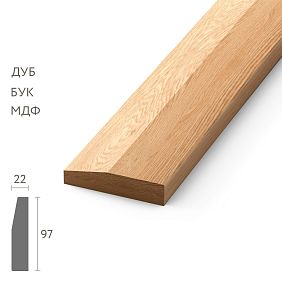
Density of MDF for skirting is from 750 kg/m³. Lower density means the end is not resistant to mechanical loads. Thickness is 14–16 mm. Length of a standard plank is 2400 mm.
Important nuance: MDF skirting board ends are sensitive to moisture. With regular direct wetting (e.g., in a hallway with wet shoes or by the entrance door), an unprotected end begins to swell. Therefore, in such areas, it's better to additionally seal the ends during installation.
For comparisonMDF and other skirting board materials— is a separate detailed topic that deserves a thorough breakdown. Briefly: MDF wins over polystyrene in strength and over duropolymer in price with a comparable visual result in dry rooms.
Complete guide toMDF skirting board sizes— with tables, parameters, and recommendations — is available on the website.
Wooden skirting board for laminate: where it excels
WoodenSkirting made of solid woodfor laminate — a choice that seems excessive to many. "Why expensive wood for laminate?" But that's the wrong way to frame the question.
When a wooden skirting board is the right solution
Wooden baseboard for laminate is justified in several situations.
High-budget interior with premium laminate. Laminate of class 33–34 with a thickness of 10–12 mm and a texture mimicking natural oak looks convincing — but only when accompanied by genuine materials. An MDF baseboard next to such flooring looks dissonant upon closer inspection. A wooden baseboard made of beech or oak is organic.
Interior with wooden doors and trims. When a room features natural wood — doors, frames, trims — a wooden baseboard in a matching tone completes the unified wooden system. MDF here will look like a substitute, not as part of the system.
Classical and neoclassical interior. The complex profile of a baseboard with figured reliefs is organically reproduced precisely in natural wood. MDF allows for similar milling, but the feel of the material is different.
Long-term renovation. A wooden baseboard, with proper care, lasts 30–50 years. MDF — 10–15 years. If the renovation is done 'for a lifetime' — wood pays for itself.
Which types of wood are suitable for baseboards under laminate
Beech — dense, hard, takes staining well. Will give a clean result under any color — from white to dark mocha. Oak — pronounced texture, noble grain pattern, excellent durability. Most visually neutral to most laminates with wood imitation. Pine — softer, cheaper, but less resistant to mechanical impacts.
with a classic profile creates a sense of solidity, reliability.made of beech or oak — this is a story about a material with character, which over the years does not lose but gains. Staining with oil or stain emphasizes the texture, and restoration is possible even after 20 years — something that cannot be said about MDF or polyurethane.
In addition to baseboards, for systemic wooden finishing, it is worth considering alsoPogonazh iz massiva— moldings, cornices, trims — all from the same wood species, in the same stain.
Polyurethane and duropolymer for laminate: when it makes sense
Polyurethane and duropolymer skirting boards - a category that is often either ignored or overestimated. Let's break it down honestly.
Polyurethane skirting board
Polyurethane molding— a lightweight synthetic material with good moisture resistance. The main advantage compared to MDF: it is not afraid of moisture on the ends and can be used in more demanding conditions.
For laminate floors in ordinary living spaces, polyurethane skirting board is a reasonable choice if:
-
the room has high humidity (hallway, kitchen);
-
you need a skirting board for painting in a complex shape - polyurethane mills well;
-
the budget is average, but you want a more durable result than MDF.
Limitation: under strong mechanical impact - table corners, chair legs - polyurethane can deform. Not critical, but noticeable.
Duropolymer
Duropolymer skirting board for laminate - a choice for wet areas or for rooms with uneven walls. The flexibility of duropolymer allows you to press the skirting board tightly against an uneven surface without gaps. Moisture resistance is excellent.
Limitation: the price of durapolymer is usually higher than MDF for a similar visual result in dry rooms. And if precise RAL painting is needed — the surface accepts paint less predictably than MDF.
Comparative breakdownof polystyrene, durapolymer and MDFwill help finally set priorities for a specific task.
How to match skirting board color to laminate
Color is the most subjective, yet the most noticeable parameter. A mistake here is immediately visible. Let's examine effective color strategies.
Baseboard in floor tone
Skirting board matching the laminate color — a classic strategy where the lower boundary of the wall 'merges' with the floor. The eye perceives the space as a single mass — the floor continues into the skirting without interruption.
This works when the laminate is neutral: light oak, ash, beige, gray. A skirting board of the same shade creates a calm, uniform lower tier.
When choosing a wooden skirting board for laminate with wood imitation: the skirting's tint should match not the laminate pattern (they will never match exactly), but the overall tone — light, medium, or dark.
White skirting board for laminate
A white MDF baseboard creates visual continuity with white door casings, white ceiling cornices, and white window frames. When all architectural details are executed in the same color, they form a unified system, a spatial framework that connects disparate elements — floor, walls, ceiling, furniture — into an integral composition. This technique is fundamental to Scandinavian design, where white architectural decor creates a light shell within which the most diverse colors and textures can coexist.— a universal and currently the most popular solution. It suits almost any laminate and any wall color. White skirting on a white wall — the horizontal line 'disappears.' White skirting on a colored wall — a clear, light boundary that enlivens and structures.
With light ash laminate — white skirting creates an airy feel. With dark wenge or dark oak laminate — white skirting becomes an intentional contrast, a classic interior design technique.
Gray and dark skirting for laminate
Gray skirting — relevant for laminate under concrete or gray oak. Dark skirting with light laminate — a bold designer move that works in modern conceptual interiors: light floor, dark skirting, neutral walls — the space gains a clear lower 'anchor.'
Skirting in the color of the doors
One of the most competent professional approaches is to orient the skirting color not to the floor, but to the doors and trims. The logic: skirting and trim are horizontal and vertical profiles of the same system, and their coordination creates a sense of a full-fledged architectural interior.
For white doors — white skirting. For oak doors — skirting in the tone of oak. For dark doors — dark or neutral skirting.
This rule works withsolid wood moldings: when the entire system — skirting, trim, cornice — is made from the same wood species in the same tint, the interior achieves a coherence that cannot be created by random selection.
Complex laminate and mismatch with doors
What to do if the laminate is one color and the doors are another? This is a common situation. Solution:
-
A skirting board in a neutral tone between the floor and doors (for example, both are brown shades of different saturation, the skirting board is a medium tone);
-
White skirting board as a reconciling neutral;
-
Skirting board matching the wall color — the horizontal line 'disappears,' and the coordination issue is resolved.
How to choose the height and profile of a skirting board for laminate
Skirting board height: proportion table
Incorrect skirting board height is the first visual mistake in renovation. Too high a skirting board in a low room 'lowers' the ceiling and weighs down the space. Too low in a high room looks accidental and unnoticeable.
| Ceiling Height | Recommended skirting board height |
|---|---|
| Up to 2.5 m | 50–65 mm |
| 2.5–2.7 m | 65–80 mm |
| 2.7–3.0 m | 80–100 mm |
| 3.0–3.5 m | 100–120 mm |
| over 3.5 m | from 120 mm |
Detailed breakdown onMDF skirting board height— taking into account the features of Moscow apartments and country houses — on the STAVROS website.
Tall and wide laminate skirting board
A tall laminate skirting board (from 100 mm) is already an architectural element. It creates a distinct horizontal line and scales the room. In interiors with oak-look laminate and wooden doors, a tall solid wood skirting board enhances the feeling of a rich material solution.
A wide skirting board (from 120 mm) is suitable in rooms with ceilings from 3 meters. In open-plan studios, in living rooms with high ceilings, a wide profile anchors the lower tier of the space.
Straight profile and contemporary minimalism
A straight skirting board without relief—a rectangular profile with clean planes—is the perfect choice for a contemporary interior. Loft, Scandinavian style, Japanese minimalism—anywhere without decorative embellishments. A straightMDF laminate skirting boardlooks laconic and does not visually overload the space with details.
Requirement: a straight profile is merciless to uneven walls. The slightest gap at a straight plank is immediately visible. For uneven walls, a profile with a soft edge or rounded base is better.
Baseboard with cable channel
A laminate skirting board with a cable channel is a functional solution when hidden wiring is needed without chasing walls. LED furniture lighting, socket lines, internet cable—all of this can be hidden in a closed channel under a decorative cover.
Typical channel size is 20×12 mm, which is enough for 2–3 cables of 1.5–2.5 mm². It is installed the same way as a regular skirting board—to the wall, independently of the laminate.
Hidden skirting board for laminate
Hidden (shadow) skirting creates a 'floating wall' effect: a shadow gap between the wall and floor, making the wall visually not touch the floor. A modern and striking technique. Requires perfectly even walls and quality installation — otherwise, imperfections are especially noticeable.
What is better for laminate: MDF, wood, or polyurethane
The most common question when choosing a skirting board. The honest answer — there is no universally best material. There is the best for a specific task.
| Criterion | MDF | Wood (solid wood) | Polyurethane | Duropolymer |
|---|---|---|---|---|
| Price | Medium | Above average | Medium | High |
| For painting | Excellent | Excellent | Good | Good |
| Moisture resistance | Medium | Depends on coating | High | High |
| Strength | Medium | High | Medium | High |
| Durability | 10–15 years | 30–50 years | 10–20 years | 15–25 years |
| Restoration | Impossible | Yes | No | No |
| Complex terrain | Yes | Yes | Yes | Yes |
| For laminate | Excellent | Excellent (for premium) | Good | Good |
Conclusion for most situations:
-
Standard apartment with 31–32 class laminate → white MDF skirting or paintable. Optimal price/result ratio.
-
Apartment with 33–34 class laminate and wooden doors → solid wood skirting. Systematic approach.
-
Kitchen, hallway, high-humidity room → duropolymer or polyurethane. Moisture resistance is more important than the aesthetics of natural wood.
-
Designer project with precise color solutions → paintable MDF by RAL. Maximum customization.
Detailed breakdown on the topicof installation and selection of MDF skirting— considering room types, mounting methods, and practical nuances — in a separate article.
How to buy laminate skirting boards without mistakes: a step-by-step algorithm
Buying skirting boards is a chain of related decisions. An error in one link leads to an incorrect result in the end.
Step 1: Determine the height relative to the room's ceiling
Measure the actual ceiling height in each room. Choose the skirting board height according to the proportional table above. If there are several adjacent rooms with different ceilings — choose a uniform height for the entire apartment based on the most common ceiling.
Step 2: Choose the material
Ask yourself three questions:
-
What class of laminate and how long is the renovation planned for?
-
Are there wooden doors and architraves in the room?
-
Нужна ли кастомная покраска под конкретный цвет?
Answers to these three questions already narrow the choice down to one or two options.
Step 3: Decide on a color strategy
Choose one of the approaches:
-
baseboard matching the floor tone;
-
white baseboard as a neutral;
-
baseboard matching the doors and trims;
-
contrasting baseboard as a design accent.
Order samples and compare them with the actual flooring under natural daylight in your space — not in the store under fluorescent lighting.
Step 4: Specify the structural profile
Straight or with relief? With cable channel or without? Flexible soft edge or rigid? The answers depend on wall evenness and the interior design style.
Step 5: Calculate the linear footage with a margin
The formula is simple: perimeter of the room in meters minus the total width of door openings × 1.10 (10% allowance for cutting and mitering). For a 4×5 m room with one 90 cm door: (18 − 0.9) × 1.1 = 18.81 linear meters — order 20 m.
Step 6: Purchase from a single batch
Different batches of MDF skirting boards in the same color may have a slight color shift. Order the entire volume at once — with a 15% surplus for future reorders in case of damage during installation or future replacement.
Step 7: Choose a manufacturer with a full range
Buy skirting board for laminateis better from a manufacturer who:
-
offers wooden and MDF skirting boards in a unified stylistic line;
-
coordinates the skirting board with architraves, moldings, and cornices from the same system;
-
ensures color and geometry consistency within a batch;
-
has samples for comparison with the actual flooring.
Nuances of Installing Skirting Boards on Laminate
Knowing a few installation principles will prevent mistakes even experienced professionals make.
The Gap Rule
Leave a 3–5 mm gap between the bottom edge of the skirting board and the laminate surface. Laminate expands with heat and moisture—it must move freely.
How to control it: during installation, place 3–4 mm spacer wedges under the skirting board—and remove them after fixing. The gap will remain automatically.
Attach to the Wall, Not the Floor
The skirting board is fixed to the wall with dowels through a mounting strip or liquid nails—but never to the laminate or floor base. This rule is broken more often than you might think.
Cutting Angles
Internal corners—45° or butt-jointed (by trimming in place). External corners—45° with a mirrored cut. For MDF skirting—use a miter saw or miter box with a precise template. For solid wood skirting—use a miter saw with fine teeth.
Detailed instructions forinstalling MDF skirting boards— with all the nuances of fastening and cutting — in a separate article.
Jointing of planks along their length
The joint of two planks along their length — at a 45° angle (not a straight end-to-end butt joint). This reduces the visibility of the joint when viewed along the skirting board. Joints are placed in less noticeable areas — closer to a doorway or furniture.
About the company STAVROS
STAVROS is a Russian manufacturer of wooden architectural millwork with a full production cycle. The company has been operating since 2002. Its specialization is wooden and MDF millwork for residential and commercial interiors: skirting boards, architraves, moldings, cornices, plank panels. Its own production facility in St. Petersburg ensures quality control at every stage — from raw material preparation to the final finish.
STAVROS has completed work on projects of federal significance — the Konstantinovsky Palace, the Alexander Palace, the State Hermitage Museum. This is not just a claim — it is a production standard applied to every order: a private apartment, a country house, or a large-scale commercial project.
Showrooms — in St. Petersburg and Moscow. Delivery — throughout Russia. Partner program for designers and architects. Capability to produce custom profiles according to individual drawings.
FAQ: answers to the most common questions
Which skirting board is best for laminate flooring?
Depends on the laminate class, interior type, and budget. For a standard apartment — MDF skirting board (white or paintable). For expensive laminate flooring with wooden doors — solid wood skirting board. For wet areas — duropolymer or polyurethane.
Can you install a white skirting board with laminate flooring?
Yes, and it is one of the most successful options. A white skirting board works with practically any laminate: with light laminate — it creates an airy feel, with dark laminate — a classic contrast.
What is better under laminate: MDF or wood?
MDF — more precise, cheaper, good for painting. Wood — more durable, natural texture, can be restored, organic with natural materials in the interior. The choice depends on the overall renovation concept.
What height of baseboard to choose for laminate?
Based on ceiling proportion: ceiling up to 2.5 m — baseboard 50–65 mm, 2.5–2.7 m — 65–80 mm, 2.7–3.0 m — 80–100 mm, above 3 m — from 100 mm.
Is polyurethane baseboard suitable for laminate?
Yes. Especially where moisture resistance and flexibility for uneven walls are important. For dry living rooms — MDF or wood will give a better visual result at a comparable price.
Is it necessary to match the baseboard to the color of the laminate?
Not necessarily. Several strategies work: baseboard matching the floor tone, baseboard matching the door tone, white baseboard as a neutral option. Consistency with doors and trims is more important than an exact match with the floor.
What to do if the laminate and doors are different colors?
Choose a white baseboard — it is neutral to any combination. Or decide what is more important — matching the floor or the doors — and focus on the more dominant element.
Can it be used in a small room?
A high skirting board (from 100 mm) in a room with a ceiling lower than 2.7 m will visually 'lower' the ceiling and reduce the space. For low ceilings — a skirting board up to 70–80 mm. For high ceilings — from 100 mm.
Is it necessary to leave a gap between the skirting board and laminate?
Yes. Laminate is a floating floor covering. A 3–5 mm gap between the lower edge of the skirting board and the surface of the laminate is mandatory for free expansion of the covering with changes in temperature and humidity.
Where to buy skirting board for laminate in Moscow?
In the catalogSTAVROS floor skirting boards— wooden and MDF skirting boards in a full range of heights, profiles, and finishes. Delivery across Moscow and all of Russia.