Article Contents:
- What is usually meant by the query 'skirting for kitchen units'
- Wall-mounted skirting for countertops
- Furniture plinth skirting for kitchen
- Floor skirting near kitchen units
- Skirting for kitchen cabinets and skirting for countertops — what's the difference
- Which materials are best for kitchen cabinet skirting
- Aluminum: the best choice for practicality
- Plastic and PVC: affordable and versatile
- Flexible silicone skirting board
- Decorative solutions: acrylic and artificial stone
- Which skirting board to choose for the joint between the countertop and the wall
- Area near the sink
- Area near the cooktop
- If the backsplash is uneven
- If minimal visibility is needed
- How to choose a furniture plinth for the bottom of the cabinet
- Protection from dust and moisture
- Height of the plinth
- Baseboard color
- Matching with floor skirting
- What sizes and shapes of furniture skirting are available
- Length
- Profile height
- Cross-section shape
- Accessories
- How to choose the color and texture of furniture skirting
- Under countertop
- Under backsplash
- Under metal and chrome
- Wood-look
- Under floor
- Installing skirting board for kitchen unit: what's important to know beforehand
- Surface Preparation
- Installation Sequence
- Sealing is a mandatory step
- If the wall is uneven
- Replacing skirting board on kitchen unit
- Mistakes when choosing skirting board for kitchen unit
- Mistake 1: Confusing countertop and baseboard skirting
- Mistake 2: Choosing only by color without checking heat resistance
- Mistake 3: Not sealing the bottom seam
- Mistake 4: Forgetting to buy accessories
- Mistake 5: Too high profile for narrow backsplash
- Error 6: Installing skirting boards without surface preparation
- If a more expensive and cohesive kitchen interior is needed
- Molding products as a systemic solution
- MDF cornice for the kitchen
- Decorative moldings for facade design
- Wooden slats on the kitchen wall
- Slatted skirting board for wall panels
- MDF molding products
- Floor skirting board near the kitchen set: the right choice
- Conclusion: how to choose the right skirting board for the kitchen set
- About the Company STAVROS
- Frequently Asked Questions About Skirting Boards for Kitchen Units
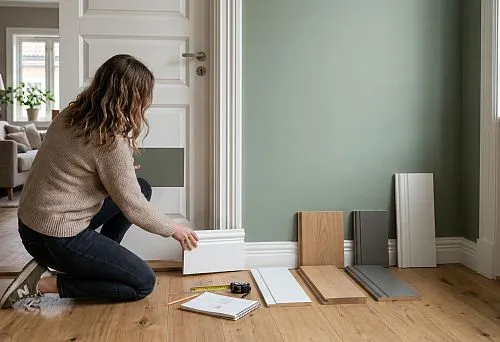
When a person types 'skirting board for kitchen unit' into a search engine, they usually have a very specific task in mind—and it's not always related to the floor skirting board against the wall. Most often, it refers to one of three things: a wall skirting board for the countertop, a furniture plinth skirting board at the bottom of the kitchen, or decorative profiles for finishing the work area. Each of these solutions has its own logic, materials, dimensions, and common mistakes when choosing.
This article will break down all three tasks in order. We'll start with the main point—what exactly lies behind the query 'skirting board for kitchen unit' in each specific case. Then we'll cover materials, shapes, dimensions, and installation. And at the end—we'll carefully discuss how to move from a functional kitchen solution to a decorative system if the task is broader than just closing the gap at the countertop.




What is usually meant by the query 'skirting board for kitchen unit'
The confusion in this topic is systemic. The word 'skirting board' encompasses several completely different products that perform different functions and are installed in different parts of the kitchen. Let's sort it out once and for all.




Wall skirting board for countertop
This is a profile that closes the joint between the work surface of the countertop and the wall (backsplash). It prevents water, grease, small debris, and food residue from getting into the gap between the countertop and the wall. Without it, this joint is a constant source of dirt, odors, and eventually—mold.
The wall skirting board for the countertop is installed horizontally along the back and side edges of the work surface. It usually has a triangular or rectangular cross-section, comes in lengths of 3 or 4 meters, and is supplied with corner elements, end caps, and connectors.
Our factory also produces:


Furniture plinth skirting board for kitchen
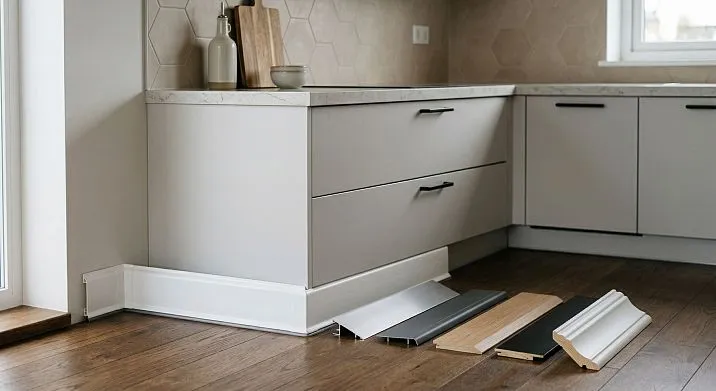
A plinth skirting board is a decorative and protective element for the lower part of a kitchen unit. It covers the space between the bottom cabinets and the floor, conceals the furniture's adjustable legs, and protects the floor area from dust and moisture.
The height of the baseboard skirting is typically 100–150 mm — designed for standard adjustable kitchen furniture baseboards. It attaches using special clips to the cabinet legs and is easily removable for repairs or rearrangement.
Get Consultation
Floor skirting for the kitchen set
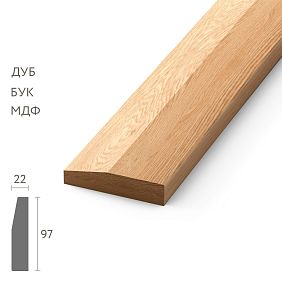
This is a regular floor skirting that runs along the perimeter of the kitchen — including next to the kitchen set. Its purpose is to cover the joint between the floor and wall, creating a decorative outline for the room.MDF Skirting BoardorWooden baseboard— they are precisely what fulfill this role in the floor perimeter area of the kitchen.
These are three different products with different purposes. They do not compete — they complement each other. All three can be present in a kitchen simultaneously.
Skirting for the kitchen set and skirting for the countertop — what's the difference
This question arises for almost everyone encountering the choice for the first time. People often confuse the furniture baseboard skirting and the wall skirting for the countertop, although these are products with fundamentally different functions.
Skirting for the countertop (wall splashback):
-
Installed in the work surface area — at the back and along the sides
-
Protects the countertop–wall joint from water and grease
-
Profile height: 20–60 mm
-
Materials: aluminum, PVC, plastic, acrylic, silicone, decorative stone
-
Visible in the apron area, directly contacts water and steam
-
Includes corner connectors, end caps, mounting posts
Furniture skirting board for kitchen:
-
Installed at the bottom of the cabinet near the floor
-
Covers cabinet legs, creates a unified bottom line for furniture
-
Height: 100–150 mm
-
Materials: PVC, MDF, aluminum, matching cabinet fronts
-
Installed on clips, easily removable
-
Does not contact water or steam during normal use
Floor skirting at kitchen unit:
-
Installed along the perimeter of the kitchen floor
-
with a classic profile creates a sense of solidity, reliability.orBaseboard MDF
-
Height: 40–100 mm
-
Function — decorative, covers the floor–wall joint
| Element | Where it is located | Height | Function |
|---|---|---|---|
| Wall-mounted splashback (countertop) | Rear/side edge of the work surface | 20–60 mm | Water protection for the joint |
| Baseboard skirting | Bottom part of the cabinet at floor level | 100–150 mm | Covers cabinet legs |
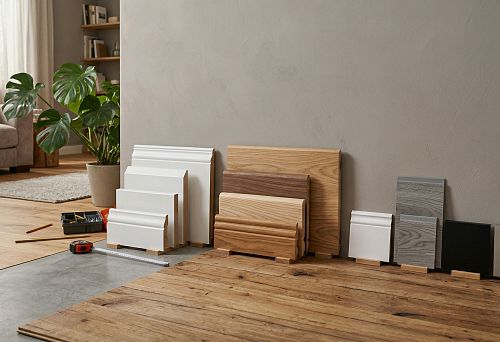
| Floor skirting board | Kitchen floor perimeter | 40–100 mm | Decorative, covers gaps |
What materials are best for kitchen cabinet skirting
The kitchen is an aggressive environment for any material. Steam, splashes, grease, household chemicals, temperature fluctuations. That's why choosing a material for cabinet skirting is primarily about operational conditions, not just appearance.
Aluminum: the best choice for practicality
Aluminum profile is the optimal material for wall skirting in the countertop area. It doesn't melt, doesn't deform at high temperatures, doesn't absorb odors, and is easy to clean with any household products.
Why aluminum is the best choice near the cooking zone and sink:
-
Full heat resistance: does not melt even near open flame or steam
-
Absolute moisture resistance: does not swell or deform
-
Resistance to household chemicals: acids and alkalis in cleaning products do not damage the surface
-
Long service life: aluminum does not age visually, does not yellow, does not break
-
Neat appearance: matte or anodized aluminum looks professional and restrained
Aluminum wall skirting is available in several shades: matte silver, anodized gold, bronze, anthracite. For a modern kitchen with metal details, aluminum is the obvious first choice.
Limitation of aluminum: the design range is smaller than that of plastic. For kitchens in a 'warm' style or wood-like finishes, aluminum is less organic. But in terms of functionality, it is unrivaled.
Plastic and PVC: affordable and versatile
Plastic skirting for kitchen units is the most common budget option. Wide selection of colors and textures (including imitations of stone and wood), easy installation, affordable price.
Characteristics of plastic skirting for units:
-
Wide range of shades and textures — easy to match any countertop color
-
Easy to cut with regular scissors or a hacksaw
-
Tight fit to uneven walls — plastic is slightly elastic
-
Moisture resistance — sufficient for most kitchen conditions
The main drawback of plastic is its reaction to high temperature. PVC deforms under prolonged heating. Near the cooking surface, a plastic skirting may lose its shape over time. For the stove area, aluminum is preferable.
Polypropylene (PP) plastic is more heat-resistant than PVC and better suited for the area near the stove. When choosing a plastic skirting for a cabinet, clarify the material: PP or PVC.
Flexible silicone skirting
Flexible self-adhesive silicone skirting — a special solution for situations where the wall is highly uneven or non-standard. Silicone conforms to the surface shape, completely seals the joint, is easy to cut, and can be replaced without disassembling the furniture.
However, aesthetically, silicone skirting is inferior to aluminum and plastic — it looks like a sealant-gasket rather than a full-fledged decorative element. The best use for silicone skirting is the area near the sink and in places with non-standard geometry.
Decorative solutions: acrylic and artificial stone
A wall-mounted acrylic or artificial stone skirting board is a more expensive and visually expressive solution. Such a skirting looks like an organic continuation of the countertop made of a similar material. This is appropriate in kitchens where the goal is to create a monolithic surface.
Acrylic skirting for the countertop is produced to match the color of the countertop itself or in a contrasting shade. It is moisture-resistant, easy to clean, and does not deform from temperature.
Which skirting to choose for the joint between the countertop and the wall
The countertop-wall joint is the most vulnerable spot in the kitchen. This is where water from the sink, steam from the stove, and cooking splashes get. Without reliable protection of this joint, moisture penetrates under the countertop and into the wall, leading to furniture deformation, mold, and unpleasant odors.
How to choose the right skirting for the joint between the countertop and the wall — we'll break it down by zones.
Zone near the sink
Near the sink, water is a constant. Here, you need the most airtight and moisture-resistant option. The best solutions:
-
Aluminum wall-mounted skirting with a silicone gasket or sealant applied along the bottom edge
-
Flexible silicone skirting as an additional seal on particularly vulnerable areas
-
Acrylic skirting to match the countertop — if the design effect is important
Installation feature at the sink: the bottom seam between the plinth and the countertop must be sealed with a silicone sealant compatible with the countertop material. Without sealant, even the best plinth will not protect the joint from water penetration.
Area near the cooking surface
The main threat here is high temperature. PVC near the stove will melt and deform over time. The correct choice:
-
Aluminum is the only guaranteed heat-resistant option
-
Stainless steel — for kitchens in industrial or loft style
-
Polypropylene plastic — if aluminum is unsuitable due to color or design, as a compromise solution
If the backsplash is uneven
An uneven backsplash made of tile or wall panel is a common problem. A gap of variable width forms between the uneven backsplash and the countertop, which neither aluminum nor acrylic plinth will fully cover without additional work.
Solutions:
-
Flexible plastic or silicone plinth with sufficient overhang that covers the gap along the entire length
-
Aluminum profile with trimming and finishing silicone sealant along the bottom line — this provides both neatness and reliable insulation
-
If the gap is significant — first a leveling layer of grout or putty, then the baseboard
If minimal visibility is needed
Some kitchens are designed with a 'minus details' concept — here any bright border is superfluous. In this case:
-
Narrow aluminum profile matching the backsplash color — it visually blends with the surface
-
Transparent acrylic border — practically invisible
-
Silicone sealant matching the grout color — if the backsplash is tiled and seamless appearance is important
How to choose a furniture baseboard for the bottom of the cabinet
The baseboard is the lower 'skirt' of the kitchen cabinet. It covers the cabinet legs, the space under the furniture, and creates a visually finished bottom line. A properly selected baseboard makes the cabinet look 'monolithic' — without gaps or breaks.
Protection from dust and moisture
The space under kitchen cabinets is an area where dust, crumbs, and moisture accumulate. Without a baseboard, it's inaccessible for cleaning, and dirt inevitably builds up there. A tightly installed baseboard closes off this space and simplifies kitchen maintenance.
Important: the baseboard must fit tightly against the floor along its entire length. If the floor is uneven, a flexible option or trimming the bottom edge is needed.
Height of the baseboard
Standard height of furniture baseboard is 100 or 150 mm. It is determined by the height of adjustable legs on lower cabinets:
-
Legs at minimum height (35–50 mm): 100 mm baseboard is sufficient
-
Legs at medium level or uneven floor: 150 mm baseboard is needed
-
With significant floor level variation: the baseboard is trimmed along the bottom edge to match the slope
Color of the baseboard
Classic rule: kitchen unit baseboard matches cabinet fronts or matches the floor. Both options are valid.
Baseboard matching cabinet fronts creates a 'monolithic' look for the unit—the furniture appears as a single volume from floor to top. Baseboard matching the floor 'dissolves' into the flooring and visually lifts the furniture. White baseboard with white fronts is the most popular and foolproof option.
Combination with floor skirting board
In the kitchen, the baseboard of the cabinet and the floor skirting board along the perimeter of the floor are two different elements. They meet at the point where the cabinet ends and the free wall begins. It is important that their heights are comparable or at least do not create a sharp contrast.
For the floor skirting board in the kitchen area, Baseboard MDF white works well—it is neat, matches most kitchen fronts, and is easy to clean.
What sizes and shapes are available for cabinet skirting boards?
The size range of wall-mounted skirting boards for countertops is a topic of practical importance when selecting and installing.
Length
Standard lengths for wall-mounted skirting boards for countertops: 3 meters and 4 meters. When cutting for a specific kitchen, always take extra—account for corner connectors, which 'consume' several centimeters at each corner.
Profile Height
-
Narrow skirting board (20–30 mm): minimally noticeable, neat. Suitable for modern kitchens where 'invisibility' of the detail is important.
-
Medium skirting board (35–50 mm): standard size, covers gaps up to 20–25 mm, suitable for most kitchens.
-
Wide skirting board (60–80 mm): decorative element, noticeable, creates an expressive joint. Appropriate for kitchens with high ceilings and expressive interiors.
Cross-sectional shape
-
Triangular profile — a classic. Covers the angle between the horizontal countertop and the vertical wall. The most common option.
-
Straight profile — attaches only to the wall or only to the countertop. Used for non-standard solutions when there is no right angle.
-
U-shaped profile — wraps around the countertop edge from the top and back. Used for finishing countertop ends.
-
Flexible profile — for uneven walls and non-standard work surface lines.
Accessories
Countertop skirting is always installed as a set with:
-
Internal corner connectors — for internal kitchen corners (90°)
-
External corner connectors — for protruding corners
-
End caps — for profile ends
-
Mounting brackets — for aluminum options with mechanical fastening
Purchase a plinth for your kitchen set with a full kit: end caps and corner pieces are not always included in the basic delivery and need to be ordered separately.
How to choose the color and texture of a plinth for a kitchen set
The color of the wall plinth is not a secondary detail. In the kitchen work area, the eye constantly 'meets' this profile. An incorrectly chosen shade will be irritating on a daily basis.
Under the countertop
The most common and professional choice: a plinth matching the countertop or a shade as close as possible to it. The edging 'merges' with the work surface and creates a sense of solidity. Black countertop — black or anthracite plinth. White — white. 'Marble-look' — as close as possible to the main tone of the stone.
Under the backsplash
An alternative option: a plinth matching the backsplash. In this case, it becomes part of the vertical surface, and the countertop-edging joint is read as a boundary between two zones, not as a random detail. Works when the backsplash and countertop are contrasting.
Under metal and chrome
In kitchens with metal faucets, chrome handles, and metal inserts — an aluminum plinth in matte silver or polished chrome creates material unity. This technique is characteristic of modern and high-tech kitchens.
Wood-look
In a kitchen with wooden fronts or a natural wood countertop, a wooden edging is an organic solution. A natural wooden plinth for painting or oiling to match the countertop gives a warm, lively feel. Here, wood trim items— a wooden profile of the required shape and wood species, capable of creating a complete kitchen contour.
Under the floor
The color of the floor skirting board that runs along the perimeter of the kitchen is selected, among other things, taking into account the floor. WhiteMDF Skirting Boardpaired with a light floor is a universal solution for most kitchens with white fronts.
Installing skirting for a kitchen unit: what's important to know in advance
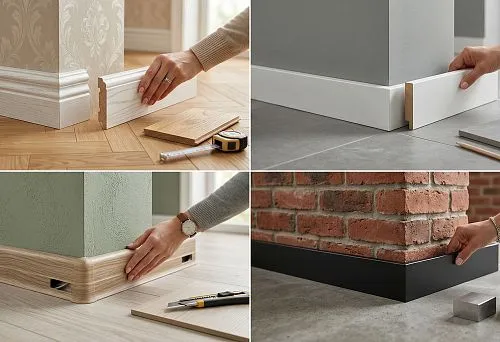
Proper installation of skirting for a kitchen unit is not just 'glue it and that's it'. There are several technical points that need to be considered in advance, otherwise the border will fall off in a year or let water through.
Surface preparation
Before installing the wall skirting, the countertop and wall must be:
-
Dry and degreased: grease and moisture prevent the adhesive from holding
-
As level as possible: major unevenness should be filled in advance
-
Free of old sealant if it's a replacement: the old layer must be completely removed
Installation order
-
Cut the profile to required lengths accounting for corner connectors
-
Prepare and dry-fit corner elements, check joints
-
Apply adhesive or sealant to the bottom edge of the profile (or to the countertop, depending on type)
-
Install the profile, press and secure during curing time
-
Foam or seal the finish seam along the bottom edge with silicone
Sealing is a mandatory step
Even with a perfectly installed skirting, the bottom joint between profile and countertop must be additionally sealed with clear or colored silicone sealant. Without this, water will penetrate under the skirting with every contact with the surface.
Sealant is chosen based on compatibility with the countertop material: kitchen silicone sealant, resistant to mold and grease.
If the wall is uneven
Uneven wall is one of the most common problems when installing wall skirting. Solutions:
-
Flexible plastic or silicone skirting board: conforms to the surface shape
-
Pre-cutting the profile along the bottom edge 'to match the wall angle'
-
Filling gaps with sealant after installing the rigid profile
-
In serious cases — preliminary wall leveling in the contact area
Replacing the skirting board on a kitchen unit
Replacing an old wall-mounted edge — a feasible task without replacing the entire kitchen. Procedure:
-
Carefully remove the old profile without damaging the countertop
-
Remove adhesive residue and old sealant
-
Clean and degrease the surface
-
Install the new profile according to the algorithm described above
Common Mistakes When Choosing a Skirting Board for a Kitchen Unit
Let's examine typical mistakes that lead to rework or quick replacement.
Mistake 1: Confusing Countertop and Baseboard Skirting
This is the most common mistake when first encountering the topic. A wall-mounted edge and a baseboard skirting are two different products that perform different functions and are installed in different places. Confusion when ordering leads to wasted time and money.
Mistake 2: Choosing Only by Color Without Checking Heat Resistance
A beautiful plastic skirting board installed right next to a cooking surface is a ticking time bomb. After a few months of use, it will deform from the heat. Only aluminum or heat-resistant PP plastic should be used near the stove.
Mistake 3: Not Sealing the Bottom Seam
A skirting board without sealant is a decorative detail without function. All water protection is provided precisely by a thin layer of silicone along the bottom edge. Without it, water passes under the profile at first contact.
Mistake 4: Forgetting to Buy Accessories
Buying linear footage of skirting board without corner pieces and end caps is a common oversight. End caps and corner connectors are a mandatory part of the kit. Without them, the skirting looks unfinished and holds worse at corner points.
Error 5: Profile too tall for a narrow backsplash
A wide 70–80 mm wall skirting on a kitchen with a 400 mm high backsplash covers 20% of the backsplash. If the backsplash is narrow, choose a narrow profile.
Error 6: Installing skirting without surface preparation
Greasy, wet, or dusty surfaces prevent adhesive from bonding. After six months, the skirting will start to peel away, creating a gap where water will immediately seep in. Surface preparation is not optional—it's an essential first step.
If you want a more expensive and cohesive kitchen interior
This is an important section for those seeking not just technical solutions, but wanting to design the kitchen as a cohesive, stylish space.
Wall skirting for countertops and baseboard skirting are functional products. They serve their purposes, but the kitchen interior isn't limited to them. The kitchen is part of the apartment. And if the goal in the living room, hallway, or open-plan space is to create a cohesive decorative outline—that's where a completely different story begins.
Trim products as a systemic solution
wood trim items—these are decorative and functional profiles: skirting boards, moldings, cornices, trims, battens. They create the architectural outline of a room and ensure visual cohesion that can't be achieved by randomly selecting individual pieces. If the kitchen is open or connected to the living room—Trimming Itemsand decorative profiles should work as a unified system with floor skirting and wall elements of the adjacent space.
MDF cornice for kitchen
DecorativeMDF Cornices— profiles for the upper part of the kitchen set. They are installed above the upper cabinets and create a finished 'crown' for the kitchen. Without a cornice, the top line of the set looks 'cut off'. With a cornice, the set gains architectural completeness.
MDF cornice for the kitchen is selected to match the facades or with contrast: a white cornice above white cabinets is a calm option, a cornice matching wooden inserts is more saturated.
Decorative moldings for facade design
Decorative wooden moldingsare used for decorating kitchen cabinet facades — as overlay frames that create 'relief' on the facade. This is a technique characteristic of classic and neoclassical kitchens, where facades with moldings are a standard of quality execution.
Wooden slats on the kitchen wall
If the kitchen is connected to the living room or opens into a common space, an accent wall withwooden planks— is an expressive and modern solution. The vertical rhythm of wooden slats against an unsaturated background creates depth and character.
Decorative wooden stripin combination with a wooden baseboard of the same species — a decorative pair that works in any area. In a kitchen-living room, this is especially noticeable: a unified decorative language of walls and floor creates a sense of thoughtful, 'expensive' space.
Wooden batten wall panels— another option for those who want a systematic solution in the form of ready-made panels with uniform slat spacing. They are installed quickly and give a neat and professional result.
Batten skirting for wall panels
If batten panels are installed in the kitchen or adjacent space, a specialLath baseboardis needed for a neat joint between the panel and the floor. It ensures a precise bottom transition without gaps and 'heels' that occur during inaccurate installation.
MDF moldings
MDF Trim— cornices, moldings, skirting boards, and decorative profiles made of MDF — are ideal for kitchens with white or painted fronts. Precise geometry, smooth surface, ready for painting in any shade. Together withbuy MDF skirting boardfor the floor area — this is a complete system made from one material, providing a uniform finish throughout the room.
Floor skirting next to the kitchen unit: the right choice
It is worth mentioning separately the floor skirting that runs along the perimeter of the kitchen and passes next to the lower cabinets of the unit.
This skirting should:
-
Match the plinth skirting of the unit in height and color
-
Resistant to wet cleaning and household chemicals
-
Be tall enough to cover the technological gap of the flooring
buy MDF skirting boardWhite, 60–80 mm high, is the optimal choice for most kitchens. It matches white fronts, looks neat next to tiles or quartz vinyl, and is easy to clean.
wooden skirting board purchase— the right choice for kitchens with wooden floors or wooden fronts. Wooden skirting in the kitchen area must have a lacquer coating — oil is less resistant to intensive wet cleaning.
Wooden corner bracket— a special small profile for internal corners and transitions. Useful when installing skirting in a kitchen with non-standard corner joints.
Conclusion: how to choose skirting for a kitchen unit correctly
Time to boil it down to straight answers — for each of the three scenarios.
If you need a wall-mounted skirting for the countertop:
-
Next to the stove — aluminum. Always.
-
Next to the sink — aluminum or acrylic with mandatory silicone sealant.
-
For a decorative effect matching the countertop — acrylic border.
-
For uneven walls or non-standard geometry — flexible PP plastic or silicone.
If a furniture baseboard is needed:
-
Standard height 100–150 mm.
-
Color — matching the facades or matching the floor.
-
Material — PVC or MDF.
-
Don't forget: tight fit to the floor and corner pieces for internal corners.
If a floor skirting board is needed near the kitchen:
-
MDF Skirting Board white for a modern interior with white facades.
-
with a classic profile creates a sense of solidity, reliability. with varnish for kitchens with wooden floors.
-
Height 60–80 mm — optimal for most standard kitchens.
If you need a solid decorative interior:
-
Buy wooden skirting boardfor an accent wall.
-
MDF Crownfor the upper part of the cabinet.
-
Wooden batten wall panelsfor accent wall decoration.
➡️ MDF skirting board — STAVROS catalog
➡️ Buy wooden skirting — STAVROS solid wood catalog
➡️ Buy wooden batten — STAVROS catalog
➡️ Wooden millwork — STAVROS catalog
➡️ MDF Kitchen Cornice — STAVROS Catalog
➡️ Wooden slat wall panels — STAVROS
About the company STAVROS
STAVROS — a Russian manufacturer of decorative products from natural solid wood and MDF: skirting boards, moldings, cornices, architraves, slat panels,Decorative wooden strip, Wooden corner bracketand the entire linemolding productsfor interior.
The kitchen is not just about function. It's a space where a significant part of life unfolds. And how it looks—from the backsplash at the countertop to the decorative battens on the accent wall—determines the feeling of this space every day.
STAVROS offers a systematic approach: floor skirting, cornice for the upper part of the cabinet, decorative battens and panels—all from one catalog, from the same wood species, with one quality principle. This is what makes it possible to create a kitchen and adjacent space that looks designed, not assembled from random parts.
STAVROS works with private clients, designers, and architects throughout Russia.
Frequently asked questions about cabinet skirting
What is cabinet skirting—is it a backsplash or a baseboard skirting?
It can be both products. The backsplash covers the joint between the countertop and the wall, the baseboard skirting covers the lower part of the cabinets near the floor. Usually, both are needed in the kitchen—but they perform different functions and are installed in different places.
What material is best for skirting near the cooktop?
Only aluminum or heat-resistant polypropylene plastic. PVC and regular plastic deform under prolonged exposure to high temperature. Near the stove—aluminum without compromise.
Is it necessary to seal the countertop plinth?
Yes, absolutely. The lower seam between the plinth and the countertop is sealed with silicone kitchen sealant after the profile is installed. Without sealant, water penetrates under the plinth with every contact with the surface.
What is the standard height for a kitchen unit's baseboard plinth?
100 or 150 mm are the two standard sizes for adjustable cabinet legs. The required height depends on the height of the installed legs and the levelness of the floor. On an uneven floor, the baseboard is trimmed along the lower edge.
Can a wooden skirting board be used in the kitchen?
Yes, for the floor perimeter—provided there is a lacquer coating. A wooden plinth with lacquer withstands wet cleaning well. For the wall-side splashback at the countertop, a wooden profile is a rare but possible solution in kitchens with a wooden countertop, provided it is properly treated and sealed.
What is a slatted plinth and why is it needed in the kitchen?
A slatted plinth is a special profile for the lower joint of wall or slatted panels with the floor. If decorative slatted panels are installed in the kitchen or an adjacent area, the slatted plinth ensures a neat lower transition without gaps or seams.
Which floor plinth is best for a kitchen with white fronts?
A white MDF plinth with a height of 60–80 mm is the optimal solution. It coordinates with white fronts and the baseboard plinth, is easy to clean, and looks neat next to any floor covering.
How to correctly choose the color of the wall-side plinth for the countertop?
The best rule: match the skirting to the countertop. This way, the border 'dissolves' into the work surface and doesn't draw attention. If the countertop is multicolored, choose a skirting that matches the main or background tone.