Article Contents:
- Why Door Skirting Affects the Entire Interior Look
- The Door Area is Always in Sight
- The Joint Between Skirting and Architrave Reveals the Quality of Finishing
- A Mistake Here Multiplies
- Which Skirting to Choose for a Door: Main Options
- Wooden baseboard
- MDF Skirting Board
- Solid wood skirting board
- High and Medium Profile
- How to Match Skirting to Doors and Architraves
- Matching the Door Color: Three Practical Rules
- Under the floor level
- Unified door unit finish
- Wooden door skirting: when it's the best choice
- When the door and architraves are wooden
- When the interior is classic
- When natural texture is needed
- When a more expensive visual effect is desired
- MDF skirting or wooden skirting: which is better for doorways
- Comparison table: MDF vs wood for doorways
- When MDF is better for doorways
- When wood is better for doorways
- How to beautifully finish the joint between baseboard and door
- Baseboard and door casing joint: three solution options
- How to end baseboard at door: practical rules
- How to avoid a 'chopped-off' appearance
- Doorway molding as a systematic solution
- Which baseboard to choose for doors in different rooms
- Hallway and corridor
- Living Room
- Bedroom
- Office
- What to combine baseboard with at the door
- Baseboard and door casing
- Skirting boards and wall moldings
- Baseboard and door decor
- Baseboard and molding decor
- Where to buy door baseboard and what to look for before ordering
- Profile, not just color
- Consistency with door casings and moldings
- Manufacturer vs Intermediary
- Quantity and reserve
- Mistakes when choosing door baseboard
- Mistake 1: Baseboard does not match the scale of the door casing
- Mistake 2: Color conflict
- Mistake 3: Profile too low for a massive door
- Mistake 4: Baseboard too simple for a classic interior
- Error 5: Lack of transition logic at the doorway
- Error 6: Different profiles in different openings of the same room
- Conclusion: which baseboard to choose for the door — three options and three answers
- About the Company STAVROS
- Frequently asked questions about door baseboards

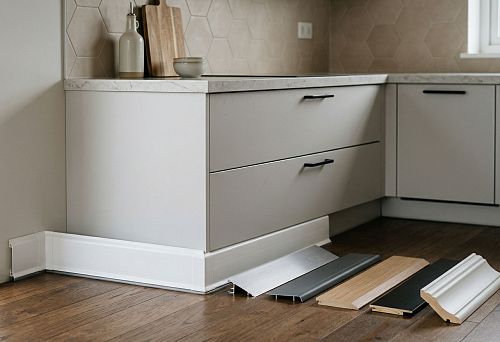
Baseboard for the door— is not a separate product category, it is a task: how to properly finish the baseboard line at the doorway, how to coordinate it with the casing, how to achieve a neat, 'expensive' look for this detail. It is this question we will examine — with all the nuances that affect the final result.
Buy baseboard for the door— is not difficult. Buying the right one that will organically integrate into the door–casing–floor–wall system is the task that requires understanding.
➡️ Select baseboards, casings, and doorway decor in the STAVROS catalog




Why the baseboard at the door affects the entire look of the interior
Попробуйте мысленный эксперимент: войдите в любую комнату и посмотрите не на мебель, не на стены, а именно на зону дверного проема снизу. Линия плинтуса, которая «подходит» к наличнику — или не подходит. Правильно завершённый узел или неаккуратный «обрубок». Зазор между плинтусом и наличником или плотное, профессиональное примыкание. Эта деталь считывается мгновенно — даже если человек не формулирует её осознанно.




The door area is always in sight
The door opening is one of the most 'high-traffic' visual elements of any room. We constantly look toward the door: when entering, exiting, or during conversation. This means any carelessness in the baseboard area at the door is constantly visible.
Our factory also produces:


The joint between the baseboard and the casing reveals the class of the finish
Professional designers know: it's precisely by the jointof the floor baseboard for the doorwith the casing that the quality of the entire finish is judged. A neat, precise fit is a sign of a systematic approach. A random gap or a baseboard that 'butts' against the casing at the wrong angle is a signal of inconsistency.
Get Consultation
A mistake here is multiplied
Unlike a wall or ceiling, a door opening is a 'repeating' area: an apartment usually has from four to ten doors. One mistake in choosing the baseboard for the door is a mistake repeated ten times. That's why this decision should be approached thoughtfully.
Which baseboard to choose for a door: main options
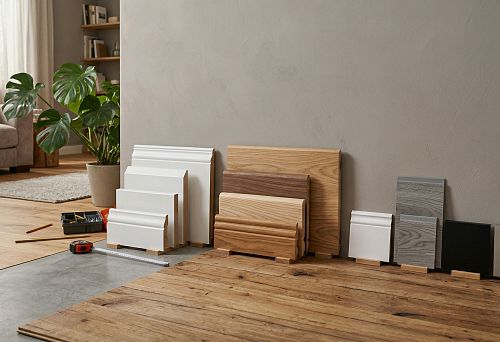
Before discussing combinations — let's decide on materials. The material of the baseboard determines 70% of the visual result in the door opening area.
Wooden skirting board
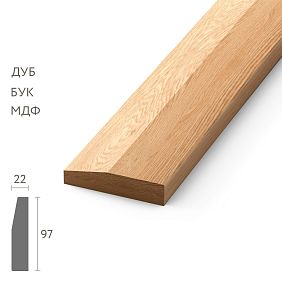
Wooden baseboard— a product made from solid wood: oak, beech, pine, ash, walnut. Living texture, warmth of natural material, precise profile that does not "warp" over time. In the door opening area with wooden architraves, a wooden baseboard is the only absolutely organic solution. It belongs to the same material family as the door and architrave — and this is felt immediately.
Wooden baseboard for a door— comes in several coating options: varnish, enamel, oil, paintable. This allows for precise color matching to specific doors and architraves.
MDF skirting board
MDF Skirting Board— a pressed board with high geometric precision and an ideal surface for painting. An excellent choice for modern interiors with white or neutral doors, where clean lines are important, not the naturalness of the material. MDF is stable, does not warp, and is easy to install.
Key advantage in the door area: perfectly white MDF baseboard with white doors and white architraves — this is a visual unity that is difficult to replicate with other materials.
Solid wood baseboard
Solid wood baseboard for a door— this is a wooden baseboard made from a solid board without gluing or pressing. Maximum strength, maximum durability. The perfect choice for classic interiors with oak parquet and wooden doors with solid wood architraves.
High and medium profile
The height of the baseboard at the doorway affects perception no less than the material. The rule is simple: the baseboard should be proportional to the scale of the casing and door. A narrow baseboard next to a wide, massive casing is a disproportion. A too-high baseboard at a neat modern door is heaviness where lightness is needed.
How to choose a baseboard for the door and casings
This is the main practical question. We will analyze all selection scenarios — by color, material, and style.
To match the door color: three working rules
Rule one — a unified tone. If the door has a certain color and shade, the baseboard is selected in the same tonal range. A white door — a white baseboard. A dark wenge-colored door — a baseboard in a similar dark shade. This gives a sense of system: the opening and adjacent areas look like a single architectural element.
Rule two — tone on tone with the casing.door casingand the baseboard — this is the closest visual 'contact' in the doorway area. They stand side by side, literally touching. If the casing is white — the baseboard is white or close to it. If the casing is made of natural wood — the baseboard is in the same species or in a coordinated shade.
Rule three — contrast as a technique. A dark baseboard with a white door and white casings — this is an intentional architectural accent. Works in modern interiors, where the contrasting line of the baseboard emphasizes the horizontal of the floor. Requires confidence in the decision: accidental contrast looks like a mistake, intentional — like style.
To match the floor
The second most important guideline is the color of the floor covering. The classic scheme: a baseboard matching the floor — 'extends' the covering vertically, dissolving the lower boundary of the wall. A baseboard matching the walls — 'lifts' the walls, making the room visually taller. The choice depends on the task.
In the doorway area, this rule is especially relevant:door thresholdshould create a smooth transition from the floor to the casing — not 'break' this junction with a sharp color leap.
Unified tonality of the door unit
The ideal solution for a doorway is a unified tonal system: door, casing, and baseboard from the same line or in coordinated shades. This solution doesn't require complex design analysis — it simply works. In the catalogof solid woodSTAVROS baseboards and casings made from the same wood species and the same finishes are available in system lines — precisely for such matching.
Wooden baseboard for a door: when it's the best choice
Situations wherewooden baseboard for a dooris not just an option, but the only correct solution.
When the door and casings are wooden
If the door leaf is made of natural wood, andWooden casinga wooden baseboard made from the same or coordinated wood species becomes an organic continuation of this system. The natural wood grain is recognized by its warmth, surface character, and how it 'breathes' in the light. A plastic or MDF baseboard next to natural wooden doors creates a material dissonance that is clearly visible at first glance.
When the interior is classic
In a classic interior — with parquet flooring, wooden doors, wall moldings, and cornices — a wooden profile is not just appropriate, it is fundamental. The classic style is built on natural materials, manual craftsmanship, and details with character.Solid wood baseboard for a doorin such a system — is not a decorative option, but an architectural necessity.
When a natural texture is needed
There is a category of clients for whom natural material is fundamentally important — in the literal sense: living texture, the smell of wood, the feeling of natural origin. For them, a wooden baseboard for the door is an axiom, not a choice.
When a more expensive visual effect is needed
In high-budget interiors, a wooden baseboard is perceived as an indicator of level. Not because it 'looks more expensive' by itself — but because it belongs to a system where all details are natural. It is the overall 'tone' of the space, which either exists or it doesn't.Wooden baseboard for doorMade of oak or walnut with a high-quality oil finish — this is a material that makes an impression from the threshold.
MDF skirting board or wooden skirting board: which is better for a doorway
An honest comparison without marketing clichés — only based on parameters that matter for the doorway area.
Comparison table: MDF vs wood for a doorway
| Parameter | Wooden skirting board | MDF skirting board |
|---|---|---|
| Appearance | Living texture, natural character | Uniform surface, ideal for painting |
| Profile precision | High | Very High |
| Matches wooden doors | Maximum | Average |
| Matches white doors | Good (white enamel) | Maximum |
| Durability | 20–30 years | 10–15 years |
| Restorability | Yes (sanding, repainting) | Limited |
| Price | Higher | Below |
| Appropriateness in classic | Ideally | Acceptable |
| Appropriateness in contemporary | Good | Ideally |
When MDF is better at the doorway
MDF wins where:
-
doors are white or painted in a neutral color;
-
door casingwhite or lacquered without pronounced texture;
-
room style is contemporary, minimalist, Scandinavian;
-
a perfect surface is needed for painting in a specific catalog shade;
-
budget is limited, but profile quality is essential.
When wood is better at the doorway
Wooden baseboardbetter where:
-
doors and architraves made of natural wood;
-
interior is classic or with a pronounced natural component;
-
durability and the possibility of restoration are fundamental;
-
a 'warm' visual effect with the character of the material is needed;
-
the door unit is considered as part of a comprehensive wooden door frame trim.
How to beautifully design the joint between the baseboard and the door
This is one of the most practically important sections. This is where most mistakes occur — and this is where most questions arise during renovation.
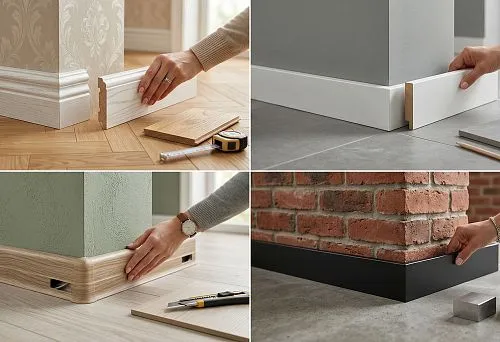
Joint between baseboard and architrave: three solution options
First option — butt joint. The baseboard is cut perpendicularly and butts its end against the side surface of the architrave. This is the most common method. Requires precise cutting and that the baseboard and architrave are coordinated in profile height. If the baseboard is significantly higher or lower than the base of the architrave — the joint looks sloppy.
The second option is a 'under-casing' skirting board. The casing is installed over the skirting board, covering its end. This is only possible with a specific installation order — first the skirting board, then the casing. It gives a very clean and neat appearance: there is virtually no joint.
The third option is a decorative transition element. A corner or end decorative block — a 'heel' or rosette — is installed in the lower corner of the casing, hiding and decorating the joint with the skirting board. Used in classic interiors with rich decor.Decor for MoldingSTAVROS includes elements specifically for this solution.
How to finish skirting board at a door: practical rules
-
The skirting board ends exactly at the side surface of the casing — it does not 'fall short' of it and does not 'go beyond' it
-
The end of the skirting board must be even and clean — without breaks or bevels
-
If the skirting board is wider than the base of the casing, it must be cut 'for shrinkage' or a transition element must be used
-
A gap between the skirting board and the casing is undesirable. If it exists, it is covered with color-matched acrylic sealant or a decorative corner element
How to avoid a 'chopped-off' look
A 'chopped-off' look is when the skirting board simply stops at the casing without any decorative finishing. This looks like incompleteness. To avoid this:
-
Choose skirting and architrave from the same line with a coordinated profile height;
-
UseDecor for Molding— corner elements, blocks, decorative transitions;
-
Install in the correct order — determine before starting work whether the skirting will be 'under the architrave' or 'to the architrave'.
Doorway molding as a system solution
If the opening is designed comprehensively —Molding for a doorway— it is a full decorative framing that includes vertical pilasters, a horizontal architrave, and lower blocks where the skirting is 'integrated'. In such a system, the joint between the skirting and the opening is architecturally resolved — it is part of the design, not a technical problem.
Which skirting to choose for a door in different rooms
Each room has its own task. Let's examine key scenarios.
Hallway and corridor
The hallway is where the interior greets guests.Skirting for a door in the hallwayshould be:
-
practical: able to withstand mechanical loads — impacts, shoe contact, cleaning;
-
neat at the junction with the door frame — this is the detail everyone sees immediately;
-
coordinated with the floor: hallways often have tile or waterproof laminate, the baseboard should match this material.
If the entrance door is wooden with solid wood frames —wooden baseboard for a doorit is mandatory here. If the door is metal with MDF overlays — white MDF baseboard.
In the hallway, the same logic applies, plus it's important to consider that the baseboard 'works' at the junction with several doorways at once: the height and profile should be uniform along the entire length.
Living Room
In the living room, the baseboard to the door is part of a broader architectural program. Here the doorway is most often the central visual element of the wall. A tallbaseboard for the doorwayin a living room with 3-meter ceilings is the correct and proportional solution.
In a classic living room, the 'baseboard + door casing + wall molding' system forms a complete architectural frame around the doorway.Moldings for wallsCoordinated with the baseboard and casings—these are not separate elements, but an architectural system.
Bedroom
The bedroom requires a delicate solution. The baseboard for the bedroom door should be quiet, calm, without excessive expressiveness. Medium height of 60–80 mm, neutral or warm shade. If the bedroom is decorated with natural materials—a wooden baseboard in a light wood species (beech, ash) or paintable to match the wall color.
An important nuance: if there are several doors in the bedroom—to the bathroom, walk-in closet, balcony—the baseboard and casings must be uniform for all openings. Inconsistency in this area is perceived as carelessness.
Office
The study—a space of authority. Here, a more 'heavy' profile works.Baseboard for the study door—made of dark wood or oak with a tinted finish. Coordinating with wooden bookshelves, dark parquet, and solid doors is a task only natural material can solve.
The height of the baseboard in the study—from 80 mm. In a system with a tall casing and, possibly, withmolding for the doorway—this is an interior that requires no explanation.
What to match the baseboard with at the door
The baseboard in the doorway area is not an isolated element. It is part of a decorative system, and the final impression depends on how well this system is coordinated.
Baseboard and door casing
Wooden casingand the floor baseboard are the most important pair in the door assembly. Coordination rules:
-
Material — the same or coordinated: wood to wood, MDF to MDF, white to white
-
Height: the width of the casing base should be comparable to the height of the baseboard — neither disproportionately larger nor smaller
-
Profile: if the casing has a figured relief, the baseboard should not be 'poorer' — and vice versa
Buydoor casingand baseboard from the same product line by one manufacturer is the most reliable way to achieve a coordinated result without additional 'fitting'.
Baseboard and wall moldings
If the interior suggestsMoldings for walls— they should be coordinated with the baseboard in terms of material and profile style. Moldings form the 'fields' of the wall — rectangular frames that start from the baseboard. If the baseboard and moldings are from the same line — the connection occurs organically, without a visual 'jump'.
Baseboard and door decor
Door Decoration— these are carved overlays, panels, decorative inserts that transform a standard door leaf. If decor in a certain style is used on the door leaf — the architraves and baseboard should support this style. Classic carved decor on a door with a smooth 'faceless' architrave is a stylistic mismatch.
Door Decorating— together with the correct selection of architrave and baseboard — is a comprehensive solution that turns an ordinary opening into an architectural accent.
Baseboard and decor for moldings
Decor for Molding— corner blocks, decorative inserts, 'heels' at the bases — these are elements that 'complete' the nodes at the junctions of moldings and baseboards. In the area of the doorway, such an element in the lower corner of the architrave is a professional technique that gives the node completeness and decorative expressiveness.
Where to buy door baseboard and what to look for before ordering
The right supplier is half the success. Let's break down what's important when choosing.
Profile, not just color
When buying through an online catalog, most people look at the photo and color. This is a mistake. The shape of the profile — height, projection, presence of relief — is not always clear from a photo. Always check the actual dimensions of the product: base width, rise height, shape of the front surface.
baseboard for the doorwaywith an incorrect profile will not provide the necessary joint with the casing — and you will have to either redo it or put up with an unsightly result.
Consistency with casings and moldings
The ideal option is to buy the baseboard and Wooden casingin one catalog, in one line. This is a guarantee: one wood species, one finish, a coordinated profile. This is exactly how the STAVROS catalog works — all wood, all profiles, all products belong to a unified system.
Manufacturer vs. intermediary
Door baseboard from the manufacturer— this means stable availability of the required profile and shade, the ability to order a batch identical to the previous one, professional consultation on selection. An intermediary cannot guarantee this.
Quantity and reserve
When purchasing door baseboardalways take a reserve of 10–15% of the calculated footage. Cutting at corners and door openings inevitably produces waste. Buying exactly the same profile six months later may prove difficult — production batches change.
Mistakes when choosing a door skirting board
Collected from real practice — dozens of observations of what goes wrong during renovation.
Mistake 1: Skirting board does not match the scale of the architrave
The most common one. A wide, imposingWooden casing80–100 mm wide architrave next to a thin 40 mm skirting board — this is a visual disproportion. The architrave 'outweighs' the skirting board, creating a sense of incompleteness at the bottom. Rule: the height of the skirting board should be comparable to the width of the architrave — or exceed it only slightly.
Mistake 2: Color conflict
A dark skirting board and a light architrave — this is not always 'contrast as a technique'. More often, it is simply a lack of coordination that catches the eye precisely in the joint area. If there is no intentional design decision — the skirting board and architrave should be in the same tonal group.
Mistake 3: Too low a profile for a massive door
A massive wooden door with a heavy leaf and wide architraves 'demands' a proportional skirting board. A skirting board with a height of 40 mm next to such a door looks like an unfinished detail. Minimum — 70–80 mm, for imposing doors — from 100 mm.
Mistake 4: Too simple a skirting board in a classic interior
Classicism does not tolerate simplifications where they are visible. A smooth rectangular baseboard next to a figured carved casing is a stylistic dissonance. In a classic interior, the baseboard should have a figured profile, coordinated in pattern with the casing and moldings.
Mistake 5: Lack of transition logic at the doorway
A baseboard that simply 'breaks off' at the casing without any decorative finish is a signal that the transition was not thought through. Use Decor for Molding, corner elements, the 'casing over baseboard' system — any of these solutions is better than a bare end.
Mistake 6: Different profiles in different openings of the same room
If there are three doors in a room, and each has its own version of baseboard, it creates chaos. A single baseboard to the door of one profile along the entire perimeter of the room is a mandatory condition for visual integrity.
Conclusion: which baseboard to choose for the door — three options and three answers
If naturalness and durability are important — Wooden baseboard for a doorfrom oak, beech, or ash array. In a system with wooden architraves made from the same wood species. Height — from 70 mm, profile — depending on the door style.
If you need a universal, neat option — MDF Skirting Board in white or a neutral color. Perfect for white doors, white architraves, modern interiors.
If you need to assemble a beautiful door unit comprehensively — buy door skirting board in a system with wooden architrave, molding for the doorwayanddecor for moldings from the same STAVROS line.
➡️ Buy door skirting board — STAVROS catalog
➡️ Wooden door skirting board — STAVROS catalog
➡️ Wooden architrave — STAVROS catalog
About the company STAVROS
STAVROS is a Russian manufacturer of decorative items made from solid wood and polyurethane. Skirting boards, architraves, moldings, cornices, balusters, paneling, decorative elements — all are produced in coordinated lines designed for systematic use in interiors.
The STAVROS principle is not details, but a system. A skirting board, architrave, and molding from the same catalog are not just 'similar products'. This is a designed trim where all elements belong to one visual language, one wood species, one finish. This is what makes an interior professional — regardless of budget and style.
STAVROS works with private clients, interior designers, architects, and construction companies across Russia. Stable warehouse, consultations on comprehensive selection, experience from hundreds of completed projects — from private apartments to commercial spaces.
Frequently asked questions about door skirting boards
Which skirting board is best to choose for a wooden door?
For a wooden door, a wooden skirting board from the same or a coordinated wood species is best. If the door is oak with oak architraves — an oak skirting board. This creates material unity for the door assembly.
How to properly finish the joint between the skirting board and the architrave?
Three options: butt joint (skirting board meets architrave perpendicularly), skirting board 'under the architrave' (architrave overlaps the skirting board end), or a decorative corner block at the lower corner of the architrave. The best option for appearance is the second, the best decorative option is the third.
Should the skirting board match the architrave in height?
Strict equality is not required, but proportionality is mandatory. The height of the baseboard should be comparable to the width of the casing. A baseboard that is too small next to a wide casing is a disproportion.
Which baseboard to choose for white doors?
White baseboard — to match the doors and casings. White MDF baseboard with a perfect surface is the most precise option for white doors in a modern interior.
Is it possible to buy baseboards and casings from different manufacturers?
Technically — yes. But in practice, this complicates the selection: different shades of 'white', different profiles, different finishes. Buying from the same line from one manufacturer is more reliable and faster.
What is a door opening molding and is it needed?
Door opening molding is a decorative framing that designs the opening as an architectural element: with vertical pilasters, a horizontal architrave, and lower blocks. It is needed in classical and neoclassical interiors, where the door opening is one of the main visual accents.
How high should the baseboard be at the door?
Focus on the scale of the door and casing. For standard doors with casings 60–70 mm wide — baseboard 60–80 mm. For massive doors with wide casings — from 80 mm. For high ceilings and representative spaces — from 100 mm.