Article Contents:
- What is Wall Finishing with Wooden Panels
- What Types of Wooden Wall Panels for Finishing Exist
- Smooth panels
- Slatted panels
- Relief panels
- Modular panels
- Paint-ready panels
- Panels with Pronounced Wood Grain Texture
- What Materials Are Wooden Wall Panels Made From
- Solid wood
- MDF with Wood Finish
- Veneered Solutions
- Combined options
- Why Wood Panel Finishing Is So Popular
- Where to Best Use Wooden Wall Panels
- In the living room
- In the bedroom
- In the hallway and corridor
- In the study
- In the dining area
- In Offices and Commercial Spaces
- For niches, columns, and partitions
- Where panels look most impressive
- Accent Wall
- TV Area
- Wall behind the sofa
- Bed headboard area
- Niches and columns
- Partitions and Zoning
- Transition from Wall to Ceiling
- How to choose panel format for finishing
- How to choose panels by color and texture
- How to choose panels to match the interior style
- Modern style
- Minimalism
- Scandinavian interior
- Jatoba
- Neoclassicism
- Classic Interior
- How to combine wooden wall panels with other materials
- How light affects the perception of wooden finishes
- What to choose: smooth, slatted, or relief panels
- Common mistakes when finishing walls with wooden panels
- What to choose for different tasks
- For an accent wall
- For background finishing
- For Modern Interiors
- For a warm natural space
- For Apartments
- For Home
- For commercial premises
- Selection algorithm: from task to panel
- FAQ: Answers to Popular Questions
- About the Company STAVROS

There are spaces you want to return to. Not because of expensive furniture or trendy decor—but because they feel warm. Warm not as a temperature parameter, but as a sensation: material, tactile, almost physical. In most cases, wood is behind this feeling. Wall paneling with wooden panels is precisely the tool that transforms an ordinary room into a space with character, depth, and living natural breath.
Why do wooden wall panels never go out of style—even though fashion trends change every two to three years? Because wood is not a trend. It is a material with a thousand-year history that returns to interiors each time in a new interpretation: sometimes as classic boiserie, sometimes as minimalist slatted battens in the Scandinavian spirit, sometimes as an accent oak wall behind a bed headboard. The form changes. The essence remains.
What is wall paneling with wooden panels
Wall paneling with wooden panels is the final or decorative cladding of interior wall surfaces using panels made of natural wood, MDF, veneer, or composite materials. Panels can cover the entire wall from baseboard to cornice or serve as a partial element—a lower dado, an accent zone, a decorative section behind furniture.
Unlike painting, wooden paneling creates volume and relief. Unlike wallpaper—a materiality that does not age and does not require replacement after a few years. Unlike decorative plaster—a natural warmth that cannot be imitated with mineral compositions.
What tasks does such paneling solve:
-
forms a visual center of the room on an accent wall;
-
adds warmth and natural texture;
-
zones space without physical partitions;
-
hides wall irregularities, utilities, technical units;
-
creates a sense of an expensive, well-thought-out interior;
-
improves room acoustics — especially with slatted solutions.
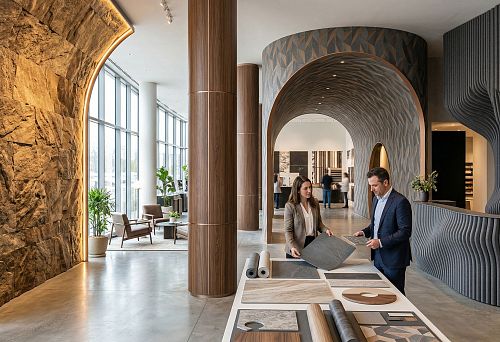
Wooden finishes are appropriate wherever natural warmth is needed: from living rooms and country houses to meeting halls, hotel lobbies, and premium showrooms.




What types of wooden wall panels for finishing are there
The market offers several fundamentally different formats. Understanding the difference between them is more important than simply choosing 'beautiful' ones.
Our factory also produces:



Smooth Panels
Smooth wooden panel — a flat surface without relief, with a calm facade. Can be made of solid wood, veneered MDF, MDF for painting, or with a decorative wood-grain film. A smooth panel creates a monolithic, solid background — it does not dominate the interior but acts as a structured plane that adds depth without visual noise.
Such solutions are ideal for classic wall systems with moldings, for Scandinavian minimalism, and for interiors where furniture and decor are the main focus, and the wall is a neutral background.
Get Consultation
Rack panels
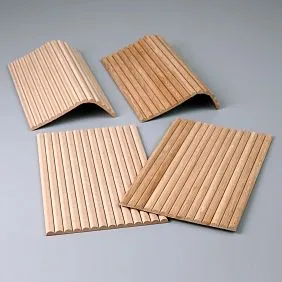
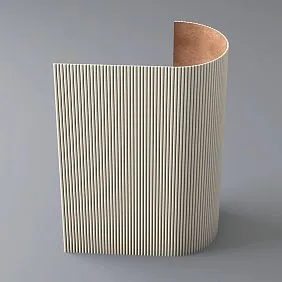
Wooden slat panels— one of the most expressive and in-demand formats in recent years. Parallel slats, fixed at equal intervals on an MDF backing or fabric base, create a lively linear rhythm that actively interacts with light.
Vertical slats visually elongate a room upward—especially valuable in apartments with standard ceiling heights of 2.5–2.7 m. Horizontal slats visually expand the space—effective in narrow hallways and elongated rooms. Side lighting turns a slatted wall into a sculptural object: each slat casts a soft shadow, giving a flat surface depth and volume.
Relief panels
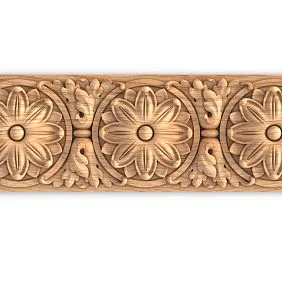
Relief panels feature a three-dimensional pattern on the surface: geometric ornamentation, coffers, waves, diamonds, abstract lines. They create an active decorative effect—especially with directed lighting, where the relief is read most expressively. Relief solutions are suitable for classic and neoclassical interiors, projects with a decorative accent, and areas where a wall should be a self-sufficient architectural object.
The main rule: relief panels are used in moderation. One wall is enough. Two or more risk visual overload.
Modular Panels
Modular systems are assembled from individual elements according to a given scheme, allowing for unique layouts: combining smooth and slatted zones, creating rhythm from several standard sizes, adding inserts from other materials. For custom design projects with non-standard solutions, this is the most flexible format.
Panels for painting
MDF panels with a clean, perfectly smooth surface—for finishing painting in any color. No wood grain texture, only precise geometry of form. This is maximum freedom for the designer: change color without complete dismantling, paint to match the wall or in a contrasting accent tone. It is paintable panels that form the basis of most systems in neoclassical and French boiserie styles.
Panels with pronounced wood texture
Veneered panels or solid wood panels with emphasized natural grain—the most 'lively' format. Each piece is unique: swirls, knots, shade transitions, interplay of heartwood and sapwood. It is precisely such a surface that creates the feeling of real wood—tangible, warm, natural.
What materials are wooden wall panels made from
Solid wood
Natural wood without glue or synthetic bases.Solid wood panelsMade from oak, ash, beech, walnut, pine, cherry. Each species has its own character:
-
Oak — dense, durable, with a rich grain pattern. A classic for living rooms, studies, and boiserie systems.
-
Ash — lighter than oak, with pronounced fibers. Excellent for modern and Scandinavian interiors.
-
Beech — fine-grained, uniform. For projects with a calm, even texture.
-
Walnut — dark, rich, prestigious. For interiors with a pronounced character.
-
Pine — light, lively, with a warm natural irregularity.
Solid wood can be sanded and restored: the surface can be renewed several times. This is a long-term investment whose value does not diminish over time.
MDF with wood finish
MDF is a board made from fine wood particles with perfect, stable geometry. It does not warp, does not react to humidity fluctuations, holds its shape well, and perfectly accepts any finish: paint, veneer, decorative wood-grain film. For slatted systems, MDF is the best substrate: precise slat spacing, a flat plane, and easy cutting.
MDF does not replace solid wood — it is a different material for different purposes. Where precise geometry, painting, and stability are needed, MDF is unrivaled. Where a living natural texture is needed, solid wood or veneer is required.
Veneered solutions
Veneer is a thin slice of natural wood glued onto an MDF or plywood substrate. Veneered panels provide the appearance of real wood at a significantly lower cost. Available in a huge range of species: oak, walnut, cherry, maple, zebrano, merbau, wenge.
The surface looks like natural wood, reacts to light like natural wood—and creates the same sense of natural warmth. At the same time, veneer is more resistant to humidity fluctuations than solid wood and easier to install.
Combined options
Many modern solutions combine several materials: solid oak slats on an MDF base, smooth veneered panels with metal inserts, MDF systems with decorative carved overlays. The combination allows for a unique result: the practicality of the base plus the richness of the finish.
Why wooden paneling is so in demand
The answer doesn't require complex arguments—just observe how people react to such spaces.
Texture and depth. A wooden surface is not flat. It has relief, structure, tactility. Even a smooth veneer panel has a visual depth that paint or wallpaper lacks.
Sense of warmth. Wood is perceived by our nervous system as a warm material—not metaphorically, but physiologically. An interior with wood literally feels warmer and more comfortable.
The interior looks more expensive. Natural and organic materials are associated with high quality. One accent wall with wooden panels elevates the visual level of the entire room.
Zoning without partitions. Finishing with wall wooden panels on part of a wall or as a partition divides space without physical barriers—light and air remain free, while zones are clearly defined.
Works in both residential and commercial projects. Restaurants, hotels, offices, meeting rooms, showrooms—everywhere, wooden finishes create an atmosphere of status and thoughtfulness. At the same time, in a residential interior, it adds coziness and personal character.
Where is the best place to use wooden wall panels
In the living room
The living room is the most natural place for wooden wall finishes. An accent wall behind the sofa, the TV area, the wall at the entrance to the room — all of these work.Rafter panelsIn the living room, they create rhythm and depth; smooth veneered panels provide a noble backdrop for furniture. The main rule: one accent wall, the rest neutral.
In the bedroom
The bedroom requires a relaxing atmosphere. Wooden panels behind the bedhead create an accent zone, eliminate the need for a separate headboard, and set a warm tone for the entire room. The best choice is light or natural wood tones, a calm rhythm of slats, or a smooth veneered surface without an active pattern.
In the hallway and corridor
The hallway is the first thing a guest sees. Wooden finishes here set the tone for the entire home. Traditionally, a lower panel belt 90–120 cm high is used — it is both decorative and practical: it protects the lower part of the wall from dirt and mechanical impact.
In the study
The study is a space for concentration and status. Dark wood species: walnut, merbau, dark oak — create the necessary atmosphere of weightiness. Light ones: ash, beech — help to focus without a feeling of pressure.boiserie wall systemsIn a study with library shelves — this is a classic that never goes out of style.
In the dining area
The dining room requires warmth and coziness. Wooden panels form a 'cocoon' around the dining table, making the area intimate and lively. The slatted rhythm adds dynamism without overloading the space. Works well in combination with warm pendant lighting over the table.
In the office and commercial space
In commercial interiors, wooden finishes create a sense of quality and thoughtfulness. The possibility of replication is especially valuable: MDF panels allow reproducing a unified system in several rooms with absolute geometric accuracy. For meeting rooms, lobbies, reception areas — wooden wall panels for finishing remain one of the most effective tools for creating the desired atmosphere.
For niches, columns, and partitions
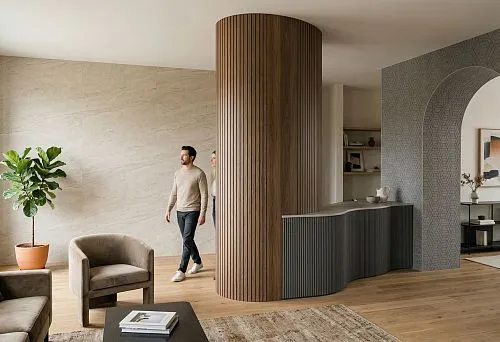
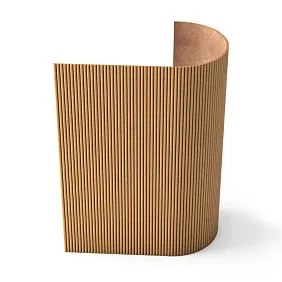
A niche finished with slatted panels becomes an art object. A column covered with flexible slatted modules becomes a sculptural accent. A partition made of panels zones the space and creates a decorative element at the same time. For radius columns and arches — exclusively flexible panels on a fabric base: they wrap around any shape without deformation.
Where exactly do panels look most effective
Accent Wall
One wall, fully clad in wood, becomes the conceptual center of the room. Everything else serves as a backdrop. This is the most effective technique — and the most economical: maximum effect with minimal finishing area.
TV area
A TV wall with wooden panels is a classic solution for the living room. The panels visually 'anchor' the zone, create a background for the screen, and hide cables and equipment. The slatted rhythm makes this area especially lively and modern.
Wall behind the sofa
The wall behind the sofa is the main visual plane of the living room when viewed from the entrance area. Wooden panels here work as an architectural background that unites the sofa, lighting fixtures, and decor into a single composition.
Bed headboard area
In the bedroom, a wooden wall behind the headboard creates a finished, cohesive feeling. Its height can vary: from the area directly behind the bed to the full height of the wall. This is one of the most rewarding applications of wall wood finishing.
Niches and columns
A niche is a compact zone with great decorative potential. Wooden panels inside the niche create depth and contrast. A column in a slatted 'cladding' is a sculptural element that unifies the space.
Partitions and zoning
Partial partitions made of slatted panels are one of the best zoning techniques in open-plan layouts. Air and light pass through the gaps between the slats, while the space is clearly divided into zones.
Transition from wall to ceiling
One of the boldest and most effective techniques is when wooden panels transition from the wall to the ceiling without a break. This creates a 'cocoon' effect and a sense of architectural integrity. It is implemented using flexible slatted modules or specially designed modular systems.
How to choose a panel format for finishing
A smooth plane — for a neutral background, for classic systems with moldings, for interiors where the main focus is furniture and decor. A smooth panel is quiet but adds structure.
Slatted rhythm — for modern accent zones, for playing with light, for rooms where depth is needed without overload. Slats 'make' the wall — they turn a plane into sculpture.
Relief volume — for classic, neoclassical, art deco, and decorative accents. Used in measured doses — one zone, no more.
For small rooms: light shades, medium slat spacing, one accent wall — do not cover all four planes with wood. A vertical slat rhythm visually raises the ceiling.
For large spaces: you can work with larger formats, bold tones, wide slat spacing, and several accent zones.
How to choose panels by color and texture
Light wood tones — bleached oak, light ash, birch — easily fit into white, cream, and beige interiors. They add natural warmth without overloading the space.
Warm natural tones — honey oak, medium-saturation walnut, cherry — create a cozy, lively atmosphere. They work in bedrooms, living rooms, and studies with warm lighting.
Dark textures — wenge, dark walnut, merbau — are an expressive accent. They require precise work with lighting; in small rooms, they are used only on one wall.
Calm wood grain — uniform texture without pronounced fibers. For modern interiors and minimalism.
Pronounced texture — panels with emphasized fiber patterns, swirls, and shade variations. A self-sufficient decor that requires no additions.
Combination with floor, furniture, and doors: for a cohesive result, panels, doors, and flooring should work in the same color palette. Not necessarily the same wood species — consistency in color temperature is important.
How to choose panels to match the interior style
Modern style
Clarity, conciseness, control. Slatted panels with an even rhythm, neutral oak or ash shade, matte finish. No decorative excess.
Minimalism
Maximum restraint. Smooth panels in the same tone as the wall — for painting or with a thin veneer without a pattern. If slats — then with a wide spacing and small thickness.
Scandinavian interior
Natural light wood, honest texture, natural irregularity. Birch, ash, light oak with a matte oil finish. Calm rhythm of slats, nothing extra.
Japandi
Precision and quietness. Narrow vertical slats of ash or oak with natural toning. Rhythm spacing — medium, without dense arrangement. Here, solid wood slats on an MDF backing are the perfect combination of naturalness and geometry.
Neoclassicism
Structured wall systems with moldings, cornices, coffers. MDF is the primary working material: it mills easily into any profile, paints perfectly.wall panels boiserieMade of MDF with enamel in warm cream tones — a classic neoclassical response.
Classic interior
Full boiserie systems from baseboard to cornice. Oak, walnut, painted MDF in classic tones. A unified architectural system where walls, doors, and cornices are connected by rhythm and material.Custom manufacturing of boiserie wall panels— precisely for such projects.
How to combine wooden wall panels with other materials
With paint. One wall in wood, the rest painted — the most common and effective solution. The paint shade should support the warm palette of the wood or create an intentional contrast.
With glass. Matte glass softens the contrast, mirrored glass adds depth and visually expands the space.
With metal. Brass, bronze, and matte black details — furniture legs, lighting fixtures, handles — create an expressive combination with warm wood. Metal emphasizes the natural value of wood.
With stone. A natural alliance that always works. Marble countertops, stone fireplace cladding, stone-look porcelain tile — paired with wooden panels, they form a rich natural unity.
With textiles. Rugs, pillows, curtains in natural tones soften the texture of wood and add tactile variety.
With furniture fronts. For a maximally cohesive effect, wall panels, furniture fronts, and doors should work as a unified wood system — in the same species or in harmonious tones.
How light affects the perception of wood finishes
Light is the second material when working with wood panels. Without proper lighting, even the most beautiful panels can lose half their expressiveness.
Side lighting is the main ally of slatted panels. It creates expressive chiaroscuro between the slats, making the surface volumetric and sculptural. Wall sconces, track spots, floor lamps — all work in favor of the slats.
Warm light (2700–3000 K) enhances golden and amber tones of wood. For living rooms, bedrooms, and studies — ideal.
Cool light (4000 K and above) neutralizes the warm tint of wood, making it more restrained. For offices and work areas — suitable, for residential — risky.
Panel backlighting — built-in LED strips behind or under slatted panels create a glowing effect and highlight wood texture at night. This is one of the most spectacular techniques in modern interiors.
Under side lighting, wood texture is perceived much more strongly — check panel samples specifically under real lighting conditions, not just from catalog photos.
What to choose: smooth, slatted, or textured panels
For a calm background: smooth panels for painting or with calm veneer. A neutral plane that doesn't compete with furniture.
For a modern accent: slatted panels with a uniform rhythm. A lively, sculptural surface that changes with the lighting.
For zoning: slatted panels on a partition or partial wall. Light and air pass through the gaps, dividing the space without barriers.
For decorative volume: relief panels. One wall, a precise pattern, proper lighting. That's enough for a powerful effect.
For complex areas (columns, arches, niches): flexible slatted modules on a fabric base — they wrap around any geometry without seams.
Common mistakes when finishing walls with wooden panels
A list of the most common mistakes — and how to easily avoid them:
-
Choosing panels based only on photos. Color, texture, and rhythm look different in person and under different lighting.
-
Not considering the room's lighting. The same panels produce different results under warm and cool light.
-
Using too bold a texture for a small room. A dense wood pattern in a small area creates visual clutter.
-
Panels on all four walls in a small space. Wood should be an accent, not a 'prison'.
-
Not understanding where to place emphasis and where to provide background. This is a conceptual error that later cannot be fixed without complete dismantling.
-
Mixing incompatible wood species and shades. Two or three different wood tones without systematic logic create chaos.
-
Not considering doors, floors, and furniture. Panels should work in a unified system with adjacent materials.
-
Ignoring the interior style. Slatted panels in the Japandi spirit do not pair with gilded Baroque-style furniture.
-
Not planning transitions. How will the panel fit into a corner? What will be on the ceiling? Where will the finish end? — all this is decided before installation, not after.
-
Buying panels without understanding the overall concept. First — the concept, then — the material selection.
What to choose for different tasks
For an accent wall
Slatted panels made of solid oak or veneered with a pronounced texture. One tone, one rhythm, vertical direction of the slats.
For background finishing
Smooth panels for painting in a neutral tone. Clean geometry, no active texture.
For a modern interior
Minimalist MDF slatted panels with an even rhythm, light or natural oak, matte finish.
For a warm, natural space
Veneered or slatted panels made of solid wood in shades of honey oak or walnut. Oil finish, natural texture, living pattern.
For apartments
One accent wall in the living room, a headboard area in the bedroom, a lower belt in the hallway. Three points — and the interior gains character.
For home
In a country house, wooden panels are appropriate on a wider scale: a system in the living room, finishing in the study, accent zones in the bedrooms. A unified wood logic creates a cohesive living image.
For commercial premises
MDF panels with wear-resistant coating or veneer with additional varnishing. Precise geometry, possibility of replication. For meeting rooms and lobbies — systems with moldings in a business-neutral tone.
Selection algorithm: from task to panel
A simple sequence that always works:
-
Define the task — accent, background, zoning, concealing flaws
-
Choose the material — solid wood for natural texture, MDF for painting and geometry, veneer for balance
-
Choose the format — smooth, slatted, relief, modular
-
Select the color and texture — to match the style, lighting, furniture, and floor
-
Consider the style — each format and shade works within its own stylistic context
-
Move to specific solutions — with an understanding of all previous steps
Finishing with wooden wall panels is not difficult. The difficulty lies in making the right choice without understanding the task. Once the task is understood, the solution finds itself.
FAQ: Answers to popular questions
Which wooden wall panels are best to choose for finishing?
Depends on the task. For natural texture — solid wood or veneer. For painting and precise geometry — MDF. For slat systems — solid wood slats on an MDF backing.
What is better for wall finishing: solid wood, MDF, or veneer?
Solid wood — for maximum natural effect and longevity. MDF — for painting, geometry, and commercial volume projects. Veneer — for the visual effect of wood at a lower cost.
Are wooden panels suitable for the bedroom and living room?
They work excellently. For the living room — an accent wall or TV area. For the bedroom — the headboard area of the bed.
Can panels be used in the hallway and corridor?
Yes. A lower belt at a height of 90–120 cm is a classic solution: decorative and practical at the same time.
Which panels are better for an accent wall?
Slatted with a pronounced rhythm or veneered with natural texture. One tone, one direction — without mixing.
What to choose for finishing: smooth or slatted panels?
Smooth panels are for a neutral background and classic systems. Slatted panels are for a modern accent and playing with light.
Can panels be used for zoning?
Yes. Slatted panels on a partition or partial wall are one of the best techniques for visual zoning.
How to match the color of panels to furniture and flooring?
Work within the same color temperature: warm wood goes with warm flooring and warm fronts. It doesn't have to be the same species; harmony of tones is important.
Are wooden wall panels suitable for a modern interior?
Yes. Slatted panels with a uniform rhythm in neutral tones are one of the most sought-after solutions for a modern style.
How to avoid overloading the interior with wooden finishing?
One accent wall is enough. The remaining surfaces should be neutral. Light shades are lighter than dark ones. A calm rhythm is better than a dense one.
Can panels be combined with paint and stone?
Yes. Wood pairs well with paint, stone, metal, and glass. The key is balance: one material dominates, the others complement.
What mistakes are most commonly made when choosing?
They choose based on photos without considering real lighting, ignore style and adjacent materials, overload all walls with panels, and don't plan transitions at corners and niches.
About the company STAVROS
If you need not just information about wall wood paneling, but a specific solution — manufacturing, material selection, installation — contact STAVROS.
STAVROS is a Russian manufacturer with over 20 years of experience in creating wooden interior products. The range includesslatted panels made of MDF and solid oak, classical boiserie wall systems, products made from solid wood and MDFmade to order, moldings, cornices, baseboards, architraves, and decorative overlays. All products are manufactured with precise geometry, in custom sizes, and in a wide range of species and finishes.
STAVROS handles the full cycle: from on-site measurements to delivery and installation. Showrooms in Moscow and St. Petersburg. Material samples for visual assessment before ordering. Work with designers, architects, and direct clients in any artistic style — from classic to contemporary minimalism.